Showing posts with label So-Bad-It's-Good. Show all posts

Monday, 27 January 2014

Review: Doctor Who Classic: The Invasion of Time (Revisited)

See here for my previous look at this story.

https://blogger.googleusercontent.com/img/b/R29vZ2xl/AVvXsEgaIe3aUqLJ9LuyN_RM98qqom5tJ5v5qYDFkp962VjM1MZqt8m7xpcBjCV9DHgPqr2d3oDJVsLYtJSNvBJjBxCPU73MKVW9lHboqr0zfttUwvPngmDMVLxeUk77qxeIu7s9Z8Aq06_G1ypi/s400/Picture+9.jpg
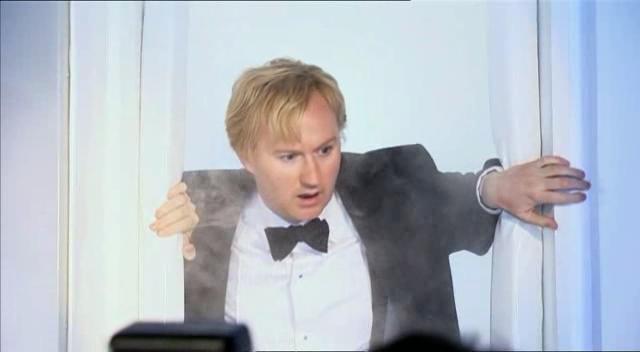
The Doctor pretends to go evil for some sheets of foil.
From Cathode Ray Tube
Doctor Who - Season 15, Story Six - The Invasion of Time (Revisited)
Written 16/7/13

What to say about this story? Well, I had originally wantd to try and write an article on this story for Celebrate, Regenerate, but I couldn't find a single thing that I actually liked about the story. I mean, that's a bit of hyperbole, really. It's two and a half hours of Doctor Who, there are some things that I can find here and there. But as an overall experience, The Invasion of Time so fails in every single one of its aims that it reaches a point which waivers dangerously between hilarity and tragedy. And that's not a good thing, it's never a good sign when I can't tell whether I outright hate the story or love it in a So-Bad-It's-Good way. Usually it's a little more clear cut.
    The first four episodes are bad enough on their own - a concept play where we're led along the garden path by The Doctor's apparently dark turn, which is never hinted at until the second episode and so we're left thinking that The Doctor is a total and utter tit for a week. Plus, the aliens he's apparently helping are some of the most weak and lily livered in the show's history - the Vardans, whom, while awesomely powerful in principle, are pathetic in execution. I've followed some pretty crappy looking monsters in my time as a fan, but I will not accept a monster who is literally a sheet of tin foil with a strong irish accent. Their humanoid forms are even less impressive, looking like bored versions of the Great Gazoo with a great deal less screen presence. I can understand your budgetary limitations and at a stretch I might even accept the tin foil in the same way I accept the same in Timelash. But the acting is just so poor. It really is, there's no escaping that.
     The last two episodes are where the serial really goes to shit, with all semblance of plot thrown out of the window in favour of running around the TARDIS corridors for a bit being chased by Sontarans. As is Invasion of Time practice, this is the worst execution they ever saw, with crumbling costumes hiding actors who have been for some reason directed to put on strong cockney accents. After four episodes which might have been simply mediocre on their own, the final two drag it out into a dull slog which you pray might sometime end. It's so random that they have to break open the by-this-time-tired book of Who mythology, essentially pulling the get-out-of-jail-free card by having The Doctor shoot the Sontarans out of existence and then forget all memory of it.
Hey, it's the guy from The Android Invasion!
From the BBC
     In my original review, I talked a bit about Gallifrey, and that's important too. After the fan uproar at seeing the mighty mythology brought down to something a bit more human, going to Gallifrey was dangerous ground, especially when the budget was in the state it was. Instead of the wonderfully complex, multi-layered sets we saw previously, the civilisation is reduced to a series of blandly coloured corridors occupied by about three people, and then some location filming outside which instead of exploring Gallifreyan society and customs only serves to raise more and more questions.
     This story stands as Leela's last, and it's a damn shame after this season and a half that a character so previously well-developed manages to be kicked out with such a bullshit excuse. Leela falls in love with Andred, a minor character whom she barely speaks to over the course of the story and whom she has so little chemistry with it felt weird to see them even holding hands. It's not something that Leela would do, there's no continuity in the characterisation that after being shown the wonders of the civilised world with Leela that she would choose to settle down with a guard. Plus her presence in this story at all sends a bad word back to the Hand of Fear, where humans aren't allowed on Gallifrey. It's almost as if everything this story does is towards fucking up Season 14.
     And now to the few spits and spots I do like. John Arnett's Borusa is fandabydozy, and is quite wonderfully playful in his trickery as he guides The Doctor around Gallifreyan politics. The scenes between him and The Doctor play out very differently to Borusa's last incarnation, and at a stretch I would say that it's a tiny bit better. I also happen to like the roaming around the inside of the TARDIS, no matter how nonsensical the location filming in Hospitals and Swimming Pools happens to be. It's playfully done and it doesn't look too tacky, and while the TARDIS interiors we see in JNT's tenure (which are remarkably consistent in appearance) are my favourite, I love the recursion and randomness that this serial feels fit to provide to fill up the last two episodes.
The Doctor is made President.
From Basement Rejects
     So, not a total washout. At the end of the day there's no-one I can really blame for this story, and I feel bad for it because the show was struggling with its cash and it is genuinely a miracle that the story was even made. After all the work that went into ensuring that the show made the screen, I think the whole story is imbued with a wonderfully shoddy charm. When I began this runthrough, The Invasion of Time was one of my least favourite stories. Given some of the crap I've seen, I can at least say that The Invasion of Time is entertaining, and given all the trouble it faced in production I find that something of a wonderful miracle.

Thanks.

NEXT WEEK: We meet Romanadvoratrelundar Fred Romana's first incarnation in The Ribos Operation.

Monday, 30 December 2013

Review: Doctor Who Classic: The Invisible Enemy

Welcome, reader to the last review of 2013. Which I'm writing in June. S'all a bit topsy turvey really.

http://www.doctorwhoreviews.co.uk/4T_files/The%20Invisible%20Enemy%206.jpg
Hardcore Prawn, as Neil Perryman puts it.
Doctor Who - Season 15, Story Two - The Invisible Enemy
Written 30/6/13

Doctor Who is a very varied show. Some stories are overwhelming serious. Some stories aim for a political message amongst piles of cheese. Some stories are so rattled by their production problems that they fail to do anything at all. The Invisible Enemy is a mix of the first and third, a story whose special effects get weirder and weirder as one goes along but whose incredible charm, especially in its centre two epiodes, lead me to rather love it in the way that one loves the offensive stereotypes of mentally ill protagonists in Oscar bait films. With similar amounts of inner personal outrage.
     A base on the moon Titan is afflicted by a web in space which infects the minds of the crew via mental attacks. The TARDIS materialises in the vicinity and is caught in the same beam, sparing Leela but infecting The Doctor with the Nucleus, the prawn-like life-form that the other infectees want to protect and use to procreate an alien species. The Doctor and Leela go to a space-hospital to look at the disease, where they meet Professor Marius and his robot dog, K9 (!). Using a part of the TARDIS, Marius follows the Doctor's instructions and creates clones of he and Leela to climb into The Doctor's body and find the Nucleus. The clones confront it, but disintegrate before they can do anything. Leela's clone contained her immunity, helping The Doctor to synthesise a cure, but the machine works in reverse and the Nucleus is magnified to man-size. The Doctor and Leela, along with K9 in tow, blow up Titan and save the Universe. Sorry, Solar System.
     After a season or two of stories taking themselves far too seriously with old Victorian Mansions and ancient gods about the place, the appearance of Marius and his (for now) charming robot servant breathes a fresh air into the series. The serial feels very much like it's aimed towards children after the systematic violence and adult allusions that defined the previous series Marius himself (Frederick Jaeger) is a fun screen presence and the first few appearances for long-term companion K9 are quite frankly wonderful. Episode Three's homage to the common-used plot of The Fantastic Voyage fitted right in, even with the cheesy special effects that did make me laugh, especially when The Doctor's white blood cells are big white Styrofoam balls hanging from the ceiling and bouncing into things. Most impressively, The Doctor's inner fight with the Nucleus is acted rather well. At least until we see it.
http://2.bp.blogspot.com/-fYUxKWZGkKs/UXBAcrcMOjI/AAAAAAAAK5U/d33LeWaEEG8/s1600/k9-the-invisible-enemy-5.jpg
An icon is born.
     And that is where the story gets awful weird. Besides the other numerous special effects failures (and the fact that they blew up Titan, which is a pretty cool moon), the story's main downfall comes with the appearance of the Nucleus. In concept, the story is fine, if cheesy, and the execution is mostly okay. But the simple fact is, the design of that monster is fecking hilarious. Inside the body it's a binbag with a crabclaw, and outside the body it's a massive great shrimp that can't even walk around by itself. The camera angles shoot it like it's a school production and the previously tolerable standard ranting becomes just silly when we're supposed to believe that Zoidberg's less intimidating brother is going to rule the Universe.
      I enjoyed the Invisible Enemy, in a period where I was beginning to wonder if I'd make it through Season 15 into what I hope is going to be an awesome Key To Time arc. Because I like it, it obviously gets hated on a lot by fandom by what I see as incredibly trivial reasons, although the simple what-the-fuckery of the Nucleus in its larger form does turn a fairly decent story into a So-Bad-It's-Good laughfest by the end. I'm just so grateful that after two stories which bored me with their overbearing darkness and foreboding, I'm allowed to laugh at cheesy sci-fi goodness that appeals to everything I like about the show.

Thanks.

NEXT WEEK: Yet another alien figure has been manipulating Humanity for centuries... all in The Image of the Fendahl.

Monday, 21 October 2013

Review: Doctor Who Classic: The Android Invasion

http://images3.wikia.nocookie.net/__cb20061115063154/tardis/images/5/5b/Androidinvasion.jpg
How much cooler can Doctor Who get?
Doctor Who - Season 13, Story Four - The Android Invasion
Written 27/5/13

It's a little bit sad, really, that it's taken til this point in the season to find a story that I truly enjoyed. Sure, Terror of the Zygons and The Pyramids of Mars may have their merits, but this era's penchant for Gothic depressiveness leaves me with something of a bitter taste in the mouth. The Android Invasion has both a newfound sense of levity and a commitment towards new ideas, taking mystery and humour and wrapping them together in a tasty little ball. At one point I almost found myself calling it "Moffat done well," except for the fact that he probably doesn't like this story. (And at least three or four percent of my love for it comes from how Fandom tends to treat it.)
     The Doctor and Sarah believe they've landed in the quaint country village of Devesham, but something is amiss - there are armed, hooded men in the woods and the village seems abandoned. A deliciously slow reveal sees the village repopulated and the discovery of an astronaught, thought lost but in fact kidnapped and brainwashed by the Kraals, who have recreated the village and space-centre in order to plan their invasion of Earth using Android duplicates.
     There's a sense of fun in the script, with The Doctor out of his grumpy mood and finally having real chemistry with Sarah Jane again. Our villains aren't the forebearers of great myths, they're not almighty beings who are plotting to destroy the planet or the universe or such. They're just aliens rather maniacally trying to find a new homeworld. The use of Androids in this story is done rather well - a lot like the Androids of Tara, the duplication is played more for drama than for comedy, which means that it works just about perfectly. Put together with a nice country setting and a half-decent rocket control centre, and we're talking gold.
http://www.kasterborous.com/wordpress/wp-content/uploads/2010/dw-s13-androidinvasion1.jpg
Sarah saves the Doctor from being dissolved.
    The story also features one of my favorite cliffhangers of the Tom Baker era thus far, in which The Doctor discovers the duplicate Sarah and we see her face fall off as she's knocked to the ground. It's a brilliantly chilling moment and is one of many that I love. A man climbing out of a pod and strangling Sarah Jane, the Stepford-esque nature of the Androids in their confusion at the Doctor and Sarah Jane's presence, the scene in which The Doctor comes face to face with his armed duplicate. It's a treasure trove of great moments.
     I really fail to see why anyone can dislike this story, really. It was by far the most fun I've had this season - and that doesn't seem as though it's going to change any time soon, seeing as next week we've got a Frankenstein analogue and the week after it's a Triffids one. The concept behind android duplicates may not be particularly original, but the slow-burning mystery of the episode's premise was well-executed enough that it complemented the witty banter and made by far the most enjoyable serial of the season.

Thanks.

NEXT WEEK: Where the production team decide to do more retconning in a single scene than Moffat managed to do in 45 minutes... it's The Brain of Morbius.

Monday, 25 March 2013

Review: Doctor Who 3.6: The Lazarus Experiment

http://upload.wikimedia.org/wikipedia/en/4/4e/Lazarus_Experiment.jpg
I wanna imagine this scene being played out in-studio.
Doctor Who - Season 29, Episode Six - The Lazarus Experiment
Written between 20th and 21st February 2013

It really hits home in The Lazarus Experiment how different of an approach the show took towards Martha than it did Rose. At this stage, due to The Doctor's "one trip" business, it feels like she's still only just beginning. Rather an odd thing, considering we're half-way through the season. Most of The Lazarus Experiment felt very much like filler, but there was a swirl of ideas both wonderful and completely terrible to keep me interested. Like last week, we have to say goodbye to Biology for a bit - bigtime.
     The Doctor, after giving Martha her "one trip" (which he admits has somewhat escalated), takes her home. He's about to pop off, but he hears on a local news report about Professor Richard Lazarus (Mark Gattiss) and his groundbreaking experiment. The Doctor decides to attend the event, organised by Martha's sister Tish, and saves the day when Lazarus' machine almost explodes with him inside. When the machine is opened, the pensioner Lazarus comes out as a youthful Mark Gatiss, and claims that he has just enabled human immortality. However, Lazarus' machine has made his DNA unstable, and he periodically transforms into a massive pincered monster. After faking his death once, The Doctor and Martha guide him to a Church, where The Doctor uses sound waves to make him fall to his death. The Doctor offers Martha a permenant place as companion and they pop off.
     Mark Gatiss' character veers on the cliché at times, but I at least found him captivating. There's something quite Voldemort-y in his key motivation to avoid death at all costs, and his memories of cowering in war-torn London gave him a very human motivation for doing so. That theme of immortality was complemented quite well by The Doctor's role in the episode - not just blatantly against attempts at Immortality for the sake of it, but also sincere and heartfelt in his explanation of the loneliness that said immortality brings. Ten is really quite awesome in this series, and I can't for the life of me think why.
http://images3.wikia.nocookie.net/__cb20111011052224/tardis/images/c/c3/The_Lazarus_Experiment_160.JPG
I probably enjoy Gatiss' acting a little more than his writing.
     The main problem with the story, then, is soley down to its Monster-Of-The-Week nature. The Lazarus mutant may be very scary indeed, but it shatters my suspension of disbelief into a million tiny pieces. Genetics just doesn't work like that - DNA doesn't randomly sporadically jump around just cos you shake it up a bit, and changing someone's DNA doesn't automatically change what they look like, it's not like some crazy biological cheat code. Also, DNA doesn't "hide" past options - at worst, it can hold a few minor evolutionary throwbacks (like tails or hindlegs in whales), but they ease themselves out during adult growth. There's never been a stage in human evolution where we had the option to become a massive skeletal beast with a dislocatable jaw and a stinger that can suck the life out of people.
     Despite that, I actually quite enjoy The Lazarus Experiment. It's a fun adventure, and there's enough depth to its villain that it makes a decent watch, even if it isn't a masterpiece. I'm also loving the development of the relationship between Martha and The Doctor, which I find rather fascinating and is so far the main reason why I'm enjoying Series Three to the extent that I am. It ma have silly CGI and some sillier concepts, but the performances sell it and it's more than enough to make it fun.

Thanks.

NEXT WEEK: The first Who appearance of the dreaded Chris Chibnall... it's 42.

Thursday, 6 December 2012

Review: Doctor Who 4.X: Voyage of the Damned

I'm The Doctor, and my characterisation is rapidly going downhill!
Doctor Who - Season 30, First Christmas Special - Voyage of the Damned
Written 21/10/12

I'm sorry. Like, I really am. I just don't seem to get "fan opinion". Because I'm the guy who thinks that Blink is overrated. I'm the guy who not only loves Colin Baker, but will defend his era and his character to the grave. And on this universally derided example of RTD's worst recesses... I come up positive. I like this story. I like how overblown it is, how hammy it is, how so little of it makes sense. I like how all the right elements are there but how they've been jumbled up and only sometimes resemble anything coherant. And I liked how seriously it took its own bullshit. Of course I know that Voyage of the Damned does, for many various reasons, stink to high heaven, but for whatever reason, I look past it all and find some damn entertaining Doctor Who.
     Having just had what looks like the Titanic somehow crash through the indestructable TARDIS exterior and into the dimensionally transendental interior, The Doctor doesn't bat an eyelid and decides to hop on board to see what's going on. It turns out that the ship is a space-liner from the planet Sto, orbiting Earth as tourists come to enjoy the Christmas Spirit. There, The Doctor makes friends with maid Astrid (pop starlet Kylie Minogue) and they get to pop down to earth, where they meet the erstwhile Wilfred Mott (Bernard Cribbins). All is not as it seems, however, as the robotic Heavenly Hosts start malfunctioning and the Captain (Geoffrey Palmer) deliberately causes the ship to run into some asteroids. Only The Doctor, Astrid and some other stereotypes make it through, each one of them being picked off one by one as they make their way through the ship. Soon, The Doctor faces hammy villain Max Capricorn, who was planning to crash the ship for an insurance scandal, but Astrid saves the day by sacrificing herself to stop Capricorn. The Doctor stops the ship from crashing and, frustrated at all the death, tries (unsuccessfully) to bring Astrid back.
     RTD just throws so many characters at us, and then gives the episode extra time to make sure that they all get developed in a sorta-satisfactory way, and then he either lets the jackasses win or kills them off. The sole nice-guy left, sans The Doctor, who's behaving for once, is Mr. Copper, played by Clive Swift (Keeping Up Appearances, as well as playing Jobel back in Revelation of the Daleks), whose performance delivers much-needed charm. It's slightly odd that RTD does what he does with the characters in question; there's a Billy Zane type who acts like a dick for the entire episode and whose survival is used to mark some kind of weak tragedy, a fat couple who are constantly used for comic relief despite being shown to be funamentally good people (to this rather chubby reviewer's chagrin) and a small, red, prickly cyborg with a funny name who doesn't really seem to have any purpose beyond providing a reason for the story to ham-handedly show that Sto is prejudiced towards them. And this isn't even necessary in the end, because Capricorn's primary motivation wasn't to escape/avenge prejudice - no, that'd actually be sympathisable, gasp - but for cheap monetary gain and petty revenge over his business partners.
SYMBOLISM!!!!11!
      For many an RTD hater, this was, burping bins and farting Slitheen aside, the first point where it started to click that he might be a bit of an extravagant writer. There are many setpieces and weird moments which are clearly supposed to be more impressibe than they end up being, with Murray Gold's music drowning out the other senses and cinematography that is rather baffling (this from the same director of Cyberwoman and the dreadful Daleks In Manhatten two-parter). The two worst examples are ones that big-up Ten in a way which is gonna eventually lead to the shit-fest of The End of Time, and both are frankly embarrassing. The first is a speech used for the trailer, which features The Doctor responding to a rather spot-on queery by Billy Zane with a series of pronouncements about his origins which really shouldn't make much sense but is responded to with awe. The second is the semi-finale, where The Doctor reacts to the death of Astrid and Capricorn by grasping hold of two of the Heavenly Hosts and flying in what is a painful, painful Jesus comparison. (Almost pictured.)
    Voyage of the Damned is in no way perfect, but at the same time its silliness is also it's main charm. Had this been done with an ounce more compentancy, and ounce more care and attention, it would have bombed harder than the Germans on Portsmouth. But it didn't, and thus Voyage of the Damned is one of RTD's more entertaining flops. It has a lot of annoying things in it, but the panache and style with which it is filmed makes it a comic masterpiece greater than all of Moffat's comedy work combined. I love Voyage of the Damned for the very reason that I hate it - it's badly made, badly written, but it just doesn't care.

Thanks.

P.S. 600TH POST! Gimmie some!

Monday, 3 December 2012

Review: Doctor Who Classic: Destiny of the Daleks (Revisited)

The Daleks take a course in intution from Davros. They are
unfortunately unable to make any notes.
See here for my previous look at this story.

Doctor Who - Season 17, Story One - Destiny of the Daleks
Written 8/9/12

Terry Nation is one hell of a figure when it comes to Doctor Who. He brought us not only the everlasting Daleks, but also many other stories for the first four Doctors. An equal figure outside of Who is one Douglas Adams, the writer of the widely popular Hitchhiker's Guide To The Galaxy and one of the wittiest men in history. Together, they came together to try and start the 1979/80 season with a bang, by reintroducing not only the Daleks, but also their incredibly popular creator, Davros.
     Having fitted a randomiser to escape the Black Guardian, The Doctor is busy fixing a sore K9 when Romana announces that she has regenerated, into the form of the previous story's Princess Astra. (Lalla Ward.) He's not very happy at first, be after she "tries on" several bodies he accepts the Astra body as just right. They find themselves on a rocky planet that The Doctor feels like he's been to before. There, they meet a landing party of the disco-esque Movellans, who reveal that they are on Skaro. The Daleks have been fighting a war with the Movellans using battle computers, and so both sides have become so logical that neither can outwit the other. The Daleks have returned to Skaro to dig up Davros in the hope that he has some answers, but The Doctor gets there first. Davros, when he awakens, takes the power a bit to his head, and sends out suicide daleks to blow up the Movellan ship. The Doctor, luckily, leads a group of Dalek slaves to incapacitate all of the equally homicidal Movellans and blow up the Daleks before they do any harm. The slaves fly away, Davros is cryogenically frozen until next time, and The Doctor and the new Romana pop off of their travels.
      The story's biggest problem is that it takes on the ideas of a very much-loved story (Genesis) and then performs them in a way which, despite being to the best of its ability, inevitably fails to live up to those past glories. The imposingly bland corridors of the Kaled Bunker are now green and purple affairs littered with sugar-glass and lit by what appear to be stage lamps that have been deliberately left in shot. The grand, majestic battlefields between the Kaled and Thal domes are now replaced by a standard BBC Quarry. Davros as played by David Gooderson is no longer the calculating schemer we know and love but now a generic, shouty villain who spends the vast majority of his airtime either being pushed around on a joy-ride by the Doctor. If it was being taken entirely seriously, then we might be able to forgive this - I respect Warriors of the Deep for the fact that it still manages to convey its themes despite its crippling studio problems - but Douglas Adams' additions to the script make it just knowingly self -aware enough to be a problem.
     That isn't, though, to say that the story is without merit. The direction, using the new Steadycam technique, is actually quite impressive and does its best to make a quarry look like a rolling landscape. The concept behind the Daleks and the Movellans' impasse, if one ignores Nation's apparant lapse in memory about the Daleks' organic nature, is actually quite an interesting sci-fi idea and feels similar to the arguments about logic's value from Two's era. There's nothing wrong, fundamentally, with the story's concept, but it's all in the execution. At times, with its winking humour that pokes fun at both Doctor Who and the Daleks, Destiny feels very much like a parody of the series rather than a season opener.
Oh look! Rocks!
     Aside from the whole Davros thing and the fact that only four Dalek models were left (all of which have very recognisable damage marks from previous stories/handling) the other thing this story is famous for is being the story in which Romana II appears. Mary Tamm, who had played Romana as introduced for the previous season's Key To Time arc, declined to continue playing the character, and so they hired Lalla Ward, who had played character Princess Astra in the previous serial. I personally prefer Tamm's Romana, although I've seen a lot more of Romana II than I have of Romana I (six serials to one) so I don't really have an opinion yet. While rather strange and certainly without Watsonian reason, the regeneration scene (written entirely by Adams) is a fun bit of script that covers the changeover nicely.
     Adams' first contribution to Who, and Nation's last, Destiny is a good indicator of the stories that the troubled production of Season 17 had to come. And of course you've heard me go on about troubled productions over and over again, you know I have. But Season 17 was a time of greatness and a time of camp self-awareness that forced the show into reverse gear for the next few years. Destiny of the Daleks could be called So Bad It's Good, but luckily the calibre of Adams' writing means that it just scrapes into an "OK" category. And OK Doctor Who is usually more fun than other programs anyway.

Thanks.

NEXT TIME: Paris gets called a rude name. Monty Python makes a cameo. The Doctor and Romana go on a date.

Monday, 13 August 2012

Review: Doctor Who Classic: Delta and the Bannermen

Seven and Ray are in danger.
Doctor Who - Season 24, Story Three - Delta and the Bannermen
Written 9/6/12

The last true three-parter, excluding the 135-minute epic The Two Doctors, was Planet of the Giants - the first serial from the second season back in 1964. Since these serials were designated by the fan community rather than the actual production team, Delta and the Bannermen stands as the first of six deliberately three-part serials in the McCoy era. In something that seems common in this season, it feels almost deliberately sitcom-esque in its structure - and that is both to its benefit and its detriment in equal measure. Like the previous two serials, this mix of goofy Eighties comedy and decent sci-fi ideas means that the story is a riot from beginning till end.
     Becoming the ten-billionth customer of the Navarinos spaceport, the Doctor and Mel are invited on a sight-seeing tour to 1959 Disneyland aboard a space-bus with shape-changing aliens. When an unfortunate collision with an American military satellite sends them hurtling down into the Shangri-La holiday camp, The Doctor becomes embroiled in the battle between the criminal Bannerman and their intended victim - Delta, the last queen of the Chimeron. Along the way, they meet a pair of mechanics, two US spies, a beekeeper and a very enthusiastic camp owner.
Sure, you're so pretty that I'm totally not freaked out by your
green alien baby.
      The standout irritation from Delta and the Bannerman is the character of Billy, a mechanic who decides that since this Delta girl is pretty, he should abandon everything he knows in order to become the new male of her species. A novel idea, maybe, but one that makes Billy come off as a complete and total tit. Worse, the plot has to do so many curves away from common sense to make it happen: when Billy walks in to find that Delta is clutching a green blob and calling it her child, he shows absolutely zero sense of surprise and calmly sits down while Delta casually explains the plot to him. It's incredibly contrived. Originally, one can guess that the reason behind the plot was to free up minor character Ray, his childhood friend who is incredibly distressed by his choosing of Delta but then goes on to become the Doctor's main ally throughout the episode. Since Bonnie Langford was considering leaving, she would have become the new companion; the movement of this story back a position and the writing of Dragonfire rendered this null and void, leaving the story with this almost robotic character design.
      Again, Music affects the story drastically, it really doesn't understand what the music is for. A lot of the sequences have this cheery tune that almost reminds me of Yackety Sacks (Benny Hill). I understand that they were trying to lighten the series after JNT's efforts to reverse the problems with Season 17 had led them too far in the wrong direction, but this story (the first written for Seven) had the chance to really show what the character could do. There's no point in having such great characters (because Seven is great here) and then ruin it all by making your story into a laughing stock.
Ken Dodd's in this. Just thought
I'd mention.

      It's also stuffed with soooo many characters. In Paradise Towers this was to show seperations of class and race, but here it's just the fact that we're getting into the Holiday Camp spirit and there's lots of people around. As I said, the highlights are the scenes with Sara Griffiths' Ray, who would make excellent companion material, and with the incredibly life-affirming Burton, the Shangri-La manager. It's unfortunate that the story's worst characters are those in the title; Delta and her daughter are incredibly wooden and flacid, while Gavrok (Don Henderson, who would later turn up in Series VII of Red Dwarf)'s Bannermen are a race of unexplainedly evil gangsters that embody a million clichés. Especially egregious is the scene where The Doctor and Gavrok face off, while the evil leader randomly chews some raw meat for effect.
      But most importantly, the episode is just a romp. You feel like our leads are having fun, no matter what amount of danger they're in, and that makes Delta and the Bannermen incredibly entertaining. Apart from the music and the few characters I mentioned, there is nothing to hate in this serial simply because it feels so sitcomesque - most of the characters are fun to watch, in a way that really encompasses Season 24 in a way that I haven't experienced with Who before. Even though this atmosphere is probably what draws most fans away from the season, I absolutely adore it and I'm having a fun ride.

Thanks.

NEXT WEEK: Don't get burnt by the oddity of the Dragonfire.

Monday, 30 July 2012

Review: Doctor Who Classic: Time and the Rani


Through some astounding mathemathics, this is my 500th Post! When I began this blog I never thought that I'd reach 50 posts, not least ten times that amount. I'd like to thank any readers (if you're out there) for sticking with me and I invite more people to read Audenshaw Reviews in the future. To celebrate this milestone, I'm looking at a season that is often considered worse than all of the Saward Era combined, beginning with Pip and Jane Baker's Time and the Rani....

http://images.wikia.com/tardis/images/5/5a/TimeAndRani.jpg
The Rani (Kate O'Mara) tries some rather odd things in order
the get the Doctor to help her...
Doctor Who - Season 24, Story One - Time and the Rani
Written 8/6/12

I liked Season 22, and I liked the vast majority of Season 23. But I knew that that was because of Colin, and because I'd been raised on that era. Now Saward was gone, and the show was desperate to move in a new direction. Not fully understanding the definition of irony, they hired Pip and Jane Baker for one last story that went on to become known as one of the worst in the show's history, Time and the Rani - a tale so ridiculous that it's driven many to tears. However, readers of this blog over the past year should know exactly where this review is going. For the very reasons that so many despise Time and the Rani, I loved it. It was silly, ridiculous and actually, bloody hilarious.
      One thing I don't like, however, is the regeneration sequence. The Beeb had fired Colin Baker after perceiving him to be the problem (and not the writing staff) and so when they asked him back for a regeneration sequence to turn him into Sylvester McCoy, he rightfully told them where to stick it. The result is a bit silly, really - a horribly raw 3D graphic of the Rani shooting the TARDIS and then seeing Sylvester play Colin in a wig, the implication being that the Sixth Doctor met his end by hitting his head on the TARDIS console. As much as the team may have been iffed at Baker's decision, you can hardly blame him and they really could have done better than this episode presents. I did however like the trying-on sequence, in which Seven dressed up as Napoleon, Four, Three, Five and then Two while making several awful puns. It was a nice nod to the past and grounded the story for a short time.
    Sylvester himself? I bloody love him here. The Seventh Doctor is rather unfortunate in that the leftover material from Six and the desire to make the show family-friendly again left him with a bit of a personality disorder - in Season 24 he's a vibrant scots clown and in the final two seasons he's a scheming machiavellian chessmaster. Regardless, I like them both and when the script is being odd Sylvester more than manages to make up for it. The Doctor here is somewhat classic model - a buffoon on the outside hiding a cunning streak underneath. And despite a few moments of bad comedy, Pip and Jane get the characterisation just right. Well, for my tastes at least.
http://images.wikia.com/tardis/images/0/07/Strange_Matter_Chronon_simulation_Time_and_the_Rani.jpg
Science doesn't work that way, Rani.
     And, to my quite horrible surprise, this story actually made me like Mel. I don't what it is - she just came off as a much more rounded and much less extroverted character than she did while fumbling about with Colin. There was a lot in the story that I thought I wouldn't like, and the biggest of these is the writing, but to be frank I actually think that Time and the Rani is better written than Mark of the Rani two seasons earlier. Now before you load your shotguns, let me explain: Mark of the Rani had a lot of good ideas, but it floats about like no-one's business and there isn't really a cohesive plot. It just seems to come to an end, without the Rani's true plan ever being uncovered. Time and the Rani is cleverer than that - it presents the information about the Rani's (admittedly convoluted) plan just as the Doctor finds out. It's got better pacing, and I empathise more with the poor Lakertyans than any of the dull 16th Century types that Pip and Jane used in both Mark and The Ultimate Foe.
     However, as a scientist the Rani's evil plot does trouble me with just how far from reality it strays. Basically, the Rani has brought together the minds of several Human geniuses to help her solve a problem. That bit I have no trouble with. Her problem, however, is stupid, and if you'll bear with me I'll explain why.
<science> The Rani wants to detonate a "strange matter" asteroid above Lakertya, which will "cause an explosion the size of a supernova." She's doing this to form "Helium-2" which will form "chronons" when they fall onto Lakertya's atmsophere, enveloping the planet and turning it into a super-powered time-machine. Firstly, their definition of strange matter as being incredibly dense is somewhat correct, as it is believed to be formed in the centre of neutron stars and as such would "weigh as much as a planet" in small amounts(1). However, the key there is that an asteroid of such matter at such a small size could not exist on its own in the vacuum of space. Secondly, you cannot "detonate" strange matter, nor would an explosion the size of a supernova result from doing so. Thirdly, the substance the Rani is so desperately trying to create, Helium-2, is incredibly unstable and would fall apart into Hydrogen less than microseconds after being produced(2) - not least creating "chronons" and other such substances confined to the realms of Sci-Fi-Science. And to top it off, despite having used human scientists to build her big brain machine, she intends to use the planet to alter evolution and prevent Humanity from ever existing, which is Paradox 101. </science>
      The Rani is a lot more actively villainous here than she was in the previous story, but the efforts to impress for the regenaration story meant that she lost some of the personality that made her unique. The Rani was meant as someone who was fundamentally amoral and interested soley in the pursuit of science, ethics be damned. Here she has an evil scheme that would confuse even The Ainley Master, and thus she comes out looking a lot like his distaff counterpart. The highlight of the story is in the first two parts, where to persuade the confused, newly-regenerated Doctor to help rebuild her brain-machine, she decides to dress up as Mel and give him amnesia. It's absolutely ridiculous (that's a word I'm using a lot, I realise) and provides many of the story's more sitcom moments.
http://images.wikia.com/tardis/images/b/bd/Sixth_regeneration.JPG
The alleged regeneration, aka swirly face thing over wigged actor.
      So what if it's unbelievable? That's certainly never stopped Doctor Who before. At the end of the day it's a question of whether I enjoyed Time and the Rani, and I most certainly did so on every level. Where it was good, it managed to change my negative attitudes towards a number of things, and it even made me admit to liking Mel even after I spoke of how much I despised her back in the Saward era. Where it was bad, it was so much that it went through the other side and became utterly hilarious. Time and the Rani is a great story and I'd reccomend it to anyone - seriously or otherwise.

Thank.


NEXT WEEK: We book a room at Paradise Towers.

Monday, 25 June 2012

Review: Doctor Who Classic: Timelash

The Doctor faces the mutated Borad
Doctor Who - Season 22, Story Five - Timelash
Written between the 21st and 22nd April 2012

The Twin Dilemma, if you remember, was a story that I loved despite its terrible reputation, and while I recognised some of the shoddy acting I didn't really see what everyone found so offensive about it. This wasn't the story that its placing deserved. And it's happened again; Timelash is another competitor for one of the worst Who stories of all time, and yet I can't see that much wrong with it. My ability to love Doctor Who has made this season's set of reviews a lot more difficult for me. I was expecting to be ranting right now about how terrible this story is, but I just don't get it.
     The story is set on the planet Karfel, where the formerly peaceful planet has become a brutal dictatorship run by the elusive Borad, his chosen representative, the Maylin, and an army of robots disorientated by mirrors (which have been banned.) They execute their prisoners by throwing them into the titular Timelash, a time-tunnel which either disintegrates them or lands them in 12th Century England. The Doctor, seeing this time-tunnel, follows it backwards and ends up on Karfel just as the Borad has shifted his staff around. It turns out that Maylin Tekker (the wonderfully hammy Paul Darrow) wants The Doctor to retrieve Vena, the daughter of the last Maylin who rebelled against the Borad, from the Time-Lash. Before he can argue, the Doctor discovers that the Borad's forces have kidnapped Peri and are holding her hostage in the caves of the dreaded Morlox beasts.
Paul Darrow's Tekker is delightfully hammy.
     Sixy follows a diversion in the tunnel and ends up in the 19th Century, retrieving Vena and picking up a stowaway in the form of a young man named Herbert. Upon their return to Karfel they stage a coup and The Doctor takes time to retrieve a special crystal from the Time-lash that has the ability to absorb energy and release it exactly ten seconds later - allowing him to both deflect enemy weaponfire and make his image lag ten seconds behind. Sixy rescues Peri and finally confronts the Borad, a former politician called Megelen who was voted into power and then, after a horrific accident, became half-human, half-Morlock. It's his intention to kill all life on Karfel and mutate Peri into being his mutant bride. Luckily, the Doc is able to use the crystal to trick him, and after saving the day he takes his 18th century stowaway home, to become HG Wells.
     A mere two serials after we met George Stevenson in doontoon Nukassel, we get to meet HG Wells in a story that's heavy influenced by his work. The Doctor's machine lets him be The Invisible Man, the Morlox and the pure citizens of Karfel are very reminiscient of Wells' The Time Machine, the war between the Karfelons and the Bandrils is a War of the Worlds and the Borad's transformation is from The Island of Doctor Moreau. Like George Stevenson, his presence isn't really vital to the plot, but here it's an acknowledgement of the story's themes rather than a random cameo.
HG Wells marvels at all this technobabble.
     Near the end of the story The Doctor is forced to fly the TARDIS into a missile to prevent a war that Maylin Tekker inadvertantly started with neighbouring planet Bandril. The Doctor never explains how he survives this impact, and thus it's held up as an example of the story's poor writing. As far as I can see it, what's the problem? The TARDIS is damn indestructable - that's what he said before he went out, and that's the obvious reason why he's not space debris. Often it feels like people just try to find excuses not to like Timelash, and I really, really don't know why. They say the Time-Lash looks like tin-foil. Not as much as the Vardans. They say that the ending was already done once before. Go figure, we're on Year 22 by this point.
     Timelash doesn't deserve the scorn it gets by any means. It stands in between two a lot more epic stories and thus it's odd for some that it appears to be a simply told Doctor Who adventure, quite like The Twin Dilemma was. In its soul are some very good, consistant sci-fi ideas, as well as a few subtler nods towards the show's past than the others stories of the season mananged. Timelash is on par with the rest of the stories of this season - a bit fluffy, but absolutely perfect in tone and character. And you need to watch it to find that out.

Thanks.

NEXT WEEK: I finish off Season 22 as I receive the Revelation of the Daleks. Erm... Revisited. As part of Season 21 Fridays, I try not to get buried in Frontios.

Monday, 4 June 2012

Review: Doctor Who Classic: Attack of the Cybermen (Revisited)

The Doctor takes a... hands on approach.
See here for my previous look at this story.

Doctor Who - Season 22, Story One - Attack of the Cybermen
Written 15/4/12

Saward didn't like Colin Baker, but he sure did love his Cybermen, as we see in Earthshock and in their large role in The Five Doctors, much to the other wrtiers' chagrin. When JNT called for a strong opener to Baker's first full series, Saward decided to deliver his magnum opus; a shining example of his style that will go down in the annals of Who history. For better or for worse. At its heart, Attack of the Cybermen is trying to be something a lot bigger than it manages to be, but that's not for want of trying. At the end of the day, it's still a great Cyberman story, and allows us an incite into both The Sixth Doctor and the Saward Cybermen.
     The Doctor and Peri, still reeling after the events of The Twin Dilemma, follow a distress call to 1985 Earth. There they find old soldier Lytton (from Resurrection of the Daleks) working with time-travelling Cybermen. Under duress, Lytton and The Doctor are transported to the far future on the planet Telos, where they join the Cryons in their attempt to revolt against the Cybermen and prevent temporal disaster. Along the way they meet undercover cop Russell (Davros-actor Terry Molloy), partial-Cybermen Bates and Stratton and the Cryon Leader. They also manage to fix the Chamelion Circuit, albeit temporarily.
This serial is obsessed with continuity - sometimes to its
detriment.
     The serials' ownership is the most complex and difficult to pinpoint in the series' entire history. The version I choose to believe is much-simplified; the serial is acreddited to "Paula Moore," a penname used by Eric Saward to hide his involvement in the script. Saward, as script-editor, was unable to commission his own work. Ian Levine, the infamous fan who was the show's unofficial continuity adviser, likely contributed a lot of details to the serial regarding the history of the Cybermen.
     As ever, Six is brash here, but he shows a more consistantly.... pleasant streak than in Dilemma. His character is erudite and witty, but there are a few moments where he's a little too willing to become violent. At the end of the day he doesn't really save the day; his presence is simply the catalyst for the Cryon resistance movement to start working. This is a key feature that you see a lot in this era, and for me it feels a lot more natural than some of the later stories where the Doctor is shoe-horned into the action in unrealistic ways. Sometimes The Doctor just doesn't get the big roles; much better than in, say, Midnight, where the evil invisible monster just happens to attack the tourists on the trip that The Doctor attends.
     All of the key Sawardisms are here. There are multiple storylines, all running along different streams which eventually converge. There's also a deeply entrenched dark humour absoutely everywhere, from the direction to the costumes, from the dialogue to the musical score. At times it feels almost inappropriate, but what it does do is create a memorable atmosphere. Wihout that humour, then this dark affair would be very bleak indeed. A key feature that sets Attack of the Cybermen apart is the mass of continuity references; it starts from the very beginning, with The Doctor landing in the original setting of the pilot for no reason, and then having to stop the Cybermen from changing things that were only seen twenty years prior to its broadcast. While I love some good continuity as much as the next person, the problem here is that it just doesn't feel relevant; it becomes overactive fanwank that most people at the time wouldn't have been able to appreciate.
Maurine Colbourne is great as the slippery Lytton.
     The story is the first exploration of the 45-minute format that would become common-place in the new series, but here it jarrs with the series' tone and makes it feel even longer, despite the fact that it's actually 10-minutes shorter than the average 4-parter. Despite this, I like the format for the same reasons I like it in Nu Who - it allows you to do a lot more with the characters, makes filler less viable and prevents some of the more silly types of cliffhangers that the show's seen.
     There are a few issues with this story's tone, and its fan-wank stuffed content feels a little overindulgent for what the serial ultimately becomes. But I love the story. It gives me a decent chuckle now and then, and the dark humour is just so consistant and so ubiquitous that it gives the story this deliciously thick tone. Attack of the Cybermen may not be the best story in the world, but it's certainly a hell of a lot of fun.

Thanks.

NEXT WEEK: I did Vengeance on Varos last November, so next week is The Mark of the Rani