Showing posts with label Garrus. Show all posts

Sunday, 8 June 2014

Papers, Please

Papers, Please is a video game where you role-play the action-filled life of an immigration officer in the fake communist country Arstotzka. People walk into your checkpoint, you check their papers and then decide whether or not they can come into the country. It is my game of the year, better than Tomb Raider, Saints Row, Bioshock Infinite or any other game that was released in 2013. But wait, you say. Surely something with gameplay of this calibre must have something else up its sleeve. Well of course it fucking does. The game does everything right and combines story, art style, gameplay and atmosphere to make an exceptional game.

Glory to Arstotzka! The greatest country!
In the game you and your family are given an apartment to stay in because of your job as border control and you are payed for every person you deal with, unless of course you make a mistake, in which case you will not be payed and eventually fined and that's a problem because of that family at home you have to feed. First, the game starts off easy. On the first day, all people need is a valid passport to enter the country (though one hilarious, recurring character even fails this), but after a terrorist attack on your checkpoint, the system becomes more and more bureaucratic. So by the 15th level or so, the game starts to look like that picture on the right, so making a mistake that costs your son that life-saving medicine he needs is pretty easy. You are in a hopeless situation and Arstotzka doesn't give a shit about you, so you have to take care of yourself and your family, often at the cost of others. The game likes to give you choices that can turn you into either a heartless monster or the most corrupt government official in the Universe, or both. One good example is the woman who didn't get into the country because she took the piss out my son's crayon drawing. Another is the husband and wife seeking asylum. The husband gets through without a problem, but the wife doesn't have an entry permit. You have to make a choice between receiving a fine, but reuniting a couple or doing your job and rejecting her entry into the country. It might seem an obvious choice without the context of playing the game, but since all your money in game basically goes to rent and food for your family, losing even a small amount of money can be catastrophic and its easy to be unforgiving or even corrupt if it means you can that extra bit of cash by bending the system in your favour. This is the whole point of the game. You immerse yourself into the situation you are in and you see the effect your choices have on the people you interact with. Being good isn't always easy and this game showcases better than most.

You may not have realised this from my review, but Papers Please can be as depressing as fuck. The world of Arstotka is crafted with a grey, pixelated art style, almost completely devoid of colour, apart from that giant bright red stamp that says "DENIED" on it. But fear not, for every sad story, there is a hopeful one (though these hopeful stories can be fucked over by the sad ones). The game takes care in showing the humanity being crushed by the beaurocracy, authoritarian tendencies and all-round bullshit of the government. But the humanity is still there and that's what makes Papers Please so beautiful, the balance of people's compassion and dickishness. You can see loved ones reunited, save people seeking asylum from neighboring countries, but who don't have the paperwork needed to pass. You have the choice to make a huge difference in people's lives. Or you can fuck them over. Your choice.

Saturday, 24 May 2014

Camaraderie in Space: My Adventures in Mass Effect

Thanks for the inspiration Andy, you too Connor.

After years of Andrew's irrelevant reviews about Star Trek, Lost and Whovian Lore, I shall write the magnum opus of this website and my own writing (which isn't saying much as this is limited to 3 crap reviews and GCSE English coursework). I, however, should probably introduce myself first. I'm Tanju, 17 years old and autistic. Despite what a lot of people think, autistic people feel emotion and have a sense of humour, even if they appear neutral and monotonous. What makes me so different from so-called "neurotypicals" is my difficultly understanding social norms and having deep and very specific special interests like science, maths, politics and video games. This means I often straddle and frequently cross the line between loud and obnoxious and quiet and reserved. I've always managed to fit in with groups of people, but I rarely ever find myself as anything other than an outsider with more than two or three people. All my life I've felt I was shunned and misunderstood and I've never had a long-term romantic relationship with anyone (or short-term really). My behaviour has made people I care about any connection I made with people has been undermined by my autism, even if it doesn't affect their opinion of me and vice versa.

Then came Mass Effect. I've been using the trilogy as a coping mechanism for my autism since ME2 came out in 2010. I then played through the original and finally the third the day it came out. I didn't realise this at the time though. I just thought I was playing a set of really good sci-fi RPGs. It only dawned on me today, on the final day of sixth form, after probably saying a final goodbye to a lot of people I know and a long talk with close friends. But anyway, enough about me, you want to know about Mass Effect don't you?

The greatest innovation in RPGs this generation.
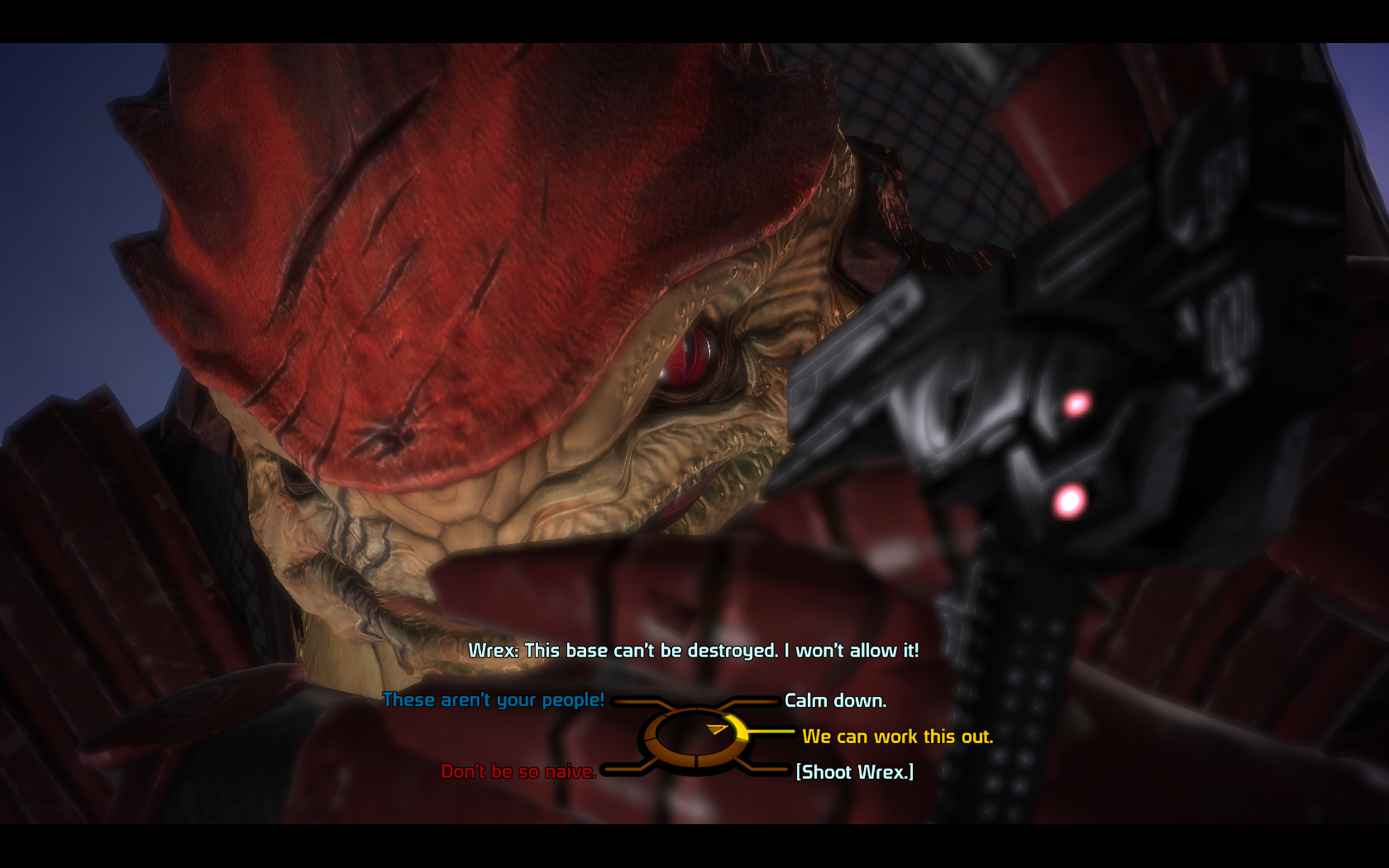
The games in the Mass Effect trilogy are science-fiction action-RPGs with a focus on having strong story and narrative, which meant a complex and interesting backstory for the universe, tough choices that affect the game and personal relationships with characters in the game. Those personal relationships are what made me fall in love with the game. You are Commander Shepard, celebrated war hero and captain of the spaceship Normandy. Inbetween missions, you could explore the Normandy and talk to your crew, which was diverse and consisted of people from different species and within the humans, different ethnicities, nationalities, etc.  They all have their own story to tell, they're all interesting. Even one of the more disliked crewmembers, Ashley, wasn't just some dumb bimbo. She was religious in a society that near-universally secular, she had a sister she cared about and she loved poetry. Then there was fan favourites like Tali, a skilled young Quarian engineer who was eager to prove herself and deeply patriotic, prioritising her fleet over anything else, and Wrex, a disillusioned Krogan warrior who hates how his people have lost their sense of tradition after a weaponised fertility plague dooms them to extinction. These characters were deeply written and if you immersed yourself into the game, you cared about them. The way you talked to them was the dialogue wheel, shown above. Through this wheel, you could advance or end a conversion seamlessly, ask questions, make moral choices or persuade someone to do something or side with you. It towed the line between choice and cinematic immersion and it worked. I felt like I was Shepard by using this to controlling the flow and general direction of his (or her) actions and dialogue. This helped me develop as a person by allowing me to have something I didn't have in real life, people I felt comfortable sharing experiences with. I was respected by the people who followed me to hell and back. I definitely didn't have autism in-game. I was confident and a good leader, without having an extreme amount of choice that would cause my autism to get in the way.

At this point I'd just like to point out that Mass Effect was not about having a power trip, but an experience where I connected with the characters on a personal level. They weren't pixels on a screen. They were friends, as much and maybe more so than my non-fictional ones. And I know that this wasn't a unique experience for me. The games are clearly designed with this in mind. You completed "loyalty missions" in Mass Effect 2, in order to gain the trust of your new crew. You saw their personal struggles and saw them on a deeper level. Then you have the Citadel DLC, basically a touching, hilariously fun 7-hour final goodbye to the crew of Normandy. Seriously, you have a fucking party at the end. Name one franchise where you would pay £15 for a story about having a party with the main characters.

My care for these characters allowed me to have an emotional stake in the outcome of the game. My rationale for my choices in the game wasn't based on the common good or some other bullshit, but on how they would affect my crew. Without Wrex in my crew, the Krogan would be generic alien enemies. I wouldn't give a shit about them and they wouldn't mean anything to me. We base our choices in real life on how they affect people and if you can't visualise these people, you ignore their troubles. The "starving children in Africa" are an abstract concept until you see their faces on charity adverts. My worldview in-game was based on talking to the dozen or so comrades who helped me save the galaxy. They were people who were immersed in a culture I would never understand. If we have wildly different and contradictory traditions on our own planet, how can we ever comprehend as the Volus' finance-based or the Turian's militaristic culture? Well, a good start would be to talk a Volus or Turian.

Mass Effect isn't some happy Skyrim-esque space adventure, where you can just explore wherever you want to and absorb the beauty and complexity of the open world. It has a linear-ish story and it has to progress to mean anything. You're trying to achieve a single goal along the way. Destroy the Reapers, giant robotic space cuttlefish hell-bent on fucking up the galaxy. This enemy doesn't any nuance to it. They're evil and incomprehensible (at least until that ending...). They exist merely as an obstacle for the protagonist, i.e. me and the awesome crew of the Normandy, to overcome. An equivalent in real life would be A-Level exams, like the ones I should be revising for right now instead of writing essays on video games (by the way I study Further Maths and Physics, not English Literature). We experience stress, sadness, turmoil. The stakes are high and there is little room for error. You can't talk to an exam paper, or persuade it to go easy on you. You finish the paper on the day the best you can. But exams aren't the only thing you do, you have banter with friends, parties, drama, relationships. These are the interesting things in student life, not exams and the same goes for Mass Effect, the Reapers exist as a plot device, but it allows us to overcome hardship to show us our true character. Without situations that require us to do so, we will never need to adapt. That's allowed Mass Effect to have contrast and variety. Dark moments were offset by the humour and joy and camaraderie.  For every comrade dead, for every memorial in Mass Effect 3, there was the good times on the Normandy, there was the sheer and utter fun that the Citadel DLC. It was real and even with autism I could feel that. A goal to overcome and an ideal to reach, the future free from the Reapers or the 4 years in university, made me love every moment, good or bad.

You may ask me, "why a video game?" Hundreds of films, books and TV shows have dealt with struggles of people and their personal relationships, some are even about the struggles of the autistic. If sci-fi escapism is part of the equation, shows like Firefly include the tight-knit crew you mentioned. What makes a video game like Mass Effect so special? The answer to that is long-winded and difficult to put into words, but there is one aspect I can confirm. I'm in control. When I watch Firefly, I empathise with the crew, but I'm not Nathan Fillion, however awesome that would be. No matter how much I become part of that community, the story of Firefly isn't mine. Its the story of Captain Reynolds and his crew trying to make it in a world that is indifferent to him, no matter how many fan-fics I write to rectify that. Mass Effect is my story, through and through. Every aspect of Shepard is customisable. My own Shepard I identify with the most is basically a carbon copy of me, friendly whenever possible, with choices which favoured liberal ideology and multiculturalism (that meant mostly Paragon choices) and a straight male who romanced Tali. Another Shepard I'm fond of is a bi female who romanced Liara in ME1 and Garrus in ME2 & 3 and was mostly Paragon, but sarcastic and a no-bullshit kind of girl. This makes Mass Effect good for replaying, but also gave me a way to express myself. The choice I had in the game was mostly an illusion, but it was a good one. With good writing and a little movie video game magic, playthroughs felt completely different from one another. I was writing a new 100+ hour story for the universe every time I replayed the trilogy. Was Shepard someone who tried to be fair and bring peace to everyone he could or did he sometimes make the questionable choice because the ends justify the means? Was he into girls or guys? Was he even a "he"? We will never know and frankly Bioware, I don't want to know.

I didn't write this for any reason other than needing to express myself. These are my thoughts unfiltered by rational argument, or even proof-reading. I am not a creative writer and if you are, you can probably tell I had no plan for this other than chucking all my ideas onto one post. I just hope that you can relate to my story and maybe appreciate autism a little bit. All it takes is some open-mindedness. But if I had to ask for something, an early copy of Mass Effect 4 wouldn't go amiss. Think about it Bioware.

Once last thing, I'd recommend the film Ben X as the themes in that film reflect the ones shown in this essay. Its also an awesome film, check it out.

Wednesday, 6 November 2013

Mass Effect

The game has plenty of tough situations
where there are multiple ways to handle things.
To celebrate the religious festival known only as N7 Day, I will review the video game Mass Effect which is, in my definitely not biased opinion, the greatest video game ever made. Set in the near future, humanity is a newcomer on the galactic stage, yet to earn the trust of the Space UN Security Council. You are Commander Jesus Shepard (first name, gender, appearance and personality are customisable), a bad-ass war hero on the SSV Normandy SR-1. After an attack on a human colony by a rogue Council agent and the mysterious robots known as the Geth, she has hallucinations dreams caused a strange alien artifact and the game revolves around solving the mystery that could change the galaxy forever...

But seriously, the story is engaging; you surround yourself in the world and become as much a part of it as you want to be. For many people, ME is simply a decent shooter. There's nothing wrong with that, but underneath that, there's a galaxy to discover. In this world, humanity aren't a galactic superpower. They're newcomers trying to earn their place, similar to humanity in Star Trek: Enterprise (in Mass Effect, instead of First Contact with Vulcans, they had a war with the turians). You represent humanity and as you travel the cosmos, you uncover the stories of the galaxy's inhabitants and you can change those stories forever. Outside combat situations, the game revolves around choosing dialogue options. The game has a dialogue system in which you can choose between Paragon, sympathetic and moral, or Renegade, be an arsehole. If you keep making Paragon choices or keep making Renegade choices, you gain access to dialogue options you wouldn't normally have, allowing you to convince others to help you or talk someone down. This system is clear, precise and allows conversations in the game to flow. The system is also where you make key choices that define the game. You can choose who lives or dies. Or you can defend the religious freedoms of the jellyfish preacher. I'm super cereal. The choices in this game carry on and affect the story of later games.

Chillin' on the moon.
One of the main inspirations of the game is obviously Star Trek. There are missions in the game that happen no matter what, but by exploring the galaxy you can see things and play missions that another player may have completely ignored. This creates a sense of exploration about the game that stands out. From your ship, you can travel to other star systems and you go to the planets in these systems, learning about their history, their structure (politically, astronomically and geologically speaking), even make one small step for mankind (as well as turian, asari, krogan...) and land on strange new worlds, travelling in the Mako, which for some unknown reason looks like one of those old Big Trak toys from the 80's.

Garrus' rebellious streak contrasts
his people's martial discipline and
"society first" attitude. He's also
just an awesome bro. 
This game oozes immersion and this immersion strengthens this game's greatest achievement: your crew. You may love them or hate them, but your squad-members are well-written, interesting and feel real. They give you a window into the game's universe and if they were aliens, a window into the culture, history and society of that particular species. A good example is Wrex, a krogan. Without Wrex, the krogan would seem to us to be henchman of the main villain and nothing more. Having Wrex on your squad gives them a personal story and shows the hardships the species had faced. Thousands of years ago, the krogan were decimated by a sterility plague created by the ruling races of the game, the salarians and turians. Wrex tells you how it destroyed their society and how krogan became simple soldiers of fortune or bouncers: trophies and not the great race they once were.

But the game isn't just serious story. The game is funny when it needs to be, especially if your character is a Renegade. Shepard becomes a sarcastic arsehole (like me in real life) and the game just becomes pure awesome. All in all, the game has balance and variety with the hope and humour of the personal elements of the story offsetting the annoying-as-fuck politicians and morally grey galaxy. You know, like in real life.

Even though Mass Effect is the story ever told by humanity, the gameplay is less than stellar. The game has a few immersion breaking glitches and the combat needed improvement, no matter how fun throwing singularities at robots was. Side quests reuse the levels, so you may be fighting through the same warehouse over and over again. It can get repetitive and it sometimes feels like the combat gets in the way of the story. If you play the game for combat rather than story, you are better off with one of the game's sequels or another series altogether.

Even with this in mind, Mass Effect makes you feel like you are the captain of the Normandy and is one of the most immmersive experiences I've ever had. Bioware have created a universe and characters people can invest in, in the same way people immerse themselves in Star Wars or Doctor Who. It's a great game.

Monday, 19 August 2013

Garrus: Star Trek Into Darkness

Because I refuse to see it, my friend is going to write a review of the most recent Star Trek film.

[Insert sarcastic caption here]
Star Trek Into Darkness - 2013, Directed by JJ Abrams

Star Trek Into Darkness is a film in which a distinguished Starfleet officers repeatedly punch a man in the face; also "KHHAAAAAAAANNN!"

But seriously, Into Darkness (and Abrams' Star Trek) had potential. I really love Abrams' direction and visual style (yes, even the lens flares). The clean and efficient design and the use of bright colours gives new Star Trek a distinct sci-fi look. The film was (mostly) well-directed. This was supported by a decent cast; Pine and Quinto are perfect as Kirk and Spock, the Enterprise crew is good, with Bones is a standout character and Benedict Cumberbatch is perfect as the main villain, well apart from, you know, the whole Khan thing.

Anyway, this gave Into Darkness the opportunity to become something great. I wasn't expecting the classic series or TNG, but instead they could have made a grand space adventure with a strong focus on what made the TV shows so good; the tough choices, the diplomacy, the exploration! But somehow they fucked it up... and I know why. The script. It was on par with a monkey shitting on a typewriter. That wasn't a joke, its that bad. Nothing made sense. Instead of trying to be its own film, Into Darkness decides to pussy out of having its own meaningful story and copy Wrath of Khan, as well as every part of Star Trek lore, badly. Try to list everything that you think the average person knows about Star Trek; Klingons, Tribbles, the Prime Directive. They're all in this film, for no reason other than 'fanservice'.