Showing posts with label Christmas. Show all posts

Saturday, 26 December 2015

Review: Doctor Who 9.13: The Husbands of River Song

Ten years into the run of the Doctor Who revival, and Christmas specials have rather an odd position in the show's makeup. They can't be too dense or packed with mythology, or they'd exclude a large proportion of the audience who only watch on Christmas Day. But, despite this, both RTD and Moffat have on various occasions packed the Christmas specials with huge, important arc stories. The Husbands of River Song is a very odd attempt at both, having some elements designed for mass consumption and some rather more complicated story work related to Moffat's old messy stalwart, River Song, whose presence on the show in my mind is as welcome as a Jar-Jar Binks cosplayer in a Star Trek convention.
Can we just look at how unpretty this poster looks? It's horrid.
     The Doctor arrives on a human colony in the future at Christmastime, but ends up running into River Song and her servant Nardole (Matt Lucas, Little Britain), who don't recognise Twelve as The Doctor and instead think that he is an assassin they tasked with killing Song's genocidal cyborg husband King Hydroflax. River reveals that her marriage to Hydroflax (Greg Davies, The Inbetweeners) was a ploy to steal the space-diamond from inside his head and sell it to a high bidder, and when The Doctor physically removes the still-living Hydroflax's head from his autonomous body, it chases them into the TARDIS, which River uses to escape. She and The Doctor head off to meet her buyers on a space-ship built for rich genocidal killers, but they turn out to be adherants of Hydroflax's religion and so River is forced to crash the ship on its final destination - the Singing Towers of Darillium. Just after River works out who Twelve is, she also remembers that the Singing Towers is the location of their last night together, and it seems as though her story is about to come to a close.
     I'd made it fairly clear before that I wasn't happy about River Song coming back to the series - her story was convoluted, ridiculous and tiring. There were only so many times I could put up with River's smug caricature popping up as one of Moffat's go-to female archetypes. Strangely enough, though, that archetype seems to not be in effect here - River is a lot more clueless, a lot more fallible, even though this is supposed to be near the end of her adventures with The Doctor. While I wasn't happy that her timeline was being dragged up yet again, I did enjoy the slickness and subtlety with which the "Singing Towers of Darillium" prophecy was fulfilled - especially as that particular thread had already been rather less-than-satisfactorily explored in a DVD extra a few years ago (during the height of the show's River-mania).
     And, of course, that level of continuity made those elements of the story a little impenetrable to a lot of watchers, who certainly don't remember minor one-line mentions from a story which aired seven years ago. Despite how much Moffat and his fandom claim that the show is as strong as ever, ratings are falling steadily, and there's a growing feeling, however accurate, that "it's not as good as it was." It feels a little arrogant of Moffat for this special to unload all of this continuity on us at Christmas without batting an eyelid towards explaining those previous connections, especially as the show has been trying it's best during Capaldi's run to forget the period of the show where most of River's adventures happened.
Greg Davies works as a bumbling school headmaster, but does
not have the presence to play a genocidal alien warlord.
     Aside from that, the episode was... well, it was fine. It was harmless. The episode was clearly trying, in the bits where it wasn't asking you to consult the TARDIS Wiki, to be humourous. The problem was that the whole thing was imbued with gallows humour, from casual talk of murder, mutilation and beheadings to charming races of genocidal conquerors. This extended to the visual style too, with lots of images of exchanging heads and people literally extracting things from their brains while still conscious which, while funny in say Red Dwarf, felt very out of place for 5ish on Christmas Day. It also jarred with the main comedic thrust of the episode, a very Sarah-Jane-Adventures-style misunderstanding in which despite repeated hints, River doesn't recognise The Doctor until the pivotal moment of the climax.
     I didn't expect much from The Husbands of River Song, and I didn't get much, either. Moffat apparently wrote this episode with the intention that it be the last thing he wrote for Doctor Who - until he decided to carry on and write Series 10. I was surprised given that description that this episode wasn't even more ridiculous than it turned out to be, although I don't think I want to know what that looks like. All I know is that however much Moffat's writing has changed to become a little more subtle and little less offensive, the general meh-ness of this episode is a clear demonstration if any was needed that Doctor Who really needs, if you'll pardon the reference, a regeneration.

Thanks.

Friday, 25 December 2015

Merry Christmas!

Merry Christmas everyone!

I've come back for a bit so my writing is gonna go into a lul again. I love writing for the website so I will get back to it, but for a while I'm gonna focus on my Uni work.

This year will finish off with the Doctor Who review (hopefully today), and then with TV Shows I Watched in 2015, which will appear sometime in the new year.

Thanks.

Wednesday, 25 December 2013

Review: Doctor Who 7.α: The Time of The Doctor

http://ichef.bbci.co.uk/images/ic/944x531_b/p01nbgg0.jpg
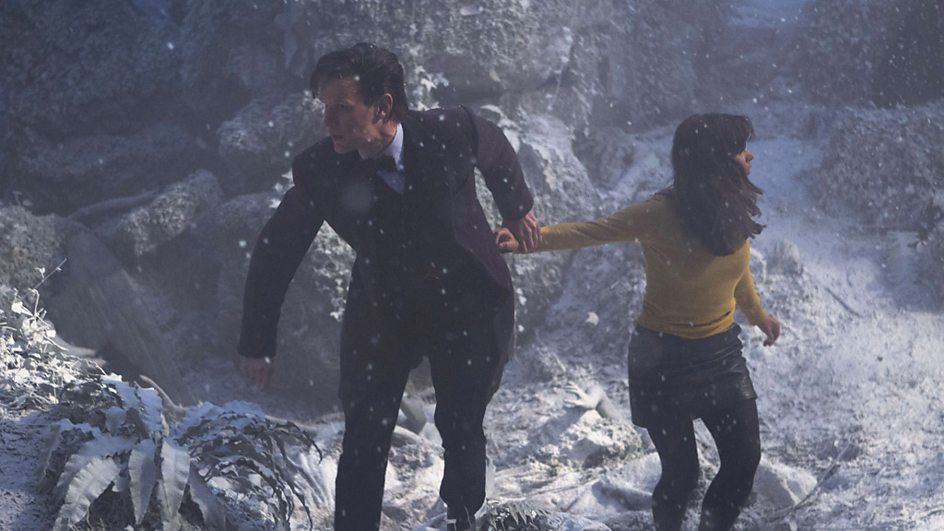
The Doctor and Clara's relationship is as stiff as ever.
Finally, Season 33 comes to an end. It's only been two years or so, you know. And with it, ends the tenure of Matt Smith's Eleventh Doctor, an incarnation whose initial good beginnings were later soured by a devilish inconsistency and a nasty streak in which he happily committed genocide, rewrote time to fit his own needs and committed so many unreprimanded cases of sexual assault that I'm surprised there have been no angry letters on Points of View. I've really reached the point with Doctor Who where I can't be bothered to use objective analysis, and even if I was going to I'd still be using this article to point out how much crap Moffat just served us instead of actual Doctor Who. So, with our bellies full of Christmas cheer and seasonal indigestion, we'll get started. I'll also be doing a drinking game of sorts for all of the standard features of each Moffat episode - see if you can join in. (I don't drink, so luckily I won't get liver poisoning.
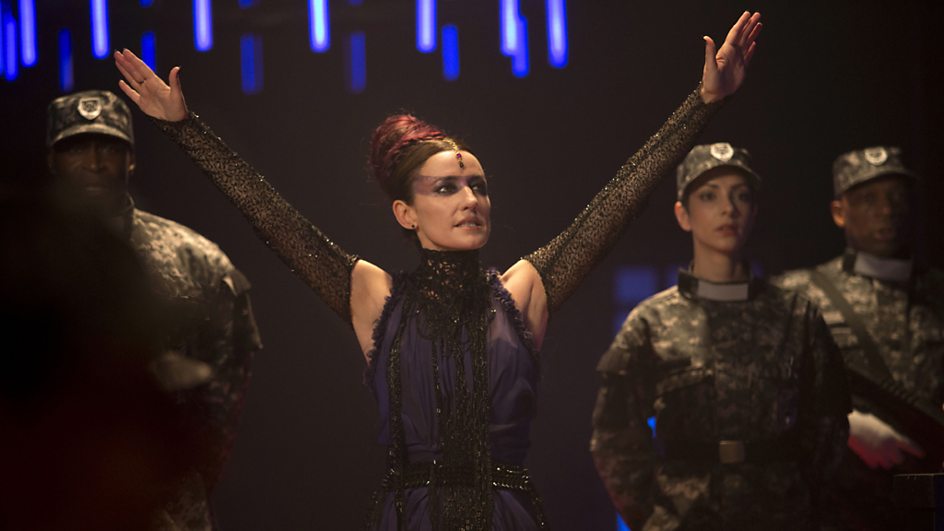
     There's a planet surrounded by a force field, set up by the Space Pope, who is of course a feisty, flirty woman who has the hots for The Doctor. (Drink.) Clara asks The Doctor for help with a mundane family task, upon which The Doctor turns up naked for some reason and smacks Clara on the arse without her consent (Drink.), leading to him taking her along to the planet to find out what's below the forcefield that's powerful enough to lead all of the Doctor's enemies to assemble above it. (Drink.) It turns out to be Trenzalore (Drink.) where a time-space crack (Drink.) containing retcon Time-Lords (Drink.) can only be released if The Doctor speaks his real name. (Down the bottle.) He then spends 300 years or more defending a town called Christmas from repeated invasions from all of his worst enemies, and it turns out that the Silence were working for The Pope but the nasty ones from before were part of a stupid sect and in the end the Pope and The Silence really want to stop the Universe from going kablammy and eventually, after lots and lots of confusing nonsense (Drink, if you're still capable.) The Doctor uses magic energy from the Time Lords to bypass his regeneration limit and become Peter Capaldi.
http://ichef.bbci.co.uk/images/ic/944x531_b/p01mzszq.jpg
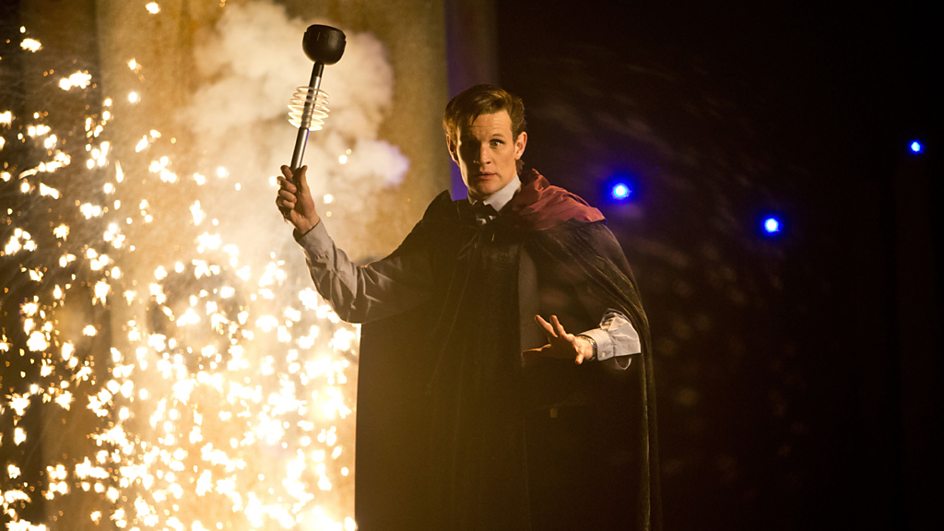
Matt's final hour is as ridiculous as his first.
     I'll get my social justice stuff out of the way here, so that those who wish to cover their eyes can just skip to the next paragraph. Where to begin with this, eh? Well, The Doctor makes a joke about OCD, which is a real condition and not something people say to be trendy (or at least shouldn't be saying to be trendy, because it doesn't mean what they probably think it means.) Then we have at least three cases of clear sexual assault (an arse-smack, a naked rub-down and a forced kiss), all of which go without reprimand. And then there's our characterisations. Not a single Person of Colour or member of the GSRM community in sight, as per the standard, and our two main female characters are either robbed of agency or hyperfetishised. Or both, on one occasion. Let's not get started on every single distasterous scene with Tasha Lem the Space Pope, let's focus more on Clara Oswald. Because character development is apparently too good for Moffat to deliver, she spends the vast majority of the episode lacking any agency, thrown about time when necessary for Moffat to time-skip in that non-adorable way he does in lieu of showing actual characterisation. And, when she does get to do something, it's using her girlish charm to convince The Time Lords (you remember, the ones that want to destroy the Universe) to give The Doctor a new regeneration cycle because, and I shit you not, because they love him.
     The Time Lords switching from obstructive beaurocrats/genocial maniacs into hidden, unseen carebear gods is one of many, many plotholes brought up by this episode. There are far too many to mention here, especially as this episode seems to be a reactionary piecemeal of explanations for all of the various Moffat plots which he forgot to finish because hey bowties are cool, let's go demean yet another demographic. One of the biggest ones is the whole paradox thing that Moffat has created over this past season, and intentionally or not he's written a massive great paradox which makes his entire era totally moot. He has, in effect, retconned his own retcons - both of them. The Doctor doesn't die at Trenzalore, so the Tardis is never at Trenzalore to be his grave. Clara never jumps into the past, The Doctor never meets Clara in the first place, Clara isn't at Trenzalore to help him and thus The Doctor dies. And then doesn't. And then does. It's an eternal paradox, and quite a twisty-turny one.
http://ichef.bbci.co.uk/images/ic/944x531_b/p01mzt3p.jpg
Space Pope Tasha Lem allows closure for that Silence crap.
     The Time of The Doctor is the end of a trilogy of stories, each more outlandish and more nonsensical than the last. It's arguably been something of a magnificently tragic fall - not for The Doctor, who's been a complete arse for the past three years or so, but for any tolerance I had for Moffat's scruples. If he can't try, why must I? While I enjoyed The Time of The Doctor as an exercise in sheer madness, it's reached the point where as long as this guy is in charge of the show, I'll never be able to really invest in anything that's going on. Moffat's Who is one of no consequences, a complex sci-fi show written with paper-thin, offensive characterisations and a continuity more lax than that of the most terrible sitcoms (including Moffat's.)

Thanks. Merry Christmas.

IT'S CHRISTMAS!

Hello there, Winter reader. This is June!Andrew speaking, wishing you a very Merry Christmas firmly out of the way of the season.

Hopefully the second half of the year hasn't brought me into any depressive lapses, destructive tendencies or world-shattering catastrophies. And the same for you, too.

So, like every year, I invite you to get the hell off my website and spend time with your families and friends on the one day of the year that you're obligated to do so. Trust me, you'll thank me for it in the end.

Thanks. Merry Christmas.

Sunday, 30 December 2012

Review: Doctor Who 7.Y: The Snowmen

Clara and The Doctor work well together. Like, really well.
Written between 25th and 30th December

In the past, Moffat Christmas Specials have taken a story from Classical Christmas Literature and given it a Doctor Who twist, with the main companions and storyline firmly out of the action. Taking a leaf out of RTD's book, Moffat has used this Christmas special as an opportunity to introduce the next phase of his era, with a new companion, title sequence and TARDIS interior. While it did come at the cost of some of the main plot, the sheer charm with which the new setup was introduced has got me thoroughly primed for the series' return in the spring. Even if Moffat's riddles confuse me a little.
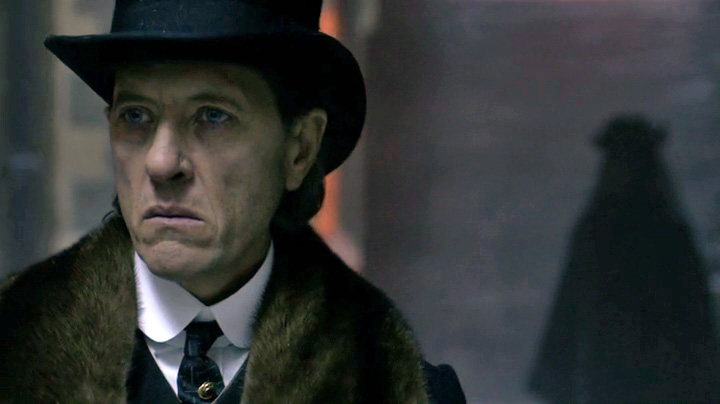
     The Doctor is in mourning after losing Amy and Rory, and is hiding out in Victorian London under the protection of Madame Vastra, her wife Jenny and their Sontaran servant Strax. Clara (Jenna Louise Coleman), is a barmaid who, in her spare time, pretends to be the wealthy governess of a Stately Home. She accidentally comes across The Doctor while out, and follows his investigation as he discovers that sentient snow has been terrorising the peoples of London. The snow is being controlled by the Intelligence, an accidental creation of the mind of Doctor Simion (Richard E Grant, whose played non-canon Doctors twice). After Clara helps The Doctor to escape a solid-ice creature that the Intelligence was trying to give form, she falls from a great height and lies dying in the house. While the Doctor faces the Intelligence, the sadness of the Governer's family crying for Clara causes the psychic snow to turn to tears, releasing the Intelligence out into the world. The Doctor realises that Clara and Oswin from back in Asylum of the Daleks are different versions of the same person, hundreds of years apart, and goes to look for another version.
Jenna-Louise Coleman doesn't disappoint, again.
     While I was a tad annoyed that our companion is once again getting up and sexy with The Doctor, this felt different. Unlike River and Amy, whom the Doctor accidentally imprinted himself on when they were young, Clara has an instant chemistry with Eleven that's quite fascinating to watch. Moffat still ended up writing her with his obsession with sexual promiscuity, but it was a tad more tame here than in Asylum and worked a bit more smoothly. In a really intuitive way, there's something about Smith and Coleman that just really works on the screen, and it makes the episode a joy to watch. It was a shame that Richard E Grant's character, Dr. Simion, wasn't as well characterised.
     It was this lack of characterisation in our villains that actually provided the episode's main issue - while strong in its leads and very interesting conceptually, the main threat of the story was painfully underdeveloped because of it. Our solution is incredibly rushed and the "family crying on Christmas Eve" line was both cheesy as heck and on par with similar "Power of Love" feats that the series has thrown before. I suppose it was Christmas and all that, so we were due some doughy sentiment, but I got the feeling that the episode became so bogged down in the new mythos that it often failed to make a cohesive plot for itself to follow. The snow feeds on thoughts, suddenly it's made a body, we can't let the snow touch the body, it wants physical form, wait now it's the creation of a child's mind, now it can control people. There was a strange level of inconsistency behind the villain's actions.
      Strange, when said villain formed a major part of this episode's almost slavish reliance on the series' past. I think Moffat did manage to balance between entertainment for new viewers and references to the Classic Series, but he sure didn't make it easy for himself. The new title sequence borrows heavily from past versions and is the first since Sylvester McCoy's era to show the Doctor's face in the credits. The new TARDIS is much darker and features, rather wonderfully, a hexagonal console not unlike that ubiquitous in the old days. And, more relevantly to how I began this paragraph, the villain of the story is taken from two 1960s stories: The Abominable Snowmen and The Web of Fear. It's really weird and awesome that Moffat saw fit to write a prequel to two stories that no longer exist in their entirety. (Even if it does have me thinking back to the Eighties and the hubub caused by the continuity references in Attack of the Cybermen).
http://images2.wikia.nocookie.net/__cb20121226034532/tardis/images/0/0e/RichardEGrant-as-WalterSimeon-in-TheSnowmen.jpg
Richard E. Grant's sociopathic Simeon comes off a bit wooden.
     My rambling aside, The Snowmen did have a lot of flaws when it came to ensuring that the story held together. But it was a balance of so many different influences and ideas both old and new that it's really a miracle that the main leads' had room to do their thing. The end result, on the face of it, is two very charismatic actors creating two very interesting characters, and a TARDIS team that promises not only to be unlike anything we've seen before and to take influences from the show's history. It wasn't perfect, but it was Moffat's best Crimbo special and one of the best things he's written in a long while.

Thanks.

Thursday, 20 December 2012

Review: Doctor Who 4.17-18: The End of Time

Yeah, Merry Christmas and a Happy New Year.
Doctor Who - Season 30, Episodes 17-18 (Third Christmas and New Year Special) - The End of Time
Written between 2nd and 17th November 
If you like The End of Time, read at thy peril.

Next year, I'm gonna go back to Tennant. This run of episodes has convinced me to do that. Maybe he's not as bad as I've thought he was over the past several years. The End of Time, though, does have a lot to answer for. It's an important story for me, for the simple reason that this is where pretty much all of my Ten-hate began. Seriously. I liked Ten, and then I watched this story, and for the past three years now, that's the way I've felt about him. What could be so bad about a story that it could literally change my mind about one of my favourite characters from light admiration to complete and utter hatred? Well, The End of Time'll do that to you. Journey's End, the "series finale" of Series Four, had been a messy, messy thing. But The End of Time took that to new levels.
     At a base level, what annoys me about The End of Time is the level with which RTD attempts to make it grandiose and epic and then fails on such a tremendous scale. This began a few episodes back with the “he will knock four times” prophecy from Planet of the Dead, one that still plagues this episode and which makes very little sense considering the vast number of times someone does four successive knocks in the interim episodes. There are so many set-pieces and grand pronouncements that RTD has to ignore things like reason and coherent storytelling in order to get his characters into these crazy situations. And of course that’s how the story will be remembered – by the big moments, by the stunts. But that a good episode doesn’t make, and thus most of the first half of the special is complete and utter tripe.
     This episode’s actual plot, when you take The Master and the Time Lords out of the equation (which I will cover, don’t worry) has very little new to offer. The bigged-up villains from the opening prophecy, the Naismiths, do little other than have a big house and some convenient guards, and their only characterisation seems to be a kind of weird incestuous tone between them. The other new guys are the Vinvocci, who are another spin on RTD’s “spiky aliens are funny” gag from back in Voyage of the Damned, except this time they’re embodied by the still-very-much-in-Being-Human Sinead Keenan. Both pairs get ridiculously little characterisation, and exist for the sole purpose of hanging the story's already thin plot around. If you cut out the Master's stupid plan, then they really have no reason to exist in the story at all.
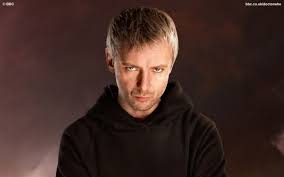
Cheap Resurrection, hair-dye included with the price.
     No Daleks here, no Cybermen, but we do have to put up with RTD's version of The Master. I'll get into greater detail when I cover The Last of the Timelords next year, but I always felt uneasy with his approach - the Master has always had a problem with being taken seriously as a villain and this cross from the Moriarty-like figure to something of a more Joker-like archetype doesn't do the stories any favours. Here he manages to use a piece of alien tech to transplant himself on every human being on the planet, providing one of NuWho's most ridiculous cliffhangers and proving ultimately pointless when it's easily reverted in the second half. The Master most definitely improves in the second half, when he's acting like a person and not like a weird, randomly-resurrected monster, and despite the blatant pandering I do enjoy some of the more slashy scenes between him and the Doctor.
     And yes, "Randomly resurrected" is one way of saying it. There are lots of things in The End of Time that I can forgive, but this is definitely not one of them. In his desperate attempt to bring back The Master after he'd been lazily killed off at the end of The Last of the Time Lords, RTD seems to have forgotten the concept of plot and common sense and instead randomly throws a whole barrel of bullshit at the screen and hopes some of it will stick. So Mr. Saxon randomly gets a parliamental cult who use magic (they don't even bother throwing technobabble at it, it's magic and potions from ancient books) to ressurect The Master, while his wife throws a potion at him that turns him into a super-hungry skeletor with magic electro-powers. It's completely and totally insane and is also completely unnecessary, or would be if RTD hadn't been so insistent during his reign of having ridiculously poignant finalés. It's a big whalloping great ten minutes of most puerile drivel and is, without a doubt, the worst scene in the history of Doctor Who. Worse than New Earth. Yeah, that bad.
     Davies did try to do something interesting with this story, in bringing back the Time Lords for one last go and revealing some of the backstory to Davies' big Time War storyline that he's started the series off with five years prior. However, despite the wonderful aesthetic that he manages to bring up around the Time Lords in this story, they're essentially just turned into hammy villains that have none of the political satire attached to them that the Classic Series so revelled in. Timothy Dalton's Rassilon, while enjoyable hammy in itself, comes off as an over-powered villain who is then too easily defeated - it's the worst of both worlds. Especially at certain points in the first half, in which RTD saw fit to make him add narration. What narration effectively does is show that you, as a writer, don't have the ability to put your message across on screen and have to resort to someone actively telling you the plot.
Dalton!Rassilon is not happy. Or sane.
     Now, one thing that RTD introduced when he brought back the Master a few years prior was the idea that The Master had been driven insane across his life by the sound of a Time-Lord heartbeat constantly drumming in his mind. This of course provides something of a problem; we have something like 25 adventures with the Master before this, and not once does he ever mention the drumming in his head being the cause of his dickery. Hell, there were times in the past where The Master was a perfectly sane guy who just seemed to like fucking up the Doctor's day (looking at you, Delgado!Master). It introduces something that retcons Who history going back to 1971, and for that it just doesn't make any particular sense. This episode decides that it was these crazy End-of-Days Timelords that put the message in his head, using it as a gap between the Time-Lock and Earth. Well, I'm sorry Rusty, but that's one shitty Time-Lock you got there that can actually pass matter and energy through it. I'll be going more into The End of Time's bad science next Wednesday.
      This story's last legacy, before I get onto the story's good bits, comes in the form of RTD's total and utter inability to leave his role without incredible pomp and circumstance. I've already mentioned the stupid prophecising and the mad Woman who randomly appears for no reason across the special, but there's a much longer bit that not only failed in its original intention but made a lot of things even worse. Even after stropping to his death and accepting his magic radiation-box, Ten flips one up to Caves of Androzani and gets to walk about for a week before he dies. He visits all of the companions of the New Series thus far, and they're all a bit off for various reasons. We find that Martha and Mickey are now engaged and go around hunting Sontarans, which seems to have been for the sole reason that both characters were People of Colour and Rusty couldn't think of a less racist way to tie up his loose ends. The Doctor gives Captain Jack the name of Alonso from Voyage of the Damned so he can have a bunk up, showing that either The Doctor has little to no idea of what shit went down during Children of Earth or just doesn't care, and he then saves the life of Sarah Jane Smith's son Luke. Finally, Ten decides paradox schmaradox and goes to say hello to Rose before she's even met him, which makes one wonder why she didn't initially recognise Ten when he first regenerated only a few months after this encounter.
     I planned to finish this with a rant about Ten's characterisation, so before I do that I'll talk about this story's good bits. Rusty does have a knack for writing certain characters very well in certain situations, and veteran Bernard Cribbins gives Wilf, this episode's effective companion, some of the most powerful and thought-provoking ideas that RTD ever came up with. Wilf is one of the sole reasons why I'd ever watch Season 30; while Rusty may have had some questionable ideas on how to write for PoCs, he got writing for elderly spot on and it's one of the best representations that the series has ever done. The two best scenes, then, in the entire special come when Wilf and The Doc have a nice sit-down chat - firstly in the Café scene where Wilf confronts The Doc on his death wish, and later on the Vinvocci spacecraft where he begs The Doc to take up arms.
Faux choices for a dying Time-Lord.
     Ten. The Tenth Doctor was best in his middle-season, I find, and as much as I find Season 29 a bit meh I will say that The Doctor was a lot more bearable. The End of Time presents Ten as perhaps the most cowardly of all of his incarnations, struck with righteous indignation that someone as awesome as he should ever have to pass on the torch. After nine regenerations before him, all gone to with a certain degree of grace, Ten stinks up the show and has a hissy fit, claiming that regneration is just tarted-up death. Finally, he makes his last words the ridiculous, "I don't want to go," straight out of RTD's own mouth. One of Doctor Who's core themes is about change - unintentionally, perhaps, and the result of William Hartnell's declining health, but nevertheless one that has persisted throughout its time. The End of Time has ultimately created a legacy of Tennant fans who simply cannot accept change any more - who cannot accept change in a series in which change is one of the main attractions. And that's a really, really bad thing.
     The End of Time is not good, let's just clarify. In no sense of the word, be it classically good or So-Bad-It's-Good, no, it's neither of those things. It has some interesting things in it, here or there, but it's also a rather damning dissertation on a producer's misunderstanding of what Doctor Who really is. I'm all for a producer celebrating his time on the program, but it's necessary to the show's ability to change that this be done well. The End of Time doesn't do it well - in its core, it has poor, poor writing instead of actual characterisations and plot, and in its legacy it insults all Doctor Who before or since. The End of Time is something that Doctor Who will be scarred by for many, many years to come, and I can only hope that when Moffat bows out, he does so with a great deal more subtlety.

Thanks.

See you next year, Tennant Era. We still have unfinished business.

Thursday, 13 December 2012

Review: Doctor Who 4.14: The Next Doctor

Ten gets spoken down to. I like it.
Doctor Who - Season 30, Episode Fourteen (Second Christmas Special) - The Next Doctor
Written 29/10/12

Ah, RTD, with your suddenly provocative writing. Around Season 30, RTD started writing Doctor Who very much for the tabloid press, and that resulted in lots of "shocks" and "epic moments" which didn't evolve from the actual stories but seemed to just be plopped there for no good reason. It pretty much started with the ridiculous "The Doctor's Daughter", carried through to a fake regeneration in The Stolen Earth (part of a Two-Parter I consider the NuWho equivalent of Pete) and then here, to the first of the Specials, in which David Tennant's promise to leave was exploited for viewership even when no such thing occurred. Despite that, the disturbing trend of me actually enjoying these Christmas Specials is continuing, and strong.
     The Doctor materialises in Victorian London, and encounters a man claiming to be The Doctor (David Morrisey), albeit with incredible memory loss. He's fighting the Cybermen, whom he thinks caused him to regenerate. While Ten initially thinks that he's meeting a future self, he soon realises over time that this Doctor, with an ordinary screwdriver and a Hot-Air-Balloon for a Tardis, may not be the real thing. Meanwhile, the Cybermen are led by man-hating work-house owner Mercy Hartigan (Dervla Kerwin) who is working for them in order to get back at all of the chauvanists who ruined her life. The Doctor works out that the other man is in fact Jackson Lake, a man who was attacked by the Cybermen and, in defending himself with alien infostamps, accidentally got brainwashed into thinking he was The Doctor. When he helps him to come to this realisation, they work together to attempt to stop the Cybermen's plan - to create a giant mecha - culminating in The Doctor going up in a balloon and disconnecting Mercy from the system, causing her to self-destruct.
     The episode's main charm comes in the characterisation of both Jackson Lake and Mercy Hartigan, both of whom improve what is at its heart quite an odd script. Even though the reveal that of course this "next" Doctor isn't the titular Time-lord comes far too early in the story, its made up for by David Morrisey's ability to make you like him no matter what role he's in. Jackson Lake is someone fundamentally human and the relationship he has with The Doctor is at times quite touching. Mercy Hartigan's character is refreshing in that she recognises the gender inequalities of the age and uses them to her advantage. The bit where she's more powerful than the entire Cyber hive-mind is a bit bollocks, though, and her screaming causing them to explode was a bit silly.
WOMAN SCREAM!
     A bit silly is unfortunately true of a few things in this episode. The random new type of Cyberman that only appears in this episode and then never again. The intergalactic pen-drives that also double as slide-show projectors and high-calibre energy weapons. After the unholy recesses of Journey's End this is relatively sane, but it does show where RTD was eventually going in the making sense department. So much of this episode was done for sheer monetary value, it's insane - the various new Cybermen, for more types of toys and voice-changer helmets, the hint of "The Next Doctor" to drum up tabloid interest and get new viewers. I'm not saying that a producer should be completely ignorant of the show's viewing figures, but that should be the secondary concern behind actually making good Who.
     But yeah, I enjoyed The Next Doctor, despite all of the inklings within it that RTD was getting a bit tired. I won't have a rant about that until I cover The End of Time and, eventually, Journey's End. All I have to say here is that David Morrisey and Dervla Kerwin carry the script in a really engaging way and, ignoring its fundamental pointlessness, the gimmick central to the premise does deliver a lot of interesting moments for both the audience and for David Tennant's interpretation of The Doctor. A thumbs up from me.

Thanks.

NEXT THURSDAY: Did someone say The End of Time?

Thursday, 6 December 2012

Review: Doctor Who 4.X: Voyage of the Damned

I'm The Doctor, and my characterisation is rapidly going downhill!
Doctor Who - Season 30, First Christmas Special - Voyage of the Damned
Written 21/10/12

I'm sorry. Like, I really am. I just don't seem to get "fan opinion". Because I'm the guy who thinks that Blink is overrated. I'm the guy who not only loves Colin Baker, but will defend his era and his character to the grave. And on this universally derided example of RTD's worst recesses... I come up positive. I like this story. I like how overblown it is, how hammy it is, how so little of it makes sense. I like how all the right elements are there but how they've been jumbled up and only sometimes resemble anything coherant. And I liked how seriously it took its own bullshit. Of course I know that Voyage of the Damned does, for many various reasons, stink to high heaven, but for whatever reason, I look past it all and find some damn entertaining Doctor Who.
     Having just had what looks like the Titanic somehow crash through the indestructable TARDIS exterior and into the dimensionally transendental interior, The Doctor doesn't bat an eyelid and decides to hop on board to see what's going on. It turns out that the ship is a space-liner from the planet Sto, orbiting Earth as tourists come to enjoy the Christmas Spirit. There, The Doctor makes friends with maid Astrid (pop starlet Kylie Minogue) and they get to pop down to earth, where they meet the erstwhile Wilfred Mott (Bernard Cribbins). All is not as it seems, however, as the robotic Heavenly Hosts start malfunctioning and the Captain (Geoffrey Palmer) deliberately causes the ship to run into some asteroids. Only The Doctor, Astrid and some other stereotypes make it through, each one of them being picked off one by one as they make their way through the ship. Soon, The Doctor faces hammy villain Max Capricorn, who was planning to crash the ship for an insurance scandal, but Astrid saves the day by sacrificing herself to stop Capricorn. The Doctor stops the ship from crashing and, frustrated at all the death, tries (unsuccessfully) to bring Astrid back.
     RTD just throws so many characters at us, and then gives the episode extra time to make sure that they all get developed in a sorta-satisfactory way, and then he either lets the jackasses win or kills them off. The sole nice-guy left, sans The Doctor, who's behaving for once, is Mr. Copper, played by Clive Swift (Keeping Up Appearances, as well as playing Jobel back in Revelation of the Daleks), whose performance delivers much-needed charm. It's slightly odd that RTD does what he does with the characters in question; there's a Billy Zane type who acts like a dick for the entire episode and whose survival is used to mark some kind of weak tragedy, a fat couple who are constantly used for comic relief despite being shown to be funamentally good people (to this rather chubby reviewer's chagrin) and a small, red, prickly cyborg with a funny name who doesn't really seem to have any purpose beyond providing a reason for the story to ham-handedly show that Sto is prejudiced towards them. And this isn't even necessary in the end, because Capricorn's primary motivation wasn't to escape/avenge prejudice - no, that'd actually be sympathisable, gasp - but for cheap monetary gain and petty revenge over his business partners.
SYMBOLISM!!!!11!
      For many an RTD hater, this was, burping bins and farting Slitheen aside, the first point where it started to click that he might be a bit of an extravagant writer. There are many setpieces and weird moments which are clearly supposed to be more impressibe than they end up being, with Murray Gold's music drowning out the other senses and cinematography that is rather baffling (this from the same director of Cyberwoman and the dreadful Daleks In Manhatten two-parter). The two worst examples are ones that big-up Ten in a way which is gonna eventually lead to the shit-fest of The End of Time, and both are frankly embarrassing. The first is a speech used for the trailer, which features The Doctor responding to a rather spot-on queery by Billy Zane with a series of pronouncements about his origins which really shouldn't make much sense but is responded to with awe. The second is the semi-finale, where The Doctor reacts to the death of Astrid and Capricorn by grasping hold of two of the Heavenly Hosts and flying in what is a painful, painful Jesus comparison. (Almost pictured.)
    Voyage of the Damned is in no way perfect, but at the same time its silliness is also it's main charm. Had this been done with an ounce more compentancy, and ounce more care and attention, it would have bombed harder than the Germans on Portsmouth. But it didn't, and thus Voyage of the Damned is one of RTD's more entertaining flops. It has a lot of annoying things in it, but the panache and style with which it is filmed makes it a comic masterpiece greater than all of Moffat's comedy work combined. I love Voyage of the Damned for the very reason that I hate it - it's badly made, badly written, but it just doesn't care.

Thanks.

P.S. 600TH POST! Gimmie some!

Thursday, 29 November 2012

Review: Doctor Who 3.X: The Runaway Bride

The Doctor and Donna meet unexpectedly.
Doctor Who - Season 29, Christmas Special - The Runaway Bride
Written 21/10/12

Ah. Yes. Erm, this is embarrassing. I had gone into The Runaway Bride expecting to have something deeply vitriolic to say. Hate to spread. Something really venemous to make good similies out of, like, "worse than an ameoba's painting skills" or "more tired than an out-of-shape flamingo" or something. But, er, no. I kinda like this one. Is it bad that I don't quite know why? The Runaway Bride presented something very strange in that it is in a way a companion introduction story that's about a season too early and feels a season too late. It isn't really special and there's nothing really that brings it above the rest of Season 29 in quality but there is something strangely rewarding about it in the long run that, for me at least, gives it a barrell of well-earned charm.
     Just after The Doctor has lost Rose Tyler to a parallel Universe, mouthy bride-to-be Donna Noble (Catherine Tate) appears in the console room, having literally disappeared from her wedding without warning. Disgruntled, he attempts to return her home, discovering that the bride worked as a temp for a firm known as HC Clements and has managed to miss all of the major earth invasions over the past few years. She's being chased by last year's robot santas, who are being attracted by the huon particles that are somehow inside her. They go to the reception, where they've started with out her, but it turns out that the robots can track her there and The Doctor destroys them. Heading to HC Clements to find out what's going on, they find that Donna has been spiked with Huon particles by her reluctant boyfriend Lance in order to serve the will of the Empress of the Racnoss, queen of a species the Time Lords destroyed in the Dark Times. Heartily pissed off, The Doctor uses the Robot Santas' bombs to blow up undersea base, drowning the Racnoss and only just getting out alive. The Doctor drops Donna off home and pops off on his merry way.
     I initially detested the way that Catherine Tate played the role, in a way which really reflects half of my attitude towards Donna in general - she's often loud and comedically sociopathic without rhyme or reason, and doesn't seem so much human as she does a walking sitcom cliché. As the episode progresses, though, we see something truley remarkable - RTD's first successful piece of Character Development, which takes loud oblivious Donna and turns her into a conscientious woman ready for a better life. This development would continue when she takes up the companion mantle in Season 30, and despite its ridiculous payoff in Journey's End (which will inevitably have to be reviewed someday) it stands as one of RTD's best-written characters. And that, fundamentally, is why, despite all of the things I've mentioned, I like Donna.
You may not like her characterisation, but you gotta say
this action scene kicks ass.
     But what was it about the episode that made it just right enough for me to actually like it? It wasn't the very, very ambitious villain design, which features Sarah Parish in the largest prosthetic the BBC ever made, nor was it the muddled but ingenious plot by the Racnoss to have the Human Race for Christmas Dinner. No, it was... it was Tennant. This is the first time since initial broadcast wherin, outside a Moffat episode, Ten hasn't done something I found annoying. He was quite brilliant here, actually. I think the general comedic feel of the episode certainly added great chunks to my appreciation, and the darkness that RTD so loves was given out in just a small enough quantity to actually mean something for a change. (Although I did notice that The Doctor is happy to let the British Army shoot down the Racnoss Web, killing the Queen... let's not dwell on it too much.)
     So... yeah. The Runaway Bride isn't anything special, I suppose. But what it does have is just this great feeling, almost like a buddy movie, of two great friends coming together for the first time. Add to that a great deal of decent humour, a hammy villain (MY KEY! MY KEY!) and a really quite good piece of Character Development, and you've got the recipe for a Christmas treat that does that and so much more. It introduced Donna, showed us a more subtle side of Ten and gave me a good laugh on Christmas morn and again when I rewatched it. Good on you.

Thanks.

NEXT THURSDAY: NuWho's first So Bad It's Good episode...