Showing posts with label Metaphysics. Show all posts

Tuesday, 4 June 2013

Time Travel, Destiny and Eastwood Ravine

Written 5/4/13

When I reviewed the very Time-travel heavy Fifth season of Lost, I ended up explaining a few issues regarding the subject and how the show treated it (and ultimately why Faraday was nuts). I didn't really go into a lot of detail about how I generally perceive travelling in time and the ways that we can apply it consistently, so I thought I'd go through some fun things in an essay. Because I have nothing better to do with my time.
http://0.tqn.com/d/lost/1/0/T/u/-/-/Daniel.jpg
Daniel pointing a gun at his mother, who is pregnant with him.
Luckily he never gets to pull the trigger.
      There's a difference, I must clarify, between the time travel in more serious works and in shows like, say, Doctor Who. Sure, Who flirts with a load of Time Travel tropes, but it's all as the author deems necessary and the laws themselves are highly contradictory. If you were to try and go through the series and track all the timeline changes, you'd find a bit of a tangled mess. Which is fine, because Doctor Who is a family show and not some silly essay about Time Travel in fiction. This article will thus be talking about consistent models of Time Travel - ones in which the writers keep things fairly logical, even if they don't realise that they're doing it. Consistent models must also avoid paradox - contradictions in the timeline that mean that the effect prevents the cause i.e. a man going back in time and shooting his grandfather, thus preventing his birth.
     The first model, whose name I've borrowed from Lost, is the "Whatever Happened, Happened" model. Basically, the timeline is fixed - the time travel is part of the way that the timeline is built. The actions of the protagonists in the past are vital to the act of travel in the first place. It's sorta like a record player - you can push the needle back, but it's going to travel on the same path back to the point no matter what you do. This model avoids the danger of paradox because there is simply no avenue for contradiction - no matter what the protagonist does, he cannot change anything - even if that means that the usual laws of physics circumvent themselves to prevent it. So say our guy tries to shoot his grandfather. Either the gun will jam, or the grandfather won't be killed, or he'll have already had his kids, etc. etc.
     The example I used was of course Lost. In the fifth season, half of our intrepid heroes end up skipping through time, ending up in the 1970s. When mention is made of possible paradoxes, local scientist Daniel Faraday explains their predicament as above. When an opportunity presents itself to prevent the heroes' plane from crashing on the Island in the first place, they try to take it by throwing a Hydrogen Bomb down a mineshaft. This inevitably leads to the crash of their plane in the future, thus meaning that in their attempt to change their fate, they became the cause of it.
http://images1.wikia.nocookie.net/__cb20100122055851/lostpedia/images/1/18/4x13_Departure.jpg
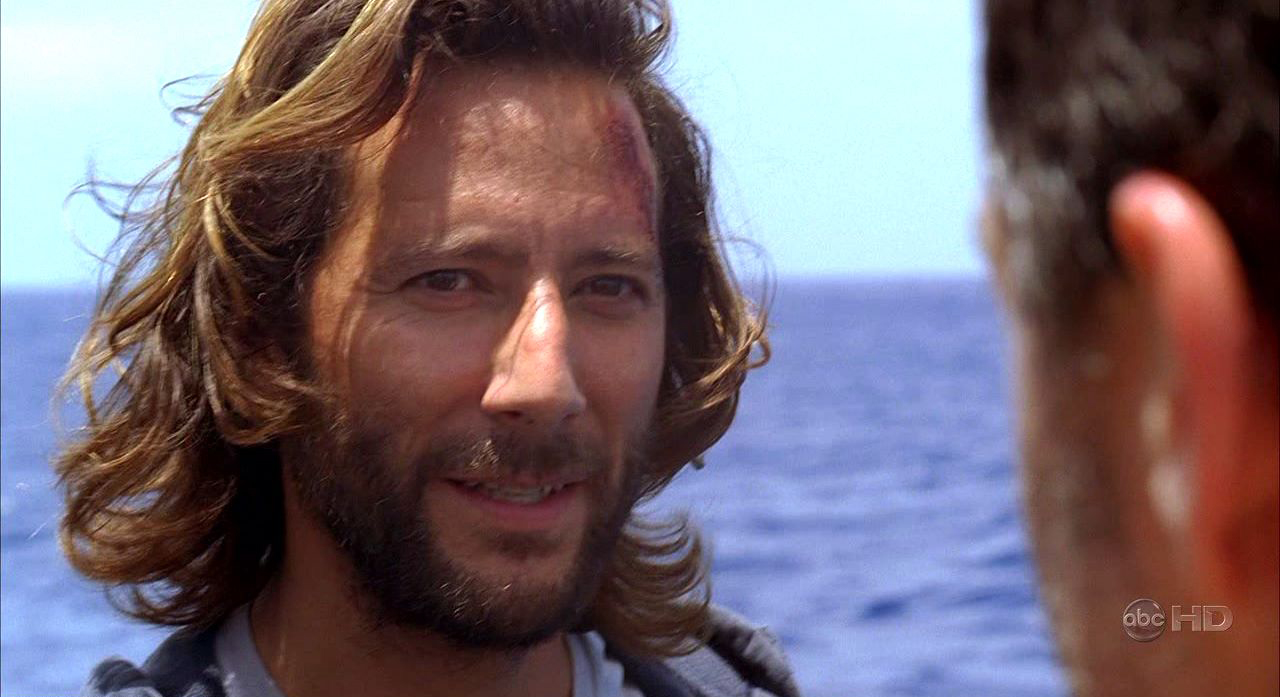
Desmond can see the future because the future's already
been written.
     However, Lost also explored Time Travel in other ways. One of the massive themes of Lost is fate and destiny, and quite often this is in floaty bullshit from mysterious side-characters, or from dreams and visions from the main cast members that aways seem to remarkably vivid and accurate. On first inspection this is fantasy style hoshposh - enjoyable nonsense. But Time Travel gives it an entirely different coat of paint. Take for example John Locke, who is told throughout his life that he is special. It is shown that this originates from himself telling people before he was born that he was special. His fate, and his accuracy in predicting it, came entirely from a time loop.
     This also allows us to sciencify more standard prediction of the future, such as when Desmond has premonitions throughout Season Three. If your timeline is completely fixed, if all of your actions are pre-ordained, then it isn't really a stretch that you can accurately say what's gonna happen next. We don't even need to worry about a God - as I mentioned in a previous metaphysics article, the future in Lost is written by... the writers.
      The first model doesn't let you change anything within your own perception, which is pretty much useless for a lot of writers, for whom changing the past is the main aim of your journey. Thus we meet the second model, known by me as the Many Worlds Model after the Many Worlds Theory of Quantum Mechanics. As seen in such films as Back To The Future and Déja Vu, it supposes that travelling back in time isn't really time travel at all. Rather, you cease existing in your own Universe and begin spontaneously existing at an earlier point in time in an otherwise identical parallel universe. The man going back to kill his grandfather is able to do so without any bother at all; but should he travel forward, he will find a Universe in which he never existed.
https://blogger.googleusercontent.com/img/b/R29vZ2xl/AVvXsEiGTDgMzVOogUjjn929W7nJ-FGX52-6yB1GazpQFpjqkHRETCCNLtp6FoiyBUhgRinjJ6WRd3Jq_FzwHfjTYYT7Hz_HXLUbZyOUU2NbV3SaZ4d2P7nuxlUM0GjbEOnFjsv76C0e1mRIHw_z/s1600/doc+brown+thinking+cap+back+to+the+future.jpg
The Doc exists in eight different parallel universes because
of the first one's time travelling.
     Again, a bigger example is Back To The Future. In the third film, we encounter three realities with quite a few differences, but the one I'll be using is the name of a ravine. In the first two films, the local gorge is called "Clayton Ravine" after Clara Clayton, a Wild West schoolteacher who rode over the edge and died. Doc Brown travels back in time, and creates a parallel universe in which he appears in 1885 and saves Clayton's life. The name is thus changed to Shonash Ravine. Marty, who travels laterally into this new Universe via a "ripple effect," finds that the Doc died a few days later, and so he creates yet another Universe in which he appears a few days after Doc and saves his life. Staging his own death to get home, the ravine is thus named after his fun alias, and is called (Clint) Eastwood Ravine.
     All this is rather fun. But unfortunately, this is fiction. In reality both models come under a lot of extreme scrutiny, and it all ties into energy and science and the laws of physics and such. The first model doesn't work because quantum mechanics makes it definitively clear that the future is not a certainty; we aren't living on a fixed set of events. The second is more sciencey; we're not even sure that parallel universes exist, and the entire idea of things spontaneously disappearing and reappearing goes against the idea that energy cannot be created or destroyed. Time Travel is a nice thought, and looking at the way that it's applied in fiction can be quite interesting. But for now, it seems rather more like a distant dream.
     Oh well. Back to the TV set.

Thanks

Wednesday, 7 November 2012

Metaphysics and Gene Hunt

Thanks to the Life On Mars wiki for this convenient
and wonderful image.
Listen, I know this article is total bullshit. But it's here. Hopefully the last in my three-part series on Metaphysics. Written 5/10/12.

The worlds present in the GHTTB are fairly consistent for the vast majority of its run. The Coma World (I refuse to ascribe to the silly Limbo theory and explain away that solution as Alex's fevered dreams in the few moments of semi-consciousness before death) runs parallel to reality and is affected by what is happening to said Coma World's host. In Life On Mars, Sam is the world's Host. His memories of 1973 create a brown world with cowboy cops like Gene Hunt, one in which he faces his parental issues and in which he learns how to feel happy with his life. For him, while the world around him is definitely produced by his own head, that does not dismiss its validity as a reality.
     More than Alex, Sam's world is very much affected by the status of his body in Reality. He is much more prone to hallucinations, blackouts and delusions due to too many meds, the return of old colleagues, the death of a mentor - there's an explicit chain between the realities that creates many a plot point and, indeed, most of the tension in the series. Unlike the cheeky reference to the Creator connection in Back To Earth, the Bonanza has a much more personal and powerful singular Creator - one that is unwilling. This makes its status in the quantum multiverse more troublesome, because that would imply a causal link between the Sam of the Bonanza's reality and of the Universe elsewhere, as opposed to a single entity.
      Alex's world reflected her memories of the Eighties, which for her were tainted by not only her mother's affair but the death of her parents and her eventual adoption. While Sam's attempts to change his Coma World were in order to return home, Alex's were always a lot more personally motivated - she didn't just remember Tim and Caroline Price as her parents, but she had also grown to respect them as people while in the Coma World. While Alex has fewer (but more vivid, usually) hallucinations than Sam, she has a much stronger bond with the Coma World than she does with Reality, which helps to explain why she is unable to escape.
Sam gets more crazy shit, but that's because
he's more in tune with Reality.
     Ashes To Ashes went all weird on us during the gap between the final two seasons, presenting a third reality that was supposed to represent Alex's death in the operating theatre. Time dilation between Universes is a common theme in the Bonanza, and thus explains why the moment of death was seen as a completely different reality from the moments of believed post-death. Strangely, Alex's stronger connection to her personal Coma World can be seen here as well - even in this reality within a reality, Gene and the crew of CID bleed through and her "awakening" is not to the real world, but to the 1980s. While it may just seem to be weird for the sake of being weird, it instead presents the largest part of the metaphysical theory surrounding the Bonanza as a whole.
      In the Life on Mars and Ashes To Ashes universe, the greater poignancy with which you remember one's past, the stronger bonds you form within the world created by your mind. Sam was sent back to 1973 because that was the year his father ran away, an event that, while it had troubled him, isn't seen to have had a large effect on Sam in the present. Alex, on the other hand, was eyewitness to her parent's murder-suicide, and the following years of foster parenting by the man who arguably led to said event (by having an affair with her mother) made sure that it became imprinted on her mind. When Alex heard Sam's description of the Coma World, she instantly became obsessed with the idea of causality within such a vivid world and that is the reason why she is so much more in tune. For Sam, it remains 1973 throughout his entire stay in the Coma World. His experiences and memories are stagnant, unchanging. Alex's time moves rather swiftly, comparably.
      One constant remains in both worlds that lends credence to the idea that the Coma World is in fact part of the Quantum Multiverse, and exists as a Parasite Universe that can only be controlled by the counterparts of those in Reality. Gene, Ray, Chris, Annie, Shaz, Martin Summers - these people all once existed in Reality, outside of the Host's memories. What does that mean, then? Who is the Host when these guys aren't around? If we are to preserve the Coma World without straying off into Limbo territory, then we have to concede that the quantum doubles created by this parasite Universe can live on after their counterparts in Reality have already died. And that, perhaps, is why both Sam and Alex end up dead, even though the former was able to escape. To create a double in another Universe, you must incapacitate, remove or kill the original in Reality. The reason why there was a connection between the two Universes was that this doubling up created an unstable point - a weak spot, allowing one reality to spill over into the other.
This theory doesn't cover Keats. But I try to ignore him,
despite how wonderfully he's played by Daniel Mays.
      This, then, becomes consistant with our exploration of Red Dwarf. If a Universe created via Hallucination is maintained by said person, then there will be inconsistancies where reality and the imagination of the host collide in a sort of cosmic reaction. In BTE, it was Lister's acceptance of the reality's true nature that allowed Kochanski to form within it, and it's because both Sam and Alex realise what's going on that their worlds are so relatively affected by the outside. The Gene Hunt Time Travel Bonanza, for all of its bullshit regarding demons and limbo, can be turned into an interesting collection of sci-fi concepts that neatly explain exactly what's going on without even touching the supernatural. It may not be actual proven science, but it's still fun and I'm glad that this series of articles has allowed me to examine this.

Thanks.

  << Red Dwarf - Back To Earth ----------Metaphysics---------- ||                                                      

Wednesday, 3 October 2012

Review: Red Dwarf: Back To Earth (Revisited)

Coronation Street does not, in fact, play part in my
metaphysical theory. It does help it, though.
See here for my previous look at this story.

Red Dwarf - Series Nine - Back To Earth
Written 29/9/12

Metaphysics, eh? I spoke about this in a really boring way a month or so ago, but re-watching Back To Earth in preparation for Red Dwarf X has allowed me to realise that for once, Doug Naylor has written something that is both incredibly clever and incredibly frightening in a million different ways. At a glance, the scenario created by Back To Earth is just played for laughs, and ends up being a throw-back to universally loved episode Back To Reality from back in Series V. But at its heart, what Naylor has created is something rather profound and, within the confines of the story itself, astonishing in its scale.
     So the Dwarfers believe, due to a run in with a female Despair Squid (who thus uses hallucinogenic happiness ink because girls are soft and such and suchlike yawn yawn), that they have entered our reality, in which they are fictional characters in a Red Dwarf TV Show. Their "real" world is of course subtley different to ours in a number of telling ways; London appears as it does in Blade Runner, the Creator is played by Richard O'Callaghan instead of the erstwhile Doug Naylor, and for some reason both Kochanski and Chloe Arnett exist at the same time. The end of the episode sees them kill their Creator, and find out that this was something that he had scripted; the typewriter of their Creator can be used to control the world, but ultimately there is another typewriter somewhere else controlling that. Here lies the key to their brilliance.
    We may say that the Dwarfers don't exist, and so there's no point in arguing about metaphysics. But with the Quantum Multiverse, they do exist, somewhere, and it's a world that does have a Creator. Essentially, we live in a Godless Universe in which our imaginations allow us to inadvertantly control the paths of other, similar universes. In other words, anyone who has ever written fiction, or imagined a hypothetical scenario, is a deity to another Universe. The Dwarfers weren't being controlled by "The Creator," but they are, ironically, controlled by another creator, Doug Naylor, who has set this whole thing up.
It's almost as confusing as that poster...
     This explains so much, and it seems obvious when you think about it. Back To Earth pushes against both the Fourth Wall and against the differences between the Watsonian (the in-story) and the Doylian (the out-of-story). Those subtle differences between our reality and their "reality" reveal not the shoddyness of the script but instead the fact that Naylor is specifying that while this resembles our reality, it is in fact yet another layer of metaphysical existence. The back of the DVD cover being similar but not the same, the existence of Series IX and X in 2009, the head of the Red Dwarf fan club being called Redge Wharf - these aren't just jokes, my friend, they're genius. When the despair squid arrives, it makes Rimmer fear for his life - which is obviously an indication that the squid focused their shared hallucination on Lister, which begs the question, why? Well, we now know the answer. Because Lister is the Main Character.
     Or at least that's how I rationalised it. Metaphysical buggery aside, Back To Earth does feel like a poor imitation of all those things that came before, but I admire it for trying to do something incredibly interesting and for, in the end, inspiring Dave to commission a brand new series of Dwarf which, at the time of publishing, is due to start tomorrow. My best hopes for Red Dwarf X and my thanks to Red Dwarf, Back To Earth.

Thanks.

<< Model Dependant Realism and You ----------Metaphysics---------- Metaphysics and Gene Hunt >>

Friday, 10 August 2012

Model Dependant Realism and You

Star Trek may defy our reality; that doesn't mean that we
can't treat it scientifically.
Written 8/8/12. Sorry if it's a bit serious.

Let's talk about science. Specifically, TV Science. Now it's common parlance in the TV trade to invoke the "MST3K Mantra" in order to excuse plotholes. The mantra, named after the US comedy series Mystery Science Theatre 3000, is based upon its themetune, which states, "It's just a show; I really should relax." Well, I'm ignoring that today, so I can talk about one of science's key features that stops everything from going chest skyward. Adding to that, I'll discuss why this relation between science and fiction exposes the problems with the Theistic Hypothesis.
     Let's take a look, for a second, at reality. The Universe operates under a series of rules; a series of laws that, while perhaps varying between different scales, work together without contradiction to form what we experience around us. Particles move as quanta and as waves, with space being a sea of probabilities; probabilities influenced by the four forces. Three of those forces are governed by particles, with the last being a quirk of spacetime itself. Laws, whether Physical, Chemical or Biological, remain constant to allow our reality and disallow what we may call Miracles. For shorthand, I will call this set of laws "26.100", from the name of Walter Lewin's lecture hall in his online lectures in 1999. These laws have been ascertained by both theoretical analysis of observation, but also as the result of experiment, since the dawn of human thought.
     Now let's take a look at a fictional world. I would use Doctor Who, but that's a tad inconsistant with its rules, so I'll instead look at Star Trek. Despite being full of technobabble, Star Trek is known for at least having the same technobabble for the same situations. Planets spin round as they do in 26.100; atmospheres are the same, life develops in similar ways. Matter and Anti-Matter still react to form energy, and vice versa. Everything we know to be true in our reality is also true in theirs. Apart from a few important details. Like, for example, the ability to travel faster than light. In reality, the speed of light is not specific to photons but to any massless particle, because it stands as the proportion between time and space, and between energy and mass. So what does this mean? Parts of the Trek Universe follow 26.100, and parts of them defy them. It would seem incredibly contradictory; how are we going to resolve the situation?
     But yes, it is possible. Science is not just an abstract academic field; it applies to everything, and the scientific method can't stand contradiction. Something's gotta go; either 26.100 is wrong, or the Warp-speed spaceships are wrong. If this were reality, we would be forced to reject the spaceships. This isn't reality, and so with regret, we must throw away all of the rules and laws that allow our existence. But this is easier than we think. Being in a different Universe, the results of experimentation would be different also. The experimental results that so guide 26.100 would instead deliver us a different set of laws, ones that allow both our cushy existence and the defiance of Einstein's cosmic speed limit. We may not be able to conceive of it, but it must be possible, because despite the fact that we have never seen a conventional experiment and its results, we have seen that both the normal laws exist AND that spaceships travel that fast.
Quantum Physics and Newtonian Physics give different
outcomes, but both agree with experiment and so neither is more
correct than the other.
     This emodies one of the key principles of the Scientific Method; the value of experiment. As outstanding physicist Richard Feynman said, "If it disagrees with experiment it is wrong. In that simple statement is the key to science. It does not make any difference how beautiful your guess is. It does not make any difference how smart you are, who made the guess, or what his name is – if it disagrees with experiment it is wrong. That is all there is to it."And this applies to any system, whether big or small, whether perceptionally real or fictional. The laws of Newtonian motion that ruled physics for hundreds of years were defied by the undisputable discoveries of Quantum Physics, but one is no more correct than the other. A molecule will behave in one way and a ball will behave in another, even if said ball is composed of said molecules.
    Really, this relates back to why I don't believe that there can be a deity. Because when we examine 26.100, we do have experimental data. We are faced again with a dilemma between two models; 26.100, and the idea of a Deity. Last time we had to discard 26.100 because the evidence for faster-than-light travel was beyond all reasonable doubt. Herein lies the Theistic Hypotheses' main fault. Because this is reality. And 26.100 does have the upperhand. Nowhere is there a single shred of usable evidence, not one dent upon the Universe that would suggest that supernatural intervention was at all necessary. That is why Religion has no place working in the realm of science, in the realm in which our set of laws is apparent. It also allows us to take in the true beauty of the world around us, revelling both in the astounding revelations of analysis, and in the murky depths of counter-intuition that affect our daily lives.

Thanks.

                                    || ----------Metaphysics---------- Red Dwarf - Back To Earth >>