Showing posts with label Things I Love. Show all posts

Friday, 19 July 2013

Yet More (Other) Shows I Love

Written between 27th June and 13th July 2013

Following happily in the footsteps of my posts talking about the shows and films that I like but would (probably) never review in full, this post is for me to talk about the shows I've discovered recently and that I absoutely adore, but will most likely never write about at any great frequency. From the crazy adventures of MJN Air to the wastes of Zombified Georgia, I've been having some real fun.
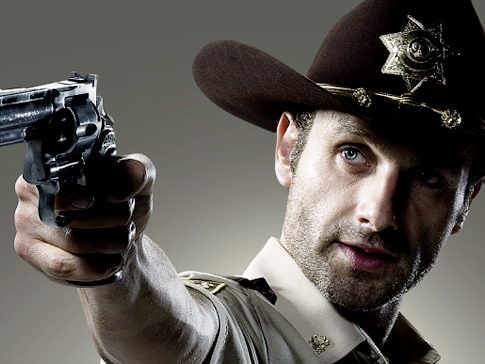
http://images2.wikia.nocookie.net/__cb20130304173308/deadliestfiction/images/9/97/Rick_Grimes_.jpeg
Protagonist Rick Grimes.
From Wikia
The Walking Dead.

I was already familiar with Robert Kirkman's expansive Walking Dead franchise, following various groups of people in the US State of Georgia as they survive after a world-wide Zombie apocalypse. The show is a loose adaptation of the comic series, taking certain liberties with the plot for better and for worse. What drew me to the show was probably just wanting to know what all of the damn fuss was about. I wasn't disappointed when I got here.
     The thing you immediately notice about the show, especially in its first two seasons, is how much it bathes in its own atmosphere, tending to keep background music to a minimum and spending a great deal of time on simple talk between the characters as they struggle under constant threat. The characters feel like real people, and for the most part issues are sorted out as they would be in real life - issues are actually discussed and not held back for cheap dramatic tension, and as a result the way the characters react to the bigger and more important developments paints a much more detailed picture of who they are.
     The series' arguable protagonist is Rick Grimes, played by British actor Andrew Lincoln (that creepy guy in Love Actually who films Keira Knightly and then has those signs and the CD player) who seamlessly pulls off a Southern accent to the extent that I forgot who he was and thought he was an American actor to begin with. Like a certain Mr. Shephard from another US show, his story is probably not the most interesting, but it's still damn good - we see the slow progression from just optimist to delusional opportunist, as the politics surrounding his family life, which initially appear to have improved post-Apocalypse, go into meltdown.
     The pacing of the show is admittedly all over the place, and that comes with the territory of having such a variation in season length - six episodes for the first season, thirteen for the second and sixteen for the third. But despite that, even when not a lot is going on, there's something rather uniquely engrossing about the show's atmosphere and the way it treats both its characters and its world. We've barely seen what the effects of the apocalypse are outside of the state of Georgia, but we don't need to - because these feel like real people, doing real things in a difficult scenario. And that's why I love it.
     I keep making mental comparisons to Survivors. Which I really shouldn't.

Cabin Pressure.

http://ichef.bbci.co.uk/images/ic/640x360/legacy/brand/b00lmcxj.jpg?nodefault=true
Arthur, Douglas, Carolyn and Martin.
From the BBC.
A Radio show! On this blog! Radio comedian John Finnemore began his BBC Radio Four sitcom Cabin Pressure in 2008, surrounding a small charter airline called MJN Air. The show has an impressive core cast, utlising Benedict Cumberbatch (Sherlock, Star Trek Into Darkness), Roger Allam (Ashes to Ashes Series Two) and Stephanie Cole (Tenko, Waiting for God) as well as starring himself. The show's character-based humour is exemplary and the writing between the leads is better than most of the sitcoms I've seen on television.
     Thanks to the radio medium, the vast majority of the comedy comes from the interactions between characters, whose complicated characterisations develop vastly across its alphabetically named 25 episodes. I especially love protagonist Martin, played by Benedict Cumberbatch, whose insecurity about not being a natural pilot (but being someone who loves it so much that he's just had to learn how to be one) gives him a great massive dollop of charm. A close runner-up is classic sitcom snarker Douglas played by Richard Allam, whose constant slimy wit makes the show what it is.

http://img1.ak.crunchyroll.com/i/spire2/654681f8eefdc13ad8dee196ff2a74f71366329524_full.jpg
You can watch all episodes of this anime
legally, and for free, on Crunchyroll. (Here)
Shingeki no Kyojin (Attack On Titan)

As well as listening to my first radio show this year, I also started following my first Anime. I'd resisted the genre for a while, feeling unable to associate with the cultural associations and tropes from that part of the world. However, after some subtle browbeating from my friends, I decided to give it a go, and it appears that my choice was a good one. (Although not one for those with a delicate disposition...)
     Set in a crapsack dystopian world where mankind is menaced by nigh-immortal Giants, humanity is forced to live behind a set of three giant walls until one faithful day where a really big one comes along and provides our protagonists with their primary motivation. The series' depressing edge is only tempered by its gruesome imagery and its rather fascinating interest in a world where corruption in the system is obvious and unchallenged and where a person's primary concern is whether their death serves the Human cause.
     The series takes a lot of its mythology from Norse and Greek legend, which I suppose is what made it easy for me to get into. I feel as though the anime avoids many of the stereotypes that I'd associated the genre with in the past, such as excessive and problematic fanservice as well as soap-esque twists. While the plot does twist and turn, it does so in a spectacular fashion that only seeks to build upon its engrossing ontological mystery. It's bloody good, and I'm personally a little impatient for the next episode to come out.

Thanks.

Tuesday, 24 July 2012

Opinion: (Other) Films I Love

Unlike my similar post last year on the shows I love but won't review, this year I'm looking at film. And, because it's a little more extensive, I'll be looking at wider sections of Films as well as individual pieces.

Pixar Films
Steve Jobs' only real contribution to the civilised world worth talking about is his endorsement of Pixar Studios, initially created by George Lucas and eventually sold to Disney. Unlike many studios out there, I can really feel that Pixar does what they do for the artistic value of the work itself. It's about the story and its characters first and foremost, and so they're prepared to do anything and animate anything to make sure that they come across well.
     My favourite Pixar film is probably Wall-E, which I see as a really fun apocalyptic drama with some decent environmental themes. Wall-E is one of the only Pixar films that doesn't work on some kind of parental bonding, and it's risky for the company merely because of that - the only other times that they have escaped the formula are the Cars movies, which are by far the company's biggest let-downs. I also love Finding Nemo, for its excellent cast and soundtrack, and Up for its brilliant writing, taking what could have been a stereotypical mess and moulding it into something moving and powerful.
     2011's Cars 2 was the studio's lowest point to date. But, unlike with other production teams, I can be sure that 2012's Brave is going to be the animated movie event of the year.  Pixar continue to be the pioneers of 3D animation and so far haven't strayed too far from their key focus upon bringing joy to the world through film.

Richard Curtis' early stories used Hugh Grant in his place.
Richard Curtis
The writer of The Vicar of Dibley and Blackadder, Richard Curtis, is one of the best British comedy writers of a generation. His homely style and his cast of recurring actors makes his ouvre one constantly evolving examination of Britain and what it finds funny. His first two films, Four Weddings and a Funeral and Notting Hill are similarly written, Hugh-Grant-driven rom-coms with very witty writing, even if they are both cursed with having a similar format.
      There is no film for me, however, that rivals Love Actually as a feel-good experience. In our house we watch it every Christmas, but not just for the setting - for the characters, for the comedy and for the music. It's cheesy in parts but all in all Love Actually is a brutally optimistic examination of all kinds of love, intertwined with parodies of a Very British Christmas.
      His most recent film, Rock The Boat, is less of the normal Richard Curtis Rom-com but is still one of his best works to date. Set on a pirate radio barge in the 1960s, the film's chaotic mix of parody and genuine adoration for its era is perfectly set up by its cast of loveable characters. The film's climax, set to Procul Harem's A Whiter Shade of Pale, is an incredibly powerful scene and really demonstrates the power of the music itself.
       Richard Curtis has contributed more to British Culture over the past three decades than a lot of people have. He'll always be one of my heroes, and hopefully the rest of the British public see him as one too.

Back To The Future is awesome from the poster up.
Back To The Future
Time-travel has always interested me. Back To The Future caught my eye at the age of nine, and by the end of the film I simply had to get the rest. Rather willingly, my parents bought me the trilogy, and the rest is history. While some of the writing can be a little cliché in places, there's no denying that the trilogy is one of the most simply fun sci-fi series in cinema.
     In a way, it's dated attempts to portray the Eighties as first the modern day and then a time to look back upon make BTTF a key example of the way that Eighties culture evolved in the latter half of the decade. The first film, made in the mid-eighties and set in the 50s, is similar to a number of films at the time hearkening back to those "Golden Years." The second, made in 1988, spends time in the past but also looks forward to a future that looks upon the Eighties lovingly. And the third and final film is a pseudo-Western, showing how in the early 90s Sci-Fi evolved into new forms.
      Back To The Future often feels phoney, but that's just its Eighties aesthetic. The trilogy is a great feel-good experience, blending the right mix of comedy and drama to produce some of the finest sci-fi-comedy in the 20th Century.


The Marvel Cinematic Universe
The rest of this article was written in January, but this section was written much later, in late April. The Avengers and the series surrounding it is one of the most ambitious film projects since the Harry Potter Franchise, seeing six films completed in four years with many more in pre-production. This series continues to be absolutely astonishing in terms of the quality of direction, storytelling, characterisation and cinematography, and I absolutely adore the fact that this style of film is in the mainstream. 
   The most important thing that this series of films has brought and will continue to bring to Western Cinema is the same style of continuity as one sees in the original comics, with characters and storylines crossing completely different genres in a really enjoyable way. What's more, this franchise is gonna have at least another three films out in the next two years, which is some great production rate. The fun never stops.

One Man In Black that I don't find annoying.
The Princess Bride
Yeah, this isn't a group of films, but one in particular. I only really discovered The Princess Bride from TV Tropes and then saw that my sister had it on video. I wasn't disappointed. Based on a book by William Goldman, the film is a hilarious pastiche of the entire fantasy genre while still managing to be an epic and powerful entry in its own right. The film's clever writing has meant that a lot of its phrases and lines have entered American popular culture.
       And so, if this article has anything to really say, it'd be to reccomend that you go and see this movie. I don't want to spoil anything, and that's how the film is best viewed. I can promise you that The Princess Bride is one of the most funny and heart-warming films that certainly I can reccomend.

Thanks.

Wednesday, 28 December 2011

Opinion: Christmas Telly 2011

Christmas is a wonderful time of year. While the rest of the annum offers us modernistic, bleak offerings reflecting a cracked society, Christmas is the one time of year when things come together to provide a warm blanket of seasonal joy. Here is my rundown on some of this year's best Crimbo telly.

Lost Christmas, Sunday 18th, BBC1 Starring Eddie Izzard and others.

The first half of this urban fairy-tale was actually quite disturbing as an amnesiac known only as "Anthony" (Eddie Izzard) brought together a group of people with his ability to find lost things - including people. The drama is surprisingly dark when one considers that it was released for a CBBC audience, but the lessons it taught about simple acts of kindness in life were valuable. I in particular loved the drama's thick Hindu themology, as well as the wonderful twist that makes perfect sense. Lost Christmas is a tad strange, but if you stick it out you'll be left with a poignant drama that examines all areas of life.

The Old Bleak Shop Of Stuff, Monday 19th, BBC2 Starring Robert Webb, Stephen Fry, David Mitchell, Celia Immre, Johnny Vegas and others.

I adore Dickens, and so this wonderfully satirical parody of his life and works was perfect for me. Taking aspects from his main works (especially the Pickwick Papers), the comedy follows Jendrington Secret-Past (Robert Webb) as he loses his family to evil lawyer Skullingworth (Stephen Fry) and has until midnight to get them back. The best thing by far is the dialogue, which mocks Dickens' lexicon beautifully and yet still allows for a captivating plot that mixes all of the writer's favourite stories. The Old Bleak Shop Of Stuff is a love letter to Charles Dickens and his legacy.

Little Crackers, Various Times Throughout the Season, Sky One Starring John Bishop, Jane Horrocks, Alan Davies, Sheridan Smith, Shappi Khorsandi, and many others.

These now-yearly short dramas have been brilliant this year. Taking on the heart-warming experiences of well-known actors and comedians, these autobiographical tales are all heart-warming and poignant. The best is by far John Bishop's tale of being payed in teddy-bears, but I also loved Sheridan Smith's tale as well as Alan Davies significantly sadder affair with a friend's dog.


Thanks. Merry Christmas.

Friday, 5 August 2011

Opinion: (Other) Shows I Love

You know the shows I love - Doctor Who, Blackadder, Red Dwarf, etc. . But there are some shows that I can't find either the time or the nerve to review but do watch on a regular basis. So; here are four (Other) Shows I Love.

Star Trek
The Cast of Voy. Season 4 onwards.
I’m not enough of a fan to really review any Star Trek episodes – there are other people on the internet that can do and are doing it better. I love Star Trek because unlike Doctor Who, it takes one central sci-fi idea and expands upon it in a wonderfully technobabble-filled setting. Like that show, Star Trek is best when examining character and realistic moral dilemmas, something it does very often.
     That said, my favourite series of Trek is probably Voyager, mainly for its focus on the Borg. Its bad episodes are, unlike certain episodes of the putrid Enterprise, funny because of said poor quality. While not every character gets enough development, I think that the excellent development of The Doctor and Seven of Nine are enough to watch Voyager’s highlights. I also like Deep Space Nine for its deeper political tales and its very strong characterisation across the board (although to me the Ferengi are downright ridiculous and entirely superfluous to proceedings.)
    Part of Voyager’s fun that I really enjoy is Janeway, whose splintered and inconsistent characterisation is even joked at in some of the later seasons. Her character is a “matriarchal hypocrite” – like Karen Fisher but with 100x more responsibility. Her exploits make the show dynamic, and even when this applies to the show’s quality it’s still something that keeps me coming back.
    Star Trek, while more science-based than Doctor Who, is in some ways a perfect Americanised staple. Maybe I’m being too heavy on the comparison, but both have had a profound influence on their home cultures and on each other. Different, but the same.
     For good reviews from everything Star Trek, I reccomend Sci Fi Debris.

Luther
I said at the beginning of the year that I’d be reviewing the second series of this excellent cop-drama series, but I couldn’t conjure the words. Luther (Hollywood actor Idris Alba) is fundamentally a tired concept amongst tired concepts – a maverick cowboy cop who doesn’t play by the rules and has nothing left to lose. But, for some glorious reason, Luther takes this and rejuvenates it with perfect art-deco style and a series of characterisations so fun to witness that it feels a shame not to come back every week.
    The first series had its share of issues, but the show was held together by the side-character Alice, a psychopath who managed to escape prosecution for the murder of her parents. A charming stalker, she assisted Luther and helped him with not only his troubled private life (with ex-wife Indira Varma and new hubby John, played by Paul McGann) and his cases.  The second series left those characters behind, and with some strong characterisations the series stood on its own two feet with a series of three powerful villains.
    One thing that separates Luther with other cop-shows is that, rather than trying to discover who the killer is, the show introduces the villain as a main character and then follows how the police find out what we know. Not new to the genre, maybe, but it’s a concept not seen on British crime drama at the moment and thus feels very fresh and exciting.

The Brittas Empire
Readers of my blog know that I absolutely adore Red Dwarf mainly for the performances turned in by Chris Barrie as Rimmer. In 1993, Barrie got his own sitcom – The Brittas Empire, set around the neurotic and incompetent Gordon Brittas in his day-to-day management of a Leisure Centre.
     The series’ charm for me, like a lot of other, “UK Gold Comedies”, is that the humour relies on both slapstick and on the characterisation. Gordon is probably one of the most well-characterised comedy protagonists this side of Reginald Perrin, and this is in no doubt codified by Barrie’s stunning performance.
            The show ran for seven series before it was cancelled, and after that Barrie went off to film a full series of Red Dwarf (the horrifically bad Series VIII). Despite British Brevity, this means that I unfortunately couldn’t review it as I haven’t the money nor the time to discover which episodes are in which order and to find them in television together at a convenient time.
            The Brittas Empire will always hold a special place in my heart, not only for its cast of brilliantly written characters, but also for the tremendous performances and the often powerful and satirical stories.

Jeeves and Wooster
One of the more well-known adaptations of P.G. Wodehouse’s series of written comedies, Jeeves and Wooster took the incredibly well-written and enjoyable stories and took them to screen with the same vigour. Starring two of the early nineties’ best comedians – Hugh Laurie (fresh from Blackadder) and Steven Fry, who had been popular with their sketch-comedy series A Bit of Fry and Laurie – I love the show for its trademark wit and charm, taking an Edwardian feel and translating it to modern audiences. It feels more like an ITV Costume Drama than a typical “UK Gold Comedy,” and so is too oft ignored – a crime, considering the quality of its writing and acting.

There are many other shows I like but can’t review, but these are the ones that I have considered reviewing in the past and just haven’t been able to.

Thanks. 

Saturday, 31 July 2010

Top Five Favourite Films


I’ve never covered film on this blog because it’s quite a daunting task; programming and film can be quite different in style and message. A lot of the time a film has to achieve in a few hours what a series can achieve in many more, although on the flipside there is often a much higher budget. Here is my personal Top 5 Favourite films of all time, in reverse order.

5. Charlie and the Chocolate Factory (Written by John August and Roald Dahl, Directed by Tim Burton, Music by Danny Elfman. 2005)

Not a popular choice among the critics, as well as fans of both Dahl and Burton, I find this film’s style, humour and tone inescapable. As well as sticking as closely as is possible to the original novel, it also injects warmth and a message that manages to update the film for the modern age, contrasting with Dahl’s often strict (and today, fairly ridiculous) views.
            Anyone who hasn’t heard of this story, from the book, this film or the 1974 version, is a poorer man for it. Its simplicity is paramount to its success; it’s the tale of Charlie Bucket, who is one of five children invited to tour around the factory of the fictional chocolate maker, Willy Wonka. In this edition, Wonka’s attitude and general dissonance with the outside world is amplified, and as is his childish, whimsical nature. The crucial thing is that reasons are given for why he is like this.
            Elsewhere, Danny Elfman’s score is charming and variable, Burton’s artistic style is spot-on, and Johnny Depp gives us an… interesting character.

4. Sherlock Holmes (Written by Michael Robert Johnson, Directed by Guy Ritchie, Music by Hans Zimmer. 2009)

It is surprising that a film that, as of posting, I saw only three weeks ago is number four on the list. What is it about this film that I love? It’s a mixture of intriguing, witty mystery, swirled up with exciting but realistic action. The performances are superb and the soundtrack just flows.
            As from the title, the film is another adaptation of the Sherlock Holmes book, published by Arthur Conan Doyle in the 1880s and 90s. This time the elusive sleuth and his assistant, Doctor Watson, are updated with developed performances by a good fake-Brit by Robert-Downy Junior and comfortable Jude Law. The instant chemisrty between the characters means that whether you’re looking at a gambling problem, or a thick argument, it all feels slick.
             It’s best to approach this film, and any Sherlock story, without any knowledge of the plot, as to enhance the experience. Therefore, I’ll move on.

3.) Big Fish (Written by Danny Wallace, Directed by Tim Burton, Music by Danny Elfman. 2003)

Yes, my highest Tim Burton film is the oft-ignored Big Fish, which is unusual in Burton canon as it contains only two of his recurring cast members. A tale set in the American South during an unspecified time period, alternating between the modern day and a period around the Second World War. It tells the story of the dying Edward Bloom, as his son tries to discover whether the tall tales surrounding his life are true.
            In essence, it’s a wonderful exploration of one mans lie, focussing on all areas of everyone’s lives. Albert Finnley and Ewan McGregor both do a brilliant job as the protagonist, and Helena Bonham Carter gives a role that doesn’t feel like an unnecessary cameo.

2. The Truman Show (Written by Andrew Niccol, Directed by Peter Weir and Music by Burkhard Dallwitz. 1998.)

A tough call, my two top favourite films are quite close together. Coming in second by a thin margin is The Truman Show, one of Jim Carrey’s first dramatic roles. It was one of the first films, and one of the first pieces of media, to capture the idea of reality TV, and in this case it stands at its most effective.
            The film follows Truman Burbank, chosen by birth to be part of a completely immersive world, and his life broadcast 24 hours a day from the day he was born to the day he died. He is funny and generally accepting of this strange, 1950s style world, which is littered with oddities like circular traffic and people advertising mid-conversation. Around his early thirties, outside forces begin to make Truman start to see the oddities of the world around him.
            The entire film is a slick philosophical pondering on whether we truly know whether the world around us is real, a predecessor of sorts to The Matrix’s popularisation of a simulated reality.

1. Pleasantville ((Written and Directed by Gary Ross and Music by Randy Newman. 1999)

Here we are. My favourite film of all time, Pleasantville is a cauldron of genres; an out-of-this-world adventure, a symbolic examination of human nature, and a chick flick, all rolled into one.
            Two 1990s teens are arguing over the remote; David is an obsessive fan on a 1950s sitcom called Pleasantville, while his sister Liz is a class whore who hates the show. When a strange repairman gives them a magical remote, both are transported into the show as two of its teen characters. While the world is black and white, events slowly occur which mean that colour starts to appear in the town, mainly due to Dave and Liz’s modern freedoms. What follows is an examination of philosophy, race and gender roles, and the changing face of the American family.#

Thanks.