Showing posts with label DW15. Show all posts

Friday, 31 January 2014

Overview: Doctor Who Classic: Season 15

Written between 17th and 19th July 2013

http://static.bbci.co.uk/programmeimages/976xn/images/live/p00vh3h7.jpg
Tom's look of despair sums up my thoughts.
It appears that I'm not exactly a Graham Williams fan. Make no assumptions - I didn't start out with an agenda against him, it just seems like the two full seasons of his that I've seen have been rather diappointing. There's still the Key To Time, so I can't write it all off, and by saying this I am by no means saying that I found nothing in Season 15 to entertain me. The changeover from Hinchcliffe and Holmes to Williams and Reed feels like a difficult and turbulent one, as the series jerks back and forth between stories which emanate the gothic roots of previous seasons and then newer, less well-done stories with their own charms. It feels like there was a desperate attempt to capture what has been previously successful.
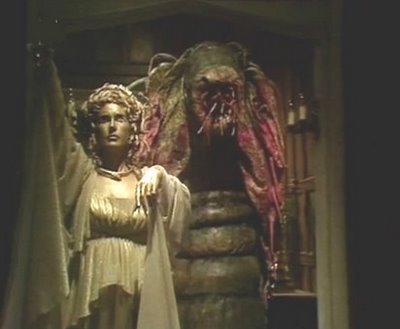
     The season's two gothic stories, The Horror of Fang Rock and The Image of the Fendahl, both have highly atmospheric writing and both are incredibly similar to the bread and butter of the Hinchcliffe and Holmes era. They both suffer, like those stories, from fundamentally underdeveloped concepts, and due to that they threaten to bore me silly. Horror is especially dry, but special mention must be made for Fendahl, which rattles along like a tumbleweed on a dry windy day until the final episode, where the concept gets thrown at us in spades. They appear as remnants of the prior era, but I don't know in my heart if that's a bad thing consider the rest of the season.
     The first few glimpses into the new era's style come in the form of The Invisible Enemy and The Sun Makers, two stories which I love and the only two in this season I can say that for outright. The Invisible Enemy is filled to the brim with an inescapable charm that surpasses its technical limitations, whereas Robert Holmes' temporary swansong The Sun Makers is a biting and hilarious parody of the UK tax system, which feels relevant despite how vicious it can be, perhaps unfairly in some areas. That these two different types of stories oscillate like this is very, very odd and marks the season's unevenness.
http://ichef.bbci.co.uk/images/ic/272x153/legacy/episode/p00vfclh.jpg?nodefault=true
They tried, they did.
     And then we get to the stinkers. While the gothic stories and Underworld are the only stories in the season which I found truly unwatchable, one gets the feeling that the budgetary problems weren't being met with the same vigour as before, and for reasons that I don't know (but which likely do exist and an are fully justifiable), the season's budget tends to run incredibly low near the end, resulting in the horrifically bad Underworld and The Invasion of Time, which is badly executed even if charming in its own incompetance. (I mean, green screen is visible in some of the corridor shots. They used the green sheet itself as a wallpaper cos they couldn't find anything else.)
     The final season in my runthrough of Four will be Season 16. After the relative shambles of this season, Anthony Read will move onto the series' first official arc. It was a move brought on to unify the season, the one that came after this season, one in which you never know from story to story what the style or theme or general level of competance is going to be. It ranks almost effortlessly at the bottom of my list of seasons from the Classic Series, and that's a shame because I'm sure that the production team at the time were really trying to follow up what had been considered by many to be the show's Golden Age.

Thanks.

Monday, 27 January 2014

Review: Doctor Who Classic: The Invasion of Time (Revisited)

See here for my previous look at this story.

https://blogger.googleusercontent.com/img/b/R29vZ2xl/AVvXsEgaIe3aUqLJ9LuyN_RM98qqom5tJ5v5qYDFkp962VjM1MZqt8m7xpcBjCV9DHgPqr2d3oDJVsLYtJSNvBJjBxCPU73MKVW9lHboqr0zfttUwvPngmDMVLxeUk77qxeIu7s9Z8Aq06_G1ypi/s400/Picture+9.jpg
The Doctor pretends to go evil for some sheets of foil.
From Cathode Ray Tube
Doctor Who - Season 15, Story Six - The Invasion of Time (Revisited)
Written 16/7/13

What to say about this story? Well, I had originally wantd to try and write an article on this story for Celebrate, Regenerate, but I couldn't find a single thing that I actually liked about the story. I mean, that's a bit of hyperbole, really. It's two and a half hours of Doctor Who, there are some things that I can find here and there. But as an overall experience, The Invasion of Time so fails in every single one of its aims that it reaches a point which waivers dangerously between hilarity and tragedy. And that's not a good thing, it's never a good sign when I can't tell whether I outright hate the story or love it in a So-Bad-It's-Good way. Usually it's a little more clear cut.
    The first four episodes are bad enough on their own - a concept play where we're led along the garden path by The Doctor's apparently dark turn, which is never hinted at until the second episode and so we're left thinking that The Doctor is a total and utter tit for a week. Plus, the aliens he's apparently helping are some of the most weak and lily livered in the show's history - the Vardans, whom, while awesomely powerful in principle, are pathetic in execution. I've followed some pretty crappy looking monsters in my time as a fan, but I will not accept a monster who is literally a sheet of tin foil with a strong irish accent. Their humanoid forms are even less impressive, looking like bored versions of the Great Gazoo with a great deal less screen presence. I can understand your budgetary limitations and at a stretch I might even accept the tin foil in the same way I accept the same in Timelash. But the acting is just so poor. It really is, there's no escaping that.
     The last two episodes are where the serial really goes to shit, with all semblance of plot thrown out of the window in favour of running around the TARDIS corridors for a bit being chased by Sontarans. As is Invasion of Time practice, this is the worst execution they ever saw, with crumbling costumes hiding actors who have been for some reason directed to put on strong cockney accents. After four episodes which might have been simply mediocre on their own, the final two drag it out into a dull slog which you pray might sometime end. It's so random that they have to break open the by-this-time-tired book of Who mythology, essentially pulling the get-out-of-jail-free card by having The Doctor shoot the Sontarans out of existence and then forget all memory of it.
Hey, it's the guy from The Android Invasion!
From the BBC
     In my original review, I talked a bit about Gallifrey, and that's important too. After the fan uproar at seeing the mighty mythology brought down to something a bit more human, going to Gallifrey was dangerous ground, especially when the budget was in the state it was. Instead of the wonderfully complex, multi-layered sets we saw previously, the civilisation is reduced to a series of blandly coloured corridors occupied by about three people, and then some location filming outside which instead of exploring Gallifreyan society and customs only serves to raise more and more questions.
     This story stands as Leela's last, and it's a damn shame after this season and a half that a character so previously well-developed manages to be kicked out with such a bullshit excuse. Leela falls in love with Andred, a minor character whom she barely speaks to over the course of the story and whom she has so little chemistry with it felt weird to see them even holding hands. It's not something that Leela would do, there's no continuity in the characterisation that after being shown the wonders of the civilised world with Leela that she would choose to settle down with a guard. Plus her presence in this story at all sends a bad word back to the Hand of Fear, where humans aren't allowed on Gallifrey. It's almost as if everything this story does is towards fucking up Season 14.
     And now to the few spits and spots I do like. John Arnett's Borusa is fandabydozy, and is quite wonderfully playful in his trickery as he guides The Doctor around Gallifreyan politics. The scenes between him and The Doctor play out very differently to Borusa's last incarnation, and at a stretch I would say that it's a tiny bit better. I also happen to like the roaming around the inside of the TARDIS, no matter how nonsensical the location filming in Hospitals and Swimming Pools happens to be. It's playfully done and it doesn't look too tacky, and while the TARDIS interiors we see in JNT's tenure (which are remarkably consistent in appearance) are my favourite, I love the recursion and randomness that this serial feels fit to provide to fill up the last two episodes.
The Doctor is made President.
From Basement Rejects
     So, not a total washout. At the end of the day there's no-one I can really blame for this story, and I feel bad for it because the show was struggling with its cash and it is genuinely a miracle that the story was even made. After all the work that went into ensuring that the show made the screen, I think the whole story is imbued with a wonderfully shoddy charm. When I began this runthrough, The Invasion of Time was one of my least favourite stories. Given some of the crap I've seen, I can at least say that The Invasion of Time is entertaining, and given all the trouble it faced in production I find that something of a wonderful miracle.

Thanks.

NEXT WEEK: We meet Romanadvoratrelundar Fred Romana's first incarnation in The Ribos Operation.

Monday, 20 January 2014

Review: Doctor Who Classic: Underworld

http://1.bp.blogspot.com/-_6oewbxddcY/UXCY6su13TI/AAAAAAAAK7Q/pqEKjfWBsv4/s400/doctor-who-underworld-minyans.jpg
Star Trekkin', cross the universe.
Doctor Who - Season 15, Story Five - Underworld
Written between 18th and 19th July 2013

Doctor Who presents us with another solid tip for future writers - never borrow from Greek Legends. Nobody thinks it's particularly clever to borrow from some of the oldest stories of modern civilisation, and the parallels rarely translate well to modern situations. Between Underworld and its spiritual successor The Horns of Nimon's love of Theseus and the Minotaur, Greek myth is pretty much blacklisted as an influence until someone can do it properly.
     In the ideas department, Underworld doesn't start off bad - The Doctor and Leela meet the Minyans, a race of aliens whom The Time Lords tried to help out millions of years ago, leading to endless war and the anihilation of their planet. A survey mission of these tired immortals ends up on a planetoid run by another sect of Minyans whose ancient religion has led them into an oligarchical rule, forcing The Doctor to help the original mission escape and be on their way to their final desination, a new planet for them to settle on.
     The trouble with writing a story about a society of immortals is that Immortals are boring. Even the Time Lords stop at 13 lives and tend to get old quite often, just to make things more relatable. The civilisation on the planetoid, with its dictatorships and strangely dressed guards, is a poor show on last week's and managed to lose my interest entirely. What kills the story, though, is the sets - or lack of. The sets that we do see are universally bland and uninspiring, and the rest of the story in the planetoid features wobbly model work and HUGE amounts of unnecessary CSO. They obviously couldn't afford to location shoot, and the result means tons of static, unconvincing shots of people running around a greenscreen. I was more convinced by Time-Flight.
http://www.doctorwhoreviews.co.uk/4Y_files/Underworld%20(2).jpg
"Once I caught a gumblejack this big."
     I'm not really at a point where I can fully rip this story a new one, as by about the second episode things got so bad that I barely registered the rest. Underworld is a story that tries to use CSO to cover up its lack of budgetary concerns - it tries to pull of the impossible. If your budget is this low, then someone please for the love of god write a Bottle Episode where there're only a few characters on one or two sets. Don't try to attempt an epic story where the direction is going to drawn out and terrible, the setting is going to yank you out of the story like a newborn being pulled from the safety of its mother's womb and where I can't remember what's happened in the past ten minutes because I probably fell asleep.

Thanks.

NEXT WEEK: The Invasion of Time, which is at least better than this story.

Monday, 13 January 2014

Review: Doctor Who Classic: The Sun Makers

http://gillatt.files.wordpress.com/2011/12/297559.jpeg
The Collector and his high-pitched whining really get ta ya.
Doctor Who - Season 15, Story Four - The Sun Makers
Written between 17th and 18th July 2013

Taxes. Tax the rich, tax the poor. Tax the windows, tax the door. There is no more contentious issue in politics than taxation, a fundamental and vital part of any stable political system that nonetheless is open to a great deal of abuse in the wrong hands. The Sun Makers, like its spiritual successor The Happiness Patrol, throws a lot of ideas out there to write a powerful, quite jovial satire of the entire Captialist system, and it does so with a stylistic flair that feels a lot more succinct than the rest of Robert Holmes tenure. That being an important thing, considering that this was his final story as script editor.
     The Doctor and Leela accidentally land on the dwarf-planet Pluto, which has become the last resting place for Humanity after an alien-run company took control of them. People call each other "Citizen" and consider themselves as work units, slaving away at dreary existences while kept docile by the use of airborne chemicals. While initially suspected of being a terrorist, it turns out that the Company is aware of the Time-Lords and the shrewd monarch known only as The Collector can only watch as The Doctor helps lead a rebellion of the underclasses to take back Humanity's freedom.
     It's probably not that accurate to compare The Sun Makers with The Happiness Patrol - both are satiring different British political parties and the attacks in the later are much less subtle. The Sun Makers excels by itself because it is a decent adventure story anyway. Things are presented in quite the opposite way, I think, with the issue being overwork and overtaxation due to the inate problems with the Captialist system. I think the reason why I like stories with big governments and civilisations is because the potential to draw parallels to real-world issues is that much greater. And I love a story that can be cheeky like that. Especially when it manages to be so vicious about it. The episode's core focus is an attack on the Inland Revenue, who here are respresented by the Company, and while they are taken to ridiculous extremes, the parallels between the problems in this story and real-life encounters with the Tax man are not too far off.
https://blogger.googleusercontent.com/img/b/R29vZ2xl/AVvXsEj7jneJIyvn9Ouko68thaGt5qrF2se1ybvuo3cqowXvDPSgN5wpKP4gpFrFuZPT2ezQQkUOFlR_z6x-GTlAPXHM1SQsJZD0Z5vTTAjeGD-e5QIAKUXNE-6NO0fGMn9SRjV9juTkiZKQ_58/s320/vlcsnap-2009-11-23-12h54m40s164.png
The Gatherer and his funky outfit.
      The side characters representing the civilisation's underground did end up going a bit panto, and there was the constant thread of cheesy overacting weaving in and out. That isn't necessarily a bad thing, of course, but it did come off as a little weird with The Collector, a man whose only alien traits seemed to be his short stature and an annoyingly high-pitched voice which really begins to grate after a while. It is a memorable characterisation, evoking many of the qualities that the slimy Sil later would. There was a superb ability all round in the conviction that they gave towards making the concept of this futuristic Pluto into a reality.
     But really the story's killer edge is its level of humour, worked out not just by those performances but also in the absurdity of the premise. The script, like The Invisible Enemy, is focussed more towards that humour, even if a lot of the subtle themes will go straight over the kids heads in a way unlike violent or sexual references often fail to. The serial manages to coast for about ten minutes or so with The Doctor turning up simply on the humour arising from the extravagent Gatherer and his overzealous collecting.
     The Sun Makers made my classics list very easily, and for the first time in a while. It stands out in a season that stinks of mediocrity as a story that, while still suffering from the same lack of direction as the rest, is a solid satire of the present government and well-done story of revolution and freedom to boot. It has a timeless quality in its mix of humour and tragedy, a style which is typical of Robert Holmes. It would be another seven years before he'd write for the series, but his legacy would carry on as one of the best Who writers who ever lived. And if you need an example of why, The Sun Makers will do the job.

Thanks.

NEXT WEEK: Apparently it's really bad. I don't know anything else about it. We plunge into Doctor Who's Underworld.

Monday, 6 January 2014

Review: Doctor Who Classic: Image of the Fendahl

http://images1.wikia.nocookie.net/__cb20110510191535/aliens/images/d/d8/Fendahl3.jpg
The Fendahl and her Fendahleen. From Wikia
Doctor Who - Season 15, Story Three - Image of the Fendahl
Written 6/7/13

Fendahl is a story whose outward appearance is big and foreboding and whose reputation in a time where common perception sees Who's dominance beginning to slowly slip gives it great deal of kudos. Doctor Who, even by this point, is no stranger to great foreboding forces working over millions of years, and they would continue to appear after Fendahl as well. After a story like The Invisible Enemy which was seeming to gain some jollity, Fendahl seems to throw that in the pan and get awfully serious again, for Leela creator Chris Boucher's final Doctor Who outing.
     The titular monsters are said to be the occupants of the planet that once existed between Mars and Jupiter and who escaped to Earth when it exploded and became The Asteroid Belt over 12 million years ago, hiding itself in rock and subliminally affecting humanity so as to further its purposes in the modern day, where scientist Professor Fendelman (Brian Murphy) is used by the Fendahl to return to their physical form. The Doctor and Leela happen to be popping by and, following local suspicions about The Old Religion, prevent the Fendahl's plan from succeeding.
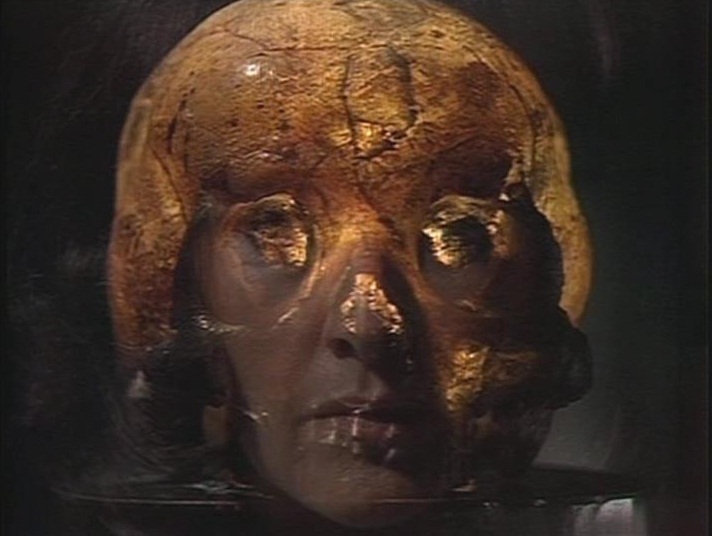
     The episode's plot is all over the place, never knowing what it's trying to do. At the beginning there's some almost sitcom-esque dialogue which actually quite enjoyable, but the mysteries that the serial slowly builds up one by one never really mesh together in a satisfying way even at the end. There's a glowy skull and a guy who's secretly speaking for the Fendahl and then there are spirit Fendahleen which are eating people alive and there's very little to say how they're related or whether we should really care. It's an apathy that comes from what I find to be a fundamentally uninspired villain. Big overarching evils are ten a penny, and while that doesn't exactly make them difficult to execute well it does mean that this story, which fails to characterise them in any meaningful way, doesn't get any points from their execution. The episode evokes pagan rituals and sacrifice with pentagrams and stuff but it doesn't feel like it's a grand overarching plan and is more indicative in my eyes of a failed attempt to grab imagery from somewhere that at the time would have been considered scary and cool. If you're going to go to full ritual sacrifice and pentagrams, why not make a Devil allegory or something like that? I'm not going to be scared of the big invisible thing just because The Doctor assures me that it's very bad indeed.
http://images3.wikia.nocookie.net/__cb20120518011030/tardis/images/f/fb/Image_of_the_Fendahl.jpg
Benedict Cumberbatch's mum... From Wikia.
     However, the story does have a number of good points. As well as the use of the symbolism of the Old Religion and all the jazz that goes along with it, the use of its characters is outstanding. The villain Maximillian Stael, determined in a sorta Cyberman-collaborator way to harness the almighty power of the Fendahl, gets quite a dark ending when, bewitched by its charms, he has the Doctor pass him a gun so that he may commit suicide rather than become a Fendahleen. Doctor Fendelman, the mad scientist throughout, turns out to be talking 100% of sense. All this comes in the fourth episode, which manages to tie things together enough for me to even make that synopsis up there, and by itself it's a decent piece of science fiction. It's a shame that the serial is so bottom-heavy in that regard.
     Before the final episode, Image of the Fendahl is a slow and sluggish whose ideas and themes threaten to collapse the thin plot holding them up. The fourth episode makes some small concessions, and overall I did enjoy the serial, but as a whole the story jumps here, there and everywhere and isn't very easy to follow. Chris Boucher's final story for the program is messy and doesn't really reflect the same level of quality as his previous two, but regardless of my disdain for the vast majority of Image of the Fendahl, it is a story that most of the fandom loves regardless.

Thanks.

NEXT WEEK: If you get too cold I'll tax the heat, If you take a walk, I'll tax your feet. It's the story of the Taxmen in The Sun Makers.

Monday, 30 December 2013

Review: Doctor Who Classic: The Invisible Enemy

Welcome, reader to the last review of 2013. Which I'm writing in June. S'all a bit topsy turvey really.

http://www.doctorwhoreviews.co.uk/4T_files/The%20Invisible%20Enemy%206.jpg
Hardcore Prawn, as Neil Perryman puts it.
Doctor Who - Season 15, Story Two - The Invisible Enemy
Written 30/6/13

Doctor Who is a very varied show. Some stories are overwhelming serious. Some stories aim for a political message amongst piles of cheese. Some stories are so rattled by their production problems that they fail to do anything at all. The Invisible Enemy is a mix of the first and third, a story whose special effects get weirder and weirder as one goes along but whose incredible charm, especially in its centre two epiodes, lead me to rather love it in the way that one loves the offensive stereotypes of mentally ill protagonists in Oscar bait films. With similar amounts of inner personal outrage.
     A base on the moon Titan is afflicted by a web in space which infects the minds of the crew via mental attacks. The TARDIS materialises in the vicinity and is caught in the same beam, sparing Leela but infecting The Doctor with the Nucleus, the prawn-like life-form that the other infectees want to protect and use to procreate an alien species. The Doctor and Leela go to a space-hospital to look at the disease, where they meet Professor Marius and his robot dog, K9 (!). Using a part of the TARDIS, Marius follows the Doctor's instructions and creates clones of he and Leela to climb into The Doctor's body and find the Nucleus. The clones confront it, but disintegrate before they can do anything. Leela's clone contained her immunity, helping The Doctor to synthesise a cure, but the machine works in reverse and the Nucleus is magnified to man-size. The Doctor and Leela, along with K9 in tow, blow up Titan and save the Universe. Sorry, Solar System.
     After a season or two of stories taking themselves far too seriously with old Victorian Mansions and ancient gods about the place, the appearance of Marius and his (for now) charming robot servant breathes a fresh air into the series. The serial feels very much like it's aimed towards children after the systematic violence and adult allusions that defined the previous series Marius himself (Frederick Jaeger) is a fun screen presence and the first few appearances for long-term companion K9 are quite frankly wonderful. Episode Three's homage to the common-used plot of The Fantastic Voyage fitted right in, even with the cheesy special effects that did make me laugh, especially when The Doctor's white blood cells are big white Styrofoam balls hanging from the ceiling and bouncing into things. Most impressively, The Doctor's inner fight with the Nucleus is acted rather well. At least until we see it.
http://2.bp.blogspot.com/-fYUxKWZGkKs/UXBAcrcMOjI/AAAAAAAAK5U/d33LeWaEEG8/s1600/k9-the-invisible-enemy-5.jpg
An icon is born.
     And that is where the story gets awful weird. Besides the other numerous special effects failures (and the fact that they blew up Titan, which is a pretty cool moon), the story's main downfall comes with the appearance of the Nucleus. In concept, the story is fine, if cheesy, and the execution is mostly okay. But the simple fact is, the design of that monster is fecking hilarious. Inside the body it's a binbag with a crabclaw, and outside the body it's a massive great shrimp that can't even walk around by itself. The camera angles shoot it like it's a school production and the previously tolerable standard ranting becomes just silly when we're supposed to believe that Zoidberg's less intimidating brother is going to rule the Universe.
      I enjoyed the Invisible Enemy, in a period where I was beginning to wonder if I'd make it through Season 15 into what I hope is going to be an awesome Key To Time arc. Because I like it, it obviously gets hated on a lot by fandom by what I see as incredibly trivial reasons, although the simple what-the-fuckery of the Nucleus in its larger form does turn a fairly decent story into a So-Bad-It's-Good laughfest by the end. I'm just so grateful that after two stories which bored me with their overbearing darkness and foreboding, I'm allowed to laugh at cheesy sci-fi goodness that appeals to everything I like about the show.

Thanks.

NEXT WEEK: Yet another alien figure has been manipulating Humanity for centuries... all in The Image of the Fendahl.

Monday, 23 December 2013

Review: Doctor Who Classic: The Horror of Fang Rock

http://farm2.static.flickr.com/1173/1314340069_da86e11e8a_o.jpg
The Doctor talks to the Rutan.
Doctor Who - Season 15, Story One - The Horror of Fang Rock
Written between 23rd and 30th June 2013

The new producer's first story, a rushed replacement for the original draft of Terrence Dicks' State of Decay (which would later be used in Season 18), does very little to differentiate itself from the old regime in terms of tone, gore or intent. This is not a bad thing, however, as it's a good-old Terrance Dicks script that knows what it's doing and, along with managing to be one of the first "kill 'em all" stories, is one of the most tense and atmospheric that I've seen in this run so far.
     The Doctor and Leela happen upon a foggy lighthouse on their way to Brighton, and as they arrive one of the three lighthouse keepers is killed by a mysterious monster. As a yacht runs aground and the small crew come inside, the monster begins picking people off faster than The Doctor can work out what it is. It takes the form of Luddite keeper Reuben, and after that The Doctor discovers it to be a Rutan, one of the enemies of the Sontarans who are losing their war and who plan to conquer Earth. The Doctor blows up the lighthouse with the Rutan inside and he and Leela go off on their merry destructive way.
     The atmosphere that Dicks creates using the foggy shores of the lighthouse's stretch of rock encouraches upon the story, making the situation of those trapped there ever the more dangerous. Rather wisely, we don't see the Rutan until the third episode, where its appearance as a wobbly green blob does the story absolutely no favours. The aim was to create a fearsome and strange alien race that the Sontarans themselves would have feared in battle, and the result is an alien whose various machinations leave its true nature confused. An alien killing a man offscreen is no more scary than jumping out on someone and realising they're in a different room.
https://blogger.googleusercontent.com/img/b/R29vZ2xl/AVvXsEj_HxPgj163Lnu4jApwUpro1hsJbfKwjpYDDhD0f6EJTI4mb-oLFdT2yWGuKPvEZW4HKjQqtQAa23V08wNEfOPWInZBOHOp_UUpb7vTFYhf2jhDs4CzuupitefxKsGTHRFvGReu-boJWok/s320/vlcsnap-2009-11-16-18h16m15s70.png
Leela's still badass, however. At least some things don't change.
     The story's guest cast throw in an extra subplot about something or other that I didn't really follow, and which had very little do with the rest of the story. It felt injected into the story to give it something to do toher than to just have an alien killing people in a lighthouse, which as the basis for a hammer horror story is great, but otherwise it's pretty shit. While the performances of the initial three guest characters were enough to make me feel a little sad when they were inevitably offed, I got a bit of a tired Big Brother feeling when they had throw some more in just to keep things happening.
     I know I shouldn't keep shitting on people's beloved Classic episodes like this. There are those who herald this particular story as incredibly tense and powerful and a really great start to the era. But it didn't say anything to me, it just felt like the same thing we'd been getting for the previous three years where classical allusions were used to pad out an underdeveloped original idea. The Horror of Fang Rock is okay, and I enjoyed its first two episodes, but after a while it just really began to bore me in a way that Doctor Who never should.

Thanks.

NEXT WEEK: Doctor Who predicts that weird episode of The Magic School Bus in The Invisible Enemy.