Showing posts with label Films I Saw Recently. Show all posts

Monday, 12 May 2014

Review: Ghost World

http://upload.wikimedia.org/wikipedia/en/c/c3/Ghostworldposter.jpg
From Wikimedia
Ghost World
2001, Dir. Terry Zwigoff, Written by Daniel Clowes. Written 25/4/14.

Teenage cynicism. It's not surprising that we all face a part of our lives in which we question the world around us to the extent that we doubt that anything good will come of our endeavours. Much like it's 90's colleague Daria over on MTV, Ghost World, adapted from the graphic novel of the same name by Daniel Clowes, follows two teenage girl who embody the deadpan cynicism often associated with the teen demographic - taking the time to, of course, deconstruct those associations and examine them for all of theirt worth. At it's heart it's a film about loneliness and disconnect from society, but it's also a fantastic look at all sides of teenage mindsets without doing much stereotyping.
     Having just graduated from high-school, eternally-deadpan friends Enid (Thora Birch) and Rebecca (Scarlett Johansson) are planning to get a house together, having chosen not to go to college. While Rebecca is work conscious and has a workable if not that promising idea of her future, Enid is a dreamer whose abrasive personality disconnects her from almost everyone around her - everyone, that is, except Rebecca and Seymour (Steve Buschemi), a lonely jazz-fan who the two meet when Enid decides to prank him by answering his desperate lonely hearts ad and then standing him up. Enid begins to obsess over Seymour, to the point that she and Rebecca's friendship slowly disintegrates - meanwhile, Seymour gets into a relationship and she can't seem to cope. After a misguided one-night-stand with Seymour, Enid makes the choice to run away for good, with her fate left up to the viewer.
     The film uses Enid and Rebecca to contrast stages of maturity and development. The start of the film sees Rebecca as more dismissive and irreverant than Enid, but as the film develops she is the one who develops. Enid stagnates; she never tries to connect with the people around her, instead dismissing the entire human race as beyond her ken and blaming them for her isolation. This is also seen in her remedial art class, where the teacher is a comical figure who is more obsessed with deep, abstract art rather than other, less pretentious forms of expression, culminating in her borrowing a racist caricature as a "statement" on racism which leads to any small hope of a career being removed along with it. It's quite interesting to look at the reactions to this film; a lot of the audience left the film not just invested in Enid's story, but deeply in tune with her views of the world. (Hint: you're not supposed to share Enid's views about the human race.)
http://videovortex.files.wordpress.com/2014/02/enid-ghost-world-2813176-900-599.jpg
Enid and Seymour are bonded by obsession.
From videovortex
     Part of the film's key statement is to take this deadpan attitude and show how it is fundamentally a great exaggeration, to the extent that Enid cannot really operate. She believes that the adults around her are useless, that society can only bring her sadness; yet society keeps trying to help her. She's on the scholarship but she fucks it up by being ridiculously insensitive, she rejects a pretty decent job offer from her step mother, and she completely fucks up her friendship with Rebecca due to her obsession with Seymour. (There are also some minor characters that steal the show a scene at a time, but they're more for window-dressing.)
     Ghost World is an assault on its premise - and one that's done in a thoroughly world-shattering way. Enid and Rebecca are both parodies and accurate representations of the attitudes they embody - such paradox is usual when it comes to matter of the teenage persona. At the same time, we're forced to examine what society does to people - both in the expectations that are put on Enid and Rebecca in their slow road to adulthood, and in the loneliness which Seymour feels due to his obsession and anger. It's quite telling that just as Seymour explains this to Enid, she can't see those same properties in herself and her obsession with him. The fact that we can is the reason for this film's tremendous success, even if it makes you examine a few uncomfortable home truths.

Thanks.

NEXT WEEK:We learn about the fabled Leopard Shark in The Life Aquatic with Steve Zizzou.

Monday, 28 April 2014

Review: The Eternal Sunshine of the Spotless Mind

As in its beginning, work on the blog has basically come to a complete standstill. I've finished the Lost reviews, but if I do finish Voyager Season 3 then it will be far after it's due, probably in the Summer. As for now, I've got a few films to talk about, so without much ado...

eternal-sunshine-of-the-spotless-mind-1
POSTER SHOT!!! From thefilmchair
The Eternal Sunshine of the Spotless Mind
2004, Written by Charlie Kaufman, Dir. by Michel Gondry. Written 24/4/14.

There's a certain set of a assumptions that come with cult films - a very specific number of tropes that tend to get played out over and over again. This is especially true in romance - there is, after all, only a certain number of ways that two hetereosexual cisgender white people can interact with each other romantically. It's a genre which has very much been done to death - but then again, that's something that doesn't seem to really bother Charlie Kaufman (Being John Malkovich, Adaptation), who excels and taking genres and tearing them apart at the seams. While the film starts out as a conventional if odd romance, it soon develops deeper science-fiction roots which serve not only to offer some questions about human nature, but to bring the entire romance genre crashing into the real world.
     The film follows the quiet, unassuming Joel Barish (a straight-faced Jim Carrey) as he bunks off work and ends up meeting the excitable Clementine Kruczynski (Kate Winslet), with whom he finds an immediate connection. Flashback to a day prior, and we learn that both Joel and Clementine have chosen to erase their memories of a prior relationship which went sour due to their innate incompatibility. The film then follows Joel inside his mind, reliving the memories of his relationship with Clementine while a host of minor characters (doing the erasing) undergo their own, distracting plotlines. The film's structure works to force the secondary characters into as much dramatic limelight as the two leads, and as a result it's that much richer.
     By going backwards through Joel's memories of his relationship with Clementine, the film both mirrors and parodies the conventional US rom-com format - the cute meeting, the argumentative stages, and then slowly growing closer to the point of intimacy. Except that it points out at every step of the way the problems which come with their relationship, from their personality clashes to their irrational complaints about one another - culminating in the ending of the film (spoilers hur hur) in which both Joel and Clementine in the present receive the tapes they made before their memory wipe, and decide to proceed with their relationship even knowing that they may end up explosively breaking up. And then there was some weird recursion thing, but I ignored that.
eternal-sunshine-of-the-spotless-mind-3
Clementine and Joel. That mug looks painful.
From thefilmchair
     The film's secondary character sinclude a host of faces which for 2004 is quite impressive - faces like Kirsten Dunst, Elijah Wood, Mark Ruffalo and Tom Wilkinson. They engage in a storyline running through the other one, in which they are all involved in erasing Joel and Clementine's memories of each other. (By choice.) Each of them is equally fucked up: Wood's character uses Joel's memories of Clementine to attempt to seduce Clementine and steal her underwear; Dunst is pursuing a relationship with Ruffalo's character in order to get in with her boss Wilkinson; Wilkinson has already had an affair with Dunst but keeps wiping her memory of it; and Ruffalo knows about Wilkinson's plot but bangs Dunst anyway. It's the potatoes to Carrey and Winslet's meat, and manages to probe all of the unhealthy relationship archetypes which romance films tend to gloss over as good.
     The film's writing is what makes it a good film, and Kaufman is three for three, but the film's acting is what takes it to the next level, especially between Carrey and Winslet. This was in the short string of movies where Carrey was attempting to be serious, and unlike the similarly brilliant The Truman Show, Carrey's characterisation is about as far from the norm that he can get. There's no gurning, no catchphrases - the film hangs on the fact that this is a shy guy with deeply fucked up internal problems. The same for Winslet, even if quality for her is a little more expected. Those two make a surprisingly fun double-act, even when they're screaming random shit at each other. ("You're trying to figure out, did she fuck someone tonight?" "Clementine, I assume you fucked someone tonight. Isn't that how you get people to like you?") And it's that, as much as this film's novel approach to storytelling, that makes The Eternal Sunshine of the Spotless Mind so fantastic.

Thanks.

NEXT WEEK: Charlie Kaufman write about Charlie Kaufman writing Adaptation in Adaptation.

Tuesday, 22 October 2013

Review: The Royal Tenenbaums

The Royal Tenenbaums (2001) - Directed By Wes Anderson
Written 19/10/13.

I tried to review this the day I first saw it, a few months ago. I gave up. I had to stand down and admit to myself that I am not in any way a serious studier of film - I'm just a guy who writes about it now and then on his own website. I do not have the tools in my arsenal to accurately describe all of the minutiae of Wes Anderson's films. Well, I just got the DVD in the mail and I needed something to occupy my time with, so this is my simple and honest attempt to discuss with you a film for which I have incredibly confused feelings.
     As I mentioned in my review of Moonrise Kingdom, the most recent Wes Anderson film, his directorial style mainly employs the use of plinky plonky, whimsical music over well-crafted shots, with a few trademarks being symmetrical scene set-ups, whole-screen face close-ups and cut-aways to books or records within the universe of the film. The performances occupy a form of melodrama which converts everything into a dry, laconic style in which emotion and meaning is conveyed by small physical actions rather than facial expressions and/or vocal intonation. This is used to craft a story with a large number of call-backs, recurring elements and themes, as well as a bittersweet view of the world which doesn't quite fall into realism or cynicism but alternates between the two for the purposes of the plot.
     The film's characters are the Tenenbaums and their associates, a family of geniuses whose neglectful father figure Royal (Gene Hackman) leads into a lifestyle which will inevitably cause them to all break down after a 22 year plot jump to the beginning of the film. His children are financially-gifted Chas (an understated Ben Stiller) who is overprotective of his kids after the death of his wife the year before, former Tennis pro Richie (Luke Wilson) who garnered his father's attentions but has become a recluse since a public breakdown, and their adopted sister Margot (Gwenyth Paltrow) who lives a depressed, promiscuous existence and with whom Richie is madly in love with. There's also Eli Cash (Tom Wilson), Richie's childhood friend with whom Margot is having an affair. Royal, seeing his wife Etheline (Angelica Houston) is moving on with her life, attempts to bring his family back together by pretending to have stomach cancer and eventually is forced to move beyond his deceit and actually become a better person.
      Individual character development amongst the epic cast of characters is minimal on an individual basis, with each being forced to overcome their major neurosis by the film's end - the focus being on the family's collective improvement thanks to Royal's reckless actions. There are a few very strong scenes that stand out in people's memories of the film which I do have to cover, but they're pretty spoilery so if you've been reading up till now, go on and see the film. "waits." Okay, so one of the film's most famous scenes is one in which Richie, whose image in the film encompasses long hair and a large beard, responds to finding out about Margot's promiscuity by shaving all of his hair off and then cutting his arms open using his razor. The way this scene is shot, with Luke Wilson staring the viewer down as his image literally falls from his character and then professing his wish to die, is incredibly powerful.
Richie, Margot, Royal, Chas, Ethel, Henry and Pagoda.
       The problem being that it comes as a moment of melodrama in a pretty none melodramatic film. Margot as a character occupies a permanent malaise which has a variety of causes - her adoptive father's prejudice against her, her real father chopping her finger off by accident, being led into a marriage to an older man after finding no satisfaction in her youth. The film presents her promiscuity after her parents' breakup as an outlet for this malaise, an attempt to engage with the world. Richie's suicide attempt in response to learning about this past is displayed afterwards as a tragic thing which one or more other characters somehow blame on her. She then reveals her mutual love for him, and despite their icky issues they're implied to be closer and happier together afterwards. In a way, you could say that Richie is rewarded for showing the behaviours he shows in the film - behaviours which are obsessive, and creepy. He falls in love with his sister, spends his childhood painting portraits of her, fails in his chosen profession because she got married and has to go on a round-the-world voyage 10 years later because he's still obsessed with her.
      I think there's a very blurred line between dark humour and serious drama, and it's one that The Royal Tenenbaums tries to sit on for as long as possible. The suicide scene is a perfect example of how this both jarrs and sets the tone - the horror of seeing the blood roll down his arms then set against seeing him rushed through a hospital ward, face still covered in a thick layer of shaving cream. An earlier scene in which Royal's best friend stabs him and then helps him hobble over to a cab like an old buddy. And then the final scene, in which a funeral headstone makes up a funny lie about the cause of death. Direction technicalities aside, these little things that run throughout are what define The Royal Tenenbaums - they are what make it memorable, what make it lovable, and what set up this film as a classic piece of early Noughties cinema.

Thanks.

Wednesday, 21 August 2013

Review: Kick-Ass 2

http://cdn.bloody-disgusting.com/wp-content/uploads/2013/07/Kick_Ass_2_Poster_7_12_13.jpg
From bloody-disgusting
Note: this review contains swearing and other terms that some people may find vulgar or offensive. Just warnin' ya.

There's something rather beautiful about a piece of visual art that can so effortlessly and invisibly walk the line between being a thorough parody of a genre and taking it far too seriously for it's own good. It's often done through deconstruction of an idea, which basically places that common factor into a realistic scenario and demonstrates (sometimes with annotations) why that idea ceases to work. The Kick-Ass franchise, both in the Graphic Novels by Mark Millar and in the the two cinematic films, the latter of which has only recently been released in the UK, are devoted to taking the Superhero Genre that has been flooding our popular culture for the past several decades and not just deconstructing it, not just parodying it, but coming out the other side as a justifiable piece of work in its own right.
      Kick-Ass 2 manages to be a more straight-up Superhero film than its predecessor, adapting the second volume of the Graphic Novel which features comic-book geek Dave (Aaron Johnson), who decides to emulate Batman and become a vigilante, with the help of trained-since-childhood-uberwarrior Mindy (Chloe Grace Moretz) - codenamed Hit Girl - whom he teamed up with in the first film after his low-level meddling accidentally led to the death of his father. The popularity of Dave's persona, Kick-Ass, leads to a city-wide phenomenon of inexperienced vigilantes, opposed by Chris D'Amico (Christopher Mintz-Plasse) who is driven by pettiness and bitterness at the events of the previous film to become an outrageous supervillain by the name of The Motherfucker. The film follows the clashes between the rising Superhero movement, the Supervillain army and the authorities, as well as both Dave and Mindy's attempts to concile their vigilante urges with the suburban life expected of them.
      The franchise as a whole has been lambasted by the popular media for its heavy use of violence, inappopriate language and lewd sexual humour, but unlike less tasteful flicks such as anything that falls off of the desk of Seltzer and Friedberg, this is done sparingly and with enough caution as to make it count when it does happen. I personally see nothing wrong with swearing, sex and violence, although excessive toilet humour can be somewhat lazy. This film is more intelligent than that. Unlike its predecessor, which was transliterated straight from the Graphic Novel's view, there is a sense that Kick-Ass 2 has been sufficiently toned down. Hit-Girl is now 15 years old as opposed to 12, there are certain absurdly violent acts cut out. One of those adjusted scenes is still causing controversy - a rape scene in the graphic novel was transfered onto another character in the film and is played for a joke at the expense of the rapist. While I'd rather have just taken that scene out entirely, because it raises all sorts of dark and really out-of-tone issues, I'm glad that it was sufficiently pushed back in the direction of the perpetrator.
http://throwingdigitalsheep.com/wp-content/uploads/2013/08/Taking-aim-Jim-Carrey-a-010.jpg
Jim Carrey is actually pretty awesome in this film.
From throwingdigitalsheep
     And it's little push-backs that make the film stand out from just being a parody, as much as those stand-out elements stop this film's heavy doses of character development and plot movements from sending it into a lazy Superhero flick the likes of Green Lantern. It manages to both portray characters that I identify and sympathise with and also make them ridiculous and hilarious. They are simultaneously larger than life and perfect to fit within it. The film's mix of parody of superhero tropes and genuinely strong characters in both a comedic and a dramatic sense more than makes up for any mistakes it happens to make when judging how far it's willing to cross the line into territory that other franchises might consider to be dark. And that's why, really, I found it so simply fun. I don't know if this is a signal that we're heading for a Kick-Ass trilogy, but I certainly liked what I saw in the first two movies, and if they're as consistent as those then I think we'll be fine.

Thanks.

Tuesday, 30 April 2013

Review: Chronicle

http://upload.wikimedia.org/wikipedia/en/thumb/f/f9/Chronicle_Film_Poster.jpg/220px-Chronicle_Film_Poster.jpgChronicle
2012, Directed by Josh Trank
Written between 13th and 14th April 2013

On the surface, Chronicle is filled with enough tropes to make it seem very tired and perhaps just a little uninspired. It's a found-footage movie, there are teenagers with superpowers whose abilities force them to undergo a coming-of-age story. Luckily, there are other things at work in Chronicle that save it from the scrap-heap and ensure its place as one of 2012's more interesting low-budget flicks - a strong cast of young actors, a hyper-realistic take on the genre and a dark twist that was executed with a fine finesse.
     Three teenagers discover an object in the woods that grants them superpowers. They are the neurotic and unpopular Andrew, who lives with his dying mother and ridiculously abusive father, his cousin Matt, who is constantly trying to impress former girlfriend Casey, and the everyman popular guy Steve. The three find an artefact in a hole in the woods, and the next day they've been granted powers - telekenesis, flight and the ability to form shields around themselves. At first they use their powers to mess around, but after Andrew puts someone in hospital, they decide to regulate themselves. Steve drives Andrew to use his powers in a talent show, improving his popularity, until an incident leads to further humiliation. Steve is killed, and Matt ends up having to face Andrew, who wreaks havoc upon the city.
     Contrary to expectation, the tale is told from Andrew's point of view - on its own, it stands as a half-decent story of an abused, isolated teenager who takes out his pent-up wrath and indignation upon the world. The show deliberately avoids making comic-book comparisons (almost strangely at times), but I don't really mind that, so I'd call Andrew's story the archetypical super-villain origin story. Except, you know, transplanted into reality, where the morality plays involved are a hell of a lot more complex. You don't really feel sorry for the assholes that Andrew ends up torturing, and you sorta wish that he could have gotten to kill his dad, and yet at the same time you can see that he's morphed into someone with very little self-control.
http://www.scifinow.co.uk/wp-content/uploads/2012/10/Chronicle-2-sequel-Max-Landis.jpg     And thus comes the film's key gimmick. The found-footage aspect of the movie is always done flawlessly, and Trank's direction in this regard is quite brilliant considering that while the genre is known for stretching reality in order to get everything filmed, this story actually hinges the fact that Andrew (and later others) are filming everything as an insight into his personality. It's an early indication that Andrew isn't quite right in the head, and is complimented wonderfully as he uses his speciality power, telekenesis, to switch-up the camera angles.
     Chronicle's virtues are in the subtlety and finesse that comes with the execution of the premise - the way the characterisations flow throughout the story, and the way that real issues of gray morality are applied to standard superhero cliches in a way that doesn't feel like it's trying to make a point. The nature of its premise means that a lot of the time a few of the other characters felt left out, but that didn't matter because it did enough with the rest of them to feel worthwhile. It may not be perfect, but it's fun, refreshing and at times quite wonderfully deranged.


Thanks.
    

Tuesday, 23 April 2013

Review: Hanna

I've spoken about Hanna before, in one of my Films I Saw Recently segments. But here it is again, now that I've become thoroughly obsessed by it.

https://blogger.googleusercontent.com/img/b/R29vZ2xl/AVvXsEh62Y1fH5a4RohArSfJCgTx7EWvAylJUFfhmEyVT9hMsQEOkHTi55yxRKfGOleDHsd6QJJOQ-gEb_OK4_imkoIdqr8VP2oohSmfQ3iwdBA9QAWaVlJb3pbFE4EmYy7F5Linf9IYZy-W9iQ/s1600/hanna-poster-22.jpgHanna
2011, Directed by Joe Wright.
Written 17/4/13

Hanna is a film that combines several different genres and only just manages to get away with it, doing so in an unenviably slick style that aims to satisfy everybody. Initially presented as a sci-fi influenced action movie, the story opens out onto a cornucopia of fnatasy imagery and strong characterisations that are not only marvellously progressive (most of the time) but which create long-lasting and timeless figures.
     Hanna (Saoirise Ronan) is a young girl raised by former US spy Erik Heller (Eric Bana), hidden away in the Siberian woods and taught only the encyclopedia, several languages and how to survive and fight. The pair are being hunted by tough CIA agent Marissa Wiegler (Cate Blanchett) who has old business with Heller and is responsible for the death of Hanna's mother. Upon their agreement, Hanna is released into the world, and upon escaping the CIA's capture, she makes her way across Europe to meet up with her father again and discover not only the truth behind her conception, but also the joys of the human experience.
     To start off with, many kudos to The Chemical Brothers, the Mancunian (yay) electro group who created the film's incredibly detailed and action-packed score. When I bought this film online I had to buy the soundtrack as well - from the graceful African-influenced tones of Hanna's Theme to the creepy nursery rhyme feel of The Devil in the Details. The music ties the film together exceptionally well, and the way that it matches with the visual direction is often absurdly good - there's a chase scene where the pace of the actors' footprints matches that of the beat exactly.
     Both Hanna and Wiegler are strong characters, and are some of the strongest female characters I've seen in cinema. They both harbour many layers of compexity, and their roles as dramatic foils are exceedingly well-written. Hanna, despite her isolation from the modern world and her disorientation when faced with modern amenities, is immediately empathisable through her pragmatic attitude and her burning curiosity for something more to the human experience. Blanchett's Wiegler, despite a slightly out-of-place Southern accent, is captivating as the ruthless villain whose admiration and perhaps parental attitude towards Hanna is countered by her underhanded determination to pacify her and/or use her as a weapon.
http://www.expatica.com/upload/HANNA05.jpg
Saorise Ronan pitches the character perfectly - her every
action tells us a little something more about who Hanna is.
     One of the aspects of the film that makes it so memorable is the direction by Joe Wright, which is completely different to that of his previous films (Pride of Prejudice and Atonement) and is a great deal more ambitious, too. Disorientating chase scenes, epic fight sequences, a one-shot through the streets of Berlin down into the Bahnhof. I also love the way in which he incorporates some of the film's strong fairy-tale thematic imagery too, especially in the House of Wilhelm Grimm, which is a vivid recreation of Hanna's childhood dream worlds.
     Hanna's main criticism could be that the sci-fi idea running up its jacksy was executed in a lacklustre fashion. And while that could be said to be true, that concept is only a device, and is by no means the film's focus, which is on the struggle for freedom from the past's mistakes and on attempting to discover what it means to feel human. And in that regard, Hanna succeeds tremendously. It may have all the credentials of a forgettable thriller, but Hanna's subtle underlayers shine through to such an extent that it has quickly become one of my favourite films.

Thanks.

Tuesday, 16 April 2013

Review: Moonrise Kingdom

http://24.media.tumblr.com/b4314b9a5cd8dd7cb6ba90ac074c39be/tumblr_mq2oal8zPZ1qbxuwto1_500.gif
3.25 Mile Outlet.
Moonrise Kingdom
2012, Directed by Wes Anderson.
Written 13/4/13

Wes Anderson is a director that I've not really experienced before, but his 2012 piece Moonrise Kingdom was an experience that I just had to tell you about. The film is one with a highly charged aesthetic, full of jump-cuts and shots meant to portray a sense of the make-believe, or the whimsical. Through this aesthetic, draped further with a soundtrack stuffed with French New-wave and light opera, Anderson delivers a script that examines all manners of human existence, from the innocence of young love to the cynicism of middle-age. It throws out a number of standard children's comedy tropes and then casts them in a delightfully darker light. Don't be fooled by Moonrise Kingdom's whimsey - there is something dark and deranged hiding behind it all, and that's what makes it all worthwhile.
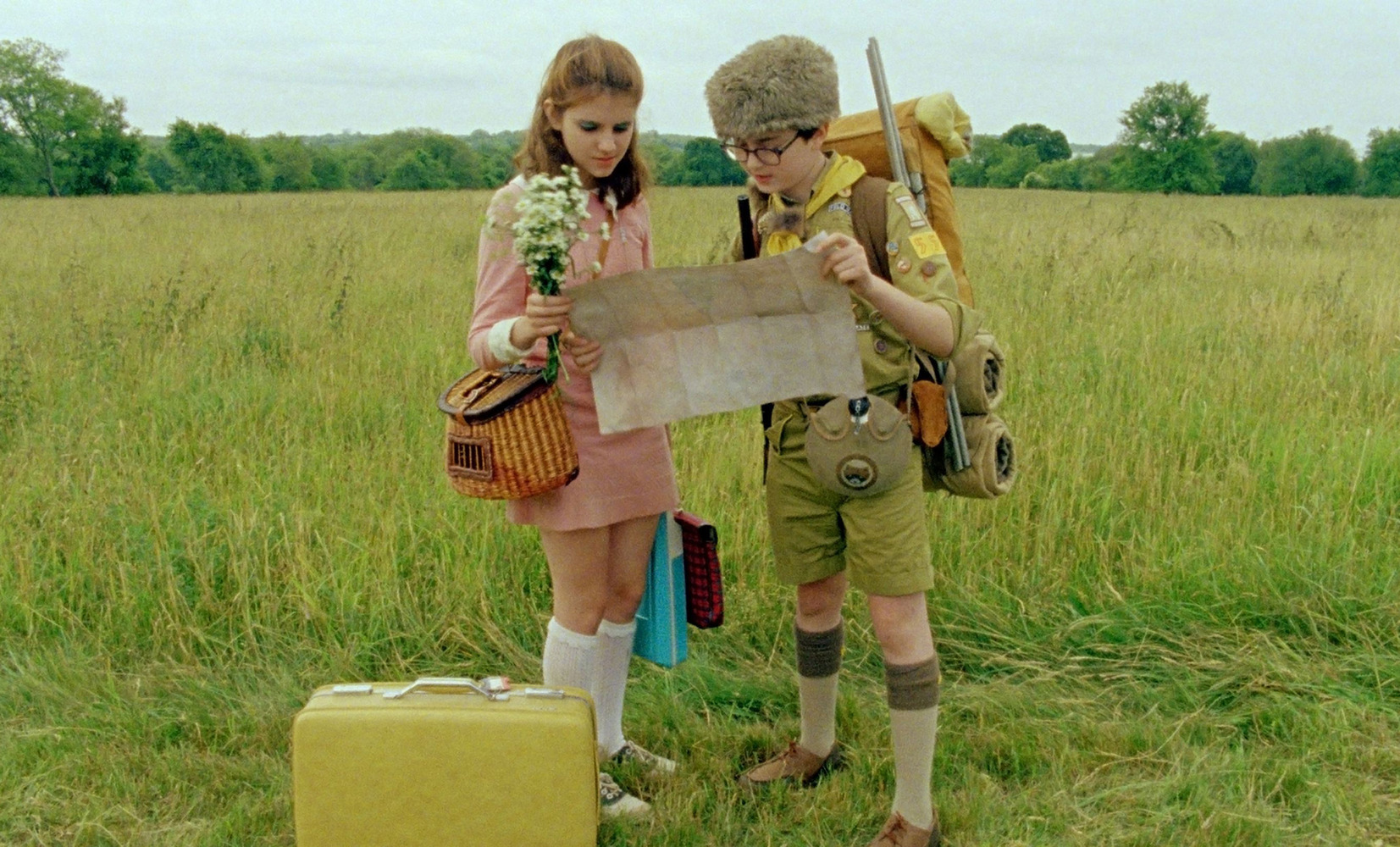
      It's 1965. Sam Shakusky (Jared Gilman) and Suzy Bishop (Kara Heyward) are both maladjusted children living in uncomfortable circumstances on the fictional New England island of New Penzanzce; Sam as an orphan permenantly drafted into the Scouts (led by Ed Norton's Randy Ward) and Suzy as a stressed-out teen living with highly dysfunctional parents Walt (Bill Murray) and Laura (Frances McDormand). The search for the two children is led by Island Police chief Captain Sharp (Bruce Willis), who soon grows to realise that his own life has been robbed of the innocence and drive that the two children, despite their personal problems, do possess. As the two children attempt to escape both their carers and the authorities, everyone involved is forced to re-evaluate their life-choices and question whether they did the right thing.
     The film's New England aesthetic, filled with forests, lakes and coves, contributes towards a thematic turn towards the fairy-tale. The film's quiet genius is that it manages to mingle the simplistic morality of the two children ("We're in love; we just want to be together") with the more muddy waters of Laura's infidelity and abusive nature towards her husband (who has two black eyes by the end of the film - ironic, considering some of the claims made against Bill Murray in real life.) There's a deliberate ambiguity as to which is to be prefered - the children's relationship almost mocks the later, with easily-resolved petty arguments and a faux marriage ceremony, while on the other side Bill Murray and Bruce Willis' characters both express regret at their current circumstances and have been driven to their pessimism by years of bad decisions.
http://sojo.net/sites/default/files/mainimages/blog/movie_-_Moonrise-Kingdom.jpg
Suzy and Sam run away from their troubles, and fall in love.
     Quite interesting, I find, is the film's pacing. One of the reasons that I think the characterisations work so well is due to the relaxed introduction into the story in the first half, where we explore the relationships between our characters to the full extent that we can. As an ensemble it's very well developped, with a lot of attention going into subconscious actions as well as just the dialogue, which is often used to derive most of the film's quirky humour. I definitely prefer that first part to the eventual climax and the blissfully happy ending, but that second half does clarifiy a lot of the first half's ideas and ultimately gives us some of the film's most memorable moments.
     Moonrise Kingdom was adored by critics but mostly ignored by the General Public, which is a damn shame. It's a film that mixes cerebrality and a thorough examination of human happiness with quirky direction and diagogue that is on its own heartwarmingly written. If Wes Anderson's technique and his tacit acknoweldgement of the medium gets on your goat, then I suppose you might have some problem here, but otherwise this is a hidden gem amongst 2012's film arsenal.

Thanks.

Sunday, 23 December 2012

Review: The Hobbit: An Unexpected Journey

Martin Freeman's Bilbo is too often left to
the sidelines, but captivates when he is
the focus.
The Hobbit: An Unexpected Journey - 2012, Directed by Peter Jackson
Written between 22nd and 23rd December

Of all of cinema's themes, the most abstract yet ubiquitous is that of adventure. As children we are told that our lives are driven by the quest to leave the familiar and go off on daring deeds in places far and wide. In adulthood, the spirit of adventure is somewhat lost to us, and becomes an ironic statement on the mundane - adventurous spirit drives us to pick the slightly more expensive, sun-flower seeded bagel over the standard plain, drives us to take a turn onto the A-Road through the hills rather than sit in traffic on the M6. Still, it lies at the heart of many a tale, especially the prelude to Tolkein's Lord of the Rings trilogy, The Hobbit.
     In its most recent publication, The Hobbit is not a long book; it is a breezy 80 pages long and contains a fair story that explores the early adventures of Bilbo Baggins and explains how the One Ring came to be in his possession. Peter Jackson, the director of the Lord of the Rings Trilogy from the early Noughties, is not a man satisfied with brevity. Through some divine intervention, this 80-page story is extended into a very, very long three hours of some astounding special effects, sorta ok acting and writing that seems to make the actors do all of the work when it comes to characterisation.
     The Hobbit is a strange film in that while much can be said to happen, very little feels as if it is happening. Usually is film is broken up into large action setpieces and quieter moments of acting and exposition, and while it was true here neither really lived up to their purpose, with the quiet scenes hardly used for anything other than grand prophesising and telling ancient tales, and action scenes often being unnecessarily long. The nadir is probably a scene around the two-hour mark where a walk through the mountains is interrupted by the mountains coming alive and beginning to fight one another.
     Effectively, the film manages to expand its source material pretty much to breaking point, leaving out very little of the book and yet leaving the viewer with a strange sense that very little has actually been accomplished. The Lonely Mountain is still so far away at the end of the three hours, and yet most of the plot from the book is done with. Frankly, I fail to see exactly what they have left that they can fill six entire hours with, when even this was padded to the gills with what felt irrelevant flashbacks and random songs cramping up the place.
     Notable beyond the main performances were those of a few minor characters. Richard Armitage's Thorin was a bit one-note here or there, but he did give off a commanding presence as the Dwarven leader. Sylvester McCoy, who we know as the Seventh Doctor, gave a rather wonderful turn as Radagast the Brown, a delightfully mad wizard harnessing the powers of nature. And, of course, Martin Freeman continues his long string of successes after Sherlock with a performance that, while not particularly bold or immediately fascinating, is for the most part captivating.
    Oh, and Gollum. Andy Serkis is always someone I've had a great deal of respect for, especially in 2011 where he followed up a brilliant episode of Accused (where he played a creepy taxi-driver) with his Oscar-worthy mo-cap performance as Ceasar in Rise of the Planet of the Apes. He returns to the role of Gollum after a nine-year gap, and the megalomania with which he imbues the role is absolutely brilliant - I was beginning to get tired in the cinema at this point, and Gollum's appearance at the 2 1/2 hour mark perked me right back up again.
     I suppose the main problem with The Hobbit was just that it made me feel tired more than anything else. In its deepest essence it is a kid's film, with very simple characterisations and a plot that is about a group of people going from one place to another and having encounters along the way. While that's by no means a bad thing, I just don't think that there was anything here to justify the run-time, and that is one of the biggest crimes in cinema. I didn't feel motivated, I didn't really want to find out what happened next beyond getting out of the tedium of the current scene and onto something that was at least slightly different. It contains some of the most beautiful special effects shots that I've ever seen in cinema. But visuals alone do not a good film make. And that was the The Hobbit's biggest downfall.

Thanks.

Wednesday, 25 April 2012

Films I Saw Recently, Volume Two

http://upload.wikimedia.org/wikipedia/en/6/6d/Hanna_poster.jpgHanna
2011, Directed by Joe Wright

I often got the feeling that Hanna didn't know what it wanted to be. On the one hand it was a sci-fi enthused thriller that never let up the pace, and on the other it was a touching character piece that explored the mind of a young girl discovering what it means to live in the 21st Century world. In the end it bounced back and forth but ultimately suceeds at both, thus becoming the best kind of action-thriller. Combined with some complex imagery that asked a lot of questions for the viewer, this made Hanna one of the most interesting thrillers I've ever seen.
     The titular character (Saoirse Ronan, The Lovely Bones) is the 16-year-old supposed daughter of famed spy Erik Heller (Eric Bana, The Time Traveller's Wife), being hunted by the CIA after he killed her mother many years ago, and hiding a secret. Operative Marissa Wiegler (Cate Blanchett) is sent to kill Heller, who in turn trained Hanna into a fighting machine to kill Wiegler. She is also fluent in several languages, and her only other experience of the world is through Grimm's Fairy Tales. As Heller lets Hanna into the real world, she must run across the German world to escape the hands of the CIA and to find the truth about her conception.
     Hanna's main attraction is the direction from Joe Wright, the man behind Atonement. He imbues the story with the feel of a modern fairy tale, sticking firmly in the realm of the original Grimm's Tales, from the German setting to the dichotomy between the main character's innocence and the dark nature of her pursuers. For a few moments in the middle of the film Hanna meets some British tourists and, for the first time in her life, she explores her humanity and her relationships with other people and cultures, just as the fairy-tale protagonist does.
    I loved Hanna because of its haunting and evocative visuals and its breathtaking action sequences. It may end up a little confused, but it's a powerful and memorable film that ought to be seen for posterity alone.

http://upload.wikimedia.org/wikipedia/en/3/37/Captain_America_The_First_Avenger_poster.jpgCaptain America: The First Avenger
2011, Directed by Joe Johnston

Getting ready for Avengers Assemble! next week, I went and saw Captain America, the fifth film in the ambitious Marvel Universe. These films are some of the best blockbusters of the past few years, with great characters, great action scenes and some interesting takes on the Superhero genre, culminating in pure and utter nerd fuel. Wheras Iron Man was a modern sci-fi-action flick, and Thor took on a more fantastical direction, Captain America examines more historical themes as well as modernising what it a fundamentally dated concept.
     In the 1940s, the war is on and young Steve Rodgers (Chris Evans, trying to recover his reputation after the terrible Fantastic Four movies) wants to join the army. After failing five times, German scientist Erskine sees his spirit and heroism and volunteers him for an army scheme supervised by Peggy Carter (Hayley Atwell) to turn him into a supersoldier. Erskine explains that the last person to receive the serum was the mad Johann Schmitt, one of Hitler's head honchos whose obsession with Norse mythology led him to use the serum for evil means. Schmitt has stolen the Tesseract, an object from the Norse gods that contains unspeakable power.
     The serum works and through publicity deals Rodgers becomes Captain America, an advert for the US War effort. Finding that his army friend is in a nearby base of Schmitt (Red Skull), Rodgers goes against protocol and manages to save all of the prisoners. From then on Rodgers becomes the embodiment of progress and leads the army against Schmitt's cult, HYDRA. In the final confrontation, Schmitt is destroyed by the Tesseract and to save New York from nuclear annihalation, Rodgers crashes his ship into the Arctic, freezing instantly and only waking up, in SHEILD headquarters, seventy years later.
     Chris Evans does a good job of bringing a vulnerability to a role that is essentially Mr. Manly, while still being able to the carry out the pure action goodness that the Marvel Cinematic Universe provides. He's the centrepiece in a star-studded blockbuster that mixes retro stylings with the modernisation of a brilliant story. I loved it from start to finish, and while it may not be a particularly sublte piece it's incredibly enjoyable on every level.

Thanks.

Tuesday, 27 March 2012

Film: The Hunger Games

http://upload.wikimedia.org/wikipedia/en/4/42/HungerGamesPoster.jpg
That facial expression? Get used to it.
The Hunger Games - 2012, Directed by David Ross, Written by Suzanne Collins, 12A  
Written 25/3/12
"May the odds be ever in your favour."

On Sunday, I went with some friends to see The Hunger Games, a film that is getting a crap-load of good marketing right now. Hailed as the new Twilight, the film promised to mix great teen drama with actual themes like the rich/poor divide and the superficiality of modern society. And if it had done that, I would not be writing this review.
     The Hunger Games is an adaptation of the first in a trilogy of books, written by Suzanne Collins. It concerns a futuristic vision of America called Panem that is split into twelve "districts" of varying economic status and the central Capitol, whose elite residents control the wealth and power of the other districts. In remembrance of the quashing of the districts' past rebellion, two young people are taken from each district and forced to participate in a televised fight for the death in a Truman-esque dome. Katniss Everdeen (Hereafter Catnip) is from the rundown District 12, and volunteers to help save her sister from being chosen.
     At The Hunger Games' core, there is a set of very interesting and very relevant ideas trying to burst out. There are varying comparisons to modern America's perception of shows like American Idol and the X Factor, trading admiration for freedom from public humiliation. There was also some biting political reference to the 1% controlling the 99%, which is an important issue the world over. But that had to be channelled through the characters and through the medium, and that just didn't measure up to the standard that it had set for itself. The background inklings of this themology was there but it never got a chance to really shine through, and when it did it didn't correlate with the foreground action.
Catnip, Peeta and The Facial Expression.
     I was told by one of my friends, who have actually read the series, that Catnip's major personality trait is a staunch will and a sombreness inherant in her life that made it difficult for her to smile. This, I can clearly say, did not translate through to screen, and it simply appeared as if Jenniffer Lawrence was emanating Keanu Reeves' acting repetoire with her single facial expression. And even with this in mind, I didn't get, "stony and resolute" from her performance, I got "stony and wooden." This may have worked in the Arena scenes in which she was fighting for her survival, but in the exterior scenes where she had to win over both her friend and the population of the Capitol, she just doesn't come across as a likeable character.
     One of the things that people have been comparing to Twilight are the hints of a love-triangle between the central female protagonist and the weak pretty guy (Peeta) and the rustic strongman (Gale). These characters never met, and thus this didn't materialise, despite a few romantic overtones. These romantic overtones were channelled into the thematic aspect, being manipulated by the team as a PR device to get the public to route for District 12's fighters. For me it felt too little too late - there was no real representative of what the average Joe got out of the Games in the first place, and setting up a love-story wouldn't change that. The Hunger Games seems to forget the brutality of its own premise.
     However, there were some characters who shined above the rest. Stanley Tucci played an extravagent blue-haired show-host presenting the Games, and provided some of the film's best satire and comic relief. On the heroes' side was endearing past-winner Haymitch (Woody Harrelson), whose initial apathy fell away into a noble character that felt a lot more warm than our protagonist. Other than this, a lot of the characters fell into single dimensions. The "evil" alliance of teens in the Games stripped the situation of any moral ambiguity. The President of the Capitol punished his underlings without consideration for future action. The cute little girl had to die, if only to squeeze as much out of the scenario as possible. That last one really got me, because The Hunger Games spent so little time really lamenting the Games' potential for suffering that the death of this character, who we'd seen for a maximum of five minutes, didn't really hit me as much as they wanted it to.
     There were a few other nitpicks, especially in the details of this dystopian future. Why are there no guns? Why do the poorer areas of the US look like they're pre-Civil War, and yet everyone has a television? Why does the international community not care about this brual totalitarian regime? How does the world of The Arena work? How were the makers of the show able to conjure creatures out of midair? Why does anyone watch this damn show? If you compare this to Pleasantville, director David Ross's previous effort and one of my favourite films, it covers up these details in a really competant way. They weren't vital to the film, but they did take me out of it.
     David Ross's direction seemed to take an odd turn here, and while it was quite proffessional for most of the time, there were long stretches where he employed shaky cam. This is a clique in Hollywood born in The Blair Witch Project, one that really, really needs to die. The first 20 minutes of the film can at times be nigh unwatchable due to the weird cuts and shaky cam, and it adds absolutely nothing to the film except a migraine. Elsewhere, the same technique is used to disguise really shoddy fight choreography and keeping things at a PG-13 rating.
     And yet. I still enjoyed myself, and I'd still see both the sequels. Why is a very difficult question to answer. Likely, it was because I see potential in what The Hunger Games trilogy can do, and because I loved the rich aesthetic. The aesthetic was highly deriviative and didn't make much sense, but it was still incredibly modern and the time spent in the capitol was a lot more interesting from a science-fiction point of view than the incredibly repetitive running through the same stretch of jungle. Regardless of what I think of the film's characters or message, this is a very beautiful film in both its grand set-pieces and in its visual depiction of the human race.
     The Hunger Games is deeply flawed in several places, and it feels more embryonic than it really should. But I'd still reccomend you go and see it, because at its heart it's a story with a lot of potential. The action stuff in the Arena wasn't for me, but it has captured the hearts of many others and I'm sure that things will have improved by the sequel, Catching Fire, in November. It's sad to see such potential go to waste from the director of one of my favourite films, but I can only hope that the more political sequel will remove any comparisons with prior works and allow Suzanne Collins' trilogy to really stand out.

Thanks.