Showing posts with label Premier. Show all posts

Saturday, 28 September 2013

Review: Atlantis 1.1: The Earth Bull

I'm beginning to wonder if all this "Saturday Teatime Drama" business is particularly worth it any more. Steven Moffat's "cool" scheduling has done its best to remove the genre's arguable originator from its lofty position, and historical series trying to match that position have all been fundamentally flawed. A year after the horrendously misguided Merlin ended its five-year run, two of its producers and one of its better writers have come together again to mangle Greek myth, what with the entire mythological history of the British Isles having been totally and completely mined out.
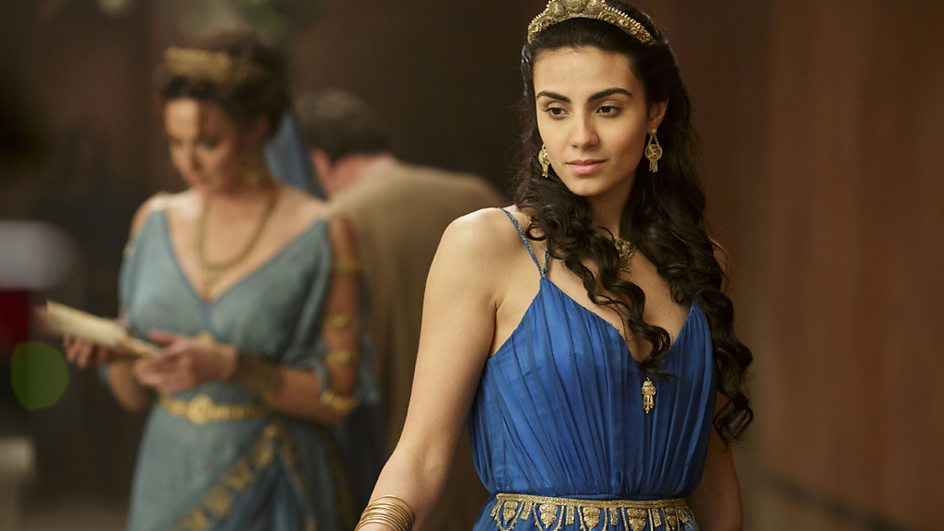
http://ichef.bbci.co.uk/images/ic/944x531_b/p01gw6zg.jpg
JASON! JASOOON! From The BBC
     The premiere began by giving me hope, setting us up in the present day with Jason (Jack Donelly) going underwater to find the remains of his father's expedition. We were then placed firmly in Merlin's "just go with it" methodology as we were expected to hold our suspension of disbelief as our Jason was dragged through a time-portal into Ancient Atlantis, which was apparently occupied by Caucasian or slightly-Asian-looking people who all spoke perfect English in a variety of regional accents. Amongst the misplaced historical celebrities to be found in the cast are Pythagoras (Robert Emms, War Horse), Hercules (Mark Addy, Game of Thrones) King Minos (Alexander Siddig, Star Trek: Deep Space Nine) and his daughter Ariadne (Aiysha Hart).
     The episode rips its plot from Theseus and the Minotaur, wiping our poor old Theseus from the mythological timeline and replacing him step-by-bloody-step with Jason, who doesn't seem to question the odd world around him. The plot itself was a fairly standard adventure affair, with a few attempts here or there to hint at some overshadowing mysteries which couldn't be more obvious if they tried. (Such as the fact that Minos is most definitely Jason's father, and the Oracle his mother.) What bugged me the most about the whole affair was how quickly our premise was delivered. It was so haphazard and silly that it hardly got a chance to breathe before our valient heroes were off re-writing the bloody Plutarch.
     I may be expecting too much of a premiere, but what felt very lacking was any actual characterisation beyond the same archetypes that allowed Merlin to rattle on without doing anything for a good three seasons. We have our dashing hero who is the son of the King (in my predictions at least), assisted by a vaguely nerdy dude and an old mentor, guided by a mysterious magical being and who must use his skills to fight mythological beings. The only difference is that the Arthur/Merlin dynamic of master/servant and the mystery provided by the Fascade are instead replaced by Jason being just wonderful and brave and having no real character flaws at all.
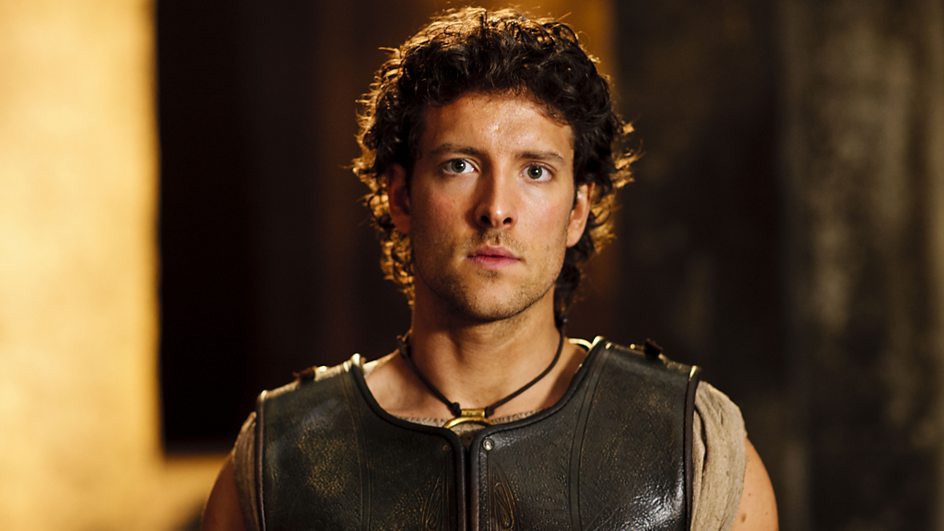
http://ichef.bbci.co.uk/images/ic/944x531_b/p01gw6tr.jpg
Let me guess, the obvious love interest is the obvious
love interest. From The BBC
     Most of all, I think one of my biggest pet peeves with the episode is its lack of self-awareness. Great mythological background or no, Jason is still a 21st Century guy - that's supposed to be used in order to allow the audience to identify with him as he journeys into this strange new world. He should know what's going on, have some vague knowledge of the myths he's re-enacting. Yet the only references made to the fact that he's from the future come very early on, are used for cheap jokes about how maths is boring and fat people are funny, and then are thrown completely aside for useless heroic daring do.
     I missed Merlin over this gap, you know, if only because it's so rarely that I get something so genuinely disappointing week after week. It makes the good episodes better and the worse episodes more tolerable, something that Atlantis seems to have mastered far more quickly than its Arthurian brother. At the present rate I do wonder if Atlantis is really what anyone needs at the moment, and whether it's even possible with its loose set-up for it to match the few highs that Merlin actually managed to reach, but it certainly wasn't a boring 45 minutes and I'd much rather have something to complain about for 13 weeks than be left without.

Thanks.

NEXT WEEK: A girl named Medusa... I certainly hope they're not going to try re-enacting how she got her snakes. (Look it up.) It's A Girl By Any Other Name.

Thursday, 5 September 2013

Review: Voyager 1.1-2: Caretaker

http://images1.wikia.nocookie.net/__cb20080813114356/memoryalpha/en/images/1/18/Caretakers_array.jpg
The Caretaker's Array
Star Trek Voyager - Season One, Episodes One and Two - Caretaker
Written 18/5/13

Voyager's feature-length premiere is almost perfectly representative of its future course. The show begins with an injection of pure promise, setting up the series' premise in the lacklustre way that the show does best. In the first story alone we find plot threads left hanging, actions from Janeway that make me baffled and several other delicious goodies. To be fair, Caretaker uses its feature-length to great use, and the story is decent enough to get the show off to a memorable start.
     A group of Maquis freedom fighters led by Native-American Chakotay, half-Klingon B'élanna and Vulcan Tuvok disappear in a region of space called The Badlands. Sent to search for them is the Federation USS Voyager on its maiden journey, headed up by Captain Kathryn Janeway. Also along for the ride are new ensign Harry Kim and streetwise disgraced ensign Tom Paris. They enter the Badlands and are pulled by an array over 70,000 light years from their home, to the other side of the Galaxy. They discover, after picking up the annoying Neelix and helping to rescue his Ocampa girlfriend Kes from the Kazon, that the Array is run by a powerful alien Caretaker who was pulling ships in to look for his mate. After rescuing B'elanna and Harry from Ocampa, where they had been sent by the Caretaker, Kazon attack ships prevent Janeway from using the Array to get home. Janeway chooses the blow up the Array and strand Voyager in the Delta Quadrant rather than let the Kazon get their hands on it. The two crews join up and head off on their way home.
     Our first impressions of the Delta Quadrant are less than impressive. It's understandable for the writers to want to use the other side of the galaxy as a good excuse for making first contact with all these different species, as they did with the Gamma Quadrant wormhole in DS9, but they could have perhaps chosen some better ones to start off with. Neelix is irritating from the off (although not as much as he would steadily but surely become), and the villains of the first two seasons, the Kazon, are somewhat ridiculous in the way their design and attitude mimics Klingons except without any of the general competence.
https://blogger.googleusercontent.com/img/b/R29vZ2xl/AVvXsEgGHD4AbUBsH_RYSTtxnmuFeXrsRF-5A27G4mMqpABGw4ZkPQQC8ol__Gkj68QqLT9i6jU-81R1gTfPZeS2xX6XhQ5XPeJ9IVxQsENGeiYy59p9W4sSXi_EIMbiUh3SqUjrQj0HiWULF8cI/s1600/caretaker_0897.jpg
Neelix's first act is to con Voyager, by the way. Just to make
him more endearing. Han Solo you ain't, brotha.
     After what feels like a pacey start as Voyager chases the Maquis ship's trail and then has to undergo the trauma of being pulled at trans-warp speeds across the Galaxy, the episode comes to a halt when the crews of both ships are kidnapped and placed inside a hologramatic scenario designed to mimic a Southern farm. One moment we're in sci-fi space funtimes, the next we're in Little House On The Prairie, with sinister old women offering holographic cookies. Then there's the whole B'elanna and Harry subplot, where they find themselves with strange growths on Ocampa. Their condition is never explained, and once they're rescued they live happily ever after for the next seven seasons, so I really don't know what that was about.
     As the journey home begins, the overwhelming message that spins off of Caretaker is of the strange and the unknown. The first episode has a great many pacing issues, and the core concepts the set the ship off on its voyage are a teensy bit pathetic.Despite that, though, there is the inkling here and there that if the show can carry out its premise in a semi-competent fashion and eventually develop beyond it, then it could have some real hope for the future. (Hint: This doesn't turn out well for anyone.)

Thanks.

NEXT WEEK: Bad Science galore as Voyager gets trapped in and then escapes from the Event Horizon of a Black Hole, in Parallax.

Wednesday, 26 June 2013

Review: Lost 1.1: Pilot (Part One)

http://images1.wikia.nocookie.net/__cb20061009021318/lostpedia/images/a/af/JackEye.jpg
Jack's eye opens as the first shot.
Lost - Season One, Episode One - Pilot (Part One)
Written 12/4/13
Warning - I've seen all of Lost, so I might sometimes accidentally make reference to massive spoilers from later series.

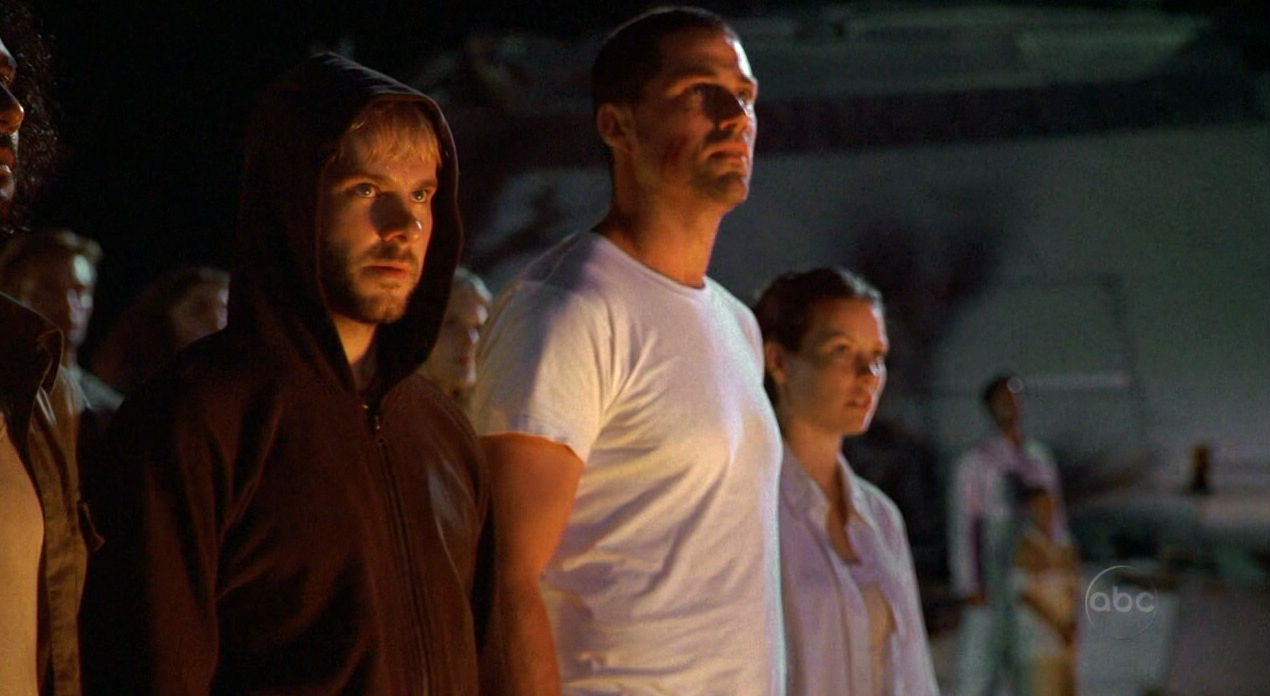
22nd September 2004, and Oceanic Airlines Flight 815 undergoes a mid-air breakup and crashes on an island believed to be somewhere in the South Pacific. There are 72 initial survivors, 48 of which are from the plane's mid-section. Those mid-section survivors, led by obsessive spinal surgeon Jack Shepherd, go on to be whittled down to a selection of very few, with dozens of kooky adventures along the way. This was the opening premise of Lost, a show that I reviewed the finale of a few weeks ago. and the opening Pilot is vastly different in almost every aspect of its production and scriptwriting.
     Initially inspired by one of my favourite films, Cast Away, the idea was pitched by Lloyd Braun and was laughed out of office. One of the most expensive pilots in TV history up to that point, the idea was picked up by J.J. Abrams and Damon Lindelhof, both of whom are now known for their reboot of the Star Trek franchise. (Which I'm going to talk about later this year.) While most of the people involved in the production of the show's beginnings had very little to do with the rest of the show's progress, it was Abrams' backing that got Lindelhof onto the show and ensured its survival beyond Disney's lack of faith.
     The direction is much more cinematic than the show would later become, with Michael Giacchino's as-ever brilliant score rolling over montage scenes like this is the beginning of a blockbuster film rather than a TV show. I do think that I prefer this more out-there direction style - it gives a due sense of occasion to the crash and the events surrounding it. Our first flashback comes in a singular manner, allowing an introduction to the concept while also giving us time to sink into the present storyline. I think it's a slight sign of Lost's regression that in later series, the present began to feel like more a B-plot. Here it has pride of place. I suppose that feels weird for me.
http://images1.wikia.nocookie.net/__cb20090603180822/lostpedia/images/2/25/1x01_Monster.jpg
The Monster is first heard in the Jungle.
     The characterisations at this point haven't of course had the ability to go into the depths that centric episodes would later provide, but we get decent impressions of most of the cast just through their initial actions after the crash (even if we'd later discover that these aspects of their personalities were in reaction to the crash itself.) Of particular interest are Jack, Kate and Charlie, all of whom end up going on the series' first "mission" to find the cockpit and thus get the most discussion time - Jack is focussed and influential, Kate is caring and personable, and Charlie is the former rock star with a secret cocaine habit. Locke and a few other characters are seen, with an interesting amount of mystery being given to the former.
      The first half of the pilot is nothing short of a work of cinematic art. The direction presents the show's enigma in a way that manages to get a lot across without feeling baggy, both world and character building while still keeping a fast dramatic flow. The scene in the cockpit is one of my favourites, just for the way that it's constructed so precisely. The episode doesn't just stand well on its own, which is does brilliantly, but also manages to show the main themes of the series in a powerful and enduring way.

Thanks.

Tuesday, 26 February 2013

Review: Being Human 1.0: The Pilot

http://forbiddenplanet.co.uk/blog/wp-content/uploads/2008/05/Andrea%20Riseborough%20Russell%20Tovey%20Guy%20Flanaghan%20Being%20Human.jpg
The image you will find on all articles discussing the pilot.
Written 24/2/13

For the sake of completionism, seeing as Being Human is reaching its tragic and untimely end, I thought that I'd take a look at the Pilot that started it all. In 2008, BBC Three was undergoing a rebranding to appear less adult and more dynamic and cool. To facilitate this development, the channel chose to make three pilots for dynamic new series, two of which would be turned into fully fledged series the following year. These included the street-oriented West 10 LDN, the weird and wonderful Phoo Action and, as we see here, the original brief for a cheesy drama-comedy called Being Human.
     The only recognisable face in the cast (i.e. the only cast member to survive the crossover) is Russell Tovey, who is playing much, much camper version of himself. Mitchell actor Guy Flanagan is a much cooler and quieter take than Aiden Turner would later give it, feeling more like a stoner than a brooding heartthrob. Lenora Crichlow's position is taken by the much more Northern Andrea Riseborough, who I actually prefer in the role - she manages to capture the character's initial agoraphobia and loneliness in a way that's much more pulling than Lenora, whose Annie is much more awkward. There's little mention of her death, though, so it's debatable whether Riseborough could have gone forwards to work with that.
     Another interesting difference comes in the Vampires - the ones in the Pilot feel much more modern, hanging out in night-clubs and travelling by limousine, with Adrian Lester's much more subtle Herrick (I love Jason Watkins, before you all pounce on me) feeling rather weird. Lester's interpretation is much more of a PR guy, whereas Watkins' Herrick is called into so many other situations in which his madness and desperation are often brought to the fore. You believe that Watkins' Herrick is mad enough to try to take over the world from Bristol. Lester's Herrick... not so much. Elsewhere, and vampire Lauren (played here by Canadian actress Dominique McElliglott, Moon) goes from being this vulnerable and difficult woman in the main series to being the cheesiest performance I think I've ever, ever seen. (And that includes The Kandyman.)
The not at all scary and the scarily bad.
     It's a real shame, really, that the Pilot has been sorta hidden away for all these years. It has a feeling that's much more embryonic than that of the series proper, outlining a great deal of potential rather than developing anything too long term. It also doesn't have any predispositions - it works perfectly well on its own as an examination of humanity and our desperate desire for normality. It's also pretty funny, to boot. Simply put, it's as good an episode as any other and it more than justifies the lengths that many people went to in order to get the show a full commission.

Thanks.

Thursday, 4 October 2012

Review: Red Dwarf 10.1: Trojan

Howie and Arnie face certain doom... or do they? Digital Spy
"It's a Moose!"

I've been waiting for new Dwarf for a good two or three years. Of course, that can't compare with those actually conscious enough to have seen the last broadcast series, who've been waiting a whole damn decade and a half for some new action. But it's still been a pretty exciting time. When I first made this blog back in the halycon days of 2009, I couldn't have even dreamed that we'd be seeing new Dwarf, and when it was announced I doubted that I'd actually be here to review it. For me, this isn't just the return of one of my favourite TV shows. This is an acheivement, an honour, and something that I find very rewarding.
     Trojans is quite simply a statement of what Red Dwarf X has set out to acheive in this short series, and that is, admirably, to make us laugh in a way which we haven't done since Series VI. It was short, sweet and had within it a series of developments that managed to balance respectful references to the show's past and well-worn characterisations with brand new material reflecting a much more modern style of comedy. At first I was a bit wary, but soon the performances and the script actually won me over to it in a way that I really haven't felt since Rob Grant left the series. Spoilers will always follow.
     Rimmer has just failed his astronavigation exam again, and no technique will help him get over his anger. They find a ship called Trojan, a high-class Star-ship with a drive capable of vast travel across the Universe. Unfortunately the drive is dead in the water, but the ship is still powerful enough to receive a message from a hologram on a crashing ship, which turns out to be from Rimmer's brother, Howard, who is also a Hologram. Recovering from an attack of Resentment that nearly wiped his memory core, Rimmer decides to pretend to be the captain aboard the Trojan. When Howard arrives with his Simulant colleague Sim Crawford, he appears to be respectable and quite shocked at Rimmer's acheivements - until a resentment attack reveals that Howard is very similar to Rimmer after all. Crawford decides to rebel and use the ship to unite the sector's simulants, but Cat is able to download the Rimmers' resentment into her and she is disabled. Howard collapses and wishes his brother farewell.
Kryten and Lister weren't the focus, but they still
got stuff to do.
     This episode dealt with a lot of the problems innate in Red Dwarf's premise and converted it to a more modern setting. Aside from the aesthetic - plasma screens, hand-held devices and other such things - it also managed to perfectly balance all of the character beats. While Rimmer was the main focus, the other three characters got their own smaller personal stories that kept them busy and provided them with motivation in the central plot. Even if you pick out a few spots that weren't quite as well done as they could have been, this was a strongly written script. It dealt out the funnies in a way that both eased us back into even having Dwarf in the first place and managed to squeeze some character work in for good measure.
     No matter what you think, it's good to have Red Dwarf back on the air, especially when it's of this high quality. It feels like a privelage to still be here for Dwarf's return, and Trojan made sure that I wasn't disappointed. For every niggling doubt, every hang-up, every worry, Trojan had an answer and at points, I was laughing like a loon. I've missed ya, Dwarfie, and I'm glad you're back.

Thanks.    

Monday, 5 December 2011

Review: Doctor Who Classic: An Unearthly Child

Doctor Who, Season One, Story One (1963)

It's only Story One, and they're already running from cavemen.
Who do I think I am, eh? What cheek must I have to dare to review - to even try to review - An Unearthly Child, the first ever Doctor Who story? It is rather daunting, actually. The show has just had its 48th Anniversary, and the production team on NuWho are gearing up for the 50th Anniversary in two years. It's a good time to be a Whovian and I've tasked myself with reviewing the Alpha to Moffat's Omega. Reviewing where it all began, on the 23rd November 1963.
     Historical Context is actually quite interesting, in this case. The world was still in the depths of the Cold War, just having recovered from the strains of the Cuban Missile Crisis. Producers Sydney Lambert and Verity Newman created the show in an effort to introduce an informative science and history show to the nation's children. Its broadcast date was rather impromptu; Jack Kennedy was assassinated the day before, and so Doctor Who was brought in to replace the next day's news program as the story developed. It wasn't an immediate failure, and while the show didn't really pick up until the show's second story, An Unearthly Child is still seen as one of the more important stories in the show's history.
     Friendly schoolteachers Ian and Barbara (William Russell and Jaqueline Hill) are intrigued by one of their pupils, Susan Foreman (Carole Ann Ford), who talks about decimalisation and despite being incredibly intelligent can't seem to master basic facts. They decide to follow her home to speak to her parents, but find themselves following her into I.M. Foreman's junkyard on Totter's Lane. There they discover a Police Box, and a doddering old man. Fighting their way inside to try and find Susan, the teachers discover that the box is bigger on the inside. The old man introduces himself as The Doctor (William Hartnell), who explains that he and Susan are from a far off planet and that their ship, the TARDIS, is capable of time-space travel. At the end of the first ever episode, the Doctor decides that the two have seen too much, and takes them off in the ship. It lands in 100,000 BC.
Entering the Time Machine.
      And, as many have said, that's where the interesting bits of this story end. The opener is a staple of science fiction, an introduction to several concepts that have lasted for the past 48 years. The next three episodes have their own tone and structure outside of the first episode. This, I suppose, can be blamed on the episode structure itself. These early stories weren't at all intended to be so, and were in fact even more serialised in nature. The first thirteen episodes have been collected into three serials for the sake of continuity with later formats, but together they have a much more connected storyline and feel. There's little reason for An Unearthly Child to be connected to the following three episodes; it's just neat.
     This seperation isn't exactly sealed by the setting and events of these three episodes. The Doctor sets down upon 100,000BC, where a tribe of cavemen are trying to create fire. The Doctor and Susan express disbelief that the TARDIS hasn't changed shape; usually it fits in with the surroundings. As his three companions talk, The Doctor is kidnapped by the cavemen as "the one who can create fire"; Za, the leader of the tribe, has been fighting off competition from Kal. his companions attempt to rescue him but all of them are sent to be sacrificed in the Cave of Skulls.
     As the four attempt to escape, an Elder sets the four free. Kal discovers this and kills her. The four journey back to the Tardis but are stopped by three more cavemen, who return them to the encampment. After they expose Kal's murder, they are returned to the Cave of Skulls, where they use burning skulls to distract the cavemen long enough to escape back to the TARDIS. They head off, and the radiation meter on the TARDIS rises...
Creating fire.
     As you can see, I was able to sum up 75 minutes with two paragraphs. That's not to the story's immediate detriment, but it does render the sequence a lot less memorable. In the place of a complex and winding plot, the script is unusually filled with good character development, carving Ian and Barbara into audience identification figures and showing a Doctor characterisation that really surprises viewers of the later series. He's grouchy, kidnaps Ian and Barbara, smokes, and nearly kills a caveman by bashing his skull in with a rock. This is not the heroic archetype that the public and the casual fan recognises as The Doctor, and the key character arc of these 13 episodes is to watch as the character transforms into such.
      An Unearthly Child is a story unfortunately split by its content. The first episode is a brilliant piece of sci fi in its own right, and the following 75 minutes reinforce this with brilliant character work that prepares us for the series to come. As a beginning it was immediately successful and set the stage perfectly. Travel with me next week, as I move from 100,000 BC to the planet Skaro.

Thanks.

NEXT WEEK: The Daleks in... The Daleks.

Wednesday, 21 September 2011

Review: Fades 1.1

BBC Three is good at things like this. Being Human in itself is proof of that, and Fades' cryptic advertising campaign duals with its relatively all-star cast to create something that could be so much better. My impression of the series by the first episode alone? Well, it's impressive - there's a nice mixture of mythology and character work, and it runs on that to create something both emotionally connective and intriguing.
     The premise revolves around a quasi-religious ideology; the Fades are the remnants of people whose souls haven't ascended. Whether one ascends is random, but the Fades often become spiteful because of their eternal limbo. The series begins as our protagonist, Paul (Iain De Caestecker) with his friend Mac (Daniel Kaluuya) discovers the Fades for the first time via an incident with a Fade that has broken through into the world of the living, killing Sarah (Natalie Dormer) and half-blinding Neil (Johnny Harris) who serves as our series' Obi-wan. Paul is balancing his life by a thread; he has constant bad dreams which cause him to wet the bed, and he's in a loose Will-they-won't-they situation with the girl of his dreams. When he finds out that the visions he sees are caused by his pre-ordained ability rather than personal delusions, he goes with Neil to discover the truth. Elsewhere, Mark (Miranda's Tom Ellis), Sarah's partner, works at the school as a teacher and is devastated by the news of her death.
      I bring up Mark because it would be easy to overlook his character entirely. The majority of the episode was a pair of double acts between Paul and either Neil or Mac. Kaluuya, fresh from a cancelled Psychoville, puts his comedy bones to good use and provides some much needed comic relief in an episode where the mythology is on the gory side. In fact, all of the characters are instantly watchable and fundamentally human. In fact, the only performance I had trouble with was Dormer, whose lines consist of trailer taglines.
      The episode doesn't really pick up until about ten minutes in, after the very mythology-laden beginning falls away for the character development that I so loved in this episode. Paul is the textbook flawed protagonist; and Neil is the textbook "wise old one". But it still feels fresh despite how worn the format is and the while the concept itself is by no means new - and what ideas are nowadays - it's well executed, in a way that has me wanting more next week.
      The first episode of Fades was near-perfect, with well-written characterisations fused perfectly with gory visuals and interesting mythology to back it up. While it had a slow first few mintutes, when it got going it was an incredibly gripping piece of television that I'll definitely return to next week. The perfect premier.

Thanks.

Thursday, 1 September 2011

Review: Doctor Who 1.1: Rose

The Doctor explodes into Rose's life.
When Doctor Who ended in 1989, it was the end of an era. The sci-fi phenomenon that had so affected British Culture for over 25 years was cancelled at the request of television executive Michael Grade, who hated the program. Aside from a few disasterous attempts like Dimensions in Time, the next Who wouldn't appear for seven years, when the Movie was released in 1996. That flopped, but it did inspire a producer by the name of Russell T Davies to revive the show and, 16 years after its cancellation, the revived show aired in 2005. The Ninth Doctor, played by Christopher Eccleston, was joined by former 90's pop star Billie Piper as Rose Tyler.
     The weight upon this story's shoulders is understandably immense. Rose was faced with the task of not only proving that the show could be revived, but introducing the show and its mythos to a brand new generation while reinventing it to meet modern standards. The careers of everyone involved were on the line. Suffice to say that my reviews of Matt Smith's series are proof of how it fared. Rose has its issues, but before I go on about the specifics it is important to recognise its role in Who history.
     We're introduced to our companion for this season, Rose Tyler, almost immediately. She's a normal girl living a normal life; a blond shop assistant living with Mum Jackie (Camille Coduri} and happy with loser boyfriend Mickey Smith (Noel Clarke, whom I mentioned in TW:Combat}. Then one day she's attacked by show-window dummies in the back of her shop and meets an eccentric stranger known only as The Doctor. He helps Rose escape before he blows up the building; he's getting rid of the transmitter that's making the plastic beings (Classic Series monsters known as Autons} work. In the process she's given an Auton arm, which her boyfriend Mickey disposes of.
100% Polypropelene!
     The arm crawls back up to try and kill her, however, but The Doctor picks it up. Rose brings him into the house and questions him, but he walks out and tells her to forget him. Researching, Rose (with Mickey} goes to see a Doctor enthusiast named Clive {the creepy Mark Benton} who gives some backstory. Meanwhile, Mickey is... eaten by a wheely bin. That burps afterwards. Dear oh dear. Mickey is replaced by an obvious-looking Auton duplicate. The Doctor arrives and beheads the duplicate, taking Rose with him to the TARDIS.
     They trace the origin signal from the head but they can't get too close. After Rose gets over the shock of The Doctor being a space-travelling alien, they banter about Mickey and where the signal is coming from, which turns out to be the London Eye. Climbing down into the base of the Autons' leader, the Nestene Consciousness, The Doctor's calls for negotion fall on blind ears as they know that his Tardis was involved in the war that destroyed their home planet. While an invasion rages in London, Rose manages to save the day by pouring The Doctor's pre-prepared Antiplastic into the Consciousness. They all escape in the Tardis, and the two are dropped off at home. Rose initially rejects The Doctor's invitation, but when he says that the Tardis also travels in Time she agrees. In slow motion.
     The Autons are a risky move on the part of RTD, despite their use twice in 1971-2 to open a series. Their execution here is mostly brilliant - the alien invasion scenes are perfect but the scenes with burping bins and the like are incredibly silly even for the intended audience. These scenes tended to lean towards a more physical comedy strand, frighteningly close to later Red Dwarf. Despite this, their inclusion does act as a symbol, passing the torch from the original series to the new, and their storyline neatly introduces one of NuWho's main background events - the War that The Doctor talks about briefly in front of the Nestene.
The RTD Tardis makes its first appearance.
     Ignoring my fondness for Peter Davison and Colin Baker, Christopher Ecclestone is my favourite Doctor by far. I have the utmost respect for his incredibly prolific career and his portrayal of The Doctor is one of my favourites - the manic, eccentric humour hiding a more serious, cynical interior born of a dark past. His introduction is the monosyllabic summation of the series to date - "Run" - and sets a tone for the series better than any long speeches could possibly do. His best moment in the episode is the monologue that he gives to persuade Rose to forget him, in which he describes how he can feel the Earth turn and spin around the sun. Billie Piper, despite contempory worries, is brilliant as our companion Rose, who more than ever acts as an Audience Identification figure. Never before has the companion been so thoroughly written as to stand for the everyman.
    The TARDIS, after its last incarnation as a grand library in the Movie here scales down a bit into this earthy, coral-themed version. While it feels a little naked compared to the Matt Smith version, the design is very evocative of the machine's tempermental nature, as well as taking the central tenets of the old console room (hexagonal segments, a round console and a central column} and giving the design a new spin.
    Rose does pale when compared to some of the better episodes of NuWho, but as a premier to the new series it did its job spectacularly well. The leads are excellent in all respects and the use of the Autons is inspired. The episode's only low point is a few rare scenes that are too childish for most tastes, and that did lie with the execution of the Auton concept, but it did nothing to harm the story in the long run. Rose is a brilliant start to the revived series and left me desperate for the next Saturday to come.
The Doctor Does Not Save The Day.
Thanks.

Monday, 11 July 2011

Review: Torchwood 4.1: The New World

Forenotes: 1.) The official publicity gives the official name of this series as "Torchwood: Miracle Day." For the purposes of simplicity, I will be reviewing it as "Torchwood 4". 2.) There are intense spoilers for a program that has, as of the time of writing, not yet aired in the UK. 

Gwen acts badass to protect Anwen.
So; after managing to watch the premier of this new, Americanised series of the cult hit, what can I say about it? Well, surprisingly little. The show tempted me in with a trailer that promised a high-action adventure with all of our favourite Torchwood stars; instead, we got a slow-moving investigative thriller with a few Welsh overtones. Despite the fact that there are less episodes here than in Series One and Two, it still feels more serialised. The question being, then: Can Torchwood 4 support its premise over the course of ten weeks?
    Our main focus for this particular episode was on our American brethern; CIA analyst Esther Drummond (Alexa Havins) investigates Torchwood, a message about them having appeared on their databases at the exact same moment that everyone in the world stopped dying. Agent Rex Matheson (Mekhi Phifer) initially dismisses her concerns, but decides to follow the lead when he, as par "Miracle Day," survives being impaled after a road accident. Flying over the Wales, Matheson comes into contact with Gwen Cooper (a tired Eve Myles), her husband Rhys (Kai Owen) and their baby, Anwen. Both Esther and Rex end up bumping to Captain Jack Harkness (John Barrowman), culminating in an action scene in the finale where Jack, Gwen and Rhys escort Rex away from a mysterious helicopter gunman who was trying to kill Gwen.
    Along the sidelines we saw the effects of "Miracle Day," notably the spread of the phenomenon (in which no one has died, no matter what injury) and the failed execution of convicted peadophile rapist Oswald Danes (Bill Pullman), whose repellent personality paints him quickly as the villian of the piece. The episode expored the concept with some gusto, I thought; not only explaining the base aspects of Davies' premise but also its ramifications. Especially gruesome was the example of a terrorist who had blown himself up, leaving his charred corpse fully conscious afterwards. Like Children Of Earth before it, this series of Torchwood has so far earnt its "adult" rating with more adult themes about death, rather than the more childish examples seen prior.
Rex Matheson finds Gwen in Wales.
     The American involvement certainly has had an effect on the show past locale and character nationality. Its production values are much, much slicker and the escapade resembles more of a Hollywood blockbuster than usual Torchwood fare. Despite British director Bharat Nalluri's (of Life on Mars alumni) best efforts, the episode had much more of an American atmosphere that made even the Welsh hills more spectacular.
     The New World wasn't as fast paced or gripping as its publicity had suggested but it did run well on its central premise, one that is interesting enough to stay the course. I'm a little worried about some of the characters and how Davies will manage to balance their writing with his more familiar creations, but for now I think it's safe to say that Miracle Day is off to a good start.

Thanks.

Sunday, 6 March 2011

Review: Being Human 1.1

Mitchell, George and Annie.
When BBC Three revamped itself in 2008 for a more student-focused market, it ran a series of Pilots which were, supposedly, to be made into series. These were low-budget experiments with outlandish synopses; the other series supposedly comissioned from them was Phoo Action, a comic-book inspired tale of a Hong-Kong cop fighting monsters on the streets of London using Karate. In that case, the tale of Being Human sounds almost sober.
      The concept of a house-share between a werewolf, a vampire and a ghost is admittedly one stuffed to the proverbial brim with cheese, and sounds as clichéd and painful as most children's television shows. Head Writer Toby Whithouse, however, knows his stuff, and the series' emotional complexity manages to push past the cliché (most of the time). But, more to the point, how does the first episode of this premier series set-up shop after the pilot?
      Well, there are a few casting changes. Russell Tovey remained as werewolf George, but vampire Mitchell is now played by Aiden Turner and ghostly Annie by Lenora Crichlow. The episode is a "reboot" of the ilot, but tends to just rumble along in places as if trying to set up a status quo. In short; George and Mitchell are visited by vampiress Lauren, whom Mitchell transformed by accident in the pilot, and isn't keen to help seeing as he's trying to stay "clean" of blood. George meanwhile is forced to change in the house as his old transformation spot (as seen, again, in the pilot) is being used by construction workers. We're also introduced to their landlord, Annie's ex-fiance Owen.
George transforms at the full moon.
     Speaking in hindsight, the episode presents us with a much different picture to later on in not only this series but in the series as a whole; it thrives mainly as a comedy with some incedental horror tidbits here and there. The low-budget werewolf transformation actually looks more realistic for all of its slight cheesyness, and Annie's general greyish colour scheme helps to connotate her ghostly presence (not that anything else does; she can apparently pick things up and be seen, making her supernatural presence not all that impressive so far).
     Being Human starts with a fun and well written comedy piece that while not being particularly overwhelming does sow the seeds for a lot of dramatic potential. It's got decent characterisation for its principle cast and is a generally entertaining hour of cheesy supernatural antics.

Thanks.

Tuesday, 18 January 2011

Josh: No Ordinary Family: Episode 1&2 (recap)

"You can't fly but you can jump." George.
Plot: 'No Ordinary Family' is an American television series from the company - ABC, which is a sci-fi, comedy drama which began airing last year in September over in the USA. But, on British channel; Watch (part of the BBC), it began last week with a double-bill.

Episode One sees the Powell Family, who are dysfunctional family living in fictional Pacific Bay, California. Father and police sketch artist; Jim (Michael Chilkis) decide to take the family on a holiday to South America as they do not talk much to each other anymore and he feels left out. But, all goes wrong when their plane crashes into a river in Brazil, which seems to give them supernatural powers. Jim is first when he saves his colleague Detective Yvonne Cho (Christina Chang) from a gunman in the office, by catching one of the bullets. So along with his friend and comic book fan; George St. Cloud (Romany Malco) he develops his new abilities by trying to fight crime and discovers he can jump miles at time and is super-strong. He does this and is able to successfully draw perfect images of the offenders for his superiors.

Meanwhile, his wife; Stephanie (Julie Benz), discovers she can run incredibly fast, can heal quickly and has a really fast metabolism which helps her keep slim. So, with her friend and lab-assistant (Katie Andrews -Autumn Reeser) at her company; Global Tech, she uses her powers to her own advantages. This includes getting a sample of the water in the river that her family were subjected to in Brazil but she finds nothing in it. But at the same time she is in the middle of a project about an amazing plant which intrigues her boss. But her boss; Doctor Dayton King (Stephen Collins) is more or less the bad guy, who employs 'The Watcher' (another 'super'(Josh Stewart) to keep an eye on other supernatural humans, which leads up to the murder of Yvonne in episode two.

And then we go back to Jim and Yvonne's children; JJ (Jimmy Bennett) and Daphne (Kay Panabaker) who also have powers, but JJ keeps his secret as the powers he owns make his parents proud. You see JJ, has gained a 'super-brain' and is now highly intelligent unlike his previous self which was rather 'dumb'. But this causes his disbelieving teachers to doubt him and accuse of him of cheating, which makes Jim upset. On the other hand we have Daphne, a rebellious teenager who is dating the bad boy of her school, who is now telepathic. This new power is hard for her to handle at first but then she controls and is able suss out her boyfriend is cheating on her with her best friend.

Opinion: An exciting and addictive double-bill of this US drama has intrigued me to review it because I think that it is so good. In comparison to other US super-hero shows like Heroes and Smallville, which I never watched as I think them not good, this is a feel good family show. It has all the basic elements of a normal superhero themed programme and all the original abilities you get with it but this show has a nice twist to it. The show has light-hearted humour, strong fantasy action and an interesting adult take on both the parents and children's lives. It also has a good focus on topics such as teenage sex, dyslexia and relationship problems. If people reading this haven't already tuned in then do, you haven't missed much important plot because I've summarised all here. Tune in tonight at 8pm on Watch, I urge you, this is a great show that I'll be reviewing here every Wednesday starting tomorrow.
Thanks, Josh.

Friday, 7 January 2011

Review: Misfits 1.1

The "Misfits" get their powers.
Channel Four, as a company, always held a strange position around the TV dinner table - BBC the responsible mother figure, ITV the precocious teenager and Channel 5 the little brat in the armchair. C4 and its various spinoff channels hold the role of "quirky uncle", sitting on the sidelines and firing off obscure, under-the-table jokes and ideas. In essence, Four was the eptiome of the "alternative," and couldn't escape its mixture of reality shows like Big Brother and its weird comedies.
     Then, in 2007, E4 premiered Skins, an innovative and gritty teen drama. Suddenly, "innovative and gritty" became E4's thing, the channel nearly typecast as showing either American reruns or "innovative and gritty" dramas, and parodied as such. Oh well, they said. Howard Overman (a mainly BBC writer, know for Hotel Babylon, New Tricks, Hustle and Merlin) was brought in to write a show of his own creation. That show was a Skins-reminiscient superhero drama called Misfits. It was, indeed, "innovative and gritty". With that in mind, how does the premier of this new show fare? Let's just say it didn't do badly.
     Misfits 1.1 is quite strong in terms of storytelling because it holds the show's characteristic energy and determination, firmly setting down strong characterisations while pushing forward an amusing and mildy intriguing plot. Of note is the way that the show manages to dodge many of the main tropes plaguing the superhero genre, keeping it firmly about character instead of spectacle.
     As you should know (if you've read any of my Misfits reviews so far), the episode focusses around a group of  five six delinquents working on their community service - cocky irishman Nathan, chav Kelly, sexy Alisha*, shy Simon, runner Curtis and thug Gary. The episode starts with the six being adressed on their first day by frustrated probation worker Tony, each being very strongly characterised from the off. We get our Mass Super Powering Event - a storm, which imbues all of the characters with their abilities.
The five six characters paint some benches
     While not wearing now, the episode uses Misfits' commonly seen "freak of the week" plot, where the group are stalked by a super-powered murderer. Here, Gary is offed by a power-induced-rage filled Tony, after which he attempts to assault the group while they hide from the storm in the Community centre. Simon is the first to mention his abilities (turning invisible when people ignore him), followed by Kelly (who'd been hearing people's thoughts.) After a few conveniences, Alisha and Curtis' powers are also revealed (a sex-inducing touch and time reversal, respectively) and Kelly manages to dispatch Tony with a whack from a fire-extinguisher. They, frightened at being blamed for the two murders, drag the bodies away and buy them under the motorway.
     As an introductory episode, 1.1. does a very good job of painting the pattern that the series will follow. The most refreshing thing is of course the more-or-less realistic dialogue - the powers aren't the core focus of the series, and there isn't any melodrama beyond Nathan's usual madness. A sign of good things to come, perhaps?

Thanks.

*Spelt differently in subtitles, promotional material and other sources, as well as in these reviews. For the remainder of my Misfits reviews, she shall be refered to using one i - "Alisha".

Sunday, 14 November 2010

Review: GHTTB: LoM, 1.1

Life on Mars: Series One, Episode One

I've often spoken about how it's important to set up your stall cohesively but quickly. The only thing that Life on Mars has going for it is the nostalgic richness of the 1970s environment, and so the first five or so minutes in the present really fail to catch one's immediate interest...
     It's only when work-obsessed DCI Sam Tyler gets knocked down in a car crash that the story really starts to unfold. You see, Tyler happens to wake up in 1973 to a soundtrack of David Bowie, demoted to DI and forced to work with the much more instinctive DCI Gene Hunt. Hunt is a loudmouthed, misogynist bigot, and he's captured the heart of the nation.
    As an opener, LoM's first episode does wonders to get you in the mood for some 70s police prodecure, as well as stamping down its strange style. Only Sam is particularly well characterised at this point, with the others merely empty shells of their particular character trait.
     Of note (of course), is the soundtrack, which is an excuse on its own to watch the show. A mix of some of the best songs of the 1970s (however unchronological) gives the show a great atmosphere. Adding to this are the nostalgic flares all over the place, and, at least for me, the recognisable places in Manchester where the series was filmed.
     Overall, the pilot shows us the ropes of the series, and gives basic outlines of its characters. It firmly lays down the cutesy, nostalgic atmosphere, while having a gritty murder to get along with. It is a little unnerving to see Sam go on mad rants as he tries to wake himself up, but that's part of the series and it would seem odd without it.

Thanks.

Thursday, 16 September 2010

Overview: The Black Adder

The Black Adder is a different and distinctive comedy. It varies greatly from the next three series in both budget and characterisation, and, as is typical, this made the show much better. Despite that, BA1 is still entertaining and funny - just a different form of humour.
     Rowan Atkinson tends to prefer physcial comedy to witty speech, as seen in his Mr. Bean roles, and his influence on the writing team really shows. This is the only series in which assistant Baldrick, played by Tony Robinson, acts as the more intelligent and witty of the two. This dynamic would later serve to form the core of the series' comedy.
     Also unique to this series was the role of Brian Blessed, who added a violent sense of fun. BA1 never had a subtle delivery, and it seems fitting that the stereotypically loud Blessed be cast as King Richard (IV). Along with this greater focus on visual styles, the bigger budget meant that sets and shots were often large and extravangant - something that didn't necessarily improve the quality of the comedy.
     Overall, it's quite a fun watch, taking a mixture of farce, historical in-jokes and political satire to decent direction and large amounts of research. Low viewing figures led to Blackadder II being given a much lower buget, and thus the Blackadder that we know was born. Join me next Thursday when I review Blackadder II.

Thanks.

Sunday, 22 August 2010

Review: The Black Adder: The Foretelling and Born to Be King

The Black Adder, Episode One - The Foretelling
Blackadder is one of the big greats of British comedy, written by Rowan Atkinson and Richard Curtis, it takes a fun look at history with a satirical eye and a brilliant manner.
     But where did it all begin? In this wonderful episode, we learn the basics surrounding the alternate history that the show presents, in which the Battle of Bosworth Field was won by Richard III, but he had his head chopped off by his nephew, Edmund (Rowan Atkinson). Edmund's father (Brilliant Brian Blessed) then becomes King, leaving him Prince Regent. Along the way he nurses a man back to health (Who turns out to be Henry Tudor) and plans to become the king of England.
     It's a very funny episode, that seemlessly and hilariously introduces the basics. In this series in particular we see the dynamic; The Black Adder (Edmund) and his trusty servants Baldrick (Tim Robinson) and Lord Percy (Tim Mcinnery). Edmund and Percy are stupid; Baldrick is unfortunate but more cunning. This would evolve as the series went on.

The Black Adder, Episode Two - Born to Be King
 We get to see a lot more of Edmund's innate cunning here, but also his power-madness. He will go on ramges against those he dislikes despite it interfering with his ultimate plans, and his companions' pandering to his needs goes unnoticed.
       In this episode, King Richard (IV) has gone off to the crusades, leaving Edmund and his brother to ook after the castle. Upon his immenent return there arrives a mad scotman that Edmund loaths, although he has some information that Edmund might need...
     This series so far is witty and brilliant, not sparing the blood and guts to make the comedy work. Another excellent episode.

Thanks.

Thursday, 12 August 2010

Review: Survivors 1.1

To make up for my lack of Lost reviews, I'm going to be taking on a much smaller project, reviewing Series One of the remake of Survivors. You see, to those who weren't born, Survivors was a 1970s drama series based on an idea which at the time seemed practically impossible; a supervirus wiping out most of Earth's population. It was very depressing, but ran for four series. When there were fears over the various forms of Influenza around the globe, some bright spark at the BBC decided that it would be fun to bring the series back for a remake in 2008.
          And so here's the first, feature length, episode. We focus on all of the main characters, which cover most of the basic ethnic groups to fill in the modern consus form, as they go about their daily lives. As it happens, a terrible virus is spreading across the world, named "European Flu." Our main character, Abby Grant, is worried about her holidaying son, who's quite recently recovered from a terminal illness. She ends up trying to drive to get her son from the holiday camp, while the world falls apart around her, and she gets the virus. As our lucky protagonist, she manages to fight it off. All of the characters fall asleep somehow, and when morning breaks 99% of the world's population is dead.
          Our main characters, all immune to the virus, which include a muslim boy (Najid, perhaps the most annoying thing the BBC have ever produced), a sorta-muslim bachelor (Al), Abby, a survivalist black man (Greg), an ex-army prisoner (Tom) and a lesbian doctor (Anya), meet up on the Manchester Ringroad and decide to stave out this new world together.
          I may have simplified the plot a bit, but that's what it is. There's some marvelous tension and some well-used gore that accurately and skillfully covers the virus' spread. It doesn't fall back on the "touchy subject, good programme" excuse and is actually quite a skillful piece of television. My only gripe at this stage is that none of the characters are very developed; they're just a bunch of grouped stereotypes. The only character with any backstory is Abby, and her whining for son Peter is quite irritating at times. Still, it's a good one-and-a-half-hour of sci-fi, and gets off to a good start. We have the hope of exploring a secret scientist lab, as shown in the end of the episode, and this should help keep away the tedium of the open country setting.

Thanks.

PS. A quick note in this episode is that publicity focussed heavily on the roles of lesbian teacher Freema Agyeman (Who played Martha Jones in Doctor Who Series 3-4) and Abby's husband David, played by Shaun Dingwall (Who played Rose's father in Doctor Who Series 1-2). Nonetheless, both die in the virus attacks, making it a little pointless.