 |
| Ol' Petey hanging out. |
This is a big'un. Written between the 5th and 15th of May 2012.
I appreciate that it may be difficult to simply overview five years of a program. If it was that easy, I could have done the Gene Hunt Time Travel Bonanza all in one go. ' makes mental note '. But the Saward Era is where I began all those years ago, before the show came back and when I was just a wee lad watching one of these new DVD things. I must have been five or six at the time, but what The Five Doctors did for me was to introduce me into a brave new world. Here was a fictional universe lasting over 26 years, and best of all, it was coming back. When I wanted to get further into Classic Who later on, my first stop was my cousin's large Who collection. From this I got The Two Doctors and Revelation of the Daleks, two really fun serials that concreted my love for the Sixth Doctor through thick and through thin. As I grew to know more about Who, I decided to take a proper look at the era that spawned so much in my modern life. That began in 2010, and it ends today.
Before Christopher Ecclestone came along in 2005, Peter Davison was
my Doctor, and in many ways he still is. The brazen youth, shouting at the cosmos with the intellect of a much older man - that was something that I felt like I could empathise with. More importantly, Five is always calm and collected, up until his final story in which he sacrifices his life in order to save his companion. Five wasn't a weirdo, he wasn't an egotist - he was calm, sensible. Vulnerable. Human. With Five, you always knew that the companion would be safe - even if the scripts meant that no one else was. Six... still confuses me. I literally have no idea why I like him so much. He's arrogant, crass, rude, and often completely out of touch with reality. But the thing that struck me was that he still fought for good. He's really the other side of Five's coin in that while you can't see them as the same person, you can see them being part of a greater, balanced whole. Six was the unstable element to Five's safe sensibilities, the contrarian to Five's straghtforward honesty. Despite his arrogance, he still
cared. And he cared enough to not care about the rules when his friends were in danger.
 |
| Let's not get too big-headed. |
Saward's personal style changes a lot as we go through the era. He personally affected/wrote
The Visitation, Earthshock, The Awakening, Resurrection of the Daleks, The Twin Dilemma, Attack of the Cybermen, Revelation of the Daleks and
The Ultimate Foe. As time goes on, we see a clear development of his "multi-strand" technique of interlacing many different plots together, which sometimes works (
Revelation) and sometimes doesn't (
Resurrection.) This era saw a notable number of "Kill 'em all", where large numbers of background characters died. This didn't help the show's reputation, and in certain cases could be said to have contributed to the show's demise. Funnily enough, the most vicious of these is certainly
The Caves of Androzani by the great Robert Holmes, and yet that's often considered one of the greatest stories in the program's entire history.
Season 19 - 1982, Peter Davison - New Beginnings
Season 19 was a big test for the program in terms of what it could stand. While the last few years of Tom Baker's tenure had been somewhat less fun that how it began, he was still The Doctor in the public consciousness. In a way, the show had become reverse-typecast so that it wouldn't be right without Baker at the helm, and there were fans of the show who had only been born while Baker was The Doctor. His influence was, to be frank, amazing. And JNT was faced with the epic task of having to follow that up. Although it may not seem like it, Peter Davison was the perfect choice - a well-known actor after having been in All Creatures Great and Small, and by far one of the most capable actors who've ever taken on the role. His Doctor was Baker's opposite - quiet, correct, and, most importantly, young. Davison injected some desperately needed youth into the program and despite its many gradiose concepts, the 19th Season was one of the show's most kid-friendly for a long time.
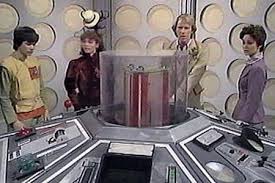 |
| The Season 19 Team at full strength. Den of Geek. |
One problem that Five always suffered with, especially in his first season, was an overstuffed TARDIS. Adric, Nyssa and Tegan provided wide and varied personality types for the series to play with, but it meant that their characters didn't get any time to shine. I always preferred Nyssa to the other two because Tegan complained about everything and Adric is, well, Adric, but because of her less-than-outgoing personality type she never really got the right execution. She was the companion that could be afforded to spend an entire story sleeping, the one that could stay behind in the TARDIS to do the things that the script-writers could fit in anywhere else. Adric's death in
Earthshock, while sad, is probably the best thing that could have happened to the season and after that Nyssa got notably more character development.
That's not to say that the other companions weren't involved. Season 19's main plot was that they were trying to get Tegan, who had mistakenly wandered into the TARDIS in Season 18, back to Heathrow Airport in 1982 in time for her to get to her job as a Flight-attendant. This inadvertantly means that we get four stories where they land on Earth in various time zones, which to be honest is rather clever if productive of unimaginative settings. It works better as a theme than as an actual goal, as we see when we reach the dreaded Timeflight and Tegan actually ends up at Heathrow. The season was far better when it was exploring its own ideas, as we see in
Four to Doomsday, Kinda and
Black Orchid, and they're the ultimate standouts of the season.
 |
| The Saward Cybermen... stand around. |
The Saward stories within Season 19 itself are of note. The Visitation was written before Saward became script editor, and was an audition of sorts for his suitability for the role. It does show his fascination with the 1600s as we'd later see many times in his historicals, and it does read a lot more like a radio drama than one often thinks. It isn't by any means a bad story, but it's nothing really interesting. Compared to that story, Earthshock is a completely different beast. It's a story that I've really beat on in the past simply because of how deriviative it is - it takes so many archetypes and ideas from the Alien franchise, and the JNT Cybermen aren't really used as anything other than a generic monster. It may be a great return to form for the monsters after their seven years away, but the story itself really bores me to tears and Adric's death, coupled with a suspense filled first episode, is the only real attraction.
My favourite story of the season is by far
Black Orchid, which is just plain fun in a more innocent era. It's very fluffy and at times the plot makes little to no real sense, but for me that forms part of its charm and there isn't a serial this season that gives me as much fun.
Four To Doomsday certainly comes close to that, though, with its quirkily stupid plot and the really quite interesting concepts at hand. The best story of the season in the classical sense is probably
Kinda, whose philosophies and ideas mix with great acting from all to make one of the most thoughtful serials out there. My
least favourite story, and the winner of the covetted Bad Sci-Fi award, is
Time Flight, which mixes an absolute lack of sense or reason with shoddy production values. The truth is, I even like that - it's a fun romp and it's nowhere near unpleasant.
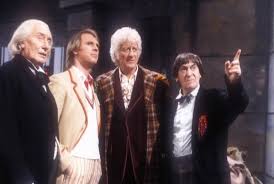 |
| Three Doctors and a Bloke in a Wig |
Season 20 - 1983, Peter Davison - Anniversary
Back in 1963, William Hartnell said of Doctor Who, "This will run for five years." Twenty years later, and the producers were due some rightful celebration. The Anniversary year revelled in its position, but it did suffer because of the stresses of what it had to do, and in the end it didn't turn out as well as it could have due to strikes and problems with writers. Season 20 saw Tegan come back, saw Turlough arrive, Nyssa leave and saw The Five Doctors come together to celebrate their acheivements. (Well, Three Doctors and a Bloke in a Wig.) Season 20 itself is a fair mix of very well-made stories with varying degrees of success, but there's a much higher standard overall and you can see the effort that they were putting in despite the problems with strike action.
As part of the Anniversary Season, JNT brought back lots of former monsters and characters. In order, we saw Omega, Borusa and Gallifrey, The Mara, The Guardians, The Brigadier and The Master, followed by the
epic Five Doctors special. Apart from
Arc of Infinity, which flounders somewhat, all of this season's stories managed to take these guest stars and put them into interesting stories. And surprisingly enough, it never falls into the same trap that stories like
Attack of the Cybermen later would - the mythology is not the most vital part of the story. It's merely complementary to an original, usually better, tale.
Enlightenment is a great example. The Guardians from Season 16 form a large part of the story and the eventual conclusion features them heavily, but they're mere background characters in a space-epic about Eternals.
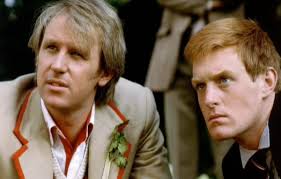 |
| Five and Turlough get friendly. |
Companion-wise, Season 20 rarely feels as overstuffed as the previous season, despite at least one story with three companions. Nyssa's initial appearance as The Doctor's sole companion gives her the impetus for some serious character development that really helps to define the character and seperate it from the behind-the-scenes figure of Season 19. In fact, this development reaches its head in
Terminus, which I still tear up at every time I see it. Tegan's reappearance is really, really stupid, and I had hoped that she would have been left behind for good. Apart from in the one Mara episode, the character floats along as the same caricature as before. She does get some decent work in
Enlightenment, however, which is mainly due to the fact that during the Black Guardian Trilogy Turlough tends to act as his own entity outside the team. Turlough himself gets his best work here, as the confused boy fighting between his lust for power and his common sense of right and wrong. This really shows up best in
Mawdryn Undead, with the rest of the trilogy (especially Terminus) consigned to quite petty villainy.
The strike problems really show their head when you look at the season's semi-final story, The King's Demons. There in place of a Dalek story called The Return (later to be rechristened as Resurrection of the Daleks) it showcases the nadir of JNT's capacity for decision making in his use of Kamelion. The prop is damn creepy and is by far the scariest thing in a story which features duels, jousts and medieval torture devices. Luckily, the story is made up for by the Five Doctors, which is an absolutely astonishing effort and is the Saward Era's high point by a long shot. It's the story that got me into Doctor Who - the story that introduced me into this magical world.
 |
| Goodbye, Nyssa. "tear" |
Bests and worsts are difficult in such a good season, but my personal favourite of the season is
The Five Doctors. The sheer spectacle of seeing the Who world pull together as it did makes this story an instant classic and will always be one of my favourite stories from the show. In the season-proper, my favourite is the moody
Terminus, whose dark atmosphere is tempered with great ideas and a heart-breaking final scene. The most classically-good story of the season is probably
Enlightenment, with it's Kinda-esque devotion to a high-concept sci-fi idea, or
Snakedance for its fun take on the Mara and for Martin Clunes. My
least favourite is by far
The King's Demons, which, unlike its bedfellow
Arc of Infinity, has very few redeeming features and features the damn-creepy Kamelion.
Season 21 - 1984, Peter Davison and Colin Baker - Darkness and Change
My viewing (and reviewing) of Season 21 has been incredibly topsy turvey. That could be the reason why my perception of the season is so fractured, but that also has to do with the way the season is structured as The Doctor loses companions and eventually changes himself. Season 21 would be the last time to date that a Doctor changed mid-season, and that's mainly because the reaction to the one serial with newbie Colin Baker was, to say the least, volatile. But for all of its sharp edges, the season has relatively few clunkers in my book, and the ones that are there are affected massively by production problems and not because of scripts.
 |
| The Myrka was the victim of bad budgeting. |
Margaret Thatcher's 1983 election robbed the production teams of several weeks, leading to
Warriors of the Deep and
The Awakening having some real problems on their hands, especially the former. That doesn't make them unwatchable, but both stories are notably incredibly pessimistic in tone.
Warriors of the Deep is a quite contentious story for me - it's bad, and I can see that it's bad and I know why it is, but I can't help but enjoy it for its So Bad It's Good value. The Myrka is hilarious, Tegan's styrofoam door acting is terrible and vampiress Ingrid Pitt giving a judo-chop to the Myrka
as a first line of defence is one of the funniest things in Doctor Who. It's a real shame that this still ticks people off, though, as this was inevitably the story that began the show's descent when Michael Grade got the wrong end of the stick.
This season saw companions come and go a lot. Tegan disappears in
Resurrection of the Daleks after one decent story in the form of
Frontios, but the former story is often so confused with other things that it doesn't get to focus on her story.
Planet of Fire sees the belated development of Turlough, and it all feels a tad rushed as we're supposed to absorb all this information about where Turlough is from, his relation to the people of the planet Sarn, why he was on Earth, who his parents were, and what his favourite colour is. It also introduces Peri, who in her three stories develops slowly into the form we see her in during Season 22. In her first story she gets a few decent lines, but Nicola Bryant's crisp English accent did cut through occasionally and her step-dad's accent was even worse.
 |
| Fighting for his life. |
We can't talk about Season 21 without mentioning the gamechanging
Caves of Androzani and, conversely, the much-derided
The Twin Dilemma. To be honest? I love both of them for very different reasons.
Androzani is a powerful Shakespearean tragedy with great, great acting and a script that never lets up, and provides Davison with some of his best work for the program. It's not typical of his era at all - it's more of a callback to Holmes' 70s work - but it's still classically brilliant.
The Twin Dilemma is just plain fun - a simple story with an entertaining performance by Baker, who manages to question our perceptions about the Doctor just enough for us to have to learn to trust him again. That's amazing.
My favourite story of the season is
Frontios, where Bidmead gets all of the characters dead on and mixes it with a great idea in the style that he's so used to. Frontios took a Tardis team that I was really down about and turned it into a great narrative combo. The most classically good is
Caves of Androzani, which is Robert Holmes awesomeness in its purest form. My least favourite is
The Awakening, which is utterly droll. I rarely have course to call Doctor Who boring - I think
Boom Town is a classic,
Terminus is a highlight and
Black Orchid is fun - but
The Awakening is by far one of the most irritatingly bland stories I've ever had to sit through simply because of the stupidity at the core of its central premise.
 |
| Sixy started off with a continuity drive. |
Season 22 - 1985, Colin Baker - Sheer, unadulterated fun
Too many people beat on Season 22. The era was strife with publicity issues and it remains as what is oft-considered a dark age in the show's history. But for me, there isn't any problem. Against the odds, I enjoy every single story from the 1985 season, and despite the fact that some of the stories are a little fluffy, none of them are drastically bad in the way that, say, Time-flight is. Colin Baker is one of my favourite Doctors and over everything his Doctor is what makes 22 one of my favourite seasons in the Classic era so far.
The dynamic between Six and Peri is an interesting one for me; while the pair are often caricatured as constantly fighting, but really the dynamic is more like a married couple (ooh, don't remind me of
The Airzone Solution) where the two may argue, but they care for one another deep down. Colin's abrasive personality means that a lot of scenes occur where the two are just arguing; in my experience, this has led to some of the funniest and certainly weirdest lines in the era. Where would we be without, "Rest is for the weary, sleep is for the dead. I feel like a hungry man
eager
for the feast!" Despite being a bit of a tit at times, Baker's Doctor is a character that I absolutely love. He's like a sitcom dad. I like him for the same reason I like Stan Smith from
American Dad - I don't agree with some of the things he does, but he's a character that is ultimately striving for good. Peri does spend a few episodes of the season as the token screaming companion -
Mark of the Rani and
Timelash especially - but she does get some further development. You could try a drinking game based on how many villains want to do the naughty with Peri, but I hear that stomach pumps are expensive nowadays.
 |
| Timelash is a bit off, but not as bad as it could have been. |
The program got in a lot of trouble for violence in this season, which is strange when one considers the relatively large amounts of violence and gore in earlier seasons that received only a harsh letter from Ms. Whitehouse.
Attack of the Cybermen saw Sixy using guns, and the Cybermen squeezing Lytton's hands into a bloody pulp.
Vengeance on Varos had the acid bath sequence (the guard fell in, he wasn't pushed, don't even try) and torture devices.
The Two Doctors had the cannibal-esque Shockeye and his death via Doctor + chloroform.
Timelash had the gory Borad.
Resurrection of the Daleks had a mutated head begging for death, galaxy-wide cannibalism and a stabbing. There's no doubting that Season 22 is a dark one, but I don't have any problem with the levels of violence - I watched a few of these as a kid and it didn't do me any harm. As for the Doctor using lethal force - well, that's just who this Doctor is. He only killed a sapient being once, and that was in a script by the adored Robert Holmes. It's a lot of fuss over nothing.
My favourite story of my favourite season is the excellent
The Two Doctors, simply for how fun it is. The Sontatarans are good, the Androgums are interesting, the setting is beautiful and Two is still very much on form. The best classically good stories are certainly
Vengeance on Varos and
Revelation of the Daleks - both dark classics dripping with satire and strong messages. My least favourite is probably
Timelash,
simply because I didn't like the way that HG Wells was characterised. I did love its atmosphere though, and it's not as bad a story as people make it out to be.
 |
| The Doctor on Trial. |
Season 23 - 1986, Colin Baker - Timelord On Trial
Ah, the hiatus. 18 months of pure stupidity. Not that Nu Who hasn't done similar (2009 comes to mind) but it was a statement from the show's executives that the series was listing in popularity. The series' ratings never returned to the heights of Davison's seasons post Hiatus and while this was probably the fault of the break there was one other contributing factor. The Trial season was one of the most outstanding concepts the series had ever undertaken, and it was almost inevitable that it would never reach the heights it wanted to on such a low budget.
The season starts out strong with its first serial of four episodes, which return to the 25 minute format. Eschewing character development, Baker and Bryant have a much stronger chemistry and the atmosphere is instantly lightened. This does wonders for the story from a character point of view, but it does mean that the focus is elsewhere; Robert Holmes' penultimate script uses several of his Seventies trademarks (strange robots, comedy double acts - two of them) and quite a strong concept. Despite this, it flounders for the majority and relies much more on the strength of the Trial scenes themselves. The characters in these scenes make the best of the single set, especially Michael Jayston's Valeyard. The Valeyard's character is one of the most powerful of the Saward Era and the first serial of the season shows this off with great panache.
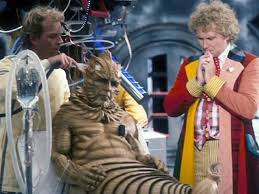 |
| Mindwarp indeed. Better prosthetics =/= better story |
Mindwarp, the fifth-to-eighth episodes of the season, take on a much stranger notion. Written by Phillip Martin, the same guy behind the brilliant Vengeance on Varos, Mindwarp suffered a lot from the Trial aspect of the plot and while I admire a lot of the clever storytelling devices, it is confusing and at times unpleasant to watch. It tries to bring across the darkness of that first story into this season, and it just doesn't work with the Trial scenes. This season didn't need a brainwashed Doctor torturing Peri, it didn't need her to be brainwashed herself, balded and then killed by Brian Blessed (a fate worse than death.) The serial sticks out like a sore thumb, and while I like it, the story wasn't what the season demanded.
And then we get to the dreadful, dreadful Terror of the Vervoids. I don't want to hate this story - it contains many things that I admire in other stories from the period. But the simple problem is that I think it doesn't contain any thought behind it. At least the silliness in Timelash was evoking plots from HG Wells, this is something like Day of the Triffids crossed with a back-door blue movie. Pip and Jane Baker... I could forgive them for other things. I don't think that Time and the Rani is as bad as most people say it is, and The Mark of the Rani was one of the most interesting stories of the previous season. But the tired Trial aspects, coupled with patronising storytelling and the rushed introduction of an incredibly annoying companion in the form of early Mel, really start to show the end of the era in ways that are immediately apparent.
 |
| The Doctor is in trouble one last time. |
Saward wanted a big end to the Trial season, and it was problems on the final serial of the season that led to his eventual resignation. Written by four different people over the two episodes, this leaves The Ultimate Foe as a demonstration of all that went wrong during Saward's final season. It was goofy, it had cheesy dialogue, and it was incredibly confused as to what it wanted to be. You could say that he never intended to leave, but the Trial wasn't the best finale that he could have given us as a script writer.
Conclusion
This has been a very cathartic experience for me. As I said before, this era is the one that brought me into the world of Who. It's been strange, and at times painful, but the era for me is never truly boring. There was always the best of intentions and in the long run, the struggle between Eric Saward's radio-drama ideals and JNT's mad whims created some of my favourite pieces of TV ever made. It's been a pleasure writing these reviews and I hope that you've had a pleasure (or will have pleasure) reading them.
Thanks.

 Mindwarp


