Showing posts with label Games. Show all posts

Friday, 13 July 2018

Shadow of War-Bore: Fight Pits, Shadow Wars and How To Kill An Ending

Very mild spoilers for Middle Earth: Shadow of War up ahead, but hopefully no major plot twists.

The game's final act devolves into siege and defence missions.
Shadow of Mordor took a lot of people by surprise; a game that broke a long trend of poor video game adaptations set in the world of Middle Earth, and which combined elements of other popular franchises to create something greater than the sum of its mechanics. After briefly dismissing it on PC because it didn't run very well, once I got the game on PS4 I was addicted - I poured over 50 hours into that sucker, and eventually had to tell myself to stop. Over time the longing wavered, but recently I decided to soak up those last few trophies and soon I was back in love. Middle-Earth: Shadow of Mordor is an incredibly fun time simply because it does a lot right at once - an immersive and well-crafted world, the genius Nemesis system, and movement and fighting mechanics that are easy to get good at and hard to master.

So I was excited when, in 2017, the sequel, Middle-Earth: Shadow of War hit store shelves. Not soon after launch the game was mired in controversy over its predatory lootboxes and microtransations, and I decided not to purchase the game until I could do so without sending anything to Warner Brothers. As of May 8th, the mechanism for those microtransactions has been removed from the game entirely, with an overall of the game and its final act coming later this week. I picked up the game a few days ago and, breezing through the story, I find myself wading through Act 4: The Shadow Wars. This, over all other things, will be the topic of this article. I could talk about the game's differences in tone, its new clunky mechanics and its major divergences from Tolkien, but none of those things have sapped the joy from my spirit as much as the game's final chapter.

One of Shadow of War's biggest selling points was the restructuring of its Orc hierarchy from a loose oligarchy of five warchiefs into a series of Fortress siege-and-defence missions, with each related mission requiring the input of a lot of time and resources. After the game's major twist in Act 3, the rest of the game become a long series of these missions, as the forces of Sauron repeatedly attempt to take the four fortresses that protagonist Talion has conquered. If the required fortresses are defended, the stage progresses; if they are taken, then progress is linked to taking the fortress back. The most efficient way to take back a fortress is to remove the Warchiefs and replace them with your own, allowing you to waltz in and take it back in a breeze.

Fight Pit missions are unskippable and boring to watch, and yet
form a backbone of maintaining your army.
A big feature of both games is the ability to take Orcs you have brainwashed to your side and have them ingratiate themselves with an enemy Warchief in order to betray them down the line. In Mordor, this was accomplished by having said Orc succeed in one of the game's standard "Nemesis" missions, in which they would have a fine feast, or ambush an enemy camp, or hunt a beast. While those styles of mission still exist in War, the act of making your Orcs into spies has now fallen to the Fight Pit missions. Fight Pit missions pit one Orc against another in a three-minute unskippable cutscene, and while mostly harmless at first are easily the worst thing about this game once in the Shadow Wars. Act 4 of the game requires you to defend your fortresses from 20 individual assaults, and each failure to defend adds a siege to that number. I am seven sieges in, and I failed five of them for various reasons. As a result, I have sat through over 90(!) of these Fight Pits in siege preparation alone, not counting the ones I watched in Act 2, or the challenge fights you inexplicably have to finish in order to have a full roster of Warchiefs to defend your fortress properly.

The ending of Act 3 was a shocking twist and, had the credits rolled on an uncertain future for Talion, it still would have made for a fun and engaging addition to the series. Shadow Wars feels tacked on and trite; the narrative talks of Talion fighting for decades to disrupt the armies of Sauron, but it feels more like the game stretching out playtime in a way which isn't fun and isn't dynamic. Manipulating the Nemesis system in Mordor was part of the fun of the game; it was engaging and even when I had to grind through it for a trophy, it was still a good time. Preparing for a siege in War is a dull slog. My most efficient method of removing all of the Warchiefs is to give each of them two Spy Bodyguards, which usually sees me watching twelve Fight Pit cutscenes in a row and then doing six identical Betrayal missions in a row. I then have to watch six more Fight Pit cutscenes to install my Warchiefs, hoping that at some point I didn't recruit too many Orcs and the game had suddenly decided to wipe one of my Spies from existence for no reason. (This happened three times.) This lasts up to an hour, at which point you are on to the next siege, and the next threat of tedium.

Of course, this is simply the most efficient method of preparing for these sieges. You could finish off the Warchiefs by doing their individual missions, which while still repetitive do offer more of a challenge. But even with these missions, you still have to sit through six fight pits, and you miss out on the few benefits that the Fight Pits have - weeding out the weaker Orcs in your army and buffing the ones who make it through. It is stupid that these missions are so beneficial and yet so damn tedious. Not only did the developers artificially extend the runtime of their game with this exploitative and soporific crap, they made the best mechanism to traverse it literally the most boring thing in the game. The controversy around Shadow Wars and microtransactions has enveloped this game's potential, and for the majority of players their experience ended either after having sat through this monotonous void of fun, or having given up somewhere along the line, dejected and disappointed. At the moment, that last one is me - I will go no further.

I don't even know if that counter does anything...
I really wanted to love War as much as its predecessor. Ironically, Mordor saw me playing long after the main story had ended because I enjoyed the gameplay so much. Now here with War I feel like I'm in a limbo state - not particularly enjoying myself, but still invested in seeing this thing through that I can't stop. On the way, I'm finding that the length of Shadow Wars is not its only problem. All of the little shortcuts that War has made in terms of its variety of Orcs, its ambient dialogue, it all gets highlighted when being repeated over and over again. Shadow of War doesn't just manage to kill its own ending; it manages to make a good game painful to sit through. I will not finish Shadow Wars. And you shouldn't either.

Thanks.

Saturday, 10 March 2018

Review: Firewatch

Writing about video games is not my strong suit. A game experience is so much more dynamic than film, and has a lot more potential to engage. Nowhere is this more true than in Firewatch, a 2016 game from small Campo Santo studio which I played two days ago and haven't been able to shake since. It's often grouped into the Walking Simulator genre, itself making nods to the genre-defining Gone Home, although it has a great deal more freedom of movement than the term usually suggests. What it does have in ommon with other walking sims is a deep, engaging story, told with expertise and simplicity. With a pretty woodland sandbox and a handful of voice actors, Firewatch manages to tell a story about isolation and paranoia which, while perhaps inelegant, had me hooked from start to finish. This review will touch upon spoilers, so if you intend to play, please go do so now.

You play as Henry, a Fire Watchman in the lush Shoshone National Forest who took this job to escape his ill wife, who has dementia. His only regular contact is with Delilah from the next tower over, and Henry's supervisor. Mundane operations in the forest soon turn into a desperate hunt to uncover what seems to be a conspiracy to stalk and harass Henry and Delilah for unknown reasons. The story is told mostly through the radio, with the player able to call Delilah to talk, ask about interesting places and things, and even to flirt on occasion. While the actual plot of the game is fairly linear, your comments and behaviours do come back to haunt you later, which gives it a little bit of replay value. There are elements of the story which are either left ambiguous or are plot holes, and it's not sure which, but I think a lot of them exist as red herrings to drive the player's paranoia. As for the ending: I think that, although a little abrupt, it works in context and drives home the message that running away from your problems is more often than not a terrible idea.

Firewatch is short and sweet - six hours tops if you have no sense of direction, and a smooth three if you're on a second or third play through. The game's environment, navigated with a map and compass, is immersive and beautiful, and although initially you are limited in where you travel, the map soon opens up as Henry acquires more tools and resources. For those who desire more challenge, there is an option to turn off the "you are here" icon on the in-game map, requiring you to work out where you are from your surroundings. I personally didn't notice that option until my second play through, by which time I rarely needed to use the map. By the end of my first time with the game, I felt like I had learnt its paths as well as my own hometown, and the minimal, immersive design is a big factor in that. Firewatch made me want to go for a walk in the woods.

As for graphics, the game runs on Unity in a rugged art style that very much favours the game's terrain. This game is very pretty, and can sometimes be breathtaking. The designers obviously saved a lot of time and money in making it so the only animated human we see up close is Henry's own torso,but that in itself helps the theme of isolation. The game's only real downfall in that regard was the consistent framerate drops on PS4, which two years post-release still haven't been addressed. One thing I found hard to get used to was that going too far off the path sometimes led Henry to just stop abruptly, which broke up the flow but luckily didn't happen too often. The game was updated after launch to include a designer commentary and a Free Roam mode, which is much appreciated but could have done with little tweaks like including Delilah's comments on everything and allowing you to sleep to change the in-game time.

Overall though, the only thing I'd complain about with Firewatch is that there simply wasn't enough of it. I would have appreciated a little more time as a mundane Watchman before the paranoia started to set in, if only another twenty minutes or so. This game grabbed me in a way that a game hasn't in a long time - owing mainly to its beautiful immersive visuals, its impressive minimalist storytelling and its short runtime, which meant that the twists and turns of the plot came hard and fast. For me, games like this don't come along that often, and I don't think I'm ever going to forget it.

Thanks.

Friday, 13 March 2015

Review: The Walking Dead Game: Season Two

Written between 2nd and 13th March 2015. Contains spoilers for both seasons. Like seriously, play the game before reading anything past the second paragraph.

http://www.themarysue.com/wp-content/uploads/2013/10/clementine1.jpg#geekosystem
Clementine takes centre-stage this season.
Image from themarysue.com
If there's one writing cliché I'm guilty of using on this blog, it's the idea of the "difficult second album." It's hard for a second outing of anything if it has to focus on living up to the expectations left by its predecessor. Season Two of The Walking Dead Game was following up a literally Bafta-winning story, and they had to carry on despite having killed off their relatable, popular main character and almost all of his friends. The game's second season does many things admirably, and mostly continues the legacy of its predecessor, but there are several areas where the game loses its way and suffers as a result. As last time, my focus will be mainly on the game's plot, but I will discuss my experience of the game's interactive dynamics. And how they made me scream at my desktop.
     What shines through as the problem with Season Two is poor writing decisions on a story level. In a game this dependant on its plot to get by, mistakes like that can disrupt the entire experience - and this time there's the weight of expectation on the game's shoulders. I'm going to get into more specifics later on, but for now I'll comment on something I noticed - some of my main criticisms of the game's poor writing can also apply to the first season. The difference is that Season Two rarely takes the time to develop the relationships between characters in the same way that the first season does, with characters either dead, doomed or emotionally cold. While some fans argue this is just the way of the zombie apocalypse, this robs the player of their connection to the characters.
     Two years after the events of Season One, and Clementine is still travelling with Omid and Christa. After an altercation, Omid gets shot. Sixteen months pass, and Clem is seperated from Christa in a confrontation with bandits. On her own, she gets bitten by a dog and is then encountered by a group of survivors living in a cabin. After learning to trust her, she stays with them and eventually runs with them as they flee from William Carver, the man whose group they had previously separated from. After they meet up with Kenny from Season One in a ski lodge, they are eventually all captured by Carver. With the help of survivalist Jane, they escape, but on the run their group slowly loses members. One way or another, we end up with Clementine travelling with Kenny and Jane. In a surprising amount of choice, the player can either end the season travelling with Kenny, with Jane, or making it on her own.
http://img3.wikia.nocookie.net/__cb20131202031009/walkingdead/images/d/df/WDG_S2_Omid.png
Hey Clementine, I know we're two years into a zombie
apocalypse, but I'm going to leave you alone in a dark restroom
to do something with my pregnant girlfriend that I don't want
you to be in the same room for.
Image from Wikia
     Choosing to have Clementine as the player character has its ups and downs. As one of the most popular characters from the first season, it's fun to see how Clementine has changed since she was younger, and especially interesting to develop her more directly as a character using either the same philosophy that the player used in Season One, or down a completely different path. My Lee was a diplomat who knew when to be pragmatic and when to keep people on his side. My Clementine, for reasons which will become apparent, is a girl who calls everyone around her out on their bullshit. That becomes necessary because of the main downside to having Clementine as the PC - in order for the player to get to do anything, every single adult character around her is either embarassingly incompetent or just hilariously obnoxious. You do find yourself wondering why the twelve-year-old girl ends up being this group's rational head.
     Because, no matter what you choose, Clementine will be the smart one here. The Cabin survivors that the season kinda focuses around don't make a very good impression - upon finding that Clementine has a dog-bite, the group's resident doctor suggests leaving her out in a cold, exposed shed overnight without cleaning the wound, because a trained medical professional apparently can't tell the difference between a long, saliva-filled dog bite and the rounder, decaying-remains-filled Walker bite. The way the group and the personalities of its various members has been written, it's very difficult to believe that these people have survived this far - especially as this three year time skip places the game further into the apocalypse than any other media in the franchise. And I don't just mean the strange things they do to force Clementine into doing stuff, I mean the headcount on these guys - Walkers are slow and easy to kill individually, only threateningly dangerous in hordes, but the game (in both seasons) makes false tension out of a few shuffling dudes who you could literally walk away from.
     One thing that could explain how the group survived is Pete, the guy who you can choose to try and save as the end-of-episode cliffhanger to the season's premier. The fact that Pete dies either way is a small sample of this thing recurring across the season - there are about five or six characters where you can choose to save them or not, and whatever happens they die anyway. Again, same thing happened in Season One, but this time the inevitability of those characters' deaths isn't worked into the story, and they just sorta leave. This is bad enough with Pete, Sarita, Alvin and Luke, but it's especially painful with Nick and Sarah. (More on them later.) This also reflects one of the greater overall problems - your decisions may affect which scenes you see, but everything more or less happens the same until those last few scenes deciding between Kenny and Jane. And, given the game's track record, I can't help but see Clementine ending up on her own next season anyway, seeing as there's really no way that Telltale would make two or three seperate games all at once just to follow these plot threads.
http://i.ytimg.com/vi/rrJZZnHKLsY/maxresdefault.jpg
Seriously, anyone who doesn't choose [HUG KENNY] here
has a heart of stone...
      Talking of predicting next season... of course Kenny is back. In a fantastic application of "we never saw the body", Kenny appears in Episode Two, freshly bearded and filled with enough PTSD to shake a stick at. By this point the player has been used and abused by the Cabin Survivors enough to want to welcome Kenny with open arms as the last vestige of familiarity, and I found it quite laughable that the rest of the episode kept trying to set up a rivalry between Kenny and Clem's closest ally in the Cabin Survivors, Luke. Of course it really depends on whether you liked Kenny in the first season (which I know a lot of people didn't given his tendency to hold a grudge on the player if they ever sided against him), but I felt like the episode was trying to use his internal grief at the loss of his original family as some sort of argument against the player siding with him. I don't blame Kenny for being messed up - the man lost his wife and son in the space of a few hours, after they'd survived together for so long. He may be angry and irrational sometimes, but he has his priorities right, and for me that's what matters.
     Compare this to Jane. Jane is more or less a carbon copy of Molly from the first season - a hardened, pragmatist survivalist who insists on isolationism ahead of compassion at all costs. Jane believes in manipulating people to break them apart and pray on their weaknessses - she leaves a baby exposed in the cold just to try and make Kenny out to be dangerous and irrational. Going with Kenny gives you the chance to live in a safe and thriving community up in Wellington, while going with Jane leaves you living with her in an abandoned hardware store filled with supplies, constantly looking after a child. For me, at least, the game's final decision was the easiest I'd ever had to make, and even taking into account my prior knowledge of events, the lengths the game has to go to to demonise Kenny in the narrative just seems really bitter and cynical. The Walking Dead is a depressing universe, but this second season never has any moments of real levity, and the result is a really harsh and unpleasant look at humanity.
     Pushing that even further is Nick and Sarah, who share an issue with Kenny and Jane. In this universe a lot of characters have mental health issues - Jane and Kenny are both changed people because of events in their past, for example. Nick and Sarah are different though - they are both designed to be hated characters, and both characters die horribly, even after you've saved them. Although neither character explicitly says as much, it's fairly clear (at least from my perception and the perception of a lot of fans on the internet) that Nick suffers from depression and that Sarah is autistic.1 The fact that these characters were designed to be hated, the fact that their deaths end up being so gruesome and are intended to be cathartic for the player - that leaves a very sour taste in my mouth. Especially given the producers' seeming delight while discussing the inevitable death of a scared 15 year-old girl in an interview at the time. (More on that here.)
http://img2.wikia.nocookie.net/__cb20140312184745/walkingdead/images/8/81/AHD_Bonnie_Caught.png
I hope Bonnie was your favourite 400 Days character. Cos
you're pretty stuffed otherwise.
Image from Wikia
     Now, a quick aside. Between the two seasons there was released a sixth episode, a DLC called "400 Days", which gave us short glimpses of five brand new characters across the first 400 days of the apocalypse. At the end of that episode, we discovered a representative from a survivor group, and depending on your choices, particular characters would go with her or stay by themselves. (I got all five, btw. Just saying.) We were told this would pay off in Season Two - and it does! One of the characters, Bonnie, can star in four of the five episodes... except, she goes to the group no matter what you did in her chapter. The other four characters we were introduced to? If you got them to go along, they make five-second cameos in Episode Three and then die. Oh, and Bonnie can die in Episode Five, so she's for it come Season Three either way. In other words, another fantastic demonstration of the impotence of the player in their decisionmaking.
     I didn't get to cover everything in this article and I could go on ranting a lot more - about how Omid and Christa die because they decided to leave Clementine alone and randomly have sex in a disused public bathroom, how Carver decided to kidnap a bunch of random people for no reason, and how the game makes characters do irrational things near the end just to give us our end conflict. But the biggest problem is that which I've mentioned - the game insists on telling its own version of events instead of allowing the player to give events their own context. And the paint with which the game brushes its canvas is in particularly muddy colours, a sad and bitter worldview which makes you hate all of the other characters for their sheer inhumanity. It's really disappointing that a game like The Walking Dead ended up like this, and although I'm still sorta looking forward to Season Three (to just find out what the hell they do), I'm not as gripped by it as I once was.

Thanks.

1 I am not autistic, nor a medical professional, and thus have no real basis on which to actually say that Sarah is autistic. I am basing this entirely on the way I have seen people identify with the character as such, and the hurt they felt when she was treated the way she was. I apologise in advance if this offends any readers who do have autism and who do not feel that the character adequately represents someone with the condition.
    

Tuesday, 10 February 2015

Review: The Walking Dead Game: Season One

I have never before covered video games on this site - my friend Tanju has, in his article on Mass Effect, but I never went there. While the medium of games is both an exciting and innovative one, I have never been anywhere near the forefront - aside from Minecraft, I tended to play PC Games from the early 00's. This Christmas I finally gave in and downloaded Steam, and with that came a few steps closer - finally playing games like Skyrim that I'd only ever seen Let's Plays of. Among these games was one of my favourite games to watch - The Walking Dead Game by Telltale Games, a point-and-click-ish interactive story set in the universe of Robert Kirkman's The Walking Dead. (The comics, not the TV Show. Which I will talk about, I promise.)
http://i.kinja-img.com/gawker-media/image/upload/s--iu-WzRpm--/814467108483821347.jpg     Unlike the vast majority of mainstream games on the market, The Walking Dead Game (hereafter The Walking Dead) and other games from Telltale Games embrace a story-heavy structure, with player interactivity restricted either to the performance of specific actions to progress the plot, or in decisions which alter the protagonists' relationships with other characters but not the overall progress of the plot. In this respect, The Walking Dead is the perfect game for me to look at - a game which pioneers the trend in the blending of cinema and gaming, and which does so fairly competently at that. I watched both seasons of the game on the internet show Video Games Awesome, a show which I've watched for a number of years, and I found the first season as entertaining to watch as it was to play, even if the latter experience came with a great deal more tension. Spoilers follow.
     You're convicted murderer Lee Everett, and you're on your way to a Georgia prison when you have a car accident. Upon waking you find yourself in the midst of a zombie apocalypse, and, meeting a little girl named Clementine you find yourself her protector. You meet with redneck Kenny and his family, eventually making your way to your family's chemist store in Macon where you meet with another small group of survivors. The group settles in at a Motor-Inn. Following a trip to a local dairy with more than milk on the menu, the group unintentionally angers a group of local bandits and they're forced to move on, with Kenny focusing on his plan to head to coastal city Savannah and find a boat - the same place Clementine's parents were last seen. You arrive in Savannah to find it ransacked and no boats to be found - what's more, Clementine is eventually kidnapped and you get bitten on your way to find her. You rescue Clementine and she helps you inside a small enclosure as Savannah is horded by zombies - and the season ends as you either succumb to your wound, or have Clementine shoot you.
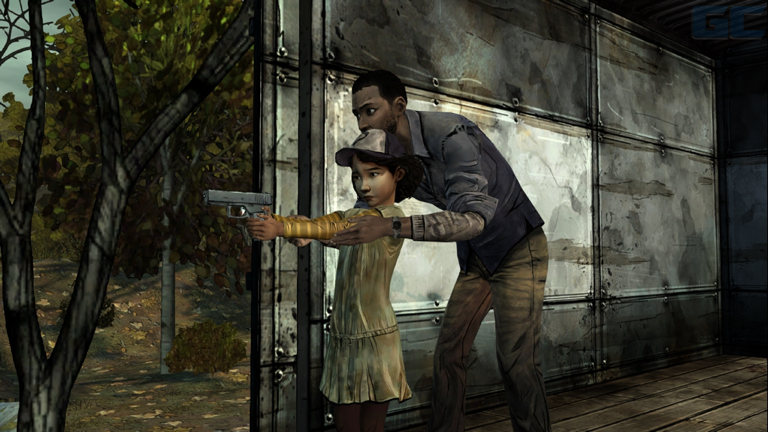
     That final moment is a heart-wrenching one for a single reason - the relationship between Lee and Clementine. No matter how much of an ass the player makes Lee, he and Clementine end up developing a strong bond, and the writing and voice-acting for these two characters makes their relationship a very appealing part of the story. This really started the trend which was later followed by Bioshock Infinite and The Last of Us of the male protagonist and the young(er) girl that he protects, and who actually affects gameplay. Here, Clementine is written as a realistic little girl, and it's so expected that the player will grow to love the character that the vast majority of the plot is aimed at finding and saving her. If the player so chooses, Lee can eventually have Clementine dispatch the season's villain, and in a compulsory scene he guides her through killing a Walker and protecting herself.
http://wpuploads.appadvice.com/wp-content/uploads/2013/10/1-1-1.png
Lee and Clementine's relationship forms the backbone
of the story.
     While the relationship between Lee and Clementine doesn't change, this isn't the same for other characters. The game sets up dichotomous views between characters and has Lee either side with one of them or ignore them, and any decision affects the way that characters will respond to Lee down the line (should they live that far.) Sometimes this affects characterisation - Kenny still bears a grudge on Lee in Episode Four should he not side with him on a particular issue in Episode One - but most of the time it makes the game feel like a more fluid and realistic experience. Sometimes there are issues with the choices' ambiguity - the choices themselves are usually three or four one-line options which you get a limited time to assess, and each often makes Lee say things contradictory to the intention of that option. (This would be abused by the writers in Season 2.)
     Sometimes the choices take more drastic changes to the plot than character relationships and contexts, with individual characters living or dying depending on the player's choice. This happens in the first episode when choosing between tech-savvy Doug or sharp-shooting reporter Carley, and in the third episode it feels like it makes a large difference, with Carley having a decent-sized subplot. However, whichever character you saved ends up being killed mid-way through the third episode in the same circumstances, and both make only small cameos in the second. Choice exists, but it is an illusion - and while the illusion is obvious, the small differences that are made to gameplay by these choices feel enough to make each player's experience sufficiently unique. The sole exception for me was later on in Episode Three, where walking-shitstorm Ben reveals to you on a fast-moving train that he has basically caused all the deaths in that episode, and you never get the option to throw him off the side.
     My favourite part of the game was sculpting the character of Lee - my Lee was diplomatic and leader-like, sided with Kenny on almost everything, but harsh when people fucked up. (*cough*Ben*cough*) Obviously there are a finite number of options for what you can do, but I found expressing my decisions through the character a very satisfying experience - especially in Episode Three, where I managed to convince Kenny to stop the train and euthanize his dying son without resorting to physical violence. The last two episodes were less interesting for me because the character development and group politics gave way to the inevitability and hopelessness of the season's endgame, but they were just as immersive and I really felt concerned for Lee and Clementine's fates.
http://img1.wikia.nocookie.net/__cb20131029182043/walkingdead/images/1/16/SFH_Preview_Ben.png
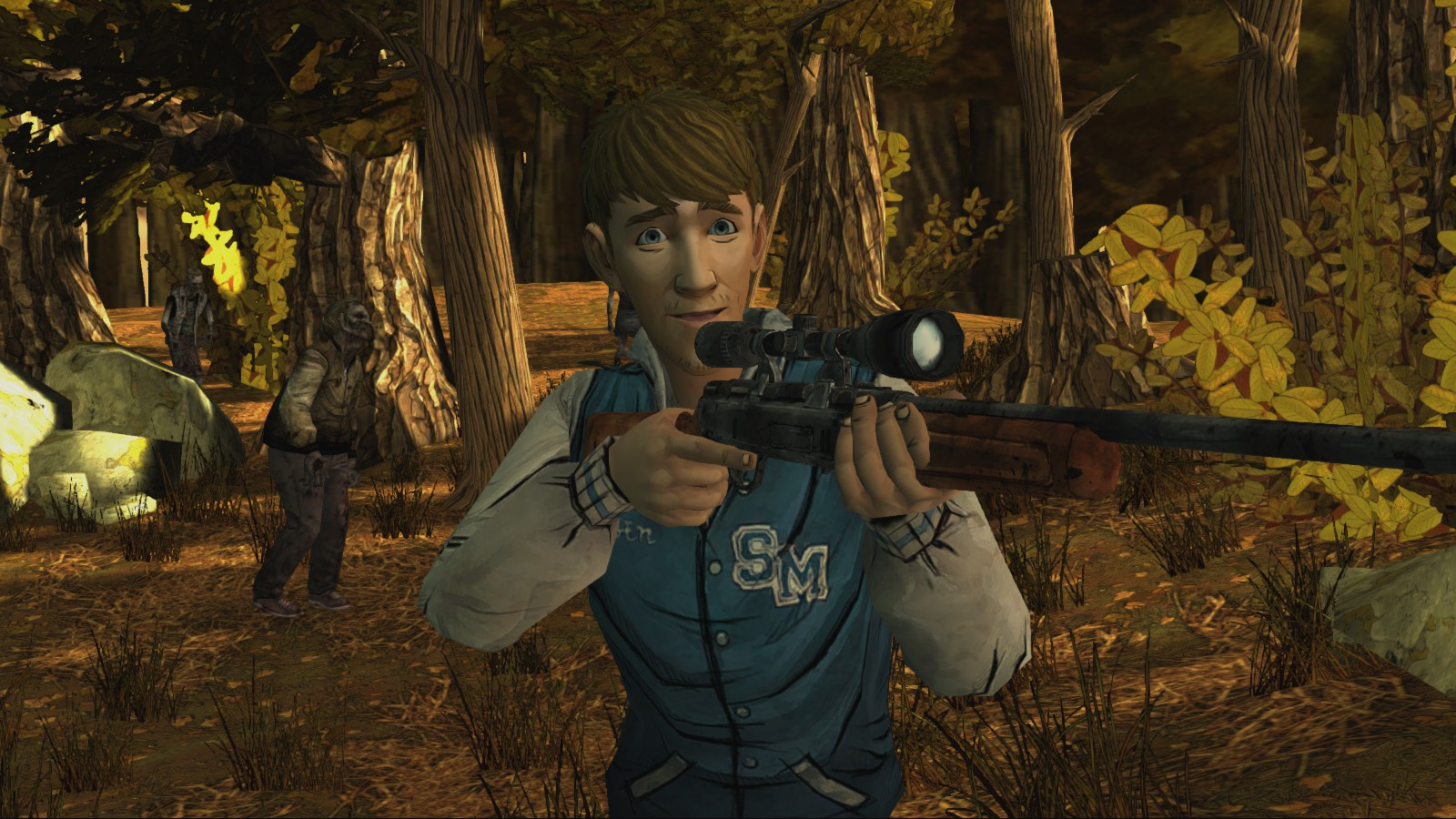
This little shit gets a dozen people killed, abandons Clem
in a time of danger, and is a character I hate more than
the season's actual villain.
     Now, for the thing I don't usually get to talk about. How does The Walking Dead Game's nature as an interactive product affect it as an experience? I'll have a lot more negative to say when I look at Season Two, but I have to say I think the blending of genres is quite well done. Aside from the decision aspect, the game plays out the plot as a point-and-click adventure, having Lee find items or find out information that allows him to overcome some obstacle. During more fast-paced scenes, Quick-Time Events are used to provide tension as well as player involvement - luckily for PC users, this tends to comprise pushing Q until you're told to push E. This mechanic is worked into the plot - often this is used when Lee is pushing close doors and such, and if he as a character is unable to complete the action, neither can you, no matter how fast your trigger finger is. The interactivity mechanic, finally, also adds some drama/catharsis to certain significant actions like executing trapped walkers or defeated villains, where it's more effective for the player to have to do it themselves.
     Season One had a few quirks here or there that made it sometimes frustrating - once or twice the game mechanics didn't pan out well, and the aforementioned ambiguity in some of the decisions which made me be more harsh or more supportive one way or another than I wanted to be. But 90% of the time the story carried itself well, and the use of the various options when it comes to the protagonist's personality and relationships with other characters means that the result is an immersive, personalised experience and an amazing story. How could it go so wrong after this?

Thanks.

PS. For those interested, I saved Carley, left Lilly, let Ben go and I finished episode four with Kenny, Omid and Christa. I didn't chop off my arm.

Sunday, 8 June 2014

Papers, Please

Papers, Please is a video game where you role-play the action-filled life of an immigration officer in the fake communist country Arstotzka. People walk into your checkpoint, you check their papers and then decide whether or not they can come into the country. It is my game of the year, better than Tomb Raider, Saints Row, Bioshock Infinite or any other game that was released in 2013. But wait, you say. Surely something with gameplay of this calibre must have something else up its sleeve. Well of course it fucking does. The game does everything right and combines story, art style, gameplay and atmosphere to make an exceptional game.

Glory to Arstotzka! The greatest country!
In the game you and your family are given an apartment to stay in because of your job as border control and you are payed for every person you deal with, unless of course you make a mistake, in which case you will not be payed and eventually fined and that's a problem because of that family at home you have to feed. First, the game starts off easy. On the first day, all people need is a valid passport to enter the country (though one hilarious, recurring character even fails this), but after a terrorist attack on your checkpoint, the system becomes more and more bureaucratic. So by the 15th level or so, the game starts to look like that picture on the right, so making a mistake that costs your son that life-saving medicine he needs is pretty easy. You are in a hopeless situation and Arstotzka doesn't give a shit about you, so you have to take care of yourself and your family, often at the cost of others. The game likes to give you choices that can turn you into either a heartless monster or the most corrupt government official in the Universe, or both. One good example is the woman who didn't get into the country because she took the piss out my son's crayon drawing. Another is the husband and wife seeking asylum. The husband gets through without a problem, but the wife doesn't have an entry permit. You have to make a choice between receiving a fine, but reuniting a couple or doing your job and rejecting her entry into the country. It might seem an obvious choice without the context of playing the game, but since all your money in game basically goes to rent and food for your family, losing even a small amount of money can be catastrophic and its easy to be unforgiving or even corrupt if it means you can that extra bit of cash by bending the system in your favour. This is the whole point of the game. You immerse yourself into the situation you are in and you see the effect your choices have on the people you interact with. Being good isn't always easy and this game showcases better than most.

You may not have realised this from my review, but Papers Please can be as depressing as fuck. The world of Arstotka is crafted with a grey, pixelated art style, almost completely devoid of colour, apart from that giant bright red stamp that says "DENIED" on it. But fear not, for every sad story, there is a hopeful one (though these hopeful stories can be fucked over by the sad ones). The game takes care in showing the humanity being crushed by the beaurocracy, authoritarian tendencies and all-round bullshit of the government. But the humanity is still there and that's what makes Papers Please so beautiful, the balance of people's compassion and dickishness. You can see loved ones reunited, save people seeking asylum from neighboring countries, but who don't have the paperwork needed to pass. You have the choice to make a huge difference in people's lives. Or you can fuck them over. Your choice.

Wednesday, 6 November 2013

Mass Effect

The game has plenty of tough situations
where there are multiple ways to handle things.
To celebrate the religious festival known only as N7 Day, I will review the video game Mass Effect which is, in my definitely not biased opinion, the greatest video game ever made. Set in the near future, humanity is a newcomer on the galactic stage, yet to earn the trust of the Space UN Security Council. You are Commander Jesus Shepard (first name, gender, appearance and personality are customisable), a bad-ass war hero on the SSV Normandy SR-1. After an attack on a human colony by a rogue Council agent and the mysterious robots known as the Geth, she has hallucinations dreams caused a strange alien artifact and the game revolves around solving the mystery that could change the galaxy forever...

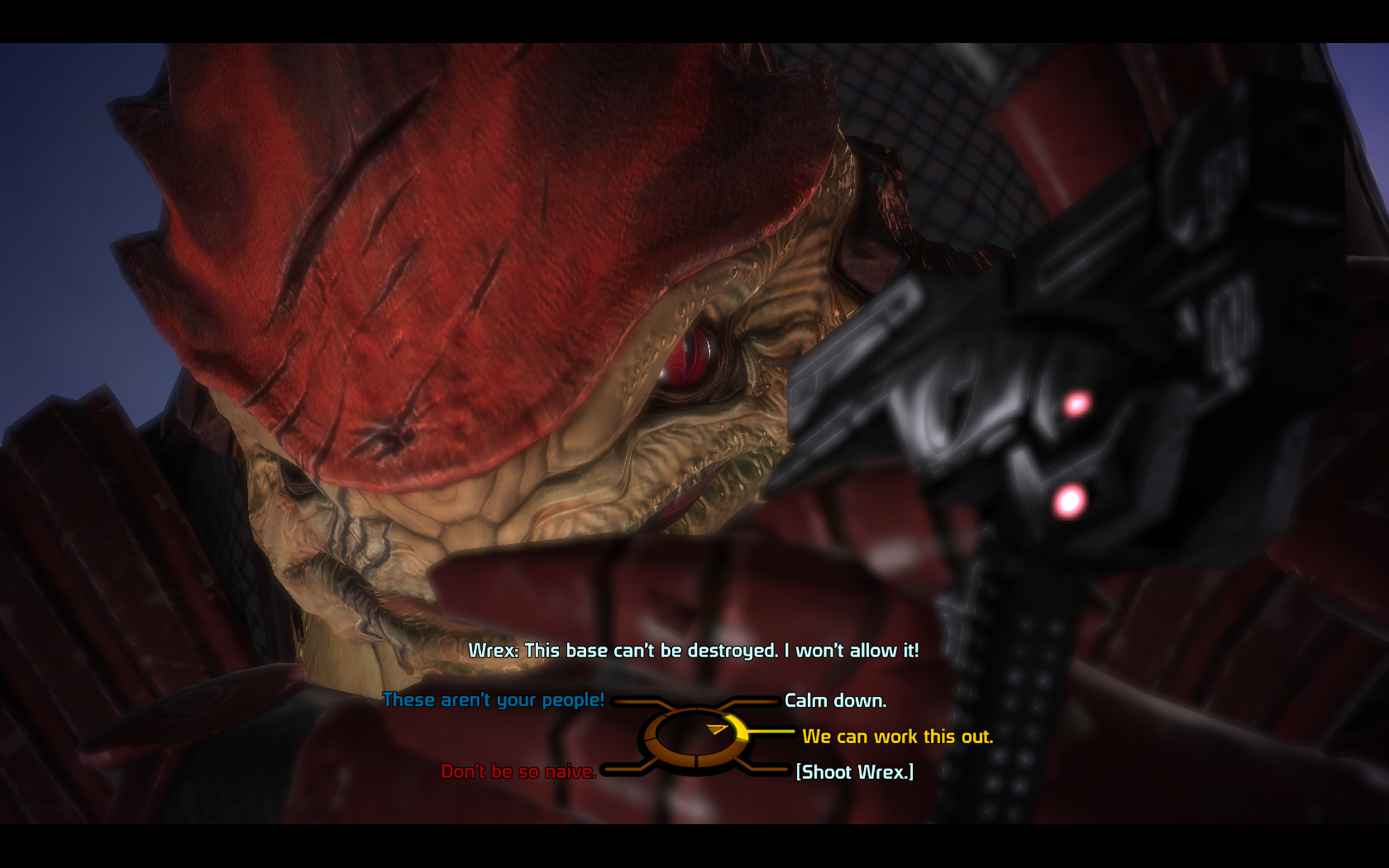
But seriously, the story is engaging; you surround yourself in the world and become as much a part of it as you want to be. For many people, ME is simply a decent shooter. There's nothing wrong with that, but underneath that, there's a galaxy to discover. In this world, humanity aren't a galactic superpower. They're newcomers trying to earn their place, similar to humanity in Star Trek: Enterprise (in Mass Effect, instead of First Contact with Vulcans, they had a war with the turians). You represent humanity and as you travel the cosmos, you uncover the stories of the galaxy's inhabitants and you can change those stories forever. Outside combat situations, the game revolves around choosing dialogue options. The game has a dialogue system in which you can choose between Paragon, sympathetic and moral, or Renegade, be an arsehole. If you keep making Paragon choices or keep making Renegade choices, you gain access to dialogue options you wouldn't normally have, allowing you to convince others to help you or talk someone down. This system is clear, precise and allows conversations in the game to flow. The system is also where you make key choices that define the game. You can choose who lives or dies. Or you can defend the religious freedoms of the jellyfish preacher. I'm super cereal. The choices in this game carry on and affect the story of later games.

Chillin' on the moon.
One of the main inspirations of the game is obviously Star Trek. There are missions in the game that happen no matter what, but by exploring the galaxy you can see things and play missions that another player may have completely ignored. This creates a sense of exploration about the game that stands out. From your ship, you can travel to other star systems and you go to the planets in these systems, learning about their history, their structure (politically, astronomically and geologically speaking), even make one small step for mankind (as well as turian, asari, krogan...) and land on strange new worlds, travelling in the Mako, which for some unknown reason looks like one of those old Big Trak toys from the 80's.

Garrus' rebellious streak contrasts
his people's martial discipline and
"society first" attitude. He's also
just an awesome bro. 
This game oozes immersion and this immersion strengthens this game's greatest achievement: your crew. You may love them or hate them, but your squad-members are well-written, interesting and feel real. They give you a window into the game's universe and if they were aliens, a window into the culture, history and society of that particular species. A good example is Wrex, a krogan. Without Wrex, the krogan would seem to us to be henchman of the main villain and nothing more. Having Wrex on your squad gives them a personal story and shows the hardships the species had faced. Thousands of years ago, the krogan were decimated by a sterility plague created by the ruling races of the game, the salarians and turians. Wrex tells you how it destroyed their society and how krogan became simple soldiers of fortune or bouncers: trophies and not the great race they once were.

But the game isn't just serious story. The game is funny when it needs to be, especially if your character is a Renegade. Shepard becomes a sarcastic arsehole (like me in real life) and the game just becomes pure awesome. All in all, the game has balance and variety with the hope and humour of the personal elements of the story offsetting the annoying-as-fuck politicians and morally grey galaxy. You know, like in real life.

Even though Mass Effect is the story ever told by humanity, the gameplay is less than stellar. The game has a few immersion breaking glitches and the combat needed improvement, no matter how fun throwing singularities at robots was. Side quests reuse the levels, so you may be fighting through the same warehouse over and over again. It can get repetitive and it sometimes feels like the combat gets in the way of the story. If you play the game for combat rather than story, you are better off with one of the game's sequels or another series altogether.

Even with this in mind, Mass Effect makes you feel like you are the captain of the Normandy and is one of the most immmersive experiences I've ever had. Bioware have created a universe and characters people can invest in, in the same way people immerse themselves in Star Wars or Doctor Who. It's a great game.