Showing posts with label TWDG. Show all posts

Friday, 13 March 2015

Review: The Walking Dead Game: Season Two

Written between 2nd and 13th March 2015. Contains spoilers for both seasons. Like seriously, play the game before reading anything past the second paragraph.

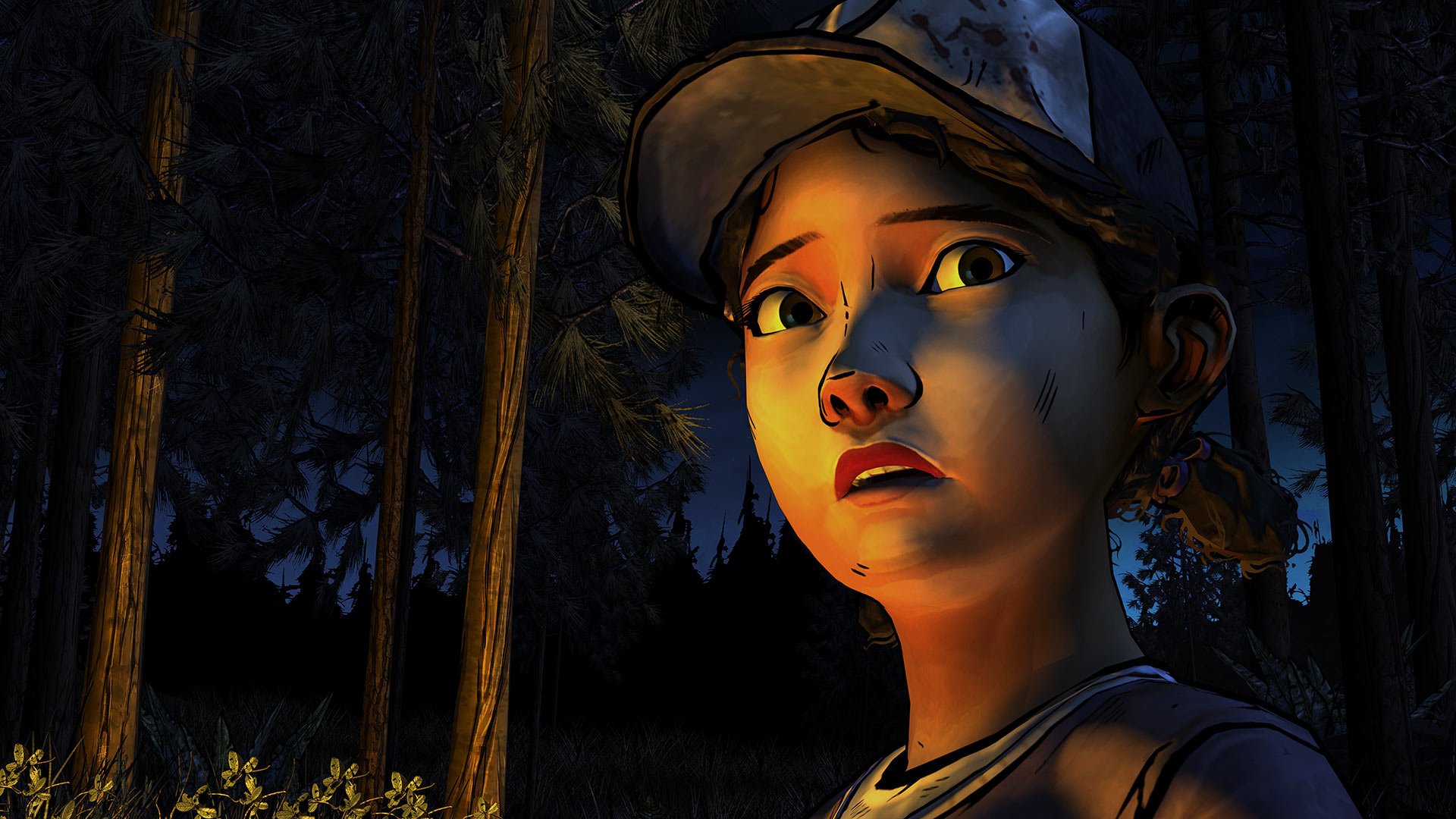
http://www.themarysue.com/wp-content/uploads/2013/10/clementine1.jpg#geekosystem
Clementine takes centre-stage this season.
Image from themarysue.com
If there's one writing cliché I'm guilty of using on this blog, it's the idea of the "difficult second album." It's hard for a second outing of anything if it has to focus on living up to the expectations left by its predecessor. Season Two of The Walking Dead Game was following up a literally Bafta-winning story, and they had to carry on despite having killed off their relatable, popular main character and almost all of his friends. The game's second season does many things admirably, and mostly continues the legacy of its predecessor, but there are several areas where the game loses its way and suffers as a result. As last time, my focus will be mainly on the game's plot, but I will discuss my experience of the game's interactive dynamics. And how they made me scream at my desktop.
     What shines through as the problem with Season Two is poor writing decisions on a story level. In a game this dependant on its plot to get by, mistakes like that can disrupt the entire experience - and this time there's the weight of expectation on the game's shoulders. I'm going to get into more specifics later on, but for now I'll comment on something I noticed - some of my main criticisms of the game's poor writing can also apply to the first season. The difference is that Season Two rarely takes the time to develop the relationships between characters in the same way that the first season does, with characters either dead, doomed or emotionally cold. While some fans argue this is just the way of the zombie apocalypse, this robs the player of their connection to the characters.
     Two years after the events of Season One, and Clementine is still travelling with Omid and Christa. After an altercation, Omid gets shot. Sixteen months pass, and Clem is seperated from Christa in a confrontation with bandits. On her own, she gets bitten by a dog and is then encountered by a group of survivors living in a cabin. After learning to trust her, she stays with them and eventually runs with them as they flee from William Carver, the man whose group they had previously separated from. After they meet up with Kenny from Season One in a ski lodge, they are eventually all captured by Carver. With the help of survivalist Jane, they escape, but on the run their group slowly loses members. One way or another, we end up with Clementine travelling with Kenny and Jane. In a surprising amount of choice, the player can either end the season travelling with Kenny, with Jane, or making it on her own.
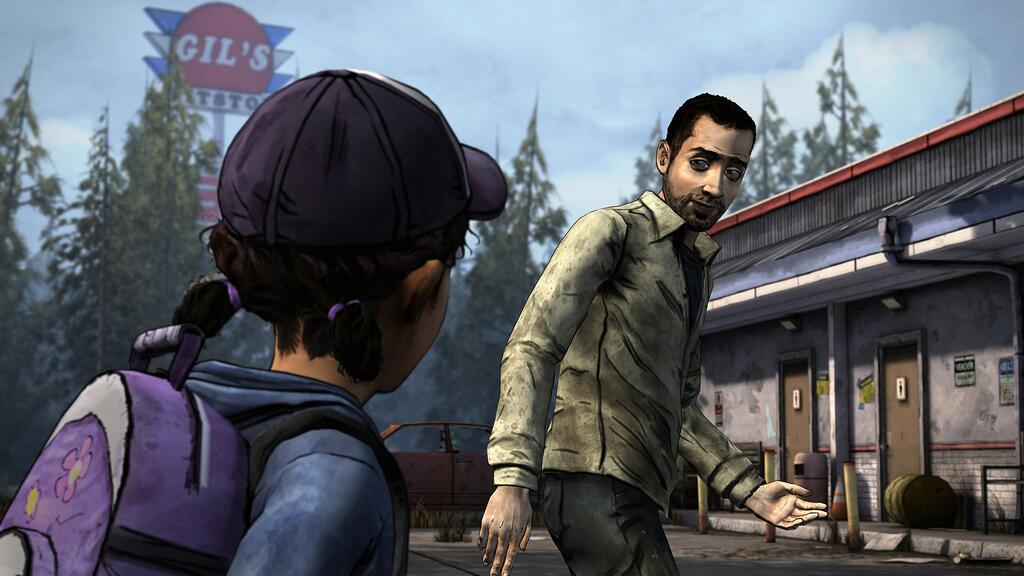
http://img3.wikia.nocookie.net/__cb20131202031009/walkingdead/images/d/df/WDG_S2_Omid.png
Hey Clementine, I know we're two years into a zombie
apocalypse, but I'm going to leave you alone in a dark restroom
to do something with my pregnant girlfriend that I don't want
you to be in the same room for.
Image from Wikia
     Choosing to have Clementine as the player character has its ups and downs. As one of the most popular characters from the first season, it's fun to see how Clementine has changed since she was younger, and especially interesting to develop her more directly as a character using either the same philosophy that the player used in Season One, or down a completely different path. My Lee was a diplomat who knew when to be pragmatic and when to keep people on his side. My Clementine, for reasons which will become apparent, is a girl who calls everyone around her out on their bullshit. That becomes necessary because of the main downside to having Clementine as the PC - in order for the player to get to do anything, every single adult character around her is either embarassingly incompetent or just hilariously obnoxious. You do find yourself wondering why the twelve-year-old girl ends up being this group's rational head.
     Because, no matter what you choose, Clementine will be the smart one here. The Cabin survivors that the season kinda focuses around don't make a very good impression - upon finding that Clementine has a dog-bite, the group's resident doctor suggests leaving her out in a cold, exposed shed overnight without cleaning the wound, because a trained medical professional apparently can't tell the difference between a long, saliva-filled dog bite and the rounder, decaying-remains-filled Walker bite. The way the group and the personalities of its various members has been written, it's very difficult to believe that these people have survived this far - especially as this three year time skip places the game further into the apocalypse than any other media in the franchise. And I don't just mean the strange things they do to force Clementine into doing stuff, I mean the headcount on these guys - Walkers are slow and easy to kill individually, only threateningly dangerous in hordes, but the game (in both seasons) makes false tension out of a few shuffling dudes who you could literally walk away from.
     One thing that could explain how the group survived is Pete, the guy who you can choose to try and save as the end-of-episode cliffhanger to the season's premier. The fact that Pete dies either way is a small sample of this thing recurring across the season - there are about five or six characters where you can choose to save them or not, and whatever happens they die anyway. Again, same thing happened in Season One, but this time the inevitability of those characters' deaths isn't worked into the story, and they just sorta leave. This is bad enough with Pete, Sarita, Alvin and Luke, but it's especially painful with Nick and Sarah. (More on them later.) This also reflects one of the greater overall problems - your decisions may affect which scenes you see, but everything more or less happens the same until those last few scenes deciding between Kenny and Jane. And, given the game's track record, I can't help but see Clementine ending up on her own next season anyway, seeing as there's really no way that Telltale would make two or three seperate games all at once just to follow these plot threads.
http://i.ytimg.com/vi/rrJZZnHKLsY/maxresdefault.jpg
Seriously, anyone who doesn't choose [HUG KENNY] here
has a heart of stone...
      Talking of predicting next season... of course Kenny is back. In a fantastic application of "we never saw the body", Kenny appears in Episode Two, freshly bearded and filled with enough PTSD to shake a stick at. By this point the player has been used and abused by the Cabin Survivors enough to want to welcome Kenny with open arms as the last vestige of familiarity, and I found it quite laughable that the rest of the episode kept trying to set up a rivalry between Kenny and Clem's closest ally in the Cabin Survivors, Luke. Of course it really depends on whether you liked Kenny in the first season (which I know a lot of people didn't given his tendency to hold a grudge on the player if they ever sided against him), but I felt like the episode was trying to use his internal grief at the loss of his original family as some sort of argument against the player siding with him. I don't blame Kenny for being messed up - the man lost his wife and son in the space of a few hours, after they'd survived together for so long. He may be angry and irrational sometimes, but he has his priorities right, and for me that's what matters.
     Compare this to Jane. Jane is more or less a carbon copy of Molly from the first season - a hardened, pragmatist survivalist who insists on isolationism ahead of compassion at all costs. Jane believes in manipulating people to break them apart and pray on their weaknessses - she leaves a baby exposed in the cold just to try and make Kenny out to be dangerous and irrational. Going with Kenny gives you the chance to live in a safe and thriving community up in Wellington, while going with Jane leaves you living with her in an abandoned hardware store filled with supplies, constantly looking after a child. For me, at least, the game's final decision was the easiest I'd ever had to make, and even taking into account my prior knowledge of events, the lengths the game has to go to to demonise Kenny in the narrative just seems really bitter and cynical. The Walking Dead is a depressing universe, but this second season never has any moments of real levity, and the result is a really harsh and unpleasant look at humanity.
     Pushing that even further is Nick and Sarah, who share an issue with Kenny and Jane. In this universe a lot of characters have mental health issues - Jane and Kenny are both changed people because of events in their past, for example. Nick and Sarah are different though - they are both designed to be hated characters, and both characters die horribly, even after you've saved them. Although neither character explicitly says as much, it's fairly clear (at least from my perception and the perception of a lot of fans on the internet) that Nick suffers from depression and that Sarah is autistic.1 The fact that these characters were designed to be hated, the fact that their deaths end up being so gruesome and are intended to be cathartic for the player - that leaves a very sour taste in my mouth. Especially given the producers' seeming delight while discussing the inevitable death of a scared 15 year-old girl in an interview at the time. (More on that here.)
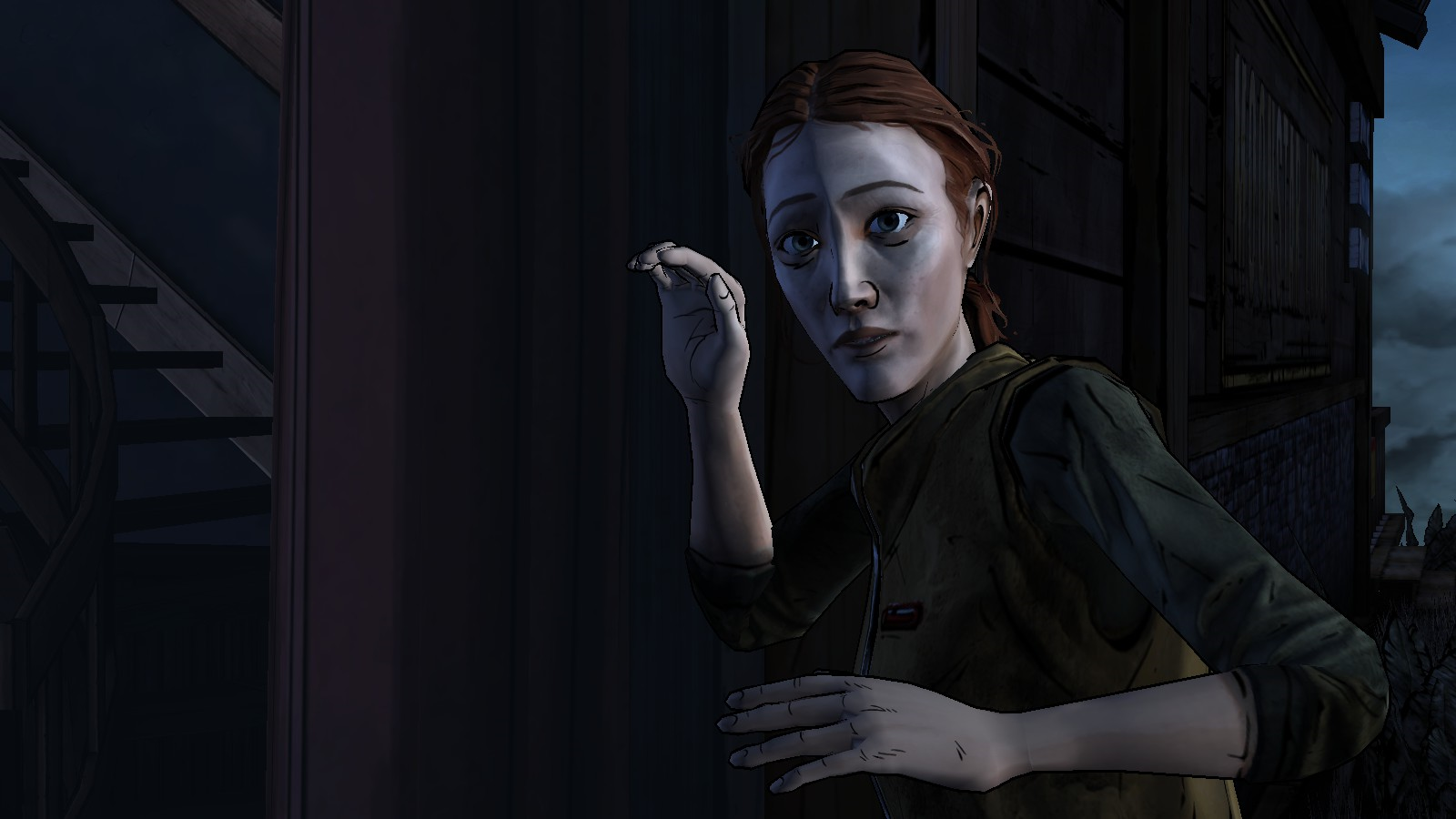
http://img2.wikia.nocookie.net/__cb20140312184745/walkingdead/images/8/81/AHD_Bonnie_Caught.png
I hope Bonnie was your favourite 400 Days character. Cos
you're pretty stuffed otherwise.
Image from Wikia
     Now, a quick aside. Between the two seasons there was released a sixth episode, a DLC called "400 Days", which gave us short glimpses of five brand new characters across the first 400 days of the apocalypse. At the end of that episode, we discovered a representative from a survivor group, and depending on your choices, particular characters would go with her or stay by themselves. (I got all five, btw. Just saying.) We were told this would pay off in Season Two - and it does! One of the characters, Bonnie, can star in four of the five episodes... except, she goes to the group no matter what you did in her chapter. The other four characters we were introduced to? If you got them to go along, they make five-second cameos in Episode Three and then die. Oh, and Bonnie can die in Episode Five, so she's for it come Season Three either way. In other words, another fantastic demonstration of the impotence of the player in their decisionmaking.
     I didn't get to cover everything in this article and I could go on ranting a lot more - about how Omid and Christa die because they decided to leave Clementine alone and randomly have sex in a disused public bathroom, how Carver decided to kidnap a bunch of random people for no reason, and how the game makes characters do irrational things near the end just to give us our end conflict. But the biggest problem is that which I've mentioned - the game insists on telling its own version of events instead of allowing the player to give events their own context. And the paint with which the game brushes its canvas is in particularly muddy colours, a sad and bitter worldview which makes you hate all of the other characters for their sheer inhumanity. It's really disappointing that a game like The Walking Dead ended up like this, and although I'm still sorta looking forward to Season Three (to just find out what the hell they do), I'm not as gripped by it as I once was.

Thanks.

1 I am not autistic, nor a medical professional, and thus have no real basis on which to actually say that Sarah is autistic. I am basing this entirely on the way I have seen people identify with the character as such, and the hurt they felt when she was treated the way she was. I apologise in advance if this offends any readers who do have autism and who do not feel that the character adequately represents someone with the condition.
    

Tuesday, 10 February 2015

Review: The Walking Dead Game: Season One

I have never before covered video games on this site - my friend Tanju has, in his article on Mass Effect, but I never went there. While the medium of games is both an exciting and innovative one, I have never been anywhere near the forefront - aside from Minecraft, I tended to play PC Games from the early 00's. This Christmas I finally gave in and downloaded Steam, and with that came a few steps closer - finally playing games like Skyrim that I'd only ever seen Let's Plays of. Among these games was one of my favourite games to watch - The Walking Dead Game by Telltale Games, a point-and-click-ish interactive story set in the universe of Robert Kirkman's The Walking Dead. (The comics, not the TV Show. Which I will talk about, I promise.)
http://i.kinja-img.com/gawker-media/image/upload/s--iu-WzRpm--/814467108483821347.jpg     Unlike the vast majority of mainstream games on the market, The Walking Dead Game (hereafter The Walking Dead) and other games from Telltale Games embrace a story-heavy structure, with player interactivity restricted either to the performance of specific actions to progress the plot, or in decisions which alter the protagonists' relationships with other characters but not the overall progress of the plot. In this respect, The Walking Dead is the perfect game for me to look at - a game which pioneers the trend in the blending of cinema and gaming, and which does so fairly competently at that. I watched both seasons of the game on the internet show Video Games Awesome, a show which I've watched for a number of years, and I found the first season as entertaining to watch as it was to play, even if the latter experience came with a great deal more tension. Spoilers follow.
     You're convicted murderer Lee Everett, and you're on your way to a Georgia prison when you have a car accident. Upon waking you find yourself in the midst of a zombie apocalypse, and, meeting a little girl named Clementine you find yourself her protector. You meet with redneck Kenny and his family, eventually making your way to your family's chemist store in Macon where you meet with another small group of survivors. The group settles in at a Motor-Inn. Following a trip to a local dairy with more than milk on the menu, the group unintentionally angers a group of local bandits and they're forced to move on, with Kenny focusing on his plan to head to coastal city Savannah and find a boat - the same place Clementine's parents were last seen. You arrive in Savannah to find it ransacked and no boats to be found - what's more, Clementine is eventually kidnapped and you get bitten on your way to find her. You rescue Clementine and she helps you inside a small enclosure as Savannah is horded by zombies - and the season ends as you either succumb to your wound, or have Clementine shoot you.
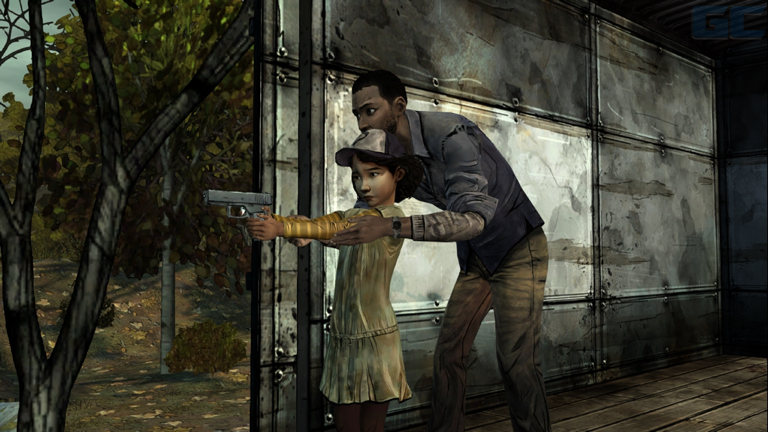
     That final moment is a heart-wrenching one for a single reason - the relationship between Lee and Clementine. No matter how much of an ass the player makes Lee, he and Clementine end up developing a strong bond, and the writing and voice-acting for these two characters makes their relationship a very appealing part of the story. This really started the trend which was later followed by Bioshock Infinite and The Last of Us of the male protagonist and the young(er) girl that he protects, and who actually affects gameplay. Here, Clementine is written as a realistic little girl, and it's so expected that the player will grow to love the character that the vast majority of the plot is aimed at finding and saving her. If the player so chooses, Lee can eventually have Clementine dispatch the season's villain, and in a compulsory scene he guides her through killing a Walker and protecting herself.
http://wpuploads.appadvice.com/wp-content/uploads/2013/10/1-1-1.png
Lee and Clementine's relationship forms the backbone
of the story.
     While the relationship between Lee and Clementine doesn't change, this isn't the same for other characters. The game sets up dichotomous views between characters and has Lee either side with one of them or ignore them, and any decision affects the way that characters will respond to Lee down the line (should they live that far.) Sometimes this affects characterisation - Kenny still bears a grudge on Lee in Episode Four should he not side with him on a particular issue in Episode One - but most of the time it makes the game feel like a more fluid and realistic experience. Sometimes there are issues with the choices' ambiguity - the choices themselves are usually three or four one-line options which you get a limited time to assess, and each often makes Lee say things contradictory to the intention of that option. (This would be abused by the writers in Season 2.)
     Sometimes the choices take more drastic changes to the plot than character relationships and contexts, with individual characters living or dying depending on the player's choice. This happens in the first episode when choosing between tech-savvy Doug or sharp-shooting reporter Carley, and in the third episode it feels like it makes a large difference, with Carley having a decent-sized subplot. However, whichever character you saved ends up being killed mid-way through the third episode in the same circumstances, and both make only small cameos in the second. Choice exists, but it is an illusion - and while the illusion is obvious, the small differences that are made to gameplay by these choices feel enough to make each player's experience sufficiently unique. The sole exception for me was later on in Episode Three, where walking-shitstorm Ben reveals to you on a fast-moving train that he has basically caused all the deaths in that episode, and you never get the option to throw him off the side.
     My favourite part of the game was sculpting the character of Lee - my Lee was diplomatic and leader-like, sided with Kenny on almost everything, but harsh when people fucked up. (*cough*Ben*cough*) Obviously there are a finite number of options for what you can do, but I found expressing my decisions through the character a very satisfying experience - especially in Episode Three, where I managed to convince Kenny to stop the train and euthanize his dying son without resorting to physical violence. The last two episodes were less interesting for me because the character development and group politics gave way to the inevitability and hopelessness of the season's endgame, but they were just as immersive and I really felt concerned for Lee and Clementine's fates.
http://img1.wikia.nocookie.net/__cb20131029182043/walkingdead/images/1/16/SFH_Preview_Ben.png
This little shit gets a dozen people killed, abandons Clem
in a time of danger, and is a character I hate more than
the season's actual villain.
     Now, for the thing I don't usually get to talk about. How does The Walking Dead Game's nature as an interactive product affect it as an experience? I'll have a lot more negative to say when I look at Season Two, but I have to say I think the blending of genres is quite well done. Aside from the decision aspect, the game plays out the plot as a point-and-click adventure, having Lee find items or find out information that allows him to overcome some obstacle. During more fast-paced scenes, Quick-Time Events are used to provide tension as well as player involvement - luckily for PC users, this tends to comprise pushing Q until you're told to push E. This mechanic is worked into the plot - often this is used when Lee is pushing close doors and such, and if he as a character is unable to complete the action, neither can you, no matter how fast your trigger finger is. The interactivity mechanic, finally, also adds some drama/catharsis to certain significant actions like executing trapped walkers or defeated villains, where it's more effective for the player to have to do it themselves.
     Season One had a few quirks here or there that made it sometimes frustrating - once or twice the game mechanics didn't pan out well, and the aforementioned ambiguity in some of the decisions which made me be more harsh or more supportive one way or another than I wanted to be. But 90% of the time the story carried itself well, and the use of the various options when it comes to the protagonist's personality and relationships with other characters means that the result is an immersive, personalised experience and an amazing story. How could it go so wrong after this?

Thanks.

PS. For those interested, I saved Carley, left Lilly, let Ben go and I finished episode four with Kenny, Omid and Christa. I didn't chop off my arm.