Showing posts with label Film. Show all posts

Saturday, 26 March 2016

Review: Batman V Superman: Dawn of Justice

Batman (Ben Affleck) and Superman
(Henry Cavill) square off.
Warner Bros.
This review contains spoilers for the film's climax. I'll try to mark them where possible. 

Are DC and Warner Brothers really so desperate to cash in on the success of Disney's Marvel Cinematic Universe that they would rush the production of the Justice League? Well, yes. Yes they are.
     Warner Brothers launched the so-called "DC Extended Universe" with Man of Steel back in 2013, a film plagued by a painfully serious mood, extensive shoed-in messianic overtones, a confusing editing style and a climax in which Superman commits cold-blooded murder and produces $750 million worth of property damage. (That's thirteen 9/11 attacks.) Years later, the loquaciously titled Batman V Superman: Dawn of Justice tries to rephrase that film in terms of a serious discussion about the nature of messianic figures and individual vigilantism. It doesn't work, instead providing a painfully long, loud and bland attempt to rush the formation of the Justice League and be "controversial".
      Aside from a very confusing editing style which often randomly goes off into ridiculous dream sequences, the film gives itself far too much to juggle - it's quite sad when a film lasts the same length as a Lord of the Rings movie and it barely feels like any characterisation has actually occurred. Aside from continuing the storyline of Man of Steel, BvS also introduces Batman, Lex Luthor, Wonder Woman, Aquaman, Cyborg and The Flash. (Although to be fair the last three are glorified cameos.) Batman is arguably the main star of the film, with Ben Affleck actually being surprisingly good in the role, giving a seriousness which is more serious than his predecessor Christian Bale, but which feels like it has more authority (especially as Batfleck uses a voice modulator and doesn't just put on a silly deep voice.) Gal Gadot is also great as Wonder Woman, although mysteriously they decided to leave all of her character development for next year's stand-alone movie, keeping her appearances down to several scenes sneaking around and then a final triumphant appearance in the final Boss Fight.
    As we're meant to eventually care about both Batman and Superman, we need a villain, which takes the form of Alexander Luthor. Instead of the comics' suave genius Lex Luthor, we instead get his son, a nerdy neurotic psychopath whose mannerisms have a lot more in common with Heath Ledger's Joker - although the most obvious comparison was with a slightly deranged version of actor Jesse Eisenberg's most famous role, Facebook founder Mark Zuckerberg. Luthor's plans are never clear, and the fact that the finale depends on him seemingly randomly manipulating Kryptonian technology to create a monster seems to come out of nowhere. Lex Luthor's mere existence causes a lot of the film's plot holes, from his bizzare and self-defeating desire to blow up the world, his out-of-nowhere personal vendetta with Superman, and the fact that he's able to gain access to giant amounts of alien technology by basically assaulting a US Senator.
It's not a bad performance, but his character does cause the
movie a lot of its problems.
Warner Bros.
      The film's biggest lasting legacy is its darkness, and that's not just a media circus. Everything is taken to its darkest point possible while still keeping the PG-13 rating. Batman, whose character tends to abhor guns due to the murder of his parents at gunpoint, is seen in this movie carrying dual kalashnikovs and gunning, stabbing and impaling his criminal enemies willie nillie. The film takes the idea of Superman as a vision of hope and grinds it into the dirt, reveling in in-universe right-wing media sources decrying Superman as an alien monster to be treated with utmost suspicion. And, funnily enough, I see there point - this is a Superman who gets angry, who doesn't control his immense power, and this inevitably leads to his destructive battle with Batman. By far the lasting impact of this film's darker influences was a scene in which Superman is tricked into going to a Congressional Hearing by Lex's men - a hearing which turns out to be a trap when an explosion flattens Capitol Hill. The image and shooting of the scene was very well done and caught me completely by surprise, but the subject matter may still be a little raw given the events only three days prior to the film's release.
      By far the worst symptom of this darkness, though, was the ending. Spoilers follow for this paragraph. Once Lex Luthor's plot has been defeated, we find his back-up plan - Doomsday. Via some alien jigory-pokery that isn't really explained very well, Lex Luthor creates the giant Kryptonian supermutant Doomsday, a fella who looks like Azog the Defiler and who can fire immense electromagnetic blasts from his face. Superman and Batman team up with new arrival Wonder Woman to fight him, with Superman using Batman's Kryptonite spear to stab him in the chest. In the resulting melee, Doomsday impales Superman on one of his claws, and Superman dies. The problem is that despite five grueling hours of Dark!Superman material, we still don't know him in as much depth as we do other versions of the character. I don't care enough about the character to be shocked by his death, and I also don't believe that DC is going to permenantly kill off their headline character in the second film of a franchise that already has five more films planned out. This plotline was used far too early, and it essentially destroys any tension in future films from the DCEU. It also continues the ridiculous, lazy messianic archetypes ruling over the Superman character - even to the point where in both the UK and US, the film premiered on Good Friday.
Maybe if people stop obsessing over Gal Gadot's physical
appearance, they might realise she's a fantastic Wonder Woman
and I'd love to see more of her.
Warner Bros.
   At its core, Batman V Superman: Electric Boogaloo could have hit some very interesting points - if they had kept the drama down to just Batman and Superman, following on from the repercussions of Man of Steel and deconstructing the typical Superhero action film by really showing the consequences of mass-scale collateral damage. Those aspects of the film were by far the best, especially the superb performance by Holly Hunter as the Senator in charge of leading the hearings. Sadly, it was Lex Luthor and the endless tie-ins to future movies that took a strong premise and coated it in tar and feathers. Warner Brothers really failed to understand that the reason why The Avengers works is because we had time to get personally invested in each character over a number of years. This film is often compared to Captain America: Civil War, a similar superhero duel movie coming out in May, but that ignores the main difference that will almost certainly make Civil War superior - it is the thirteenth film in its franchise, while this is only the second. Combine that rushed pace with poor direction and a general lack of a sense of humour, and you get one of the biggest let-downs of this year so far.

Thanks.

P.S. Hopefully my review won't make Ben Affleck too sad. (Thanks to my friend Jen for asking me to include this. ^.^)
P.S.S Reasons to watch Channel Five news...

Monday, 26 October 2015

Review: Submarine

For another look at this film, why not read my friend Josh's review here?

Submarine - Directed by Richard Ayoade (2010)
Written 24/10/15.

I tried my absolute best to despise this film for five years. My impression from promotional images was that this was a piece of twee, misguided faux-Andersonian dreck plastered across a British background and filled to the brim with the pretentious, "quirky" mannerisms and stupid quotes to be mass-produced on moody Tumblr posts. And, for my part, I was more or less completely correct. Now now, don't go away. I was far too harsh on Submarine - I judged the book by the cover, and I was mad to do so, because this film is one of the most refreshingly realistic romantic comedies I've seen in a long time. Simultaneously managing to be sweet, witty, and just a little bit weird, Submarine uses art-film techniques for a remarkably accessible experience.
     Directed by comedian Richard Ayoade (The IT Crowd, Was It Something I Said?), the film follows Swansea teenager Oliver Tate (Craig Roberts, Being Human) and his strange, creepy obsessions with both his parents' love life and with Jordana Bevan (Yasmin Paige, The Sarah-Jane Adventures), a cold pyromaniac that he is desperately in love with. Tate narrates the film with a fast-paced string of sometimes-witty sometimes-cringey teenage observances about the world he lives in, and charts his efforts to both save his parents' flagging marriage and to woo Jordana. Obstensibly opening as a quirky romantic comedy, the film wanders through several shades of surrealism before settling in on our own reality, where Oliver must take responsibility for the stupid decisions he made trying to achieve both of his goals.
     The film's Welsh aesthetic is breathtaking and feeds into the overall feel of the film, tying in loose, Andersonian references to French New Wave and classic Hollywood into maritime folklore. Ayoade spends a great deal of time deliberately muddying the waters between love and grief, and there are a few scenes which deal with certain characters' experiences with depression and hopelessness. Despite this bleakness, the film also feels quite warm - stoked with nostalgia of our own childhood mistakes, and eventually triumphant when despite cocking up massively, Oliver is implied to get everything he wanted. It's a bittersweetness which ends up falling very much on the side of sweet, and the film takes you through so many peaks and troughs of feeling that it really earns that final one-sidedness.
I mean... you can tell why I thought this film was hipster trash,
right? Look at this stuff. It's not, though, you should totally go
and see it.
      A lot of this is down to the likability of the leads. Craig Roberts, at this point trying to move away from his time in Tracey Beaker and that one Being Human episode with a gimp in it, manages to create a wonderful duality within Oliver Tate - a character who is clearly selfish and pretentious, but whom you end up loving regardless because of the genuine good intent behind a great deal of what he does. Despite sporting a dodgy accent, the same is also true of the wonderful Yasmin Paige, presenting Jordana as effortlessly cool and distant one moment and gentle and fragile the next. It really pisses me off that the most work she's had since this film is effing Pramface (although I have yet to see Glue, so there's always time).
       One thing that makes Submarine work is that it isn't trying to be clever with its direction - it occasionally uses title cards and other stylistic flourishes, but these are all heavily functional and serve to enhance the film's mood. It's a story of two strange but highly identifiable characters, engaging with the rest of the world and attempting to find solace in their idea of "okay". I've been tempted throughout writing this review to call Submarine, "the British Moonrise Kingdom". But I've got a much different idea now, one that surprised even me when I decided I was going to write it.
       Submarine is better. And that's the best accolade I can give.

Thanks.

NEXT WEEK: We discuss the artsy-fartsy Jim Jarmusch film, Broken Flowers.

Friday, 17 July 2015

Review: Frances Ha

Frances Ha (2012) - Directed by Noah Baumbach

In my past two reviews, Into The Wild and Tracks, both of the films I reviewed focused on young people, setting out into the world and taking their desire to leave society to a logical extreme, with tragedy in the former case and future success in the latter. But explorer Robyn Davidson was a member of the Baby Boomer generation, and Chris McCandless was in Generation X. What about the young people of today - the so called "millenials", the "90s kids", the "lizard people"? With this film, starring and co-written by indie actress Greta Gerwing, I touch upon an entire genre of films about semi-rich, obnoxious white kids living in the city and not knowing what to do with their lives.
     Frances (Gerwig) is a 27-year-old trainee dancer who lives with her best friend Sophie. After breaking up with her boyfriend, Sophie ends up moving to a better apartment without her, and Frances spends the rest of the film couch-surfing and moving around social groups, dropping the few opportunities that her life does bless her with. After falling out with and reconciling with Sophie and other friends, she eventually achieves some form of hope for the future, with her own apartment, a potential boyfriend, and a job opportunity.
     Gerwig arrived in the mainstream from a film movement known contentiously as "Mumblecore", an informal collection of films mostly by the same people, following young people through their struggles in post-graduate life, expressing their feelings through naturalistic dialogue and the inanities of modern life. This films feels slightly more focused than some of those Mumblecore films, but the film focusses on the same issues. I've heard the idea of a "quarter-life crisis" often discussed, and this film is an 85-minute essay on that very concept. It's not like Frances doesn't have hopes and aspirations, and it's not like she's completely talentless - it's just that all of the parts of her life don't come together as naturally as we're taught that they will. She doesn't always have a network of friends, even in this age of constant communication and social networking, and she doesn't always have the financial ability to invest in and carry through the things she wants to do. Her life is built upon dreams more than it is resources and ability, something I know I'm guilty of in my life.
Sophie and Frances, in the film's monochrome style.
      But even though I identify with the film and the movement, and its terrifying implications for the future of my life, as I try and reconcile my love of film with my attempt at a Physics degree, I can't say it was all sunshine and roses. Not all films are meant to be entertaining first and foremost, but they have to at least capture one's interest.over the running time. Near its middle, in Frances' most bleak moments, the film risks dragging its audience into a deep apathy at the hopelessness and lack of drive that it possesses. This is not helped by the film's greyscale complexion (the artistic reason for which I can't really place), and the fact we spend good portions of the film with pretentious socialites.
    Frances Ha is not a mood film; it's not a film that you sit down when you want to feel anything in particular. It has its funny moments, its sad moments, but the result is something which manages to be both as naturalistic as it's trying to be and still a little twinged with the air of an artistic movement its lead can't really escape. A lot of the film can be unpleasant, both for parts of its listless dialogue and for the worryingly familiar subject matter, but all of its foibles and plot points come from life itself, and so I can't really fault it. What is life, after all, if not a slightly crappy and less structured form of storytelling, each of us the lead in our own picture? And if that idea is what this film represents, then it did so perfectly.

Thanks.

Friday, 10 July 2015

Review: Tracks

Tracks (2013) - Directed by John Curran

Following on from Into The Wild in a loose theme, we come across another true-story film about someone travelling through the wilderness. Like that film, this film has amazing cinematography and landscapes, although unlike that film, I don't hate the main protagonist. Starring Mia Wasikowska (Tim Burton's Alice In Wonderland) and Adam Driver (Frances Ha) the story follows future travel writer Robyn Davidson on her single-minded quest to trek across the Australian desert with nothing but four camels and a dog in 1977, and despite its fairly lackadaisical pace it more than makes up for it with barrelfuls of charm and astounding visuals.
     I'll admit the only other role I've seen Wasikowska in was her American breakout film Alice In Wonderland, where many found her attempt to act unworldly come across as a tad static. I'm convinced now that that was down to the script and not the actress, as Wasikowska's portrayal of Davidson is layered and subtle, capturing her both in moments of dogged determination and strength, and in the journey's low points where, struck by isolation and heat, she begins to lose herself. Which is lucky, as she's rarely ever off-screen, and carries most of the film reacting off of the landscape, and a small cast of side characters devoted to aiding or documenting her journey.The only other standout character is Driver's Rick Smolan, Davidson's photographer and sort-of love interest, who despite less than promising beginnings is able to develop from an annoying presence to a decent guy.
     John Curran treats the story with a great deal of artistic loyalty - he doesn't big up Davidson as some kind of folk hero as Penn did to the subject of Into The Wild - he lets the character more or less tell her own story. An important aspect of this is the cinematography - deserts are at risk of becoming very boring, but Curran manages to make every shot beautiful and uses them to contribute towards the film's amazing otherworldly tone. Borrowing heavily from the culture of the Aboriginal people that Davidson met along her journey, the film's imagery and sound design evokes a spirituality which manages to establish the film's dual nature as both a travelogue of Davidson's journey and as a wider examination of life and culture in the Australian outback.
Robyn Davidson (Mia Wasikowska) and her dog Diggity.
     It's hard to pick this out as a thing because of the film's biographical nature, but I seriously love this film's narrative structure. Way before the journey actually begins, we follow Davidson's arrival in Alice Springs and her attempt to set herself up for the journey, learning about camels and arranging funding from National Geographic. In all this she is fundamentally ungrounded - an ethereal girl with a few mentions of a home life, but with that base replaced by her determination to make her trip. But just before she's about to leave, her friends arrive - clean clothed, evidently used to society, they instantly force Davidson into context, both making her seem much stranger than before, and, in my case, demonstrating more than ever why she wanted to make the trip in the first place. Her friends come and they booze and chatter and argue and even though I probably have more in common with them than I do Davidson, the structure just makes me get it. It's genius.
     It's lucky that I'm reviewing this straight after I reviewed Into The Wild. I feel guilty about making the comparison so often because this should really stand on its own, but the similarities between the films are just so striking. This journey is a triumph and not a tragedy - admittedly, you know, Davidson survived and became a writer, while Chris McCandless died on his journey, but the truth is that their journeys are just as ill-advised as the other. The difference is that even in the harsh environment of the Outback, Davidson never fully rejects other people, and one of the lessons she appears to learn in her travels is to value the connections she has with those close to her. She's an inspiring woman, this is an inspiring film, and I'd really recommend it.

Thanks

Monday, 22 June 2015

Review: Into The Wild

Into The Wild (2007) - Directed by Sean Penn

In the April of 1992, rambler Christopher Johnson McCandless ventured out into an area of the Alaskan wilderness known as the Stampede Trail. He had a small number of provisions - he had spent the last two years on the road, not communicating with his old friends and family, aiming to become totally independent and self-sufficient. In the September of the same year, McCandless' malnourished body was discovered by hikers, and the story of his doomed adventure entered into the American consciousness. And then, fifteen years after his death, two films were released which investigated McCandless - one by an independent filmmaker with a more documentary bent, and this film, directed by Sean Penn and fully dramatised.
     Penn seems to admire the subject of his film - the man who liked to refer to himself by the alias "Alex Supertramp" on his travels. The film covers his journey across the States over the two years before he travelled to Alaska, presenting itself as a sideshow of interesting places and faces, and intercutting with a more conjectured portrayal of the last few months of his life, living in an abandoned bus. It's difficult for me to make judgement on the film without directly judging the man himself, which I feel would be something of a dick move on my part, and so I'll clarify that when I say that Alex is someone I have very little sympathy for, I am referring to his dramatised counterpart, here played by Emile Hirsch.
     On first viewing Into The Wild I didn't know that this was a true story - this was one story that hadn't crossed the pond. This is important because it meant that my view of the subject was completely free of prior bias. Chris is from a fairly wealthy middle-class family that can afford to let him run a car and is prepared to buy him a new one on a whim. He seems to have gone to a fairly good University and passed with flying colours, with Harvard being a possible career path. His eventual escape from his home-life therefore feels an act of pure selfishness. We hear possible rationalisations from his family: his father was abusive; his father never told him or his sister that they were bastards. But none of those things (with the exception of his father's alleged abuse) cover up the fact that though all this, I see Chris as a pretentious, naiive figure, far from the tragic martyr to the American Dream that the film paints him as.
The last photo taken by the real McCandless, rip.
      Which is, as far as I see it, something of a flaw within the diamond that is the rest of the film. In all the ways that matter, this film is excellently made and it looks and sounds gorgeous. The cinematography is clever and vibrant and it brings out the best of the film's sweeping landscapes. It also takes an amazingly demented turn near the very end of the film as we see Chris literally shuffle to his final resting place and die of malnutrition. By far my favourite thing about the film, though, is its soundtrack and audo work. Complementing an amazingly poignant soundtrack by Eddie Vedder are the voiceovers done by Hirsch as Chris and Jenna Malone (The Hunger Games) as Chris' sister Carine, the latter of whom gives the film the vast majority of its hindsight.
     Despite the film's popularity having stemmed from the perception of its protagonist as a great figure of freedom and independence and rejection of society, I think the film works a lot better as a long, bittersweet epitaph - one which, despite often being as pretentious and unnecessarily verbose as its subject, Which is why I think you really should watch this movie - because, no matter what conclusion you come to on McCandless himself, this is a beautiful movie and a beautiful, real world tragedy.

Thanks.

Monday, 20 April 2015

Review: The One I Love

File:TOIL poster.jpg
From Wikimedia
The One I Love (2014), Directed by Charlie McDowell

Spoiler Warning. If you have any intention of seeing this film, go ahead and do so before reading beyond the first paragraph of this article. This is not just my reccomendation - this was the main message given to the press upon this film's release last year, promising a provocative twist on an otherwise run-of-the-mill story about a couple - Ethan (Mark Duplass, Jeff, Who Lives At Home) and Sophie (Elisabeth Moss, Mad Men) - who go away on a retreat to try and rekindle their marriage. The promise of such a twist has been so woven into the film's marketing blurb that it's almost certain to result in disappointment from some viewers, but I certainly wasn't one of them, as much as I think the film needed some fine tuning on its Charlie-Kaufman style plot. Remember, spoilers from now.
     Ethan and Sophie have been failing to rekindle their relationship, unable to develop their relationship beyond their initial spark of passion and now reaping the unhappiness from having not moved it forward. Their new marriage councillor sends them to a retreat which seems normal at first, until both of them experience things with the other that their spouse does not remember. It seems that when one of them enters the property's guest house, they are able to interact with a doppelgänger of the other, with certain things refined and improved - Sophie's doppelgänger cooks fried breakfasts for her husband, and Ethan's is sensitive and works out. Things take a strange turn when both doppelgängers are able to leave the guest house, spiralling the film out into a bizzare sci-fi-lite plot in which it's revealed their copies are people conditioned to be like them in order to escape the house. It all gets confused from that point, until the real Ethan escapes with the woman he believes to be his real wife - and we are left to wonder whether he is right.
     I wouldn't usually put focus on a film's advertising, but the director put so much PR into the preservation of a spoiler-free experience that one must wonder where that's coming from. The One I Love's concept is something out of a Twilight Zone episode (indeed, that show is name-dropped) and the film doesn't really drop its big "twists" until about two-thirds of the way through. If you accept that McDonnell just wanted to preserve the first time experience (despite living in this age of digital free information), then it was a poor decision - said third-act twist is poorly explained and not really elaboated on - and that's okay for the purpose of the movie, it's just not something to get hyped up over. A more cynical view is that the whole thing was a marketing plot to allow the film to be advertised as a more mainstream romantic comedy instead of the quirky pseudo-thriller that it is.
     All that makes things a little awkward from the off, because despite that little bit of strangeness in its marketing, I really love this film. Duplass and Moss carry the film for pretty much its entire runtime, and play two characters who are subtly the same but different. Moss especially manages some Tatiana Maslany style subtlety whenever she gets to play her doppelgänger (mainly near the film's end.) On a textual level, The One I Love captures the necessity of renewal in long-term relationships, with both characters defeated by their inability to compromise and work towards maintaining their relationship as both of them change and grow older. If the final scene's suggestion is to be believed, then Ethan can never learn his lesson, because he now lives with a version of his wife who will change to acquiesce to his desires, and by pursuing Fake!Ethan, Sophie is now trapped in the estate for some unknown amount of time, possibly for the rest of her life.
     The supernatural idea that defines the first half the of the movie becomes its main flaw when they try to explain it - as a plot device it just exists, but the moment you try and explain its mechanics in real-world terms you start to strain suspension of disbelief. A doppelgänger producing house in the middle of nowhere is a random supernatural occurrence. Introduce elements of conspiracy and secret files and a strange, lethal force-field, and you start wanting to put people behind their existence. And the film doesn't need that, because as it stands its a good enough exploration of the central relationship. If you've not seen the film and you read this far anyway just to defy me (it's okay, I still love you, reader), go and see it. There are a few shots that linger for too long and all over the direction could have some fat cut away from it, but as an experience it's still a fantastic rollercoaster with a fairly decent message behind it.

Thanks.

Wednesday, 9 July 2014

My Wes Anderson Experience

The camera turns 90 degrees to the side, revealing some unknown figure. They make a sardonic reply. Maybe they're smoking on a cigarette. A child says something no child would say. Time slows down in a dramatic moment. A classic rock song comes on. A dog or other small animal is killed in a way which is both tragic and hilarious. People don't have the right accents. You're reading something and the cover appears with bold yellow letters in the Futura font. A narrator discusses your every move. You pass Owen Wilson, Jason Scwartzman and Bill Murray and think nothing of it. You're in a Wes Anderson film.
     Wes Anderson films are some of my favourites, not only because of the times they came into my life but because of the inventive style and themes which don't hide his problems but instead do their best to make up for them. Having seen all the films now, I wanted to put down my thoughts on my experiences with each of these varied and wonderful films, for better and for worse.
http://upload.wikimedia.org/wikipedia/en/a/ae/Bottle-Rocket.jpg
From Wikimedia

Bottle Rocket (1996)

Based on a short of the same name Anderson directed in 1994, Bottle Rocket is the debut of the Wilson Brothers Owen and Luke, the former now known mainly for wacky comedies. This was the last of Anderson's films that I saw, and what is immediately noticeable with hindsight is how simply normal the style is - the camerawork is more naturalistic and the characters distinctly more human. The tale of two friends, one attempting to become a career criminal and the other trying and failing to move away from that life, works mainly because of the brothers and their familial relationship.
      Although Wilson's directorial style is typically absent here, there are hints towards it development. The film ends with the first of Anderson's famous slow-mo scenes as Owen Wilson's character goes to prison. It's not a film I love, but I don't really hate it either, and it's fairly fun where it needs to be.

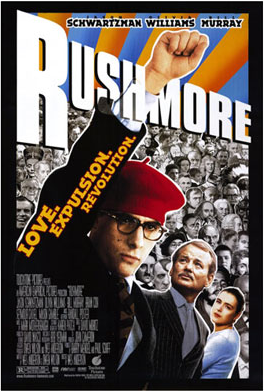
Rushmore (1998)

From Wikimedia
Rushmore is my least favourite Anderson film by a pretty wide margin, and is thus of course a critical darling. It's not that it isn't good - in place it's brilliant - it's just that I don't enjoy the way it was executed. Jason Schwartzman, another of Anderson's major collaborators, makes his début here in what is his most complex and thought-through performance as the central character Max Fischer, a brilliant-but-lazy fourteen year-old whose crush on nursery teacher Miss Cross (Olivia Williams) leads him into direct competition with tired industrialist Herman Blume (Bill Murray, in his first of many Anderson appearances.)
     Instead of developing any particular relationships, the film is focused entirely on the development of Max's character, from his ignorant and arrogant beginnings to what is hopefully (and deliberately ambiguously) more wise ending. His sparring with Blume ends up failing spectacularly in a fantastic scene which rips away the film's prior pretence of being a romantic comedy, with Williams' Cross tearing into both Max's adolescent sexual posturing and Blume's desperation. The rest of the film sees Max rebuilding the bridges he burnt with his barber father and the few classmates who actually liked him.
     The reason why I can't really watch this is for that first half, in which Max's personality is so grating that it makes the film difficult to watch. The implication at the end that the vast majority of his development has been for show doesn't make that any easier, and neither does this being the first example of Anderson's habit of giving children adult voices. It works here because it shows Max's precociousness and arrogant naivety, but in later films it stands out and adds a strange tone to proceedings, especially in films which focus on children as main characters.

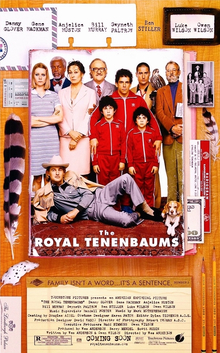
The Royal Tenenbaums (2001)

http://upload.wikimedia.org/wikipedia/en/3/3b/The_Tenenbaums.jpg
From Wikimedia
The archetypical Wes Anderson film, and by far the most well-known. It's the first with an all-star cast, as well as being the first which really displays the style Anderson is known for. Unlike his first two films, which could conceivably take place in our reality, Tenenbaums is the first which feels like it exists in a bizarre parallel world where everything has been subtly rearranged to be more whimsical. This also brings out another shade of Anderson's work in which dark themes take the wheel, even though humour and whimsy surround them.
      Following the decline and rise of the Tenenbaum Family, the family's many members and their respective backstories (explained in a long intro by narrator Alex Baldwin) means that there's something for everyone. The film's nature means that everyone is stained by tragedy - Richie by his failed career and life-long obsession with his adopted sister, Margot by her abandonment issues and eternal dissatisfaction, and Chet by the death of his wife and the obsession with health and safety that follows. This is all bound together by the film's central focus on patriarch Royal (Gene Hackman) and his attempts to bring his family back together by any means, even if that means that he has to change his character to do it.
     For me the film is in a weird place - I love the film's style and aesthetic, as well as its fantastic soundtrack. The dynamics of the Tenenbaum family are ridiculously enjoyable to watch - as is the liberal amounts of development that every single character gets in spades. Where I end up feeling a little awkward is during the film's depiction of suicide and the underlying misogyny that surrounds that entire issue. Mid-way through the film, Luke Wilson's Richie discovers that his adopted sister Margot has in her life had a string of lovers, and for a reason I can't fathom this drives him into a suicidal state which Margot later blames herself for. It's a stain on what is otherwise a fantastic film with some really warm themes.

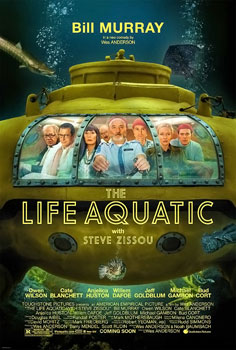
The Life Aquatic With Steve Zissou (2004)

http://upload.wikimedia.org/wikipedia/en/7/7c/Lifeaquaticposter.jpg
From Wikimedia
Bill Murray is a prolific contributor to the Anderson oeuvre, and this film is his day in the lime-light. The Life Aquatic is a tribute/ripoff of the works of famous oceanographer Jacques Cousteau, who style and works are borrowed by Anderson to create a tale of redemption and loss. Critical reception to this film was terrible - it is thus, of course, one of my favourites. The main criticism of the film is that Anderson's direction and set design so often breaks with convention that it often becomes impossible to maintain the suspension of disbelief, but I think this is what the film wants, as it continually plays with the audience's expectations by comparing and contrasting with reality.
     Bill Murray is at his best when playing characters who are tired of life - this is true of more or less all of his Anderson appearances, with the possible exception of his cameos in The Darjeeling Limited and The Grand Budapest Hotel. Here though is where that performance gets to shine, as through the guise of defamed oceanographer Steve Zissou we see his cynicism develop to a fever pitch. At the same time, Wes Anderson gets in his daddy issues with the character of Ned Plimpton (Owen Wilson playing against type), who believes himself (falsely, as we discover at the end) to be Zissou's son.
     Mark Mothersbaugh (who scored the first four Anderson films) adds to the film's distinct aesthetic with his score - half of which is Seu Jorge's brilliant Portuguese covers of David Bowie songs, some out-of-nowhere electropop and then the chilling Zombies b-side "The Way I Feel Inside" for Ned's death.
     It's tempting to call Wes Anderson the king of Daddy Issues, and this film is the middle of a trilogy in which those themes are at the forefront. The Life Aquatic instead focuses on isolation and, as is as also a common Anderson theme, the idea of lost glories. This is big in every Anderson film from The Royal Tenenbaums onwards, but here is where it first became the star focus.

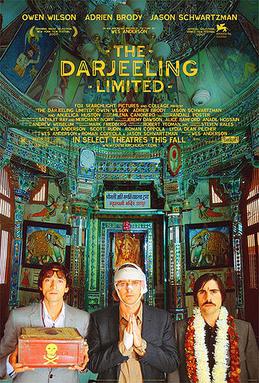
The Darjeeling Limited (2007)

http://upload.wikimedia.org/wikipedia/en/1/1e/Darjeeling_Limited_Poster.jpg
From Wikimedia
My favourite Anderson film, and one that I can quite literally watch at any time without getting tired of it. Following a successful and critically loved short called Hotel Chevalier, Darjeeling follows three American brothers (Played by Owen Wilson, Adrian Brody and Jason Schwartzman) on a train-ride across rural India, meeting for the first time since their father's funeral and, initially unknown to the younger two brothers, on a quest to find their estranged mother (Anjelica Huston). Along the way they indulge in spiritual encounters, obstensibly to gain enlightenment but actually coming to learn more about each other and the reasons why they fell apart in the first place.
     Unlike most of the rest of Anderson's post-Bottle Rocket films, there's very little in way of presentation and pretention. Not to say that his style isn't everywhere, but there's no narration or bookmarks or grand storytelling. He lets the three leads play out their own characters in a series of confined spaces, eventually casting them out into the wilderness and bringing their shared neuroses to a head. It's quite odd to think that Anderson's most heartwarming and uplifting film centres almost entirely around a sequence of two funerals and two seperate abandonments. But it's about siblinghood and family and overcoming past differences in a way which, while still fairly bittersweet, is somewhat more positive than elsewhere in the ouevre. (Last time I'm gonna use that word, I promise.)

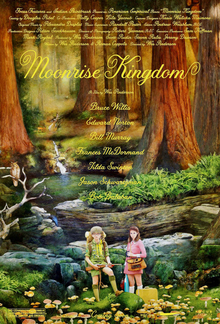
Moonrise Kingdom (2012)

http://upload.wikimedia.org/wikipedia/en/4/4f/Moonrise_Kingdom_FilmPoster.jpeg
From Wikimedia
My first exposure to Anderson, Moonrise Kingdom came into my life at a time where I needed escapism, and escapism is what I got. The world of New Penzance and the associated islands are incredibly isolated, and this makes the adventures of Suzie Bishop and Sam Shakusky all the more influential on the islands' tired adult populace. On a surface level it's a story about two children breaking free from the shackles of society and falling in love with each other. On a deeper level, it's about the adults of the story realising that their lives could do with a bit more of the couple's childlike idealism.
      Also making Moonrise Kingdom so memorable is the first appearance in the collection by composer Alexandre Desplat (he's done so many scores it's not worth listing just a few of them), whose floaty original music is mixed in with a score heavy in the works of Benjamin Britten. The resulting score gives the film an ethereal atmosphere and underlines both the film's sense of adventure and its sense of nostalgia.
      My favourite performances in the film are those of Bruce Willis' exasperated Captain Sharp and Bill Murray in a role which makes Steve Zissou look like a beacon of positivity.

The Grand Budapest Hotel (2014)

http://upload.wikimedia.org/wikipedia/en/a/a6/The_Grand_Budapest_Hotel_Poster.jpg
From Wikimedia
Anderson's most recent production is one in which every single shot is an Andersonism. It is, visually, an exquisitely constructed piece of artistry, in which every single shot has some great artistic reference (or simply looks pretty.) At the same time as maintaining this aesthetic, it also presents a continual mix of maddash comedy stylings and a great, all-imposing melancholy which encroaches on the film from beginning to end. There's no character development as in other Anderson films - instead, we examine a series of continual, domino-esque falls from grace as the eponymous hotel and the great figures associated with it each move past their golden eras.
      The result is a breathless film, as beautiful as it is horrifying, as funny as it is morose. Desplat's score not only enforces the film's strange omni-European roots, but also drives home the various styles of fashion and music that the film passes through as it flashes back and forth between the present and various decades of the 20th Century. Both Ralph Fiennes and Tony Revolori's lead characters are eccentric individuals with coloured pasts and a deep layer of sadness beneath their exteriors, and the relationship that develops between them (less father-son this time, at last) is a joy to behold, even when it ends up having tragic consequences. It's a beautiful film and, despite the very bitter end to its tale, it's an experience that's worth having. It's the pinacle of what Wes Anderson has acheived.

Thanks.

Monday, 12 May 2014

Review: Ghost World

http://upload.wikimedia.org/wikipedia/en/c/c3/Ghostworldposter.jpg
From Wikimedia
Ghost World
2001, Dir. Terry Zwigoff, Written by Daniel Clowes. Written 25/4/14.

Teenage cynicism. It's not surprising that we all face a part of our lives in which we question the world around us to the extent that we doubt that anything good will come of our endeavours. Much like it's 90's colleague Daria over on MTV, Ghost World, adapted from the graphic novel of the same name by Daniel Clowes, follows two teenage girl who embody the deadpan cynicism often associated with the teen demographic - taking the time to, of course, deconstruct those associations and examine them for all of theirt worth. At it's heart it's a film about loneliness and disconnect from society, but it's also a fantastic look at all sides of teenage mindsets without doing much stereotyping.
     Having just graduated from high-school, eternally-deadpan friends Enid (Thora Birch) and Rebecca (Scarlett Johansson) are planning to get a house together, having chosen not to go to college. While Rebecca is work conscious and has a workable if not that promising idea of her future, Enid is a dreamer whose abrasive personality disconnects her from almost everyone around her - everyone, that is, except Rebecca and Seymour (Steve Buschemi), a lonely jazz-fan who the two meet when Enid decides to prank him by answering his desperate lonely hearts ad and then standing him up. Enid begins to obsess over Seymour, to the point that she and Rebecca's friendship slowly disintegrates - meanwhile, Seymour gets into a relationship and she can't seem to cope. After a misguided one-night-stand with Seymour, Enid makes the choice to run away for good, with her fate left up to the viewer.
     The film uses Enid and Rebecca to contrast stages of maturity and development. The start of the film sees Rebecca as more dismissive and irreverant than Enid, but as the film develops she is the one who develops. Enid stagnates; she never tries to connect with the people around her, instead dismissing the entire human race as beyond her ken and blaming them for her isolation. This is also seen in her remedial art class, where the teacher is a comical figure who is more obsessed with deep, abstract art rather than other, less pretentious forms of expression, culminating in her borrowing a racist caricature as a "statement" on racism which leads to any small hope of a career being removed along with it. It's quite interesting to look at the reactions to this film; a lot of the audience left the film not just invested in Enid's story, but deeply in tune with her views of the world. (Hint: you're not supposed to share Enid's views about the human race.)
http://videovortex.files.wordpress.com/2014/02/enid-ghost-world-2813176-900-599.jpg
Enid and Seymour are bonded by obsession.
From videovortex
     Part of the film's key statement is to take this deadpan attitude and show how it is fundamentally a great exaggeration, to the extent that Enid cannot really operate. She believes that the adults around her are useless, that society can only bring her sadness; yet society keeps trying to help her. She's on the scholarship but she fucks it up by being ridiculously insensitive, she rejects a pretty decent job offer from her step mother, and she completely fucks up her friendship with Rebecca due to her obsession with Seymour. (There are also some minor characters that steal the show a scene at a time, but they're more for window-dressing.)
     Ghost World is an assault on its premise - and one that's done in a thoroughly world-shattering way. Enid and Rebecca are both parodies and accurate representations of the attitudes they embody - such paradox is usual when it comes to matter of the teenage persona. At the same time, we're forced to examine what society does to people - both in the expectations that are put on Enid and Rebecca in their slow road to adulthood, and in the loneliness which Seymour feels due to his obsession and anger. It's quite telling that just as Seymour explains this to Enid, she can't see those same properties in herself and her obsession with him. The fact that we can is the reason for this film's tremendous success, even if it makes you examine a few uncomfortable home truths.

Thanks.

NEXT WEEK:We learn about the fabled Leopard Shark in The Life Aquatic with Steve Zizzou.

Monday, 28 April 2014

Review: The Eternal Sunshine of the Spotless Mind

As in its beginning, work on the blog has basically come to a complete standstill. I've finished the Lost reviews, but if I do finish Voyager Season 3 then it will be far after it's due, probably in the Summer. As for now, I've got a few films to talk about, so without much ado...

eternal-sunshine-of-the-spotless-mind-1
POSTER SHOT!!! From thefilmchair
The Eternal Sunshine of the Spotless Mind
2004, Written by Charlie Kaufman, Dir. by Michel Gondry. Written 24/4/14.

There's a certain set of a assumptions that come with cult films - a very specific number of tropes that tend to get played out over and over again. This is especially true in romance - there is, after all, only a certain number of ways that two hetereosexual cisgender white people can interact with each other romantically. It's a genre which has very much been done to death - but then again, that's something that doesn't seem to really bother Charlie Kaufman (Being John Malkovich, Adaptation), who excels and taking genres and tearing them apart at the seams. While the film starts out as a conventional if odd romance, it soon develops deeper science-fiction roots which serve not only to offer some questions about human nature, but to bring the entire romance genre crashing into the real world.
     The film follows the quiet, unassuming Joel Barish (a straight-faced Jim Carrey) as he bunks off work and ends up meeting the excitable Clementine Kruczynski (Kate Winslet), with whom he finds an immediate connection. Flashback to a day prior, and we learn that both Joel and Clementine have chosen to erase their memories of a prior relationship which went sour due to their innate incompatibility. The film then follows Joel inside his mind, reliving the memories of his relationship with Clementine while a host of minor characters (doing the erasing) undergo their own, distracting plotlines. The film's structure works to force the secondary characters into as much dramatic limelight as the two leads, and as a result it's that much richer.
     By going backwards through Joel's memories of his relationship with Clementine, the film both mirrors and parodies the conventional US rom-com format - the cute meeting, the argumentative stages, and then slowly growing closer to the point of intimacy. Except that it points out at every step of the way the problems which come with their relationship, from their personality clashes to their irrational complaints about one another - culminating in the ending of the film (spoilers hur hur) in which both Joel and Clementine in the present receive the tapes they made before their memory wipe, and decide to proceed with their relationship even knowing that they may end up explosively breaking up. And then there was some weird recursion thing, but I ignored that.
eternal-sunshine-of-the-spotless-mind-3
Clementine and Joel. That mug looks painful.
From thefilmchair
     The film's secondary character sinclude a host of faces which for 2004 is quite impressive - faces like Kirsten Dunst, Elijah Wood, Mark Ruffalo and Tom Wilkinson. They engage in a storyline running through the other one, in which they are all involved in erasing Joel and Clementine's memories of each other. (By choice.) Each of them is equally fucked up: Wood's character uses Joel's memories of Clementine to attempt to seduce Clementine and steal her underwear; Dunst is pursuing a relationship with Ruffalo's character in order to get in with her boss Wilkinson; Wilkinson has already had an affair with Dunst but keeps wiping her memory of it; and Ruffalo knows about Wilkinson's plot but bangs Dunst anyway. It's the potatoes to Carrey and Winslet's meat, and manages to probe all of the unhealthy relationship archetypes which romance films tend to gloss over as good.
     The film's writing is what makes it a good film, and Kaufman is three for three, but the film's acting is what takes it to the next level, especially between Carrey and Winslet. This was in the short string of movies where Carrey was attempting to be serious, and unlike the similarly brilliant The Truman Show, Carrey's characterisation is about as far from the norm that he can get. There's no gurning, no catchphrases - the film hangs on the fact that this is a shy guy with deeply fucked up internal problems. The same for Winslet, even if quality for her is a little more expected. Those two make a surprisingly fun double-act, even when they're screaming random shit at each other. ("You're trying to figure out, did she fuck someone tonight?" "Clementine, I assume you fucked someone tonight. Isn't that how you get people to like you?") And it's that, as much as this film's novel approach to storytelling, that makes The Eternal Sunshine of the Spotless Mind so fantastic.

Thanks.

NEXT WEEK: Charlie Kaufman write about Charlie Kaufman writing Adaptation in Adaptation.

Saturday, 15 February 2014

Review: Star Trek Into Darkness

 For my friend Garrus' review of this film, see here. Sorry about that, buddy.

http://oyster.ignimgs.com/wordpress/stg.ign.com/2012/12/star-trek-into-darkness-teaser-poster1-610x903.jpg
From IGN.
Star Trek Into Darkness
2013, Directed by J.J. Abrams

If the Trek fandom was irked at J.J. Abrams' 2009 reboot/retcon of their franchise, last year's follow-up movie Star Trek Into Darkness was something of a declaration of contempt - and not just because of the awkward title. Three months after its release, fans were already calling it the worst Trek movie ever made, even behind Galaxy Quest, which is a parody flick. But what was it about Abrams' latest big-budget blockbuster that made it so hateful? Well, it could have something to do with the fact that Abrams and co. took their Star-Wars-esque philosophy and casual misogyny and used them to bastardise some of the franchise's most glorious moments.
     STID is the Nu!Trek adaptation of the second film in the franchise, The Wrath of Khan, as well as a straight up re-working of most of the elements from the 2009 movie. Following a terrorist attack on Earth by scary white man John Harrison (Benedict Cumberbatch), Starfleet Admiral Marcus (Enterprise guest star Peter Weller) sends the Enterprise off to the Klingon's home system to eliminate him and the threat he poses to humanity. Upon finding Harrison, the newly reinstated Captain Kirk discovers that his is none other than Khan, a genetically engineered tyrant from Earth's Eugenics Wars who was awakened by Marcus to fight a war with the neighbouring Klingons. As Khan takes his revenge on Earth and on Marcus, the crew of the Enterprise are forced to stop both of them from breaking the fragile peace between the two powers.
     The basic premise of Into Darkness is not a bad one on principle, with a lot of elements lifted from Deep Space Nine which certainly make the film more interesting than it might have been without them. But the devil comes in the execution, which sees several scenes from 2009 played out again - Kirk being convinced by Admiral Pike to join/rejoin Starfleet, before a sudden battlefield promotion sees Kirk in charge of the Enterprise and onto fight an immensely powerful enemy through guile, cunning, falling a long distance and getting cheat codes from the Prime Universe's version of Spock. Add in some glaringly stupid plot holes, and you've got yourself a very, very unsatisfying plot - especially as 2009's travel-anywhere-in-the-Galaxy technology has now been added to by an elixer of life which can bring anyone back to life
http://www.racebending.com/v4/wp-content/uploads/2013/05/startrek01.jpg
Despite the fact that in the Original Series Khan was
played by Mexican actor Ricardo Montalbain, it still doesn't
excuse the whitewashing on the part of Into Darkness's
casting managers. From racebending.com
     And, adding to that exponentially, is the film's treatment of women and minorities. While the main cast remains as diverse as it was in The Original Series, the only people who get anything important to do are the whiter-than-white Kirk, Spock and Khan. And yes, I said Khan - a character who originates from India, who was genetically engineered as a product of all the world's races, is played by a white man whose family's main source of wealth originated in slavery. While I'm not going to blame Cumberbatch himself for playing the role, which happens to be one of the highlights of the film all things considered, I am a little weary at the fact that he was considered for the role at all when there are dozens and dozens of Indian actors who could have had that role and who were instead ignored for yet another white cast member. Further, on a completely issue, the film does not handle its two female characters at all well - ignoring for a moment the fact that fourty-seven years hasn't changed the number of female members of the main cast, we find them reduced to wearing unnecesarily skimpier outfits than their male counterparts, and used for little beyond talking about their emotions, being abused by the bad guys and being attacked to provide motivation. Considering that Star Trek's philosophy is all about acceptance and progressiveness of all peoples, it strikes harder than ever when issues like this arise here.
http://www.startrek.com/uploads/assets/articles/st13.jpg
More or less the definition of "gratuitous", no?
From Star Trek.com
     Into Darkness did well with the majority of mainstream critics, and that's because on a basic level it's not a badly constructed movie. It's got a great sense of tension, cinematography to die for and enough of a balance between Abrams' trademark style and modern chic that it's a treat to the eyes. But like 2009's reboot, Into Darkness is a hollow imitation of the franchise it's supposed to be an entry in, even more so this time as Star Trek's core philosophies are repeatedly and brutally pushed aside for a blockbuster style which, while entertaining, is as far from Gene Roddenberry's idea of Trek as you're going to get. (Or that of any of the Deep Space Nine writers either, for that matter.) We're now left with something of a problem as, even though J.J. Abrams has gone off to direct the new Star Wars film (as he tried to do twice with this series), the future of Star Trek is still in Bad Robot's hands, and the scriptwriters of the currently untitled Star Trek XIII are those same writers from 2009. Yes, the ones who wrote Kirk as an orphaned farmboy on a desert planet. Yes, I'm not looking forward to it.
     Hey, at least there's still tons of Next Gen I haven't seen yet.

Thanks.

Tuesday, 22 October 2013

Review: The Royal Tenenbaums

The Royal Tenenbaums (2001) - Directed By Wes Anderson
Written 19/10/13.

I tried to review this the day I first saw it, a few months ago. I gave up. I had to stand down and admit to myself that I am not in any way a serious studier of film - I'm just a guy who writes about it now and then on his own website. I do not have the tools in my arsenal to accurately describe all of the minutiae of Wes Anderson's films. Well, I just got the DVD in the mail and I needed something to occupy my time with, so this is my simple and honest attempt to discuss with you a film for which I have incredibly confused feelings.
     As I mentioned in my review of Moonrise Kingdom, the most recent Wes Anderson film, his directorial style mainly employs the use of plinky plonky, whimsical music over well-crafted shots, with a few trademarks being symmetrical scene set-ups, whole-screen face close-ups and cut-aways to books or records within the universe of the film. The performances occupy a form of melodrama which converts everything into a dry, laconic style in which emotion and meaning is conveyed by small physical actions rather than facial expressions and/or vocal intonation. This is used to craft a story with a large number of call-backs, recurring elements and themes, as well as a bittersweet view of the world which doesn't quite fall into realism or cynicism but alternates between the two for the purposes of the plot.
     The film's characters are the Tenenbaums and their associates, a family of geniuses whose neglectful father figure Royal (Gene Hackman) leads into a lifestyle which will inevitably cause them to all break down after a 22 year plot jump to the beginning of the film. His children are financially-gifted Chas (an understated Ben Stiller) who is overprotective of his kids after the death of his wife the year before, former Tennis pro Richie (Luke Wilson) who garnered his father's attentions but has become a recluse since a public breakdown, and their adopted sister Margot (Gwenyth Paltrow) who lives a depressed, promiscuous existence and with whom Richie is madly in love with. There's also Eli Cash (Tom Wilson), Richie's childhood friend with whom Margot is having an affair. Royal, seeing his wife Etheline (Angelica Houston) is moving on with her life, attempts to bring his family back together by pretending to have stomach cancer and eventually is forced to move beyond his deceit and actually become a better person.
      Individual character development amongst the epic cast of characters is minimal on an individual basis, with each being forced to overcome their major neurosis by the film's end - the focus being on the family's collective improvement thanks to Royal's reckless actions. There are a few very strong scenes that stand out in people's memories of the film which I do have to cover, but they're pretty spoilery so if you've been reading up till now, go on and see the film. "waits." Okay, so one of the film's most famous scenes is one in which Richie, whose image in the film encompasses long hair and a large beard, responds to finding out about Margot's promiscuity by shaving all of his hair off and then cutting his arms open using his razor. The way this scene is shot, with Luke Wilson staring the viewer down as his image literally falls from his character and then professing his wish to die, is incredibly powerful.
Richie, Margot, Royal, Chas, Ethel, Henry and Pagoda.
       The problem being that it comes as a moment of melodrama in a pretty none melodramatic film. Margot as a character occupies a permanent malaise which has a variety of causes - her adoptive father's prejudice against her, her real father chopping her finger off by accident, being led into a marriage to an older man after finding no satisfaction in her youth. The film presents her promiscuity after her parents' breakup as an outlet for this malaise, an attempt to engage with the world. Richie's suicide attempt in response to learning about this past is displayed afterwards as a tragic thing which one or more other characters somehow blame on her. She then reveals her mutual love for him, and despite their icky issues they're implied to be closer and happier together afterwards. In a way, you could say that Richie is rewarded for showing the behaviours he shows in the film - behaviours which are obsessive, and creepy. He falls in love with his sister, spends his childhood painting portraits of her, fails in his chosen profession because she got married and has to go on a round-the-world voyage 10 years later because he's still obsessed with her.
      I think there's a very blurred line between dark humour and serious drama, and it's one that The Royal Tenenbaums tries to sit on for as long as possible. The suicide scene is a perfect example of how this both jarrs and sets the tone - the horror of seeing the blood roll down his arms then set against seeing him rushed through a hospital ward, face still covered in a thick layer of shaving cream. An earlier scene in which Royal's best friend stabs him and then helps him hobble over to a cab like an old buddy. And then the final scene, in which a funeral headstone makes up a funny lie about the cause of death. Direction technicalities aside, these little things that run throughout are what define The Royal Tenenbaums - they are what make it memorable, what make it lovable, and what set up this film as a classic piece of early Noughties cinema.

Thanks.
Wednesday, 21 August 2013

Review: Kick-Ass 2

http://cdn.bloody-disgusting.com/wp-content/uploads/2013/07/Kick_Ass_2_Poster_7_12_13.jpg
From bloody-disgusting
Note: this review contains swearing and other terms that some people may find vulgar or offensive. Just warnin' ya.

There's something rather beautiful about a piece of visual art that can so effortlessly and invisibly walk the line between being a thorough parody of a genre and taking it far too seriously for it's own good. It's often done through deconstruction of an idea, which basically places that common factor into a realistic scenario and demonstrates (sometimes with annotations) why that idea ceases to work. The Kick-Ass franchise, both in the Graphic Novels by Mark Millar and in the the two cinematic films, the latter of which has only recently been released in the UK, are devoted to taking the Superhero Genre that has been flooding our popular culture for the past several decades and not just deconstructing it, not just parodying it, but coming out the other side as a justifiable piece of work in its own right.
      Kick-Ass 2 manages to be a more straight-up Superhero film than its predecessor, adapting the second volume of the Graphic Novel which features comic-book geek Dave (Aaron Johnson), who decides to emulate Batman and become a vigilante, with the help of trained-since-childhood-uberwarrior Mindy (Chloe Grace Moretz) - codenamed Hit Girl - whom he teamed up with in the first film after his low-level meddling accidentally led to the death of his father. The popularity of Dave's persona, Kick-Ass, leads to a city-wide phenomenon of inexperienced vigilantes, opposed by Chris D'Amico (Christopher Mintz-Plasse) who is driven by pettiness and bitterness at the events of the previous film to become an outrageous supervillain by the name of The Motherfucker. The film follows the clashes between the rising Superhero movement, the Supervillain army and the authorities, as well as both Dave and Mindy's attempts to concile their vigilante urges with the suburban life expected of them.
      The franchise as a whole has been lambasted by the popular media for its heavy use of violence, inappopriate language and lewd sexual humour, but unlike less tasteful flicks such as anything that falls off of the desk of Seltzer and Friedberg, this is done sparingly and with enough caution as to make it count when it does happen. I personally see nothing wrong with swearing, sex and violence, although excessive toilet humour can be somewhat lazy. This film is more intelligent than that. Unlike its predecessor, which was transliterated straight from the Graphic Novel's view, there is a sense that Kick-Ass 2 has been sufficiently toned down. Hit-Girl is now 15 years old as opposed to 12, there are certain absurdly violent acts cut out. One of those adjusted scenes is still causing controversy - a rape scene in the graphic novel was transfered onto another character in the film and is played for a joke at the expense of the rapist. While I'd rather have just taken that scene out entirely, because it raises all sorts of dark and really out-of-tone issues, I'm glad that it was sufficiently pushed back in the direction of the perpetrator.
http://throwingdigitalsheep.com/wp-content/uploads/2013/08/Taking-aim-Jim-Carrey-a-010.jpg
Jim Carrey is actually pretty awesome in this film.
From throwingdigitalsheep
     And it's little push-backs that make the film stand out from just being a parody, as much as those stand-out elements stop this film's heavy doses of character development and plot movements from sending it into a lazy Superhero flick the likes of Green Lantern. It manages to both portray characters that I identify and sympathise with and also make them ridiculous and hilarious. They are simultaneously larger than life and perfect to fit within it. The film's mix of parody of superhero tropes and genuinely strong characters in both a comedic and a dramatic sense more than makes up for any mistakes it happens to make when judging how far it's willing to cross the line into territory that other franchises might consider to be dark. And that's why, really, I found it so simply fun. I don't know if this is a signal that we're heading for a Kick-Ass trilogy, but I certainly liked what I saw in the first two movies, and if they're as consistent as those then I think we'll be fine.

Thanks.

Monday, 19 August 2013

Garrus: Star Trek Into Darkness

Because I refuse to see it, my friend is going to write a review of the most recent Star Trek film.

[Insert sarcastic caption here]
Star Trek Into Darkness - 2013, Directed by JJ Abrams

Star Trek Into Darkness is a film in which a distinguished Starfleet officers repeatedly punch a man in the face; also "KHHAAAAAAAANNN!"

But seriously, Into Darkness (and Abrams' Star Trek) had potential. I really love Abrams' direction and visual style (yes, even the lens flares). The clean and efficient design and the use of bright colours gives new Star Trek a distinct sci-fi look. The film was (mostly) well-directed. This was supported by a decent cast; Pine and Quinto are perfect as Kirk and Spock, the Enterprise crew is good, with Bones is a standout character and Benedict Cumberbatch is perfect as the main villain, well apart from, you know, the whole Khan thing.

Anyway, this gave Into Darkness the opportunity to become something great. I wasn't expecting the classic series or TNG, but instead they could have made a grand space adventure with a strong focus on what made the TV shows so good; the tough choices, the diplomacy, the exploration! But somehow they fucked it up... and I know why. The script. It was on par with a monkey shitting on a typewriter. That wasn't a joke, its that bad. Nothing made sense. Instead of trying to be its own film, Into Darkness decides to pussy out of having its own meaningful story and copy Wrath of Khan, as well as every part of Star Trek lore, badly. Try to list everything that you think the average person knows about Star Trek; Klingons, Tribbles, the Prime Directive. They're all in this film, for no reason other than 'fanservice'. 

Saturday, 20 July 2013

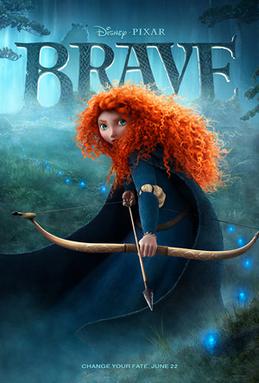
Review: Brave

http://upload.wikimedia.org/wikipedia/en/9/96/Brave_Poster.jpgBrave (2012)
Written 19/7/13

Pixar's progression over the past five or six years has been rather worrying. After producing hit after hit throughout the Noughties, culminating in the successive masterpieces of Wall-E, Up and Toy Story 3. In 2011, however, the studio hit its first critical bomb with the horrid Cars 2, a blatant cash-grab movie which left me slightly shocked. Brave was the follow up to that and, while the studio is still nowhere near to reaching its former heights even in 2013, this folklorish tale of mother and daughter marks a change for Pixar in a number of different ways.
     Despite the dazzling beauty of their animation, the depth of their characterisation and the skill with which they meld messages for kids with those for adults, the studio's ingle biggest failing across its history has been the representation of women and minorities. Until Brave, the studio's films had all focussed on primarily male dyanmics - those of the father, the son, the... suspiciously male racing car. The fact that it took 17 years for a female protagonist is astounding, but Brave does not disappoint in the way it represents women, even if the rest of the plot is fundamentally lacklustre.
    Spoilers in this plot summary, so be careful. The story follows Scottish princess Merida (Kelly Macdonald) in the early Medieval period, determined not to be driven by her mother Elinor (Emma Thompson) into marrying one of the unattractive heirs of the other three Clans, believing that her life should be free. Going against her mother's wishes, she escapes the meeting of the Clans and meets an old witch (Julie Walters), who gives her a spell which inadvertantly turns her mother into a bear - dangerous in a land where the story of Merida's father fighting the bear Mor'du is legendary. The two are forced to reconcile their differences to save the day.
     Pixar is used to working with fundamentally non-human things, from stylised toys to Monsters. Different studios and animators tend to have their own signature styles when making Human beings, but Pixar have always mixed it up and so Brave has its own signature style. The humour feels slightly more Dreamworks (minus the pop cultural references) due to the antics of Merida's triplet brothers, and the plot feels similarly humdrum as well. As much as I think the characteriations in the film are well thought-through, it's hard to see mother/daughter reconciliation happening when the mother is in the form of a bear for half the god-damn film.
http://cf2.imgobject.com/t/p/original/ivj3r7wE564ddiovbXh04VnAT2s.jpg
Bear with me for a second.
     As for the film's place in the world of feminist media... I don't know. A lot of the drama is about Merida fighting the traditional gender roles that are being forced upon her by her mother, so in that respect the film manages to pretty progressive. After about ten minutes though this opens up into a larger conflict about the nature of fate versus free will, stifling the film's civil message. It was nice to have women finally represented in Pixar's line-up after playing very minor roles in previous films as love interests, mothers or as device characters, but the film's setting still gave it a very male atmosphere and also meant that Merida and Elinor were still stuck in what is fundamentally an excessively patriarchal society.
     While certainly Brave in its pioneering representation of women in the studio's films, the film unfortunately offers very little in any other department to surprise the viewer. As a standard unthoughtful children's film it's perfectly fine - the skill of Pixar's animators is undenyable, with the film's gorgeous aesthetic and engrossing tone being its memorable aspect. But Pixar films tend to deliver in other departments as well, be they emotional or in the messages that they present. There's certainly a set of messages in Brave, but I think their story is too personal and not quite as identifiable as I think it wants to be, and that for me was the main reason that my praise wasn't as glowing.

Thanks.

Saturday, 13 July 2013

Josh: Film: Warm Bodies

2013, directed by Jonathan Levine.

WARNING: May Contain Spoilers (it does)

My main concern before watching 'Warm Bodies' was the possible similarities to the likes of the 'Twilight Saga', which I'm not so fond for a wide variety of reasons mainly concerning the poor quality of writing and acting involved. Alongside some cheesy advertising and lack of knowledge about the story itself, my only optimism revolved around the increasingly popular Nicholas Hoult as 'R'. Labelled as a paranormal romantic zombie comedy, Warm Bodies cleverly mixes these genres to provide an hour and a half of great entertainment. In no way is this film perfect, however, the way in which this absurd concept is delivered deserves some recognition.

     Set in post-apocalyptic America, R, a Corpse saves the daughter of Colonel Grigio (John Malkovich) whose soldiers are determined to kill all zombies. R thinks like a human (as depicted through a deadpan narration by Hoult) and throughout the film develops shared romantic feelings with Julie, Grigio's daughter, which seemingly spreads to the others as a cure, all against the wrath of the further deteriorated; Bonies. Admittedly, the idea of 'love saving all' is one I do not usually agree with but, within context, the idea works. Rather than produce another zombie film where the cure is some sort of medicine needed to be given out to raging undead, Warm Bodies turns it on its head. The human characteristics in the zombies themselves as well as the whole film being told from R's perspective causes audience sympathy with what is usually depicted as the atagonist. Alternatively, the murderous behaviour of the human enclave is scrutinised and the answer to the problem is not to kill the Corpses but to treat them, to love them. Conversely, though the Corpses are treated equally to the humans, the Bonies are not and this is jokingly referred to, despite this, it is understandable as they have lost all humanity and cannot be saved like the Corpses.

     Warm Bodies revitalises the zombie genre somewhat, giving us an alternative outlook on how they are not mindless creatures craving for flesh but possibly pertaining human characteristics, struggling against and hating what they are, something which is never really envisaged in any other zombie fiction. Typical zombie tropes are made humorous with genuine laugh-out-loud moments whereas new ones are introduced like the ability to experience human emotions through eating the brain. Though Warm Bodies defies some logic, the origin of the apocalypse left unexplained and Julie and R's love seemingly somehow affecting every other Corpse, the purpose of the movie is the development of Julie and R's relationship. Again, twisting an iconic concept, this time the one of a Romeo-and-Juliet-esque love story, the film sees a human and zombie falling in love. Though there was excessive use of music which lacked certain subtlety, Hoult and Teresa Palmer have excellent chemistry conveying a cute romance which doesn't venture into the extreme like its associates 'Twilight' and others.

     Infusing the zombie genre with romantic comedy significantly impacts how 'scary' or 'realistic' the zombies are, even the CGI of the Bonies is sketchy, however, their presence is not to be one of intimidation and so this impact is both necessary and acceptable. The light yet effective use of humour and the apocalyptic setting to this primarily romantic fiction is one of uniqueness and brilliance which allows Warm Bodies to be a surprisingly fantastic film. Though full of minor limitations and things which could have been improved or removed, Warm Bodies is a heartwarming piece of cinema which just falls at the last hurdle to become a cult classic.

Thanks, Josh.