Showing posts with label TWD. Show all posts

Monday, 28 December 2015

TV Shows I Watched In 2015

It's that time again, folks. Here is a list of the shows that I watched this year, some of which I watched live as they came this year, and some of which I just happened to binge and thought I'd mention here. Spoilers everywhere.

This image is, in itself, a spoiler. Unless you don't
watch the show. Image from sidekickreviews
Game of Thrones - Season 5, HBO/Sky1
Written 15th August.

Another season of Game of Thrones went by, and along with it another series of controversies, odd character decisions and an unhealthy obsession with victimising women. The show managed to cover pretty much all of the most recent two novels in G.R.R Martin's A Song of Ice and Fire book series while also going more heavily off-book than ever before. This led to, as in last season, a lot being left out, as well as characters being moved around, killed off and generally manipulated in such a way as to confound anyone who knew the plot of the books.
    The best and most amazing storyline was also the one that went most off-book - fresh off the heels of killing his father, Tyrion Lannister is smuggled to the continent of Essos and is encouraged by his saviour Varys to seek out Dragon Queen Daenerys Targaryen. Along the way he is kidnapped by exiled servant of the Queen, Jorah Mormont, who happens to be heading in the same direction. Unlike in the books, however, Tyrion actually makes it, leading to several scenes of Daenerys and Tyrion together. A lot of the frustration with Dany's storylines in the first four seasons was their loose connection to the plots going on in Westeros, and getting to see Tyrion in that part of the world made the mythology tie together more physically - as well as putting my two favourite characters onscreen at once.
"Bring it." From Wikimedia
     Over in controversy corner, and the show continued its trend from last season of exploiting violence towards women and girls. Sansa, who at this point in the books has stopped doing anything, is shipped over to her home in Winterfell, where she becomes the wife and plaything of the disgusting Ramsay Snow. After spending four seasons building her up and delivering her the agency she always wanted, her character was derailed in a plotline designed to act as a redemptive arc for the tortured Theon Greyjoy. This culminated in a horrific rape scene, thankfully not showing the act but regardless framing the scene by making us watch Theon's face as we hear Sansa's terrified screams. This carries forwards to the storyline in the North, where, again off-book, Stannis Baratheon decided to use his daughter for a blood magic ritual, and again we get to watch his face as we hear his daughter's genuinely blood-curdling and upsetting screaming. The list of reasons why this doesn't make sense is long, but notably: killing his daughter makes half of his mercenary army rout the field; his wife kills herself because of her guilt; and now the guy who believes himself the "rightful king" has no heirs whatsoever. Which is why it didn't happen in the books.
     Now with the death of Jon Snow (or not, it's an uncertainty carried over from the book), and a great deal of material not covered by the series (leaving a few notable holes), the future of Game of Thrones is uncertain. HBO has guaranteed that the show will get another two seasons in order to conclude its story, and they've apparently been given notes from Martin himself. Despite all of the horrible ways that David Benioff and D.B. Weiss like to hurt female characters and mess up the story, I still enjoy Game of Thrones, and I want to see it get better.

Rick's group approaches the Alexandria Safe Zone.
From Wikia
The Walking Dead - Seasons 5B and 6A, AMC/Fox
Written between 15th August and 27th December.

The fifth season of The Walking Dead, now finished, can only be described as... sedate. Which is an achievement, for a show which is pretty sedate anyway. 5A had a few interesting moments, but its story progression was fairly slapdash and lacked focus. That lack of focus continued into the second half of the season, with Beth's death glossed over with the death of brilliant supporting character Tyreese. Thankfully, the season picked up again, following our characters into the Alexandria Safe Zone. Seeing our characters back into a suburban environment was really interesting, and would have been even better if they hadn't bogged it down with an off-book romantic subplot. I did however love Rick's descent back into savagery - it felt like a logical progression that after he killed two entire groups (the Claimers at the end of 4B and the Hunters in the middle of 5A) he would flip out upon being asked to trust a group of people who had stayed out of the whole thing. The final scene of the half-season, with Morgan finally meeting Rick again after two seasons, was the icing on the cake.
     I think one of my problems with The Walking Dead, starting this year, was the fact that there appears to be no end in sight. That's not a specific problem with TWD - this occurs in all fiction in this genre, with a number of different possible endings, none of which are going to be very satisfying. It doesn't really help that the show, like Game of Thrones, is adapting its source material somewhat faster than it can be produced. Five years into the show, we're seven years into the comics, and that's not even taking into account the extra plots grafted onto the show's canon. The thing that saved Lost's last few seasons was a definite ending point, and that gave the series a sense of purpose going forward, and a guarantee of sorts that everything would come to a head. Season Five proved that this is exactly what The Walking Dead needs, and what it currently sorely lacks.
     That was, of course, until the beginning of the Sixth Season in the Autumn, at which point the show suddenly shot up a gear. Having spent 5B establishing the people of Alexandria, their politics and the threat of a chaotic group known as The Wolves, 6A set about providing key character development, juicy plots and a refreshing pace. By far the saving grace of this season was the arrival of Morgan, whose philosophical differences with the rest of the cast allowed for some realistic conflict that didn't just descend into painful, "it's inevitable that we're all going to die" nonsense. It also provided quite possibly my favourite episode of the entire show, the phenomenal parable that is, "Here's Not Here" which has Morgan in the spotlight. With these things in mind, I'm a lot more confident about the show's future, and I hope that this movement out of mediocrity lasts for a long time.
Insert joke about the West Coast here.
From Forbes

Fear The Walking Dead - Season 1, AMC
Written 3rd September.

For some critics, this six-part miniseries preceding Season 6A of the parent show travelled far too slowly. I am not one of those critics. There is a certain lackadaisical pace to Fear which it has inherited from The Walking Dead, but there are several things it holds in its favour - characters we haven't been slugging it with for five years, the new concept of watching the apocalypse happening from the start, and the sense of tension as society slowly collapses. So much of The Walking Dead consists of wandering around empty countryside, with tension only mounting when the characters decide to explore an abandoned structure or something like that - here, the tension is constantly building as the world basically crumbles around our knowing protagonists. And that, for me at least, is more worth tuning in for than seeing what weird thing Rick is gonna do this week.

Hey Nicky, you so fine, you so fine you blow my mind
Hey Nicky! From zimbio
Orange Is The New Black - Season 3, Netflix
Written 15th August.

Where do I begin? I tried my best to avoid the hype train on this Netflix series set in a women's prison, mainly because I expected I'd have a great deal of Hype Backlash. Now that I have seen it... what was I thinking? This show is just as awesome as everyone said it was! Originally focusing around rich white girl Piper Chapman and her year in prison on drug-possession charges, the series opens up into a lots-and-lots-of-characters ensemble drama which takes the format of Lost (main plot in the present with an character-specific flashback each episode) and puts it into a format which is deliberately designed around binge-watching. It also manages to portray important issues like LGBT rights, trans discrimination, police and government corruption, sexual abuse and many more in a responsible and innovative manner. (With the exception of the show's solid refusal to say the word "bisexual".)
    I love this show for so many different reasons. The characters are all well developed, with everyone (except Dee, fuck Dee) getting several shades of grey to their characterisations. My favourite character is probably Red, played by the amazing Kate Mulgrew (better known as Captain Janeway). While I actually did enjoy Piper's story in the first season, I agree with the common idea that her storyline is less interesting as time goes on, and I think it's a sign of great writers that the show evolved to focus on a wider set of characters. I'm really looking forward to Season Four and I'm glad that I finally joined the bandwagon.
Sarah and her clones face off against Project Castor.
From screenrant

Orphan Black - Season 3, BBC America
Written between 16th August and 3rd September.

Despite some shaky moments, the third season of Orphan Black continued to demonstrate Tatiana Maslany's immense talent. The appearance of male clones played by Ari Millen threw several new factions into the mix, and proved to take the series in directions that were both positive and negative; positive in that the male clones allowed our sisters to finally discover their genetic origin and advance the mytharc, and negative because these new male characters just weren't as interesting as the pre-developed relationships. This made the beginning of the season feel a little messy, and the varying subplots didn't really mesh together until the very end.
     This season's main theme, tied into all of its storylines, was the importance of family - both actual family relationships and those forged in friendship. Alison ran for head of the local Schools board, funding it by running drugs through her mother's soap shop. Pregnant Helena was captured by the male clones (Project Castor to contrast the female Project Leda) and eventually rescued by Sarah. Sarah and her adopted mother Siobhan then followed several clues in order to find both Castor and Leda's genetic origin - Kendall Malone (Alison Steadman), Siobhan's birth mother, a genetic chimera with strands of male and female DNA.
     Season 3 was messy in places, and it didn't really find its footing until a few episodes in. But it's still not a series that can really be faulted. Tatiana Maslany is still the best actress working on television today, no question, and that didn't change. I can't really complain about the uselessness of the Castor storyline from the beginning of the season, or the random new love interest given to Cosima, when everything with T-Mas was so brilliant. From the discovery of the genetic original, to the introduction of new clone Krystal, the treatment of Rachel as she recovered from a pencil to the eye, and the amazing silliness of Alison's drug business, I kept finding something to love. I can't wait for Season Four.

Gemma Chan as Mia. From Channel Four
Humans - Series 1, AMC/Channel 4
Written 6th September.

By far this year's biggest surprise was the C4/AMC coproduction Humans, adapted from a Swedish series about an alternate Present Day in which human-like robots known as Synths have taken a valuable place in human society. Originally a focused character drama looking as the Hawkins family, the show spiralled out into a rich mythology and backstory while never losing that skill with its characters. In rifling through all of the ways in which robots have been treated in science fiction, the show managed to develop its cast of humans and sentient synths as a large set of distinct, well-developed and sympathetic by Episode Two. Add in phenomenal acting turns by Katherine Parkinson, Colin Morgan, Gemma Chan and newcomer Lucy Carless, and you've got one of the best newcomer shows of the year. (See here for my longer article on the show.)

These are two attractive people. From ibtimes
Outlander - Season 1, Amazon Prime/Starz
Written 6th September.

Carrying on the recent rise in online-only shows, this year I also watched the first season of Outlander, a show only available in the UK via Amazon Prime's exclusive premium on-demand service. Adapted from the series of books by Diana Gabaldon, the show follows 1940s army nurse Clare Randall as she is thrown back in time to 18th Century Scotland. There she is taken in by the Clan Mackenzie, a local lordship in opposition to the British throne, and she falls in love with the strapping Jamie Fraser. Forced to fight the evil ancestor of her 1940s husband, she must find a way to get home.
     Outlander often struggles with its balance of historical drama and sci-fi leanings. Like its obvious protegĂ© Life On Mars (which actually succeeds the publishing of the books which inspired the show), it's often difficult to remember the fact that Clare is displaced out of time, at least once the "Fish-out-of-water" humour runs dry. Luckily, the plot is well-placed enough that a lot of the time you don't much care, and those sci-fi elements do raise their heads again. I did find a lot of the show's nudity and sex scenes a tad excessive (this show has more nudity than Game of Thrones, although it's usually a lot less bloody and violent) and I found it questionable that the two main villains of the this first season were both implied to be gay (and the same was not true of any other character.) But despite concerns, there's something strangely compelling and relaxing about the escapades of Clare Randall, especially in the second half of the season, when the series' mytharc begins to bear fruit.

Even on the poster it looks like she doesn't wanna be here.
From the BBC
Doctor Who - Series 9, BBC1
Written 27th December.

After being pleasantly surprised by Series 8, I had a lot of hope for my favourite show. Moffat was still here, of course, but there was something of a development in his writing style that seemed to me to be less about making offensive jokes and more about actual character development. Series 9 was very much one step forwards, two steps back. A lot of Moffat's old tropes returned, including an arc which didn't really go together very well, and the habit of retconning important parts of Doctor Who's history. However, the show did go the extra mile in taking some steps in new directions, especially when it came to the Time Lords.
     The most notable differences in this season came with the show's new format and aesthetic. Most all but two of the episodes in the season were organised as two-parters, which brought to mind the format of the Sarah Jane Adventures. I had hoped that it would allow a lot of the stories to become more developed, as they were approaching the length of Classic serials, but that didn't really come to pass as a lot of the time each individual part had a very different tone, pace and occasionally writers than the other half, meaning there was something of a lack of tonal consistency. This tied into another aesthetic shift for the show, with Moffat falling back into his misguided desire to make the show "cool" and "modern", exchanging the Sonic Screwdriver for a gaudy set of sunglasses and Peter Capaldi's Pertwee-esque costume for a hoodie and trainers. And the less we talk about that electric guitar, the better.
     Clara finally got to leave this series, although they had to ruin it again by giving us a passable if noble departure, followed up by a less believable resurrection and an open-ended departure off into space. Series 8 had her developing from a normal-ish human being into a character somewhat obsessed with taking on the responsibilities and identity of The Doctor, and that development did continue here, albeit a great deal more slowly. Unlike the previous season, which presented this as a noticeable flaw which Clara really shouldn't be working towards, this year it was just an accepted fact about who she was, including during both of her exits. I like that she carried on that development, but I still think that it would have been so much better to just let her leave in Last Christmas like she was supposed to.
I am going to break that guitar. From BBC America
      And, finally, this year was struck with a number of arcs and recurring characters. From the second episode we got not-so-subtle mentions of "The Hybrid", a retconning Time-Lord prophecy which spluttered to an unsatisfactory ending in the finale. Part of that developing arc was the reoccurring face of Maisie Williams as Ashildr/"Me", who didn't really impress in the role, with the exception of a more subtle turn in The Woman Who Lived. These recurring aspects did tie the season together into a cohesive whole, but the result didn't really gel very well because of the vast changes in tone and the fact that most of it is brushed aside for an arc with the Time Lords in the finale.
     For a series that tried very hard to be different, it's a shame so much of it failed in the execution. For the first time we got two female writers and both of their episodes were slated by fandom, even though they were two of the best episodes of the season. The Zygon two-parter, while dangerously stupid in its politics, was at least trying to be relevant and interesting science fiction. There's a sense of stuttering, of a car failing to start repeatedly. The question is, can Doctor Who recover before it burns out the clutch? And, if rumours are to be believed, is next year the last outing for both Capaldi and Moffat?

At least Miko's story turned out not to be as terrible as I thought.
Heroes Reborn - Season 1, NBC
Written between 30th October and 27th November.

I had a lot on the table for Heroes Reborn. Despite a lot of my misgivings about its parent series, I was still of the opinion that it could have really done with one final season to conclude the story and the journeys of these characters, as well as to explore that last cliffhanger in which the existence of Evolved Humans (now "Evos") is now a public matter of fact. When Reborn began I wasn't very impressed with the the way it reused a lot of the same character archetypes and themes to say a lot of the same things, but as the series went on I began to see how tightly the story has been written, avoiding a lot of the pitfalls that Heroes itself often fell into.
       Instead of acting as yet another cycle of Heroes' repeating storyline, the focus of the series around the aftermath of an orchestrated terrorist attack means that this Universe feels a lot more adult, with characters having to face the consequences of their actions as and when they happen. There are enough old faces to make the show still feel like you're watching Heroes, but for the most part the injection of new blood has very much updated the show, developing it past its mid-noughties chic and neatly avoiding a lot of the stink that the show had picked up by its fourth season. Its biggest improvement is in its time-travel story, which manages to be very tight-knit and cohesive, dotting all the is and crossing the ts to make an exciting and yet perfectly logical sequence of events.
     I wish I could have reviewed this week-on-week, but I really didn't have the energy to do so. I'd also have liked to see how it ended - but for some stupid reason NBC have decided to leave the final three episodes of the season in January, ending this year's run with an awkward filler episode and completely demolishing any and all momentum that the show has. People are not going to tune in in January to finish this thing off, and if they do, all of the tension will just be gone. It feels a little like NBC want to sabotage this show and make sure that Heroes doesn't end up coming back full time, and that's a real shame, because once this little mini-series got going, it really deserved a fair chance.

Luther is captivating but running out of ideas. From the BBC
Luther - Series 4, BBC1
Written 27th December.

Erm... Hi? I've loved Luther since it started, I think it's an amazing, unique take on the detective genre which combines gruesome villains with a charismatic lead, playing off of a number of detective show cliches while never actually feeling held down by them. It fell into a nice format of four hour-long episodes in two rhyming couplets, which worked, keeping the character's intensity in short bursts. The third season ended on an open-ended but satisfying moment, keeping it open for star Idris Elba's desire to take the series to cinemas. That's what makes this incredibly short two-parter seem a little... well, weird is the word. It's nice to see you, Luther, but why is this such a flying visit?
     Given the brevity of the series, I was expecting something huge from the two-parter, something which would fundamentally change the format of the series. While we shifted some of the cast around, replacing Warren Brown with Rose Leslie and starring a brand new messed-up killer who eats his victims and then leads the police to each of them with a trail of identity papers. It was a balance of moments both introspective and painfully tense, but it didn't really have the barnstorming, triumphant surge which made Luther work - there needs to be the catharsis that comes with watching Luther beat the shit out of someone. The second half also wandered off into very strange territory, and even with Luther's extraordinary stories it stretched my sense of disbelief. I would have much preferred that this be the first two episodes of a brand new series instead of this strange "event" show which didn't really feel like it made that much of a lasting impression.

This show would be at the top if this was a "Top 11 Shows" list.
From denofgeek
Jessica Jones - Season 1, Netflix
Written 27th December.

A late addition to this list, but I couldn't talk about 2015 without mentioning Jessica Jones, the latest of the Marvel spin-off TV shows appearing on Netflix. Running alongside the series of blockbuster films and two TV shows on Disney's ABC channel, Marvel moved its vast Cinematic Universe over to Netflix earlier this year, with the 13-episode series Daredevil starring Charlie Cox. I wasn't really interested in that series, but I was interested in Jessica Jones, a series about a superhero-turned-private-eye starring Kristin Ritter and David Tennant. And let's get this out of the way, because it's going to be the most controversial thing I say on this list - Jessica Jones is the best thing that the MCU has produced.
     The main themes behind Jessica Jones , are incredibly important, as they discuss a topic very rarely addressed in mainstream media - female agency. Jones' main villain, Kilgrave, is a super villain whose ability lets him make anyone do whatever he wants them to, and he used this to both physically and psychologically abuse Jessica for a number of years. The series doesn't shy away from the language surrounding the topic - Kilgrave is a rapist, he's a murderer, and he's also the most charming person in the room. The show is a testament to both Ritter and Tennant - Ritter for portraying the anger and strength of a survivor of abuse, Tennant for managing to deliver the most realistic portrayal of an abuser I've ever seen on television.
     But the brilliant thing is that those issues aren't the be-all and end-all - there are a lot of amazing action scenes, some great mysteries and intrigues, a heart-breaking romance subplot that doesn't feel insultingly shoehorned in. There's a charming noir feel that the series maintains with very little effort, but it also feels modern and engaging and almost beyond clichĂ©. Of all the shows on this list, this is the one that I have to recommend the most highly - it's clever, consistent, breathtaking in its topics and just one of the best TV shows to come out in 2015.

Thanks.

Friday, 31 July 2015

Review: The Walking Dead: Season Two

Written between 19th March and 31st July 2015. Spoilers. 

Ask a Walking Dead fan about Season Two and there's likely to be some grumbling about "that damn farm," and "they should just kill Sophia already." After the relatively brief first season, the show's sophomore outing got a double-length season of 13 episodes, split in half (of course, this is US TV). While Season One had been an interest to critics, Season Two is where the show began courting some mainstream popularity. Which is confusing, given this is a season full of frustrating character decisions, a long-winded and dry storyline and, true to what I mentioned earlier, that damn farm. Season Two does have a few cracking episodes and it gives us some fairly interesting and long-lived characters, but at the same time it takes a certain amount of commitment to keep coming back each week.
     One thing to bear in mind about these infrequent Walking Dead reviews: I haven't seen these seasons in about two or three years. And I really don't know if I can set aside the time to go back and watch 10-12 hours of television. I'm not entirely sure why this show's season length increases so dramatically from the initial mini-season to 13 and then 16 episodes, but it doesn't actually help the show that much. We do get some more character beats for that extra time, but in Season Two those beats are focussed on one or two characters - which, for an ensemble piece, means that most of the cast has to deal with obnoxious filler. Examples of which include: Andrea shooting Daryl because she thought he was a walker; Lori crashing her car on an empty highway; Daryl being taunted by a hallucination of his brother, and Carl having a teenage strop which inevitably leads to Dale's death.
     Maybe the filler isn't the best place to start. This season's main developing storyline sees our survivors, having escaped from the CDC, attempt to travel to Fort Benning. Along the way they are forced to stop by a traffic build-up on the highway, and a sequence of events leads to them staying on the Greene Family Farm and the disappearance of Carol's daughter, Sophia. While Hershel Greene and his daughters are initially quite friendly and helpful in the search for Sophia, the survivors soon discover that he refuses to see the Walkers as anything less than human, and so has been keeping a herd of them (including, unfortunately, Sophia) in his barn. After the group slaughters the zombies kept in the barn, the group is forced to deal with infighting and the threat of another, unknown group of survivors. Eventually, the Atlanta Herd from the pilot episode works its way over to the farm, and the survivors (+ the Greene family) are forced to escape. Shane and Rick confront each other, and Shane is killed.
     The thing that Season Two does get right is the development of Shane and his decent into pure hatred and villainy. Robert Kirkman used the series to keep the character alive longer and flesh him out, and Jon Bernthal more than rises to the challenge. Shane is a pragmatist; he genuinely believes that he can lead the group and keep them safe more than Rick can, and he's prepared to kill/threaten anyone who gets in the way of that vision. On a moral level Shane lost me the moment he tried to rape Lori at the end of last season, but that doesn't really get brought up this season - probably so that the more sympathetic moments he gets this season actually ring true.
     The nature of the season means that there's lots of weird filler in almost all episodes. Even my favourite episode of this season, the stand-out 18 Miles Out, is 60% a brilliant two-hander character piece between Shane and Rick and 40% weird sub-plot where Lori argues that women should stay in the kitchen and Andrea tries to help new character Beth Greene commit suicide. Season Two stands out as a sort of teething stage as the show developed from its original miniseries format into its eventual style, and the two forms really do clash, leading to a season with good storytelling and characters in some areas and pointless filler and stupid decisions in others. It's an uneven, wandering season, but it certainly points the show in the right direction.

Thanks.

P.S. This isn't my best work. But it'll be better when I look at Season 3A some time in the future. :D

Friday, 13 March 2015

Review: The Walking Dead Game: Season Two

Written between 2nd and 13th March 2015. Contains spoilers for both seasons. Like seriously, play the game before reading anything past the second paragraph.

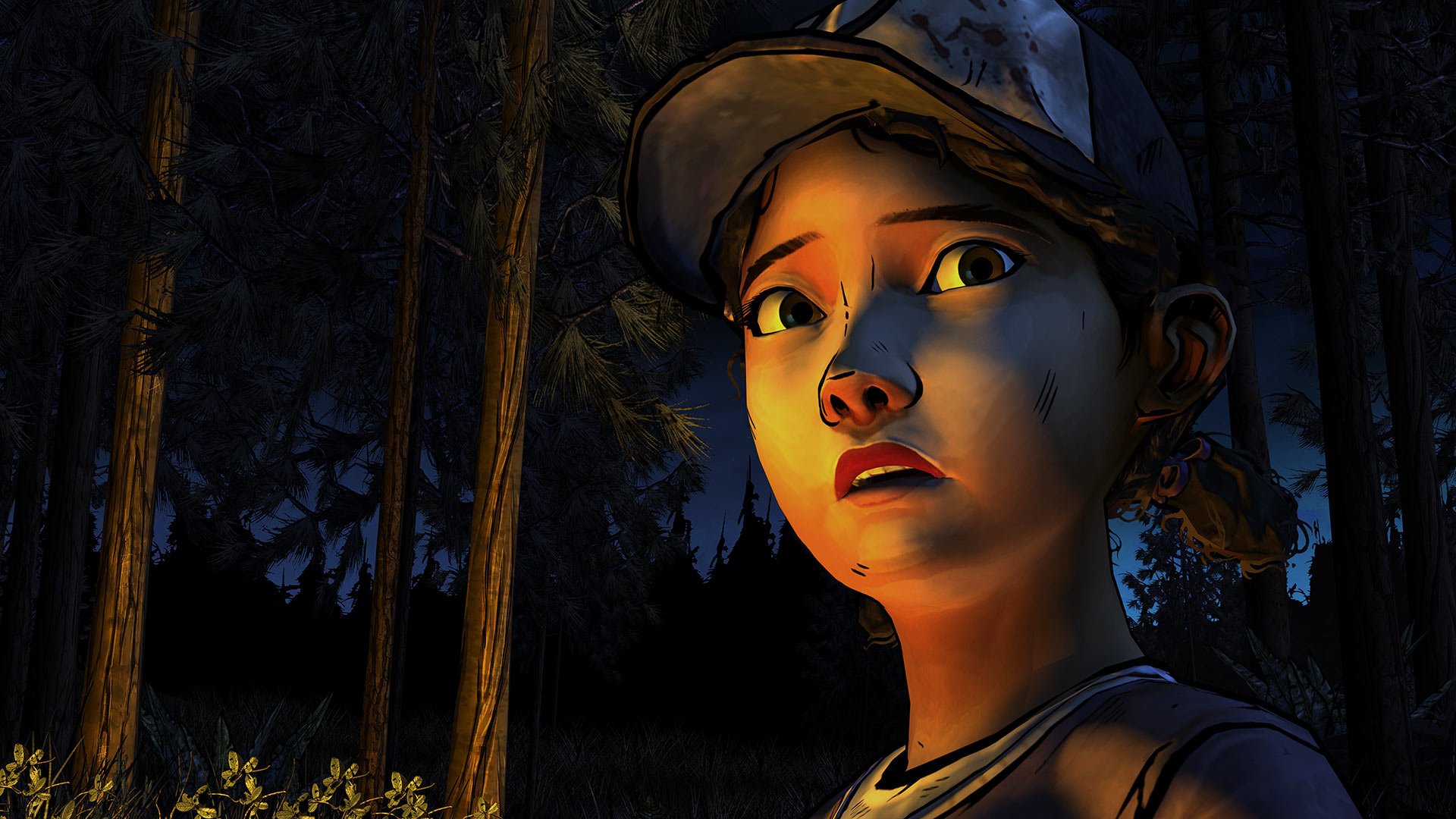
http://www.themarysue.com/wp-content/uploads/2013/10/clementine1.jpg#geekosystem
Clementine takes centre-stage this season.
Image from themarysue.com
If there's one writing cliché I'm guilty of using on this blog, it's the idea of the "difficult second album." It's hard for a second outing of anything if it has to focus on living up to the expectations left by its predecessor. Season Two of The Walking Dead Game was following up a literally Bafta-winning story, and they had to carry on despite having killed off their relatable, popular main character and almost all of his friends. The game's second season does many things admirably, and mostly continues the legacy of its predecessor, but there are several areas where the game loses its way and suffers as a result. As last time, my focus will be mainly on the game's plot, but I will discuss my experience of the game's interactive dynamics. And how they made me scream at my desktop.
     What shines through as the problem with Season Two is poor writing decisions on a story level. In a game this dependant on its plot to get by, mistakes like that can disrupt the entire experience - and this time there's the weight of expectation on the game's shoulders. I'm going to get into more specifics later on, but for now I'll comment on something I noticed - some of my main criticisms of the game's poor writing can also apply to the first season. The difference is that Season Two rarely takes the time to develop the relationships between characters in the same way that the first season does, with characters either dead, doomed or emotionally cold. While some fans argue this is just the way of the zombie apocalypse, this robs the player of their connection to the characters.
     Two years after the events of Season One, and Clementine is still travelling with Omid and Christa. After an altercation, Omid gets shot. Sixteen months pass, and Clem is seperated from Christa in a confrontation with bandits. On her own, she gets bitten by a dog and is then encountered by a group of survivors living in a cabin. After learning to trust her, she stays with them and eventually runs with them as they flee from William Carver, the man whose group they had previously separated from. After they meet up with Kenny from Season One in a ski lodge, they are eventually all captured by Carver. With the help of survivalist Jane, they escape, but on the run their group slowly loses members. One way or another, we end up with Clementine travelling with Kenny and Jane. In a surprising amount of choice, the player can either end the season travelling with Kenny, with Jane, or making it on her own.
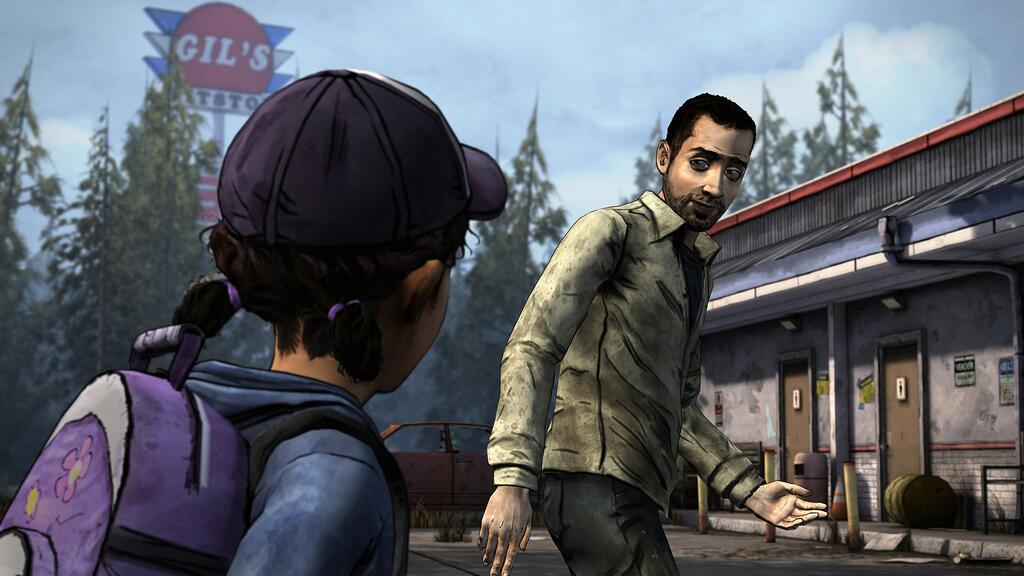
http://img3.wikia.nocookie.net/__cb20131202031009/walkingdead/images/d/df/WDG_S2_Omid.png
Hey Clementine, I know we're two years into a zombie
apocalypse, but I'm going to leave you alone in a dark restroom
to do something with my pregnant girlfriend that I don't want
you to be in the same room for.
Image from Wikia
     Choosing to have Clementine as the player character has its ups and downs. As one of the most popular characters from the first season, it's fun to see how Clementine has changed since she was younger, and especially interesting to develop her more directly as a character using either the same philosophy that the player used in Season One, or down a completely different path. My Lee was a diplomat who knew when to be pragmatic and when to keep people on his side. My Clementine, for reasons which will become apparent, is a girl who calls everyone around her out on their bullshit. That becomes necessary because of the main downside to having Clementine as the PC - in order for the player to get to do anything, every single adult character around her is either embarassingly incompetent or just hilariously obnoxious. You do find yourself wondering why the twelve-year-old girl ends up being this group's rational head.
     Because, no matter what you choose, Clementine will be the smart one here. The Cabin survivors that the season kinda focuses around don't make a very good impression - upon finding that Clementine has a dog-bite, the group's resident doctor suggests leaving her out in a cold, exposed shed overnight without cleaning the wound, because a trained medical professional apparently can't tell the difference between a long, saliva-filled dog bite and the rounder, decaying-remains-filled Walker bite. The way the group and the personalities of its various members has been written, it's very difficult to believe that these people have survived this far - especially as this three year time skip places the game further into the apocalypse than any other media in the franchise. And I don't just mean the strange things they do to force Clementine into doing stuff, I mean the headcount on these guys - Walkers are slow and easy to kill individually, only threateningly dangerous in hordes, but the game (in both seasons) makes false tension out of a few shuffling dudes who you could literally walk away from.
     One thing that could explain how the group survived is Pete, the guy who you can choose to try and save as the end-of-episode cliffhanger to the season's premier. The fact that Pete dies either way is a small sample of this thing recurring across the season - there are about five or six characters where you can choose to save them or not, and whatever happens they die anyway. Again, same thing happened in Season One, but this time the inevitability of those characters' deaths isn't worked into the story, and they just sorta leave. This is bad enough with Pete, Sarita, Alvin and Luke, but it's especially painful with Nick and Sarah. (More on them later.) This also reflects one of the greater overall problems - your decisions may affect which scenes you see, but everything more or less happens the same until those last few scenes deciding between Kenny and Jane. And, given the game's track record, I can't help but see Clementine ending up on her own next season anyway, seeing as there's really no way that Telltale would make two or three seperate games all at once just to follow these plot threads.
http://i.ytimg.com/vi/rrJZZnHKLsY/maxresdefault.jpg
Seriously, anyone who doesn't choose [HUG KENNY] here
has a heart of stone...
      Talking of predicting next season... of course Kenny is back. In a fantastic application of "we never saw the body", Kenny appears in Episode Two, freshly bearded and filled with enough PTSD to shake a stick at. By this point the player has been used and abused by the Cabin Survivors enough to want to welcome Kenny with open arms as the last vestige of familiarity, and I found it quite laughable that the rest of the episode kept trying to set up a rivalry between Kenny and Clem's closest ally in the Cabin Survivors, Luke. Of course it really depends on whether you liked Kenny in the first season (which I know a lot of people didn't given his tendency to hold a grudge on the player if they ever sided against him), but I felt like the episode was trying to use his internal grief at the loss of his original family as some sort of argument against the player siding with him. I don't blame Kenny for being messed up - the man lost his wife and son in the space of a few hours, after they'd survived together for so long. He may be angry and irrational sometimes, but he has his priorities right, and for me that's what matters.
     Compare this to Jane. Jane is more or less a carbon copy of Molly from the first season - a hardened, pragmatist survivalist who insists on isolationism ahead of compassion at all costs. Jane believes in manipulating people to break them apart and pray on their weaknessses - she leaves a baby exposed in the cold just to try and make Kenny out to be dangerous and irrational. Going with Kenny gives you the chance to live in a safe and thriving community up in Wellington, while going with Jane leaves you living with her in an abandoned hardware store filled with supplies, constantly looking after a child. For me, at least, the game's final decision was the easiest I'd ever had to make, and even taking into account my prior knowledge of events, the lengths the game has to go to to demonise Kenny in the narrative just seems really bitter and cynical. The Walking Dead is a depressing universe, but this second season never has any moments of real levity, and the result is a really harsh and unpleasant look at humanity.
     Pushing that even further is Nick and Sarah, who share an issue with Kenny and Jane. In this universe a lot of characters have mental health issues - Jane and Kenny are both changed people because of events in their past, for example. Nick and Sarah are different though - they are both designed to be hated characters, and both characters die horribly, even after you've saved them. Although neither character explicitly says as much, it's fairly clear (at least from my perception and the perception of a lot of fans on the internet) that Nick suffers from depression and that Sarah is autistic.1 The fact that these characters were designed to be hated, the fact that their deaths end up being so gruesome and are intended to be cathartic for the player - that leaves a very sour taste in my mouth. Especially given the producers' seeming delight while discussing the inevitable death of a scared 15 year-old girl in an interview at the time. (More on that here.)
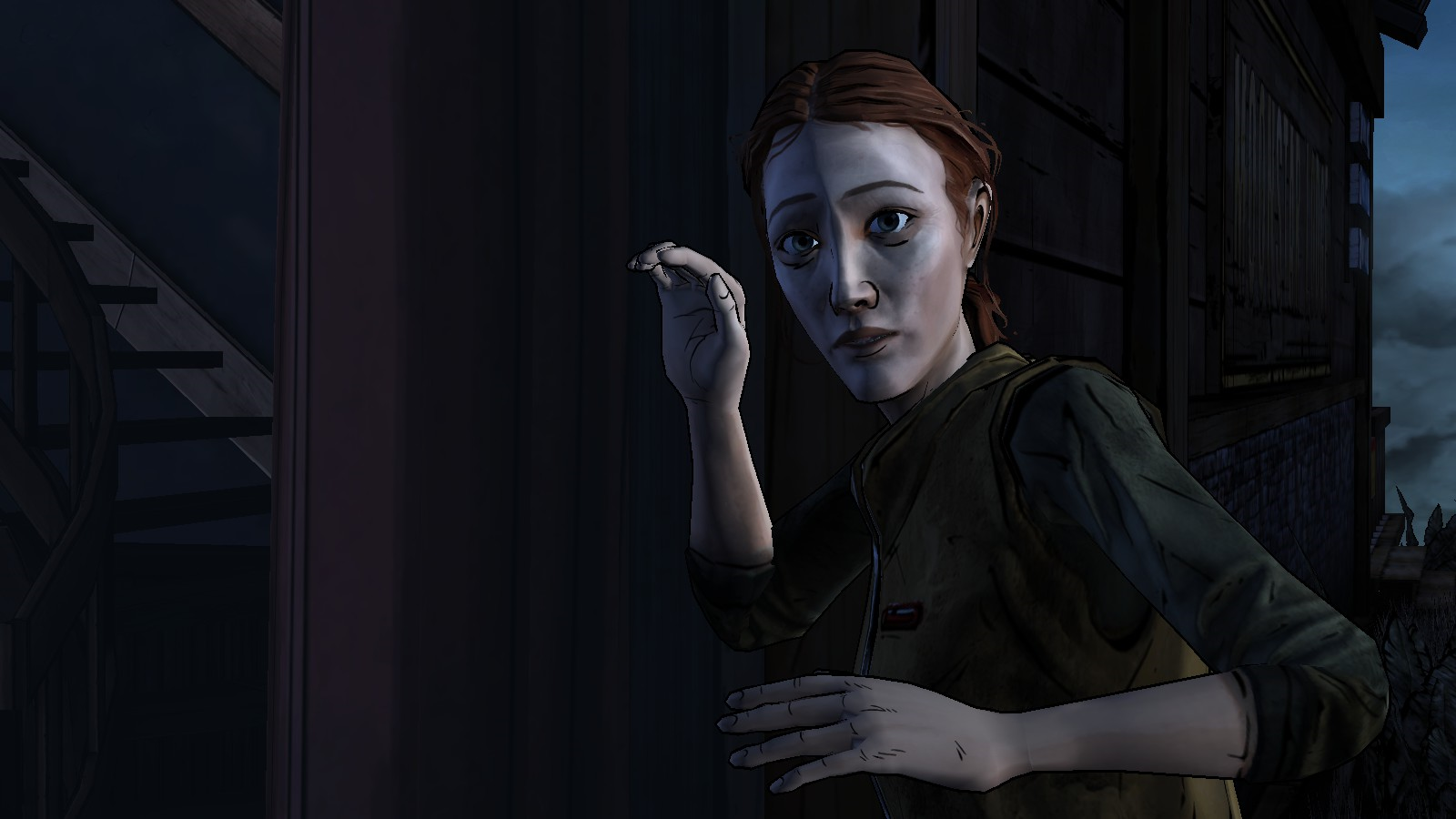
http://img2.wikia.nocookie.net/__cb20140312184745/walkingdead/images/8/81/AHD_Bonnie_Caught.png
I hope Bonnie was your favourite 400 Days character. Cos
you're pretty stuffed otherwise.
Image from Wikia
     Now, a quick aside. Between the two seasons there was released a sixth episode, a DLC called "400 Days", which gave us short glimpses of five brand new characters across the first 400 days of the apocalypse. At the end of that episode, we discovered a representative from a survivor group, and depending on your choices, particular characters would go with her or stay by themselves. (I got all five, btw. Just saying.) We were told this would pay off in Season Two - and it does! One of the characters, Bonnie, can star in four of the five episodes... except, she goes to the group no matter what you did in her chapter. The other four characters we were introduced to? If you got them to go along, they make five-second cameos in Episode Three and then die. Oh, and Bonnie can die in Episode Five, so she's for it come Season Three either way. In other words, another fantastic demonstration of the impotence of the player in their decisionmaking.
     I didn't get to cover everything in this article and I could go on ranting a lot more - about how Omid and Christa die because they decided to leave Clementine alone and randomly have sex in a disused public bathroom, how Carver decided to kidnap a bunch of random people for no reason, and how the game makes characters do irrational things near the end just to give us our end conflict. But the biggest problem is that which I've mentioned - the game insists on telling its own version of events instead of allowing the player to give events their own context. And the paint with which the game brushes its canvas is in particularly muddy colours, a sad and bitter worldview which makes you hate all of the other characters for their sheer inhumanity. It's really disappointing that a game like The Walking Dead ended up like this, and although I'm still sorta looking forward to Season Three (to just find out what the hell they do), I'm not as gripped by it as I once was.

Thanks.

1 I am not autistic, nor a medical professional, and thus have no real basis on which to actually say that Sarah is autistic. I am basing this entirely on the way I have seen people identify with the character as such, and the hurt they felt when she was treated the way she was. I apologise in advance if this offends any readers who do have autism and who do not feel that the character adequately represents someone with the condition.
    

Monday, 23 February 2015

Overview: The Walking Dead: Season One

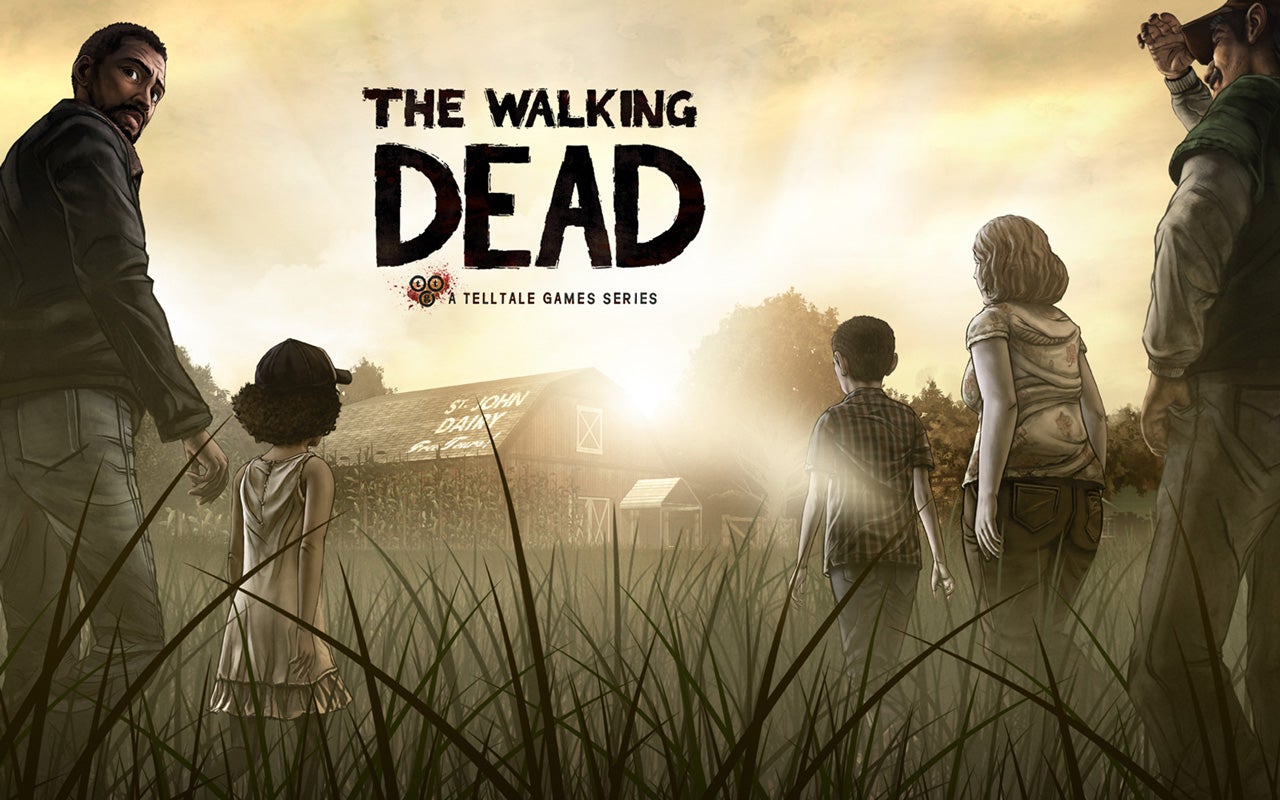
I love this shot - so much that I have the poster of this
next to my bed. From amctv
Written between 10th and 23rd February 2015.

The Walking Dead, I feel, was a bad pick for me to try and go through. I'll still write about it, don't worry, but it requires a certain acquired taste to get through, and I think I might have lost that taste a while ago. It's not in any way that the first season of the show is bad, per se - in fact it's probably one of the most true to the show's spirit. But the show has a deliberately slow pace which lends to its depressing atmosphere, and returning to the show to examine that is never a cheerful affair. Don't let that dampen this review, though - The Walking Dead's first season is the most on point, and its relative brevity is a godsend, because it allows the themes of the comic's first volume to be condensed without any extraneous baggage.
     Rick Grimes is a cop who gets shot, waking up three months later in a hospital surrounded by corpses both lying down and walking around. Taken in by a man named Morgan, he discovers that in his coma, there was a zombie apocalypse. He heads into the city of Atlanta, running into a group of scavengers whom he helps escape the infested city. It turns out that Rick's wife Lori and son Carl are at the group's main camp - as is Rick's old partner Shane, who has been having an affair with Lori once he thought Rick was dead. After their camp is overrun by walkers, the group head to the Center for Disease Control in Atlanta, and there they discover Edward Jenner, the last scientist still working on a cure. He eventually reveals that the cure is hopeless, and the group are forced to escape his compound before it self-destructs. Before they go, Jenner whispers something in Rick's ear.
     The show's premier episode Days Gone Bye is a work of cinematic art - had this been the first movie in a cinematic Walking Dead franchise, it more than would have met the standard. Despite reservations, Andrew Lincoln's British heritage is completely invisible, and he lives and breathes the character of Rick from the off, working as an effective lonely protagonist for much of the episode as he wanders silently through the ruins of the world. There are a few slow moments here or there, but overall the result is an episode whose slow pace makes the horror and gore all the more noticeable. The same effect can be seen later in the show across the first few seasons, but here is where it was done best and where it wasn't bogged down by some of the more tiresome politics between the characters.
http://upload.wikimedia.org/wikipedia/en/9/92/The_Walking_Dead,_Season_1_Cast.jpg
The cast of characters. (For this season, anyway.)
From Wikimedia
     The show borrows its ensemble cast from the comic, with a few important additions and absences. A number of characters introduced in the first volume of the comic don't appear until the third season, and the presence of The Dixon Brothers, T-Dog and several other new characters fleshes out the cast and changes the dynamic in several ways - notably, the show provides a lot more avenue for conflict between characters within the group, whereas the comics limit that conflict to between Shane and Rick. This has both good and bad points - the Dixon Brothers are some of the show's stand-out characters, especially Daryl, who despite his nature as a show original is one of its most distinctive presences even today. On the downside, Rick's family gets very much the short straw, with Lori being more actively adulterous than in the comics and Carl having gone from a sorta-cool kid to a big load on the group. (He would get better.) There's also the addition of Shane's attempted rape of Lori, original to the show, which while an intriguing addition to TV!Shane's more developed characterisation doesn't feel done in very good taste.
      I'm writing these reviews at the same time as the broadcast of The Walking Dead's fifth season - by which time it's had a lot of changes and a lot of time to find its groove. Six episodes was the perfect number to cover this introductory story arc, and as a straight-up adaptation of most of the comics' first volume, the show manages to do a fantastic job of establishing its own tone and style, following the source material but developing it and expanding the mythos of the franchise. There are a lot of arcs left unfinished after the series' end and its clear that this needs to be the start of something bigger, but as a standalone series that might have been a one-off, the show is an excellent addition to the post-apocalyptic genre.

Thanks.

P.S. It puts Survivors to shame, as hard as that might not be.

Tuesday, 10 February 2015

Review: The Walking Dead Game: Season One

I have never before covered video games on this site - my friend Tanju has, in his article on Mass Effect, but I never went there. While the medium of games is both an exciting and innovative one, I have never been anywhere near the forefront - aside from Minecraft, I tended to play PC Games from the early 00's. This Christmas I finally gave in and downloaded Steam, and with that came a few steps closer - finally playing games like Skyrim that I'd only ever seen Let's Plays of. Among these games was one of my favourite games to watch - The Walking Dead Game by Telltale Games, a point-and-click-ish interactive story set in the universe of Robert Kirkman's The Walking Dead. (The comics, not the TV Show. Which I will talk about, I promise.)
http://i.kinja-img.com/gawker-media/image/upload/s--iu-WzRpm--/814467108483821347.jpg     Unlike the vast majority of mainstream games on the market, The Walking Dead Game (hereafter The Walking Dead) and other games from Telltale Games embrace a story-heavy structure, with player interactivity restricted either to the performance of specific actions to progress the plot, or in decisions which alter the protagonists' relationships with other characters but not the overall progress of the plot. In this respect, The Walking Dead is the perfect game for me to look at - a game which pioneers the trend in the blending of cinema and gaming, and which does so fairly competently at that. I watched both seasons of the game on the internet show Video Games Awesome, a show which I've watched for a number of years, and I found the first season as entertaining to watch as it was to play, even if the latter experience came with a great deal more tension. Spoilers follow.
     You're convicted murderer Lee Everett, and you're on your way to a Georgia prison when you have a car accident. Upon waking you find yourself in the midst of a zombie apocalypse, and, meeting a little girl named Clementine you find yourself her protector. You meet with redneck Kenny and his family, eventually making your way to your family's chemist store in Macon where you meet with another small group of survivors. The group settles in at a Motor-Inn. Following a trip to a local dairy with more than milk on the menu, the group unintentionally angers a group of local bandits and they're forced to move on, with Kenny focusing on his plan to head to coastal city Savannah and find a boat - the same place Clementine's parents were last seen. You arrive in Savannah to find it ransacked and no boats to be found - what's more, Clementine is eventually kidnapped and you get bitten on your way to find her. You rescue Clementine and she helps you inside a small enclosure as Savannah is horded by zombies - and the season ends as you either succumb to your wound, or have Clementine shoot you.
     That final moment is a heart-wrenching one for a single reason - the relationship between Lee and Clementine. No matter how much of an ass the player makes Lee, he and Clementine end up developing a strong bond, and the writing and voice-acting for these two characters makes their relationship a very appealing part of the story. This really started the trend which was later followed by Bioshock Infinite and The Last of Us of the male protagonist and the young(er) girl that he protects, and who actually affects gameplay. Here, Clementine is written as a realistic little girl, and it's so expected that the player will grow to love the character that the vast majority of the plot is aimed at finding and saving her. If the player so chooses, Lee can eventually have Clementine dispatch the season's villain, and in a compulsory scene he guides her through killing a Walker and protecting herself.
http://wpuploads.appadvice.com/wp-content/uploads/2013/10/1-1-1.png
Lee and Clementine's relationship forms the backbone
of the story.
     While the relationship between Lee and Clementine doesn't change, this isn't the same for other characters. The game sets up dichotomous views between characters and has Lee either side with one of them or ignore them, and any decision affects the way that characters will respond to Lee down the line (should they live that far.) Sometimes this affects characterisation - Kenny still bears a grudge on Lee in Episode Four should he not side with him on a particular issue in Episode One - but most of the time it makes the game feel like a more fluid and realistic experience. Sometimes there are issues with the choices' ambiguity - the choices themselves are usually three or four one-line options which you get a limited time to assess, and each often makes Lee say things contradictory to the intention of that option. (This would be abused by the writers in Season 2.)
     Sometimes the choices take more drastic changes to the plot than character relationships and contexts, with individual characters living or dying depending on the player's choice. This happens in the first episode when choosing between tech-savvy Doug or sharp-shooting reporter Carley, and in the third episode it feels like it makes a large difference, with Carley having a decent-sized subplot. However, whichever character you saved ends up being killed mid-way through the third episode in the same circumstances, and both make only small cameos in the second. Choice exists, but it is an illusion - and while the illusion is obvious, the small differences that are made to gameplay by these choices feel enough to make each player's experience sufficiently unique. The sole exception for me was later on in Episode Three, where walking-shitstorm Ben reveals to you on a fast-moving train that he has basically caused all the deaths in that episode, and you never get the option to throw him off the side.
     My favourite part of the game was sculpting the character of Lee - my Lee was diplomatic and leader-like, sided with Kenny on almost everything, but harsh when people fucked up. (*cough*Ben*cough*) Obviously there are a finite number of options for what you can do, but I found expressing my decisions through the character a very satisfying experience - especially in Episode Three, where I managed to convince Kenny to stop the train and euthanize his dying son without resorting to physical violence. The last two episodes were less interesting for me because the character development and group politics gave way to the inevitability and hopelessness of the season's endgame, but they were just as immersive and I really felt concerned for Lee and Clementine's fates.
http://img1.wikia.nocookie.net/__cb20131029182043/walkingdead/images/1/16/SFH_Preview_Ben.png
This little shit gets a dozen people killed, abandons Clem
in a time of danger, and is a character I hate more than
the season's actual villain.
     Now, for the thing I don't usually get to talk about. How does The Walking Dead Game's nature as an interactive product affect it as an experience? I'll have a lot more negative to say when I look at Season Two, but I have to say I think the blending of genres is quite well done. Aside from the decision aspect, the game plays out the plot as a point-and-click adventure, having Lee find items or find out information that allows him to overcome some obstacle. During more fast-paced scenes, Quick-Time Events are used to provide tension as well as player involvement - luckily for PC users, this tends to comprise pushing Q until you're told to push E. This mechanic is worked into the plot - often this is used when Lee is pushing close doors and such, and if he as a character is unable to complete the action, neither can you, no matter how fast your trigger finger is. The interactivity mechanic, finally, also adds some drama/catharsis to certain significant actions like executing trapped walkers or defeated villains, where it's more effective for the player to have to do it themselves.
     Season One had a few quirks here or there that made it sometimes frustrating - once or twice the game mechanics didn't pan out well, and the aforementioned ambiguity in some of the decisions which made me be more harsh or more supportive one way or another than I wanted to be. But 90% of the time the story carried itself well, and the use of the various options when it comes to the protagonist's personality and relationships with other characters means that the result is an immersive, personalised experience and an amazing story. How could it go so wrong after this?

Thanks.

PS. For those interested, I saved Carley, left Lilly, let Ben go and I finished episode four with Kenny, Omid and Christa. I didn't chop off my arm.

Monday, 19 January 2015

TV Shows I Watched In 2014

Last year I delivered a Top Ten Shows list, which I very much enjoyed. For one reason or another, 2014 didn't see me watching that many shows from this year alone, and saw me more on the catch-up thanks to Netflix. So, in the spirit of fairness, here are the fiction-based TV Shows that I watched in 2014 that came out in that year.

Game of Thrones - Season Four, HBO/Sky 1

Game of Thrones' fourth season saw a sea of controversy and intrigue, as the plot developments moved onto the second half of G.R.R. Martin's third novel in his Song of Ice and Fire series, A Storm of Swords. Much as its fellows over at The Walking Dead, GoT is attempting to follow the plot of the books while keeping things fresh for those who've already read them, as well as imprinting its own stamp on the series. Whether this has been successful or not is up to debate, but the general feeling that I left the series with was that many opportunities had been missed and several plot elements were twisted to gain a much more problematic bent than in the original text.
http://img4.wikia.nocookie.net/__cb20140130192027/gameofthrones/images/1/17/Pedro-Pascal-as-Oberyn-Martell-Indira-Varma-as-Ellaria-Sand_photo-Helen-Sloan_HBO.jpg
Oberyn and Ellaria, this season's standout characters.
Shame they were so short-lived. From Wikia
      The biggest controversy (spoiler warning), came in the season's third episode, Breaker of Chains, in which anti-hero/anti-villain Jaime Lannister raped his twin sister Cersei as she mourned over the death of their son, Joffrey, in the previous episode. While disgusting enough in the book, the fact that the series decided to make this a non-consensual act and then proceed to never bring it up again left a bad taste in my mouth, and highlighted a lot of the other moments in the show when the producers had chosen to include more on-screen rape and sexual violence than was in the book to begin with. While this had calmed down by the end of the season, we were still given more of the same in the completely show-original scenes at Craster's Keep where villain Karl Tanner (an admittedly fantastic performance by Burn Gorman, Torchwood) used and abused a village of women already brought up in a life of incestuous torture. It's a strange thing that GoT brings sentences like that up.
     However, there were some fantastic moments this series which helped to balance out the controversy. The appearance of Pedro Pascal's firey bisexual Prince Oberyn Martell became an absolute scene-stealer whenever he was on screen, especially as he tread carefully around the politics surrounding King's Landing. The main plot in the South, with the death of Joffrey and Tyrion's trial for murder, didn't get quite the development it could have, but it came to a fantastic head in the penultimate episode. Some of Tyrion's motivation for his actions in the finale has been removed from the show's text, and that made his motivations less clear, but Peter Dinklage is still the stand-out actor of the show. Add in fantastic developments for Sansa and other characters, and GoT is still worth coming back to every year.
http://blogs-images.forbes.com/erikkain/files/2014/10/twd-morgan.jpg
It's telling that the most exciting thing I found in 5A was
a few brief shots of Morgan. From Forbes

The Walking Dead - Seasons 4B and 5A, AMC/Fox

AMC's zombie drama seems to have been daring out into more experimental territory, and simultaneously bringing in higher and higher viewing numbers. After spending the first half of its fourth season in tense action at The Prison, the second half moved into a strange direction, breaking the ensemble cast up and focusing on groups of 2-3 people at a time as the characters escaped The Prison and headed down the tracks to Terminus, a promised land. Mixing in plot developments from Volumes 9-11 of the Comic series, the season had two stand-out episodes. The Grove saw badasses Carol and Tyreese escorting the deranged Lizzie and her younger sister Mia, and the eventual consequences when Lizzie tries to prove her theory that Zombies are just like other people. The season finale, A, felt in its second half like a bit of an anticlimax, but dealt with a certain brutal scene in the comics with a fantastic level of poignancy and horror.
     After Season Five had mopped up the cliffhanger from the previous show, the plot developments seemed to take a weaker turn. A major stepping-stone plot from the Comics was dealt with by the third episode, leaving the rest of the season to deal with long-winded flashbacks and a show-original plot based on Beth which ended (spoiler warning) with Beth's death. While the episodes preceeding the event were enjoyable enough, Beth's death comes at the end of the episode after everything has reasonably been resolved, and thus has started to poke a big hole in the show's suspension of disbelief. I'm still a Walking Dead fan, but the second half of Season Five needs to find a little more tension and make a little more progress toward's the show's eventual move to D.C.

http://www.doctorwhotv.co.uk/wp-content/uploads/clara-capaldi-danny-series-8.jpg
How little I care. (Yet still watch, albeit with a
month delay.) From Wikia
Doctor Who - Series 8, BBC1

Moffat is still here. That should say enough; while his writing is not as intensely unpleasant as it was the end of Matt Smith's tenure, there are still bumps here and there, and even that aside, the show is fast becoming stale under his leadership - and that's not just from my Tumblr-driven social justice background, that seems to be an increasing sentiment amongst fans too. By this point Moffat has had the job for about as long as RTD did, except that he isn't cutting his losses and will continue to be showrunner at least until the end of this year (and, he threatens, for even longer.)
     While I haven't finished my individual reviews of this season, I do have a good grasp of my basic problems. Clara, despite how much the series tries to build her up, has an arc which is either incredibly subtle or just tellingly hollow, which follows her seperation from The Doctor and her personality taking on a more destructive form of The Doctor's role. The problem with this was that it came bundled up in the relationship with Danny Pink, not only tying up her development into a man for no reason, but also forcing a relationship which, upon deeper inspection, is unhealthy and unbelievable. Peter Capaldi is doing his absolute best with what he's got, and despite The Doctor's new asshole persona I still think that Capaldi's Doctor knows what he's doing more than Smith's did. But in using his character differently in each episode, the series treads all over its attempts to present continuous themes, and the result is a season of uneven episodes.
     By the end of the season I'd found ways of looking past my problems with the show and at least enjoying it on a surface level - the finale two-parter was especially good in that regard, as for all it did to confuse and stretch Doctor Who canon, it managed to stay true to the (admittedly thin) characterisations and do so in an entertaining way. I used to hope that Doctor Who could become better - but now it seems to want to settle for middle-of-the-road. Tonally, Series 8 makes me think more "Adian Hodge's Survivors" than "Saturday night blockbuster", and you know my feelings on that.


http://38.media.tumblr.com/da50e4b562573ef8561ccfa312b1fd1d/tumblr_n72s7gg5lQ1rgvfxho1_r1_500.gif
Rachel Duncan... smiling...
From orphanblack.tumblr
Orphan Black - Series 2, BBC America

My darling, my precious. There are shows I might enjoy more on television, but from my position as a critic I can't think of a show which is just as good as Orphan Black is on every level - acting, themes, plot structure - it's just an amazing, juggernaught of a show. The second season didn't just carry on the plot from the first season, it ramped it up by including a number of new characters and plotlines which only deepened and en-richened the shows universe and characters. Most of this is thanks to the tireless efforts of star Tatiana Maslany, this season playing five clones regularly, and two more in guest spots. The distinct characterisation that Maslany gives to each of her characters and the seamless way she has them interact with and imitate each other is a masterpiece of acting ability, and I can honestly say I've never seen anything like it.
     Season Two's main theme, alongside its intrigue and conspiracy, seemed to be on the positions of women in society, with each of the clones playing a different role and the show really focussing on the clones' attempts to regain their agency after it was robbed from them by a number of organisations. It also followed religious extremism, the rights of the individual, and gave a sensitive if out-of-the-blue look at transgender issues by examining how the clones' dilemma has affected a transman clone, Tony Sawicki.
http://cdn.bbcamerica.com/brightcove/16764841001/201406/1848/16764841001_3613698256001_BBCAmerica-OrphanBlackS2-InsideLook-E208-Tony-30-WebTeam-H264-Widescreen-1920x1080-vs.jpg?pubId=16764841001
Tony Sawicki. Tatiana gives him all the respect the
role demands. From BBC America
     I could go into a lot of detail with how each of the main characters developed, but the most impressive to me was Rachel Duncan, a clone introduced at the eleventh hour in the first season who very quickly developed a very emotionally complex backstory and motivation - a tragic villain who has faced as much if not more suffering than the main characters, but who has been driven to believe that the company who created her and the other clones has to maintain its power. There's an amazing scene near the end of the season where, out of the blue, we see Rachel smile for the first time, and it's so both forced and jubilant that the result is scary and sad. Tatiana Maslany has smiled so many times on this show, but she managed to turn this one into the season's most powerful scene.
     Orphan Black's third season may just be its last, whether because the ratings haven't been that good or simply as a matter of narrative necessity - with this much happening in each episode, it seems sensible to know that you have an end in sight. But if that is the case, I can say that I will severely miss this show - and I hope that Maslany goes on to even more success.

http://i3.mirror.co.uk/incoming/article3484297.ece/alternates/s2197/In-The-Flesh-BBC3.jpg
Kieren and Amy both had tragic moments in the finale.
From The Mirror
In The Flesh - Series 2, BBC3

A couple of days prior to writing, In The Flesh was cancelled. This is a crime against television. Like Orphan Black, In The Flesh is a fantastically written show with not only amazingly strong character development, but also brilliant representation for female and minority characters, and themes surrounding prejudice, war, society and love. While the second season of the show wasn't as condensed as the original three-part miniseries, the show used its extra three hours to tell a story in a larger universe, with a stronger plot arc, more time to invest in its characters and an ending which felt absolutely shattering but at the same time thematically perfect.
     BBC3 has made a number of questionable decisions over the past few years, and that is probably a contributing factor to the channel's eventual disappearance later this year. It is frustrating, however, to note that shows like Jack Whitehall's asinine chatshow Backchat was safely renewed and moved into BBC2, while provocative, relevant dramas like In The Flesh (and to some extent The Fades) were thrown by the wayside. And to think I was annoyed about White Van Man. Luckily, In The Flesh has a massive fandom and the current twitter hashtag has provoked claims that Netflix may take the series up. Watch this space.

Sherlock - Series 3, BBC1

http://flavorwire.files.wordpress.com/2013/12/sherlock_watson.jpg
This whole show is just so dodgy.
From Flavorwire
One of the benefits of this not being a Top Ten is that I can include Sherlock at all. While it wasn't here for long, broadcasting as it did on three consecutive weekends at the very start of the year, Sherlock's third season made its odious presence known. Sherlock series are always quite brief, so I can sum up this series' three episodes as follows: Okay, Fairly good, Horrendous. Moffat's sexism and lack of narrative tact is always more refined in Sherlock, tempered only by the good natures of Mark Gattis and Steven Thompson, but not even they could fix the waste of film that is His Last Vow. On one hand assassinating the character development of Mary Morstan and dehumanising her in the most digusting ways possible and on the other hand giving suspension of disbelief a kick in the shins and throwing it in a ditch, this season's development from okayish into pure arse made me lose any faith that Sherlock will develop beyond Moffat's personal mouthpiece.

Elementary - Series 1&2a, CBS

http://cdn2-www.craveonline.com/assets/uploads/2013/02/file_205539_0_Elementary_117.jpg
Holmes and Joan have an amazing relationship that
is refreshingly platonic, instead focusing on trust and
friendship. From craveonline
I completely forgot about this one, but I did actually watch it, and I did end up having strong feelings about it. I suppose that was my issue with CBS' Elementary - it's a great show with some clever ideas, well-thought-out mysteries and decent character development that takes its more flashy British counterpart and wipes the floor with it. The problem for me as a viewer, aside from the lengthy seasons, was that in this form Elementary was a bit too much like the standard police procedural. Each episode ends up so focused on the mystery itself that, while there is very strong character development, it happens over a longer period of time.
     I binged the first series and the first half of the second all the way back in January, so I am a bit hazy, but if I had to mention my favourite bits it would probably be any moment of the show with Natalie Dormer. That woman is an artist. Both in-show and out.

And that was this year. Some TV was fantastic, some of it was tragic, and some of it mixed the two in a way which was confusing for everyone. See you guys next year.

Thanks.

P.S. Waiting until 20:14 to post this...

Saturday, 28 December 2013

My Top Ten Shows of 2013

Written 23/12/13.

This year I have watched a lot of TV. This was basically my dedicated catch-up year, and I've been watching so many more US shows that I've just neglected through the years. However, British TV has been quite good this year too. To make things fair, I won't make mention of the ridiculous amounts of stuff from previous years that I've catched up on this year, and focus on things that aired in 2013 (as well as giving each season a cheeky rating out of ten stars.) 

10.) The White Queen (Starz/BBC) ★★★★★☆☆☆☆☆

Following in the footsteps of The Tudors, our latest attempt at a medieval regal drama adapted the best-selling but controvertial set of books by Phillippa Gregory which attempted to put a feminist focus on the Wars of the Roses and examine the politics of three particular women - Elizabeth Rivers, wife of Edward IV; Margaret Beaufort, the mother of Henry Tudor who manipulated court to bring him to power; and Anne Neville, the wife of Richard III who helped him rise to the position of power he stood in prior to the Battle of Bosworth Field.
      The adaptation aspect of the production meant that quite a bit of the plot tended on the side of silliness, with some of the characters being possessed of real-world psychic powers and the way that the series is eminently Ricardian in its bias, instead blaming the disappearance of the Princes In The Tower as a political move suggested by Margaret Beaufort. Despite the weird way that it chooses to deiver its history, the cast of characters are all quite well developped and there isn't a dull performance among them - my favourites being Aneurin Barnard as the slimy Richard III and Amanda Hale as Margaret Beaufort, a character who I rooted for throughout the entire series as she played the Yorkist and Lancastrian sides against one another in order to allow her own illegitimate son to the throne.

9.) Shigeki no Kyojin (Season 1) ★★★★★★☆☆☆☆

SIE SIND DAS ESSEN UND WIR SIND DIE JAEGER! Yes, it's everyone's favourite "trendy" anime series, with its fair share of depression, depression and depression with a side helping of badass teenagers and the devastation at the discovery that yes, yet another of your favourite characters has been mercilessly eaten by mindless homicidal giants. That said, SnK's worldbuilding and characterisation is absolutely second-to-none, and the fact that it's one of the few anime series I've seen which isn't deeply problematic in its attitudes to women is icing on the cake.
     Shigeki no Kyojin pretty much introduced me to the entire genre of Anime, which before had simply been, "those weird Japanese cartoons." And while they're still cartoons that are simulatenously weird and Japanese, the sheer depth with which SnK develops its post-apocalyptic world, the themes and characters within it and the mytharc behind it all, just blows me away. It's not something that I really ever get excited about, but when it is on and holds my interest it's always a fascinating and wonderful experience.

8.) Misfits (E4, Series 5) ★★★★★★★☆☆☆

Misfits had a really dodgy fourth series, and the show had been steadily declining since its peak in 2009-10. However, with its cast list finally set down in stone after constant shifting, the fifth season promised a large arc that would see the show through to a suitable conclusion, and for the best part that happened, with a season which was easily the best since that golden period. The characters were more thoroughly explored, the arc was well-built if a little anticlimatic at the end and it was certainly more funny than Series Four ever managed to be.
      I think the problem with Misfits was that after the second series, it began to very much drift away from its initial brief - that of a superhero-based sitcom seen through the "gritty" filter of Skins-esque TV. The powers were a factor behind our character's problems, and they added a fantastical elements to the characters' already outlandish personalities. The newer characters and their powers weren't as tailor-made, and the result was a series where the only useful or commonly-used power of the bunch was the strange one where Alex buggered people and stole their powers from them.
     However, whatever happened to it, I will miss that bit of grey superhero cheese on my TV every autumn, and I am quite honestly sorry that Misfits is at an end at all. Apparenty Howard Overman has a film written and the series is left open for more adventures in the future, but for now I wish the show and its legacy a sad goodbye.

7.) The Walking Dead (AMC, Seasons 3B and 4A) ★★★★★★★☆☆☆

Stuff... and things. Having caught up on The Walking Dead this year and having watched a series go from being an ethralling and atmospheric commentary on humanity to a prison-based runaround with a cartoonish villain (down to the eyepatch), I was a little apprehensive about the fourth season of AMC's post-apocalyptic drama. It seems that the production team for this show changes around so often that its tone is very rarely consistent, but the first half of the fourth season presented a show confident in its desire to both honour its comic book origins while simulatenously making its own brave decisions.
      The result was the plague storyline, which drove our characters to the limit in an interesting and game-changing way while a back-door look at the Governor at the end of the season tied up Season 3's loose end and prepared the show for a new start after an achingly long 24 episodes in the Prison. The checklist of things that needed to be done to get the series back on its feet meant that this half of the season didn't feel very consistent, but I for one am very much looking forward to the series' return in February 2014.

6.) Being Human (BBC, Series 5) ★★★★★★★☆☆☆

Like its strangely connected cousin Misfits, Being Human in 2013 was setting down a new cast after quite a few changes as well as recovering from a dodgey fourth season. Toby Whithouse's comedy drama had its final season reduced in length in a wonderfully symmetrical way, with a plot which led the series away from its hilariously mundane premise and into full on anti-apocalypse warfare tied in with buddy comedy. A little bit like Fawlty Towers. Except that every other guest is Satan.
     Most notable of all the episodes this year was the finale, which was one of the best finalĂ©s so far this decade, presenting a horrifying scenario in which The Devil analysed each of our characters in turn, tempted them and then set them down in a miracle scenario which may or may not be everything they've ever wanted. It was a summary of all the show's themes, from the capacity of redemption to the bare bones of what makes someone human. While it ended on an uncertain note, the show's final series did it justice in ways that not a lot of other shows can boast about in the past few years.

5.) Luther (BBC, Series 3) ★★★★★★★★☆☆

It's been two years since the last series of Neil Cross' fantastic drama, and unfortunately again this was to be the final one. Following the previous series' trick of two two-part stories forming four episodes in total, this time around we had a fantastic arc which led to quite a few dramatic moments culminating in the death of Luther's closest companion and the triumphant return of villainess Alice Morgan to lead Luther off into TV Movie territory.
     With writing as brilliant as ever and Idris Elba's acting as nuanced as I've ever seen it, the rest of the series' poignant arcs and creepy, creepy villains made Luther quite simply one of the best shows on TV this year. I've come to view Luther as something of an anti-Sherlock, in the way that it approaches so many things in ways that Sherlock, the far more popular show, could never hope to do with as much success. Luther has a range of well-written women and racial minorities, while Sherlock, written by Moffat and Gattiss, can only write bland archetypical women and demonises its single PoC character at ever turn.
     These shows need to stop ending, seriously. I hope there aren't any other final series' on this list.

4.) Cabin Pressure (BBC Radio 4, Series 4) ★★★★★★★★★☆

I'm cheating again, I know, but I really couldn't think of any other contemporary show and I've loved Cabin Pressure so much this year that it would have been criminal not to put it on the list. John Finnemore's talent for witty dialogue, flexible storytelling and powerful characterisations has been the radio show into a confident final series, one which will culminate in a one-off special at the beginning of next year. The final series saw the development of the relationship between MJN Owner Caroyln and suave pilot Herc, and the attempt by Benedict Cumberbatch's Martin to get a new (paid) job with Swiss Airways.
     This series' penultimate and ultimate episodes, Xinzhou and Yverdon-les-bains, are two of my favourite episodes in all of Cabin Pressure. Xinzhou is the quiet tale of the four main characters simply sitting in their snowed-in aircraft on a Chinese runway for a whole night, and yet it produces such fantastic comedy throughout that it's barely noticeable that it's an obvious bottle episode. Yverdon-les-bains, in which Martin gets his interview, has a lot of references back to the first episode of the show and ends on a cliffhanger which, despite being a mundane enough statement on its own - "They're going to get back to me," - is loaded with enough subtext and intrigue to sink a battleship. Or ground an airplane, in fact.

3.) In The Flesh (BBC, Series 1) ★★★★★★★★★☆

Hot on the heels of Being Human's finale, this excellent three-part series examining prejudice and love in rural Yorkshire was everything we needed, especially when funnelled through the brilliant, brilliant concept of sentient zombie-hood. The main focus was on rehabilitated zombies Kieren Walker, his former zombie-friend Amy Dyer and his secret gay lover Rick Macy, all of whom died in various circumstances which not only inform their post-mortem outlook on life but on how the prejudiced community of one small Yorkshire town. The show is heart-wrenching and thoughtfully written, and I really would reccomend you catch it somewhere, even given the fact that a new, longer series is coming next year.

2.) Game of Thrones (HBO, Season 3) ★★★★★★★★★★

What is there to say about G.R.R. Martin's epic fantasy other than, if you aren't watching it, why the hell not? It's a ridiculously well-written, well-performed and well-directed piece of television fantasy for the new decade, and the third series, adapting the first half of the third book in the Song of Ice and Fire saga, has been the best yet. And now I'm left in an awkard position because if I spoil this series in any way, you really aren't going to get the best out of it. So I'll stop here and say this - just go and see it if you haven't. Because Game of Thrones is some smashing television and in my eyes it can only get better.

1.) Orphan Black (BBCA, Season 1) ★★★★★★★★★★

A massive surprise for me this year, as this show wasn't even on my radar. But, surprisingly enough, my favourite new show of 2013 is Orphan Black, the brilliantly acted sci-fi mystery in which Tatiana Masleny single-handedly demonstrated how ridiculous her acting talent really is. As well as convincingly portraying six (or more) very different personalities over this first season, she also had to act out each clone pretending to be all of the others, due to the show's habit of putting the clones' similarity in appearance to good use. The result is a show where I am honestly baffled when I look at the cast list - simply because I can't believe that these varied characters with all of these different emotional states are played by the same person. And a show that can do that after one season is more than worth this year's top spot.


 ------------------------------------------

So that's 2013's television. I hope you've enjoyed reading this article, and I hope you've enjoyed my reviews over this past year. For news about what's coming in 2014, look for my post about that on New Year's Day.

Thanks.
P.S. I would have maybe put Season Five of Breaking Bad on here, but I'm not quite there yet, so no can dosies.