Thursday, 16 August 2012

Josh: Film: The Dark Knight Rises

The cast of 2012's best film?
The Dark Knight Rises, is the third and final instalment of the Christopher Nolan Batman trilogy which started back in 2005 with the innovative success that was 'Batman Begins'. The film sees the continuation of Bruce Wayne's story this time eight years on since the events in the popular favourite blockbuster; 'The Dark Knight'. Living as a recluse Wayne is Batman no more. He isn't needed during a time of peace that's graced Gotham City due to the Dent Act based on lies about a Harvey Dent who everybody believes that Batman killed. Only Comissioner Jim Gordon knows and carries the burden of the truth. The movie sees a terrorist known only as Bane, who has to breathe through an apparatus, plan to destroy the city. With Bane threatening Gotham and the dark times returning, Batman must come back with the help of his old friends and new ones including a hot-headed police officer, John Blake, and a seductive cat-burglar, Selina Kyle. With an enemy of superior strength and high intellect, Batman faces his most difficult challenge both physically and emotionally in one of the most enjoyable 165 minutes of your cinematic viewing experience.      Without exaggeration I can honestly admit to struggling to form any kind of sentence for about an hour and a half after watching this film. After recovering from my awe I was able to think about the characters of this film considering the fact that this movie relies on its focus on characters. Anne Hathaway’s Selina Kyle looked promising from the trailers and I think she proved a lot of people wrong with her portrayal. Her character was intriguely complicated and I very much preferred her more loosely sexualised interpretation of Catwoman compared to the innuendo filled Michelle Pfeiffer version that we witnessed in Batman Returns (1992). Though a manipulative criminal, you're able to realise her true intentions through the effortless performance Hathaway gives. Catwoman isn't a superhero and she isn't a villain, she's a blend of both worlds and works independently, the example of strong woman in a male-dominated world in which she is able to outsmart many of them. Though Catwoman's intentions can be selfish she's the mix of personalties you need in the very black and white world Nolan has created. A superb version of the character.
Gotham's finest; Blake and Gordon
     Joseph Gordon-Levitt’s John Blake was the unsung hero who had many particularly brilliant moments during the movie. The way in which Gordon-Levitt is able to play this newly invented Nolanverse character sees the audience gain a connection with the character of Blake, meaning we can be sympathetic to him throughout. Marion Cotillard's Miranda Tate's is a rather ridiculous attempt at giving Bruce Wayne some sort of love interest but the true nature of this character is something unexpected and yet rushed too.
     Morgan Freeman’s Lucius Fox was nicely used for his wit during this very dark film and was used appropriately when his character's skills were required. He featured more than usual here and I'm glad he did. Michael Caine’s Alfred Pennyworth is sadly neglected and used more as a plot device more than anything yet still greatly performed and loveable as usual. However, though a stellar job, Caine's version of Alfred doesn't make a mark on the late Michael Gough who remains an adorable piece in the sometimes grotesque jigsaw that's the original Batman series. Gary Oldman’s Comissioner Gordon features heavily which is something I really appreciate Christopher Nolan for doing with these modern Batman movies. The role Oldman has played has been consistently, without fail, being stunning. Oldman’s performance is just another reminder why he’s referred to as one of the many greats of the Hollywood industry. I’m glad Nolan’s shaped his character similar to his comicbook counterpart. In the original Batman films Gordon, as played by Pat Hingle, was a lame attempt at making the Comissioner a source of humour which failed and I look back at those films and realise how much potential that character has when comparing to the Dark Knight trilogy Comissioner.
Bane versus Batman
     Now, Tom Hardy's Bane. As the main antagonist Bane doesn’t really have a backstory which is something that seems to happen with a lot of villains in the Batman universe. Bane's story is very sketchy and just like Heath Ledger’s Joker (a glorious performance by the way) he’s a very complex character that needed some sort of reasoning behind the motivation he has to destroy Gotham rather than what the script gives us. Bane doesn't fit into the category he's thrown into and its one of the few faults wrong with this film. However, I can admit, without knowing everything it adds to the entertaining mystery surrounding the character. Bane’s highly intelligent and ruthless. He’s not stupidly bulky or dumbed down like in the ridiculous Batman and Robin but a believably intimidating dictator which slots in perfectly with the thematics of this dystopian world we're launched into. Christian Bale’s Bruce Wayne, though played well previously, has usually been slightly wooden. However, in the Dark Knight Rises he reflects a multitude of emotions we barely see from that actor. I was actually surprised at how good Bale was here and my respect for him as an actor, though already high, has increased that bit more. I adore characterisation like that used in The Dark Knight Rises because its Bruce Wayne that makes the moral decisions here, not Batman. When it comes down to it, super-hero's have their alter-ego's and their secret identities who act differently to one another. Despite this, Batman and Bruce Wayne, more than ever, are one here. Still, I’m rather disappointed with how the Batman himself was featured because he popped up rarely. In addition, when he did appear he was as marvellous as he could be.
     Now the film itself overall, which there isn’t much I can tell you about because the movie is powered by the fuel of its amazing characters whose reinventions in Nolan's world differ to their comic-book origins in so many ways but in a way that means that when applied to the modern, gritty world of Gotham they work perfectly. Hans Zimmer’s soundtrack is riveting and beautiful in a variety of ways that allows the film to flow smoothly. The regularly occurring Arabic chant is a clever inclusion and used when necessary. Bane and Batman’s themes are memorable and representative of their characters. The music in this film is so important because a lot of the time the film is quiet and so when its featured it pumps up the tension tenfold or enhances a scene in the way it should.
     The cinematography is elegant, the direction is inch-perfect and the writing has so many incredible moments which assists the visuals and the actors on screen creating the possibility of gaining awards look even more likely than ever for this outstanding series. The mix of CGI and real effects are manufactured for high quality viewing and all of the action scenes keep your heart pounding. These and the narrative and your connection to the characters keep everything tense and exciting and on the edge of your seat. It's just a shame about the Bat, the hyped up hover-craft we've been seeing through advertisement. Its overly-used and probably implanted to be used as a critical plot device and reveal for the end of the film. Its flight is too unrealistic which makes this prominent new vehicle disappointing. I'd also like to point out that the Tumbler Batman uses never required the rider to have their backside sticking out until they were Catwoman in pleasing tight black lycra. And also, even during a time when 13 million people need his help desperately, Bruce still sees it fit to apply black makeup when donning the Bat suit.
Batman never had do this but I'm not complaining
     In my heart I’m a Marvel fanboy through and through but the end of this trilogy makes my affection for DC Comics increase. I didn’t used to be such a big Batman fan but Christopher Nolan’s changed that with his dazzlingly dark and realistic approach to this comic book hero. This marks a incredible end to what can be categorised as one of the most popular and successful film trilogies in not just the super-hero film world but general one too. The Dark Knight Rises happily replaces the Avengers as 2012's film of the year in my opinion.

Thanks, Josh.
P.S. I'd just like to share my condolences to the families and friends of those who were unfortunate enough to be killed at the screening of this film in Colorado and that my thoughts are with them.

Wednesday, 15 August 2012

Review: GHTTB: Ashes To Ashes 2.4

Ashes To Ashes - Series Two, Episode Four. Written 18/2/12
"Once upon a time, in this room, a man drew a line. He said that police corruption was gonna become a thing of the past. That man was a liar and that man is now dead. I am gonna re-draw that line. I am not a liar. We are police officers and we will behave like police officers. We will fight, slap, knock-down, beat-up and intimidate to hold back the wave of scum. That is our right and that is our duty. But if I find one man feathering his own nest, by so much as one bent penny... I will destroy him."

Jackie Queen returns in time for SuperMac's final battle.
This mini-arc was slightly spoilt by its third installment, but its final segment returns to Series Two's standard of quality in a big way. It exposes a change in the writers' approach across the first and second series which, which developing Ashes To Ashes' distinct identity from its successor, has some major problems. Regardless of that, 2.4 settled this plotline in an awesome way and set us up for the second half of the series.
      Pregnant journalist Jackie Queen, a Glaswegian who we saw back in Life On Mars, arrives in CID looking for her missing niece; the most recent in a long line of Northern girls disappearing in the city. Gene follows the inquiry for old-times' sake, tracing the disappearances back to parties run by rich businessman Ralph Jarvis. For Gene and Alex, the investigation becomes serious when they discover that Jarvis is SuperMac's old school-buddy, and he is under the protection of the Masons. Gene already in the process of being sent to Plymouth, Mac tries to cover his tracks by framing Alex for embezzlement and extortion. Not to be deterred, Gene and Alex let the boys in on the investigation and go to Jarvis' mansion, discovering Mac's store of riches and arresting Jarvis for good. Mac, knowing that he has nowhere to go, kills Jarvis and committs suicide - but not before promising that Operation Rose isn't over.
     Alex makes inquiries with Jackie about Sam, which starts to show her acceptance of this world as a physical place instead of her own mind. We may have had a little explanation of this in her slowly disappearing memory of reality from 2.2, but it only serves to facilitate the purgatory ending in the next series. There is no reason why Alex should have stopped treating this world like her own hallucinations, and her attitude towards the future-knowing Summers (heard only as Adrian Dunbar) is especially strange for this very reason. So what if there's someone who knows about 1997; you're from aftere 1997, and as far as you're concerned it's your mind!
Gene gives a brilliant speech (see page quote).
     Jackie Queen's return was much more.. stereotypically handled than in Mars. Her return feels a little strange, considering that she wasn't exactly a major character to begin with. Here the writers end up concocting some bs about Gene fathering her baby on a drunken night out, before revealing later that no such thing happened. It felt a little Soap-Opera-ish, but that allowed the characters to have a bit of fun with their personalities and overall I thought that it was one of the episode's best features. I would have liked to see Phyllis the Secretary back, but we all have to make concessions in life.
     SuperMac's final hour was a much more well-written police-corruption story than was explored in Life On Mars' second series. It summed up the demi-series with a satisfying bang, and its development of the characters has been unlike anything the Bonanza manages anywhere else. I've loved reviewing this series so far, and I wholeheartedly look on to the second half of the series.

Thanks.

Tuesday, 14 August 2012

News: Celebrate, Regenerate!

The Doctor Who fan community is getting ready for the show's 50th Anniversary, and Lewis Christian, whom I know from forum Gallifrey Base, has set up a project to celebrate the anniversary using fan submissions. I've put in a few submissions myself. The deadline is the first of October, and the project is non-profit, so head on over and check it out here.

Monday, 13 August 2012

Review: Doctor Who Classic: Delta and the Bannermen

Seven and Ray are in danger.
Doctor Who - Season 24, Story Three - Delta and the Bannermen
Written 9/6/12

The last true three-parter, excluding the 135-minute epic The Two Doctors, was Planet of the Giants - the first serial from the second season back in 1964. Since these serials were designated by the fan community rather than the actual production team, Delta and the Bannermen stands as the first of six deliberately three-part serials in the McCoy era. In something that seems common in this season, it feels almost deliberately sitcom-esque in its structure - and that is both to its benefit and its detriment in equal measure. Like the previous two serials, this mix of goofy Eighties comedy and decent sci-fi ideas means that the story is a riot from beginning till end.
     Becoming the ten-billionth customer of the Navarinos spaceport, the Doctor and Mel are invited on a sight-seeing tour to 1959 Disneyland aboard a space-bus with shape-changing aliens. When an unfortunate collision with an American military satellite sends them hurtling down into the Shangri-La holiday camp, The Doctor becomes embroiled in the battle between the criminal Bannerman and their intended victim - Delta, the last queen of the Chimeron. Along the way, they meet a pair of mechanics, two US spies, a beekeeper and a very enthusiastic camp owner.
Sure, you're so pretty that I'm totally not freaked out by your
green alien baby.
      The standout irritation from Delta and the Bannerman is the character of Billy, a mechanic who decides that since this Delta girl is pretty, he should abandon everything he knows in order to become the new male of her species. A novel idea, maybe, but one that makes Billy come off as a complete and total tit. Worse, the plot has to do so many curves away from common sense to make it happen: when Billy walks in to find that Delta is clutching a green blob and calling it her child, he shows absolutely zero sense of surprise and calmly sits down while Delta casually explains the plot to him. It's incredibly contrived. Originally, one can guess that the reason behind the plot was to free up minor character Ray, his childhood friend who is incredibly distressed by his choosing of Delta but then goes on to become the Doctor's main ally throughout the episode. Since Bonnie Langford was considering leaving, she would have become the new companion; the movement of this story back a position and the writing of Dragonfire rendered this null and void, leaving the story with this almost robotic character design.
      Again, Music affects the story drastically, it really doesn't understand what the music is for. A lot of the sequences have this cheery tune that almost reminds me of Yackety Sacks (Benny Hill). I understand that they were trying to lighten the series after JNT's efforts to reverse the problems with Season 17 had led them too far in the wrong direction, but this story (the first written for Seven) had the chance to really show what the character could do. There's no point in having such great characters (because Seven is great here) and then ruin it all by making your story into a laughing stock.
Ken Dodd's in this. Just thought
I'd mention.

      It's also stuffed with soooo many characters. In Paradise Towers this was to show seperations of class and race, but here it's just the fact that we're getting into the Holiday Camp spirit and there's lots of people around. As I said, the highlights are the scenes with Sara Griffiths' Ray, who would make excellent companion material, and with the incredibly life-affirming Burton, the Shangri-La manager. It's unfortunate that the story's worst characters are those in the title; Delta and her daughter are incredibly wooden and flacid, while Gavrok (Don Henderson, who would later turn up in Series VII of Red Dwarf)'s Bannermen are a race of unexplainedly evil gangsters that embody a million clichés. Especially egregious is the scene where The Doctor and Gavrok face off, while the evil leader randomly chews some raw meat for effect.
      But most importantly, the episode is just a romp. You feel like our leads are having fun, no matter what amount of danger they're in, and that makes Delta and the Bannermen incredibly entertaining. Apart from the music and the few characters I mentioned, there is nothing to hate in this serial simply because it feels so sitcomesque - most of the characters are fun to watch, in a way that really encompasses Season 24 in a way that I haven't experienced with Who before. Even though this atmosphere is probably what draws most fans away from the season, I absolutely adore it and I'm having a fun ride.

Thanks.

NEXT WEEK: Don't get burnt by the oddity of the Dragonfire.

Friday, 10 August 2012

Model Dependant Realism and You

Star Trek may defy our reality; that doesn't mean that we
can't treat it scientifically.
Written 8/8/12. Sorry if it's a bit serious.

Let's talk about science. Specifically, TV Science. Now it's common parlance in the TV trade to invoke the "MST3K Mantra" in order to excuse plotholes. The mantra, named after the US comedy series Mystery Science Theatre 3000, is based upon its themetune, which states, "It's just a show; I really should relax." Well, I'm ignoring that today, so I can talk about one of science's key features that stops everything from going chest skyward. Adding to that, I'll discuss why this relation between science and fiction exposes the problems with the Theistic Hypothesis.
     Let's take a look, for a second, at reality. The Universe operates under a series of rules; a series of laws that, while perhaps varying between different scales, work together without contradiction to form what we experience around us. Particles move as quanta and as waves, with space being a sea of probabilities; probabilities influenced by the four forces. Three of those forces are governed by particles, with the last being a quirk of spacetime itself. Laws, whether Physical, Chemical or Biological, remain constant to allow our reality and disallow what we may call Miracles. For shorthand, I will call this set of laws "26.100", from the name of Walter Lewin's lecture hall in his online lectures in 1999. These laws have been ascertained by both theoretical analysis of observation, but also as the result of experiment, since the dawn of human thought.
     Now let's take a look at a fictional world. I would use Doctor Who, but that's a tad inconsistant with its rules, so I'll instead look at Star Trek. Despite being full of technobabble, Star Trek is known for at least having the same technobabble for the same situations. Planets spin round as they do in 26.100; atmospheres are the same, life develops in similar ways. Matter and Anti-Matter still react to form energy, and vice versa. Everything we know to be true in our reality is also true in theirs. Apart from a few important details. Like, for example, the ability to travel faster than light. In reality, the speed of light is not specific to photons but to any massless particle, because it stands as the proportion between time and space, and between energy and mass. So what does this mean? Parts of the Trek Universe follow 26.100, and parts of them defy them. It would seem incredibly contradictory; how are we going to resolve the situation?
     But yes, it is possible. Science is not just an abstract academic field; it applies to everything, and the scientific method can't stand contradiction. Something's gotta go; either 26.100 is wrong, or the Warp-speed spaceships are wrong. If this were reality, we would be forced to reject the spaceships. This isn't reality, and so with regret, we must throw away all of the rules and laws that allow our existence. But this is easier than we think. Being in a different Universe, the results of experimentation would be different also. The experimental results that so guide 26.100 would instead deliver us a different set of laws, ones that allow both our cushy existence and the defiance of Einstein's cosmic speed limit. We may not be able to conceive of it, but it must be possible, because despite the fact that we have never seen a conventional experiment and its results, we have seen that both the normal laws exist AND that spaceships travel that fast.
Quantum Physics and Newtonian Physics give different
outcomes, but both agree with experiment and so neither is more
correct than the other.
     This emodies one of the key principles of the Scientific Method; the value of experiment. As outstanding physicist Richard Feynman said, "If it disagrees with experiment it is wrong. In that simple statement is the key to science. It does not make any difference how beautiful your guess is. It does not make any difference how smart you are, who made the guess, or what his name is – if it disagrees with experiment it is wrong. That is all there is to it."And this applies to any system, whether big or small, whether perceptionally real or fictional. The laws of Newtonian motion that ruled physics for hundreds of years were defied by the undisputable discoveries of Quantum Physics, but one is no more correct than the other. A molecule will behave in one way and a ball will behave in another, even if said ball is composed of said molecules.
    Really, this relates back to why I don't believe that there can be a deity. Because when we examine 26.100, we do have experimental data. We are faced again with a dilemma between two models; 26.100, and the idea of a Deity. Last time we had to discard 26.100 because the evidence for faster-than-light travel was beyond all reasonable doubt. Herein lies the Theistic Hypotheses' main fault. Because this is reality. And 26.100 does have the upperhand. Nowhere is there a single shred of usable evidence, not one dent upon the Universe that would suggest that supernatural intervention was at all necessary. That is why Religion has no place working in the realm of science, in the realm in which our set of laws is apparent. It also allows us to take in the true beauty of the world around us, revelling both in the astounding revelations of analysis, and in the murky depths of counter-intuition that affect our daily lives.

Thanks.

                                    || ----------Metaphysics---------- Red Dwarf - Back To Earth >>

Wednesday, 8 August 2012

Review: GHTTB: Ashes To Ashes 2.3

David Bradley is the episode's only strong performance.
Though not as lively as last week, 2.3 continued a run of good-quality Ashes To Ashes, taking a lot of the themes set up so far and developing them. Mainly it was a Life on Mars-style setup of Alex fighting against an exterior force through the metaphor of her dreamscape, something that Ashes To Ashes is not in the favour of doing. Ultimately it was an issue that made the episode that small rung lower than the norm, but it didn't at all affect my enjoyment of this week's story.
     A scientist in charge of a Vivisection Lab arrives in CID, his daughter having discovered a dismembered rabbit as a warning from an Animal-Rights radicalist. On their way out, a radicalist on a motorcycle attacks the father and daughter with a bomb, leading Gene to pick up the case. With no leads, Alex focuses on convicted radicalist Robin Elliot (the excellent David Bradley, who excells in everything he's in).
     Robin knows more than he's telling, but even with the assistance of his old friend Jeremy he doesn't reveal anything. After a University Shooting Gene catches Adrian, a younger radicalist, but attacks are still taking place. After Robin's hunger strike sends him into hospital, Alex gets the last piece of the puzzle - a letter leading back to Robin's old friend Jeremy. He had been part of the events that Robin was arrested for seven years prior, and Robin was blackmailing him into comitting the radicalist acts.
     In the arc storyline, Kevin Hales is found to have committed suicide in his cell, something that Alex and Gene are suspicious of. Although Gene doesn't suspect that Supermac will go as far as murder, the rogue Superintendant tells Gene as a "brother" to amend the initial arrest files to mark Hales as suicidal. Gene refuses, and at the end of the episode SuperMac informs him of his transfer to Plymouth.
   
     It was fun, I suppose. It felt clever, in places. But it didn't really feel like anything new, and the angle of Alex fighting to stay alive felt like an unnecessary hangover from Life On Mars that I thought Series Two could have avoided. Even the arc storyline played out in a particularly predictable way; luckily that will change next week. That didn't stop the characters from being enjoyable, but they didn't go anywhere in particular.
     Episode 2.3 carried on a few themes from last week and was certainly enjoyable and interesting, but the characters and plotlines moved in predictable ways. The only stand-out thing is David Bradley's performance, which is magnificent. In this, the 27th Hour of the Bonanza, there are some things that we know not to do, and 2.3 did them. A real disappointment.

Thanks.

Monday, 6 August 2012

Review: Doctor Who Classic: Paradise Towers

Seven and Mel meet the Red Kangs.
Doctor Who - Season 24, Story Two - Paradise Towers
Written between 8th and 9th June

It must be said, Paradise Towers as it first appears is an odd story. But that's a bigger facade than the story would like to let on, and the truth about Season 24's second serial is that it's a very good story masquerading as a bad one. The story's initially light and fluffy style of Red Kangs and Blue Kangs gives away to a story filled with fairy-tale style scares - monsters coming to drag people away, and old ladies trying to gobble people up. While the story does feature some inopportune silliness, it ultimately contributes to what is a pleasurably dark and dangerous four episodes.
     The Doctor and Mel arrive on Paradise Towers, a constructed city complex that has fallen into disrepair. The rule-obsessed Caretakers, led by the Chief Caretaker (Richard Briers, The Good Life), send out the unintentionally murderous Cleaner robots, who have been dragging away the cannibalistic Rezzies (residents) and the tribalistic Kangs, groups of young girls seperated into primary-coloured gangs. As The Doctor and Mel delve deeper into the Towers' collapsing society, they have to bring together the groups and fight a common enemy that has been living in the Towers since they were built...
    The setting itself is perfect for what the story is trying to do - dark corridors and dingey warehouses. The lighting gets it spot on and the story has the best atmosphere I've seen in Doctor Who since Revelation. The story feels very much like the sort of hardcore dystopian fiction that seemed more commonplace in earlier eras. However, it was very much translated into a children's show, despite keeping all of those more adult themes. Paradise Towers deals with genocide, cannibalism, fear of criticism, racism and economic segregation, and yet it still manages to feel like a traditional Who format.
Creepy laaaadies.
     There are a few moments of laugh-out-loud silliness. The musical cues for the Cleaners aren't spookey at all, and last far too long - these machines, meant to strike fear into the hearts of young children, plod along to a cheery little melody. Clive Merrison's Deputy Chief Caretaker has some really strange line-reads, and later on in the story Richard Brier's possessed Chief Caretaker is absolutely hysterical. Worst of all are the Kangs - they become endearing later on, but when they're first introduced their loud, obnoxious shouting in unison is downright scary. And the scenes with the two cannibalistic Rezzies? Downright creepy.
     I had a lot of fun with Paradise Towers, both for the right reasons and the wrong. It's a beautiful mix of genuinely interesting standard Who fare and just enough crazy to keep it interesting. It's not perfect, and it's not as a hilarious as Time and the Rani, but Paradise Towers is still bloody good fun and continues my love of Season 24. The experiment continues.

Thanks.

NEXT WEEK: Hi de hi!We go to Butlins and meet Delta and the Bannerman.

Friday, 3 August 2012

Overview: Doctor Who: The Saward Era

Ol' Petey hanging out.
This is a big'un. Written between the 5th and 15th of May 2012.

I appreciate that it may be difficult to simply overview five years of a program. If it was that easy, I could have done the Gene Hunt Time Travel Bonanza all in one go. ' makes mental note '. But the Saward Era is where I began all those years ago, before the show came back and when I was just a wee lad watching one of these new DVD things. I must have been five or six at the time, but what The Five Doctors did for me was to introduce me into a brave new world. Here was a fictional universe lasting over 26 years, and best of all, it was coming back. When I wanted to get further into Classic Who later on, my first stop was my cousin's large Who collection. From this I got The Two Doctors and Revelation of the Daleks, two really fun serials that concreted my love for the Sixth Doctor through thick and through thin. As I grew to know more about Who, I decided to take a proper look at the era that spawned so much in my modern life. That began in 2010, and it ends today.
     Before Christopher Ecclestone came along in 2005, Peter Davison was my Doctor, and in many ways he still is. The brazen youth, shouting at the cosmos with the intellect of a much older man - that was something that I felt like I could empathise with. More importantly, Five is always calm and collected, up until his final story in which he sacrifices his life in order to save his companion. Five wasn't a weirdo, he wasn't an egotist - he was calm, sensible. Vulnerable. Human. With Five, you always knew that the companion would be safe - even if the scripts meant that no one else was. Six... still confuses me. I literally have no idea why I like him so much. He's arrogant, crass, rude, and often completely out of touch with reality. But the thing that struck me was that he still fought for good. He's really the other side of Five's coin in that while you can't see them as the same person, you can see them being part of a greater, balanced whole. Six was the unstable element to Five's safe sensibilities, the contrarian to Five's straghtforward honesty. Despite his arrogance, he still cared. And he cared enough to not care about the rules when his friends were in danger.
6t_12
Let's not get too big-headed.
    Saward's personal style changes a lot as we go through the era. He personally affected/wrote The Visitation, Earthshock, The Awakening, Resurrection of the Daleks, The Twin Dilemma, Attack of the Cybermen, Revelation of the Daleks and The Ultimate Foe. As time goes on, we see a clear development of his "multi-strand" technique of interlacing many different plots together, which sometimes works (Revelation) and sometimes doesn't (Resurrection.) This era saw a notable number of "Kill 'em all", where large numbers of background characters died. This didn't help the show's reputation, and in certain cases could be said to have contributed to the show's demise. Funnily enough, the most vicious of these is certainly The Caves of Androzani by the great Robert Holmes, and yet that's often considered one of the greatest stories in the program's entire history.

Season 19 - 1982, Peter Davison - New Beginnings

Season 19 was a big test for the program in terms of what it could stand. While the last few years of Tom Baker's tenure had been somewhat less fun that how it began, he was still The Doctor in the public consciousness. In a way, the show had become reverse-typecast so that it wouldn't be right without Baker at the helm, and there were fans of the show who had only been born while Baker was The Doctor. His influence was, to be frank, amazing. And JNT was faced with the epic task of having to follow that up. Although it may not seem like it, Peter Davison was the perfect choice - a well-known actor after having been in All Creatures Great and Small, and by far one of the most capable actors who've ever taken on the role. His Doctor was Baker's opposite - quiet, correct, and, most importantly, young. Davison injected some desperately needed youth into the program and despite its many gradiose concepts, the 19th Season was one of the show's most kid-friendly for a long time.
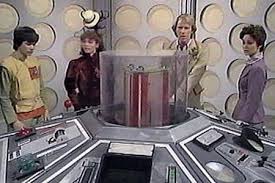
The Season 19 Team at full strength. Den of Geek.
     One problem that Five always suffered with, especially in his first season, was an overstuffed TARDIS. Adric, Nyssa and Tegan provided wide and varied personality types for the series to play with, but it meant that their characters didn't get any time to shine. I always preferred Nyssa to the other two because Tegan complained about everything and Adric is, well, Adric, but because of her less-than-outgoing personality type she never really got the right execution. She was the companion that could be afforded to spend an entire story sleeping, the one that could stay behind in the TARDIS to do the things that the script-writers could fit in anywhere else. Adric's death in Earthshock, while sad, is probably the best thing that could have happened to the season and after that Nyssa got notably more character development.
      That's not to say that the other companions weren't involved. Season 19's main plot was that they were trying to get Tegan, who had mistakenly wandered into the TARDIS in Season 18, back to Heathrow Airport in 1982 in time for her to get to her job as a Flight-attendant. This inadvertantly means that we get four stories where they land on Earth in various time zones, which to be honest is rather clever if productive of unimaginative settings. It works better as a theme than as an actual goal, as we see when we reach the dreaded Timeflight and Tegan actually ends up at Heathrow. The season was far better when it was exploring its own ideas, as we see in Four to Doomsday, Kinda and Black Orchid, and they're the ultimate standouts of the season.
6b_4
The Saward Cybermen... stand around.
     The Saward stories within Season 19 itself are of note. The Visitation was written before Saward became script editor, and was an audition of sorts for his suitability for the role. It does show his fascination with the 1600s as we'd later see many times in his historicals, and it does read a lot more like a radio drama than one often thinks. It isn't by any means a bad story, but it's nothing really interesting. Compared to that story, Earthshock is a completely different beast. It's a story that I've really beat on in the past simply because of how deriviative it is - it takes so many archetypes and ideas from the Alien franchise, and the JNT Cybermen aren't really used as anything other than a generic monster. It may be a great return to form for the monsters after their seven years away, but the story itself really bores me to tears and Adric's death, coupled with a suspense filled first episode, is the only real attraction.
     My favourite story of the season is by far Black Orchid, which is just plain fun in a more innocent era. It's very fluffy and at times the plot makes little to no real sense, but for me that forms part of its charm and there isn't a serial this season that gives me as much fun. Four To Doomsday certainly comes close to that, though, with its quirkily stupid plot and the really quite interesting concepts at hand. The best story of the season in the classical sense is probably Kinda, whose philosophies and ideas mix with great acting from all to make one of the most thoughtful serials out there. My least favourite story, and the winner of the covetted Bad Sci-Fi award, is Time Flight, which mixes an absolute lack of sense or reason with shoddy production values. The truth is, I even like that - it's a fun romp and it's nowhere near unpleasant.
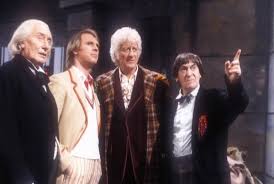
Three Doctors and a Bloke in a Wig
Season 20 - 1983, Peter Davison - Anniversary

Back in 1963, William Hartnell said of Doctor Who, "This will run for five years." Twenty years later, and the producers were due some rightful celebration. The Anniversary year revelled in its position, but it did suffer because of the stresses of what it had to do, and in the end it didn't turn out as well as it could have due to strikes and problems with writers. Season 20 saw Tegan come back, saw Turlough arrive, Nyssa leave and saw The Five Doctors come together to celebrate their acheivements. (Well, Three Doctors and a Bloke in a Wig.) Season 20 itself is a fair mix of very well-made stories with varying degrees of success, but there's a much higher standard overall and you can see the effort that they were putting in despite the problems with strike action.
     As part of the Anniversary Season, JNT brought back lots of former monsters and characters. In order, we saw Omega, Borusa and Gallifrey, The Mara, The Guardians, The Brigadier and The Master, followed by the epic Five Doctors special. Apart from Arc of Infinity, which flounders somewhat, all of this season's stories managed to take these guest stars and put them into interesting stories. And surprisingly enough, it never falls into the same trap that stories like Attack of the Cybermen later would - the mythology is not the most vital part of the story. It's merely complementary to an original, usually better, tale. Enlightenment is a great example. The Guardians from Season 16 form a large part of the story and the eventual conclusion features them heavily, but they're mere background characters in a space-epic about Eternals.
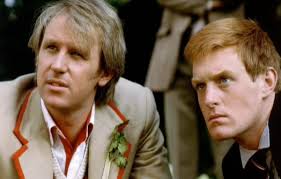
Five and Turlough get friendly.
     Companion-wise, Season 20 rarely feels as overstuffed as the previous season, despite at least one story with three companions. Nyssa's initial appearance as The Doctor's sole companion gives her the impetus for some serious character development that really helps to define the character and seperate it from the behind-the-scenes figure of Season 19. In fact, this development reaches its head in Terminus, which I still tear up at every time I see it. Tegan's reappearance is really, really stupid, and I had hoped that she would have been left behind for good. Apart from in the one Mara episode, the character floats along as the same caricature as before. She does get some decent work in Enlightenment, however, which is mainly due to the fact that during the Black Guardian Trilogy Turlough tends to act as his own entity outside the team. Turlough himself gets his best work here, as the confused boy fighting between his lust for power and his common sense of right and wrong. This really shows up best in Mawdryn Undead, with the rest of the trilogy (especially Terminus) consigned to quite petty villainy.
     The strike problems really show their head when you look at the season's semi-final story, The King's Demons. There in place of a Dalek story called The Return (later to be rechristened as Resurrection of the Daleks) it showcases the nadir of JNT's capacity for decision making in his use of Kamelion. The prop is damn creepy and is by far the scariest thing in a story which features duels, jousts and medieval torture devices. Luckily, the story is made up for by the Five Doctors, which is an absolutely astonishing effort and is the Saward Era's high point by a long shot. It's the story that got me into Doctor Who - the story that introduced me into this magical world.
Goodbye, Nyssa. "tear"
     Bests and worsts are difficult in such a good season, but my personal favourite of the season is The Five Doctors. The sheer spectacle of seeing the Who world pull together as it did makes this story an instant classic and will always be one of my favourite stories from the show. In the season-proper, my favourite is the moody Terminus, whose dark atmosphere is tempered with great ideas and a heart-breaking final scene. The most classically-good story of the season is probably Enlightenment, with it's Kinda-esque devotion to a high-concept sci-fi idea, or Snakedance for its fun take on the Mara and for Martin Clunes. My least favourite is by far The King's Demons, which, unlike its bedfellow Arc of Infinity, has very few redeeming features and features the damn-creepy Kamelion.

Season 21 - 1984, Peter Davison and Colin Baker - Darkness and Change

My viewing (and reviewing) of Season 21 has been incredibly topsy turvey. That could be the reason why my perception of the season is so fractured, but that also has to do with the way the season is structured as The Doctor loses companions and eventually changes himself. Season 21 would be the last time to date that a Doctor changed mid-season, and that's mainly because the reaction to the one serial with newbie Colin Baker was, to say the least, volatile. But for all of its sharp edges, the season has relatively few clunkers in my book, and the ones that are there are affected massively by production problems and not because of scripts.
The Myrka was the victim of bad budgeting.
     Margaret Thatcher's 1983 election robbed the production teams of several weeks, leading to Warriors of the Deep and The Awakening having some real problems on their hands, especially the former. That doesn't make them unwatchable, but both stories are notably incredibly pessimistic in tone. Warriors of the Deep is a quite contentious story for me - it's bad, and I can see that it's bad and I know why it is, but I can't help but enjoy it for its So Bad It's Good value. The Myrka is hilarious, Tegan's styrofoam door acting is terrible and vampiress Ingrid Pitt giving a judo-chop to the Myrka as a first line of defence is one of the funniest things in Doctor Who. It's a real shame that this still ticks people off, though, as this was inevitably the story that began the show's descent when Michael Grade got the wrong end of the stick.
      This season saw companions come and go a lot. Tegan disappears in Resurrection of the Daleks after one decent story in the form of Frontios, but the former story is often so confused with other things that it doesn't get to focus on her story. Planet of Fire sees the belated development of Turlough, and it all feels a tad rushed as we're supposed to absorb all this information about where Turlough is from, his relation to the people of the planet Sarn, why he was on Earth, who his parents were, and what his favourite colour is. It also introduces Peri, who in her three stories develops slowly into the form we see her in during Season 22. In her first story she gets a few decent lines, but Nicola Bryant's crisp English accent did cut through occasionally and her step-dad's accent was even worse.
29
Fighting for his life.
      We can't talk about Season 21 without mentioning the gamechanging Caves of Androzani and, conversely, the much-derided The Twin Dilemma. To be honest? I love both of them for very different reasons. Androzani is a powerful Shakespearean tragedy with great, great acting and a script that never lets up, and provides Davison with some of his best work for the program. It's not typical of his era at all - it's more of a callback to Holmes' 70s work - but it's still classically brilliant. The Twin Dilemma is just plain fun - a simple story with an entertaining performance by Baker, who manages to question our perceptions about the Doctor just enough for us to have to learn to trust him again. That's amazing.
      My favourite story of the season is Frontios, where Bidmead gets all of the characters dead on and mixes it with a great idea in the style that he's so used to. Frontios took a Tardis team that I was really down about and turned it into a great narrative combo. The most classically good is Caves of Androzani, which is Robert Holmes awesomeness in its purest form. My least favourite is The Awakening, which is utterly droll. I rarely have course to call Doctor Who boring - I think Boom Town is a classic, Terminus is a highlight and Black Orchid is fun - but The Awakening is by far one of the most irritatingly bland stories I've ever had to sit through simply because of the stupidity at the core of its central premise.


08
Sixy started off with a continuity drive.
Season 22 - 1985, Colin Baker - Sheer, unadulterated fun

Too many people beat on Season 22. The era was strife with publicity issues and it remains as what is oft-considered a dark age in the show's history. But for me, there isn't any problem. Against the odds, I enjoy every single story from the 1985 season, and despite the fact that some of the stories are a little fluffy, none of them are drastically bad in the way that, say, Time-flight is. Colin Baker is one of my favourite Doctors and over everything his Doctor is what makes 22 one of my favourite seasons in the Classic era so far.
      The dynamic between Six and Peri is an interesting one for me; while the pair are often caricatured as constantly fighting, but really the dynamic is more like a married couple (ooh, don't remind me of The Airzone Solution) where the two may argue, but they care for one another deep down. Colin's abrasive personality means that a lot of scenes occur where the two are just arguing; in my experience, this has led to some of the funniest and certainly weirdest lines in the era. Where would we be without, "Rest is for the weary, sleep is for the dead. I feel like a hungry man eager for the feast!" Despite being a bit of a tit at times, Baker's Doctor is a character that I absolutely love. He's like a sitcom dad. I like him for the same reason I like Stan Smith from American Dad - I don't agree with some of the things he does, but he's a character that is ultimately striving for good. Peri does spend a few episodes of the season as the token screaming companion - Mark of the Rani and Timelash especially - but she does get some further development. You could try a drinking game based on how many villains want to do the naughty with Peri, but I hear that stomach pumps are expensive nowadays.
18
Timelash is a bit off, but not as bad as it could have been.
      The program got in a lot of trouble for violence in this season, which is strange when one considers the relatively large amounts of violence and gore in earlier seasons that received only a harsh letter from Ms. Whitehouse. Attack of the Cybermen saw Sixy using guns, and the Cybermen squeezing Lytton's hands into a bloody pulp. Vengeance on Varos had the acid bath sequence (the guard fell in, he wasn't pushed, don't even try) and torture devices. The Two Doctors had the cannibal-esque Shockeye and his death via Doctor + chloroform. Timelash had the gory Borad. Resurrection of the Daleks had a mutated head begging for death, galaxy-wide cannibalism and a stabbing. There's no doubting that Season 22 is a dark one, but I don't have any problem with the levels of violence - I watched a few of these as a kid and it didn't do me any harm. As for the Doctor using lethal force - well, that's just who this Doctor is. He only killed a sapient being once, and that was in a script by the adored Robert Holmes. It's a lot of fuss over nothing.
     My favourite story of my favourite season is the excellent The Two Doctors, simply for how fun it is. The Sontatarans are good, the Androgums are interesting, the setting is beautiful and Two is still very much on form. The best classically good stories are certainly Vengeance on Varos and Revelation of the Daleks - both dark classics dripping with satire and strong messages. My least favourite is probably Timelash, simply because I didn't like the way that HG Wells was characterised. I did love its atmosphere though, and it's not as bad a story as people make it out to be.

21
The Doctor on Trial.
Season 23 - 1986, Colin Baker - Timelord On Trial

Ah, the hiatus. 18 months of pure stupidity. Not that Nu Who hasn't done similar (2009 comes to mind) but it was a statement from the show's executives that the series was listing in popularity. The series' ratings never returned to the heights of Davison's seasons post Hiatus and while this was probably the fault of the break there was one other contributing factor. The Trial season was one of the most outstanding concepts the series had ever undertaken, and it was almost inevitable that it would never reach the heights it wanted to on such a low budget.
     The season starts out strong with its first serial of four episodes, which return to the 25 minute format. Eschewing character development, Baker and Bryant have a much stronger chemistry and the atmosphere is instantly lightened. This does wonders for the story from a character point of view, but it does mean that the focus is elsewhere; Robert Holmes' penultimate script uses several of his Seventies trademarks (strange robots, comedy double acts - two of them) and quite a strong concept. Despite this, it flounders for the majority and relies much more on the strength of the Trial scenes themselves. The characters in these scenes make the best of the single set, especially Michael Jayston's Valeyard. The Valeyard's character is one of the most powerful of the Saward Era and the first serial of the season shows this off with great panache.
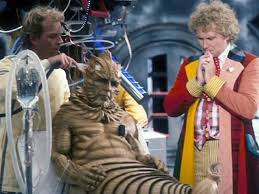
Mindwarp indeed. Better prosthetics =/= better story
     Mindwarp, the fifth-to-eighth episodes of the season, take on a much stranger notion. Written by Phillip Martin, the same guy behind the brilliant Vengeance on Varos, Mindwarp suffered a lot from the Trial aspect of the plot and while I admire a lot of the clever storytelling devices, it is confusing and at times unpleasant to watch. It tries to bring across the darkness of that first story into this season, and it just doesn't work with the Trial scenes. This season didn't need a brainwashed Doctor torturing Peri, it didn't need her to be brainwashed herself, balded and then killed by Brian Blessed (a fate worse than death.) The serial sticks out like a sore thumb, and while I like it, the story wasn't what the season demanded.
      And then we get to the dreadful, dreadful Terror of the Vervoids. I don't want to hate this story - it contains many things that I admire in other stories from the period. But the simple problem is that I think it doesn't contain any thought behind it. At least the silliness in Timelash was evoking plots from HG Wells, this is something like Day of the Triffids crossed with a back-door blue movie. Pip and Jane Baker... I could forgive them for other things. I don't think that Time and the Rani is as bad as most people say it is, and The Mark of the Rani was one of the most interesting stories of the previous season. But the tired Trial aspects, coupled with patronising storytelling and the rushed introduction of an incredibly annoying companion in the form of early Mel, really start to show the end of the era in ways that are immediately apparent.
24
The Doctor is in trouble one last time.
     Saward wanted a big end to the Trial season, and it was problems on the final serial of the season that led to his eventual resignation. Written by four different people over the two episodes, this leaves The Ultimate Foe as a demonstration of all that went wrong during Saward's final season. It was goofy, it had cheesy dialogue, and it was incredibly confused as to what it wanted to be. You could say that he never intended to leave, but the Trial wasn't the best finale that he could have given us as a script writer.

Conclusion

This has been a very cathartic experience for me. As I said before, this era is the one that brought me into the world of Who. It's been strange, and at times painful, but the era for me is never truly boring. There was always the best of intentions and in the long run, the struggle between Eric Saward's radio-drama ideals and JNT's mad whims created some of my favourite pieces of TV ever made. It's been a pleasure writing these reviews and I hope that you've had a pleasure (or will have pleasure) reading them.

Thanks.

Thursday, 2 August 2012

Review: Born To Die

Born To Die - Lana Del Ray (2012)
Written 2/7/12

Lana Del Ray, after her rather odd first album, reinvented herself into the image of 50s Americana. Since then, her first album was hyped to buggery and back, and thus it came as something of a shock when her album didn't really live up to expectations in the quality department. Sure, Born To Die isn't terrible, but it does harbour some horriffic problems with its themes and it's main concept. This grandiose image of being the naughty seductress who bathes in the hedonistic American Dream doesn't just fall down, it cascades when it even touches reality. Soon, Del Ray's blatant product placement reads more like bad American rappers than high-quality ballads.
      It's paradoxical that the album's greatest folly is also it's greatest strength, steeped in a thick atmosphere of Americana indulgence. In certain areas this works absolutely fine; the lead song Video Games is by far the best on the album, with it lax, floating lyrics sounding absolutely heavenly. It's where the newly invented Lana tries to boast about other things that it does get a tad irritating. She was born in New York and attended a boarding school; her college degree was in Metaphysics. For this reason, I find it very difficult to get behind this image of a girl living on the edges of society. At the same time, without that, the album wouldn't be as unique and/or powerful as it can be.
      What can be said is that even though most of the lyrics and themes are total hogwash, the songs themselves are infective. Of note are the aforementioned Video Games, the sultry Blue Jeans and the satirical National Anthem. This is mainly due to a collaboration between Del Ray's enchanting coltralto vocals and some decent songwriting, which manages to get across this potent Americana theme while still producing great hooks. The only true duds are Off To The Races, which is just annoying with its disjointed lyrics, and Summertime Sadness, whose chorus is repetitive and irritating.
      Something about Born To Die just rubs me the wrong way, but I don't know what it is. It could be overplay, it could be the silly arrogance of the lyrics, presenting a character that affects my suspension of disbelief. Or it could be sheer disappointment at the sheer cynicism of the whole exercise. We're living in terrible economic times, we don't want musical movements returning to times in which, funnily enough, everyone's quality of life was even worse. I'd still recommend it for the simple fact that it's become such a movement, but it's not something that I'll be revisiting with ease.

Addendum
Written 4/7/12

What am I talking about? I love this album! Or, rather, I have a much more love/hate relationship with it than I previously claimed. So what if the lyrics make me cringe, and every little mention of her "edgy" lifestyle makes me want to tune out? Fundamentally, this is some very, very well made music. It's seriously catchy, and there's a lot of satire in some places, especially in National Anthem, which mocks America's preoccupation with wealth as much as the rest of the album glorifies it. At times I can't appreciate this; there's too much cynicism in the album for me to totally love it all the time, but while I do like it, I have to defend it from my own harsh words.
     Born To Die is a fun album, and it certainly tears me based on what's going on in the moment. The lyrics are total and utter bullshit half the time, but the musical underlay is both incredibly catchy and richly atmospheric. There's so much to love, and so much to hate, but in the right mindset this album is perfect. It's just that kind of album; she's just that kind of performer.

Thanks.

P.S. This is why I don't do music reviews as often as I used to...