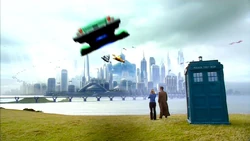
Thursday, 26 July 2012

Review: Doctor Who 2.10: Love And Monsters

Our... villain. Rusty never learns.
Doctor Who - Season 28, Episode 10 - Love and Monsters.

Just like how The Twin Dilemma bottoms the list every time the Classic Stories are judged, Love And Monsters is considered the nadir of the new series. This is RTD's writing at its very, very worst, and Love And Monsters is so unpleasant and silly that it's not exactly a glowing recommendation for the so-called, "Saviour of Doctor Who." The first "Doctor-Lite" episode, it showed us a side of the series that a lot of people never want to see again.
     The story surrounds Elton Pope (Marc Warren) and his fascination with The Doctor. It's told initially through a video diary, Elton discussing his initial encounters with The Doctor and how he joined a group with his girlfriend Ursula, (LInDA), focussed on finding him. While they enjoy themselves by doing arts-and-crafts materials, they are propositioned by evil-looking Victor Kennedy (comedian Peter Kay) to become more organised in their search. After a crazy, Scooby-Doo style run-in, Elton is tasked with infiltrating Jackie Tyler to find out about Rose. At the same time, the group is blissfully unaware that members of their group are disappearing. Soon only Elton and Ursula are left, and it's revealed that Victor is in fact a relative of the Slitheen called the Absorbaloff that's been eating people via touch. Ursula is thereforth absorbed. The Doctor turns up for the last five minutes, and Elton manages to defeat the Absorbaloff by somehow letting him be absorbed by the earth. As one last present, The Doc returns Ursula in the form of a face in a paving slab.
     The first attempt at a Doctor-Lite did what it could to ret-con Elton into the rest of the series' events, and it felt very, very forced because of that. Elton's stranger speech patterns and his borderline obsession with The Doctor meant that instead of just being slightly nerdy, Elton often comes across as seriously mentally ill. You can tell, however, that he is at least attempting to act. Peter Kay is only a convincing actor when portraying things of his own creation, and as Kennedy/The Absorbaloff he is painfully hammy in the least enjoyable way. Count Grendel is fun ham. Kennedy is just a caricature.
LInDA. Or, according to RTD, the
Doctor Who Appreciation Society.
      The Monster itself was designed in a Blue Peter Competition. That's not too bad on it's own... who better to design something scary than the child it's going to scare? What's so intensely puzzling is why the Absorbaloff was even picked. I've looked at the competition's entrants recently, and it seems like the only reason why RTD chose the Absorbaloff was for a hackney's reference to the Slitheen, thus proving that you can't trust a writer to know when he's doing something wrong.
      One of the big points of a Doctor Lite is that when he does appear it's very condensed and thus must be very good. True to form, Ten's five minutes paint him as a power-mad asshole content to consign a woman to a life as an immortal, blow-job giving paving slab. Yeah, blow-job. That's a joke at the end. A kid inspired this episode.
     A key argument in favour of this episode is how it acts as an examination of Doctor Who fandom; LInDA is the enthusiastic fan club exploring Doctor Who's foibles while Kennedy is the obnoxious fans who ruin the fun for everyone else. Which, forgetting how terrible the execution was, isn't a bad idea. But then Elton is portrayed as near-mentally insane and permenantly scarred by his experiences with The Doctor, and The Doctor ultimately fucks Ursula's existence up forever. That's not exactly positive. Also, Kennedy is basically a big Take That towards fan Ian Levine, believed part-author of Attack of the Cybermen who has been one of the program's most vocal fans and critics for the past thirty years. This isn't loving at all; this is hateful, and really bad form on Russell's part.
http://wilybadger.files.wordpress.com/2009/08/after.jpg
Rusty's mind is wrong on so many levels.
      Something that I suppose I have to mention as a Fan is how much this episode divides fandom. In a recent Gallifrey Base poll there were equal numbers of haters and fans, and I suppose that I'm glad that such an episode does exist, if only to show how Who can affect people in so many different ways. Me? I just straight-up don't like it, and no pretentious tosh can change that. If I have a sudden turn-around on Love And Monsters, I'll be sure to revisit it - but don't hold your breath.
      Love and Monsters isn't as mindless as New Earth, but it replaces banality with unwarranted stupidity. The writing is insulting, the characters either insane or stupid and the plot is bearly recognisable as Doctor Who. Love and Monsters, unlike its fellow The Twin Dilemma, certainly does deserve its place at the bottom of the New Series pile and should forever be remembered as how not to make Doctor Who.

Thanks.

And, just because I can, I'll conclude this forthnight's set of Season 28 reviews with School Reunion on Saturday

Wednesday, 25 July 2012

Review: GHTTB: Ashes To Ashes 2.1

Sally from Hyde dies in Gene's arms.
Ashes To Ashes - Series Two, Episode One

The second series of Ashes To Ashes is certainly more slick from a production side of things. The Eighties music from 1982 is even more atmospheric, and the direction has been cleaned right up. This series is my favouirte from the entire bonanza, because for the first time it has a series arc completely seperate from Alex's shenanigans.
     While there's news on the outside of Alex's discovery, the team discover a police officer strung up from the ceiling in Soho, apparently a victim of autoerotic asphyxiation. There's only one piece of evidence - a polaroid of the victim and a female friend. The group is under pressure to find out who's responsible from Superintendant Mackintosh (SuperMac, played by Roger Allam), who Alex likes for his progressionist attitude. They question the stripper from the photo, who Gene tries to protect because of her Mancunian heritage. The dead police officer's best friend, P.C. Kevin Hales, is incredibly concerned about his friend's death.
     The coroner's report comes back with date-rape drugs in his blood and signs of being forced down. When they talk to the stripper again, she is shot by an unseen assailant. Her death spurs Gene on. They question the policeman's wife again, who was playing away with SuperMac. Alex finds a rose on her desk with a note congratulating her on being found. Looking on evidence for Hale, Alex finds photos with the word Pont de L'alma - the place where Diana died in 1997, although Alex won't realise this for a while. They talk to Hale again, and get nothing.
Does SuperMac want to clean up the Force, or rule over it?
       The copper's wife comes to speak to Gene outside the station, "where the walls don't have ears." Her house has been raided, and she realises that it was probably their husband's diary that they were looking for. As Alex heads out on her own, the team find Hales' faint face in the polaroid, proving he knew something. Someone attacks Alex with chloroform, and she wakes up under surgery lights in a scene that teases her return to reality. Her kidnapper sends sounds of her scream to CID, and teases Alex about why she's in 1982 instead of the present. Gene fínds her as her kidnapper escapes. Alex and Gene go to arrest Hale, but he's been tipped off and is armed and drunk. Alex talks him down, and after they found that Hale has been accepting bribes, and is part of a larger conspiracy.
     Episode 2.1 begins the new angle of Police Corruption in a way that's incredibly entertaining. Unlike the arcs from the previous three series, which consisted of hallucinations, this feels more intriguing sheerly because the clues are there for us to follow. And, for the first time, there's an arc from both Alex and Gene's perspective; Gene is treated like a character in his own right and is all the better for it.
      Unfortunately, the set-up of these two new arcs made it nearly impossible for there to be a cohesive mystery, and so the episode jumped around between a set of people before the hasty explanation of the plot in the endscene. The only thing that really made it unique was the more overt commentary of the objectification of women and the tie-in to the Police Corruption plot that will be rumbling on throughout this series.
Alex receives anonymous letters from someone aware of her
true home.
      The first episode of this series got off to a great start, but its main story was distracted by two incredibly well-executed set-ups for this series' arcs. It could have had a much stronger central concept but everything else is on top form - characterisation, direction and certainly storytelling, as we advance upon one of the Bonanza's strongest series.

Thanks.

Tuesday, 24 July 2012

Opinion: (Other) Films I Love

Unlike my similar post last year on the shows I love but won't review, this year I'm looking at film. And, because it's a little more extensive, I'll be looking at wider sections of Films as well as individual pieces.

Pixar Films
Steve Jobs' only real contribution to the civilised world worth talking about is his endorsement of Pixar Studios, initially created by George Lucas and eventually sold to Disney. Unlike many studios out there, I can really feel that Pixar does what they do for the artistic value of the work itself. It's about the story and its characters first and foremost, and so they're prepared to do anything and animate anything to make sure that they come across well.
     My favourite Pixar film is probably Wall-E, which I see as a really fun apocalyptic drama with some decent environmental themes. Wall-E is one of the only Pixar films that doesn't work on some kind of parental bonding, and it's risky for the company merely because of that - the only other times that they have escaped the formula are the Cars movies, which are by far the company's biggest let-downs. I also love Finding Nemo, for its excellent cast and soundtrack, and Up for its brilliant writing, taking what could have been a stereotypical mess and moulding it into something moving and powerful.
     2011's Cars 2 was the studio's lowest point to date. But, unlike with other production teams, I can be sure that 2012's Brave is going to be the animated movie event of the year.  Pixar continue to be the pioneers of 3D animation and so far haven't strayed too far from their key focus upon bringing joy to the world through film.

Richard Curtis' early stories used Hugh Grant in his place.
Richard Curtis
The writer of The Vicar of Dibley and Blackadder, Richard Curtis, is one of the best British comedy writers of a generation. His homely style and his cast of recurring actors makes his ouvre one constantly evolving examination of Britain and what it finds funny. His first two films, Four Weddings and a Funeral and Notting Hill are similarly written, Hugh-Grant-driven rom-coms with very witty writing, even if they are both cursed with having a similar format.
      There is no film for me, however, that rivals Love Actually as a feel-good experience. In our house we watch it every Christmas, but not just for the setting - for the characters, for the comedy and for the music. It's cheesy in parts but all in all Love Actually is a brutally optimistic examination of all kinds of love, intertwined with parodies of a Very British Christmas.
      His most recent film, Rock The Boat, is less of the normal Richard Curtis Rom-com but is still one of his best works to date. Set on a pirate radio barge in the 1960s, the film's chaotic mix of parody and genuine adoration for its era is perfectly set up by its cast of loveable characters. The film's climax, set to Procul Harem's A Whiter Shade of Pale, is an incredibly powerful scene and really demonstrates the power of the music itself.
       Richard Curtis has contributed more to British Culture over the past three decades than a lot of people have. He'll always be one of my heroes, and hopefully the rest of the British public see him as one too.

Back To The Future is awesome from the poster up.
Back To The Future
Time-travel has always interested me. Back To The Future caught my eye at the age of nine, and by the end of the film I simply had to get the rest. Rather willingly, my parents bought me the trilogy, and the rest is history. While some of the writing can be a little cliché in places, there's no denying that the trilogy is one of the most simply fun sci-fi series in cinema.
     In a way, it's dated attempts to portray the Eighties as first the modern day and then a time to look back upon make BTTF a key example of the way that Eighties culture evolved in the latter half of the decade. The first film, made in the mid-eighties and set in the 50s, is similar to a number of films at the time hearkening back to those "Golden Years." The second, made in 1988, spends time in the past but also looks forward to a future that looks upon the Eighties lovingly. And the third and final film is a pseudo-Western, showing how in the early 90s Sci-Fi evolved into new forms.
      Back To The Future often feels phoney, but that's just its Eighties aesthetic. The trilogy is a great feel-good experience, blending the right mix of comedy and drama to produce some of the finest sci-fi-comedy in the 20th Century.


The Marvel Cinematic Universe
The rest of this article was written in January, but this section was written much later, in late April. The Avengers and the series surrounding it is one of the most ambitious film projects since the Harry Potter Franchise, seeing six films completed in four years with many more in pre-production. This series continues to be absolutely astonishing in terms of the quality of direction, storytelling, characterisation and cinematography, and I absolutely adore the fact that this style of film is in the mainstream. 
   The most important thing that this series of films has brought and will continue to bring to Western Cinema is the same style of continuity as one sees in the original comics, with characters and storylines crossing completely different genres in a really enjoyable way. What's more, this franchise is gonna have at least another three films out in the next two years, which is some great production rate. The fun never stops.

One Man In Black that I don't find annoying.
The Princess Bride
Yeah, this isn't a group of films, but one in particular. I only really discovered The Princess Bride from TV Tropes and then saw that my sister had it on video. I wasn't disappointed. Based on a book by William Goldman, the film is a hilarious pastiche of the entire fantasy genre while still managing to be an epic and powerful entry in its own right. The film's clever writing has meant that a lot of its phrases and lines have entered American popular culture.
       And so, if this article has anything to really say, it'd be to reccomend that you go and see this movie. I don't want to spoil anything, and that's how the film is best viewed. I can promise you that The Princess Bride is one of the most funny and heart-warming films that certainly I can reccomend.

Thanks.

Monday, 23 July 2012

Review: Doctor Who 2.2: Tooth And Claw

I wrote last Thursday's New Earth review and next Thursday's Love And Monsters review in January, but now I've had two other episodes fall into my lap. In the spirit of fairness, I've decided to review the second and third episodes of Season 28 and see how they compare to what are in my opinion some of the worst things in Nu Who. So, with that in mind....


Tooth and Claw.jpg
CGI wasn't up to much in 2006.
Doctor Who - Season 28, Episode 2 - Tooth And Claw  
Written 18/3/12

Werewolves. They're cool, aren't they? Wouldn't it be cool if we have a story with a werewolf? That would be awesome! And... and.... Monks! Monks who can do Matrixy martial arts! Yeah, that's awesome. What, it needs to be historical? Oh well, stick Queen Victoria in there! And get Billie to constantly make innappropriate jokes all the time. I think we should set it in Scotland to, that way David doesn't have to act for an episode. Sorted? Ok, we'll call it something cool. Tooth and Claw?
      This I can only assume was the discussion at the writer's table as they sat down and conceived Tooth And Claw, which boasts a lot of ideas and then doesn't really execute them in any sense of the word, "Well." This is of course a Russell Script, in the heart of the role-playing days in which Rose Tyler was his Author Avatar, and if Season 28 hadn't had much time to annoy you last time, then it certainly shines through here. The Doctor and Rose just seem to shamble through this story, involved but not involved; they get themselves in danger and then save the day with some good hard manual labour.
     A monastry of Scottish monks, who are for some reason ("Cool") proficient in Martial Arts, take over a house called the Torchwood Estate. The Doctor and Rose, intending to head to a concert in 1979, end up in 1879 Scotland in the path of the coach carrying Queen Victoria (Pauline Collins). Using some accent trickery and the psychic paper, the Doc gets himself in as "Royal Protector" as the Queen goes to stay at Torchwood. There, they find that the monks are in control of a creepy dude in a cage, who, upon seeing the Moonlight, becomes a werewolf. The Doctor is excited by the prospect of an alien werewolf who wants to infect the British Throne, but Rose is more preoccupied with trying to get Queen Victoria to say, "I am not amused" and then giggling about it like a five-year-old.
Torchwood House. So this is the cause of Miracle Day...
      Eventually after some shoddy exposition it's shown that the house itself was co-built by the Queen's late husband specificially for her to use, giving her the Koh-i-noor diamond before he died. The house is varnished with the very substance that the werewolf is allergic to, and the telescope in the attic is a big moon-light powered death-ray that needs the Koh-i-Noor to not burn a hole in the floor. Queenie is understandably pissed off at the two for being so smug and non-chalent when tons of people have died, and so banishes them, thereafter creating the "Torchwood Institute" and beginning Season 28's run-up to the spin-off.
     At its core, Tooth and Claw has some pretty interesting ideas - the alien werewolf concept is pretty neat, the whole "house is already a trap" is quite clever, but it's presented in the most boring way possible. Nothing is left to the viewer, it's just one linear expository path to common sense, and that means that you have to rest your burdon on the characters to make it work. And the episode spends so long building its monster up and winding itself down that the only thing left in the middle is a group of anorexically thin characterisations. Queenie is a three-part mix of stereotype, emotional poignancy and, "we need her to do this for the sake of the plot"; Derek Riddell's Sir Thomas was a genuinely good man who was for some reason blamed for treason and then topped himself to avoid the shame. They're literally the only two worth talking about.
     So after you dissect the thin plot and the thin characters, what do you have left beside Murray Gold's stirring music and shoddy CGI werewolves? The Doctor and Rose are interesting here only through their slow descent into the annoying caricatures of Season 28. DT does nothing but look vaguely interested for about 35 minutes, and the script even allows him to drop the silly English accent for the vast majority of the runtime. Rose is nought but annoying; her character acts either like someone who couldn't exist, or someone who with the mental age of a receptionner, and brings The Doc with her. Cases in point: After Queenie has just seen a man killed and is traumatised by the fact that a werewolf is trying to kill her, Rose asks if she's amused or not and has a good giggle. Elsewhere, The Doctor makes a joke about The Elephant Man. The Elephant Man, one of the most engaging tales of human kindness through a torturous life that has ever been documented, and Ten sees fit to make light of it as would a schoolboy. I've heard that Doctor Who is a kids's show at heart, but that does not excuse our main leads from acting with such desperate immaturity.
That reminds me, Being Human's on next.
     Tooth and Claw wasn't as bad as its predecessor, simply because for a short while our main leads weren't centre stage. Really, it was badly paced, badly plotted and the characters were painfully underdeveloped. It's a real surprise that RTD can go from such writing as Boom Town and The Parting of the Ways to something as poor as this forgettable mess.

Thanks.

See you on Thursday for Love and Monsters.

Friday, 20 July 2012

Overview: Doctor Who Classic: Season 23

See here for my reviews of Season 23.

Trial of a Timelord did some damn strange things. The structure, harkening back to arcs like The Key To Time and The Black Guardian Trilogy, ultimately did nought to save the series. Upon its return, the peak of viewing figures dropped from nine million to six million, and Doctor Who was never the same again. Here are the characters.


Colin was sacked for no good reason.
Six (Colin Baker) - I should have stayed here!
(All Season, unfortunately has to leave at the end.)

Colin's character hadn't been well-looked-upon in Season 22. His brashness wasn't liked by the public, and after this season he got the sack. In response to the public's anger, Six's personality was much, much more toned down for the Trial Season, and it shows. This was a necessary change, but only because the trial itself seemed to be against the initial personality. The writers had to make the change obvious, otherwise the season wouldn't work.
      The character, for the first time, shows real honest-to-god concern for Peri. Of course, it would have helped had he not then near-instantly revealed his future companion, Mel. The Trial, plus his firing, makes Six's timeline a little absent of meaning. I would have so much prefered to have seen the original Season 23, and to have watched Six's more gradual progression into a loveable Doctor rather than the swift culling of characterisation that we saw here.
       Unfortunately, Six's final lines are "Carrot Juice," a tragic sign of the show's problems still to come. If Colin Baker had stayed... well, we'll never know now. Suffice to say that I thought that it was a tragic loss, and at the end of this unfortunatley silly season I'm still sad to see him go.

Peri grows up.
Peri (Nicola Bryant) - Wife of Yrcanos
(Until Mindwarp)

I'm not all that sure how I feel about Peri's departure. It depends upon my mood. When I'm cheerful, it's a potent, gutting move that stays in the mind and makes her one of the most tragic companions in the show's history. When I'm not so cheerful, it's a stupid waste of time that wastes a character that could have been used brilliantly. Bryant expressed no desire to leave; the series could have gone on with her.
     In Season 23, Peri finally puts some proper clothes on and stops being the cover-photo of Letch's Choice Monthly. She's a great deal more mature, and this improves the character immensely. By the beginning of The Mysterious Planet, we could see that the buxom beach babe from Planet of Fire had developed into an independant woman.
      It's such a shame then that she doesn't get much to do in that story. She only really stands out in her final story, Mindwarp, where she grows up and attempts to civilise Brian Blessed's Yrcanos. This is easily one of Bryant's best performances, and the only one that manages to truly use the character well. Then she dies. I suppose having your mind wiped and then being shot by a slow-motion Brian Blessed is a good way to go.
      Peri could have been so much more, and so very nearly accomplished it. Season 23 at least saw her off without much fuss.

The face of all evil.
Mel (Bonnie Langford) - Now you're getting at the dirt!
(Terror of the Vervoids onwards)

Mel (in Season 23) is abhorrant. Her entire character. The concept behind her character. I hate it. There's not a lot about the Eighties that I really dislike on the level I do Mel; Adric was irritatingly presumptious but he also had an interesting backstory and a death that kept the program alive. Mel is useless 101 - her breathtaking optimism in the face of mediocrity is the most irritating thing in this series.
     It certainy does not help that she appears with only one line of dialogue to explain who she is. Terror of the Vervoids is fundamentally well-structured, but the three elements that make it nigh-unbearable are the villains, the script and Mel. Her screams are the soundtrack to my personal hell and her ridiculously unreal dialogue is matched only by her hideous dress sense.
      Ok, maybe I'm sliding into a bit of hyperbole about dear Mel. But like Vervoids, there's nothing redeeming to Mel at all. She just appears - we're not invested into her as a character. We don't care about who she is, what she has to say and why she wants to say it. And that's bad storytelling. Mel is bad storytelling. At least until the next season.

Thanks.

Thursday, 19 July 2012

Review: Doctor Who 2.1: New Earth

I don't like the Tenth Doctor. I really, really don't. But, since I'm currently sunning myself in Cyprus, I think I can deal with a few episodes. Here, as Ten's first real episode, is New Earth - a sequel of sorts to Series One's The End of the World.

------
Newearth2.jpg
Ten and Rose's "first date".
Doctor Who - Season 28, Episode One - New Earth

Of all of the new series, it's Season 28 that gets the most critical flack. And that's for one very good reason. David Tennant spent the entire season trying to find a characterisation for Ten. While his later performances would cement his character as whiny emo asshole, Season 28 instead presented him an an irreverant idiot. His smug, in-your-face relationship with Rose is one of the main pieces of evidence that supports the implementation The Doctor's continued asexuality. This should not have happened.
       New Earth is further cursed by a rather silly plot. The Doctor is summoned via psychic paper to a hospital on Mankind's home after The End of the World, and pops up to Ward 26 to visit The Face of Boe, where he is met by the hospital's Cat-people nuns. Meanwhile, it turns out the Cassandra survived the events of that episode and is now being helped by a servant, Chip, he lures Rose down to a cellar and then puts Cassandra in her body. Much idiocy ensues.
       After some fucking about by Cassandra, she uncovers that the reason why the Hospital is so brilliant is because they're testing hundreds of diseases and their cures on people specifically grown for the task. These people have now become sentient, and Cassandra releases them, allowing them to kill people with a touch - planning to blackmail the sisters. Cassandra and The Doctor escape, with the latter pissed at having his girlfriend's body hijacked, and so there's a horrendous set of scenes where Cassandra jumps back and forth between the two of them. Eventually she jumps into Chip, and this gives The Doctor time to fog everyone a miracle cure and to send Cassandra back in time for one last farewell. Cassandra, as Chip, dies in her own arms. Rose has had time for a new hairdo.
      The script for New Earth tries to replace wit and charm with dated pop-culture references, inappropriate sexual metaphors and the beginnings of RTD's prophecy bullshit. The writing is just awkward; body-jumping scenarios almost never inspire good writing (see Bodyswap as an exception) and RTD simply can't grasp the subtlties required. Either use the concept in a new way or don't use it at all. The solution is also ineffective and silly - passing on a liquid cure, composed of a dozen conflicting chemicals, via touch. Also, why did RTD think it smart that in his first episode Ten would be posessed and acting completely and utterly ridiculously?!?
Cassandra feels herself up. This is how they make good
television, people! Can't believe I've been so wrong all
these years.
     Worst of all, there are elements here that would continue to plague Tennant's era even when things got better. The most abhorrant of these is, "The Lonely God," issue, which was RTD's sudden decision that The Doctor would be the greatest thing in the Universe and have the ego to match. This was taken to such an extreme that Season Six's entire plot would surround The Doctor's efforts to fix the reputation his ego had left behind. Also, the continuation of "everything dies" really transforms into something nasty here. Last series it was an honest acceptance of death; here, Ten just tells Cassandra to kill herself because he wants her to. Then, after spending her entire life trying to avoid death, she just accepts it like that.
     New Earth is a mess filled with horrible characterisations for smug, immoral protagonists. The writing is poor, the devices used are cliché and any hope of making a serious point about anything to do with human nature or reality is completey stifled by wacky komedy hijinks. Ten's first real episode is not a good start, and, sadly, is indicative of his era as a whole.

Thanks.

Tuesday, 17 July 2012

Review: Film: The Truman Show

Promotional poster.
Big Brother. I'm a Celebrity. Britain's Got Talent, X Factor, Pop Idol, American Idol, Top Chef, Masterchef, The Apprentice, Coach Trip, Dinner Date. All of these are reality shows; television brought up around real people doing supposedly real things with real drama and real characters. This genre arguably began in 2000, with the creation of the Big Brother experiment in which a group of people were put in a house for three months and filmed constantly. However, the genre had been pastiched by several films in the previous years - the most powerful of them being Peter Weir's The Truman Show.
      Set in the sunny shore-town of Seahaven, Truman Burbank (Jim Carrey) is an average guy living a normal life. Or so he believes. In reality, he has spent his entire life living in the world's largest set, being watched 24/7 by millions of cameras for every country in the world. When his supposedly dead father appears as an extra, he soon begins to suspect that all around him may not be as it seems.
      Two years ago I called The Truman Show my favourite film, and with good reason. The film's design is so clever and its characters so well-written that it really tickles my chestnut. Most of all, the film's grand concept is such a pastiche of the reality that I grew up in -  a world where "reality" is so moulded and shaped by fiction that it becomes itself unreal.
Jim Carrey's best performance is uniquely
human.
       This is easily Carrey's best performance in his long career, maybe surpassed only by the well-made but badly executed I Love You Phillip Morris. The key to this, of course, is a mixture of his talents; he offsets his madcap comedy style with a lot of real emotion and potentcy that perfectly contrasts the constructed nature of the world around him. Although the character is flawed, this is what makes him the only True Man in the complex.
      I can't say any more without spoiling the feel of the film, but the reason that I love The Truman Show is because of its intensely well-contructed concepts, blended with characterisation to die for and a soundtrack worthy of great praise. All I can do is advise you to go out and see it, and perhaps hope that you share my vast sense of wonderment at this cinematic creation.

Thanks.

Monday, 16 July 2012

From The Archive: Audenshaw Reviews (An Introduction)

Back in January, our English class had to write a speech about something that would entertain everyone else. While this wasn't the speech I went with in the end, I thought that you might find it interesting. Some of the information is obviously incorrect, but I think that's fine.
-----

About two years ago, my parents took me to a one-hundred-year celebration of Gorton’s acceptance into Manchester. I was a little bitter, and I really didn’t enjoy myself. There’s just something about firework displays, I suppose. I’m not really a fan of standing in the cold trying to decide whether to feel worse about the growing tinnitus or the numbness of one’s hands. And I was angry. But it was that night, after I’d been forced into going to this display, that I began a hobby that has lasted me up until and after the present day.

How did I express my anger? I waited. I didn’t shout at my parents, I didn’t write passive-aggressive Facebook statuses. I wrote a review. Not a very good review, mind – the syntax is horrible and there are several spelling mistakes. But that review, what I called, the Gorton 100, led me to do some more writing. Just to see. Just to see whether this writing stuff could go anywhere. So I reviewed the school play. I reviewed the military band, I reviewed the Halle Orchestra. And I loved it. I loved it so much, that I created an online blog to write in. And, since I thought that it’d be about school, why not call it Audenshaw Reviews?

At first I had no idea what to review. Books? They were out of the question – who was I to offer a literary critique? Music? I knew nothing about that. The only thing I could remember was that there was ternary form and binary form and I had forgotten the difference between the two. So Music was out of the question. And then, after about a month – after a review of Lidl and Primark (they didn’t go down well) – I had a brainwave. What do I, of all people, do the most? I watch TV. I knew something about Tv. About Form, and Structure, and Tone, and Characterisation. I didn’t know a lot, but I knew what I liked. I wasn’t the best writer in the world, but I stuck at it. I reviewed the TV that I liked to watch the most  - Doctor Who, Red Dwarf, Lost.

This talk was going to be on Lost, but I thought this would be more interesting. Judging by the looks on your faces I was wrong.

You may not have thought that this talk was interesting or even relevant, but this is a hobby close to my heart. It’s been a constant to me – a part of my life over the past two years that I could always depend on. I think that it's healthy, even necessary, to find something in your life that's yours to enjoy, and yours to improve. My name’s Archie, and I’m the author of Audenshaw Reviews.

Thanks.

Friday, 13 July 2012

We're all going on a Summer Holiday!

Now that my exams are over, I'm taking some time off. For a while that meant that the only posts that you'd be getting in this next two weeks would be the beginning of Ashes To Ashes Series Two.

Luckily, I've managed to organise a few things, and so while I'm gone there will be a few more reviews than usual. And I'm not going to tell you what they are. (It would spoil the surprise!). I leave tomorrow and I return on the 29th July, and between now and then there will be almost daily reviews on weekdays. Enjoy!

Thanks.