Friday, 24 August 2012

Overview: Doctor Who Classic: Season 24

Doctor Who - Season 24
Written 10/6/12

How do I describe Season 24? I wanted to hate this series, I really did. Reviews where I say that I like things aren't entertaining to write or to read, and after having loved some of the "worst" Doctor Who in the Saward Era, I needed desperately for Sly to come through with some real clunkers. But I can't help myself; the simple fact was that despite all of the season's faults, it's really, really fun. It's fun because you know that the characters are having fun, because when it's good it's superb and where it's bad, it's so bad that you really don't care. I sat through these fourteen episodes wondering why the hell anyone would find them unpleasant. Like I did before, I'll be looking at characters.

Lifitng of the hat became a common character tic.
Seven (Sylvester McCoy) - Time and tide melts the snowman...
(All Season)

The writers couldn't decide what to do with Seven's characterisation. While Andrew Cartmel had the idea of the Doctor's manipulative streak, this took a long time to translate through - most of the writers were unaware of poor Colin's sacking, and so a lot of the scripts had been written with him in mind. What results is a Doctor with an incredible witty streak who now and then shows flashes of dark anger. This is most obvious in Seven's first story, Time and the Rani, which while excusable due to his regeneration presents an overtly silly and clownish Doctor who takes almost nothing seriously. And yet, I love it. Because Sylvester is still working the character, and it's fun to watch.
     The Doctor favoured by Cartmel starts to appear around Delta and the Bannerman, the first story that wasn't overtly written for Colin Baker, as a sort of cheery old uncle. The way he confronts the villain of the week, with such fervour - it seems almost uncomparable to the absurdist impression that we first see of the character as he pratfalls around Lakertya. And I like this guy - he's a fun Doctor, unlike his two JNT predecessors and yet still recognisably the hero. Season 24 won me over to Seven, and I'm glad that it did.

Like the 2012 Albanian Eurovision entry....
Mel (Bonnie Langford) - Surprisingly ok...
(All Season, leaves in Dragonfire)

In my last overview I may have said a few things that I now regret. Mel in Season 23 was unique - something that I hated! At last! I'd been waiting for so long, and finally the Saward Era delivered me a character whom I despised throughly. Now that she was the proper companion, however, I had none of that. Mel became a bit blander than I had expected, but with that it brought out Bonnie Langford's natural charm and turned the character into a positive influence on the series. That was what originally got me about Mel - after four seasons of snarky dysfunction with his companions, the Doctor finally met someone with whom he had a perfect friend.
     But the screams, oh god the screams. By Dragonfire it's just ridiculous how often and how painful those screams are. At least Terror of the Vervoids did a relatively clever thing and tuned the scream to the pre-credits sting - here it's just blatant, and happens in at least ten of the fourteen episodes. She's getting so little development (and, notably, absolutely no backstory) that this otherwise superficial element completely takes over her characterisation. Mel may be a pleasure on-screen, but as a character she fails absolutely.

Ok, maybe she inspired Lister's jacket, rather
than the other way round...
Ace (Sophie Aldred) - Outdated slang, Professor!
 (Dragonfire)

Ace, in the beginning, is naff. Dead naff. She may think she's ace. That she's wicked. But she's naff. And that's the biggest thing that detracts from Ace's initial characterisation - some of her superficial aspects seem to be a deliberate ploy by the production team to try to appeal to a younger audience that, at the time just didn't exist. However, Ace has one shining thing about her that differentiates her from the incumbent by several miles.
     She has a backstory! After Mel was introduced with three lines of Vervoids, it's such a relief to know that the Who scriptwriters had heard of this concept after the Hiatus shakeup, and despite the very vague nature of her Wizard of Oz-esque origin, she does get a few intimate moments that highlight the fact that she is a character - a character controlled carefully by Cartmel. Ace has the potential to become very good, and some of her lines and actions in this story show that perfectly. Onto the next eight serials!

Thanks.

Thursday, 23 August 2012

Autumn and Nostalgia Filter

As a lot of you noticed, my Birthday saw Audenshaw Reviews metamorphose into Nostalgia Filter, everywhere.This is a change I've been waiting for for a while now, for the simple reason that I've left Audenshaw School (sort-of) and so the title will eventually become redundant. Nostalgia Filter is more of a general-purpose description of what we do here, although it refers more to creating said filter than actually experiencing it, seeing as I wasn't around to see the vast majority of what I review. Regardless, this new branding will allow me to continue beyond my high-school and not feel so silly.
     Further, as of this post, I've given the blog it's now-annual lick of paint for Autumn. So what if it's not Autumn yet - it's damn-near close. Today is GCSE Results Day, and I'm getting prepared to enter Sixth Form. What does this mean for Nostalagia Filter? Well, live reviews are going to be a tad more difficult because of the larger body of work, but I'll do my best to continue to review all of the great shows coming up this Autumn, beginning with Doctor Who Season 33 starting on September 1st. I hope you'll enjoy reading as much as I do writing.

Thanks.

Wednesday, 22 August 2012

Review: GHTTB: Ashes To Ashes 2.5

Ashes To Ashes - Series Two, Episode Five

After a relatively different first half of the series, we take a sojurn back to the style of Life On Mars, albeit wth a touch of this new, more politically focussed angle. While it had a few of the issues that Ashes To Ashes always has in its attempt to blend the Coma World with the Real World, the focus on the Operation Rose line made the episode that much more powerful, as well as some great character work for Ray.
     While Gene is trying to get the papers off of the corruption case, Alex is there to witness the deafening of her future father-in-law, Brian Drake, in a mugging. After being a complete and total psychopath towards her currently-14 future husband Peter Drake, she exercises her interest with the family by trying to find the mugger. Gene is disinterested, and Ray intends to join the Army, but their interest is peaked when the DNA comes back as George Stains - a criminal who's supposedly been dead for two years. Gene is put under pressure to make an arrest (with the appropriate Bowie/Queen soundtrack). Their only lead, Metal Mickey, is refusing to talk, so Alex goes to Ray, who explains to her that the outing of Mac as a bent copper has shaken his belief in policing. Ray makes Mickey talk.
     Following the fact that Stains went to Spain, they interrogate the Drakes' neighbour Gayna, who had a Spanish boyfriend. A man calling himself "Boris Johnson" leaves Alex a note to meet in Luigi's. That night he stands her up, leaving a note. Instead, Martin Summers (Adrian Dunbar) arrives late at night in CID. Summers reveals that he too is from 2008, and implies that Alex's only way out of this world is to part of the corrupt Operation Rose. George's mother inadvertantly reveals Gayna's part in the preceedings. She helps to organise a meeting with George, but she's been found to have been assaulted. After a visit to the house, Alex uncovers that it was Pete who stole the money. When they visit Gayna Mason in hospital, they find, to their surprise, that she is George Stains, who had a sex-change to escape the law. She explains that it was Pete who assaulted her that night, taking back the things she had stolen. In the end, Gene doesn't get his big headline, because he doesn't have the heart to tell George's mother.
Gayna... née George.
     As we know, this is an Alex meets Old Family episode. When Sam met his 2006 relatives in 1973, he did so with grace and light concern, but rarely let it crowd his judgement after the events of his abandonment. When Alex meets a her 2008 relatives, she does so with the subtlety of an anvil. This is not a pleasant or logical experience. This really takes the biscuit; a mature, intellectual woman shouting profanities at a 14-year-old for things that he hasn't done. However, the episode did have some good bits; the monologue from Martin Summers was wonderful and Adrian Dunbar, finally seen after a month, does the job perfectly. Ray also got some much-needed character development regarding his disillusionment with policing.
     With the powerhouse of the Police Corruption storyline slowing down after Mac's death, 2.5 took a slight breather, but it never let up on the mystery and this is one of my favourite individual cases in this series, if only because of its sheer surprise value at the end. 2.5 wasn't as good as the past few weeks have been, but it was still some brilliantly and lovingly crafted entertainment that improved our characters.

Thanks.

Tuesday, 21 August 2012

Birthday!

It's that time of year again. I'm not doing anything special on the blog for my Birthday this year, but I thought it'd be nice to celebrate it here.

Thanks.

Oh, and I might have changed a few things here or there. Things are still in flux, though. 

Monday, 20 August 2012

Review: Doctor Who Classic: Dragonfire

The Doctor and friends.
Doctor Who - Season 24, Story Four - Dragonfire
Written 9/6/12

It makes me sad, really. I expected not to like this series, but it's been a total and utter riot. Dragonfire takes the program into its final stages, as we wave goodbye to dear old Mel (whom I've actually come to really like) and say hello to Sophie Aldred's Ace, a character whose eight serials allow her some of the best character development the Classic Series had to offer. Dragonfire confuses me as to whether it needed one episode more or one less, but I can say that it finishes the season on another standard Doctor Who adventure with the appropriate amount of random craziness.
     Following a distress signal, the Doctor and Mel arrive on Ice-World - an intergalactic shopping mall run by the tyrannical regime of Kane, who buys people as slaves and freezes them in his cryogenic palace. There they run into Sabalom Glitz (Tony Selby), the space conman from the The Doctor's Trial. At the same time, they meet Ace - a 1980s teenager who was whisked away to Ice-World by unknown forces and who has a thirst for adventure. Together they venture into the depths of Iceworld, and find that the legends of the Dragon and its fire are truer than they first believed. At the end of the story, Mel decides to leave and travel the Galaxy with Glitz, while The Doctor takes Ace under his wing as the next companion.
     Ace's introduction isn't the best, but it is remarkably better than Mel's was. The character's early attempts to appeal to the youth of the time consists of use of slang that was outdated even at the time - "ace", "wicked," "naff." At the time the audience consisted mostly of people who'd stuck it through and were watching Doctor Who because they were fans. The attempt to garner a younger audience didn't work, and it doesn't make sense when you compare it to the darker direction that the show was heading into. Luckily, she does get a few intimate moments that fully explain her backstory and characterisation, and her character is promising if nothing else.
     The other secondary characters are fun enough too. It's nice to see Sabalom again, and Tony Selby imbues the character with a great charm, despite the fact that he's not being written for by his creator Robert Holmes in account of his death the year before. The villain, Kane, is certainly the best villain since the Valeyard, but the character lacks the humanity that he could have exploited; instead we have a sad sob story about being expelled for his crimes and desperately trying to revive his mobster wife. It's vaguely reminiscent of Batman's Mr. Freeze - not a comparison I should really be making.
The famous "cliffhanger".
     The story's main claim to fame, of course, is the cliffhanger to the first episode, which takes the phrase to a stupidly literal conclusion. Traversing the ice caves, the Doctor finds a steep ledge with a convenient railing. For reasons that will never be explained, he decides that it would be a good idea to climb over and hang off the ledge, before soon realising that he's going to fall to his death. It screams more of the writer not knowing how to work with the 25 minute format than anything else, and it's downright embarrassing regardless.
     Dragonfire finishes the season off in the right direction. While some of its pacing issues may leave the viewer with a sour taste in the mouth, the characterisations and the story's great atmosphere make this final serial of the season one to watch. Despite how much I came to love Mel over the course of the series, I'm not as sad as the surprisingly touching departure wants me to be, for the sole reason that I know that the TARDIS is still in good hands for two seasons to come.

Thanks.

P.S. Writers, please take a course in astronomical science. Then you might realise that stars don't unexpectedly go 'nova without people realising what's going to happen beforehand.
NEXT WEEK: I revisit Remembrance of the Daleks!

Friday, 17 August 2012

Top Five Cases of Bad Doctor Who Science

Written between the 13th and 14th June 2012

Doctor Who is famous for its technobabble, and through thick and thin the series has maintained a rather loose grip on the major concepts of science. Here, lovingly written, are the top five worst instances of Scientific foul-ups in the series that I've spotted. After 48 years, this is just the tip of the iceberg.
  
Three... all lies!

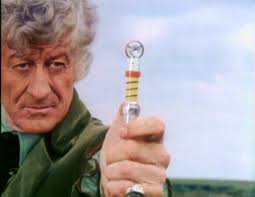
5.) "Reverse the Polarity of the Neutron Flow" (Molecular Physics)

Ah, this most famous of lines. Spoken only once by the Third Doctor in his original run, it was nonetheless extrapolated as a catchphrase from his much more commonly said phrase, "reverse the polarity," which was a stand-in for any necessary technobabble. JNT would later bastardise this and go on to have it said quite a few more times in its full form, leading to its place here.
      What's so wrong with reversing the polarity of a neutron flow? Well, first we need to know what a neutron is. A neutron is a sub-atomic particle, one of two types of nucleons that compose the nucleus of an atom. While Protons and Electrons have electrical charges (positive and negative, respectively,) a neutron is neutral - it has 0 charge. So not only is there no reason to have a flow of neutrons (since it's not flowing from positive to negative or vice versa), but you cannot reverse it's polarity because it doesn't have one. Furthermore, neutrons are unstable outside of a nucleus, and so a flow of them wouldn't be very useful in the long-run as they undergo beta decay.
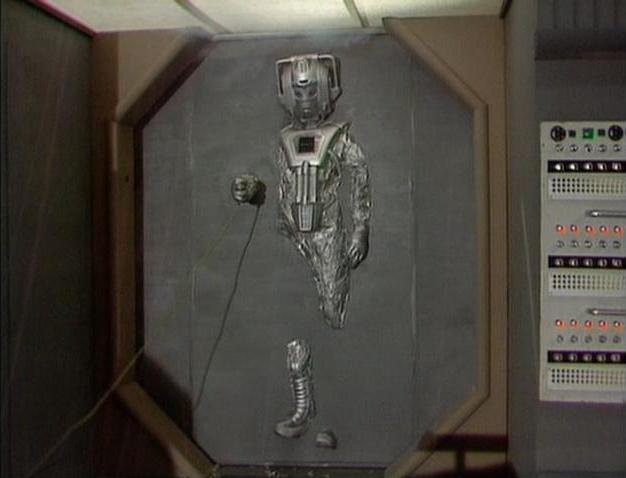
This Cyberman was trapped by Bad Science.

4.) Earthshock - Eric Saward (Physics, Paelentology and General WTFery)

Earthshock bears many hallmarks of bad science, simply in the scale of what it tries to do. We'll ignore the ending for now, and stop off first at a remarkable incident involving antimatter. The Doctor and Adric are trapped on the bridge of the Freighter, while the Cybermen are trying to cut in using what amounts to a powerful filament. The Doctor comes up with the idea of using the ship's anti-matter containment device to adjust the sheild structure around the door at the very moment the Cybermen break through, rendering the door unbreachable. He explains this by saying that anti-matter can only be kept inside a vessel with a perfect molecular structure, and the containment systems therefore have to change the structure of the outer walls to compensate for the antimatter. Despite it being a relatively simple concept, this ignore the primary fact about anti-matter - that regardless of how "perfect" your structure is, when matter and antimatter meet they will annihilate one another, and so the only way to keep them seperate is using electromagnetic fields.
      The episode's ending provides the most simple case of WTFery that I've ever seen in Doctor Who. For reasons as yet unexplained, the addition of a Cyberman battle computer to the Freighter's navigational systems pulls the ship back 65 million years, where it crashes into Earth and becomes the asteroid that killed the dinosaurs. The Cybermen are not a time-travelling race, and so it's absolutely baffling that the ship travelled in time at all; it's one of the great WTFs of the Saward Era. But ignoring all that, it still has incredibly implications. The real asteroid formed the Chicxulub crater in modern Mexico, which is one of the largest craters on record and dates specifically back to the K-T Extinction event. However, as we heard before, the ship's engine was powered by antimatter. While one milligram would be enough to send you to Pluto and back, one would think that the amounts required by a cargo ship would be substantial enough to form a larger crater than the one that's there today.

Helium-2 surrounds Lakertya... and
breaks up into harmless Hydrogen,
floating off into space.

3.) Time and the Rani - Pip 'n' Jane Baker (Particle Physics and Chemistry)

I looked at this in my review of Time and the Rani, but it's still a biggie so I'm putting it here. This serial is an example of a plot that could have sounded as if it made perfect sense only if the writers had used different terminology. Instead, they talk about Strange Matter and Helium Three. Strange Matter, also known as Quark Matter, is a hypothesised form of matter composed entirely of quarks, subatomic particles that form composite particles like protons and neutrons. Strange Matter is believed to be formed at the heart of Neutron Stars, which are so dense that the neutrons the star is composed of are crushed past the point of the forces holding them together and thus becomes a liquid-esque soup of up, down and strange quarks. The word strange refers not only to the use of that flavour of quark, but also to the fact that unlike most quark matter, it is usually stable - if only at high pressures. In Time and the Rani, we just see a random asteroid made of the stuff floating through space, orbiting Lakertya.
     Further, The Rani wants to "detonate" it to form Helium-2. Helium-2 is an isotope of Helium that consists of two protons surrounded by four electrons. Because both protons are spinning in opposite directions, "Diprotons" are incredibly unstable and break into two Hydrogen atoms within a billionth of a second of the isotope's formation. Even if you could "detonate" strange matter - which is just silly - then you couldn't form Helium-2 with it because there are no electrons in the asteroid; it's composed entirely of quarks. And, most importantly, there is no way that mixing di-protons with any substance will allow you to control the fabric of space-time. No matter how entertaining it is.
This is what you get when you try to breed species with
different numbers of Chromosomes and then give the
result to a shitty design team.
2.) Evolution of the Daleks - Helen Raynor and The Lazarus Experiment - Steven Greenhorn (Genetics - and a bit of Physics)

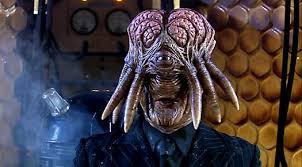
These otherwise unrelated episodes come consecutively in Season 29, and both have some really weird ideas about Genetics. Evolution of the Daleks, by the title, is all about Genetic Manipulation; The Daleks want to create Dalek-Human hybrids in order to survive, as there are only four Daleks left in the Universe. They test this out by creating weirdy tentacle mutant man Sec and then change their minds by putting Dalek minds into human bodies while still claiming it's the same thing. Luckily, the Doctor fixes it all by clinging onto the power source as it's struck by lightning (or what the Daleks call "Gamma Rays", something completely different,) somehow transfering his DNA into the mixture and making the hybrids rebel against their Pepperpot masters.
     Human biology is governed by strings of DNA that are grouped into Chromosomes, strings of the acid that dictate different areas. Human cells have 46 chromosomes, and this plays a key part in our speciation. The definition of a species is a group of organisms who can only produce fertile offspring when mating with organisms within that group. Therefore, species need to be incredibly, incredibly close genetically to even come close to a successful hybrid; Lions and Tigers, which genetically are almost identical, still produce sterile offspring. You are not going to successfully continue your species by trying to mix the DNA of Dalek mutants with regular humans; it's not going to work. And then we see that somehow, one can pump Dalek DNA into a human and have it only affect their mind! This is called, and wait for it - brainwashing, and should involve no manipulation of DNA whatsoever. The major problem with the Daleks is that it's claimed that they're incapable of feeling any emotion except hatred because Davros pissed about with their DNA, and that just doesn't work, as it doesn't here. Even the episode makes this clear - the hybrid that is Dalek Sec should have the same DNA as the humanoid hybrids, and yet he's a mad tentacle face while the others are fine and dandy.
     The biggest point of contention is most defnintely the Doctor's solution to the problem. Firstly, the Daleks go on about how their DNA splicing machine needs Gamma Radiation to work. Gamma Radiation is a form of light, like x-rays and infra-red. It is completely and totally different from what the episode shows it to be, which is LIGHTNING. And then, The Doctor clinging onto the lightning rod is enough to transfer his DNA down the rod and into the hybrids. So not only are you transfering DNA via a lightning strike into the power source of a machine meant to run on Gamma Radiation, and then having that DNA end up in the hybrids, you're mixing 46 chromosomed Human DNA with god-knows-how-many chromosomed Dalek DNA, you're also splicing in triple-helixed Time Lord DNA? And this works? Bull. Shit.
Remember that stage in Human evolution where we were
spiny monsters with scorpion tails and dislocatable jaws?
     Steven Greenhorn's Lazarus Experiment picks up where Evolution of the Daleks left off, with scientist Richard Lazarus creating a machine that uses energy to manipulate DNA and make the user younger - a machine that goes dreadfully wrong when it turns out that his DNA is fluctuating and making him mutate into a reptilian creature formed from "traits hidden deep in his DNA from the past". So first of all, Aging and DNA have a very, very tenuous link at best. Scientists believe that aging is the result of the binding chemicals that hold DNA strands together being lost when cells are reproduced; cells therefore become less efficient at certain things until there is no chemical left and the organism dies. While it may be possible in the future to reproduce this binding molecule and halt aging on a small scale, bunging someone into a machine and throwing electromagnetic radiation at them will do nothing of the sort.
      The Lazarus mutant is a complete and total debauchery of science. The claim made in the episode makes reference to Atavism, or evolutionary throwback. In reality, this is when animals develop features early on in their development that disappeared from previous generations. Usually these features disappear, like the tail on a human foetus or the hind-legs on a whale embryo, but when they last into adulthood it's considered Atavism. This can only happen with traits that once existed in said species, and so, fluctuating DNA or no, you cannot use Atavism to explain a giant scorpion-esque monster that sucks "life energy" from people. I'm stopping here before I get to Dobby and the Archangel Network, but suffice to say that Season 29 isn't very good at this.

A real example of Entropy. The ice is colder
than the liquid surrounding it. It warms up and
the liquid gets colder, until the ice has melted
and the two are in the same energy state.

1.) Logopolis/Castrovalva - Chris Bidmead (Multiple areas of Physics)

When I first reviewed these two Bidmead-written stories, I was awed by the amount of shoddy science coming from a writer whose primary occupation was in writing scientific journals. Logopolis and Castrovalva together are an absolute nightmare; a world in which the most basic laws of science are totally and completely obliterated. Granted that I like these stories for this very reason, but it's just silly.
      Let's start with Logopolis. The endpiece on a series whose theme was entropy, the serial treats entropy in very silly ways. The big deal with Logopolis is that the planet keeps the Universe alive by filtering Entropy through wormholes into other Universes. Once The Master shuts it down, entropy starts to spread throughout the Universe like a wave, destroying many planets and stars including Nyssa's home planet of Traken. This is as similar to real entropy as water is to air. Entropy is the result of the Second Law Of Thermodynamics, which states that in a closed system (one where energy cannot enter or leave), then everything will eventually balance out to the same energy level. This can be seen when ice-cubes are placed in a glass of water; the icecubes melt and the water gets colder; both are now in the same state. As presented in Logopolis, Entropy behaves more like a wave of destructive energy, sweeping through the cosmos and reducing things to dust before our heroes' eyes.
     The serial's other big sciencey thing is the use of recursion, foreshadowing Castrovalva. In this case, The Doctor's TARDIS materialises around the Masters', which itself has materialised around a normal police box. The Doctor and Adric walk through about five police boxes before randomly popping out of the back of the first TARDIS. It's such a shame that this otherwise interesting concept gets fobbed off due to time, and thus raises quite a few questions; why were there more than three police boxes in total? Where did the extra TARDISes come from, and how the hell did Four manage to get to the outside?
     The bullshittery comes on much faster and harder in the following serial, Castrovalva. From the off we have The TARDIS heading off on a random course, and Nyssa claiming that they have a high chance of hitting something because "the star density is high in this galaxy." As a rule, no. To quote Douglas Adams, Space is big. If Jupiter was the size of a marble, the dwarf-planet Pluto would be a metre away and would be the size of a single Hydrogen atom. The Universe is mostly empty space, and you'd have massively bad luck if you came into even remote contact with any matter at all. And speaking of Hydrogen, that brings me to the first episode's cliffhanger. The TARDIS is pulled towards "Event One," aka the Big Bang. This is a tenet of basic cosmology, and thus the serial gets it wrong. Event One, the creation of the "Galaxy" (read: Universe) because of the "Hydrogen in-rush". In reality, the Big Bang was the expansion of a singularity with infinite density and infinite mass, and thus if the TARDIS was travelling towards it it would have no chance of escape, like a body beyond the event horizon of a black hole.
The scale of the Earth and the Moon.
     Other things are niggling me too. The Doctor's Zero Cabinet is claimed to be "bonded by Strong-force interactions". Now without a knowledge of particle physics, this seems elementary - it's a strong force, after all. But this statement makes reference to the Strong Force, one of the four elementary forces (along with the Weak Interaction, electromagnetism and gravitation). The Strong Interaction is the force that holds together quarks to make particles like Protons and Neutrons, and then holds them together to make nucleii; atoms themselves are strong-force-neutral. Therefore, you cannot bond pieces of bloody wood together with it. And despite having a bonding structure that keeps out sub-atomic particles, this zero room seems in awfully bad shape; just as Nyssa has finished expositing about how it keeps out all exterior energy, they get a projection from outside the TARDIS. Because you know, consistency.

Doctor Who is bloody wonderful, and despite its mistakes it's still one of the most entertaining things on TV. It's worth considering as we leave this list that Doctor Who is at heart a tale about a semi-immortal yet humanoid alien who travels in time and space in a blue box that's bigger on the inside. And, at the end of the day, it's just a TV show.

Thanks.


Thursday, 16 August 2012

Josh: Film: The Dark Knight Rises

The cast of 2012's best film?
The Dark Knight Rises, is the third and final instalment of the Christopher Nolan Batman trilogy which started back in 2005 with the innovative success that was 'Batman Begins'. The film sees the continuation of Bruce Wayne's story this time eight years on since the events in the popular favourite blockbuster; 'The Dark Knight'. Living as a recluse Wayne is Batman no more. He isn't needed during a time of peace that's graced Gotham City due to the Dent Act based on lies about a Harvey Dent who everybody believes that Batman killed. Only Comissioner Jim Gordon knows and carries the burden of the truth. The movie sees a terrorist known only as Bane, who has to breathe through an apparatus, plan to destroy the city. With Bane threatening Gotham and the dark times returning, Batman must come back with the help of his old friends and new ones including a hot-headed police officer, John Blake, and a seductive cat-burglar, Selina Kyle. With an enemy of superior strength and high intellect, Batman faces his most difficult challenge both physically and emotionally in one of the most enjoyable 165 minutes of your cinematic viewing experience.      Without exaggeration I can honestly admit to struggling to form any kind of sentence for about an hour and a half after watching this film. After recovering from my awe I was able to think about the characters of this film considering the fact that this movie relies on its focus on characters. Anne Hathaway’s Selina Kyle looked promising from the trailers and I think she proved a lot of people wrong with her portrayal. Her character was intriguely complicated and I very much preferred her more loosely sexualised interpretation of Catwoman compared to the innuendo filled Michelle Pfeiffer version that we witnessed in Batman Returns (1992). Though a manipulative criminal, you're able to realise her true intentions through the effortless performance Hathaway gives. Catwoman isn't a superhero and she isn't a villain, she's a blend of both worlds and works independently, the example of strong woman in a male-dominated world in which she is able to outsmart many of them. Though Catwoman's intentions can be selfish she's the mix of personalties you need in the very black and white world Nolan has created. A superb version of the character.
Gotham's finest; Blake and Gordon
     Joseph Gordon-Levitt’s John Blake was the unsung hero who had many particularly brilliant moments during the movie. The way in which Gordon-Levitt is able to play this newly invented Nolanverse character sees the audience gain a connection with the character of Blake, meaning we can be sympathetic to him throughout. Marion Cotillard's Miranda Tate's is a rather ridiculous attempt at giving Bruce Wayne some sort of love interest but the true nature of this character is something unexpected and yet rushed too.
     Morgan Freeman’s Lucius Fox was nicely used for his wit during this very dark film and was used appropriately when his character's skills were required. He featured more than usual here and I'm glad he did. Michael Caine’s Alfred Pennyworth is sadly neglected and used more as a plot device more than anything yet still greatly performed and loveable as usual. However, though a stellar job, Caine's version of Alfred doesn't make a mark on the late Michael Gough who remains an adorable piece in the sometimes grotesque jigsaw that's the original Batman series. Gary Oldman’s Comissioner Gordon features heavily which is something I really appreciate Christopher Nolan for doing with these modern Batman movies. The role Oldman has played has been consistently, without fail, being stunning. Oldman’s performance is just another reminder why he’s referred to as one of the many greats of the Hollywood industry. I’m glad Nolan’s shaped his character similar to his comicbook counterpart. In the original Batman films Gordon, as played by Pat Hingle, was a lame attempt at making the Comissioner a source of humour which failed and I look back at those films and realise how much potential that character has when comparing to the Dark Knight trilogy Comissioner.
Bane versus Batman
     Now, Tom Hardy's Bane. As the main antagonist Bane doesn’t really have a backstory which is something that seems to happen with a lot of villains in the Batman universe. Bane's story is very sketchy and just like Heath Ledger’s Joker (a glorious performance by the way) he’s a very complex character that needed some sort of reasoning behind the motivation he has to destroy Gotham rather than what the script gives us. Bane doesn't fit into the category he's thrown into and its one of the few faults wrong with this film. However, I can admit, without knowing everything it adds to the entertaining mystery surrounding the character. Bane’s highly intelligent and ruthless. He’s not stupidly bulky or dumbed down like in the ridiculous Batman and Robin but a believably intimidating dictator which slots in perfectly with the thematics of this dystopian world we're launched into. Christian Bale’s Bruce Wayne, though played well previously, has usually been slightly wooden. However, in the Dark Knight Rises he reflects a multitude of emotions we barely see from that actor. I was actually surprised at how good Bale was here and my respect for him as an actor, though already high, has increased that bit more. I adore characterisation like that used in The Dark Knight Rises because its Bruce Wayne that makes the moral decisions here, not Batman. When it comes down to it, super-hero's have their alter-ego's and their secret identities who act differently to one another. Despite this, Batman and Bruce Wayne, more than ever, are one here. Still, I’m rather disappointed with how the Batman himself was featured because he popped up rarely. In addition, when he did appear he was as marvellous as he could be.
     Now the film itself overall, which there isn’t much I can tell you about because the movie is powered by the fuel of its amazing characters whose reinventions in Nolan's world differ to their comic-book origins in so many ways but in a way that means that when applied to the modern, gritty world of Gotham they work perfectly. Hans Zimmer’s soundtrack is riveting and beautiful in a variety of ways that allows the film to flow smoothly. The regularly occurring Arabic chant is a clever inclusion and used when necessary. Bane and Batman’s themes are memorable and representative of their characters. The music in this film is so important because a lot of the time the film is quiet and so when its featured it pumps up the tension tenfold or enhances a scene in the way it should.
     The cinematography is elegant, the direction is inch-perfect and the writing has so many incredible moments which assists the visuals and the actors on screen creating the possibility of gaining awards look even more likely than ever for this outstanding series. The mix of CGI and real effects are manufactured for high quality viewing and all of the action scenes keep your heart pounding. These and the narrative and your connection to the characters keep everything tense and exciting and on the edge of your seat. It's just a shame about the Bat, the hyped up hover-craft we've been seeing through advertisement. Its overly-used and probably implanted to be used as a critical plot device and reveal for the end of the film. Its flight is too unrealistic which makes this prominent new vehicle disappointing. I'd also like to point out that the Tumbler Batman uses never required the rider to have their backside sticking out until they were Catwoman in pleasing tight black lycra. And also, even during a time when 13 million people need his help desperately, Bruce still sees it fit to apply black makeup when donning the Bat suit.
Batman never had do this but I'm not complaining
     In my heart I’m a Marvel fanboy through and through but the end of this trilogy makes my affection for DC Comics increase. I didn’t used to be such a big Batman fan but Christopher Nolan’s changed that with his dazzlingly dark and realistic approach to this comic book hero. This marks a incredible end to what can be categorised as one of the most popular and successful film trilogies in not just the super-hero film world but general one too. The Dark Knight Rises happily replaces the Avengers as 2012's film of the year in my opinion.

Thanks, Josh.
P.S. I'd just like to share my condolences to the families and friends of those who were unfortunate enough to be killed at the screening of this film in Colorado and that my thoughts are with them.