
Doctor Who is famous for its technobabble, and through thick and thin the series has maintained a rather loose grip on the major concepts of science. Here, lovingly written, are the top five worst instances of Scientific foul-ups in the series that I've spotted. After 48 years, this is just the tip of the iceberg.
| Three... all lies! |
5.) "Reverse the Polarity of the Neutron Flow" (Molecular Physics)
Ah, this most famous of lines. Spoken only once by the Third Doctor in his original run, it was nonetheless extrapolated as a catchphrase from his much more commonly said phrase, "reverse the polarity," which was a stand-in for any necessary technobabble. JNT would later bastardise this and go on to have it said quite a few more times in its full form, leading to its place here.
What's so wrong with reversing the polarity of a neutron flow? Well, first we need to know what a neutron is. A neutron is a sub-atomic particle, one of two types of nucleons that compose the nucleus of an atom. While Protons and Electrons have electrical charges (positive and negative, respectively,) a neutron is neutral - it has 0 charge. So not only is there no reason to have a flow of neutrons (since it's not flowing from positive to negative or vice versa), but you cannot reverse it's polarity because it doesn't have one. Furthermore, neutrons are unstable outside of a nucleus, and so a flow of them wouldn't be very useful in the long-run as they undergo beta decay.
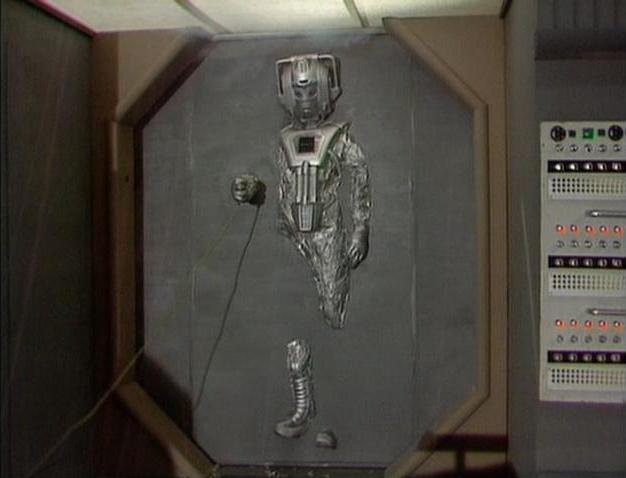 |
| This Cyberman was trapped by Bad Science. |
4.) Earthshock - Eric Saward (Physics, Paelentology and General WTFery)
Earthshock bears many hallmarks of bad science, simply in the scale of what it tries to do. We'll ignore the ending for now, and stop off first at a remarkable incident involving antimatter. The Doctor and Adric are trapped on the bridge of the Freighter, while the Cybermen are trying to cut in using what amounts to a powerful filament. The Doctor comes up with the idea of using the ship's anti-matter containment device to adjust the sheild structure around the door at the very moment the Cybermen break through, rendering the door unbreachable. He explains this by saying that anti-matter can only be kept inside a vessel with a perfect molecular structure, and the containment systems therefore have to change the structure of the outer walls to compensate for the antimatter. Despite it being a relatively simple concept, this ignore the primary fact about anti-matter - that regardless of how "perfect" your structure is, when matter and antimatter meet they will annihilate one another, and so the only way to keep them seperate is using electromagnetic fields.
The episode's ending provides the most simple case of WTFery that I've ever seen in Doctor Who. For reasons as yet unexplained, the addition of a Cyberman battle computer to the Freighter's navigational systems pulls the ship back 65 million years, where it crashes into Earth and becomes the asteroid that killed the dinosaurs. The Cybermen are not a time-travelling race, and so it's absolutely baffling that the ship travelled in time at all; it's one of the great WTFs of the Saward Era. But ignoring all that, it still has incredibly implications. The real asteroid formed the Chicxulub crater in modern Mexico, which is one of the largest craters on record and dates specifically back to the K-T Extinction event. However, as we heard before, the ship's engine was powered by antimatter. While one milligram would be enough to send you to Pluto and back, one would think that the amounts required by a cargo ship would be substantial enough to form a larger crater than the one that's there today.
| Helium-2 surrounds Lakertya... and breaks up into harmless Hydrogen, floating off into space. |
3.) Time and the Rani - Pip 'n' Jane Baker (Particle Physics and Chemistry)
2.) Evolution of the Daleks - Helen Raynor and The Lazarus Experiment - Steven Greenhorn (Genetics - and a bit of Physics)
These otherwise unrelated episodes come consecutively in Season 29, and both have some really weird ideas about Genetics. Evolution of the Daleks, by the title, is all about Genetic Manipulation; The Daleks want to create Dalek-Human hybrids in order to survive, as there are only four Daleks left in the Universe. They test this out by creating weirdy tentacle mutant man Sec and then change their minds by putting Dalek minds into human bodies while still claiming it's the same thing. Luckily, the Doctor fixes it all by clinging onto the power source as it's struck by lightning (or what the Daleks call "Gamma Rays", something completely different,) somehow transfering his DNA into the mixture and making the hybrids rebel against their Pepperpot masters.
Human biology is governed by strings of DNA that are grouped into Chromosomes, strings of the acid that dictate different areas. Human cells have 46 chromosomes, and this plays a key part in our speciation. The definition of a species is a group of organisms who can only produce fertile offspring when mating with organisms within that group. Therefore, species need to be incredibly, incredibly close genetically to even come close to a successful hybrid; Lions and Tigers, which genetically are almost identical, still produce sterile offspring. You are not going to successfully continue your species by trying to mix the DNA of Dalek mutants with regular humans; it's not going to work. And then we see that somehow, one can pump Dalek DNA into a human and have it only affect their mind! This is called, and wait for it - brainwashing, and should involve no manipulation of DNA whatsoever. The major problem with the Daleks is that it's claimed that they're incapable of feeling any emotion except hatred because Davros pissed about with their DNA, and that just doesn't work, as it doesn't here. Even the episode makes this clear - the hybrid that is Dalek Sec should have the same DNA as the humanoid hybrids, and yet he's a mad tentacle face while the others are fine and dandy.
The biggest point of contention is most defnintely the Doctor's solution to the problem. Firstly, the Daleks go on about how their DNA splicing machine needs Gamma Radiation to work. Gamma Radiation is a form of light, like x-rays and infra-red. It is completely and totally different from what the episode shows it to be, which is LIGHTNING. And then, The Doctor clinging onto the lightning rod is enough to transfer his DNA down the rod and into the hybrids. So not only are you transfering DNA via a lightning strike into the power source of a machine meant to run on Gamma Radiation, and then having that DNA end up in the hybrids, you're mixing 46 chromosomed Human DNA with god-knows-how-many chromosomed Dalek DNA, you're also splicing in triple-helixed Time Lord DNA? And this works? Bull. Shit.
Steven Greenhorn's Lazarus Experiment picks up where Evolution of the Daleks left off, with scientist Richard Lazarus creating a machine that uses energy to manipulate DNA and make the user younger - a machine that goes dreadfully wrong when it turns out that his DNA is fluctuating and making him mutate into a reptilian creature formed from "traits hidden deep in his DNA from the past". So first of all, Aging and DNA have a very, very tenuous link at best. Scientists believe that aging is the result of the binding chemicals that hold DNA strands together being lost when cells are reproduced; cells therefore become less efficient at certain things until there is no chemical left and the organism dies. While it may be possible in the future to reproduce this binding molecule and halt aging on a small scale, bunging someone into a machine and throwing electromagnetic radiation at them will do nothing of the sort.
The Lazarus mutant is a complete and total debauchery of science. The claim made in the episode makes reference to Atavism, or evolutionary throwback. In reality, this is when animals develop features early on in their development that disappeared from previous generations. Usually these features disappear, like the tail on a human foetus or the hind-legs on a whale embryo, but when they last into adulthood it's considered Atavism. This can only happen with traits that once existed in said species, and so, fluctuating DNA or no, you cannot use Atavism to explain a giant scorpion-esque monster that sucks "life energy" from people. I'm stopping here before I get to Dobby and the Archangel Network, but suffice to say that Season 29 isn't very good at this.
I looked at this in my review of Time and the Rani, but it's still a biggie so I'm putting it here. This serial is an example of a plot that could have sounded as if it made perfect sense only if the writers had used different terminology. Instead, they talk about Strange Matter and Helium Three. Strange Matter, also known as Quark Matter, is a hypothesised form of matter composed entirely of quarks, subatomic particles that form composite particles like protons and neutrons. Strange Matter is believed to be formed at the heart of Neutron Stars, which are so dense that the neutrons the star is composed of are crushed past the point of the forces holding them together and thus becomes a liquid-esque soup of up, down and strange quarks. The word strange refers not only to the use of that flavour of quark, but also to the fact that unlike most quark matter, it is usually stable - if only at high pressures. In Time and the Rani, we just see a random asteroid made of the stuff floating through space, orbiting Lakertya.
Further, The Rani wants to "detonate" it to form Helium-2. Helium-2 is an isotope of Helium that consists of two protons surrounded by four electrons. Because both protons are spinning in opposite directions, "Diprotons" are incredibly unstable and break into two Hydrogen atoms within a billionth of a second of the isotope's formation. Even if you could "detonate" strange matter - which is just silly - then you couldn't form Helium-2 with it because there are no electrons in the asteroid; it's composed entirely of quarks. And, most importantly, there is no way that mixing di-protons with any substance will allow you to control the fabric of space-time. No matter how entertaining it is.
| This is what you get when you try to breed species with different numbers of Chromosomes and then give the result to a shitty design team. |
These otherwise unrelated episodes come consecutively in Season 29, and both have some really weird ideas about Genetics. Evolution of the Daleks, by the title, is all about Genetic Manipulation; The Daleks want to create Dalek-Human hybrids in order to survive, as there are only four Daleks left in the Universe. They test this out by creating weirdy tentacle mutant man Sec and then change their minds by putting Dalek minds into human bodies while still claiming it's the same thing. Luckily, the Doctor fixes it all by clinging onto the power source as it's struck by lightning (or what the Daleks call "Gamma Rays", something completely different,) somehow transfering his DNA into the mixture and making the hybrids rebel against their Pepperpot masters.
Human biology is governed by strings of DNA that are grouped into Chromosomes, strings of the acid that dictate different areas. Human cells have 46 chromosomes, and this plays a key part in our speciation. The definition of a species is a group of organisms who can only produce fertile offspring when mating with organisms within that group. Therefore, species need to be incredibly, incredibly close genetically to even come close to a successful hybrid; Lions and Tigers, which genetically are almost identical, still produce sterile offspring. You are not going to successfully continue your species by trying to mix the DNA of Dalek mutants with regular humans; it's not going to work. And then we see that somehow, one can pump Dalek DNA into a human and have it only affect their mind! This is called, and wait for it - brainwashing, and should involve no manipulation of DNA whatsoever. The major problem with the Daleks is that it's claimed that they're incapable of feeling any emotion except hatred because Davros pissed about with their DNA, and that just doesn't work, as it doesn't here. Even the episode makes this clear - the hybrid that is Dalek Sec should have the same DNA as the humanoid hybrids, and yet he's a mad tentacle face while the others are fine and dandy.
The biggest point of contention is most defnintely the Doctor's solution to the problem. Firstly, the Daleks go on about how their DNA splicing machine needs Gamma Radiation to work. Gamma Radiation is a form of light, like x-rays and infra-red. It is completely and totally different from what the episode shows it to be, which is LIGHTNING. And then, The Doctor clinging onto the lightning rod is enough to transfer his DNA down the rod and into the hybrids. So not only are you transfering DNA via a lightning strike into the power source of a machine meant to run on Gamma Radiation, and then having that DNA end up in the hybrids, you're mixing 46 chromosomed Human DNA with god-knows-how-many chromosomed Dalek DNA, you're also splicing in triple-helixed Time Lord DNA? And this works? Bull. Shit.
 |
| Remember that stage in Human evolution where we were spiny monsters with scorpion tails and dislocatable jaws? |
The Lazarus mutant is a complete and total debauchery of science. The claim made in the episode makes reference to Atavism, or evolutionary throwback. In reality, this is when animals develop features early on in their development that disappeared from previous generations. Usually these features disappear, like the tail on a human foetus or the hind-legs on a whale embryo, but when they last into adulthood it's considered Atavism. This can only happen with traits that once existed in said species, and so, fluctuating DNA or no, you cannot use Atavism to explain a giant scorpion-esque monster that sucks "life energy" from people. I'm stopping here before I get to Dobby and the Archangel Network, but suffice to say that Season 29 isn't very good at this.
 |
| A real example of Entropy. The ice is colder than the liquid surrounding it. It warms up and the liquid gets colder, until the ice has melted and the two are in the same energy state. |
1.) Logopolis/Castrovalva - Chris Bidmead (Multiple areas of Physics)
When I first reviewed these two Bidmead-written stories, I was awed by the amount of shoddy science coming from a writer whose primary occupation was in writing scientific journals. Logopolis and Castrovalva together are an absolute nightmare; a world in which the most basic laws of science are totally and completely obliterated. Granted that I like these stories for this very reason, but it's just silly.
Let's start with Logopolis. The endpiece on a series whose theme was entropy, the serial treats entropy in very silly ways. The big deal with Logopolis is that the planet keeps the Universe alive by filtering Entropy through wormholes into other Universes. Once The Master shuts it down, entropy starts to spread throughout the Universe like a wave, destroying many planets and stars including Nyssa's home planet of Traken. This is as similar to real entropy as water is to air. Entropy is the result of the Second Law Of Thermodynamics, which states that in a closed system (one where energy cannot enter or leave), then everything will eventually balance out to the same energy level. This can be seen when ice-cubes are placed in a glass of water; the icecubes melt and the water gets colder; both are now in the same state. As presented in Logopolis, Entropy behaves more like a wave of destructive energy, sweeping through the cosmos and reducing things to dust before our heroes' eyes.
The serial's other big sciencey thing is the use of recursion, foreshadowing Castrovalva. In this case, The Doctor's TARDIS materialises around the Masters', which itself has materialised around a normal police box. The Doctor and Adric walk through about five police boxes before randomly popping out of the back of the first TARDIS. It's such a shame that this otherwise interesting concept gets fobbed off due to time, and thus raises quite a few questions; why were there more than three police boxes in total? Where did the extra TARDISes come from, and how the hell did Four manage to get to the outside?
The bullshittery comes on much faster and harder in the following serial, Castrovalva. From the off we have The TARDIS heading off on a random course, and Nyssa claiming that they have a high chance of hitting something because "the star density is high in this galaxy." As a rule, no. To quote Douglas Adams, Space is big. If Jupiter was the size of a marble, the dwarf-planet Pluto would be a metre away and would be the size of a single Hydrogen atom. The Universe is mostly empty space, and you'd have massively bad luck if you came into even remote contact with any matter at all. And speaking of Hydrogen, that brings me to the first episode's cliffhanger. The TARDIS is pulled towards "Event One," aka the Big Bang. This is a tenet of basic cosmology, and thus the serial gets it wrong. Event One, the creation of the "Galaxy" (read: Universe) because of the "Hydrogen in-rush". In reality, the Big Bang was the expansion of a singularity with infinite density and infinite mass, and thus if the TARDIS was travelling towards it it would have no chance of escape, like a body beyond the event horizon of a black hole. |
| The scale of the Earth and the Moon. |
Other things are niggling me too. The Doctor's Zero Cabinet is claimed to be "bonded by Strong-force interactions". Now without a knowledge of particle physics, this seems elementary - it's a strong force, after all. But this statement makes reference to the Strong Force, one of the four elementary forces (along with the Weak Interaction, electromagnetism and gravitation). The Strong Interaction is the force that holds together quarks to make particles like Protons and Neutrons, and then holds them together to make nucleii; atoms themselves are strong-force-neutral. Therefore, you cannot bond pieces of bloody wood together with it. And despite having a bonding structure that keeps out sub-atomic particles, this zero room seems in awfully bad shape; just as Nyssa has finished expositing about how it keeps out all exterior energy, they get a projection from outside the TARDIS. Because you know, consistency.
Doctor Who is bloody wonderful, and despite its mistakes it's still one of the most entertaining things on TV. It's worth considering as we leave this list that Doctor Who is at heart a tale about a semi-immortal yet humanoid alien who travels in time and space in a blue box that's bigger on the inside. And, at the end of the day, it's just a TV show.
Thanks.


No comments:
Post a Comment
Note: only a member of this blog may post a comment.