Thursday, 28 February 2013

Review: Survivors 2.1

These reviews are a bit late. The first two were written in December 2012 and were intended for the new year, but circumstance pushed them back a bit. Whatever, enjoy.

Survivors - Series Two, Episode One
Written 16/12/12 

Back in the glorious summer of 2010, I took advantage of a ridiculously underpriced boxset to review the first series of the 2008 reboot of Survivors, based on a story by Terry Nation that's best known for its far more popular adaption from the 70s. The new reboot did a lot of things rather differently, adding new characters and swapping a few ethnicities round to reflect Noughties Britain. While the second series had been planned for a while, the 2009 Swine Flu scare made the BBC reconsider broadcasting it, and while critical reaction was better the ratings for the second series suffered so much that the BBC threw in the towel.
Greg's life is on the line - and so are Anya and Al's when
they try to help.
     I'm going to turn around now and say that I was several million degrees too harsh on the first series of Survivors. It had its problems with characterisation and certain annoying acting decisions, but as a sci-fi concept it was fundamentally sound, and the direction and cinematography were always top-rank. Series Two starts off immeditately attempting to rectify the mistakes of the past by managing to flesh out all of our characters at once, and solidifying the dynamics between them.
     Stuck in Manchester after having to look for runaway Najid, the gang find themselves nursing a Greg whose been shot by Dexter. Stuck for medical supplies, Anja, Al and Tom head off to the Manchester Royal Infirmary, which is then collapsed by city-dwellers trying to eradicate what is essentially a disease hotspot. They all try to help, leaving Greg in the lurch, and Sarah has to sell her body for a jack. Meanwhile, Abby has been taken to the Evil Scientists' Lair, where she is told by David Whittaker (Nicholas Gleaves) that she's the only one to fight off the virus who wasn't immune and thus needs to be tested on to prevent the virus from mutating further and killing everyone. Anya and Al are rescued, and Greg recovers, but Tom is forced to leave the group when Greg denounces him as a murderer.
     One of the more surprising parts of the episode for me were the frequent flashbacks to life pre-virus for Greg, which felt very Lost-like. While they were certainly welcome, they did feel a bit belated and in the scheme of things it would have been wiser to have seen these back in the first series, when our characters were setting up. Meanwhile, Sarah, a character whom the writers seemed to spend the entire first series trying to get us to hate, gets some rather unpleasant character development when she is raped in  order to further the story. I don't know whether they were trying to be girtty or were taking her character to what they felt was a logical extreme, but it felt a tad unnecessary regardless. Worst of all was the fact that the guy playing the rapist is now on all those co-op ads. Eugh.
Abby's looking a bit worse for wear in the Scientists' compound.
     The scientist storyline was perhaps the most interesting part of this week's episode, with Nicholas Gleaves turning in another great performance as a troubled villain. The scientists, again, were a part of the first series that were very much left in the background, and that was a real shame. For all of the atmosphere and little personal stories that the first series gave us, it neglected to fill in on any of our actual characters or main villains. It felt very much like it'd been written like an American series and then they'd simply just forgotten that they only had six hours to work with.
     So, all in all, an improved start for Survivors. It feels very much like it's making up for lost time, and the result is an hour of compelling drama that both explores the post-apocalyptic world in a much more in-depth way but also advances a lot of our characterisations. I'm not sure that the flashbacks were well-placed and I really think that it's a little too late to be starting with that now, but I was glad for the character development they provided and it's certainly a trend that this series is going to continue.

Thanks.

Wednesday, 27 February 2013

Review: Lost 6.7: Dr. Linus

I've recently gone back to the first season on DVD for the first time, and boy is it weird. Good weird, though. It's not necessarily better than the later series in every way, but its certainly more accessible and the characterisation is just... by golly it's good. I don't know whether or not to review Season One for the blog, as everything I say will feel a tad redundant given that I'm going to be covering our characters' journeys as I examine their last few episodes. I'm rambling - onto Dr. Linus!

http://images1.wikia.nocookie.net/__cb20100331134909/lostpedia/images/7/72/DrBen.png
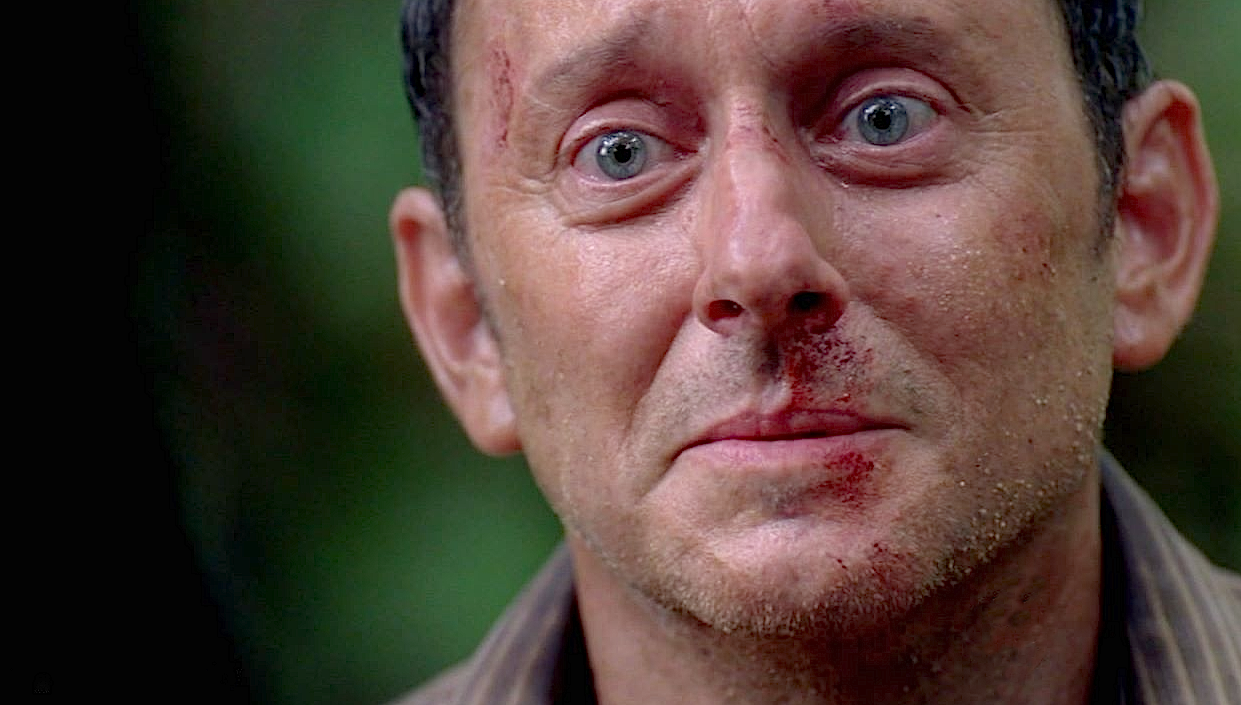
Ben begs for forgiveness and explains why he killed Jacob.
Lost - Season Six, Episode Seven - Dr. Linus
Written between 8th and 9th February 2013

Benjamin Linus. That's a sentence in and of itself - the show's most memorable, most entertaining character that only popped up in the third season. Michael Emerson's performance and simple good writing has made Ben Linus the symbol of all of Lost's potential, becoming a threefold hero, villain and expositional device. He is a character that you can never trust, that is always unpredictable and yet strangely predictable in his unpredictability. Dr. Linus, the last Ben-centric episode and one surprisingly early in the season, is about the character's redemption arc after two seasons of ruining his own life.
     In the main island storyline, Ben escaped the Temple with Ilana's group, including Miles. Desperate to discover what happened to her father figure, Ilana gives Miles Jacob's ashes, and he reveals to the group that Ben was his killer. Ilana has him shackled on the beach, and begins forcing him to dig his own grave. The Man In Black arrives to let him go, informing him of where he can find a gun, and Ilana ends up pursuing Ben through the jungle until a standoff, where Ben apologises to her and tells her that he will never come to terms with his actions. When he suggests he go off and join the Man In Black, she appears to forgive him. Richard meets Jack and Hurley at the Black Rock, and says that he's going to kill himself, but Jack talks him out of it by convincing him (with some pretty strong evidence) that it's impossible to do so. Out in the bay, a submarine appears on the horizon - it's Widmore's.
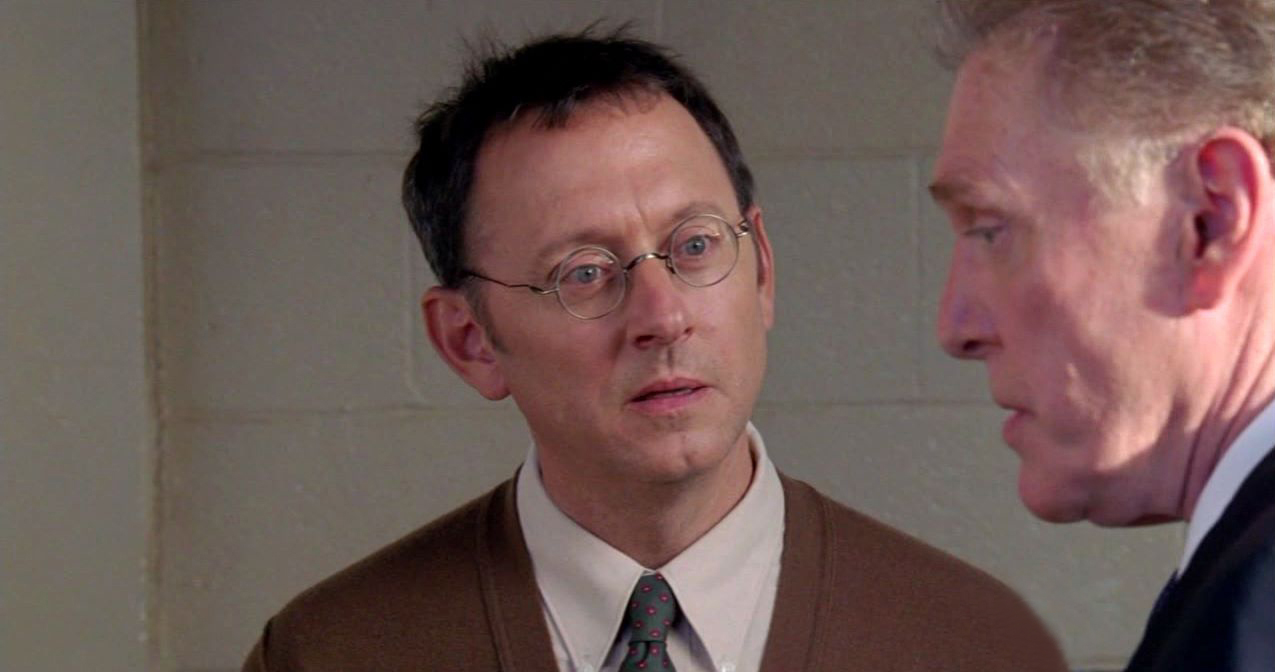
     In the flash-sideways timeline, Ben's life has taken a very different turn. He is a shy, unassuming high school History Teacher, bullied by the corrupt principal and more concerned for his students (especially Alex Rousseau, who was his adopted/kidnapped daughter in the main timeline) than he is for his own career. A conversation with Alex gives him the opportunity to blackmail the Principal and gain power in the school, but his plan is cut short when the Principal threatens to ruin Alex's chances of going to Yale like she wanted to. Unlike in the original timeline, he puts her interests before his own power, and the two come to an agreement.
http://images4.wikia.nocookie.net/__cb20100503111014/lostpedia/images/b/b0/6x07_PleaseRunDetention.jpg
Ben's flash-sideways counterpart is much less evil.
     Emerson gave another magnificent performance in this episode, with particular high points being his moment of decision in the flash-sideways and his final monologue to Ilana, which on first broadcast almost had me in tears. He was key ot the episode's success, allowing the script to fully break down the core essentials of Ben's character and push all of his buttons. In the main timeline, we got to see him punished for his deed and explain his regret over letting his power take precedence over his love for his own daughter, and in the flash-sideways we see him get to put this into practice as he sacrifices power for Alex. 
     Ben's journey through the series is one that I feel does peet off a bit at the end. It's always going to be a bit disappointing to see a character as ruthless and controlling as Ben come to terms with their own problems and try to become better people. In the end, Ben's parental-abuse-driven quest for power amounts to nothing, and I think it's fair to say that he spends the rest of this season following people around being unimpressing. However, I was glad for this episode, which gave Emerson one last chance to really go all out and take the character of Ben to its logical and very satisfying conclusion.

Thanks.

Tuesday, 26 February 2013

Review: Being Human 1.0: The Pilot

http://forbiddenplanet.co.uk/blog/wp-content/uploads/2008/05/Andrea%20Riseborough%20Russell%20Tovey%20Guy%20Flanaghan%20Being%20Human.jpg
The image you will find on all articles discussing the pilot.
Written 24/2/13

For the sake of completionism, seeing as Being Human is reaching its tragic and untimely end, I thought that I'd take a look at the Pilot that started it all. In 2008, BBC Three was undergoing a rebranding to appear less adult and more dynamic and cool. To facilitate this development, the channel chose to make three pilots for dynamic new series, two of which would be turned into fully fledged series the following year. These included the street-oriented West 10 LDN, the weird and wonderful Phoo Action and, as we see here, the original brief for a cheesy drama-comedy called Being Human.
     The only recognisable face in the cast (i.e. the only cast member to survive the crossover) is Russell Tovey, who is playing much, much camper version of himself. Mitchell actor Guy Flanagan is a much cooler and quieter take than Aiden Turner would later give it, feeling more like a stoner than a brooding heartthrob. Lenora Crichlow's position is taken by the much more Northern Andrea Riseborough, who I actually prefer in the role - she manages to capture the character's initial agoraphobia and loneliness in a way that's much more pulling than Lenora, whose Annie is much more awkward. There's little mention of her death, though, so it's debatable whether Riseborough could have gone forwards to work with that.
     Another interesting difference comes in the Vampires - the ones in the Pilot feel much more modern, hanging out in night-clubs and travelling by limousine, with Adrian Lester's much more subtle Herrick (I love Jason Watkins, before you all pounce on me) feeling rather weird. Lester's interpretation is much more of a PR guy, whereas Watkins' Herrick is called into so many other situations in which his madness and desperation are often brought to the fore. You believe that Watkins' Herrick is mad enough to try to take over the world from Bristol. Lester's Herrick... not so much. Elsewhere, and vampire Lauren (played here by Canadian actress Dominique McElliglott, Moon) goes from being this vulnerable and difficult woman in the main series to being the cheesiest performance I think I've ever, ever seen. (And that includes The Kandyman.)
The not at all scary and the scarily bad.
     It's a real shame, really, that the Pilot has been sorta hidden away for all these years. It has a feeling that's much more embryonic than that of the series proper, outlining a great deal of potential rather than developing anything too long term. It also doesn't have any predispositions - it works perfectly well on its own as an examination of humanity and our desperate desire for normality. It's also pretty funny, to boot. Simply put, it's as good an episode as any other and it more than justifies the lengths that many people went to in order to get the show a full commission.

Thanks.

Monday, 25 February 2013

Review: Doctor Who 3.1: Smith And Jones

The Doctor and Martha. Running.
My captioning is a bit lazy this week, forgive me.
Doctor Who - Season 29, Episode One - Smith and Jones
Written between 27th January and 8th February 2013

So our first noble companion has gone, and a lot of the fandom are really, really sad about it. This is not the best way to allow our viewers to recognise Doctor Who's incredible habit of change. Luckily for the show, the opener to Tennant's second season is one of the best scripts that Rusty ever produced, and says a lot more about the quality of the previous season than it does about the projected quality of this one.While Smith and Jones may not be the perfect episode, it is certainly a very good introduction, free of any stress of having to reboot the series and simply allowing us to get in touch with our new regular.
     Martha Jones (Freema Agyeman) is a 21-year-old medical student working at London's Royal Hope Hospital. It's her sister's birthday, and the planned party is causing tension between her seperated parents. As she enters work, she meets stranger Mr. Smith, and they're present when the Hospital is lifted by backwards rain onto The Moon. There, Mr. Smith sees Martha's lack of fear and introduces himself as The Doctor. It turns out that the hospital has been lifted by Space-Mercenaries known as The Judoon, who are looking for blood-absorbing alien Mrs. Finnigan (Anne Reid, The Curse of Fenric). She initially disguises herself as human and adapts an MRI machine to wipe out one side of the Earth, but with The Doctor and Martha's intervention she is stopped and the hospital is returned to Earth before everyone runs out of air.
      I suppose you could say that the script is rather desperate to get across Martha's positive traits from the get-go. She's smart, inquisitve and unafraid of the unknown - all good qualities for a companion to have. Something that felt justified at the time but that doesn't really feel justified now is the few references and nods back to Rose - according to the Doctor, she's not even a companion yet (and she won't be for at least another six or so episodes). Like I said, it's a hangover - one that may indeed be touching for the characters involved, but one that doesn't help the show to move on and execute new ideas like having a new companion should help it to.
Rhino people. 'cos.
     As for the plot itself, it's a small curse of the RTD era that monsters from Premieres are rarely very memorable. Here we have weird Rhino creatures with funny names, creatures made of leather and a woman who drinks your blood through a straw. The peril is imminent and the episode is not without tension, but the fun comes from the novelty of the scenario rather than the strength of the individual villains.We're not exactly talking high-cocnept here. But I perhaps think that that wasn't really what this opener needed, and the lack of a strong villain character allowed us to focus more on the relationship between our core protagonists.
     I suppose its the fact that Smith and Jones isn't trying to be big and complicated that is ultimately its greatest success. The main plot is designed to be fun for kids and expose us as much as possible to our new character, who hasn't had a million years to get started. And, as you can probably tell, I'm running out of things to say. Smith and Jones is good at what it wants to be, and as a companion introduction it's probably one of the best, "this is why our companion is cool" episodes. Onto the past.

Thanks.

NEXT WEEK: The Shakespeare Code! Haha Dan Brown reference.

Sunday, 24 February 2013

Review: Being Human 5.4: The Greater Good

http://ichef.bbci.co.uk/images/ic/384x216/legacy/clip/p01557x2.jpg?nodefault=true
Crom runs the gamut of emotions.
Like last week, The Greater Good was another of Being Human's tried and tested Guest Star Of The Week stories, but the wonderful thing about Series Five so far is that said stories have avoided being formulaic and have done wonders to advance our characterisations. This week was another blinder for Hal, as well as a conclusion piece for excellent guest star Ian Crom. Adding to that was the return of the sinister Captain Hatch and of Mr. Rook, now in a more villainous capacity.
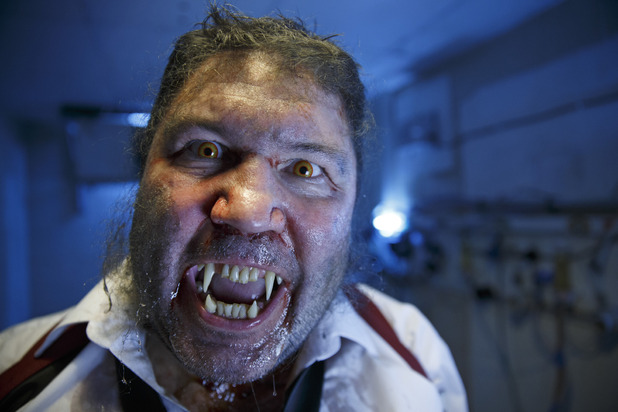
    With the power going out at Rook's facility, he shipped inmate Bobby (Ricky Grover, Eastenders) over to the House in order to keep him satiated, while demanding that Hal go and find Crom, who has converted his assistant, Alan, and gone on a killing spree. Bobby takes to Tom, and the young werewolf is able to help him slowly readjust. Similarly, Hal tried to help Crom get clean. As part of his program, Crom tried to go on a date with Alex, which was sabotagued when she admitted her lack of interest and when a plot by Rook and Captain Hatch nearly saw him torn apart by Bobby. Crom tortures Hal in the cellar, causing Hal's evil persona to surface once more, revealing that Hal is losing control. Crom chooses to not become like him, and so drinks a vial of werewolf's blood, killing himself. Hatch whispers The Secret into Bobby's ear, and he kills himself, but Alex becomes suspicious of him.
     Crom's entire storyline has been a weird and often wonderful deconstruction of Being Human's analogy. The people we've previously seen try to quit blood have all been people of purpose - Mitchell was a soldier, Hal was an ancient Lord. Crom is a lonely, quite creepy man whose life before conversion didn't offer him much happiness, and thus the attempts to return him to that time offer him very little release. It was a subtle examination of Being Human's analogy between vampirism and addiction, and Crom's decision to either drink the werewolf blood or become a monster put me in the mind of Shutter Island and its contempories.
http://i1.cdnds.net/13/08/618x412/cult-being-human-s05-e04-5.jpg
This guy keeps getting cast as thugs and idiots.
Give him a break, guys.
      Captain Hatch, after a notable absence last week, returned with a less grotesque but certainly more sinister role. Much like the devil of folklore, his subtle manipulation of Rook's desperation in order to attempt to eliminate Hal and Tom was quite interesting. I like that the series is picking up the pace, and I appreciate that there was a need to develop our new trinity a little more before getting knee-deep, but I had hoped that there would be a much more intense pace, and next week looks like it can deliver the pre-finale slamdown that we have been used to in series prior. I am really liking this series so far, and I just really hope that when it goes out it does so with a bang.

Thanks.

P.S. This Tuesday, I take a look at Being Human's pilot episode! So, er, put it in your calendars, I guess.

Monday, 18 February 2013

Week Break

We all need a break once in a while. Doctor Who and Lost reviews resume next week, where I also start reviewing the second series of Survivors. And my coverage of Being Human's awesome final series continues on Sunday.

Thanks.

Sunday, 17 February 2013

Review: Being Human 5.3: Pie and Prejudice

http://s4.tvequals.com/tv/up/2013/02/Being-Human-BBC-Series-5-Episode-3-Pie-and-Prejudice-3.jpg
Hal and the obfuscating Lady Mary.
This really is not fair. It's not fair in the slightest. Being Human is on its last series, it should be getting slowly crapper so that we don't feel so bad about its passing, and we can lament its depature and mourn for those old halycon days. But no, the writers are insistent. Against all of my expectations, this episode was bloody brilliant. If last week was the point where I accepted that the old team was gone, this was the point where I came to love the new cast just as much. Bracken, Moloney and Socha are astounding at what they do, and the scripts for this final series are allowing them to squeeze as much as they can out of their characters.
     Like the old style, the episode was split into two mixing subplots. The first involved shady weatherman Larry Chrysler (a star turn by Julian Barratt), who became a werewolf six months ago and has thus ruined his life while still pretending to be a successful personality. Tom becomes enamoured of him, and allows him access to the b'n'b in exchange for "teaching". Elsewhere, Hal revealed to Alex his old friend Lady Mary, a ghost he's been visiting for 250 years. She pretends to be prim and proper around Hal but, as Alex finds out, is thoroughly modernised and irreverent. She believes that she is the only reason that Hal is dry, wrongly believing herself to be his last victim.
     The two subplots came together in a way which allowed all of the characters to evolve. Tom was forced to come to terms withn the fact that the beast within him still affects his life outside his transformations (none of which are shown, which says something of the budget.) Alex, in seeing the delusions Lady Mary spun for herself, confronted her fear of having to be around for an eternity and accepted responsibility of Hal's inner madness. And, unknown to them all, we saw Hal's dark side when he, in response to Chrysler's taunts, lost his cool and strangled him with a TV cord. (In time to call a suicidial Rook.)
http://media.sfx.co.uk/files/2013/02/beinghuman5.3preview_610.jpg
Julian Barratt is the slimey Chrysler
     That last scene especially amazed me. Damian Moloney has always had a very different approach to vampiredom than Aiden Turner, with Hal displaying a much clearer sense of the incredibly controlled personality holding back a monster. He looks shaken up after he lets himself go, just in his mannerisms you can tell something is different now. And to speak of the scene itself, well, that was just amazing. It wasn't just anger, it wasn't even primal - it was the concentrated hate and rage of someone who has killed many, many times before.
     It's subtle and powerful acting like that that makes me more sad than ever that this series is coming to an end. Given its tone, I didn't expect Pie and Prejudice to be much, but despite the fact that the Satan arc was pushed to the side, it's by far the strongest episode of this series so far and one of the best character pieces I've seen on the show in a very, very long time. I get the feeling that this more concentrated series is really doing the show good, and if the remaining three episodes (only three, egads) are as good as this, I will be very happy.

Thanks.

Friday, 15 February 2013

Happy Anniversary Red Dwarf!

Today marks the 25th Anniversary of the initial broadcast of The End on BBC2, and thus 25 years of Red Dwarf!

Albeit with a few large gaps in the middle. But ho hum.

Also, a shout-out to my friend Joel, who is 17 today.

Thanks.

Overview: Doctor Who: Series Two

Written between 26th January and 9th February 2013.

Series One of the revived series is one that I consider to be pretty much flawless, owing to a combination of factors that complement the superb acting of its lead and the writing that enables it. The second series, something of a "difficult second album," had the job of both introducing a brand new Doctor to the public, but also of living up to the insane standards of the previous year. And, probably to the annoyance of many of you, I don't think that it quite succeeded. I will attempt here and now to explain why, without being too pretentious or insulting. (Two counts on which I will probably fail.)
     Firstly, the good bits. Conceptually, a lot of the stories of the season were actually pretty strong. You had the great Impossible Planet two-parter, as well as the well-executed Parallel Earth story earlier on in the series, as well as several strong offerings from others like Moffat and Toby Whithouse. That's gonna sound like I'm only praising the writers from the current series, and that's completely co-incidental. It is a shame that this is where I think that RTD began to slide in my expectations, not due to any abject change in talent but rather because he became too enamoured with his own characters.
     Rose is the centre of this season's problems for me. I'll just spit it out, I'm going to piss off her fans anyway. I don't hate Rose as a character - I think that it was a good idea to bring the show back with a clear audience recognition figure, and Rose provided that in spades as the charming working-class shopgirl who was carried away by the Doctor's adventures at the same time we were. But after the first series, this role seemed to diminish, and either the guest writers didn't know what to do with her or you had the main writers just trying to get her to fit in. Just take a look at the first four episodes to get what I mean: Two RTD episodes, New Earth and Tooth and Claw, in which the Doctor and Rose are all lovey and smug, and then two current writers tell other stories of the Doctor's escapades and Rose fades into the background. Her story had been told, there was nothing else to do with the character, she'd already done the journey from nobody to God and after that there's nothing much you can do.
     The Tenth Doctor is a bit odd in his first season, in that he seems composed primarily of his initial weirdness and doesn't really get a chance for much seriousness of thought. His characterisation seems to change depending on the writer, ranging from a power-mad weirdo in RTD's episodes to a serious, considerate diplomat in the series' two-parters. I think his popularity stems from the overall sense of "awesomeness" that just emanates from the character, which obviously in many cases is subjective. There's just something about the Tenth Doctor that manages to balance attractive youth and incredible experience, to the extent that, for now, his presence is enough to make you more confident about a situation.
     And that's all I can build up the will to say about this season. It's one that will continue to divide fan opinion, but it's almost universally loved by the public, so I don't really feel at liberty to spread more dirt about it. Suffice to say that I don't think it's as perfect as so many of its fangirls would have the world, believe, and while a lot of it is harmless, there are a few episodes that really just abuse the effort that went into getting the show back on the air. Anything I saw about it will probably be uncontrollable rubbish by this point, so feel free to ignore this article and everything I've said. Onto the next series!

Thanks.

P.S. A very Happy Birthday to my friend Joel, who makes cool music here.

Wednesday, 13 February 2013

Review: Lost 6.6: Sundown

http://images3.wikia.nocookie.net/__cb20100325114544/lostpedia/images/9/90/6x06_Sundown.jpg
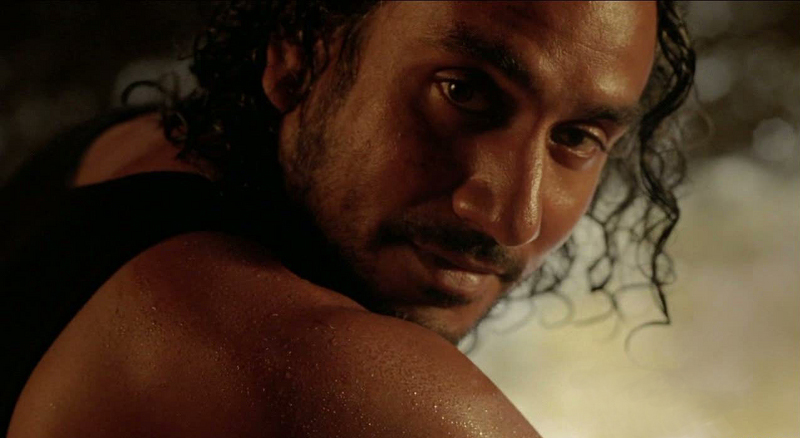
U k Sayid?
Lost - Season Six, Episode Six - Sundown
Written between 25th and 26th January 2013

Last year, in my review of Season Five's "He's Our You," I said that it was that episode that changed Sayid from being a man conflicted between his duty and his conscience into a tool for the writers to do random shit with. Even after being a torturer and a hit-man, there were enough sympathisable traits in the character that I was really quite shocked at the idea that he would ever try to kill a child. At the time, my single commenter Juanita (whom I hope to hear from again at some point in this series of reviews) asked me why I was so surprised at his behaviour when it's been part of Sayid's characterisation to get to a point of redemption and then slide back into his old ways.
     My problem then was the same as it is now, and, relating this to Sundown, it's more that Sayid's character is defined by regret and remorse. He helps Ben kill people on the Mainland because he's as angry at himself for not saving Nadia as he is at the man sent to kill her. He shoots Ben in the past because he's guilty for killing those people, and so on. What Sundown does is not, as I said before, ruin the character. What Sundown does is to remove and highlight that remorse component and show us a Sayid without it. The results mean quite a lot for the advancement of the series' plot, and we're really running on gas now.
     Sayid confronts Dogen, having learnt of his request to have him poisoned. Dogen is openly aggressive towards him, and they fight, with Dogen gaining the upper hand before restraining himself and banishing Sayid from the Temple. The Man In Black, recruiting followers, sends Claire into the Temple to send the message that those who decide to follow the Man In Black will be spared death in the upcoming massacre. Planning on getting him out of the way, Dogen calls Sayid back and asks him to stab the Man In Black with a ceremonial dagger. It does nothing to the immortal man, who instead persuades Sayid that he can bring Nadia back. Sayid goes back and kills Dogen, allowing The Man In Black to enter. In the aftermath, Kate joins MIB's camp to be with Sawyer and Clare, and Ilana's group stop by to pick up Miles, the other Candidates all having already left.
http://images1.wikia.nocookie.net/__cb20100303180727/lostpedia/images/0/0d/6x06_UsedToBeACouple.jpg
Sayid's afterlife allows him to protect the woman he loves,
even if he can't be with her.
     I'd promised myself that I wouldn't really go into too much detail about the Flash-sideways timeline and its implications for our characters, and neither would I discuss the truth behind it. I realised recently that I've already sorta revealed that the Flash-Sideways is a kind of purgatory, and I think it's important for my assessment of Sayid that I explain what this episode's flash-sideways are about. In previous episodes, the Flash Sideways gave our characters the opportunity to do the things that they failed to do in life, like for Locke to marry Helen, or for Jack to raise a son. For Sayid, the results are very different - he is still apart from Nadia, feeling that he doesn't deserve her love, and is forced to intervene to protect her from his brother's dealings with the mob.
     This is probably the first hint that the flash-sideways is some kind of afterlife, as it shows a Sayid who is living out his chance to protect the woman he loves. In the main story we find a Sayid who has had his remorse completely removed, but one who is still driven by the slightest chance that he may see the love of his life again. While the portrayl of Sayid in this episode alone may cause many fans to dismiss him, as it did at the time, it's a lot more important than that in that it's a final confirmation that despite what our writers have done to the character, his core values are still being acted upon. And consistency like that is good to see in a show that's run this long.

Thanks.