Friday, 21 September 2012

Overview: Doctor Who Classic: Season 25

The 25th Anniversary Season was a mixed bag of stories. It was also a very small bag; like the two seasons preceeding it, and every season afterwards, it only had 14 episodes. Half of the season was given over to thought-provoking satires that asked challenging questions, while the other half was given over to crowd-pleasing Monster slideshows, with varying degrees of success. Because the characters haven't much changed, I'll do that other kind of overview where I look at the bests and worsts of the season.

He makes sweets that kill people.
Best Story
By far my favourite story from the entire season has to be The Happiness Patrol, a story with delicious satire and just the right percentage of madness. Everything, from the scathing Thatcherite parallels to the demented Kandyman, is perfectly fine-tuned to make this one of the most interesting stories in the entire Seven era. I loved it from beginning to end, warts and all. Happiness prevailled. My favourite moment was most definitely the Doctor's trick, where he manages to cause a civil war amongst the Patrol simply by pretending to lauch; they wanted to shoot him for causing a riot but couldn't in fear of violating their own dogma.

Worst Story
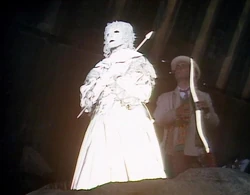
Poor Silver Nemesis. The story upon which so much importance was placed, it's another "checklist" story where the producers gave the writer a list of things that needed to be here. This time, it was a "silver" theme, the Cybermen, and something to do with the royals. Somehow this was interpreted into a 17th Century Lady, some Neo-Nazis and a Cyber-fleet that does almost nothing. It's not an unpleasant story, but it's certainly one that I don't want to visit again, for the simple reason that I've got much more interesting things to be doing. It really is an empty shell, and the worrying Cartmel Masterplan overtones only make it more throw-away.

Villains
See what I mean?
This is a season with a lot of great villains, but the scariest and spookiest are definitely the Circus from The Greatest Show In The Galaxy. Even Ace thinks that clowns are scary, and the army of eternally smiling robots are incredibly creepy. Add that to the Gods of Ragnarok and their devatatingly biting metaphorical meaning as an unappreciating British audience. And, from The Happiness Patol, you know that I love Thatcherite Helen A and the Kandyman. Worst villains? It's going to have to go once more to Silver Nemesis. On one hand you've got Lady Peinforte, who looks  and acts like a reject from Horrible Histories. Then you've got Herr Flores and his army, who have to be some of the weediest Nazis I've ever seen, not even one bloody swastika. And then there's the Cybermen. Given a silvery paint job, they stand about being impotentand being blown up by impact with a gold coin. It's so utterly disappointing on every level.

Success of the Story
The most successful story - that is, it succeeded in being what it was trying to be - was Remembrance of the Daleks. It was a much better anniversary story than Silver Nemesis, which of course is the least successful.It managed to celebrate the series using not only setting-based and visual cues, but also in the way it revitalised the Daleks and made them awesome again after the post-Genesis Davros stories made them weak. It's the standout story of the season, the one I saw first and the one that everyone is going to remember, standing beside Doctor Who's greats.

Thanks.

Wednesday, 19 September 2012

Review: GHTTB: Ashes To Ashes 3.2

Shaz spends the episode uneasy about her
future in the force.
Ashes To Ashes - Series Three, Episode Two
Written 18/6/12 

Shaz is a weird character in terms of the series' relationship to its predecessor. There the "chick" was most definitely Annie Cartwright, and she remained rather in the background for both series of Life On Mars. It's a nice sign that as we near the end this second episode of the series delivers us with a Shaz-centric episode in the style of Lost (not the first comparison I'll be making) and improves her character in an interesting and complex way. It also consolidated a few things from the premiere; mainly Jim Keats characterisation and some of the series' main motifs.
     With construction work at CID making everyone irritated, the crew are sent a hand in the post branded with a crescent moon. Trawling through past cases, they discover a string of women killed and branded, then buried in waste ground in several spots around the country. Shaz starts feeling off and everyone notices. Further investigation reveals that all of the victims were divorcees and went to the same dating agency, one that has just happened to have opened a new branch in Fenchurch; Alex and Gene plan to infiltrate it. Alex talks to Shaz, who confides in her that she doesn't feel like being a policewoman is what she was meant to do. The next day, when they find the body corresponding with the hand, Shaz runs off.
     Trying to find the killer, Alex invents speed dating, getting a chance to look at all of the male clients who responded to her form, which was designed to match the victims. This is mostly played for comedy, which is a shame, except when she meets the unassuming real killer and later Jim Keats. Keats himself has tried to convince Shaz to leave the force, and she announces her resignation the next day. On the way home, she attempts to confront a gang of youths but they threaten her with the chisel that she was frightened of earlier in the day and she is completely shaken. Trying to maintain her support, the Guv puts her on the mission to catch the killer - a man with only a few months to live, who decided to spend those months taking metaphorical vengeance on his ex-wife. For her bravery, Shaz is promoted to plain clothes and has a weird moment of "Life On Mars Music" epiphany.
The bitter murderer.
     The problem with Shaz's character is that beforehand she had Chris to rely on for emotional support. We're never clued into the reasons why they split up between seasons, especially when their get-together in the Series Two finale was such an important moment for them. It feels like it's been put there specifically to create drama, and that makes the series a little transparent. The chisel motif makes a direct reference to the finale, which we won't get into here, but it would have been more fun to have had that motif running throughout all three seasons for a better payoff.
     Other than that, there's impressively little to say about this Shaz-centric episode. Nothing really stood out or wowed me; just the introduction of a few motifs. The main plot was predictable and uninteresting, the background plot hasn't really picked up any steam yet and it's pretty much disappointment all round. Better luck next time?

Thanks.

Monday, 17 September 2012

Review: Doctor Who Classic: The Greatest Show In The Galaxy

The Doctor and Ace visit the Circus...
Doctor Who - Season 25, Story Four - The Greatest Show In The Galaxy
Written between 18th and 19th June 2012

Season 25 was a weird season of Doctor Who. There were two anniversary episodes, with a 50% success rate, and two stories that shot out into the avant-garde. The Greatest Show in The Galaxy, long name notwithstanding, is a pacey adventure that perfectly rounds off the season on a high, using weird visuals and interesting characters, mixed in with villains of epic proportions. There's also a teaspoon of satire in there somewhere. I didn't love it quite as much as I did the first two serials of the season, but by the end I was captivated.
     On the planet of Segonax, the Psychic Circus reaches out into the Universe, drawing The Doctor and Ace into the Greatest Show In The Galaxy. Despite Ace's fear of clowns, The Doctor goes in regardless, not suspecting the murderous robotic ticket operator or the violent guests of the circus until the moment it's far too late. The circus takes performers from around the planet, who are forced to perform in front of a family of three; those who impress are hired by the circus, the rest reduced to dust. Most travel the latter path. The Doctor and Ace must uncover the Gods of Ragnarock and entertain them long enough to find a way to save the day.
       There's a hell of a lot of rather nasty metaphors here. The annoying nerdy boy Whizz Kidd, who claims to "have never seen the older stuff, but I know that it's not as good as it used to be" is a parody of anally retentive Doctor Who fans.  The family is the British Audience, forever calling for more and more of a show deprived of resources and perceived as being stuck in one place, then destroying everything that doesn't come up to their ridiculously high standards. The Captain is the corrupt corporate executive, screwing over the performers in the show, and Mags the werewolf represents the people trying to get the show running again that are transformed horribly by the experience. Like all great Doctor Who, The Greatest Show works on many levels, and this is only my interpretation.
"Ashes to Ashes, Funk to Funky..."
     There are a lot of primal fears in The Greatest Show that make it great for kids and adults. Adults can understand the complex, dark themes behind the mythology and the writer's metaphors, while kids can spectacle at the spooky, spooky clowns, robots and werewolves. Even they were making me feel unsettled; the Pierrot clown leading the troop was wonderfully demented, and in fact reminded me of the character from the first series of Ashes To Ashes.
      The Greatest Show In The Galaxy is a fine end to the season, riddled with alternative meanings and characters that either frighten or intrigue. The Doctor and Ace's relationship is better than ever and the writing is just superb. The metaphors may be a bit harsh on the show and its audience, but that's open to interpretation and it's great that this far into the show's run it can still create complex and interesting content.

Thanks.

NEXT WEEK: I take a break and prepare for the return of Red Dwarf.

Saturday, 15 September 2012

Review: Doctor Who 7.3: A Town Called Mercy

The Gunslinger is a fun but complex figure.
Some people are claiming that Toby Whithouse, in this episode, is only writing a "standard Doctor Who episode," and are using that to dismiss A Town Called Mercy as forgettable, or unimportant. But what it does do is highlight a few problems that the Moffat era has posed, in that this was totally unlike its two predecessors. Mercy wasn't just a bam, sham, thank you ma'am romp, it was actually about something. it had a message, it talked about stuff that we need to be talking to our kids about. Sure, it didn't leave me with the... strength of emotion that I felt last week or the week before, but it's certainly the first story of this season that I'll be inclined to watch again.
     The Doctor and co. arrive in Mercy after attempting to head to Mexico, finding the Western town surrounded by a border enforced by an alien cyborg known only as the Gunslinger (Dominic Kemp), who has demanded that they turn over "The Alien Doctor." The townsfolk are well aware that their Doctor, a Kahler scientist named Jex (Adrian Scarborough), isn't from around here, and thus have let him rig up the town with leccy and cures for most of the contemporary diseases. The Doctor tracks down Jex' ship, using Rory and the protective Sheriff Isaac as decoys, and discovers that Jex is in fact a war criminal whose experiments created cyborgs like the Gunslinger by torturing innocents. The Gunslinger is a rogue cyborg who has searched the Universe to destroy his creators, and The Doctor doesn't know whether to allow Jex to escape or to hand him over to save the town. Soon, his deadline comes up and Jex, having had a big moral debate with The Doctor, self destructs in his own ship. Without purpose, The Gunslinger takes up the position of the town's Sheriff, becoming its everlasting protector.
     After touching upon both the issues of faith and the doctor's own sense of guilt in The God Complex, Whitouse this time looks at a Star-Trek style moral dilemma between a monster rightfully seeking revenge and a war criminal seeking redemption to hold back his own guilt - a parallel that the post-Time War Doctor can clearly relate to. It helped that Adrian Scarborough is such a brilliant actor, and imbues Jex with a sense of fragility and regret that also keys into a sort of quiet desperation when the Gunslinger does come for him. After last week's Chibnallisms (I can't bring up the courage to actually call them "characters"), these more complex characters came thick and fast and they're absolutely divine to watch in this context. Whithouse, after Being Human and his previous stories, knows how to write for people as opposed to Chibnall's empty shells and Moffat's un-thought-out archetypes.
Jex is a complex villain - the first for a while.
     Of course, it wasn't perfect. The moments which I so loved didn't gel together as well as they should have. But I really didn't mind. Whithouse's story is immeditely the standout story of the ones so far this season, simply because I'm still thinking about it for reasons that don't include confusion, anger or pure hatred. Instead, I bloody loved this episode. It was thoughtful, intelligent and visually captivating at the same time, and that's exactly what I want from this show.

Thanks.

Friday, 14 September 2012

Review: GHTTB: Ashes To Ashes 3.1

Alex asks herself what is real.
Ashes To Ashes - Series Three, Episode One
Written 13/4/12

The first piece of TV I really talked about on this site was the final ever episode of Ashes To Ashes. For me, it's a little strange to come back to that, but I think it's going to be a lot of fun. After a mind-boggling cliff-hanger that left the nation on the edge of their seats, the first episode of this series had to give us answers. While it didn't manage exactly that, it did set up the unique world of this final series that would lead to a shocking revelation about the Bonanza's world.
     Still living in a comatose 2010, Alex starts to feel disconnected from the present, culminating in a scene in a Tesco-extra where she sees the rest of the gang on TV screens and then wakes up, hair permed, in 1983, after having a hallucination of her 2010 hospital bed and a mutilated young police officer. Gene, having been blamed for her shooting, has just returned from Spain and woke her up to clear his name. Back in CID, and Ray has been promoted to DI in both the Guv and Alex's absence. As the team work on a kidnapping case, Gene is held back by officer Jim Keats (the excellent, excellent Daniel Mays), an independant officer trying to bring Gene down and who has information for Alex about the disappearance of Sam Tyler eight years prior. Despite Keats' warnings, Gene still trys to keep involved in the case when he discovers that the evidence points towards supposedly incapacitated gangster Gary Soaper. After an unsuccessful sting, they continue to investigate and discover that one of Soaper's assosciates has seen him only very recently. Using the girl's stepmother, who used to be Soaper's wife, they track down the girl to an abandoned factory and the team save the day. Back at CID, and Keats calls for celebration before going into Gene's office and going on a seething tirade about how much hatred he has for the entire department.
     Daniel Mays is deliciously devious as Jim Keats, flipping between a quiet, amiable persona and a desperate, seething rage. The character is elusive and interesting, and the first clues of his true nature are already here - he knows every word of the Bible, he's "a superstitious person" and he doesn't like the cold. Mays makes his presence known immediately and it's a captivating performance as we're unsure as to who is the villain - him, or Gene himself. The rest of the characters are fine, but there's a silly thing where Chris and Shaz have seperated in between series. After the buildup that it garnered in Series Two, it's a real waste to see it just brushed aside for little-to-no reason.
Daniel Mays' Jim Keats is a delicious performance.
     The plot itself was tense enough, with the revelation of the old gangster being an interesting reveal. The tragedy of Maggie Soaper added a nice poignancy to the episode, but that didn't stop the victim's dad from coming off as a bit of a knob. Half-way through the story Chris randomly brought in a countdown timer which served entirely to provide tension, which really felt like a cheap-shot to me. Other than that, it was Ashes To Ashes as usual.
     3.1 was an ok start to this final series, and it did all it needed to do in introducing to us the main themes and motifs that this series would have to offer. What it didn't do was satisfyingly answer last series' cliffhanger, and instead seemed only to create more questions than it answered. Overall though, it did leave me excited for the final series and for this series of reviews.

Thanks.

Wednesday, 12 September 2012

Review: GHTTB: Ashes To Ashes 2.8

Gene reads Alex's story for Jackanory.
Ashes To Ashes - Series Two, Episode Eight
Written Saturday 10th March 2012

Like Lost, the deep-set rot of its final series stretches into the preceeding one. Luckily for Ashes To Ashes, that amounts to thirty-seconds' worth of runtime, and 2.8 is the best of the five finales in the Bonanza. The way that it treats its characters and themes makes it stand as a perfect send off to by far the most engaging and powerful eight episodes that this cast ever produced. If Series One was about showing how Life On Mars could work in the Eighties, then Series Two showed us that the team had the balls to back that up.
      Over the TV, the surgeons on Alex's end announce that having removed the bullet, an infection has set in. She has to fight the infection while they administer 50ml of strong anti-biotics. In this world, Gene has discovered from several sources that a massive blag is about to happen. A criminal that Gene has interrogated turns up tortured and killed, and when they find the killer he inadvertantly reveals that the blag is Operation Rose, a bullion robbery wherein corrupt police officers will take the gold for themselves. Things are going swimmingly, until Summers leaves one of Alex's tapes on Gene's desk, in which she laments being in the Coma world. Alex comes clean to Gene about her true nature, but Gene refuses to believe her and this creates mistrust between them.
      After being contacted again by Summers over the phone, Alex helps Chris to redeem himself after last week by playing the double agent and giving them info on Operation Rose. Alex now remembers the robbery from 2008 and points to Douglas Road, but after the machinations of a female suspect called Jennette, Gene refuses to believe her. Alex, fighting to destroy the infection in her mind, tracks the team as the heist happens, and when it inevitably does turn towards Douglas Road it's her advice that leads to Gene and the Gang being there in time. As Summers is about to shoot Alex, Gene shoots him and the full 50mls are finally administered. Jennette, in on the operation, hold Alex hostage and in Gene's attempt to save her he instead manages to shoot her in the stomach. She wakes up, seemingly in the present, with Molly at her side. As the episode ends, we see that she isn't out of the woods yet; Gene appears on all of the TV screens telling her that she's in a coma, and needs to wake up.
Welcome to the mindfuck.
     At the time, we all thought that this was going to be the last episode of Ashes to Ashes, and of the Bonanza. The mindfuck ending changed this dramatically and despite how much I hate it, it is an accomplishment in British TV that Ashes To Ashes was able to pull it off. Regardless, it ruins what is otherwise an excellent ending, an ending that the character deserved after a series as dark as this one. On the other hand, the series still had one loose end - the much deserved reconcilliation of Gene and Alex after their disagreement. Because of this, the third series had to pretend to offer answers only by creating mysteries, much like a supermarket that has to bring up its prices to offer a 5% off sale.
      And really, as well head into the shitstorm that is Series Three on Friday, I just have to say that it's been great. It really has. Glenister, Hawes, Lancaster, Andrews and Lombard have acted their arses off and the writing has been absolutely superb beyond belief. Series Two of Ashes To Ashes will always be my favourite series of the Bonanza, and I'm eternally grateful for it. Of course, this just makes the tragedy of what happened next even worse. See you on Fridays, where I begin Series Three.

Thanks.
 

Monday, 10 September 2012

Review: Doctor Who Classic: Silver Nemesis

Hi! We're here because... erm... destroy them!
Doctor Who - Season 25, Story Three - Silver Nemesis
Written 18/6/12

JNT was determined to get the show popular again, and to do that he set about producing the show's Silver Anniversary. With a silver theme, the story was to feature royal themes as well as start probing into the Doctor's history with Cartmel's Lungbarrow plotline. They even went to Windsor palace and tried to get Prince Edward involved with the rag, leading to press stories and an official statement from the Royal Family that they would not, in fact, be part of Doctor Who's 25th Anniversary Celebrations. But, unfortunately, for all of Silver Nemesis' attempt to be something, it turns out to be one long 75 minutes of nothing. 
        The Doctor has just had an alarm call; a plan he set in motion 350 years prior is coming to fruition. The asteroid Nemesis, made of living Galifreyan metal Validium, is returning to Earth one last time, and everyone wants it. The Lady who initially designed the Nemesis statue's current form, Lady Peinforte, uses magic to travel forwards in time. Some Neo-Nazis decide to go after the power of the Nemesis, and plan to create a Third Reich. And, just as it's all getting nasty, the Cybermen turn up to claim the power for themselves. Through some carefully crafty explosives and chess-dancing, The Doctor and Ace revive the Nemesis Statue, eliminate the Neo-Nazis, vanquish Lady Peinforte and destroy the Cyber Fleet. Then everyone goes home. And The Doctor is mysterious.
      It literally is this simple. The plot is a basic MacGuffin quest, a hunt for a mystical item that's wanted by multiple parties. It's executed with such bland simplicity that there's nothing really to get behind. Lady Peinforte and co. have a bland "fish of out time" sort of plot that's played for laughs but doesn't really go anywhere, the Neo-Nazis are all cackling villainy but they're not at all camp about it so it doesn't mean anything, and the Cybermen are perhaps the blandest iterations the Classic Series ever produced. There's no clue as to why they're here, where they fit in within the Cybermen's timeline or why the hell Gold has turned from a mild irritant to their systems into a sustance that practically explodes on contact with them.
The Nemesis wakes.
      As I explained in an earlier review, the Cartmel Masterplan was the revelation that The Doctor had been loomed from the genetic structure of The Other, a Timelord founder whose role in forging Time-Lord society was hidden by Rassillon and Omega. Personally, like a lot of fandom I hate this plotline because it presents The Doctor as some kind of God in lieu of the chaotic travelling wizard that he's always been presented as. It also provides so much pretense and fluff to an otherwise fun tale; Russell T Davies would go on to make exactly the same mistake when lauding Ten as the "Lonely God" in NuWho. I hope that this is the last time this will really rear its head, because if it continues like this then Seven will become unbearable before too long.
      Silver Nemesis was an absolute shell of a story, and that's a damn-fine shame. It could have been a spectacle to rival the Five Doctors, but it had an even weaker script and instead tried to stuff more plot elements into a shorter run time, to little avail. The Nazis didn't need to be here, the Cybermen had no excuse for being here and it's just another Cartmel machination that The Doctor was on the scene at all. I didn't loathe it, but it did bore me and leave me with very little impression at all. My first Seven clunker.

Thanks.

Saturday, 8 September 2012

Review: Doctor Who 7.2: Dinosaurs On A Spaceship

Written 8/9/12

It's actually quite rare that I find a story so bland and useless that it has no value to me, but this happened to be one of those delightful stories. The horrifically gimmicky title promised so many things, and of course the well-worn destructive hands of Chris Chibnall failed to do anything with any form of competancy whatsoever. Dinosaurs In A Spaceship was never actively offensive (except with certain gender politics issues that the show's been suffering from recently,) but it did fail on nearly every level - as entertainment, as drama and, most importantly, as Doctor Who.
The Doctor has a "gang" which means the standard, "I'm Chris Chibnall,
look at me create a load of hollow side-characters" thing.
      An alien ship is heading towards Earth, and The Doctor wants to investigate, so he drags along a random Queen Nefetiti of Egypt, picks up a 1900s bounty hunter (Rupert Graves) and tries to pick up Amy and Rory, managing to suck up Rory's amazed Dad (Mark Williams) in the process. They discover that the ship's cargo is a ton of Cretaceous-era Dinosaurs and plants, and that the ship used to be a Silurian seeding ship that was trying to find a new planet. The Doctor ends up confronting bounty hunter Solomon, who, with his annoying robot sidekicks (an unfortunately cast Mitchell and Webb) manage to have committed a little genocide on board. After selling Nefetiti to him to get him to retreat to his ship The Doctor gets Rory and his Dad to pilot the ship away from Earth and manages to get Solomon's ship blown up. Everyone goes home and I felt pissed.
     The episode's incredibly rushed pace also leant to it it's biggest weakness - none of the characters seemed to have a real reason to be there, and their convenient uses felt more contrived than deliberate. I have enjoyed Chibnall's work before on Life On Mars and one or two episodes of Torchwood, but here it didn't even feel like his writing; more the combined ramblings of an over-excited five-year-old and someone desperately unaware of what the series is. Had this been an episode of the Sarah Jane Adventures... I might have understood. But it was just so empty of any meaning or themology - it didn't even try to say anything or do anything particularly interesting.
      So what do you do if you can't do anything interesting? Hey, let's replace it with annoying! First of all are the Mitchell and Webb robots, whose dialogue is absolutely excruciating and belongs more in a parody of science fiction than anything else. Then there's the issue of gender politics, which is treated as subtlely as we've come to expect of Moffat Who - Solomon treats Queen Nefetiti like an object (literally,) Amy has to tell of the misogynistic Riddell, it's all stuff we've seen before, done better. The humour, especially from Mark Williams' character, was incredibly crude and mindless, and I had notable flashbacks to The Dark Times of Red Dwarf. The dinosaurs were either really bag CGI or useless animatronics, and they played such a little part in the story that it feels like the Let's Kill Hiter title fiasco all over again.
The only decent thing in the episode was Amy's writing,
which is miles better than under Moffat. Shame the same
couldn't be said of all the other characters.
     There was some good here, although only where the bad seemed to dry up. As we saw in Torchwood, Chibnall is probably better at writing for female characters in general than Moffat is, and so Amy here suddenly became incredibly competant and generally the best she's been since The Eleventh Hour, taking charge of Riddell and Nefetiti and ultimately helping to discover most of the episode's expositional material. David Bradley, who played Solomon, is a great British character actor and, while I dislike the way the character was written, I found his performance incredibly captivating as someone so materialistic as to see people as prized possessions.
     In his element, Chibnall is not a bad writer, but when it comes to this show he has a track record of producing complete and utter tosh. Dinosaurs On A Spaceship continues this track record with ferver, and makes me very, very nervous not only for the fourth episode of this series, also written by him, but also for the rumours that Chibnall is being lined up to Moffat's successor. If this episode is anything to go by, I won't be tuning in. It was crude, heartless and completely pedestrian despite the abnormality of its premise, and that is the greatest failing of all.

Thanks.

Wednesday, 5 September 2012

Review: GHTTB: Ashes To Ashes 2.7

Martin Summers' traps start to close in on CID.
Ashes To Ashes - Series Two, Episode Seven

While it began in a mediocre way, 2.7 evolved into a list of the reasons why I adore this fourth series of the Bonanza. It was very dark and a lot of it didn't make sense when you really thought about it, but because of the strength of this series' characters and of this arc, it pulled through and ended with a spectacularly written and acted final few scenes. Last week may have been a dip in the series, but this episode uplifts us back to an excellent standard.
    After chasing a drugs gang based on an anonymous tip-off, CID find a Polish man buried in concrete at a building site. Excavation reveals that the man was murdered, but the site mananger Michael Rafferty denies any involvement. Police officer Martin Summers (the young version of the corrupt cop from 2008 that has been manipulating Alex) comes in to tell Gene that Rafferty is bad news, and Rafferty claims that Summers is the one in the wrong, having come asking for a bribe in exchange for his safety. Alex follows a note sent by the 2008 Summers and meets the young Summers at the building site. There, Old!Summers shoots his younger self, shattering Alex's preconceptions about this world and making her have nightmares wherein her parents tell her that she should have tried harder to save their lives. Old!Summers puts the gun in her hand, leaving her to clean up by dropping the Young!Summers corpse into some conveniently wet concrete.
     A vital piece of evidence goes missing in the investigation, and the signature on the release form is that of Summers. Knowing that the young Summers is dead, Alex reveals that the perpetrator must be a member of CID. Still bitter after the Mac scandal, Gene goes on the warpath. He gives Chris, Ray, Chaz and Vic the number of a vault at an open storage building, knowing that if one of them is a traitor, then Rafferty will go there and open a specific vault. He does so, and that evening Alex joins gene as he confronts the traitor - Chris. Feeling pressured by the wedding, Chris has been working for a voice over the phone as far back as Episode 2, trying to get the money to pay back a loan. He was the one who destroyed Kevin Hales' records, stopping the team from preventing his eventual murder and postponing their discovery of Mac's operation. Gene forgives Chris on one condition - that he never leave the police force, and forever live with his shame. Alex tracks back the phone number to a small flat - and discovers that Summers has been manipulating events from the beginning.
Chris is forced to reveal his betrayal.
     The first half of the episode wasn't as engaging as I would have liked it to have been, not really covering any themes other than the usual undercurrant of Police Corruption. Like in 2.5, Alex acted the psycho again and started attacking someone who didn't know her, but the cards really fell onto the table when Old and Young Summers met. It felt like a direct response from the writers, saying that this isn't really a Time Travel show and at the same time allowing Alex to show a real depth to her character. It was a final seperation from the world of Life On Mars, and a preview towards the more religiously-oriented finale next series. Unlike that finale, however, this is far from disappointing.
      The second half provided some outstanding drama and a real chance for Marshall Lancaster, who usually plays the bumbling comic relief, to give some actual emotions. Despite how surprising it was, it makes so much sense and also neatly ties the otherwise irrelevant Shaz and Chris storyline into the main arc. Adrian Dunbar is so strong as Summers, with his charming but equally sinister voice and demeanor, that he's easily one of the most memorable villains in the Bonanza. His existance as a malevolent entity is completely at odds with the Mars finale, where Gene was the force to be fought, and shows not only how much the characters have grown, but also how much the writing has moved on since the simple caricatures of Life On Mars' first series.
Gene is disappointed in Chris.
      Episode 2.7 was a due reminder of how good the Bonanza can be, and showed off this series characters and themes in a way that left me gagging for the finale. It may have a had a bit of a shitty first half, but the second half made up for it thousandfold and stands as some of the best Ashes To Ashes ever made.

Thanks.