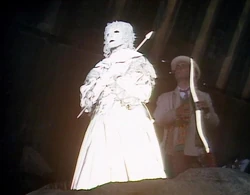
Showing posts with label DW25. Show all posts

Tuesday, 6 October 2015

FTA: Doctor Who Classic: Time and the Rani, The Happiness Patrol and The Greatest Show In The Galaxy

This eighth volume of articles from Celebrate, Regenerate! covers stories from the Seventh Doctor.(See here for more on this project.)

Time and the Rani
(Main article.)

When I first sat down to watch Time and the Rani, I was caught up in the fan opinion that it was one of the worst things this side of the Iraq War, but like my reaction to the Sixth Doctor’s stories, I was pleasantly surprised. So surprised, in fact, that I would go so far as to call Time and the Rani one of my favourite stories of the Seventh Doctor’s era, behind only the wonderful The Happiness Patrol. The reason? Time and the Rani doesn’t just break the So Bad It’s Good barrier in the way that a story like Time-Flight does. It smashes that barrier into bits, and leaves you to try and rebuild it while throwing all it can at you. Time and the Rani is not in any way a story; rather, it is an exhilarating and endlessly entertaining experience that never gets old.
     Sylvester McCoy’s early portrayal of the Seventh Doctor is very different to his later more manipulative persona, but that doesn’t make it worse by default. Instead, it’s fresh, vibrant, and unassumingly mad – it takes the bravado of Colin Baker’s Doctor and channels it into a fluid wit. The Rani, while not as unique in her performance as in her introductory story, still balances the new Doctor perfectly. Her scheme is completely mad and fifty shades of scientifically impossible, but it’s the sheer convoluted lengths to which she goes (kidnapping Albert Einstein, etc.) that make the story what it is.
     Fans lambaste Time and the Rani for being too silly, putting an emphasis on goofy humour over plot, characterisation and common sense. But the rejection of the latter is what makes it unique. Doctor Who’s primary feature is variety, and it’s a simple law of probabilities that a story this silly would pop up sometime. And what do the fans do? They have the guile to complain, to complain about this beautiful, nonsensical thing. Time and the Rani doesn’t try to preoccupy itself with the serious stuff, and instead simply tries to let the audience have fun. And at the end of the day, isn’t that just what Doctor Who is about?

The Happiness Patrol

Despite trying to not get involved with politics, my kinder friends have called me “a liberal”. This, perhaps, is the catalyst to my incredible enjoyment of The Happiness Patrol, a story which takes a metaphor for Margaret Thatcher’s regime and twists it in a deliciously demented way. Even though the Iron Lady herself was described by Sylvester McCoy as “far more terrifying than any monster the Doctor had encountered”, Sheila Hancock’s Helen A is a portrayal that is both hilarious in its send-up of the former Prime Minister and frightening in the way it represents certain aspects of Conservative policy.
     It could have been awfully dry, but the addition of just a few ounces of absurdism makes The Happiness Patrol into a complete and total classic. Most memorably, The Kandyman is a villain that does exactly what good Doctor Who villains do best – they scare the kids, and make the adults think. On the one hand, it’s been suggested that the sucrose-composed robot was designed as an attack on the indulgence and power of the capitalist system, while others simply regard it as a demonstration of just how insane Helen A is.
    And sometimes the story actually puts you under the regime’s spell. So many detractors tell of how they can’t take the villains seriously: they paint the Tardis pink, walk around with frilly hairdos and drown people in strawberry sauce. That’s the whole point! The Happiness Patrol isn’t just a satire of a specific political regime, it’s also a wider warning about the power of appearance over ideology in politics. Of course you couldn’t take Helen A’s happy clappy approach seriously at first, in the same way that people voted for good old Maggie because she looked better than Jim Callahan. 
     Plus, this is where we really see the peak of the Seventh Doctor’s powers of manipulation. Sure, we’d seen him plot to blow up Skaro in the previous story, but that had been set up back in the Pilot episode; here, the Doctor waltzes onto a planet and deposes a tyrannical regime in a single night. He seems to understand everyone he meets instantly; he talks down the Sniper who’s never had to face a man’s eyes, defeats the Happiness Patrol by showing them a smile and then introduces Helen A to the concept of negative emotions. He is not just a faceless hero, but a character in his own right, and one that is prepared to go to any lengths to defend justice, truth and freedom. 
     The Happiness Patrol isn’t just a silly exercise in 80s camp. It’s one that has a dark political undertone that has a lot to say to both the kids of the era and their parents. It's scary, disturbing, funny, melancholy, and exciting. And it’s my favourite story of the entire Seventh Doctor era.

The Greatest Show In The Galaxy

The much-mocked BBC Quarry has had to stand in for a whole variety of planets, with varying results. In the McCoy era there was a move away from the bland rocky faces of Destiny of the Daleks and Time and the Rani to what has been referred to as “a high-class quarry.” Segonax, the planet currently being inhabited by the Psychic Circle, does as Enlightenment does and provides a visual treat to go alongside one of the most metaphorically profound scripts in McCoy’s era. The Circus has many guests of many different flavours, and the secret at the heart of its’ core reflects the state of the program at that late time in its existence.
       The Circus, having moved about a bit but now firmly in one spot, is the perfect metaphor for Doctor Who. Desperately reaching out to foreign markets, it tries to attract writers and fans to please their audience, the British public (here lovingly rendered as the Gods of Ragnarok.) The Whiz Kidd represents the core fanbase, with their constant admiration for stories broadcast before their birth (“I’ve never seen the old stuff, but I know it’s not as good as it used to be.”) and how their interaction with the show only caused more problems than it solved. The three who run the circus represent various figures in the show’s production team, all of them desperately trying to pull together a show so they’re not devoured by the public’s disinterest. The Doctor, stepping in and destroying the Gods of Ragnarok (or at least ending their influence), is a profound statement by the show. It is the statement that it is ready to move on and do whatever it wants to do, no matter what the executives say. 
     Of course, the joy of the story comes not only with the various metaphorical readings, but also with the story’s aesthetic, which helps to satisfy the children blissfully ignorant of the serial’s undertones. The clowns and robots in black limousines, skating across a acrid desert; Mags transforming in the arena; Ace being locked in the robot room – this is the stuff of nightmares. The Greatest Show in the Galaxy is intelligent, and manages to say a lot more than other stories can without spoiling it for the kids. And that’s just how we like it.

Thanks.

Friday, 21 September 2012

Overview: Doctor Who Classic: Season 25

The 25th Anniversary Season was a mixed bag of stories. It was also a very small bag; like the two seasons preceeding it, and every season afterwards, it only had 14 episodes. Half of the season was given over to thought-provoking satires that asked challenging questions, while the other half was given over to crowd-pleasing Monster slideshows, with varying degrees of success. Because the characters haven't much changed, I'll do that other kind of overview where I look at the bests and worsts of the season.

He makes sweets that kill people.
Best Story
By far my favourite story from the entire season has to be The Happiness Patrol, a story with delicious satire and just the right percentage of madness. Everything, from the scathing Thatcherite parallels to the demented Kandyman, is perfectly fine-tuned to make this one of the most interesting stories in the entire Seven era. I loved it from beginning to end, warts and all. Happiness prevailled. My favourite moment was most definitely the Doctor's trick, where he manages to cause a civil war amongst the Patrol simply by pretending to lauch; they wanted to shoot him for causing a riot but couldn't in fear of violating their own dogma.

Worst Story
Poor Silver Nemesis. The story upon which so much importance was placed, it's another "checklist" story where the producers gave the writer a list of things that needed to be here. This time, it was a "silver" theme, the Cybermen, and something to do with the royals. Somehow this was interpreted into a 17th Century Lady, some Neo-Nazis and a Cyber-fleet that does almost nothing. It's not an unpleasant story, but it's certainly one that I don't want to visit again, for the simple reason that I've got much more interesting things to be doing. It really is an empty shell, and the worrying Cartmel Masterplan overtones only make it more throw-away.

Villains
See what I mean?
This is a season with a lot of great villains, but the scariest and spookiest are definitely the Circus from The Greatest Show In The Galaxy. Even Ace thinks that clowns are scary, and the army of eternally smiling robots are incredibly creepy. Add that to the Gods of Ragnarok and their devatatingly biting metaphorical meaning as an unappreciating British audience. And, from The Happiness Patol, you know that I love Thatcherite Helen A and the Kandyman. Worst villains? It's going to have to go once more to Silver Nemesis. On one hand you've got Lady Peinforte, who looks  and acts like a reject from Horrible Histories. Then you've got Herr Flores and his army, who have to be some of the weediest Nazis I've ever seen, not even one bloody swastika. And then there's the Cybermen. Given a silvery paint job, they stand about being impotentand being blown up by impact with a gold coin. It's so utterly disappointing on every level.

Success of the Story
The most successful story - that is, it succeeded in being what it was trying to be - was Remembrance of the Daleks. It was a much better anniversary story than Silver Nemesis, which of course is the least successful.It managed to celebrate the series using not only setting-based and visual cues, but also in the way it revitalised the Daleks and made them awesome again after the post-Genesis Davros stories made them weak. It's the standout story of the season, the one I saw first and the one that everyone is going to remember, standing beside Doctor Who's greats.

Thanks.

Monday, 17 September 2012

Review: Doctor Who Classic: The Greatest Show In The Galaxy

The Doctor and Ace visit the Circus...
Doctor Who - Season 25, Story Four - The Greatest Show In The Galaxy
Written between 18th and 19th June 2012

Season 25 was a weird season of Doctor Who. There were two anniversary episodes, with a 50% success rate, and two stories that shot out into the avant-garde. The Greatest Show in The Galaxy, long name notwithstanding, is a pacey adventure that perfectly rounds off the season on a high, using weird visuals and interesting characters, mixed in with villains of epic proportions. There's also a teaspoon of satire in there somewhere. I didn't love it quite as much as I did the first two serials of the season, but by the end I was captivated.
     On the planet of Segonax, the Psychic Circus reaches out into the Universe, drawing The Doctor and Ace into the Greatest Show In The Galaxy. Despite Ace's fear of clowns, The Doctor goes in regardless, not suspecting the murderous robotic ticket operator or the violent guests of the circus until the moment it's far too late. The circus takes performers from around the planet, who are forced to perform in front of a family of three; those who impress are hired by the circus, the rest reduced to dust. Most travel the latter path. The Doctor and Ace must uncover the Gods of Ragnarock and entertain them long enough to find a way to save the day.
       There's a hell of a lot of rather nasty metaphors here. The annoying nerdy boy Whizz Kidd, who claims to "have never seen the older stuff, but I know that it's not as good as it used to be" is a parody of anally retentive Doctor Who fans.  The family is the British Audience, forever calling for more and more of a show deprived of resources and perceived as being stuck in one place, then destroying everything that doesn't come up to their ridiculously high standards. The Captain is the corrupt corporate executive, screwing over the performers in the show, and Mags the werewolf represents the people trying to get the show running again that are transformed horribly by the experience. Like all great Doctor Who, The Greatest Show works on many levels, and this is only my interpretation.
"Ashes to Ashes, Funk to Funky..."
     There are a lot of primal fears in The Greatest Show that make it great for kids and adults. Adults can understand the complex, dark themes behind the mythology and the writer's metaphors, while kids can spectacle at the spooky, spooky clowns, robots and werewolves. Even they were making me feel unsettled; the Pierrot clown leading the troop was wonderfully demented, and in fact reminded me of the character from the first series of Ashes To Ashes.
      The Greatest Show In The Galaxy is a fine end to the season, riddled with alternative meanings and characters that either frighten or intrigue. The Doctor and Ace's relationship is better than ever and the writing is just superb. The metaphors may be a bit harsh on the show and its audience, but that's open to interpretation and it's great that this far into the show's run it can still create complex and interesting content.

Thanks.

NEXT WEEK: I take a break and prepare for the return of Red Dwarf.

Monday, 10 September 2012

Review: Doctor Who Classic: Silver Nemesis

Hi! We're here because... erm... destroy them!
Doctor Who - Season 25, Story Three - Silver Nemesis
Written 18/6/12

JNT was determined to get the show popular again, and to do that he set about producing the show's Silver Anniversary. With a silver theme, the story was to feature royal themes as well as start probing into the Doctor's history with Cartmel's Lungbarrow plotline. They even went to Windsor palace and tried to get Prince Edward involved with the rag, leading to press stories and an official statement from the Royal Family that they would not, in fact, be part of Doctor Who's 25th Anniversary Celebrations. But, unfortunately, for all of Silver Nemesis' attempt to be something, it turns out to be one long 75 minutes of nothing. 
        The Doctor has just had an alarm call; a plan he set in motion 350 years prior is coming to fruition. The asteroid Nemesis, made of living Galifreyan metal Validium, is returning to Earth one last time, and everyone wants it. The Lady who initially designed the Nemesis statue's current form, Lady Peinforte, uses magic to travel forwards in time. Some Neo-Nazis decide to go after the power of the Nemesis, and plan to create a Third Reich. And, just as it's all getting nasty, the Cybermen turn up to claim the power for themselves. Through some carefully crafty explosives and chess-dancing, The Doctor and Ace revive the Nemesis Statue, eliminate the Neo-Nazis, vanquish Lady Peinforte and destroy the Cyber Fleet. Then everyone goes home. And The Doctor is mysterious.
      It literally is this simple. The plot is a basic MacGuffin quest, a hunt for a mystical item that's wanted by multiple parties. It's executed with such bland simplicity that there's nothing really to get behind. Lady Peinforte and co. have a bland "fish of out time" sort of plot that's played for laughs but doesn't really go anywhere, the Neo-Nazis are all cackling villainy but they're not at all camp about it so it doesn't mean anything, and the Cybermen are perhaps the blandest iterations the Classic Series ever produced. There's no clue as to why they're here, where they fit in within the Cybermen's timeline or why the hell Gold has turned from a mild irritant to their systems into a sustance that practically explodes on contact with them.
The Nemesis wakes.
      As I explained in an earlier review, the Cartmel Masterplan was the revelation that The Doctor had been loomed from the genetic structure of The Other, a Timelord founder whose role in forging Time-Lord society was hidden by Rassillon and Omega. Personally, like a lot of fandom I hate this plotline because it presents The Doctor as some kind of God in lieu of the chaotic travelling wizard that he's always been presented as. It also provides so much pretense and fluff to an otherwise fun tale; Russell T Davies would go on to make exactly the same mistake when lauding Ten as the "Lonely God" in NuWho. I hope that this is the last time this will really rear its head, because if it continues like this then Seven will become unbearable before too long.
      Silver Nemesis was an absolute shell of a story, and that's a damn-fine shame. It could have been a spectacle to rival the Five Doctors, but it had an even weaker script and instead tried to stuff more plot elements into a shorter run time, to little avail. The Nazis didn't need to be here, the Cybermen had no excuse for being here and it's just another Cartmel machination that The Doctor was on the scene at all. I didn't loathe it, but it did bore me and leave me with very little impression at all. My first Seven clunker.

Thanks.

Monday, 3 September 2012

Review: Doctor Who Classic: The Happiness Patrol

Warning: This review may get a bit political. Happiness will prevail.

Doctor Who - Season 25, Story Two - The Happiness Patrol
Written between 17th and 18th June 2012

Some claim that during the Eighties, Doctor Who became much more politcal than, as a family teatime show, it really should have been. This is epitomised by today's story, The Happiness Patrol - a tale of a dictatorial regime, where the Doctor must step in and release everyone from the hands of oppression. It could have been awfully dry, but the addition of just a few ounces of absurdism makes The Happiness Patrol into a complete and total classic. It's scary, disturbing, funny, melancholy, and exciting. For the first time in a while, I was genuinely on the edge of my seat, and that says a lot more for me than I can put in words.
The series actually got a copyright claim from Bassetts,
claiming that the Kandyman was too similar in design
to their company mascot. It's still awesome.
      The Doctor and Ace arrive on the Earth colony Terra Alpha, a world that has come under the autocratic control of Helen A, a frighteningly dotty old woman who insists that everyone must be happy and conform to her vision of happiness. Those who do not are executed; or, worse, subjected to the torturous delights of the dreaded Kandyman. Helping some of the Happiness Patrol to work up the courage to fight against the regime, the Doctor manages to combine the world's forces to bring down Helen A's regime and free the peoples of Terra Alpha.
     Even for someone who was born in the late nineties, the politcal analogue is blaringly obvious. Helen A (played here by the wonderful Sheila Hancock) is a symbol of conformity, who is dependant upon her pet dog Fifi and upon henpecking her timid husband. She's a toned down version of Conservative Prime Minister Margaret Thatcher, who was in power between 1979 and 1990, for better or worse. The character here is a scathing satire of the naive nature of her policies and the way she hid her iron will behind a pleasant exterior. I was shocked to find out that the comparison had been toned down; apparently, as Sylvester McCoy put it in 2010, "Our feeling was that Margaret Thatcher was far more terrifying than any monster the Doctor had encountered." Personally, I love it - it's strong, gets the point across and is damn hilarious in doing it. Funnily enough, the character was going to have been by veteran actress and singer Patricia Routlege. I do fear that it would have put me off Keeping Up Apperances forever.
      Slightly less effective is the Kandyman, but he still manages to be incredibly scary. I do find the idea far fetched - I just don't see the occasion for someone to create a robot composed entirely out of sucrose who then tortures people using sweets. It is, however, a great idea to scare the kids, and that's what's important. I especially love his monologue towards the Doctor at the beginning of the second episode - "You see, I make sweets. Not just any old sweets, but sweets that are so good, so delicious, that sometimes, if I'm on form, the human physiology is not equipped to bear the pleasure." If anyone can scare the kids, the Kandyman can.
Sheila Hancock is great as Thatcher send-up Helen A.
     Sometimes the aburdity enforced by the story's premise oversteps the boundaries somewhat. The first appearance of the Happiness Patrol, in their frilly pink uniforms and dye-pink hairdos, was an absolute spectacle that didn't embue them with any sense of forboding at all. Luckily, the script worked well enough to do so over the course of the story, and by the beginning of the regime's downfall they're almost terrifying in their fanatical devotion to our lady leader. The Kandyman's repeated defeats by the Doctor, amounting to being stuck to the floor with lemonade, feel quite farcical and only highlight the implausability of his creation; is this creature, who works in a laboratory, really never exposed to substances that might react aversely to his sucrose-based makeup? Not even the lemonade, which was found in HIS kitchen?
     In short, The Happiness Patrol's absurdity is what makes it such a powerful piece. It's satirical and that not only gives it charm, but it also improves what is a concept so tired we only saw it a few stories ago. The premise and the way it works into the contemporary political scene - that's pure genius, and one of the reasons that The Happiness Patrol is one of the best McCoys I've seen so far.

Happiness Will Prevail!
Thanks.

Monday, 27 August 2012

Review: Doctor Who Classic: Remembrance of the Daleks (Revisited)

See here for my previous look at this story.

The beginning of the great team of Seven and Ace
Doctor Who - Season 25, Story One - Remembrance of the Daleks (Revisited)
Written between 12th and 15th June 2012

My first look wasn't really a review, was it? It was more of a single paragraph with some gushing in it. After Season 24, Remembrance of the Daleks instantly presents a very different image of the Seventh Doctor, while setting the series back on track with some traditional Dalek action. Not tired after the 20th Anniversary, JNT decided to throw in some effort for this 25th Season, and Remembrance was the first step towards this. Notably, Remembrance is the first story that I can call good in the classic sense -  a witty script that exploits the mythos while still providing a fun and entertaining experience. You don't need to have seen the Daleks before to love this serial; their awesomeness is cemented in a myriad of ways.
     Unlike in Attack of the Cybermen, the serial is set in the location and time of An Unearthly Child for an actual reason. The Doctor and Ace arrive at an opportune time; an army regiment has arrived to deal with a renegade Dalek, and The Doctor is on hand to offer them advice. Little do they know that the situation is being manipulated by the Doctor, who left behind a powerful artefact called the Hand of Omega in the time before the first serial back in 1963. Now faced with two Dalek factions, the Doctor and Ace must further manipulate events around Coal Hill School and make sure that the right Daleks do the right thing. Eventually the Imperial Daleks win under Davros, and take command of the Hand of Omega... which promptly destroys Skaro and then the Dalek Mothership.
      Out of perspective, the serial is very much a product of its time; the production seems to have more in common with Heartbeat than with the previous season. However, it is very clever, and is the first real sign of Andrew Cartmel's effects of the series and on the Doctor's character. Cartmel's design was later realised by the novel Lungbarrow, which had some conspiracy-theory-esque notions that The Doctor was the decendant of a Gallifreyan founder called The Other, woven together from his genetic material. This is more obvious when one watches the deleted scenes; Seven makes a few more grandiose statements, including the idea that he is "far more than just another Time Lord." Seven overall is much more manipulative and scheming, this being the first of his many schemes and plans. He also keeps his ascerbic wit from the previous season, and this combined with the great scipt makes a perfect whole.
Daleks climb stairs for the first time.
     Not to say that it's all brilliance and wit. The very nature of the serial means that at times the Doctor's dialogue feels clunky and expositional, especially when he takes the time out to explain the Daleks' entire backstory as well as explaining his incredibly detailed plans. There's also the random inclusion of Davros at the end, who, while the inspiration for one of Seven's best speeches ("Unlimited Rice Pudding!"), does seem incredibly tacked-on and unnecessary.
     Remembrance of the Daleks is damn-awesome, a great final swan-song for the Daleks regardless of whether or not it intended to be one. It contains some of the Daleks and Ace's finest moments, and begins the final run of the series in good style. It is, in every sense, a complete Classic. The Daleks wouldn't appear on television again for another 17 years, and this was as good a way as any to say goodbye.

Thanks.

NEXT WEEK: Maggie Maggie Maggie in The Happiness Patrol.