Wednesday, 12 February 2014

Review: Lost 2.5: ...And Found

http://images1.wikia.nocookie.net/__cb20061130225612/lostpedia/images/0/06/2X05-MichaelJin.jpg
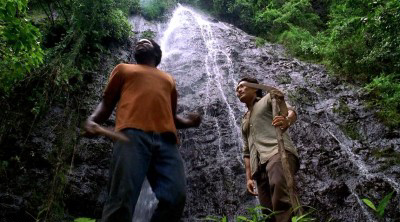
Yes Mike, cos running off into the uncharted jungle is the
best way to find your kidnapped son. From Wikia
Lost - Season Two, Episode Five - ...And Found
Written 15/7/13

Lost brings us another pun-based episode title, introducing the first of the series' many multi-centric episodes for Jin and Sun. This time we focus on how the two became such close chums, as well as moving the focus from the Swan to the Tailies, where next week's massive plot event is going to hit the hardest. It was the best Jin/Sun episode so far, and the fact that it didn't really feature their relationship until the end is something of a sad indictment of their entire schtick.
     While out collecting supplies for the Tailies' hike towards the Main Camp, Michael discovers that The Others are believed to be in a particular direction, and so he runs off in search of his son. While Ana-Lucia wants to carry on with their journey, Jin refuses to go without looking for Michael. They compromise; Eko goes with Jin to try and find him, hoping to meet up with the main group of Tailies later on. After a close shave with The Others, they eventually find him and convince him to come back with them. In the other Island plot, Sun loses her Wedding Ring and looks everywhere before she finds it in the sand she used to bury the Bottle of Messages from The Raft.
      Michael's running off foreshadowed his eventual downfall, which I found quite interesting. The perception of The Others here is also quite funny, what with them being portrayed from in hiding as muddied feet dragging a teddy bear. The direction tars them with an entirely different brush as the next and subsequent seasons, where they live in a hilarious suburban paradise and answer to a toady little man that we'll meet in about two months. (All these references forward aren't because I'm bored or anything, it's just what I'm doing out of excitement.) And, finally, we also got a good round from Mr. Eko, who at this point in the story was starting to edge up the favourite characters list with alarming frequency. For some reason, he's a much nicer person now than he'll end up being, which is probably for the best.
http://images3.wikia.nocookie.net/__cb20090614022009/lostpedia/images/0/0a/2x05_SunJinFlash.jpg
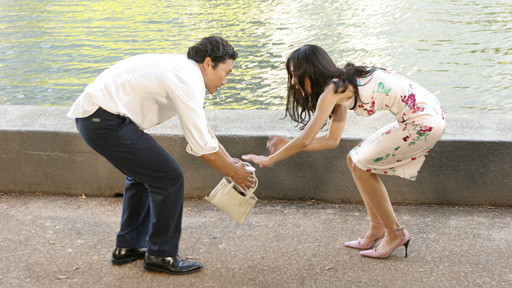
The happenstance that inspired a million boring episodes.
From Wikia
     Our flashback saw us head over to Korea to discovers how Jin and Sun met. Sun was being set up with Jae Lee, the owner of a hotel chain. They bond and have a really nice time before Lee remembers to mention that he's only going along with the arrangement so he can swan off to the States and marry the girl he really fancies, to Sun's obvious chagrin. Jin happens to be working at the same hotel, and is told by the honour-obsessed manager (I don't know how much is stereotype and how much is real with these flashbacks) not to let any lower-class citizens into the hotel. He lets in a child who needs a piss and when confronted about it he does what he should have done and resigns on the spot. Sun and Jin later accidentally walk into each other, stare at each other for a bit, and the rest is apparently history.
     ...And Found was a thesis on what it meant to belong - are you lost, or found? It took a gleeful joy in referencing its own title as it scanned through our characters, but despite that it ironically never seemed to find its own groove. Most of these centrics are about Jin and Sun's relationship, and this just paints it as something incredibly unlikely that, in the real world, would have led to an awkward exchange of apologies and a swift exit by both parties. The on-island stuff with the Tailies was fun and I'm liking where that's going, but the rest needs to get its ass in gear a bit.

Thanks.

NEXT WEEK: It's Shannon's turn to be redeemed and (spoilers) horrifically killed, in Abandoned.

Monday, 10 February 2014

Review: Doctor Who Classic: The Pirate Planet

http://dailypop.files.wordpress.com/2010/12/doctor-who_pirateplanet.jpg
The Captain and The Doctor have a faceoff.
From Dailypop
Doctor Who - Season 16, Story Two - The Pirate Planet
Written 4/8/13

I sorta shat all over Season 17, the succeeding season to this one which was watched over by the amazing Douglas Adams and which... wasn't very good. His first story for the show, though, is this week's story, and his trademark style of ascerbic wit and a healthy level of occupational absurdity and satire. The Pirate Planet is everything I would have wanted Adams' season to be, and I'm torn between wondering at the efficiency of the script and wondering what the hell went wrong in the following year.
     The Doctor and Romana continue on their quest and, when trying to land on the planet Calufrax, land on the planet Zanak instead, where an "always rich" economy is run by the insane cyborg known only as The Captain. They end up caught in his machinations, helping the rebel Mentiads who have psychic powers - powers derived from the planet's secret. The planet Zanak has a Tardis-esque transmat system which it uses to teleport around and then crush other planets for their mineral wealth and energy, no matter the living population. The Doctor faces The Captain and finds an elaborate system of crushed planets in a gravitational harmony, whose purpose, it turns out, is as a failsafe against the evil Queen who has been orchestrating all of his plans in order to keep herself alive forever. Suffice to say that everything goes to pot and The Doctor saves the people of Zanak (and of Earth and other planets) from their reign, with the crushed remains of Calufrax providing the second segment of the Key To Time.
     The script embodies The Captain with an almost paradoxical mixture of enjoyable Ham and situational wit, making him a constant source of laughs both intentional and otherwise (although it's probably all intentional knowing Douglas Adams.) The scene where he shows off his gallery of crushed planets is one of my favourites in Classic Who, as Tom Baker plays up Four's anger at the loss of so many lives so brilliantly that it's sorta chilling. "What's it FOR?". I was a little slow in realising the episode's main use of him as a very fun Doctor Who twist on the Pirate genre, especially with his robotic parrot and the third episode cliffhanger which sees him force The Doctor to walk the plank.
http://images1.wikia.nocookie.net/__cb20071018150233/tardis/images/thumb/a/ae/Pirate_planet_part1.JPG/500px-Pirate_planet_part1.JPG
The Gestalt Mentiads
From Wikia
     Like last week, there were some allegories flying around the place, but they were never the most important thing, even though they were, for the first episode at least, much highlighted. We are taught by one of the older characters all of the lies and legends spread by The Captain and his queen in order to maintain order, with rebellious characters then questioning the status quo and fighting for science. It felt like allegory for the sake of allegory, there was no real follow-up besides the comedic value of seeing the true irony behind all of the superstitions later on in the story.
     Douglas Adams' first take on both Doctor Who and on the pirate genre is a spectacular event of a story, in which the twists and turns unfold as quickly as The Doctor can fire Adams' amazing quips. It's a firm continuation for the season so far, and its focus on comedy while still providing good ideas is just what good Doctor Who feels like. The relationship between The Doctor and Romana is continuing to shine, the whole Key To Time arc thing is working out brilliantly as a plot device and so far, this season is two for two.

Thanks.

NEXT WEEK: We meet silicon-based vampires in 1970s England, in The Stones of Blood.

Thursday, 6 February 2014

Review: Voyager 2.7: Partuition

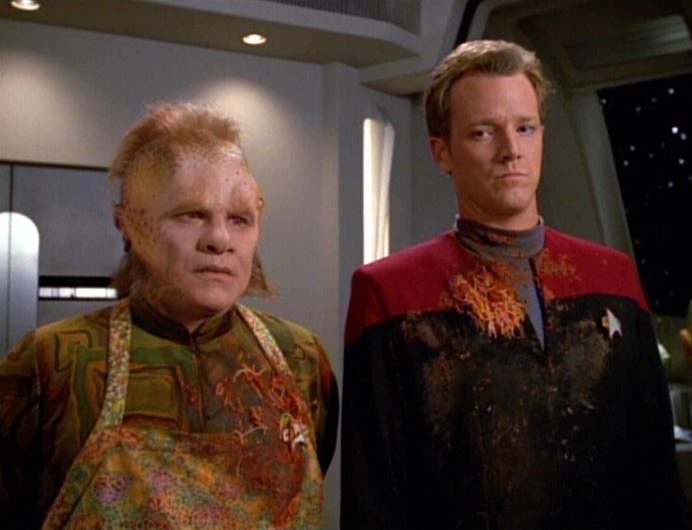
http://images1.wikia.nocookie.net/__cb20121212145603/memoryalpha/en/images/c/cf/Tom_and_Neelix_pasta_collection.jpg
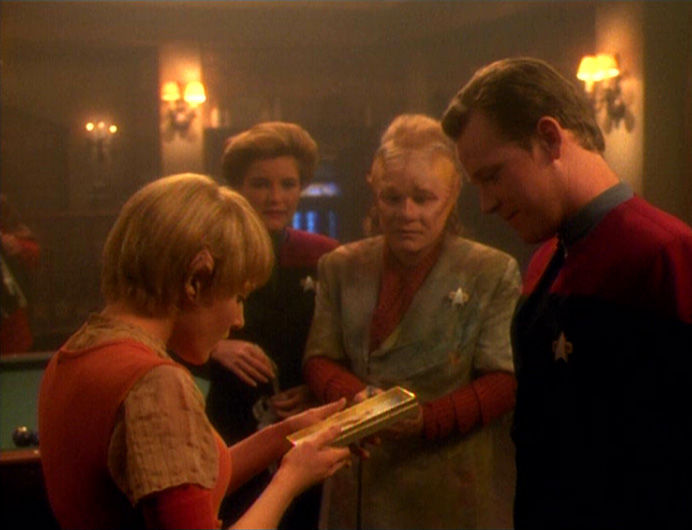
Neelix and Tom have to get a-pasta their conflict.
(Sorry!)
Star Trek Voyager - Season Two, Episode Seven - Partuition
Written 30/6/13

It is rare for an episode of a TV series to leave me with a beaming smile on my face throughout. Partuition is an episode whose writing, despite covering some plotlines which I have found to be extremely contentious, is just so good on every level that I really can't help but adore it. The episode, as well as being purely character focused in a really well-done way, also has this sense of comic timing which enhances mundane scenes into works of pure art. And I'm exaggerating a little bit, but there you go.
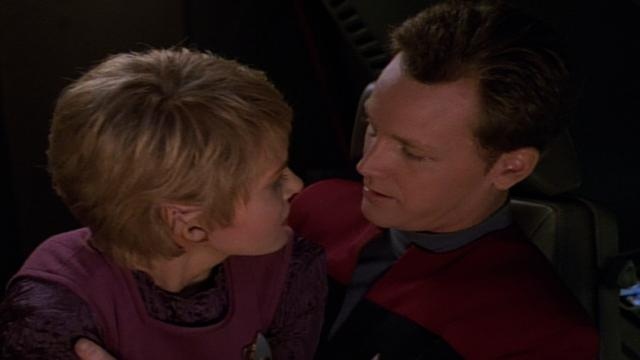
     Tom Paris is teaching friend Kes how to pilot a shuttlecraft, and when she ends up in his arms he realises that he has feelings for her. When he tries to avoid Kes to both help himself and stop the ridiculously jealous Neelix from ever getting wind of it, the two men argue and fight. At the same time, they're conveniently sent off on a mission together on a planet with a technobabble atmosphere, where they're brought together and bond over saving the life of an alien hatchling. As the two are rescued by Voyager, they discuss their issues rationally and Neelix accepts that for whatever god-forsaken reason Kes is in love with him and he should get over himself.
     The writing for everyone, but especially Tom Paris, felt very realistic this week. Usually in Trek there's an underlying sense of the strange as characters name-drop alien words in odd ways that are supposed to give the impression of 24th Century society. Here it felt like real people discussing real issues - be it Paris' attitude towards discovering he has feelings towards someone who is infatutated with someone else, his discussions with Neelix on the planet or simply the way that the crew went about their business. There was a strange exchange where Janeway and Chakotay predicted a plan that Tuvok was about to explain step-by-step, acting as if, you know, they'd all had similar Starfleet training.
http://thumbnails.cbsig.net/CBS_Production_Entertainment_VMS/319/187/2013/05/12/25029699874/CBS_VOYAGER_123_IMAGE_CIAN_thumb_640x360.jpg
Even Neelix ships Kes/Tom.
     Ultimately the episode's core idea (Paris and Neelix look after a baby and that makes them kiss and make up) is a flawed one. Early on in the episode where they're emphasising the rather desperately obsessive nature of Neelix' jealousy at this point, I found it really creepy to watch - more so than any of his more annoying transgressions in earlier episodes. While there was the feeling of the magic wand being waved to end the subplot (which is never spoken of again, luckily), the character dialogues did make up for that - it ticked all the right boxes, even if it looked a little odd doing it.
     Partuition is a testament to the importance of good base writing - your concept doesn't need to be fancy every single week, and you also don't need to try and tempt the audience into thinking that the series might have a big plot twist tand then let them down within 40 minutes. Partuition is about what good TV is usually about - a set of characters, characters you love and who you hate, characters who are identifiable. Despite the fact that at his core, Neelix is still one sick son-of-a-bitch, this episode managed to make him tolerable and that is the greatest accolade I can give it.

Thanks.

NEXT WEEK: People start seeing things. B'elanna has some sexy thoughts. Voyager tries to imitate Steven King. It's Persistance of Vision.

Wednesday, 5 February 2014

Review: Lost 2.4: Everybody Hates Hugo

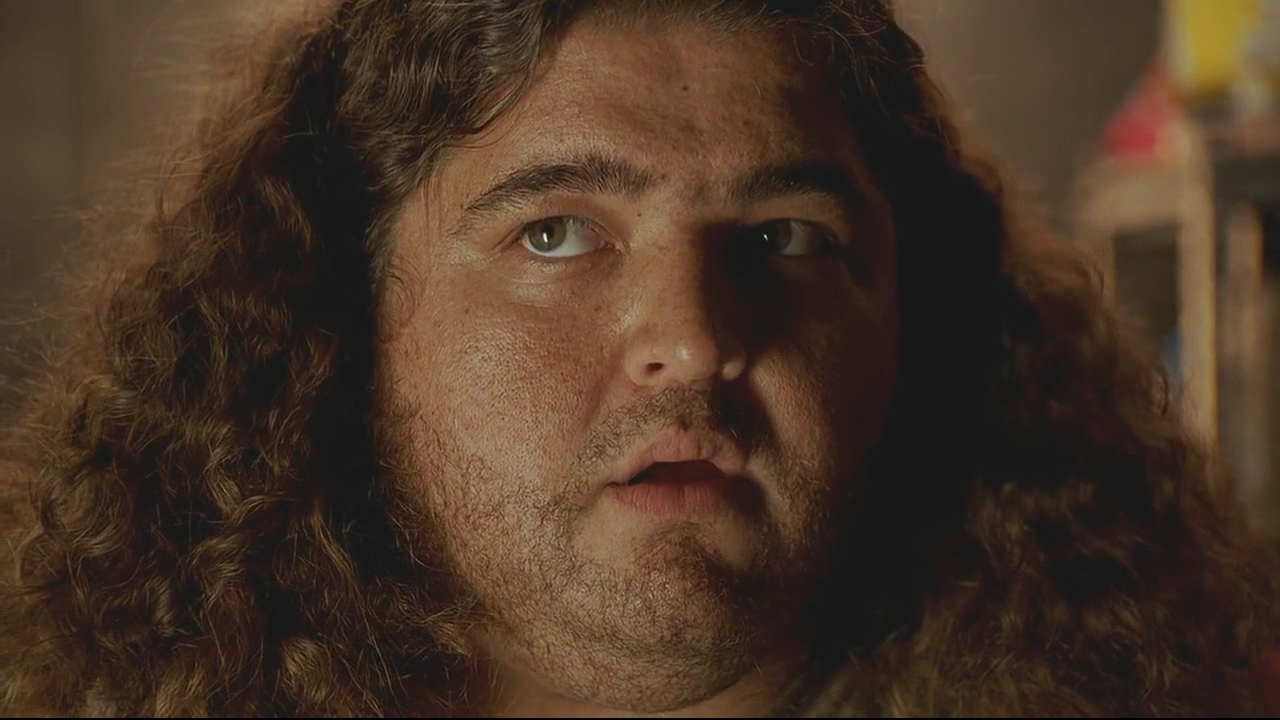
http://images2.wikia.nocookie.net/__cb20110117034831/lostpedia/images/3/34/2x04_Hurley.png
Hurley is worried about everyone hating him.
Lost - Season Two, Episode Four - Everybody Hates Hugo
Written between 9th and 11th July 2013

It's odd that this episode's final season homage, "Everybody Loves Hugo", is such a shoddy script. Especially when the original is the story that actually makes me feel for a character who otherwise would be nothing more than a comic-relief busybody. Getting the pace of the series going again with a healthy mix of characterisation and main plot drama, this episode is the one that launches Hurley into feeling like a real member of the main cast, as well as rounding out his character after the silly premise of his previous centric.
     As Jack and Sayid attempt to circumvent the thick layer of concrete in the Swan which seems to pull metal objects towards it, Hurley is given the duty of handing out the food. Flashing back to just after he won the lottery, he remembers that his few friends left him when they found out that he was moneyed and hadn't told them. Fearful of a similar reaction as "king of the food," he goes to Rose for help, and they inventory. Frustrated, Hurley plans to simply blow up the pantry, but Rose talks him out of it, leading to his decision of simply handing out the entire supply of food to everyone in a night-long feast. Despite Hurley's fears, everyone loves him for doing it.
     Jorge Garcia is a great actor, and the slow foreboding moments of happiness and hope that abound through Hurley's flashbacks in this episode are a great example of that. It's in total contrast to his previous centric - everything is going right, his life is getting better, he even gets to parr off his boss (who happens to be Locke's old boss too, jackass.) I think that makes the ultimate tragedy - a very human problem, all in all - the more hitting, and it really makes us feel for what Hurley is going through. (Although we might later change our minds when we find out what he did with some of the food.)
http://images4.wikia.nocookie.net/__cb20070819030413/lostpedia/images/c/c9/Arrowint.jpg
The run-down Tailies at The Arrow.
     The B-plot saw Sawyer, Michael and Jin brought out of the Tiger Pit by the Tailies, who then began trekking across the Jungle. They were taken to the Arrow, a DHARMA station containing the last few remaining members of their group. There they met Bernard, and he was glad to hear that his wife Rose was still alive on the other side of the Island. This side of the plot is building up some nice momentum at the moment, especially as we begin to deepen Eko and Ana Lucia beyond their initial appearances, although it's still far away from reaching its stride in a few weeks.
     Everybody Hates Hugo was a great episode, and it felt like the season was well and truly up and running - we were able to focus in on a character without it feeling like the series was slowing down for any reason. Hurley is a character whom I've often felt doesn't get utilised in any meaningful way, and a lot of the time it's up to these early centrics to make him into the 3-dimensional character that he's so often remembered as. So what if Everybody Hates Hugo - I like him even if they don't.

Thanks.

NEXT WEEK: Jin and Sun make another god-damn episode name pun with their shared centric, ..and Found.

Monday, 3 February 2014

Review: Doctor Who Classic: The Ribos Operation

http://ichef.bbci.co.uk/images/ic/944x531_b/p00r7f6p.jpg
Romana and The Doctor get on like a house on fire. Eventually.
From The BBC.
Doctor Who - Season 16, Story One - The Ribos Operation
Written 3/8/13

After the disappointment of the previous season, the new production team wanted to make a definite change. To this effect they threw in what was for the time a heap of innovation, hiring a bunch of new writers and organising the season around a single thread which would facilitate the randomness of The Doctor's travels quite neatly. The result is the Key To Time Arc, the first of the Classic Series' deliberate arcs and the only one not to be produced by JNT. The Ribos Operation was tasked with the dual purpose of introducing this premise as well as balancing a new glorious companion and a decent worldbuilding exercise. Despite all that could go wrong, nothing really does, and that is an achievement in itself.
     The Doctor is tasked by God The White Guardian to traverse the Universe and find the six parts of The Key to Time, an ancient artefact with tremendous powers so great that it had to be scattered across the cosmos. Given to him as an assistant is Romanadvoratrelundar, later known simply as Romana, in her first incarnation (we met her second when I reviewed Seasons 17 and 18 a few Winters back.) whom he has a snarky relationship with due to her snobbery and simple lack of awe at The Doctor's life acheivements. They follow the tracer to Ribos, a primitive planet who follow Antiquity-esque superstitions. Conmen Garron and Unstoffe pretend to be selling the planet off to exiled tyrant Graff Vynda-K, who soon turns the tables on them when The Doctor and Romana's attempts to gain the piece go awry.
     The Doctor and Romana's relationship is one that undergoes a surprisingly fast level of development, and yet not in such a way as to feel unrealistic. It's exceptionally well done and mirrors certain sitcoms, where development like this is very important. From the off their relationship, while rusty, has a magnetic quality that is immensely watchable - mostly provided by the clear chemistry between an already-tired-looking Baker and the late Mary Tamm, whose charm and grace in the role earnt her a spot on my list of favourite companions. My favourite scenes are those near the beginning, in which the flirting/quibbling between the two is at its most electric.
http://upload.wikimedia.org/wikipedia/en/d/d6/Ribos_Operation.jpg
The Doctor is given his mission by The White Guardian.
From Wikimedia
     The society of Ribos is less well-explored than I had hoped, but this is more than made up for by a confident set of guest characters, all of whom are played without a dull note. Villain Graff is played with a sublte balance between serious acting and standard Ham, which was enough to make me like him, and the two conmen managed to follow the "heart of gold" trope rather well as they became the sympathisable party somewhere between the second and third episodes. It was quite an odd story, in that the most memorable characters were not those native to the serial's setting, with the sole exception of Binro, a "heretic" whose Galillean story is used to explore Ribos' native superstitions.
    The change from the previous few serials couldn't be more apparant. Here is a story with a great deal of confidence in its own ideas, and the charm to back them up. It wasn't trying to be particularly high concept, and I think some of the writing surrounding Ribos and its people got a little lost in the mix of memorable guest characters. But the overall effect was to push The Doctor and his new companion into the spotlight, where they shined brighter than ever and, through some very well-done characterisation, created one hell of a good Tardis team.

Thanks.

NEXT WEEK: Douglas Adams arrives for pirates and planets in The Pirate Planet.

Friday, 31 January 2014

Overview: Doctor Who Classic: Season 15

Written between 17th and 19th July 2013

http://static.bbci.co.uk/programmeimages/976xn/images/live/p00vh3h7.jpg
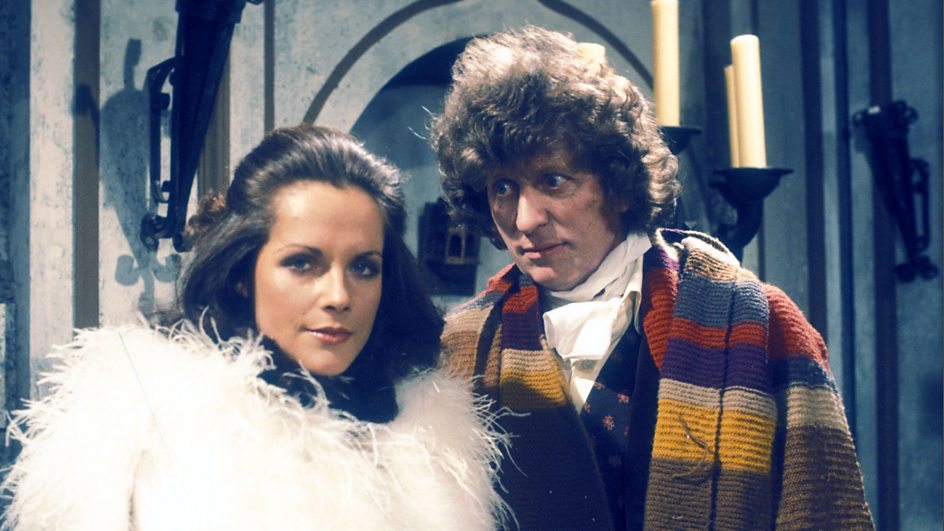
Tom's look of despair sums up my thoughts.
It appears that I'm not exactly a Graham Williams fan. Make no assumptions - I didn't start out with an agenda against him, it just seems like the two full seasons of his that I've seen have been rather diappointing. There's still the Key To Time, so I can't write it all off, and by saying this I am by no means saying that I found nothing in Season 15 to entertain me. The changeover from Hinchcliffe and Holmes to Williams and Reed feels like a difficult and turbulent one, as the series jerks back and forth between stories which emanate the gothic roots of previous seasons and then newer, less well-done stories with their own charms. It feels like there was a desperate attempt to capture what has been previously successful.
     The season's two gothic stories, The Horror of Fang Rock and The Image of the Fendahl, both have highly atmospheric writing and both are incredibly similar to the bread and butter of the Hinchcliffe and Holmes era. They both suffer, like those stories, from fundamentally underdeveloped concepts, and due to that they threaten to bore me silly. Horror is especially dry, but special mention must be made for Fendahl, which rattles along like a tumbleweed on a dry windy day until the final episode, where the concept gets thrown at us in spades. They appear as remnants of the prior era, but I don't know in my heart if that's a bad thing consider the rest of the season.
     The first few glimpses into the new era's style come in the form of The Invisible Enemy and The Sun Makers, two stories which I love and the only two in this season I can say that for outright. The Invisible Enemy is filled to the brim with an inescapable charm that surpasses its technical limitations, whereas Robert Holmes' temporary swansong The Sun Makers is a biting and hilarious parody of the UK tax system, which feels relevant despite how vicious it can be, perhaps unfairly in some areas. That these two different types of stories oscillate like this is very, very odd and marks the season's unevenness.
http://ichef.bbci.co.uk/images/ic/272x153/legacy/episode/p00vfclh.jpg?nodefault=true
They tried, they did.
     And then we get to the stinkers. While the gothic stories and Underworld are the only stories in the season which I found truly unwatchable, one gets the feeling that the budgetary problems weren't being met with the same vigour as before, and for reasons that I don't know (but which likely do exist and an are fully justifiable), the season's budget tends to run incredibly low near the end, resulting in the horrifically bad Underworld and The Invasion of Time, which is badly executed even if charming in its own incompetance. (I mean, green screen is visible in some of the corridor shots. They used the green sheet itself as a wallpaper cos they couldn't find anything else.)
     The final season in my runthrough of Four will be Season 16. After the relative shambles of this season, Anthony Read will move onto the series' first official arc. It was a move brought on to unify the season, the one that came after this season, one in which you never know from story to story what the style or theme or general level of competance is going to be. It ranks almost effortlessly at the bottom of my list of seasons from the Classic Series, and that's a shame because I'm sure that the production team at the time were really trying to follow up what had been considered by many to be the show's Golden Age.

Thanks.

Thursday, 30 January 2014

Review: Voyager 2.6: Twisted

http://images3.wikia.nocookie.net/__cb20120507204036/memoryalpha/en/images/7/74/Kes_Birthday_locket_Tom.jpg
Probably the point where you realise that Neelix has a tinypoint,
even if he's being a dick about reacting to it.
Star Trek Voyager - Season Two, Episode Six (Season One, Episode Nineteen) - Twisted
Written 17/6/13

Spatial god-damn anomalies. It's one thing to have crazy alien schenanigans, but it does take the biscuit when your main problems arise from something as silly and non-explainable as "spatial anomalies". Twisted was the penultimate episode of the produced first season, but was the last of the four "hang-overs" to be produced, supposedly because of the producers' and the network's opinion of its quality. However, as being contrary is as part of my soul as is apple tea with a hint of cinammon, I love this episode and all of its fun little faults.
     While holding a surprise party on the Sandrine's holoprogram for Kes' birthday, the ship encounters a spatial anomaly that takes out the comm system. Neelix is jealous of Tom again, because he gets Kes a necklace. As the characters attempt to get to their respective posts, the position of rooms on the ship seems to curve aoround in on each other and they all end up back on Deck Six, outside the Holodeck. As the anomaly warps the ship's dimensions and slowly approaches the Holodeck, the crew become increasingly frustrated and distressed as all of their attempts to halt its progress fail. They slowly accept their possible deaths, facing a last stand and telling people their last thoughts, before the anomaly washes over them and leaves them unharmed - it was simply a method of communication, sent by an unknown alien species.
     The writers apparently didn't like the way that having this episode just after Elogium made Neelix look like an absolute cock, but the simple flaw in their concerns is that Neelix looks like a cock no matter what he does in what order, and so putting this episode back is not really very useful. If anything it's great, because he vanishes for unknown reasons for half the episode, leading the rest of the cast to do some very nice acting. A lot of the script was padded to make up the time, and what results are quite a few really nice character scenes, one or two even including Neelix, with yet another sensible character (this time Chakotay) putting him in his place.
http://voy.trekcore.com/gallery/albums/2x06/twisted196.jpg
They spent all the money on landing the ship in The '37s.
Give 'em a break.
     And those character moments were what won it for me. A little like The Cloud, this episode feels like a multi-centric one that revels in the joy of a "normal day" under its premise, and so all of the characters get development in various directions. The killer scene is that one near the end where after arguing with Tuvok, the Maquis-minded Chakotay and Torres stop fighting him and the entire group seems to accept the possibility of their death with this brilliantly executed poignancy.
     Twisted feels like a finale. It does, it really does in the way that it reflects a lot of the overarching themes of the seasons what with Chakotay and Torres and the Maquis versus Starfleet thing being done right for a change with subtle differences in principles and attitudes and then seeing them come together and accept one another and say what they've always wanted to say. If you wanted to keep The '37s as the new season premiere, then that's fine. Twisted is not as bad as the writers and the contemporary viewers made it out to be, and despite some of its shoddy effects it allows our characters a much more subtle set of relationships than elsewhere in these early seasons can ever provide.

Thanks.

NEXT WEEK: For you, we sort out all of this jealousy business with yet another Neelix episode, where he and Tom are of course stranded somewhere and forced to work out their issues, in Partuition. For me, I'm going to go and write The '37s and finish this original first season off.

Wednesday, 29 January 2014

Review: Lost 2.3: Orientation

Lost - Season Two, Episode Three - Orientation
Written 6/7/13
Francine feels a little too much if you ask me. You all do. I mean, seriously...?"So-and-so never called me back, my mother stole thirty dollars from me" - I never even knew who my parents *were*. A couple years ago my birth mother found me and she told me - I was 'special'. And through her I met my real father - great news, right? Well, he pretended to love me just long enough to steal my kidney because he had to have a transplant! And then he dropped me back in the world like a piece of trash just like he did on the day I was born. You want your damn thirty dollars back? I want my kidney back!  .

http://images1.wikia.nocookie.net/__cb20060719234211/lostpedia/images/9/9b/Ori4.jpg
Locke is compelled to fix The Swan's computer.
From Wikia
In this week's edition of, "How Shitty Is John Locke's Life?", we're presented with an episode that puts so many others to shame it's not even funny. The way this episode wore together the advancing plotlines and the characterisations of both John Locke and Jack Shephard was inspiringly written and when all is said and done it's one of the best episodes of LOST so far on this runthrough, every second a drop of pure dramatic gold. As well as introducing two of my favourite characters in the B-plot, it also introduces us to DHARMA and to Pushing the Button, some of the things that make Season Two my favourite of the lot.
     In the A-plot, we see the conclusion to the cliffhanger from the previous two episodes, with Kate resolving the standoff by accidentally shooting the Swan computer, leading Desmond to go into a panic and to try to explain himself by telling them that he was dragged down there three years prior and made to watch a DHARMA orientation video about Pushing The Button to save the world. Jack, shaken after recognising Desmond due to his obsession with arbitrary scepticism, is incredibly critical, and lambastes Locke who calls Sayid in to help fix the computer so he can Push The Button. When the computer is fixed and Jack has had a talk with a fleeing Desmond, Locke and Jack standoff as he helps to push the button, giving in to Locke's pleas.
     The main plot of the episode was tied in very well to the flashback, which felt like it got more screen time than usual, in which we find a post-Kidney-op Locke getting together with the fabled Helen who is forced to help him get through his obsession with finding answers to his father's actions. Terry O'Quinn's performance in this episode is of a higher standard then even in his other centrics from the first season, capturing Locke's desperation and lack of internal guidance in such a subtle and mind-boggling brilliant way that I can bearly contain my admiration for it. Katey Sagal's Helen (Leela from Futurama!) is a wonderful addition to the show and the way she connects with Locke's character so intuitively and yet realistically is what rounds that part of the episode off to perfection.
http://images2.wikia.nocookie.net/__cb20110118084930/lostpedia/images/5/5c/2x03_LockeAndHelen.jpg
Helen tries to help John move on from his father.
From Wikia
     In the B-plot, the guys on the Raft were thrown into a pit by an imposing African man who we will come to know in the coming weeks as Mr. Eko. He's awesome, trust me. Thrown in with them is Ana-Lucia Cortez, whom we met in last season's finale, who reveals that she is part of the plane's tail section survivors (hereon Tailies), before she steals Sawyer's gun and gets pulled out, revealing her to be part of the group that kidnapped them in the first place. At the moment the Tailie storyline is a bit slow, but that was fine - the stuff in the Swan with both Locke and Jack's need to question their current understanding of their scenario was much more important, and we'll get to the real beef of this storyline in a month or so's time.
     The season took its time, but third episode in and we're hit with a slammer of an episode that gets everything right and in so many various exquisite and delightful ways. Matthew Fox and Terry O'Quinn act their socks off, both displaying painfully flawed characters who begin at odds with one another's ideologies and who by the end reach a grudging understanding that dregs up tragic circumstances in their pasts for both of them. It's just beautiful writing and I can honestly say that if what I remember of the rest of the season is this good, then I am so looking forward to carrying on with it.

Thanks.

NEXT WEEK: The show gets a bit harsh and insists that Everybody Hates Hugo.

Monday, 27 January 2014

Review: Doctor Who Classic: The Invasion of Time (Revisited)

See here for my previous look at this story.

https://blogger.googleusercontent.com/img/b/R29vZ2xl/AVvXsEgaIe3aUqLJ9LuyN_RM98qqom5tJ5v5qYDFkp962VjM1MZqt8m7xpcBjCV9DHgPqr2d3oDJVsLYtJSNvBJjBxCPU73MKVW9lHboqr0zfttUwvPngmDMVLxeUk77qxeIu7s9Z8Aq06_G1ypi/s400/Picture+9.jpg
The Doctor pretends to go evil for some sheets of foil.
From Cathode Ray Tube
Doctor Who - Season 15, Story Six - The Invasion of Time (Revisited)
Written 16/7/13

What to say about this story? Well, I had originally wantd to try and write an article on this story for Celebrate, Regenerate, but I couldn't find a single thing that I actually liked about the story. I mean, that's a bit of hyperbole, really. It's two and a half hours of Doctor Who, there are some things that I can find here and there. But as an overall experience, The Invasion of Time so fails in every single one of its aims that it reaches a point which waivers dangerously between hilarity and tragedy. And that's not a good thing, it's never a good sign when I can't tell whether I outright hate the story or love it in a So-Bad-It's-Good way. Usually it's a little more clear cut.
    The first four episodes are bad enough on their own - a concept play where we're led along the garden path by The Doctor's apparently dark turn, which is never hinted at until the second episode and so we're left thinking that The Doctor is a total and utter tit for a week. Plus, the aliens he's apparently helping are some of the most weak and lily livered in the show's history - the Vardans, whom, while awesomely powerful in principle, are pathetic in execution. I've followed some pretty crappy looking monsters in my time as a fan, but I will not accept a monster who is literally a sheet of tin foil with a strong irish accent. Their humanoid forms are even less impressive, looking like bored versions of the Great Gazoo with a great deal less screen presence. I can understand your budgetary limitations and at a stretch I might even accept the tin foil in the same way I accept the same in Timelash. But the acting is just so poor. It really is, there's no escaping that.
     The last two episodes are where the serial really goes to shit, with all semblance of plot thrown out of the window in favour of running around the TARDIS corridors for a bit being chased by Sontarans. As is Invasion of Time practice, this is the worst execution they ever saw, with crumbling costumes hiding actors who have been for some reason directed to put on strong cockney accents. After four episodes which might have been simply mediocre on their own, the final two drag it out into a dull slog which you pray might sometime end. It's so random that they have to break open the by-this-time-tired book of Who mythology, essentially pulling the get-out-of-jail-free card by having The Doctor shoot the Sontarans out of existence and then forget all memory of it.
Hey, it's the guy from The Android Invasion!
From the BBC
     In my original review, I talked a bit about Gallifrey, and that's important too. After the fan uproar at seeing the mighty mythology brought down to something a bit more human, going to Gallifrey was dangerous ground, especially when the budget was in the state it was. Instead of the wonderfully complex, multi-layered sets we saw previously, the civilisation is reduced to a series of blandly coloured corridors occupied by about three people, and then some location filming outside which instead of exploring Gallifreyan society and customs only serves to raise more and more questions.
     This story stands as Leela's last, and it's a damn shame after this season and a half that a character so previously well-developed manages to be kicked out with such a bullshit excuse. Leela falls in love with Andred, a minor character whom she barely speaks to over the course of the story and whom she has so little chemistry with it felt weird to see them even holding hands. It's not something that Leela would do, there's no continuity in the characterisation that after being shown the wonders of the civilised world with Leela that she would choose to settle down with a guard. Plus her presence in this story at all sends a bad word back to the Hand of Fear, where humans aren't allowed on Gallifrey. It's almost as if everything this story does is towards fucking up Season 14.
     And now to the few spits and spots I do like. John Arnett's Borusa is fandabydozy, and is quite wonderfully playful in his trickery as he guides The Doctor around Gallifreyan politics. The scenes between him and The Doctor play out very differently to Borusa's last incarnation, and at a stretch I would say that it's a tiny bit better. I also happen to like the roaming around the inside of the TARDIS, no matter how nonsensical the location filming in Hospitals and Swimming Pools happens to be. It's playfully done and it doesn't look too tacky, and while the TARDIS interiors we see in JNT's tenure (which are remarkably consistent in appearance) are my favourite, I love the recursion and randomness that this serial feels fit to provide to fill up the last two episodes.
The Doctor is made President.
From Basement Rejects
     So, not a total washout. At the end of the day there's no-one I can really blame for this story, and I feel bad for it because the show was struggling with its cash and it is genuinely a miracle that the story was even made. After all the work that went into ensuring that the show made the screen, I think the whole story is imbued with a wonderfully shoddy charm. When I began this runthrough, The Invasion of Time was one of my least favourite stories. Given some of the crap I've seen, I can at least say that The Invasion of Time is entertaining, and given all the trouble it faced in production I find that something of a wonderful miracle.

Thanks.

NEXT WEEK: We meet Romanadvoratrelundar Fred Romana's first incarnation in The Ribos Operation.

Thursday, 23 January 2014

Review: Voyager 2.5: Non Sequitur

http://images2.wikia.nocookie.net/__cb20071008013819/memoryalpha/en/images/0/0f/LibbyWatchesHarrySleep.jpg
Unfortunately, no Harry Kim Death Count. Shame.
Star Trek Voyager - Season Two, Episode Five - Non Sequitur
Written 22/6/13

Harry Kim! Harry is a somewhat useful character to have in the background not doing much, showing Voyager's fresh-faced innocence. However, like a freshly cut diamond, any attempt to take closer look into his shining exterior will reveal the flaws in his fundamental structure. Non-Sequitur has a semi-interesting idea at its heart, but where it falls down is in applying Harry Kim to that scenario and the problems that come with what I find to be his fundamentally alien personality. I can't feel for this kid, now matter how shitty I continue to find the idea of being a part of Starfleet. (Those damn Uniforms can't be comfortable.)
     Harry awakens in his girlfriend's bed apparently having had his request to join Voyager denied and instead now living in San Fransisco as a successful cadet who's about to come into some fame and fortune after designing a new kind of ship. Harry can't remember any of this; he's travelled from his home Universe after an accident in a shuttecraft, and despite his life of happiness and success he's insistent upon returning home. In the process, the fact that he knows Voyager security codes and talks to not-on-the-ship Tom Paris sets him up to appear to Starfleet as a spy for the Maquis, leading him into some serious shit as he and Paris re-create the conditions of his accident and return him to his home universe.
     Now of course, I fail to sympathise. I can understand Harry's first day, where he's confused and doesn't have a shit about what's going on, but if I was in that situation I would just roll with it. I'm gonna get married to the girl of my dreams, my career prospects are on the rise, and I'm not stranded 70,000 lightyears away from home on a ship that, for all Harry knows at this point, won't get home until he's a pensioner. There's nothing really to pull Harry back... except, of course, the irresistable pull of the Reset Button. Here's an idea; having knowledge of Voyager's disappearance and what went on in his Universe directly afterwards, he could join the team of people at Starfleet (that we see in later seasons) that are looking for it. That way he gets to enjoy the creature comforts of life on Earth while still not feeling guilty about leaving the ship behind.
http://voy.trekcore.com/gallery/albums/2x05/nonsequitur116.jpg
Parallel!Tom knows what's up, man.
     But no. Harry Kim is supposed to be some kind of perpetual innocent, but that problem is that it's taken to odd extremes and he ends up coming off like a less threatening Neelix, with an obsessive personality and a devotion to his superiors that borders on the ritualistic. When he meets bummed-out Tom Paris, he fights him and calls him nothing but a loser and a drunk - because that's totally the way you convince someone to help you, eh Harry. I take it as a sign of his total disparity from reality that when handed on a platter everything he's wanted for the past year-and-a-half, he has to try and go back out of a strange sense of loyalty to people in a different god-damn Universe.
     Non-Sequitur feels like a fairly appropriate title for an episode which seems to divert so wildly from its expectations. It's not by any means a badly written episode, and I'm not saying for a minute that I think that Harry is being out of character, but at the same time that doesn't mean I have to like it. I don't know exactly where ther to blame my disdain of this episode on Harry's characterisation, its obsession with the reset button or with the fact that even with a premise as strange and wonderful as this I was still left feeling just a little bit perturbed by the whole thing.

Thanks.

NEXT WEEK: The last of the "hold-back" episodes. It's totally Twisted.