Thursday, 9 January 2014

Review: Voyager 2.3: Projections

To give you that authentic feel, I'll be writing these reviews out of order. This is the first of Season Two's episodes that I'll be reviewing, as in the production order (the order that roughly makes sense).


The final scene, which underscores the episode's themes of
self-identity perfectly, as the Doctor tests his own nature.
Star Trek Voyager - Season Two, Episode Three (Season One, Episode Seventeen) - Projections
Written 17/6/13.

Brannon Braga is a name we're gonna get used to on this blog, especially in the second season. Beginning as a writer half-way through the run of The Next Generation, he went on to become one of the head honchos on both Voyager and its successor series Enterprise, and is known perhaps unfairly for his more terrible outings. This, however, is not terrible - in fact, it's wonderful. Braga delivers his A-game as a mixture of profound character insights and a plot more twisty and turny than a very twisty-turny thing.
     The Doctor activates in sickbay to be told by the computer he's on an abandoned ship, attacked by the Kazon. B'elanna arrives in sickbay and fills him in, telling him that there are no projectors elsewhere on the ship. She sends him to the Bridge to help Janeway, and to the Mess Hall to help Neelix. Once he returns to sickbay, apparently bleeding, he finds that he is apparently a real person, and the rest of the crew holograms. A hologram of Barclay (a minor TNG character) appears and tells him that he's a real person in a simulation who has forgotten reality, which he demonstrates by affecting the space around them. Just as Barclay is convincing The Doctor to blow up the holographic Voyager to end the program and save his life, using a Kes-inspired Mrs. Zimmerman, Chakotay walks in and uses a similar story - except that it's The Doctor's program on Voyager malfunctioning. Eventually he is returned to reality and left to wonder the ramifications of the desires that his mind cooked up for him.
     The path of the episode takes a number of unexpected turns, but for the most part it works remarkably fluidly, the only difficult bump being a "dream-within-a-dream" fakeout near the end which feels a tad unnecessary. Before that, it's rather captivating as we move from the big and dramatic "99% of crew held by the Kazon" plotline to the equally awesome-sounding one in which the computer is expressing The Doctor's heart-felt desires through a simulation which we as viewers are unsure whether or not to believe. It's that suspension of disbelief through Voyager's tendency to hit reset that really makes it work for me.
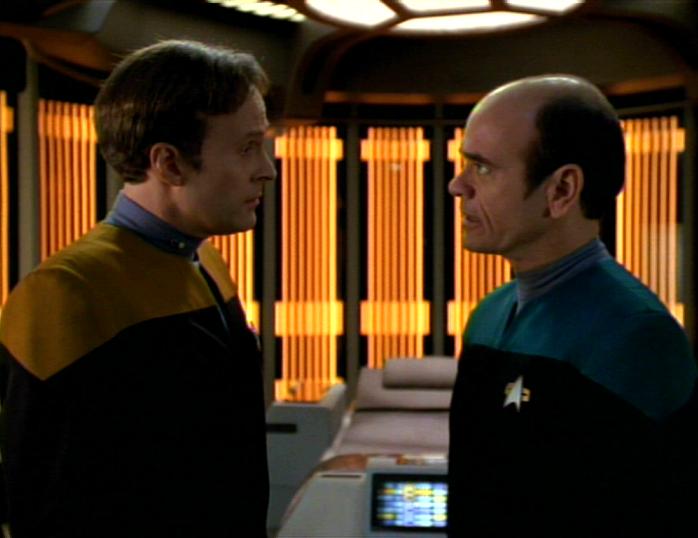
http://images2.wikia.nocookie.net/__cb20070303023923/memoryalpha/en/images/0/06/Barclay_3.jpg
Holo-Barclay tries to convince The Doctor of his coporeality.
     Plus, Robert Picardo is great as a man having an existential crisis without having existed in the first place. The central premise that The Doctor's desires are being played out is planted through the episode, first with the more mundane untitity of ship-wide movement and greater responsibility, and then with the ability to feel like a solid human and have a wife and family. The three 24th Century Treks all have a character like this (Data, Odo and The Doctor) and The Doctor is my favourite simply through Picardo's slow progression from the Doctor's normal self into someone with a great deal more emotional investment and conflict than he thought was possible.
     Projections is an episode for the show to be proud of. Following up the excellent but oh so slightly flawed Jetrel, Projections is similar in quality and barrelled me over with just how succinct it could be. Normally twists and bizzare scenarios ruin rewatch value because you know what's gonna happen, but like good script the little nods here and there to The Doctor's innermost desires make watching the episode that second time a much more powerful experience than it would be usually. To accomplish that in a season usually so reviled is something of an awesome accomplishment, and Projections is probably my favourite Season Two episode because of it.

Thanks.

NEXT WEEK: Let's talk about sex, baby, let's talk about rubbin' your feet, let's talk about crazy alien sperm, let's talk about... Elogium. Man, it's weird.

Wednesday, 8 January 2014

Prologue: Lost: Season Two

http://movista.files.wordpress.com/2010/12/lost-season-2-cast.jpg
Season Two's cast.
Written 18/6/13

I suppose these prologues are a little bit redundant now, but there's no problem with a little bit of redundancy here or there. Lost's core focus shifted a great deal between the first and second seasons, with the character-based groundwork that Season One layed down allowing the mythos of the show to take a much more active role, as well as facilitating the introduction of a number of new cast members, the majority of which unfortunately didn't last very long past it.
     Season Two introduces the Dharma Initiative, one of the show's biggest mythos points and the damn setting for most of Season Five. It also thus introduces Desmond, who is awesome. This all arrives with the opening of the Hatch to reveal the Swan, a Dharma Initiative station whose fashioned interior and mysterious contents form the backbone for a lot of the season, and help to define it with its own identity. Personally, I love the set and everything that goes with it, and thus its destruction at the end of the season is just heartbreaking for me on a number of levels.
     Elsewhere we have Season Two's unique look at the Tailies, the survivors of the plane's Tail Section who feature a host of interesting characters, the best being Ana-Lucia and Eko. Ana-Lucia is one of the best-written female characters I think I've ever seen in US TV, and despite her haters (of which she has many for some unfathomable reason), I really love her. Mr. Eko is one of my favourite LOST characters, due to the sheer complexity behind him and his badass exterior that hides a tragic and desperate past. His best moment comes at the beginning of the next season, but Season Two gives him plenty of memorable stuff to do as well.
     We're in the big leagues now, boys and girls. Get excited.

Thanks.

Monday, 6 January 2014

Review: Doctor Who Classic: Image of the Fendahl

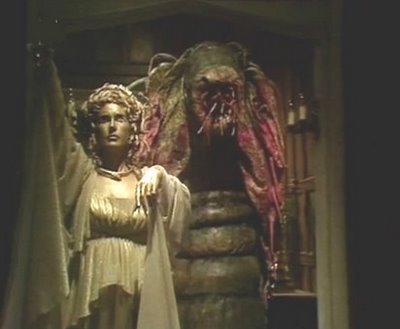
http://images1.wikia.nocookie.net/__cb20110510191535/aliens/images/d/d8/Fendahl3.jpg
The Fendahl and her Fendahleen. From Wikia
Doctor Who - Season 15, Story Three - Image of the Fendahl
Written 6/7/13

Fendahl is a story whose outward appearance is big and foreboding and whose reputation in a time where common perception sees Who's dominance beginning to slowly slip gives it great deal of kudos. Doctor Who, even by this point, is no stranger to great foreboding forces working over millions of years, and they would continue to appear after Fendahl as well. After a story like The Invisible Enemy which was seeming to gain some jollity, Fendahl seems to throw that in the pan and get awfully serious again, for Leela creator Chris Boucher's final Doctor Who outing.
     The titular monsters are said to be the occupants of the planet that once existed between Mars and Jupiter and who escaped to Earth when it exploded and became The Asteroid Belt over 12 million years ago, hiding itself in rock and subliminally affecting humanity so as to further its purposes in the modern day, where scientist Professor Fendelman (Brian Murphy) is used by the Fendahl to return to their physical form. The Doctor and Leela happen to be popping by and, following local suspicions about The Old Religion, prevent the Fendahl's plan from succeeding.
     The episode's plot is all over the place, never knowing what it's trying to do. At the beginning there's some almost sitcom-esque dialogue which actually quite enjoyable, but the mysteries that the serial slowly builds up one by one never really mesh together in a satisfying way even at the end. There's a glowy skull and a guy who's secretly speaking for the Fendahl and then there are spirit Fendahleen which are eating people alive and there's very little to say how they're related or whether we should really care. It's an apathy that comes from what I find to be a fundamentally uninspired villain. Big overarching evils are ten a penny, and while that doesn't exactly make them difficult to execute well it does mean that this story, which fails to characterise them in any meaningful way, doesn't get any points from their execution. The episode evokes pagan rituals and sacrifice with pentagrams and stuff but it doesn't feel like it's a grand overarching plan and is more indicative in my eyes of a failed attempt to grab imagery from somewhere that at the time would have been considered scary and cool. If you're going to go to full ritual sacrifice and pentagrams, why not make a Devil allegory or something like that? I'm not going to be scared of the big invisible thing just because The Doctor assures me that it's very bad indeed.
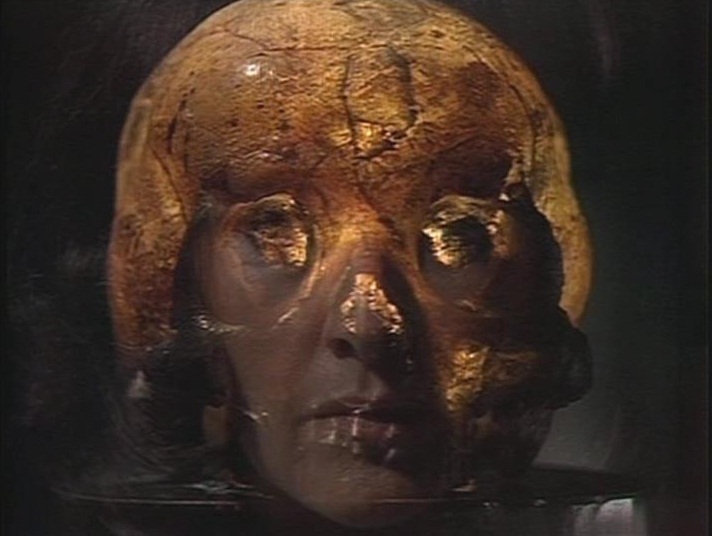
http://images3.wikia.nocookie.net/__cb20120518011030/tardis/images/f/fb/Image_of_the_Fendahl.jpg
Benedict Cumberbatch's mum... From Wikia.
     However, the story does have a number of good points. As well as the use of the symbolism of the Old Religion and all the jazz that goes along with it, the use of its characters is outstanding. The villain Maximillian Stael, determined in a sorta Cyberman-collaborator way to harness the almighty power of the Fendahl, gets quite a dark ending when, bewitched by its charms, he has the Doctor pass him a gun so that he may commit suicide rather than become a Fendahleen. Doctor Fendelman, the mad scientist throughout, turns out to be talking 100% of sense. All this comes in the fourth episode, which manages to tie things together enough for me to even make that synopsis up there, and by itself it's a decent piece of science fiction. It's a shame that the serial is so bottom-heavy in that regard.
     Before the final episode, Image of the Fendahl is a slow and sluggish whose ideas and themes threaten to collapse the thin plot holding them up. The fourth episode makes some small concessions, and overall I did enjoy the serial, but as a whole the story jumps here, there and everywhere and isn't very easy to follow. Chris Boucher's final story for the program is messy and doesn't really reflect the same level of quality as his previous two, but regardless of my disdain for the vast majority of Image of the Fendahl, it is a story that most of the fandom loves regardless.

Thanks.

NEXT WEEK: If you get too cold I'll tax the heat, If you take a walk, I'll tax your feet. It's the story of the Taxmen in The Sun Makers.

Thursday, 2 January 2014

Review: Voyager 2.2: Intiations

http://www.startrek-voyager.nl/episodes/seizoen%202/initiations.jpg
Kar assists Chakotay with avoiding booby traps.
Star Trek Voyager - Season Two, Episode Two - Initiations
Written 20/6/13

The first episode to be written for the second season, Initiation brings us in on an episode whose mission seems to be to correct a few of the mistakes made in the year prior. Thus, we are given 45 minutes to explore both Chakotay and The Kazon in a much greater level of depth than as before, perhaps providing the latter's only decent outing and strengthening the former considerably. It's an episode about fatherhood, about honour, and about how killing your immediate superior is always a good thing.
     Chakotay is out on a shuttle doing a funky ritual when he's attacked by a Kazon ship and is forced to save the occupant, a 13-year old named Kar, from an explosive death. Kar is summarily pissed, because he's been denied the glory of dying in battle and now he's been captured, he will lose the ability to gain his warrior name. The two are tractored onto another Kazon Ship, where the leader of Kar's sect tries to have Chakotay execute him. He refuses, and he and Kar escape to a local planet, where that sect's training grounds hold them stranded. As Voyager tracks Chakotay's path to the planet and runs into the Kazon, Kar bypasses new friend Chakotay's offer to let him kill him and instead kills his sect's leader, earning his warrior name and his future. Everyone lives happily ever after.
     The three prior appearances by the Kazon weren't very impressive, and very little was given about their culture other than their perpetual stupidity, shunning technology and being unable to find water despite being capable of faster-than-light travel. As they're a major Season Two villain, Initiations tries to do them some justice and presents us with a new image of Motorbike Gangs, with their territory and honour-based lifestyles. The characterisation of Kar is the first decently written Kazon in the series, helped no end by actor Aron Eisenburg, who at the time was a regular on sister show Deep Space Nine as young Ferengi Nog. It's a very good performance, and breaks the stigma of child actors quite considerably.
http://voy.trekcore.com/gallery/albums/2x02/initiations011.jpg
The Kazon go from straight-up Klingon rip-off to
Motorbike Gangs.
     Chakotay's development in this episode saw him being a little bit odd. Religious stereotypes aside, there's this general perception in Season One of Chakotay as the guy who doesn't play by the rules unless he likes them, and is willing to use his old Maquis tactics in service of Federation principles. He's the cool uncle of the crew. This episode has him trying to teach life-lessons to young Kar, and pretty much failing in everything except convincing Kar not to kill him. I thought it was a very strong set of scenes, though, as we've rarely been able to see trhis caring side of Chakotay before and his willingness to die to see Kar re-accepted into his sect was admirable.
     Initiatians revealed a series that looked to improve itself, and it did that with flying colours. The relationship between Kar and Chakotay was not portrayed with the more intimate directive style that I would perhaps have given it. But, besides that, the episode managed to portray the Kazon as an actually vaguely interesting culture for the first and if I recall correctly only time, as well as giving us some heartwarming character development for the show's cool uncle.

Thanks.

NEXT WEEK: An article I wrote several days ago. Confusing, isn't it. Not as confusing as the plot of Projections, though...

Wednesday, 1 January 2014

Welcome to 2014

Well, that last year seemed to last forever. Or at least, for a long enough time for me to write so many articles for this blog that I could drop dead now and still seem active until June. Last year I mentioned that I thought that 2013 was going to be my last year of doing this - that was for various reasons, all of which still apply, but last Summer I made a longer plan which basically means that 2014 is going to be my last year of this shindig, going up until just after I reach my fifth anniversary this December.

What's coming up in 2014? Well, some long-term US shows for one. The second and third seasons of both Lost and Star Trek Voyager will be gracing your screens every Wednesday and Thursday, with Star Trek Deep Space Nine hopefully joining them once I've done all of the Classic Doctor Who that I want to get through.

There'll also be some spendiferous Heroes overviews, as well as the new seasons of Doctor Who and, near the end of the year, a series of Best Of articles which will look at my favourite shows from over this blog's lifetime.

See you there, people. :D

Thanks.

Monday, 30 December 2013

Review: Doctor Who Classic: The Invisible Enemy

Welcome, reader to the last review of 2013. Which I'm writing in June. S'all a bit topsy turvey really.

http://www.doctorwhoreviews.co.uk/4T_files/The%20Invisible%20Enemy%206.jpg
Hardcore Prawn, as Neil Perryman puts it.
Doctor Who - Season 15, Story Two - The Invisible Enemy
Written 30/6/13

Doctor Who is a very varied show. Some stories are overwhelming serious. Some stories aim for a political message amongst piles of cheese. Some stories are so rattled by their production problems that they fail to do anything at all. The Invisible Enemy is a mix of the first and third, a story whose special effects get weirder and weirder as one goes along but whose incredible charm, especially in its centre two epiodes, lead me to rather love it in the way that one loves the offensive stereotypes of mentally ill protagonists in Oscar bait films. With similar amounts of inner personal outrage.
     A base on the moon Titan is afflicted by a web in space which infects the minds of the crew via mental attacks. The TARDIS materialises in the vicinity and is caught in the same beam, sparing Leela but infecting The Doctor with the Nucleus, the prawn-like life-form that the other infectees want to protect and use to procreate an alien species. The Doctor and Leela go to a space-hospital to look at the disease, where they meet Professor Marius and his robot dog, K9 (!). Using a part of the TARDIS, Marius follows the Doctor's instructions and creates clones of he and Leela to climb into The Doctor's body and find the Nucleus. The clones confront it, but disintegrate before they can do anything. Leela's clone contained her immunity, helping The Doctor to synthesise a cure, but the machine works in reverse and the Nucleus is magnified to man-size. The Doctor and Leela, along with K9 in tow, blow up Titan and save the Universe. Sorry, Solar System.
     After a season or two of stories taking themselves far too seriously with old Victorian Mansions and ancient gods about the place, the appearance of Marius and his (for now) charming robot servant breathes a fresh air into the series. The serial feels very much like it's aimed towards children after the systematic violence and adult allusions that defined the previous series Marius himself (Frederick Jaeger) is a fun screen presence and the first few appearances for long-term companion K9 are quite frankly wonderful. Episode Three's homage to the common-used plot of The Fantastic Voyage fitted right in, even with the cheesy special effects that did make me laugh, especially when The Doctor's white blood cells are big white Styrofoam balls hanging from the ceiling and bouncing into things. Most impressively, The Doctor's inner fight with the Nucleus is acted rather well. At least until we see it.
http://2.bp.blogspot.com/-fYUxKWZGkKs/UXBAcrcMOjI/AAAAAAAAK5U/d33LeWaEEG8/s1600/k9-the-invisible-enemy-5.jpg
An icon is born.
     And that is where the story gets awful weird. Besides the other numerous special effects failures (and the fact that they blew up Titan, which is a pretty cool moon), the story's main downfall comes with the appearance of the Nucleus. In concept, the story is fine, if cheesy, and the execution is mostly okay. But the simple fact is, the design of that monster is fecking hilarious. Inside the body it's a binbag with a crabclaw, and outside the body it's a massive great shrimp that can't even walk around by itself. The camera angles shoot it like it's a school production and the previously tolerable standard ranting becomes just silly when we're supposed to believe that Zoidberg's less intimidating brother is going to rule the Universe.
      I enjoyed the Invisible Enemy, in a period where I was beginning to wonder if I'd make it through Season 15 into what I hope is going to be an awesome Key To Time arc. Because I like it, it obviously gets hated on a lot by fandom by what I see as incredibly trivial reasons, although the simple what-the-fuckery of the Nucleus in its larger form does turn a fairly decent story into a So-Bad-It's-Good laughfest by the end. I'm just so grateful that after two stories which bored me with their overbearing darkness and foreboding, I'm allowed to laugh at cheesy sci-fi goodness that appeals to everything I like about the show.

Thanks.

NEXT WEEK: Yet another alien figure has been manipulating Humanity for centuries... all in The Image of the Fendahl.

Saturday, 28 December 2013

My Top Ten Shows of 2013

Written 23/12/13.

This year I have watched a lot of TV. This was basically my dedicated catch-up year, and I've been watching so many more US shows that I've just neglected through the years. However, British TV has been quite good this year too. To make things fair, I won't make mention of the ridiculous amounts of stuff from previous years that I've catched up on this year, and focus on things that aired in 2013 (as well as giving each season a cheeky rating out of ten stars.) 

10.) The White Queen (Starz/BBC) ★★★★★☆☆☆☆☆

Following in the footsteps of The Tudors, our latest attempt at a medieval regal drama adapted the best-selling but controvertial set of books by Phillippa Gregory which attempted to put a feminist focus on the Wars of the Roses and examine the politics of three particular women - Elizabeth Rivers, wife of Edward IV; Margaret Beaufort, the mother of Henry Tudor who manipulated court to bring him to power; and Anne Neville, the wife of Richard III who helped him rise to the position of power he stood in prior to the Battle of Bosworth Field.
      The adaptation aspect of the production meant that quite a bit of the plot tended on the side of silliness, with some of the characters being possessed of real-world psychic powers and the way that the series is eminently Ricardian in its bias, instead blaming the disappearance of the Princes In The Tower as a political move suggested by Margaret Beaufort. Despite the weird way that it chooses to deiver its history, the cast of characters are all quite well developped and there isn't a dull performance among them - my favourites being Aneurin Barnard as the slimy Richard III and Amanda Hale as Margaret Beaufort, a character who I rooted for throughout the entire series as she played the Yorkist and Lancastrian sides against one another in order to allow her own illegitimate son to the throne.

9.) Shigeki no Kyojin (Season 1) ★★★★★★☆☆☆☆

SIE SIND DAS ESSEN UND WIR SIND DIE JAEGER! Yes, it's everyone's favourite "trendy" anime series, with its fair share of depression, depression and depression with a side helping of badass teenagers and the devastation at the discovery that yes, yet another of your favourite characters has been mercilessly eaten by mindless homicidal giants. That said, SnK's worldbuilding and characterisation is absolutely second-to-none, and the fact that it's one of the few anime series I've seen which isn't deeply problematic in its attitudes to women is icing on the cake.
     Shigeki no Kyojin pretty much introduced me to the entire genre of Anime, which before had simply been, "those weird Japanese cartoons." And while they're still cartoons that are simulatenously weird and Japanese, the sheer depth with which SnK develops its post-apocalyptic world, the themes and characters within it and the mytharc behind it all, just blows me away. It's not something that I really ever get excited about, but when it is on and holds my interest it's always a fascinating and wonderful experience.

8.) Misfits (E4, Series 5) ★★★★★★★☆☆☆

Misfits had a really dodgy fourth series, and the show had been steadily declining since its peak in 2009-10. However, with its cast list finally set down in stone after constant shifting, the fifth season promised a large arc that would see the show through to a suitable conclusion, and for the best part that happened, with a season which was easily the best since that golden period. The characters were more thoroughly explored, the arc was well-built if a little anticlimatic at the end and it was certainly more funny than Series Four ever managed to be.
      I think the problem with Misfits was that after the second series, it began to very much drift away from its initial brief - that of a superhero-based sitcom seen through the "gritty" filter of Skins-esque TV. The powers were a factor behind our character's problems, and they added a fantastical elements to the characters' already outlandish personalities. The newer characters and their powers weren't as tailor-made, and the result was a series where the only useful or commonly-used power of the bunch was the strange one where Alex buggered people and stole their powers from them.
     However, whatever happened to it, I will miss that bit of grey superhero cheese on my TV every autumn, and I am quite honestly sorry that Misfits is at an end at all. Apparenty Howard Overman has a film written and the series is left open for more adventures in the future, but for now I wish the show and its legacy a sad goodbye.

7.) The Walking Dead (AMC, Seasons 3B and 4A) ★★★★★★★☆☆☆

Stuff... and things. Having caught up on The Walking Dead this year and having watched a series go from being an ethralling and atmospheric commentary on humanity to a prison-based runaround with a cartoonish villain (down to the eyepatch), I was a little apprehensive about the fourth season of AMC's post-apocalyptic drama. It seems that the production team for this show changes around so often that its tone is very rarely consistent, but the first half of the fourth season presented a show confident in its desire to both honour its comic book origins while simulatenously making its own brave decisions.
      The result was the plague storyline, which drove our characters to the limit in an interesting and game-changing way while a back-door look at the Governor at the end of the season tied up Season 3's loose end and prepared the show for a new start after an achingly long 24 episodes in the Prison. The checklist of things that needed to be done to get the series back on its feet meant that this half of the season didn't feel very consistent, but I for one am very much looking forward to the series' return in February 2014.

6.) Being Human (BBC, Series 5) ★★★★★★★☆☆☆

Like its strangely connected cousin Misfits, Being Human in 2013 was setting down a new cast after quite a few changes as well as recovering from a dodgey fourth season. Toby Whithouse's comedy drama had its final season reduced in length in a wonderfully symmetrical way, with a plot which led the series away from its hilariously mundane premise and into full on anti-apocalypse warfare tied in with buddy comedy. A little bit like Fawlty Towers. Except that every other guest is Satan.
     Most notable of all the episodes this year was the finale, which was one of the best finalés so far this decade, presenting a horrifying scenario in which The Devil analysed each of our characters in turn, tempted them and then set them down in a miracle scenario which may or may not be everything they've ever wanted. It was a summary of all the show's themes, from the capacity of redemption to the bare bones of what makes someone human. While it ended on an uncertain note, the show's final series did it justice in ways that not a lot of other shows can boast about in the past few years.

5.) Luther (BBC, Series 3) ★★★★★★★★☆☆

It's been two years since the last series of Neil Cross' fantastic drama, and unfortunately again this was to be the final one. Following the previous series' trick of two two-part stories forming four episodes in total, this time around we had a fantastic arc which led to quite a few dramatic moments culminating in the death of Luther's closest companion and the triumphant return of villainess Alice Morgan to lead Luther off into TV Movie territory.
     With writing as brilliant as ever and Idris Elba's acting as nuanced as I've ever seen it, the rest of the series' poignant arcs and creepy, creepy villains made Luther quite simply one of the best shows on TV this year. I've come to view Luther as something of an anti-Sherlock, in the way that it approaches so many things in ways that Sherlock, the far more popular show, could never hope to do with as much success. Luther has a range of well-written women and racial minorities, while Sherlock, written by Moffat and Gattiss, can only write bland archetypical women and demonises its single PoC character at ever turn.
     These shows need to stop ending, seriously. I hope there aren't any other final series' on this list.

4.) Cabin Pressure (BBC Radio 4, Series 4) ★★★★★★★★★☆

I'm cheating again, I know, but I really couldn't think of any other contemporary show and I've loved Cabin Pressure so much this year that it would have been criminal not to put it on the list. John Finnemore's talent for witty dialogue, flexible storytelling and powerful characterisations has been the radio show into a confident final series, one which will culminate in a one-off special at the beginning of next year. The final series saw the development of the relationship between MJN Owner Caroyln and suave pilot Herc, and the attempt by Benedict Cumberbatch's Martin to get a new (paid) job with Swiss Airways.
     This series' penultimate and ultimate episodes, Xinzhou and Yverdon-les-bains, are two of my favourite episodes in all of Cabin Pressure. Xinzhou is the quiet tale of the four main characters simply sitting in their snowed-in aircraft on a Chinese runway for a whole night, and yet it produces such fantastic comedy throughout that it's barely noticeable that it's an obvious bottle episode. Yverdon-les-bains, in which Martin gets his interview, has a lot of references back to the first episode of the show and ends on a cliffhanger which, despite being a mundane enough statement on its own - "They're going to get back to me," - is loaded with enough subtext and intrigue to sink a battleship. Or ground an airplane, in fact.

3.) In The Flesh (BBC, Series 1) ★★★★★★★★★☆

Hot on the heels of Being Human's finale, this excellent three-part series examining prejudice and love in rural Yorkshire was everything we needed, especially when funnelled through the brilliant, brilliant concept of sentient zombie-hood. The main focus was on rehabilitated zombies Kieren Walker, his former zombie-friend Amy Dyer and his secret gay lover Rick Macy, all of whom died in various circumstances which not only inform their post-mortem outlook on life but on how the prejudiced community of one small Yorkshire town. The show is heart-wrenching and thoughtfully written, and I really would reccomend you catch it somewhere, even given the fact that a new, longer series is coming next year.

2.) Game of Thrones (HBO, Season 3) ★★★★★★★★★★

What is there to say about G.R.R. Martin's epic fantasy other than, if you aren't watching it, why the hell not? It's a ridiculously well-written, well-performed and well-directed piece of television fantasy for the new decade, and the third series, adapting the first half of the third book in the Song of Ice and Fire saga, has been the best yet. And now I'm left in an awkard position because if I spoil this series in any way, you really aren't going to get the best out of it. So I'll stop here and say this - just go and see it if you haven't. Because Game of Thrones is some smashing television and in my eyes it can only get better.

1.) Orphan Black (BBCA, Season 1) ★★★★★★★★★★

A massive surprise for me this year, as this show wasn't even on my radar. But, surprisingly enough, my favourite new show of 2013 is Orphan Black, the brilliantly acted sci-fi mystery in which Tatiana Masleny single-handedly demonstrated how ridiculous her acting talent really is. As well as convincingly portraying six (or more) very different personalities over this first season, she also had to act out each clone pretending to be all of the others, due to the show's habit of putting the clones' similarity in appearance to good use. The result is a show where I am honestly baffled when I look at the cast list - simply because I can't believe that these varied characters with all of these different emotional states are played by the same person. And a show that can do that after one season is more than worth this year's top spot.


 ------------------------------------------

So that's 2013's television. I hope you've enjoyed reading this article, and I hope you've enjoyed my reviews over this past year. For news about what's coming in 2014, look for my post about that on New Year's Day.

Thanks.
P.S. I would have maybe put Season Five of Breaking Bad on here, but I'm not quite there yet, so no can dosies.

Friday, 27 December 2013

Overview: Heroes: Volume Three - Villains

Welcome. As ratings peaked and then dropped faster than a very heavy thing in a vacuum, the show moved towards a different approach which tried to recapture the lightning of the first season's popularity. This failed. The series continued but its popularity continued to steadily drop, not helped by a set of characters whole allegiances seem to change as often as The Cat changes his outfit in the average season of Red Dwarf. Written between 20th and 21st June 2013.

http://www.emagill.com/gallery/villains.jpg
Heroes. Villains. Get it? Yeah, I didn't actually notice this until
my rewatch. Talk about slow.
As I said, there was a response to the strike's effects. That effect being the second volume's remarkably poor reputation amongst its fanbase, which led the writers to take extreme methods to try and recapture that popularity in some of the most misguided ways possible. Instead of trying to evolve and move, as the original plan would have allowed Heroes to do, the show felt like it was becoming stagnate and convoluted, with the show failing to retain narrative coherancy within the same volume. While I still enjoy it by some absurd amount, I am not ashamed to call Volume Three my least favourite of the five.
     The plot sprung up a series of new lines in order to keep things interesting, with minor Volume Two villain Maury Parkmen turning into the worker for Peter and Nathan's dad Arthur, who it turns out survived his wife's attempt to poison him. (It's okay, he's an ass.) As Nathan is led off track by Maury's mind-tricks and Nathan's miraculous healing, his assailant, a Peter from yet another Bad Future, picks his old self up and warns the world of a Formula (held by Angela Petrelli and Hiro Nakamura, eventually stolen by new girl Daphne) that will give everyone powers.  Arthur awakens by absorbing powers from Adam Monroe, and steals Peter's powers too. His company Pinehearst becomes competition for Angela Petrelli's Primatech, crumbling after Sylar went in and let a series of dangerous super-powered criminals out. He also thinks he's Peter and Nathan's brother for this Volume, because Angela is manipulative and the writers are worse.
     Like I said, complicated. I will address a few of the subplots in detail cos if I don't I'll have nowt to talk about, but suffice to say that the constant shifting and twisting, despite making for a series of exciting revelations, doesn't exactly make for a cohesive one. The first two Volumes had themes - Genesis was about the capacity of normal people to do great things, and Generations was about the young making up for the mistakes of their elders. Villains' main theme is that some people are just assholes, and some aren't assholes, and most people can't decide, and most people don't really know. Which explains the fact that I need a fecking chart to tell me who's on whose side.
http://images2.wikia.nocookie.net/__cb20090616072752/heroes/images/4/44/Heroes_s03e03.jpg
Sylar helping Noah is perhaps the cutest thing in the world.
     First, Sylar. This volume has been given a lot of the blame for the character's "pussification", which as inappropriate a term as it is does give description to a character who, mere hours after violently murdering one man (Bob) and trying to murder his daughter, wants to be a goody two-shoes and work with Noah as his bestest-buddy-o-pal. It's rubbed off by the end of the volume anyway. He falls for Elle, works for Arthur, decides he's evil and kills the two of them before returning to Primatech to psychologically torture the Petrelli females. (And Noah.) It doesn't make sense for him, and worst of all, it makes his eventual "permenant" turn at the end of Volume Five that little bit more meaningless.
    With Hiro and Peter, you have two characters whose sheer invincibility proved to be stifling to storytelling in the previous volume. It's always been the truth that invincible people make for boring characters, because they have no vulnerabilities. Villains goes about nerfing its characters in the most painful ways possible, and I don't mean in the "oh my feels" sense, I mean in the "makes me cringe" way. Peter has his powers stolen when he gives his dad a hug after turning into an psycho after absorbing Sylar's hunger, and Arthur later gives Hiro the mind of a child, forcing him to visit a comic-book store to know to travel back in time and get healed by his momma. (This would be repeated somehow in Volume Five. Do not ask me why or how.)
     Another odd feature of the volume (which I almost forgot) is Tracy Strauss, a character played by Niki Sanders actress Ali Larter, whose resemblance is explained as due to being one of three triplets given superpowers via the Formula. And if that is not the most comedically soapy plotlines you've ever heard, I congratulate you on never having watching much TV. As it stands, I prefer Tracy overall but I think that Niki had more consistent character development, at least in the first season. Tracy doesn't feel right until Volume Four, where she's fully integrated and awesome. Volume Three, she's just some crazy woman who looks like a desperate bid to keep Larter on board.
http://heroeswiki.com/images/thumb/b/b6/Eclaire_Main.jpg/250px-Eclaire_Main.jpg
Also, there's this episode where Elle and Claire
get all shippy and I sorta love it.
    Talking of character derailment, let's say hello to the beginning of Mohinder being a bit shit. The scientist is totally wasted in his short bursts, and when he does get unique plotlines they surround the fact that his attempt to create his own Formula have turned him into a non-descript monster with webbed hands and potato-chip scabs on his back. It's almost as if Heroes has no concept of long-term thematic devices like call-backs or foreshadowing, or character consistency. I fail to see how Mohinder trapping people in a white sticky substance serves to give the series anything except innuendo.
     As Volume bad-guys go (Sylar, Adam, Arthur, Danko and Samuel), Arthur is perhaps the least well-characterised, too. Boy, I sure have a lot of crap to give to Volume Three. But Arthur isn't any kind of interesting evil. We were given an interesting set of ideas back in the second volume about how Arthur, Angela and other bad-guy Linderman were all diciples of Adam Monroe and followed his ideas about saving the world through some kind of mass human die-back. Arthur's aims and intentions are never very clear; we never really know why he wants to give powers to Humanity for any other reason than to spite his wife and to look all evil and cunning. It doesn't work.
     This is the last Bad Future scenario, given the absence of one in the next volume and a whole host of crazy time-travel retcons made in the last. Here's it's done and dusted in the first five or six episodes, with the trip failing to accomplish anything except to send Peter off into painful character derailment and to dangle a genuinely good-guy Sylar at us before killing his son and turning him into a genocidal murderer. Future Peter, despite having some cool powers, is ultimately useless and sorta kinda dies in the attempt. To Claire, if I remember rightly, who this volume suddenly decides that she wants to be an Action Girl. One of the main problems this time was that they ran out of Isaac Mendez paintings to prophesise the future with, and so it was never as iconic and wonderous. The only future-painter in this season is Usutu, and there never feels like there's any reason for him to be there besides being playing to the unfortunate Wise Black Man trope.
     Format-wise, this volume features two tidbits for our enjoyment. The first is our scheduled flashback episode, the titular Villains, which flashes us back to just before the beginning of the show and proceeds to re-write several key events in ways not internally consistant with the show's continuity. Not really a big fan of that, apart from the subplot where Angela, as the abused wife, gets her revenge on Arthur and poisons him. The other tidbit is the odd two-parter The Eclipse, wherein everyone loses their powers during an eclipse for some reason, opening a million plot-holes and making us wonder how in the hell you can have a two-parter in a serialised show.
http://deculture101.files.wordpress.com/2008/10/vlcsnap-6053271.jpg
Volume Three makes you love Daphne, just so that the next
Volume will tear your heart out. :D
     Picking my favourite episode, however difficult, brings me back to the volume's final episode, Dual, which sees Sylar trap the members of Primatech in their base and slowly torture them psychologically, in an episode that comes after the solution of the vast majority of the season's plotlines and seems to exist soley to let us have fun watching Sylar fuck with people's heads. It had a lot of stuff in it that seemed prime to confront the season on its own bullshit, especially with my favourite character Angela Petrelli andher very thorough yet character-building explanation of her long-winded Volume-long plot.
     So yeah. If you made it through that article, then you'll know that I don't have a lot of good things to say about this particular Volume. I enjoyed it at the time, but it also marked a period of the show's history for me where both I and many others felt that it lost its way. Now of course, the next Volume just so happens to be my favourite, which is wonderful, but there's no shaking the fact that Volume Three saw an end to a lot of the stuff that made the first few seasons great, for the sole reason that they tried so hard to replicate it and they ended up just making a season that was as messy as I think they could have made it.

Thanks.

Thursday, 26 December 2013

Review: Voyager 2.1: The '37s

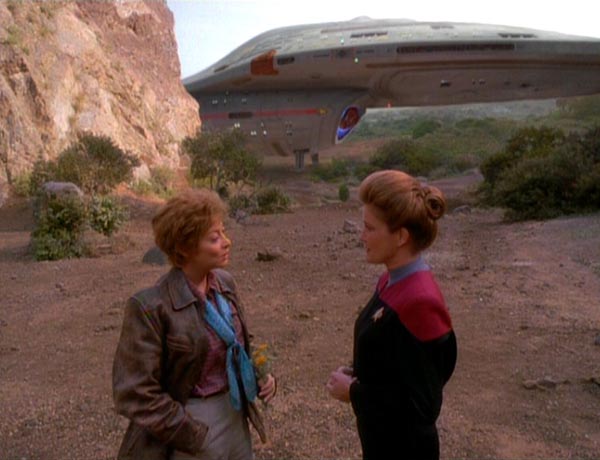
http://images2.wikia.nocookie.net/__cb20070611050452/memoryalpha/en/images/1/18/Earhart_and_Janeway.jpg
Amelia Earthart and Captain Janeway.
Star Trek Voyager - Season Two, Episode One (Season One, Episode Twenty) - The '37s
Written 18/6/13

As we finally end Season One (I've gone and reviewed the other three "hold-back" episodes in production order, so the coming weeks should be comfortably confusing) and begin Season Two, we find an episode with a great sense of majesty to its proceedings and a plot that ultimately asks us to look at Voyager's core dilemma and assess whether it's worth it to try and get home. It also managed several impressibe technical feats that the show had been trying to do since the '60s.
     Voyager finds a 1937 Ford farmtruck floating through space, and follow an AM modulation (which they apparently can't scan for) to a planet, upon which they're forced to land Voyager to reach the surface. Once their, they find eight 1937 natives frozen in suspended animation, one of them being Amelia Earhart, and after some suspicion it is accepts that they and a great deal more people were abducted from Earth in the 1930s. The local human community, raised off of the ancestors of the awakened slaves, has created a civilisation that is almost on part with Federation technology, leading Janeway to suspect that some of the crew will elect to stay behind and make a new life for themselves. When she visits the cargo bay designated for leaving crew, she finds it empty and in her newfound confidence sets off towards home.
     I felt at times like the episode didn't know where it wanted to go. The ideas present were done more for fun than for any serious comment, especially the spectacle of having Amelia Earhart, a female icon in aviation, talking to the similarly iconic Janeway (in terms of representation of women in Star Trek, being the first female "protagonist" Captain.) There managed to be something both especially comedic and momentous about it, especially in the first half where the episodes bounces around humour based on the crew's lack of knowledge of the 20th Century (sometimes in way that put the characters down a bit, like when B'elanna fails to recognise manure, even with a tricorder.)
http://images2.wikia.nocookie.net/__cb20060825032857/memoryalpha/en/images/8/81/Ford_truck_the_37s.jpg
I was going to make a driving pun, but I don't know any.
     The episode's shift in the last act to considering whether or not people would want to stay on Voyager when the civilisation (hidden, but oft refered to) on the planet was so fruitful was good and bad in a number of ways. For the bad, it served only to once again assert the status quo, leaving a full crew complement and getting rid of our guest stars, which I feel is another stifling of the show's creativity. For the good, the scene where Janeway and Chakotay realise that no-one wants to leave them is incredibly heartwarming and emphasises the sorta familial spirit that Voyager has as a show.
     The '37s was an episode out to impress, be that by managing to convincingly show the landing of a starship on a planet's surface or by giving a comic explanation in-universe to the disappearance of Amelia Earheart. It was very muddled, not knowing where it was really going, but its final destination was somewhere that felt very right for both the episode and the series as a whole. Whether you think of The '37s as a finale to the first season or as a premiere to the second, it's an affirmation that despite its issues this show still has some get-up-and-go, and it's more than willing to use it.

Thanks.

NEXT WEEK: The Kazon appear yet again, as Chakotay is forced to convince a kid not to kill him Initiations. 


Wednesday, 25 December 2013

Review: Doctor Who 7.α: The Time of The Doctor

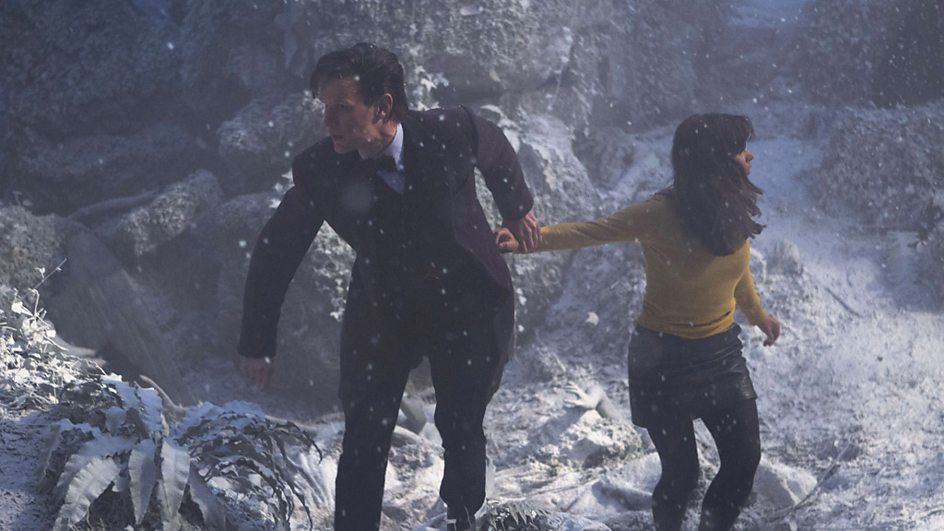
http://ichef.bbci.co.uk/images/ic/944x531_b/p01nbgg0.jpg
The Doctor and Clara's relationship is as stiff as ever.
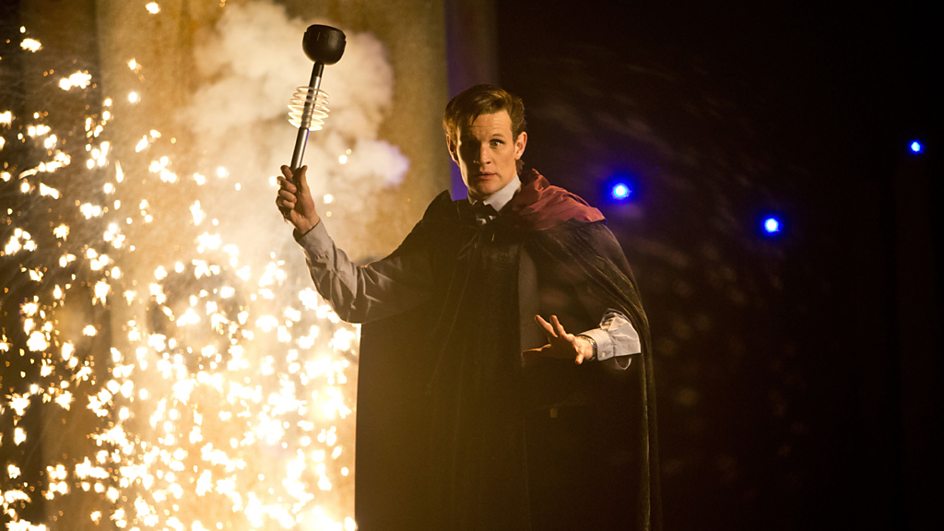
Finally, Season 33 comes to an end. It's only been two years or so, you know. And with it, ends the tenure of Matt Smith's Eleventh Doctor, an incarnation whose initial good beginnings were later soured by a devilish inconsistency and a nasty streak in which he happily committed genocide, rewrote time to fit his own needs and committed so many unreprimanded cases of sexual assault that I'm surprised there have been no angry letters on Points of View. I've really reached the point with Doctor Who where I can't be bothered to use objective analysis, and even if I was going to I'd still be using this article to point out how much crap Moffat just served us instead of actual Doctor Who. So, with our bellies full of Christmas cheer and seasonal indigestion, we'll get started. I'll also be doing a drinking game of sorts for all of the standard features of each Moffat episode - see if you can join in. (I don't drink, so luckily I won't get liver poisoning.
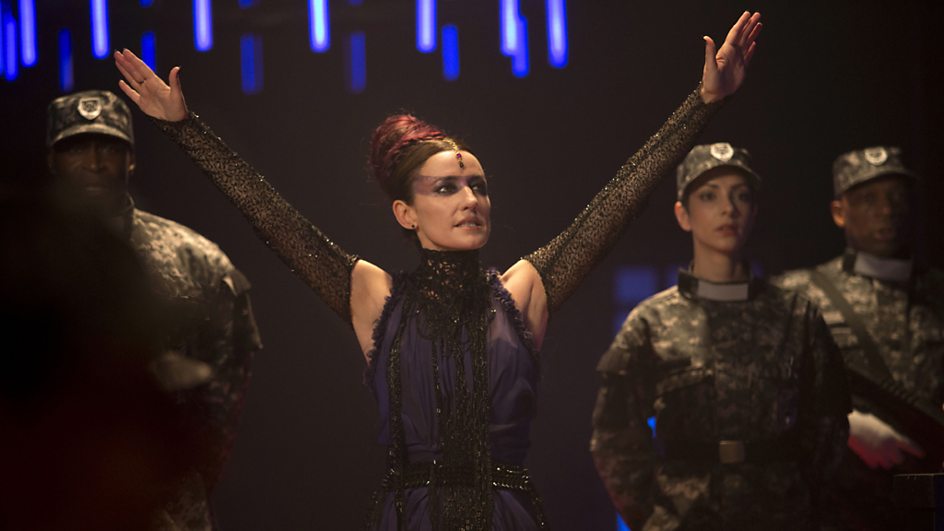
     There's a planet surrounded by a force field, set up by the Space Pope, who is of course a feisty, flirty woman who has the hots for The Doctor. (Drink.) Clara asks The Doctor for help with a mundane family task, upon which The Doctor turns up naked for some reason and smacks Clara on the arse without her consent (Drink.), leading to him taking her along to the planet to find out what's below the forcefield that's powerful enough to lead all of the Doctor's enemies to assemble above it. (Drink.) It turns out to be Trenzalore (Drink.) where a time-space crack (Drink.) containing retcon Time-Lords (Drink.) can only be released if The Doctor speaks his real name. (Down the bottle.) He then spends 300 years or more defending a town called Christmas from repeated invasions from all of his worst enemies, and it turns out that the Silence were working for The Pope but the nasty ones from before were part of a stupid sect and in the end the Pope and The Silence really want to stop the Universe from going kablammy and eventually, after lots and lots of confusing nonsense (Drink, if you're still capable.) The Doctor uses magic energy from the Time Lords to bypass his regeneration limit and become Peter Capaldi.
http://ichef.bbci.co.uk/images/ic/944x531_b/p01mzszq.jpg
Matt's final hour is as ridiculous as his first.
     I'll get my social justice stuff out of the way here, so that those who wish to cover their eyes can just skip to the next paragraph. Where to begin with this, eh? Well, The Doctor makes a joke about OCD, which is a real condition and not something people say to be trendy (or at least shouldn't be saying to be trendy, because it doesn't mean what they probably think it means.) Then we have at least three cases of clear sexual assault (an arse-smack, a naked rub-down and a forced kiss), all of which go without reprimand. And then there's our characterisations. Not a single Person of Colour or member of the GSRM community in sight, as per the standard, and our two main female characters are either robbed of agency or hyperfetishised. Or both, on one occasion. Let's not get started on every single distasterous scene with Tasha Lem the Space Pope, let's focus more on Clara Oswald. Because character development is apparently too good for Moffat to deliver, she spends the vast majority of the episode lacking any agency, thrown about time when necessary for Moffat to time-skip in that non-adorable way he does in lieu of showing actual characterisation. And, when she does get to do something, it's using her girlish charm to convince The Time Lords (you remember, the ones that want to destroy the Universe) to give The Doctor a new regeneration cycle because, and I shit you not, because they love him.
     The Time Lords switching from obstructive beaurocrats/genocial maniacs into hidden, unseen carebear gods is one of many, many plotholes brought up by this episode. There are far too many to mention here, especially as this episode seems to be a reactionary piecemeal of explanations for all of the various Moffat plots which he forgot to finish because hey bowties are cool, let's go demean yet another demographic. One of the biggest ones is the whole paradox thing that Moffat has created over this past season, and intentionally or not he's written a massive great paradox which makes his entire era totally moot. He has, in effect, retconned his own retcons - both of them. The Doctor doesn't die at Trenzalore, so the Tardis is never at Trenzalore to be his grave. Clara never jumps into the past, The Doctor never meets Clara in the first place, Clara isn't at Trenzalore to help him and thus The Doctor dies. And then doesn't. And then does. It's an eternal paradox, and quite a twisty-turny one.
http://ichef.bbci.co.uk/images/ic/944x531_b/p01mzt3p.jpg
Space Pope Tasha Lem allows closure for that Silence crap.
     The Time of The Doctor is the end of a trilogy of stories, each more outlandish and more nonsensical than the last. It's arguably been something of a magnificently tragic fall - not for The Doctor, who's been a complete arse for the past three years or so, but for any tolerance I had for Moffat's scruples. If he can't try, why must I? While I enjoyed The Time of The Doctor as an exercise in sheer madness, it's reached the point where as long as this guy is in charge of the show, I'll never be able to really invest in anything that's going on. Moffat's Who is one of no consequences, a complex sci-fi show written with paper-thin, offensive characterisations and a continuity more lax than that of the most terrible sitcoms (including Moffat's.)

Thanks. Merry Christmas.