Thursday, 19 September 2013

Review: Voyager 1.4: Time and Again

http://images.wikia.com/memoryalpha/en/images/0/01/Janeway_Time_and_Again.jpg
Janeway makes her timeline, and this episode,
vanish from the timeline.
Star Trek Voyager - Season One, Episode Four - Time and Again
Written 21/5/13

Time Travel and Voyager are like two childhood friends who bring out the worst in each other whenever they decide to meet up, getting drunk and stealing shopping trolleys only to dump them in a canal where small aquatic creatures use them for sustenance. This first Time Travel episode comes oddly close to the premiere, but shows in all its glory just how silly Voyager Time Travel can get. It's also our first look (post-premiere) of a standard Voyager alien civilisation, where the fashion still for some reason mimics that of 1990s America.
     The ship is hit by a shockwave, tracked back to a now-desolate Class-M planet. Upon investigation, they discover that the planet's civilisation used a dangerous energy source (going for a Nuclear Energy parallel here, I see) that eventually led to a planet-wide explosion. Due to some technobabble, the explosion's aftereffects have opened time pockets, through which Janeway and Paris accidentally stumble. While the crew try to open a pocket up to retrieve them, using Kes' magic psychic powers to trace their movements, Janeway and Paris attempt to stop the explosion in the past. They realise that Voyager's attempts to save them end up causing the explosion, so Janeway strands herself in the past and the timeline is erased, leading to Voyager passing the M-Class planet without incident.
     This episode sees the first reference to one of Voyager's favourite calling cards, the Prime Directive. Back in The Next Generation, the Prime Directive was a rule that forbade advanced species in Starfleet from interfering with pre-Warp civilisations, preventing them from creating very one-sided power dynamics. Here it's used when Janeway and Paris are stuck on the planet and cannot explain who they are for fear of breaking the Directive. Later in the series it would be used so often for so many varying purposes that it becomes a little hard to keep track.
https://blogger.googleusercontent.com/img/b/R29vZ2xl/AVvXsEjf-h0ropFoc3ty_jDv2INnZAXkILIAJUkwrFjOYWCX5fI227BD16JH0kGJsLbExCkHsUj-xsVMAt5m_md0TsgCTVAvVUokk5yw4_8qlaVykiODAJ-GwHb9PNqiM-LCQOIScoC47YLD7OQ/s1600/11-3-09voytimeandagain.jpg
Janeway and Paris, in their Rocket Lolly costumes.
     I found the episode's broken time-loop a little frustrating. Reset button plots (hey, another Voyager favourite) are always going to be slightly distressing because there's very little that can be brought forward from it. Their experiences on the planet have provided absolutely zero development for any of our characters, and effectively we might as well forget this episode ever existed. Which, with its bland attempts to create a Nuclear Energy parable, it is frighteningly easy to do.
     So far, it's a little difficult to see how Voyager got me into Star Trek at all. I started on the last season, which is a big habit of mine with lots of US shows, but I must say that when the syndicated episodes came round to the first season I was more than a little disappointed. However, for all of its weirdness, next week delivers us an episode with a bit more substance to it. I think that says all I need to say about Time and Again's ultimate mediocrity.

Thanks.

NEXT WEEK: Holographic lungs! Neelix gets hurt, painfully! Aliens who steal your face in a very literal sense! It's the Phage!

Wednesday, 18 September 2013

Review: Lost 1.12: Whatever The Case May Be

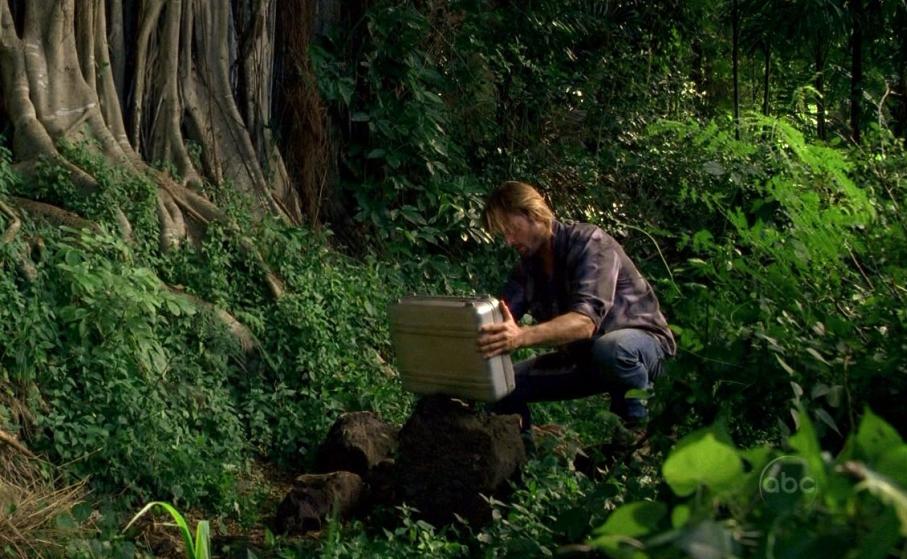
http://images1.wikia.nocookie.net/__cb20061107133013/lostpedia/images/1/18/Sawyer_the_case.JPG
Sawyer tries (in vain) to open the Haliburton Case.
Lost - Season One, Episode Twelve - Whatever The Case May Be
Written 20/5/13

After the last three weeks of heavy developments, Lost returns to a slower but still acceptable pace this week, as three separate subplots work the characterisations - two in interesting directions, the remainder relying on some rather outdated character archetypes. The result was an enjoyable episode that had this strange sense of warm charm to proceedings - especially in the burgeoning relationship between Sayid and Shannon, which despite my poo-pooing of which in The End review is quite fun.
     While out having a cheeky swim together, Sawyer and Kate discover a set of seats from the plane in a waterfall pool, with people still strapped to them. They retrieve a Haliburton Case from the seats - it belonged to the Marshall, and contained guns and Kate's personal effects - a toy plane belonging to her childhood sweetheart. Kate convinces Jack to exhume the Marshall in order to get the key, and on opening it he discovers Kate's secret. Sayid asks french-reading Shannon for help in translating Rousseau's cyphers and maps. Shannon gets frustrated when the translations come out as gibberish, but she and Sayid bond when she remembers that the cypher contains the lyrics to La Mer. Rose acts all spiritual and wise to help Charlie recover from his near-death last week. Kate's flashbacks take her to a bank heist where she played the victim, although she in turn stitched up her fellow conspirators in order to retrieve the toy plane from the dead lover's safety deposit box.
     My favourite part of the episode was the Sayid/Shannon subplot, with Sayid seeking redemption in Shannon's relative innocence and Shannon finally finding someone who appreciates her as something more than a pretty face. It felt very much like a redemption for the character after 11 or so weeks of her being defined by ridiculously extreme vapidity (Sunbathing the day after the crash) and her incessant arguing with Boone (with whom she has incestuous undertones, as is covered in next week's episode.) Shannon actually felt like a useful presence instead of joining her brother as the show's loads.
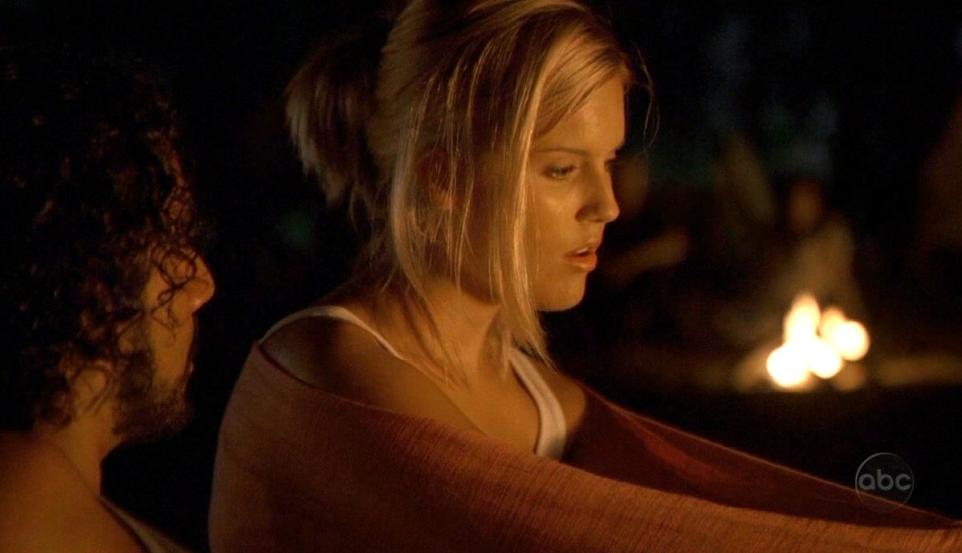
http://images2.wikia.nocookie.net/__cb20061107135124/lostpedia/images/6/6b/Shannon_singing.JPG
Shannon and Sayid bond over "La Mer".
     Rose Nadler gets a bit of character development in the next few seasons to distinguish her amongst the cast, but here the Lost writers fall into the very unfortunate Magical Negro stereotype, in which a PoC character seems to exist solely to dispense spiritual wisdom to the unfortunate white protagonist figure. It's probably wrong of me, but I really didn't care about Charlie's storyline, and as much as I appreciated that his near-death experience didn't leave him fine and dandy, it was a tiddle bit dull for my tastes.
     And it's beginning to become such that the main Jack and Kate storylines, while still entertaining, aren't the most interesting part of the episodes. I call it over-exposure, really. 14 main characters and 12 episodes in, Jack and Kate have had three centric episodes each (if you include the Pilots). Whatever the Case May Be was a nice breather episode that nonetheless kept up some nice character work, but I question why this couldn't have been a Shannon-centric episode, especially seeing as Kate's only flashback development was a goddamn hint towards her fourth centric episode much later in the season.

Thanks.

NEXT WEEK: Boone and Shannon aren't blood siblings, it turns out. Thankfully. It's Heart and Minds.
P.S. This is my 750th Post!

Monday, 16 September 2013

Review: Doctor Who Classic: Genesis of the Daleks (Revisited)

See here for my previous look at this story.

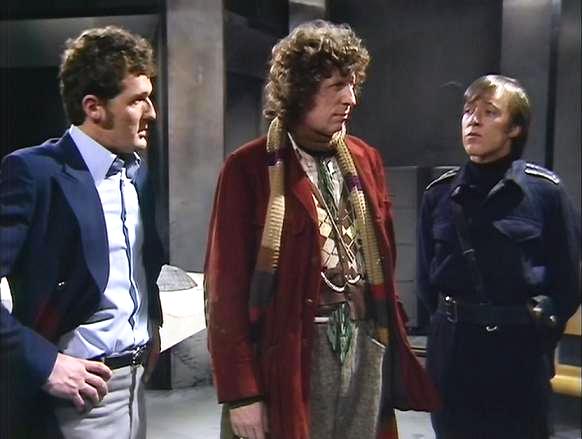
http://images1.wikia.nocookie.net/__cb20100918143860/headhuntersholosuite/images/6/66/Doctor_Who_-_Genesis_of_the_Daleks_(Part_3)_003.jpg
On the plus side, Harry stops being a twit this week.
Doctor Who - Season 12, Story Four - Genesis of the Daleks
Written 17/5/13

It's odd that so many of the stories so often declared the best of all time are often quite bleak in nature. Androzani is blatantly depressing, the Talons of Weing-Chang harks back to a time of institutionalised racism, and Genesis of the Daleks features World War Two parallels that often fall a little close to home. And it's not exactly as if Doctor Who has ever really followed the Angst is Art ideals that the rest of Television seems to - it's a family show, one that can convey adult topics and themes to kids without feeling preachy. However you look at it though, Genesis does have that Classic sheen to it from the moment it begins.
     The story's main thematic elements rely heavily on the state of 20th Century warfare, using the "technological attrition" aspect of the plot to mix things up a little. On one hand we have the Cold War parallels, with two opposing sides locked in nuclear war, both in a constant sense of tension with the other. The superior themes are from Terry Nation's own childhood, and his original thoughts when created the Daleks in the 60's, showcasing the appearance and plot of a 1940s War Drama. The Nazi-based inspiration for the Kaleds, what with their genocidal racism and camp little salutes, is particularly blatant and yet that doesn't rob it of any of its power.
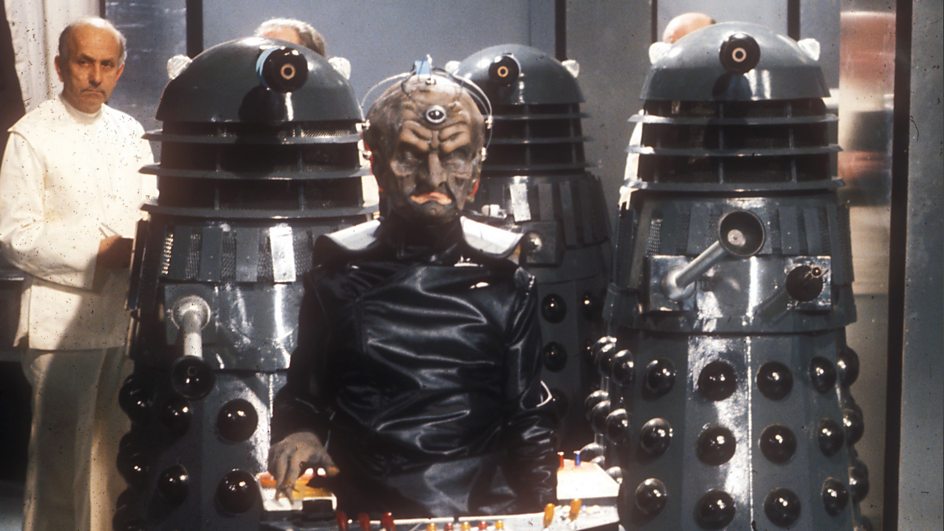
     Michael Wisher's Davros has the potential, as his later appearances would show, of becoming something of a one-note villain. Perhaps Genesis' greatest triumph is the way in which it avoids this, making use of the admittedly padded six-episode format in order to explore every facet of Davros' character, from his megalomaniacal admission of his desire to destroy every non-Kaled life form in the Universe to his sly manipulation of the Thals in order to wipe out both them and his own people in favour of freeing the world for the Daleks.
     If the story does have some downsides, it is probably in the many padding subplots that, despite being integral in developing the world to such a fabulous extent, often feel like too much a wayside from the main action. The banding about in the Thal Dome reveals some of the less amicable qualities in the other side of the war, but is often a tad boring, and leads to a series of cliffhangers that don't really go anywhere. There's also some fumbling about near the end where The Doctor for some reason manages to drop the Time-Ring and they have to go and get it back again. Silly.
http://ichef.bbci.co.uk/images/ic/944x531_b/p00y1c4w.jpg
Davros in his best, original incarnation.
     Ultimately Genesis stands out due to its incredibly detailed and comprehensive worldbuilding, the tremendous writing and acting from its main villains and its insight into the origin of the Daleks (at least in the new continuity that it creates.) Its bleak and depressing demeanour robs it of that enjoyment factor that would usually make a good Who story so rewatchable, but that doesn't stop it from being a Classically good story. Just not a personal favourite in the grand scheme of things.

Thanks.

NEXT WEEK: The Cybermen return after six years away only to stay gone afterwards for another six... it's Revenge of the Cybermen.

Thursday, 12 September 2013

Review: Voyager 1.3: Parallax

http://images1.wikia.nocookie.net/__cb20050809035737/memoryalpha/en/images/d/de/Voyager_at_event_horizon.jpg
The other ship was us all along! "surprised face"
Star Trek Voyager - Season One, Episode Three - Parallax
Written 19/5/13

It's interesting how Voyager's first normal-length episode features a whopping great scientific blunder the size of Little Whinging - not exactly the best message to send out, is it? Despite the fact that the episode spends the majority of its time using recognisable technobabble that makes no real sense, it did throw in a few ounces of character development for what may amount to the episode's centric character, B'elanna.
     B'elanna gets angry and breaks the nose of Federation equivalent Carey, leading to an argument between Janeway and Chakotay when the latter is insistent upon her becoming the new chief engineer. The ship sees a ship trapped in the event horizon of a black hole, and is unable to tractor them out. Attempting to leave the area, they find themselves pulled in, and a message they sent earlier reveals that they were seeing an image of themselves in the future. Using B'elanna's knowledge, she and Janeway "cut" their way out of the event horizon, and the half-Klingon is given the position of Chief Engineer. In a sub-plot, the quantum singularity affects The Doctor's emitters and makes him get shorter and shorter.
     The episode treats an Event Horizon as a pocket of energy that's a bit tricky to get past. In actual fact, the Event Horizon of a singularity is not a tangible thing that can be broken or moved through. I'll try to explain... All objects have an escape velocity, the speed required to bypass that object's gravity and escape from the major effects of its gravitational field. The stronger the gravity, the greater the escape velocity. The Event Horizon is the point at which the escape velocity exceeds the maximum speed of the vessel (In our Universe we say that it's the point where the e.v. is greater than the speed of light, which is our speed limit. Obviously that's gonna be bigger in Star Trek.) So it's impossible to escape from not because it's an energy field, but because it's physically impossible to get out.
http://images3.wikia.nocookie.net/__cb20100119192938/memoryalpha/en/images/9/92/Janeway_and_Chakotay,_Parallax.jpg
Janeway is staring at his nose for some reason. I don't get it.
     Luckily, despite the fact that the entire episode's pot was based on that silliness, the character developments were well balanced with them. There were a few decent arguments between Chakotay and Janeway, which are always nice to see, but I didn't like the way that after being cautious over whether B'elanna was suitable to even be part of Starfleet any more, her proficiency in a single crisis was enough to make Janeway think, "Sure, she punches people who disagree with her, but she's pretty cool." It felt forced, is what I'm saying. They went from cautious apathy to being bosom buddies in the space of a few scenes.
     And so Voyager is off to a spectacularly crappy start. Parallax is as lacklustre as we can come to expect from Voyager's first couple of seasons, combining a mix of glaringly inaccurate real-world technobabble and somewhat patronisingly simplified character dynamics. Voyager could be a series with some real teeth, but apparently their idea of showing the animosity between Maquis and Starfleet is to have off-screen fights, behind-the-scenes gossipping and extended discussions of "Maquis principles" that don't actually say anything about them.

Thanks.

NEXT WEEK: Voyager sacrifices its first episode to the Goddess of Shitty Time Travel in Time and Again.

Wednesday, 11 September 2013

Review: Lost 1.11: All The Best Cowboys Have Daddy Issues

Charlie hangs out.
Lost - Season One, Episode Eleven - All The Best Cowboys Have Daddy Issues
Written 19/5/13

 
Lost pokes fun of itself this week, title-wise. It is somewhat noticeable that pretty much every character is involved in some sort of parent-child dynamic that's gone awfully wrong somewhere along the line, and Jack is the standard father-son example as he spent his life under the shadow of unsupportive taskmaster Christian. This episode, as well as dealing once again with Jack's drive to be the hero and save the day despite overwhelming odds, gives us some backstory as to why Jack's dad was in the state he was in when he died.
     Hurley finds that Ethan was not on the place, and realising that Claire and Charlie have gone missing, a team go off into the jungle in search comprised of Locke, Kate, Boone and Jack. They follow their trail until it splits in two, where-after Kate reveals her tracking skills and she and Jack split off. The two track him for a day or so until Jack has a confrontation with Ethan, telling them to stop following him or one of them will die. When he wakes up after being knocked out, they find Charlie blindfolded and hanging from a tree. He initially fails to resuscitate but Jack perseveres beyond the point of reason and he recovers. Locke and Boone, following Locke's "sense of something special", find a metal hatch in the jungle.
     Jack's flashbacks take him to the end of his father's career, as he is called in to pull his father from a procedure where his intoxication has led him to sever a patient's artery. The patient dies, and Christian convinces Jack to do his old man a favour and not mention his intoxication, saying that it will end his career if anyone found out. Jack is reluctant but goes along with it, until discovering that the patient was pregnant. He recounts his statement and drops his father in it.
Christian tries to get away with negligence.
     The themes of the two subplots were less linked than I'm used to, with Jack's present struggles being with trying to save everyone when such a thing isn't possible, and his flashbacks being about doing the right thing no matter how much it hurts. Jack feels guilty for snitching on his father and I really don't think he should... on the one hand, his father was being a tit and needed someone to set him straight, as Christian would later admit himself in a later episode's flashback. On the other, this seems like an awfully odd time to be thinking about this issue. Everything meshed with Jack's personality, but it felt like the playlist had skipped a couple of songs. 
     This week's episode felt like a more exciting conclusion to last week, with the main character plays surrounding Jack's in-built hero complex and his antipathy towards his father. I, however, am slightly more interested in that last little plot development. The discovery of the hatch sets us off towards the finale in 14 episodes time with lots of breathing room, and is possibly, for me, the episode's most exciting development. 

Thanks.

NEXT WEEK: An episode about a suitcase. Really. Whatever The Case May Be.

Monday, 9 September 2013

Review: Doctor Who Classic: The Sontaran Experiment

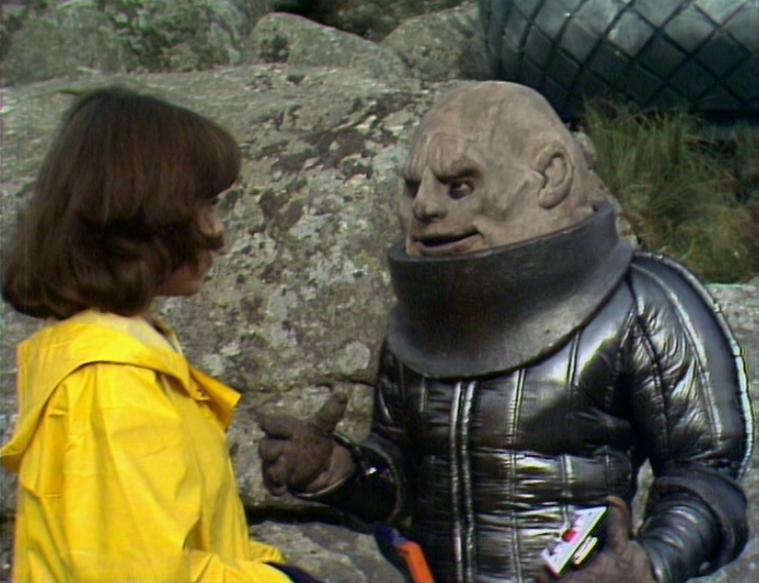
http://images2.wikia.nocookie.net/__cb20110901075459/tardis/images/0/06/Styre_and_Sarah.jpg
"Maybe you've met my cousin, Phil Mitchell?"
Doctor Who - Season 12, Story Three - The Sontaran Experiment
Written 17/5/13

Robert Holmes was one of these smart people who don't like six-parters, and so to round off the previous story he made room for this two-episode affair that carries on the story of The Ark In Space, albeit in a different location and with a much different tone. After their first appearance the year before, the Sontarans return, this time with a more focused insight into their societal structure. While it may only consist of a few silly people running around in the countryside, I do rather enjoy this serial, and it continues a string of great stories in Baker's first season.
     Transmatting down from the Nerva, The Doctor and companions find a London that is much closer to a set of moors, with the only immediately appreciable life being plants. As Sarah and Harry wander around, however, they all discover that there is life on this planet - colonists from a seperate party have been kidnapped and brought back to Earth, where they've been experimented on. While they don't initially believe that the Nerva still exists, they are all forced to pay attention when their kidnapper (and torturerer) shows his face. It is Styre, a Sontaran on Earth in order to test humanity's physical limitations in order to prepare for an invasion. The Doctor tricks Styre, sabotaging his ship to kill him and then bluffing the High Council out of their invasion attempt. That done, they prepare to transmat back up again, and the story continues.
     With the same production unit as Ark, the location and studio filming is split heterolytically between them, meaning the that The Sontaran Experiment takes place entirely on some hills in Dartmoor. The environment does give it a very modern feel, as well as the direction style which is forced to adapt to the terrain. Most of the special effects are okay as well, even if Styre's helper robot does stand out like a sore thumb as an example of 70s kitch.
http://stagevu.com/img/thumbnail/cjjzkkrokrxtbig.jpg
The Doctor tries to fix some transmat pads.
     Styre himself provides an interesting villain, exposing the Sontarans distinct methods even to the point of absurdity. The question must be asked as to why the Sontarans are so invested in examining humans before they invade Earth when the planet is completely uninhabited and the only other humans in the galaxy are either strung out across a weak galactic empire or suffering from one of the largest hangovers you can imagine. Regardless, the way Styre passed off a lot of his natural sadism as "scientific endeavour" was quite fun.
     The danger with two-parters in the Classic Series is that despite the fact that its running time roughly matches a NuWho episode, the style of writing that the old series employed doesn't give it the same sense of hectic pace. Despite that, I'd quite like to see a few NuWho episodes like this - relatively relaxed, capable of carrying a single plot and sticking to its guns throughout. It isn't perfect, I'll give you that, but The Sontaran Experiment is a fun load-off from the two scare-fests that flank it, and that's worth its weight in gold.

Thanks.

NEXT WEEK: Just like The Doctor, we revisit the Genesis of the Daleks.

Friday, 6 September 2013

Overview: Heroes: Volume One - Genesis

Like all Heroes episodes, I'm tempted to begin each of these overviews with a strange and unnecessary voiceover. Like those voiceovers, I may attempt to use grandiose clichés. The rain in Spain falls mainly on the plain. See, I just did one there. You should probably read these in the voice of an Indian guy with a pronounced London accent. Or not, it's up to you. This is the first of five overviews to cover the five Heroes volumes, ensuring I don't have to come up with enough crap to review all of the sparsely written 78 episodes. Written 18/5/13.

http://www.khairul-syahir.com/wp-content/uploads/2007/12/heroes-season-2.jpg
12 main characters is only two fewer than Lost, you know.
Now, contrary to popular belief, Heroes was not a bad show. It was a mixed show, of course, and it certainly had its problems, some of which came from the wounding blow that was the 2008 Writer's Guild of America Strike and some of which came from lazy writing and lazier continuity. But the show as a whole is one I enjoy, not just for the coolness factor that it exudes (although that is the main attraction of the first season) but also because it manages to pump out some decent characterisations.
     The first season and the first volume stick to the series' premise the most snugly - a group of people around the world (read: The United States with two guys from Japan) discover that they have super-powers, all in good time to prevent the destruction of New York via a super-induced nuclear reaction. Along the way they run into the secretive Company that tracks and catalogues Specials, and try to foil the schemes of supervillain/serial killer Sylar. By far the longest of the five volumes, Genesis takes its sweet time to get going, being rewarded with a richer and deeper atmosphere than any of the others.
     The very early episodes often suffer from a How Do I Shot Web factor as our heroes discover their abilities for the first time, and the series tries to work out the kinks in its designs and idiosyncrasies. Geneticist Mohinder Suresh's accent changes wildly, the invulnerable Clare Bennet becomes a great deal less whiny and the Man In Horn Rimmed Glasses (heron in HRG, even when his real name is revealed) shows his more badass side. The triumph of the early season, though, is the slow introduction to series villain Sylar, first from the grisly scenes he leaves behind and culminating in the first character cross-over as power-sponge Peter Petrelli saves Claire from Sylar's attacks at Homecoming. The season's middle section features some fun developments, including a guest performance from Christopher Eccleston (the year after Doctor Who, no less) and reveals about Claire's parentage that err on the soapy side but work well in the long run. It culminates with what is my favourite episode of the season, "Company Man", which has a Lost-style focus on HRG, his adoption of Claire and his flashbacks to the painful decisions he made in the past. It's probably not a positive sign that my two favourite Heroes episodes are the ones formatted like episodes of Lost, but ho hum. The drive towards the finale is done exceedingly well, with confrontations abound until the final magnificent showdown which, despite not being as sheerly awesome as it could have been still left the series with a triumphant moment of glory.
http://yattaaaaa.com/hironakamura.jpg
YATTAAA!
     A lot of the plot in the earlier volumes is driven by precognition, which makes some funky problems regarding timelines. Sometimes the visions of the bad future are painted and are subject to metaphor, but often time-travelling characters like Hiro Nakamura (and eventually Peter) visit or are visited by people from the future. The first volume's bad future is one in which Peter exploded and wiped New York off the map, which of course means that he spends most of the season angsty about not wanting to blow up.
     I haven't spoken much about Matt Parkmen or Niki Sanders, and that's probably to do with the fact that for the majority of the season they have their own shit going on. Niki is a super-strong stripper with multiple personality disorder trying to fight her alter ego Jessica in order to keep her technopath son Micah and phasing criminal husband D.L. safe from the machinations of arch-villain Linderman (Malcolm McDowell, everybody!). Her storyline oft becomes frustrating; watching someone argue with themselves only has novelty for a while. Matt Parkman is a telepath who despite become a much larger key player later on spends the first volume as an ineffectual jerkass whose abilities lose him his job, his wife and his unborn child. Instead he takes on and adopts Molly, a girl he found hiding under the stairs in the house where her parents were killed by Sylar.
      The season's final grand conspiracy involving Linderman, Peter's flying politician brother Nathan and their mother Angela (my favourite character, but not quite yet) underlines a great number of the series' themes. Whereas the series' focus quite often talks about ordinary people doing extraordinary things, the opposite comes with elite groups trying to kill millions to make humanity as a whole better. It is a cry for personal freedom and responsibility over the "Greater good" peddled by literally all of the show's main villains.
     As I said before, my favourite episode of the volume (this will be a regular thing, you understand,) was Chapter 17, Company Man. Focusing entirely upon Claire, HRG and an invasion of her house by two specials wanting answers for HRG's activities with the Company, the episode examines in depths of depths of his moral ambiguity and the lengths he's gone to in order to protect his family despite his loyalty to the company that forced him into adopting her. If I had to pick a least favourite, it would probably have to be Genesis, the pilot episode, which is shoddy in the extreme and has several differences to the norm whose remedying is never incorporated into the plot.
http://www.tvbabble.com/userimages/user2448_1178843499.jpg
Sylar, in all of his glorious undiluted evil.
     Volume One, despite probably being the most entertaining of the five, does often sacrifice character coherency in favour of spectacle and comic-book style allusions. Just because it has the most natural progression from origin towards the heroes' first triumph doesn't mean that the journey is a smooth one, and it hits many bumps along the way. Luckily though, the first volume is the one I don't really need to justify my love for - it's liked everywhere you go, and is accepted by the world's "official opinion" as the show's single decent season. Seeing as it isn't my favourite, I think we're in for some funtimes...

Thanks.

NEXT TIME Join me in eight weeks time (I know, I know) for the rather short Volume Two - Generations.

Thursday, 5 September 2013

Review: Voyager 1.1-2: Caretaker

http://images1.wikia.nocookie.net/__cb20080813114356/memoryalpha/en/images/1/18/Caretakers_array.jpg
The Caretaker's Array
Star Trek Voyager - Season One, Episodes One and Two - Caretaker
Written 18/5/13

Voyager's feature-length premiere is almost perfectly representative of its future course. The show begins with an injection of pure promise, setting up the series' premise in the lacklustre way that the show does best. In the first story alone we find plot threads left hanging, actions from Janeway that make me baffled and several other delicious goodies. To be fair, Caretaker uses its feature-length to great use, and the story is decent enough to get the show off to a memorable start.
     A group of Maquis freedom fighters led by Native-American Chakotay, half-Klingon B'élanna and Vulcan Tuvok disappear in a region of space called The Badlands. Sent to search for them is the Federation USS Voyager on its maiden journey, headed up by Captain Kathryn Janeway. Also along for the ride are new ensign Harry Kim and streetwise disgraced ensign Tom Paris. They enter the Badlands and are pulled by an array over 70,000 light years from their home, to the other side of the Galaxy. They discover, after picking up the annoying Neelix and helping to rescue his Ocampa girlfriend Kes from the Kazon, that the Array is run by a powerful alien Caretaker who was pulling ships in to look for his mate. After rescuing B'elanna and Harry from Ocampa, where they had been sent by the Caretaker, Kazon attack ships prevent Janeway from using the Array to get home. Janeway chooses the blow up the Array and strand Voyager in the Delta Quadrant rather than let the Kazon get their hands on it. The two crews join up and head off on their way home.
     Our first impressions of the Delta Quadrant are less than impressive. It's understandable for the writers to want to use the other side of the galaxy as a good excuse for making first contact with all these different species, as they did with the Gamma Quadrant wormhole in DS9, but they could have perhaps chosen some better ones to start off with. Neelix is irritating from the off (although not as much as he would steadily but surely become), and the villains of the first two seasons, the Kazon, are somewhat ridiculous in the way their design and attitude mimics Klingons except without any of the general competence.
https://blogger.googleusercontent.com/img/b/R29vZ2xl/AVvXsEgGHD4AbUBsH_RYSTtxnmuFeXrsRF-5A27G4mMqpABGw4ZkPQQC8ol__Gkj68QqLT9i6jU-81R1gTfPZeS2xX6XhQ5XPeJ9IVxQsENGeiYy59p9W4sSXi_EIMbiUh3SqUjrQj0HiWULF8cI/s1600/caretaker_0897.jpg
Neelix's first act is to con Voyager, by the way. Just to make
him more endearing. Han Solo you ain't, brotha.
     After what feels like a pacey start as Voyager chases the Maquis ship's trail and then has to undergo the trauma of being pulled at trans-warp speeds across the Galaxy, the episode comes to a halt when the crews of both ships are kidnapped and placed inside a hologramatic scenario designed to mimic a Southern farm. One moment we're in sci-fi space funtimes, the next we're in Little House On The Prairie, with sinister old women offering holographic cookies. Then there's the whole B'elanna and Harry subplot, where they find themselves with strange growths on Ocampa. Their condition is never explained, and once they're rescued they live happily ever after for the next seven seasons, so I really don't know what that was about.
     As the journey home begins, the overwhelming message that spins off of Caretaker is of the strange and the unknown. The first episode has a great many pacing issues, and the core concepts the set the ship off on its voyage are a teensy bit pathetic.Despite that, though, there is the inkling here and there that if the show can carry out its premise in a semi-competent fashion and eventually develop beyond it, then it could have some real hope for the future. (Hint: This doesn't turn out well for anyone.)

Thanks.

NEXT WEEK: Bad Science galore as Voyager gets trapped in and then escapes from the Event Horizon of a Black Hole, in Parallax.

Wednesday, 4 September 2013

Review: Lost 1.10: Raised By Another

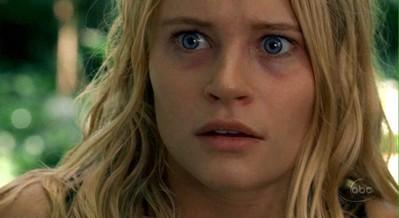
http://images3.wikia.nocookie.net/__cb20100523022626/lostpedia/images/c/ca/1x10_claire_4.JPG
Claire, about to be kidnapped.
Lost - Season One, Episode Ten - Raised By Another
Written 17/5/13

Either due to the fact that after her pregnancy she has very little to do or because of how she was treated in the second half of the show, I can safely say that to me, Claire Littleton is not the most interesting character in the world. Nothing against Emilie de Ravin and her great performance, but the character's main beef - wanting to be known as something other than "the pregnant girl" - isn't supported by her development. Her pregnancy, the way characters react to it and looking after the baby once it's born are all that seem to define her. That, and a psychotically ardent belief in horoscopes and psychics. Which is wonderful.
     Claire has what appears to be repeating nightmares of her being attacked in the night, leading her to wake up screaming, her hands covered in blood from where she has dug her own fingernails into her flesh. She believes that the attacks are real, but Jack and co. can't find anything wrong with her or any evidence of an attack. Hurley, worried about attacks in general, take a census of people - including Ethan Rom, a guy who randomly appeared last week. Claire moves away from the Caves when Jack doesn't believe her. Hurley buys the Flight Manifesto off of Sawyer and discovers that someone wasn't on the plane - Ethan, who kidnaps Claire and Charlie.
     In her flashbacks, we see the progress of Claire's pregnancy. Hipster artist boyfriend Thomas is initially happy to be raising the baby with her, but leaves when the pressure gets too much. She visits a psychic who tells her that she must raise the child, even though she intends to adopt. When she tries to sign the adoption papers, her pen doesn't work, and she takes this as a sign that the psychic was right. When she goes to acknowledge this, he changes his mind and tells her that she has to give the baby to a family in Los Angeles. Yes folks, that's why Claire was on the plane in the first place - because despite being in her third trimester, she just had to follow some random guy's instructions.
http://images1.wikia.nocookie.net/__cb20061123233807/lostpedia/images/6/6f/1x10_malkin.JPG
I got on a trans-Pacific flight while six-months pregnant
because a psychic told me to.
     Claire's kidnapping is one of the first major cast changes - she disappears here and doesn't return again for another five weeks, and lots of fun stuff happens in the meantime. I know I'm erring on the side of danger when I say this, but her willingness to believe utter claptrap is what leads to everything that has ever gone wrong for her on the show. She believes psychic Richard Malkin's predictions despite a later episode showing that he's a con-artist; she later believes that the Man In Black is her dad. Her gullibility is outstanding, and that's not a very captivating character trait to have on a show with this many wonderfully conflicting personalities.
      So yeah, that was an article of me ranting about Claire. This is the fourth article I've written today, so please forgive me if I'm a little single-minded. Raised By Another has potential in its endgame to start the gears rolling in the mystery of The Others and the show's main themes, but it spends most of its time forcing us to watch psychics peddling bullshit and Emilie de Ravin screaming incessantly. I wanted to like her character, but she's just really not for me, and her absence from the series isn't really that much of a burden.

Thanks.

NEXT WEEK: We find out about Christian Shephard's crimes in All The Best Cowboys Have Daddy Issues.

Monday, 2 September 2013

Review: Doctor Who Classic: The Ark In Space

http://upload.wikimedia.org/wikipedia/en/thumb/f/f4/Ark_in_Space.jpg/250px-Ark_in_Space.jpg
Enjoy Bubble-Wrap Responsibly!
Doctor Who - Season 12, Story Two - The Ark In Space
Written 16/5/13

It's not just the later seasons that have some continuity, you know. As we begin, finally, the reign of Phillip Hinchcliffe as Producer and the great Robert Holmes as Script Editor, Holmesy brings us the first in a series of four interlinking serials. With the TARDIS interior set still not up and running, Season 12 doesn't see use of it, and so our characters spend the next four serials attempting to return to the location of this story, the space station Nerva. As is standard for a Holmes undertaking, Ark is a great mix of well-written concept work with a captivating plot to go with it, and while not being the most absurdly fun story in the world, it's certainly memorable.
     In Harry Sullivan's first trip aboard the TARDIS, it lands on the Nerva, a space station in the far future containing cryogenically frozen humans, chosen to repopulate the Earth thousands of years after the surface was made hostile by solar flares. Leader Noah and Med-Tech Vara are disturbed to discover upon their awakening that the station has been infiltrated by a Wirrn Queen, the progenitor of a race of parasitic anthropomorphic insects who eat their hosts alive from the inside and feed off of their tissues and their knowledge. Based on something that happened while humanity was asleep, the Wirrn plan to consume the remaining humans and return to Earth as a technologically advanced species, but this is foiled when a converted Noah tricks them into packing onto a doomed shuttlecraft. The Doctor and co. take a transmat to the Earth's surface, and we wait until next week.
     Great focus is made upon the vision for the future of humanity, be it in a positive way (the Doctor's early monologue where he praises the indomitable nature of the human species) or a negative one (the slightly eugenic-esque nature of the Ark's selection process). The Wirrn aspire to eat us and to be like us. There's also some nice dark humour made from the premise, especially with Holmes' standard comic character and his cries of, "I should have stayed on Earth, I like it hot!". It doesn't seem to judge humanity as anything other than the survivors, not making a comment on our interspecies morality but rather admiring our perseverance. Its dedication to these ideas bypasses the unfortunate limitations of its special effects, which seem to consist of plastic insect heads and green-painted bubble-wrap.
http://1.bp.blogspot.com/-Z5TYJQ0F430/UVG4yD1Gf3I/AAAAAAAAKDY/uX1Eo_hoaWI/s1600/doctor-who-the-ark-in-space-ark.jpg
Humanity's future sees us frozen to escape the sun's flares.
     Harry Sullivan's characterisation bothers me, if only because I'm not sure whether the sexism inherent in a lot of the things that he does is intentional or otherwise. The show during Sarah Jane's era made a lot of efforts to push forward the Second Wave Feminist ideals that were propagating in Britain at the time, and when he isn't doing something productive, Harry is awfully likely to come out with something akin to the stereotypical 70s chauvinist "comedians". I know he'll probably improve, but I'm not inclined to like a man who calls a female leader, "a member of the fair sex being top of the totem pole."
     The Ark In Space may not be a visual delight, but thanks to Robert Holmes the ideas are developed to a fantastic degree. Bubble-wrap or no, the script takes the issues surrounding Humanity and its will for survival - and its desire for freedom - as seriously as it can. The Wirrn are a classic bug-eyed (and bug-bodied) monster whose methods are instantly memorable, and it all comes together to produce something that, while maybe not your go-to story for a pick-me-up, is certainly a fine example of the genre.

Thanks.

NEXT WEEK: Those pesky potatoes are back... it's The Sontaran Experiment.