Showing posts with label DW12. Show all posts

Friday, 27 September 2013

Overview: Doctor Who Classic: Season 12

http://www.doctorwhoreviews.co.uk/4A_files/Robot%206.jpg
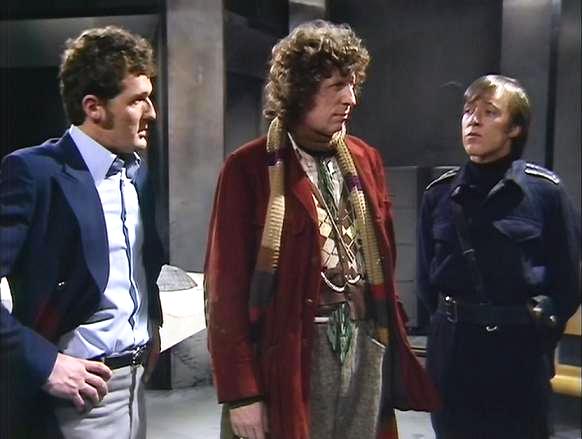
I like to think that Harry was a little piece of UNIT
that The Doctor could carry around with him.
Doctor Who - Season 12
Written 21/5/13

Returning to Classic Who has been exceedingly enjoyable. That was helped, by no end, by the fact that Season 12 is just so marvellous. Tom Baker's Doctor, even from his first few appearances, exudes a constant fun demeanour that finds ways to transform average scripts into instant Classics. The Holmes and Hinchcliffe era is oft considered a Golden Era for Doctor Who, and for very good reason.
     One of the best things about Season 12 is probably the attempt to rekindle the continuity that existed between episodes in the early Hartnell Era, where serials didn't really exist and the show was managed on an episode-to-episode basis with individual episode titles. While the season doesn't go that far, the six stories produced as part of this season (including next season's premiere, Terror of the Zygons) follow a continuous plot from Harry's entry into the TARDIS in Robot to his departure at the end of it. There are plot elements that end up spanning the entirety of the arc, including the re-occurrence of the Nerva space station, humanity's escape from Earth in the future and The Doctor's messy divorce from UNIT.
     Harry Sullivan goes through a half-decent amount of character development as the series progresses, from chauvinist ass in The Ark In Space through to loyal and brave friend come Genesis of the Daleks. I don't think that the character is a particularly memorable one, as the continuity makes his trip on the TARDIS feel remarkably short, but he is a nice enough presence while he's here. Ian Marter, the guy who played Harry, would later go on to become a big Who novelisation writer and was still working with the show up until his unfortunate death in 1986.
http://thiswastv.files.wordpress.com/2013/02/doctor_sarah.png
Sarah-Jane remains the constant companion for a while yet.
     My favourite story of the season is the fun runaround that is The Sontaran Experiment, which continues the ideas from The Ark In Space except with a fun romp around Dartmoor. Vying for the Best story is probably a tie between the gory Ark In Space and the absolute masterpiece that is Genesis of the Daleks. My least favourite story of the season is most definitely Revenge of the Cybermen, which is misguided at best and utterly deluded at worst about not only its star villains but the competency of its writing.
     One thing I have noticed is that Tom Baker's stuff hasn't drawn out the same level of sheer emotion in me as the JNT era (and the stuff immediately surrounding it) does. Perhaps because at this point everything is fine and dandy - there really aren't any big examples of backroom politics gone wrong, and the people in charge of the show knew what they were doing and just did it well. If anything can be said of this era so far, it's that there is some consistency to it, even when the standards slip below what we've come to expect.

Thanks.

Monday, 23 September 2013

Review: Doctor Who Classic: Revenge of the Cybermen

http://upload.wikimedia.org/wikipedia/en/e/ec/Revenge_of_the_Cybermen.jpg
Cybermen, it would seem, in name and appearance only.
Doctor Who - Season 12, Story Five - Revenge of the Cybermen
Written 17/5/13

The raging fanboy in me wants to scream and shout about how this story was obviously written by some quack who had no idea what a Cyberman was, what it was supposed to be about and how to write a decent story featuring them. That is, however, unfair. This unintended finale to the season (due to the real finale being moved to the beginning of Season 13 that September) was rather frustratingly written by Gerry Davis, the Cybermen's co-creator. That situation is one of many comparisons that can be made to the later story Destiny of the Daleks, which is similarly shoddy in its script and its aesthetic.
     Returning to Nerva after their excursion to Skaro, the transmat deposits them a little earlier than they expected, leaving the three to wait a while until the TARDIS can make its way back in time. They find the ship being used as the Nerva Beacon, a space station surrounding Jupiter, designed as a lighthouse to warn ships about a new moon, Voga, the Planet of Gold. A group of Cybermen, relics of a recent Cyber-War that led to their defeat due to their inherent weakness to Gold, arrive and attempt to blow up the planet to prevent their resources being used again. It doesn't work. The TARDIS arrives and the three hop off, with a message from the Brigadier asking urgently for them to return to Earth.
     The Cybermen in this story are as far from the original premise as I think it's possible to get. This is especially contentious for me; as of writing, it was only a week ago that we were given the Borgy-borg-borg Cybermen and told they were perfect again. While not as misled as that, the Cybermen here are probably even worse. Instead of their emotionless cyborg selves, we're presented with the odd paradox of more robotic creatures who simultaneously sound more human, to the extent that my immersion is totally fucked. I look at a Revenge!Cyberman and I see a shouty man in a boiler suit, because that's the way it's played. The previously stealthy Cybermats are here portrayed by silver draught exuders, too.
https://blogger.googleusercontent.com/img/b/R29vZ2xl/AVvXsEjXHceeUqKMELo-ZkWWPwstrDvDX89nSCyX1nsAaeU60PSweImLYCHW3c2EwJil_GlMRpiduNQKc1CeJvbFCWDh57tMI0_EEoHNo4rScQ6mq0ItLDHOPYfMbh9CFAXZLgGEvacMCi7IK8s/s1600/vogans.jpg
The Vogans are a decent Trek-style plastic forehead species.
     I found the portrayal of the native Vogans by far the more interesting part of the story, their inner politics regarding their past with the Cybermen providing a cool segment of the story that would have done well had it been developed enough. I could possibly see the episode revolving around them exclusively, the with the Cybermen simply a fond memory. As well as the Vogans, the use of the Nerva Beacon tied the season together nicely, even if it was a move made exclusively to save on budgetary concerns.
     The return of the Cybermen after six years away is a dramatically disappointing one. As opposed to the attempt made to revitalise the Daleks in the previous story, the Cybermen here are cheapened and unloved, treated as bland megalomaniacal villains that could occur in any sci-fi setting. There could be any villain present in this story - any villain at all, and it might just be higher in my expectations as a story with a few okay concepts. But to once again take the name "Cybermen" robs the story of any grace, and it will go down in Who lore as that one time where The Cybermen were done completely and utterly wrong.

Thanks.

NEXT WEEK: After I sum up the season on Friday, I finish this little arc with the beginning of the next season, Terror of the Zygons.

Monday, 16 September 2013

Review: Doctor Who Classic: Genesis of the Daleks (Revisited)

See here for my previous look at this story.

http://images1.wikia.nocookie.net/__cb20100918143860/headhuntersholosuite/images/6/66/Doctor_Who_-_Genesis_of_the_Daleks_(Part_3)_003.jpg
On the plus side, Harry stops being a twit this week.
Doctor Who - Season 12, Story Four - Genesis of the Daleks
Written 17/5/13

It's odd that so many of the stories so often declared the best of all time are often quite bleak in nature. Androzani is blatantly depressing, the Talons of Weing-Chang harks back to a time of institutionalised racism, and Genesis of the Daleks features World War Two parallels that often fall a little close to home. And it's not exactly as if Doctor Who has ever really followed the Angst is Art ideals that the rest of Television seems to - it's a family show, one that can convey adult topics and themes to kids without feeling preachy. However you look at it though, Genesis does have that Classic sheen to it from the moment it begins.
     The story's main thematic elements rely heavily on the state of 20th Century warfare, using the "technological attrition" aspect of the plot to mix things up a little. On one hand we have the Cold War parallels, with two opposing sides locked in nuclear war, both in a constant sense of tension with the other. The superior themes are from Terry Nation's own childhood, and his original thoughts when created the Daleks in the 60's, showcasing the appearance and plot of a 1940s War Drama. The Nazi-based inspiration for the Kaleds, what with their genocidal racism and camp little salutes, is particularly blatant and yet that doesn't rob it of any of its power.
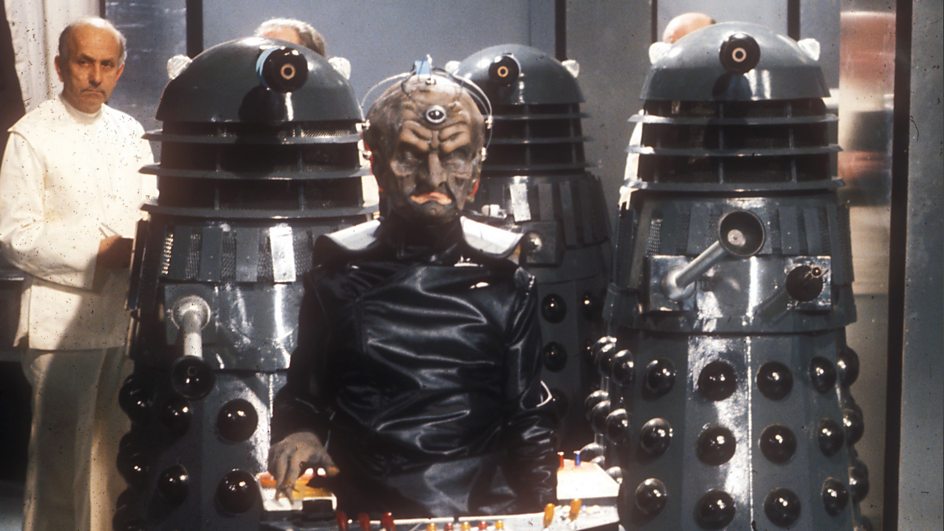
     Michael Wisher's Davros has the potential, as his later appearances would show, of becoming something of a one-note villain. Perhaps Genesis' greatest triumph is the way in which it avoids this, making use of the admittedly padded six-episode format in order to explore every facet of Davros' character, from his megalomaniacal admission of his desire to destroy every non-Kaled life form in the Universe to his sly manipulation of the Thals in order to wipe out both them and his own people in favour of freeing the world for the Daleks.
     If the story does have some downsides, it is probably in the many padding subplots that, despite being integral in developing the world to such a fabulous extent, often feel like too much a wayside from the main action. The banding about in the Thal Dome reveals some of the less amicable qualities in the other side of the war, but is often a tad boring, and leads to a series of cliffhangers that don't really go anywhere. There's also some fumbling about near the end where The Doctor for some reason manages to drop the Time-Ring and they have to go and get it back again. Silly.
http://ichef.bbci.co.uk/images/ic/944x531_b/p00y1c4w.jpg
Davros in his best, original incarnation.
     Ultimately Genesis stands out due to its incredibly detailed and comprehensive worldbuilding, the tremendous writing and acting from its main villains and its insight into the origin of the Daleks (at least in the new continuity that it creates.) Its bleak and depressing demeanour robs it of that enjoyment factor that would usually make a good Who story so rewatchable, but that doesn't stop it from being a Classically good story. Just not a personal favourite in the grand scheme of things.

Thanks.

NEXT WEEK: The Cybermen return after six years away only to stay gone afterwards for another six... it's Revenge of the Cybermen.

Monday, 9 September 2013

Review: Doctor Who Classic: The Sontaran Experiment

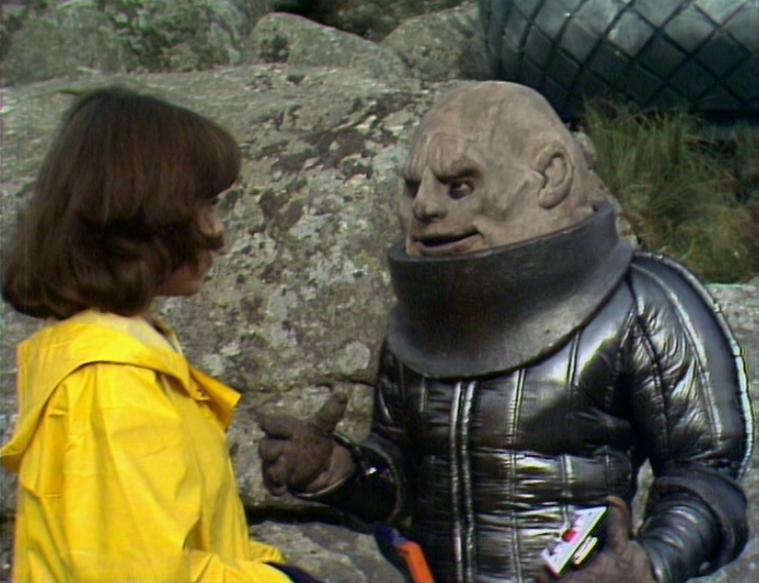
http://images2.wikia.nocookie.net/__cb20110901075459/tardis/images/0/06/Styre_and_Sarah.jpg
"Maybe you've met my cousin, Phil Mitchell?"
Doctor Who - Season 12, Story Three - The Sontaran Experiment
Written 17/5/13

Robert Holmes was one of these smart people who don't like six-parters, and so to round off the previous story he made room for this two-episode affair that carries on the story of The Ark In Space, albeit in a different location and with a much different tone. After their first appearance the year before, the Sontarans return, this time with a more focused insight into their societal structure. While it may only consist of a few silly people running around in the countryside, I do rather enjoy this serial, and it continues a string of great stories in Baker's first season.
     Transmatting down from the Nerva, The Doctor and companions find a London that is much closer to a set of moors, with the only immediately appreciable life being plants. As Sarah and Harry wander around, however, they all discover that there is life on this planet - colonists from a seperate party have been kidnapped and brought back to Earth, where they've been experimented on. While they don't initially believe that the Nerva still exists, they are all forced to pay attention when their kidnapper (and torturerer) shows his face. It is Styre, a Sontaran on Earth in order to test humanity's physical limitations in order to prepare for an invasion. The Doctor tricks Styre, sabotaging his ship to kill him and then bluffing the High Council out of their invasion attempt. That done, they prepare to transmat back up again, and the story continues.
     With the same production unit as Ark, the location and studio filming is split heterolytically between them, meaning the that The Sontaran Experiment takes place entirely on some hills in Dartmoor. The environment does give it a very modern feel, as well as the direction style which is forced to adapt to the terrain. Most of the special effects are okay as well, even if Styre's helper robot does stand out like a sore thumb as an example of 70s kitch.
http://stagevu.com/img/thumbnail/cjjzkkrokrxtbig.jpg
The Doctor tries to fix some transmat pads.
     Styre himself provides an interesting villain, exposing the Sontarans distinct methods even to the point of absurdity. The question must be asked as to why the Sontarans are so invested in examining humans before they invade Earth when the planet is completely uninhabited and the only other humans in the galaxy are either strung out across a weak galactic empire or suffering from one of the largest hangovers you can imagine. Regardless, the way Styre passed off a lot of his natural sadism as "scientific endeavour" was quite fun.
     The danger with two-parters in the Classic Series is that despite the fact that its running time roughly matches a NuWho episode, the style of writing that the old series employed doesn't give it the same sense of hectic pace. Despite that, I'd quite like to see a few NuWho episodes like this - relatively relaxed, capable of carrying a single plot and sticking to its guns throughout. It isn't perfect, I'll give you that, but The Sontaran Experiment is a fun load-off from the two scare-fests that flank it, and that's worth its weight in gold.

Thanks.

NEXT WEEK: Just like The Doctor, we revisit the Genesis of the Daleks.

Monday, 2 September 2013

Review: Doctor Who Classic: The Ark In Space

http://upload.wikimedia.org/wikipedia/en/thumb/f/f4/Ark_in_Space.jpg/250px-Ark_in_Space.jpg
Enjoy Bubble-Wrap Responsibly!
Doctor Who - Season 12, Story Two - The Ark In Space
Written 16/5/13

It's not just the later seasons that have some continuity, you know. As we begin, finally, the reign of Phillip Hinchcliffe as Producer and the great Robert Holmes as Script Editor, Holmesy brings us the first in a series of four interlinking serials. With the TARDIS interior set still not up and running, Season 12 doesn't see use of it, and so our characters spend the next four serials attempting to return to the location of this story, the space station Nerva. As is standard for a Holmes undertaking, Ark is a great mix of well-written concept work with a captivating plot to go with it, and while not being the most absurdly fun story in the world, it's certainly memorable.
     In Harry Sullivan's first trip aboard the TARDIS, it lands on the Nerva, a space station in the far future containing cryogenically frozen humans, chosen to repopulate the Earth thousands of years after the surface was made hostile by solar flares. Leader Noah and Med-Tech Vara are disturbed to discover upon their awakening that the station has been infiltrated by a Wirrn Queen, the progenitor of a race of parasitic anthropomorphic insects who eat their hosts alive from the inside and feed off of their tissues and their knowledge. Based on something that happened while humanity was asleep, the Wirrn plan to consume the remaining humans and return to Earth as a technologically advanced species, but this is foiled when a converted Noah tricks them into packing onto a doomed shuttlecraft. The Doctor and co. take a transmat to the Earth's surface, and we wait until next week.
     Great focus is made upon the vision for the future of humanity, be it in a positive way (the Doctor's early monologue where he praises the indomitable nature of the human species) or a negative one (the slightly eugenic-esque nature of the Ark's selection process). The Wirrn aspire to eat us and to be like us. There's also some nice dark humour made from the premise, especially with Holmes' standard comic character and his cries of, "I should have stayed on Earth, I like it hot!". It doesn't seem to judge humanity as anything other than the survivors, not making a comment on our interspecies morality but rather admiring our perseverance. Its dedication to these ideas bypasses the unfortunate limitations of its special effects, which seem to consist of plastic insect heads and green-painted bubble-wrap.
http://1.bp.blogspot.com/-Z5TYJQ0F430/UVG4yD1Gf3I/AAAAAAAAKDY/uX1Eo_hoaWI/s1600/doctor-who-the-ark-in-space-ark.jpg
Humanity's future sees us frozen to escape the sun's flares.
     Harry Sullivan's characterisation bothers me, if only because I'm not sure whether the sexism inherent in a lot of the things that he does is intentional or otherwise. The show during Sarah Jane's era made a lot of efforts to push forward the Second Wave Feminist ideals that were propagating in Britain at the time, and when he isn't doing something productive, Harry is awfully likely to come out with something akin to the stereotypical 70s chauvinist "comedians". I know he'll probably improve, but I'm not inclined to like a man who calls a female leader, "a member of the fair sex being top of the totem pole."
     The Ark In Space may not be a visual delight, but thanks to Robert Holmes the ideas are developed to a fantastic degree. Bubble-wrap or no, the script takes the issues surrounding Humanity and its will for survival - and its desire for freedom - as seriously as it can. The Wirrn are a classic bug-eyed (and bug-bodied) monster whose methods are instantly memorable, and it all comes together to produce something that, while maybe not your go-to story for a pick-me-up, is certainly a fine example of the genre.

Thanks.

NEXT WEEK: Those pesky potatoes are back... it's The Sontaran Experiment.

Monday, 26 August 2013

Review: Doctor Who Classic: Robot

http://4.bp.blogspot.com/-fCYOZh29XoM/UVDAPhJ8ePI/AAAAAAAAJ_g/qCpklqW34PY/s1600/robotheader.gif
Tom Baker doesn't get post-regenerative trauma. He's
just that awesome.
Doctor Who - Season 12, Story One - Robot
Written 15/5/13

I tell you, going back into Classic Who is like greeting an old friend. I originally abandoned my plans to go through Tom Baker's era, but I've since had a change of heart. Thus, we find ourselves at the beginning and the end of an era. Jon Pertwee, at that time the longest-serving Doctor, left the show in '74, and it was down to Producer Barry Letts to hire his replacement - long-term Character Actor and short-term Builder, Tom Baker was the perfect choice, reflecting Pertwee's staunch establishmentarianism with a madcap persona that nonetheless just felt right.
     Robot, for all of its trappings of a new era, has the same producer and production team as the previous season, meaning that the plot has a lot of the tropes of its predecessor. Kitch 70's standard sci-fi, with evil scientific organisations (a dime a dozen in Doctor Who) and a gaudy cardboard monster. As The Doctor recovers from his regeneration, he is drawn straight into the action as he investigates a scientific cult with utilitarian aims, using a sentient Robot designed by a Doctor Kettlewell to steal plans that will allow them to nuke everyone on Earth. The day is saved, etc, and The Doctor and Sarah Jane Smith are joined by the odd Dr. Harry Sullivan.
     Tom Baker's first performance as the Doctor has all of the charm and humour of his more famous hours, not bothering with Spearhead Syndrome and firing straight towards the action. Perhaps it's just the added benefit of hindsight, but it feels like Baker slips into the role with incredibly fluency, rolling off witty one-liners and odd statements (his first words being, "I tell you Brigadier, there's nothing to worry about. The Brontosaurus is large, and placid. And stupid!") while still coming off as an authoritative presence.
http://doctorwhofromthestart.files.wordpress.com/2013/04/robot4.jpg
Totally, girlfriend.
     The plot of the episode is a tad underwhelming for a premiere story; something more akin to mid-season filler, but despite this it still has a certain undeniable charm. As well as Baker's mere presence making things more interesting, the characterisation dished out to the K1 robot is quite charming, that of a young child with a very literalist interpretation of the world. It's actually done rather well, as long as you can ignore certain moments that reveal how cheesy the ideas really are, such as the Hammer-Horror style cry of "I have destroyed my Creator!"
     And as the era of the constant UNIT presence ends, the era of Tom Baker begins. Robot may not be the perfect story to begin the reign of what would become one of the most-loved Doctors, but in it's own way it's a send-off to the previous five years that both salutes that time and makes way for a future with a great number of possibilities. Over the next six months, I'll be showing just how many possibilities they were, taking us through the Hinchcliffe glory days and the later days of Graham Williams. See you there.

Thanks.

NEXT WEEK: The Doctor fights green bubble-wrap insects... is humanity's last hope on The Ark In Space?