Thursday, 20 June 2013

Review: Torchwood 2.10: From Out Of The Rain

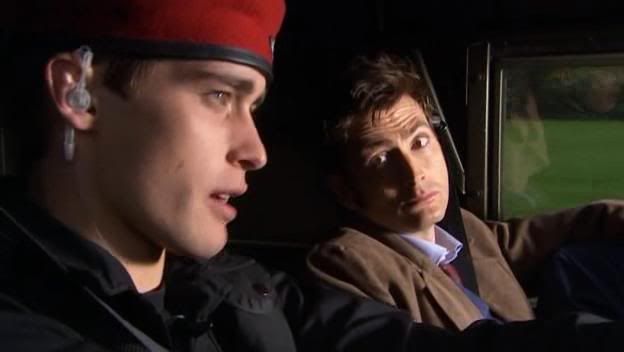
http://www.bbc.co.uk/torchwood/videoexplorer/images/460x259/tw_episodes_s2_ep10_highlights.jpg
Okay, I think you might be trying a little too hard to be creepy.
Torchwood - Series Two, Episode Ten - From Out Of The Rain
Written between 1st and 2nd April 2013

Fucking circuses, man. Clowns, harlequins, circus freaks. There is nothing funny about the Circus, and the history of freak shows and mistreatment of all sorts of peoples and animals doesn't exactly help their reputation. Only a week after the fun domestic runaround, we're given this creepy masterpiece, which manages the Moffattian feat of making you afraid of old glycerine film reels.
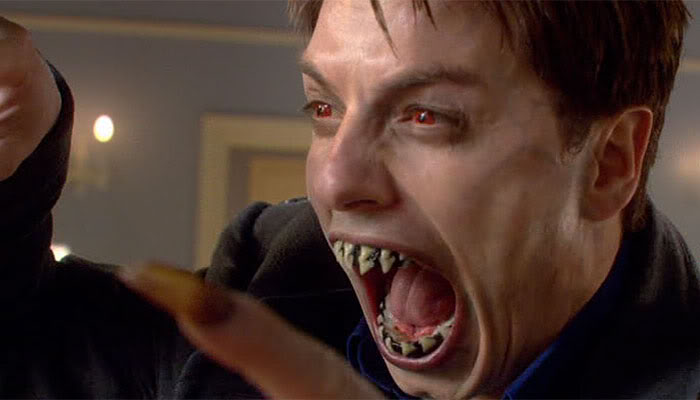
     Gwen, Ianto and Owen go down to the Electro, an old cinema that's been reopened for a couple of nights to show some old films. In a film that appears out of nowhere, there are images of the Circus, and Jack is a member - the man who cannot die. It turns out that the Ringmaster has escaped from the film, and is planning to use the souls of the living dead that he creates to bring others out of the film as well, to live on forever. Heading down to the Electro, Jack gets a modern film camera and films them all, exposing the film to kill them once and for all. The bottle containing the breaths of the people taken is nearly emptied, and the only person to survive is a little boy with a weird face (who'd later play Jackson Lake's son.)
     The two villains, the creepy Ghostmaker (Future Davros actor Julian Bleach) and the creepier Pearl (Camilla Power), have a wodnerful mixture of cheese and genuine disquiet, which only seems to amplify the effect. Their motivation is only to continue existing and performing, and like in a similar story from their parent show, the lengths they go to to do this are what make it work. That, and Julian Bleach's astoundingly weird voice, which is, I wager, why he was hired to be Davros in the first place.
https://blogger.googleusercontent.com/img/b/R29vZ2xl/AVvXsEhCdzCptXHTWe29GLZk6vcO7D-HY8Vsj6sN7yuwW2AM8jMGTu80X7wqB21kj7txurqlgrkRBUSaQ2Nm6vJO_9WXaNt0p564xTvXTjwmreh4uFpUlPoPEwL6ODqTSlDL8-YrOJMWyTEmHdk/s400/Pearl.jpg
Trailer-shot.
     The episode's atmosphere is arguably what makes it so memorable, though - not just the framing of most of the shots with a very dark emphasis in mind, but also in the haunting organ music that evokes both the vaudeville and the distinctly alien. Peter J Hammond's previous story, Small Worlds, is also heavy on this kind of atmsophere - except here it's a little more focussed.
     From Out Of The Rain is good. It maybe pushes the celluloid creatures idea a little into the realm of disbelief, but the sheer effective weirdness of the villains and the way that the episode's music and direction compliments them means that it becomes something of a petty concern. This is the sorta Torchwood story that gives little kids nightmares, and that's awesome.

Thanks.

NEXT WEEK: Chibnall shows that he can actually write, just not for Doctor Who. It's his best story, the haunting Adrift.

Wednesday, 19 June 2013

Prologue: Lost: Season One

Three seasons down, but I haven't even covered half of Lost. The reduced season length after 2008 came due to the Writers' Guild of America Strike, and venturing before then is a much more committed endeavour. The first season of Lost is 25 episodes (or 17 hours when adjusted for adverts) long, which basically means that I'll be posting these until the end of the year. Which is fun for everyone, I'm sure.
     There are no grand ancient plots and scheming villains here - just the simple story of a few weirdos trapped together on a desert island, all of whom are hiding deep-seated psychological issues with a 100% chance of somehow relating to one or more of their horrible parental figures. Of course that does mean that a lot of my favourite characters haven't arrived yet, but there's another tone of storytelling, something much more granular, that makes it feel a lot more whole than the rushed final seasons.
     There's also the presence on the production team of a certain nerd idol by the name of J.J.Abrams, who I'll be talking about in a couple of articles this Summer when I touch upon my love of Star Trek. Consider this a first go before we proceed. :) Oh, and of course, spoilers as usual. I've reviewed the end of this series before it's beginning, so don't be surprised if I give anything away.

Thanks.

Monday, 17 June 2013

Review: Doctor Who 4.7: The Unicorn And The Wasp

http://tvmedia.ign.com/tv/image/article/882/882162/the-unicorn-and-the-wasp-20080617053227843.jpg
Agatha Christie (Fenella Woolgar) helps the Doc solve a
murder case.
Doctor Who - Season 30, Episode Seven - The Unicorn and the Wasp
Written 1/4/12

Wowzers. While at times feeling a little out of sorts, this often criticised episode is an episode that is both irreverantly fun and fairly cultured at the same time, following the trend of the historical guest star with an appearance by a decent approximation of Agatha Christie and, like previous writers featured in NuWho, the story has been tailored to mimic and parody their works. Aside from a few issues with pacing, I think it's pretty good.
     The Doctor and Donna arrive at a 1920s dinner party on the day that Agatha Christie disappeared before reappearing a month later under another name. While not prying too much into the circumstances of that, they become embroiled in a mystery to find the killer of several people, including Professor Peach (a nod to the Christie-inspired Cluedo), the indian housekeeper Mrs. Chandrakala and the closeted aristocrat Roger. It is revealed that one of the members of the party is a Vespiform - a humanoid capable of transforming into a giant wasp, with telepathic powers linked to the Lady's jewel, and a result of her teenage affair with an alien in India. After much deduction, the killer is revealed to be the quiet Reverand Golightly, who has been playing out his murders like an Agatha Christie novel due to his mother's fondness for the books.
     The incorporation of references, both to Christie novels, plots, names and history gave the episode an almost Gattissian level of historical tone and, while it eres closer to the more poplised version of Christie's novels, it does feel like something of a tribute to her as both a woman and as a writer. Fenella Woolgar shows a woman blessed with an intuition and intelligence that allows her to understand motivations and thought processes, but with a frustration coming from her inability to apply it to her own personal life. Maybe not accurate to the real Christie, but a compelling character nonetheless that really stands out in the guest cast. (Which happens to include Felicity Kendal, being significantly more low-key than I'd expect.)
http://www.bbc.co.uk/doctorwho/medialibrary/images/main-promo/s4_07_ps_02.jpg
Three guesses as to which of the lively ensemble is the villain.
     The comparisons must be made, of course, to similar interbellum stories in the show's history. Like its Eighties predecessor Black Orchid, the story attempts a cohesive murder mystery, but it all goes a little too fast to work. There's a reason why Morse and Marple and the like end up going on for three hours with seventeen different ad breaks where they try to sell you various brands of expensive tea - it's about drawing the mystery out so that the viewer has the chance to pick a favourite, and pick a villain, and try and work it out from there. I know Doctor Who is a bit wham-bam-shebang in this period and we are talking about a comedic 45 minute tea-time adventure, but if you're going to make a tribute to murder mystery it would help if the villain isn't obvious within the first ten minutes.
     Other than that, I think that it all worked well. For something that was focussed more on a mid-season comedic angle, I thought that the main story and the character work behind it were surprisingly strong, and despite how out-of-the-blue the eventual solution comes, it is fascinating and amusingly appropriate for the genre. It makes me wish that there were more stories set in the 20th Century, and especially around this time period. Or maybe it just makes me want to watch Jeeves and Wooster again; either is fine. Any episode that can inspire that is good in my book, for sure.

Thanks.

NEXT WEEK: She's here! Batten down the hatches, seal off the windows. Moffat is about to be told that he's the next head writer half-way through writing a story, and the result will change the show for the next half a decade. It's the first appearance of River Song in Silence In The Library/The Forest Of The Dead.

Thursday, 13 June 2013

Review: Torchwood 2.9: Something Borrowed

http://www.tvfodder.com/torchwood/archives/01_torchwood_web.jpg
Gwen's sudden pregnancy turns some heads.
Torchwood - Series Two, Episode Nine - Something Borrowed
Written 31/3/13

So, yeah. Those past three weeks were a bit heavy, and so this week we return to a fun Torchwood runaround that manages to fit in as many mother-in-law jokes as it does attacks by alien monsters. That consistant optimism and humour does make it rather rare for this series, but that's not something to be poo-pooed - in fact, it feels like just what we need.
      The night before her wedding, Gwen is out chasing a shape-changing alien called a Nostrovite. The alien bites her arm, and come the next morning she's full term pregnant with the alien's egg. Proceeding with the wedding regardless, Torchwood are forced to intervene when a second Nostrovite, the mother, arrives to come and rip the egg from Gwen's stomach. Despite some close shaves, Rhys is able to use the Singularity Scalpel to cure Gwen, Jack uses a big fucking gun to kill the Nostrovite and the two get married, with their families getting a huge dose of Retcon.
     The episode's biggest focus was on the love triangle between Gwen, Rhys and Jack, with Gwen and Jack's intensely passionate platonic relationship being referenced to many times. The whole Jack/Gwen ship was mainly teased at in the first season, before the writers obviously discovered the 2006 equivalent of Tumblr and began shipping them like mad. As much as I feel that rampant shipping for shipping's sake does not a captivating story make, I do like the dynamics of the triangle and I love the way that it's played.
http://images3.wikia.nocookie.net/__cb20090902174423/tardis/images/6/6c/72b.jpg
Nostrovites and hilarious makeup.
     So yeah. Something Borrowed didn't really make much of an impact on me; it was a fairly standard runaround that felt a lot more Doctor Who than normal. That doesn't necessarily make it a bad episode, but for me at least it felt odd coming between last week's in-depth psychological analysis and next week's old fashioned creep-fest. I suppose it's good that we can have one last little island of levity before we advance onto the rest of the series, which is pretty much three and a bit episodes of depression, sadness and pain.

Thanks.

NEXT WEEK: A hopefully more in depth review of From Out Of The Rain

Tuesday, 11 June 2013

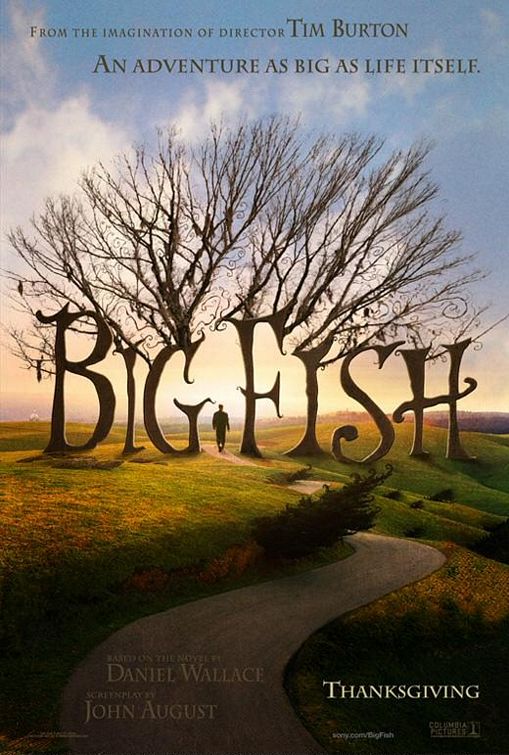
Review: Big Fish

http://static.tvtropes.org/pmwiki/pub/images/big_fish.jpgBig Fish
2003, Directed by Tim Burton.
Written 28/4/13

I know it probably doesn't mean much, but I tried to review Big Fish once before. I really didn't know whether I found the film's attitudes and ideas deeply problematic or simply reflective of a simpler age. There's something odd about Big Fish that really separates it from Burton's other films, and that's a simple sense of imminent tragedy that underscores everything that occurs, even during the film's fantastical scenarios. It feels so weird that a film about a man striving to discover the truth would so bathe in the ridiculous. It's two completely different films grafted together in a way which feels uncomfortable. Although that might have been the point - the problem being that I'm not sure.
     Edward Bloom, played by Albert Finney as an old man and by Ewan McGregor as a young one, is a folk hero in his birth town of Ashton, in Alabama. His son, Will (Bill Crudup) speaks to his father for the first time in three years in order to discover the truth behind his father's past before he dies. Throughout the film we watch flashbacks, usually narrated by Finney, which display the extravagant tales that Edward tells about his life, including saving Ashton from a giant, finding the creepy town of Spectre, working for a werewolf and stalking his girlfriend until she decides he's better than her current boyfriend and marries him on the spot. After learning that most of what his father says was true (apart from some of the more fantastical elements), Will helps his dying father to his rest by telling an extravagant tale of his own, where Edward becomes the uncatchable fish that he tried to catch at the beginning of the film.
      The film's core romance between Edward and his love, Sandra, tries to be a fluffy true love story, playing with the format enough to make it work. Edward sees her across a crowded circus and decides that he is gonna marry her no matter what, and works at the circus in exchange for a slow trickle of information about her. Eventually he arrives at her University, and when she is engaged to Edward's childhood friend, he continues to stalk her across campus and finishes off with an order of dafodills which probably breaks planning permission laws, leading to a fight between the childhood friend and Edward that leads to Sandra's change of heart.
     Now this is either incredibly clever or incredibly short-sighted, depending on your interpretation of who the film's protagonist really is. If you take the film's view that Edward is the protagonist, then this is once again the heroic and perfect Edward Bloom yet again succeeding where others have failed, conquering adversity to win his true love. If you're like me and take the more cynical view that Will is in fact the protagonist, then this story is one of a bitter man reshaping history to make himself look like the world's greatest dude, and demonising the childhood friend who he didn't like. Either way, Sandra isn't treated as a character - she's more a goal, an aim, a prize. The film doesn't pass the Bechdel test; there are no well-developed female characters in this film that aren't in some way dependant on a male character for their existence in the picture.
https://blogger.googleusercontent.com/img/b/R29vZ2xl/AVvXsEjuPwkl33YzuguDfIMFOvaTccvdmpLIsZ8XvCQ07v_n2ZCFFWPCzSQIO1GIj5-n9IG41zOp7poUIJYIUnAGy-hONuCQ4TlayWuWJYHfNX1qsF00-B0ljNRcN6SojqTGPBXPIZ41_7nEt75R/s1600/03_04_11_bigfish.jpg
"Hey, I never asked, do you get hayfever?"
      The worst thing is that this was probably unintentional. The main theme of the book, and the film (according to the producers) was to do with Will and Edward's father-son relationship and the way that Edward used tall tales as a way of keeping his distance from his own family. The thing is, that dilemma (which is there, don't get me wrong) does get shrouded by the tale of Edward Bloom's perfect life. Edward's stories don't just keep distance between him and those around them, they keep a distance between the audience and the film's core dilemma.
     Big Fish is an entertaining film by any measure, and it's very much up to the viewer to make what they wish of the film's flashbacks and their diversion from reality. I just think that you shouldn't really take them as read, especially when on its own it's the rather dull story of a perfect man, his perfect life, and his whiny-ass son. Too little emphasis is put on what I think the intention was, which is this wonderfully complex idea of a film that you can't really ever trust, where you are as skeptical as Will is and you are on as much of a hunt to find out why Edward is so ashamed to tell the truth.

Thanks.

Monday, 10 June 2013

Review: Doctor Who 4.6: The Doctor's Daughter

http://tvmedia.ign.com/tv/image/article/880/880182/the-doctors-daughter-20080609043158269.jpg
The Doctor's Daughter who played The Doctor's Daughter
in The Doctor's Daughter and then had The Doctor's Daughter.
Doctor Who - Season 30, Episode Six - The Doctor's Daughter
Written between 30th and 31st March 2013

We had a good run of gushing, I suppose. But for me this era of Doctor Who is very hit and miss, so you shouldn't really be very surprised. Especially when it comes to The Doctor's Daughter, which is an episode so steeped in problems that it's practically wading in them. As usual, it's not the total shitstorm that the typically hyperbolic fandom would have you believe, but at the same time it doesn't come away smelling of roses. (Look I made a reference.)
     The Tardis crew are swept away by the sentient machine, which drops them on the planet Messaline, the sight of an everlasting war on a subterranean world between humans and the fish-like Hath. There, The Doctor's DNA is used to make an easy-grow soldier called Jenny (Georgia Moffet, who got together with Tennant while making this episode. Aww.) and he has some paternal issues to get over when he discovers that she's a Time Lady. Separated, Martha and the rest of the gang make their way to the Temple, where they work out that the war has only lasted seven days and that the myths arose due to the easy-grow solider machines pumping out generations of clones. Jenny gets shot and The Doctor makes an egotistical speech, but thanks to Moffat meddling she revives later on, disappearing off into the sunset.
      I'll say now that there are a few ideas that I rather like in The Doctor's Daughter - the seven day war arising out of inappropriate use of cloning technology is rather clever, and is a decent extension of sci-fi ideas. It is a little shot by the character of General Cobb; all the clones we see are fresh and young, whereas Cobb sprouts all the myths despite looking like an old-timer. I personally like the theory that Cobb was always a nutjob, and that the seven-day war was just the perfect opportunity for him to kill some people.
http://1.bp.blogspot.com/-EWa7l0f2Uek/UO3ciAgo-mI/AAAAAAAAHvI/7XF-iYhsbpQ/s1600/6.jpg
Where the fun sci-fi breaks down into rubbish.
     The episode is guilty of what I would call over-sensationalism. There are often remarks made by fandom pertaining to the idea that RTD tended to appeal more to the tabloid press during his final series, and this episode seems to be this on a plate. A title like "The Doctor's Daughter" is meant only to get fans excited to see Susan's mother or something deeper in the show's mythology. Instead we got a silly story about a sexy clone and a war with the fish people.
     Whereas the three episodes of Torchwood that saw Martha's return were three of the best of that series, these three in the parent show have been less than so. And on that front, it was because Martha was criminally underused and consistently kept out of the action, making me wonder why she was brought back in the first place when it obviously effed up some of the contracting. The Doctor's Daughter promised so much, but it ended up giving us so little.

Thanks.

NEXT TIME: Agatha Christie fun in The Unicorn and the Wasp.

Thursday, 6 June 2013

Review: Torchwood 2.8: A Day In The Death

http://www.pinkraygun.com/wp-content/uploads/2008/03/owenscreamsunderwater.jpg
Owen lets out his frustration at being unable to die.
Torchwood - Series Two, Episode Eight - A Day In The Death
Written 30/3/13

At some point in our lives, we all experience bouts of sadness. And some of us experience depression, whether clinical or otherwise. Whether it's grief at the loss of a loved one; guilt at one's own misdeeds; or simply a way of looking at the world that doesn't leave room for any hope - most of us know what it feels like. A Day In The Death is my favourite episode of Torchwood because it doesn't just feature some smashing character work for Owen Harper, but it provides what I feel is a comprehensive analysis of depression and provides a case for simply enjoying your life to its full potential.
     Owen meets a girl on a rooftop who is about to jump. Revealing to her his bullet wound, he goes on to explain through flashbacks what led him to that point. After the events of last week, Owen is decommissioned and put on coffee duty. He is frustrated at his lack of perception or feeling and he is bitter at the way the world is carrying on while he must stay static and unfeeling. He tries to drown himself, but he is unable to, and he tries to keep his mind off of his nature by going on a mission, bypassing heat-sensors and infiltrating the alien horde of dying billionaire Henry Parker (the late Richard Briers). The artefact he's looking for is an alien messaging device whose energies are keeping Parker alive, and upon its removal Owen is unable to give Parker the kiss of life. Owen summarises his speech to the girl on the roof by saying that despite that, there's always something worth living for - even if it is mundane.
     Owen's condition - feeling numb all over, having deep trauma on the inside despite working in normal conditions in the day to day - is a clear analogue for depression. The episode takes that up and uses the sci-fi to make it more fluid. We see Owen reject his day to day lifestyle (throwing away all of his food and drink, which he can no longer digest), become seperated from his friends and feel a mixture of complete numbness and intense outrage at the world. It's a chart of the journey into depression, as well as the slow and painful trek out of it.
http://stuffpoint.com/torchwood/image/94759-torchwood-a-day-in-the-death-episode-screencap-2x8.jpg
Owen and Parker talk about death.
     Christine Bottomley's Maggie is perfectly balanced as the mouthy but fundamentally tragic suicidal woman, who is reeling from the aftermath of a wedding day car accident that rendered her a widow after an hour of marriage. She provided a human counterpoint; a way to work the viewer into the depressive mindset through a more identifiable tragedy. Richard Briers didn't get to do much as the dying Henry Parker, but his death and his life-long optimism about life on other worlds helped underlined the episode's messages about how your attitudes towards living your life affect your overall mood. Parker was happy because he did what he enjoyed, because he found that one spark of hope to keep him going.
     I'm probably reading too much into what is a fairly simple episode of a cult television show. But A Day In The Death is just perfectly written, and sees the end of the Martha Trilogy in a style that's instantly memorable and is, in many ways, moving. A Day In The Death may not provide a perfect metaphor for the deep psychological effects of depression, but does a damn good job of approximating it to a point where it's pretty difficult to tell the difference.

Thanks.

NEXT WEEK: We learn for the first time that if you live in the Who Universe and you're marrying a man named Williams, you'll never change your surname. It's Something Borrowed.

Wednesday, 5 June 2013

Characters: Lost: John Locke

Written 2/4/13

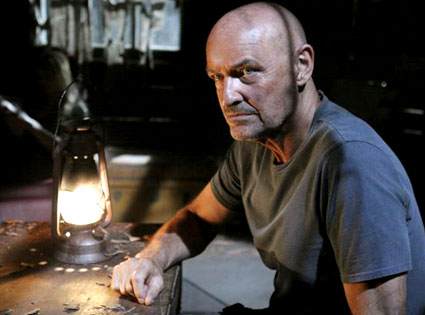
John Locke is not quite my favourite character in Lost. But of my favourite characters, he is the one who hangs around the most, so when my other favourite characters are either dead or haven't arrived yet, he does just fine. John's is a tragic tale that develops into one of distinct triumph, before falling back the other way again into one of the series greatest what-the-fuck endings. He is Lost's defining character, its working spirit, and he's also a badass bald dude.
http://static.tvfanatic.com/images/gallery/john-locke.jpg    Across the first few seasons we're shown that John has been told for a very long time that he was Special, despite being born to unloving teenage parents who shivved him into adoption and then conned him out of a kidney when he went looking for them. Every time he felt swayed by compassion, it was thrown back in his face, and his bitterness over what his parents did to him led to the breakup of his only successful relationship and to the events that led to him being paralysed before the series begins.
      It's revealed in Season Five that his belief in his own specialness, and his belief in fate and destiny, is sorta justified by time travel. By time-travelling to a few years before he was born in "Jughead", John himself inspires not the circumstances of his birth, but the constant niggling presence of people telling him that he's different. It's a stable time loop - John is trapped by it, in fact. He is destined to become the leader of The Others for the sole reason that he goes back in time and tells Richard that he is.
      A large aspect of Locke's character was his faith, and this is typically where I would back up and sprout secularisms at you for the next couple of paragraphs. But as we've seen, Locke's faith is justified by the predestination paradox that he lives in. His faith is often put against Jack's "reason", but I think that's rather interestingly wrong. As a rationalist I'd usually support Jack in this endeavor, but the observable strangeness on the island I think pushes Jack's refusal to admit to seeing the Monster or the Button's importance into Arbitrary Scepticism.
      Locke was defined by something of a grand contradiction. His life before the island had been somewhat pathetic - a man defined by his bitterness, obsessiveness and anger. On the Island, however, Locke was something distinctly more powerful - a man who the others considered somewhat mad, but whose strength of character made him a figure as forceful as Jack. Locke was, of course, a tad delusional - he shouldn't have relied so much early on on vision quests and such like. But the thing about the Island is that accurate visions seem to come with amazing frequency.
https://blogger.googleusercontent.com/img/b/R29vZ2xl/AVvXsEjH0midA-vn3hRXPaBcwJal6J6O8lv7r1atfruwqT68rVR6XxCVj1j2hab4vojhM_vIVxRCQKBZOlSyzWyDFOWH8mWvaEdGy4Xb2ES_15hAVRKaarrRWn9TwQrcvVni_yNd8DzQfQKhUO-o/s1600/lost-john-locke-season-1.jpg     His power and his inner feelings of inadequacy were eventually exploited by The Man In Black. His entire plan in Season Five is to bring the Candidates back to the Island in order to kill them and ensure that Jacob has no successors. Locke is key to this - the only reason that he leaves the Island and tries to bring everyone back is because MIB, in the form of Christian Shepherd, tells him to do so. It was a gullibility - an over-reliance on faith and visions in order to steer, the way, and a blindness towards those who may manipulate that.
     John Locke may have relied a little too much on faith to guide him, but most of his visions and beliefs ended up being right anyway. He was a character that had made his way up to the position of the Others' leader after spending his life as a man powerless to change his fate. The four and a half seasons that he's truly around are much better off for his presence - mainly because of his unpredictability and his ability to make up for his tragic past through total badassery.

Thanks.

Tuesday, 4 June 2013

Time Travel, Destiny and Eastwood Ravine

Written 5/4/13

When I reviewed the very Time-travel heavy Fifth season of Lost, I ended up explaining a few issues regarding the subject and how the show treated it (and ultimately why Faraday was nuts). I didn't really go into a lot of detail about how I generally perceive travelling in time and the ways that we can apply it consistently, so I thought I'd go through some fun things in an essay. Because I have nothing better to do with my time.
http://0.tqn.com/d/lost/1/0/T/u/-/-/Daniel.jpg
Daniel pointing a gun at his mother, who is pregnant with him.
Luckily he never gets to pull the trigger.
      There's a difference, I must clarify, between the time travel in more serious works and in shows like, say, Doctor Who. Sure, Who flirts with a load of Time Travel tropes, but it's all as the author deems necessary and the laws themselves are highly contradictory. If you were to try and go through the series and track all the timeline changes, you'd find a bit of a tangled mess. Which is fine, because Doctor Who is a family show and not some silly essay about Time Travel in fiction. This article will thus be talking about consistent models of Time Travel - ones in which the writers keep things fairly logical, even if they don't realise that they're doing it. Consistent models must also avoid paradox - contradictions in the timeline that mean that the effect prevents the cause i.e. a man going back in time and shooting his grandfather, thus preventing his birth.
     The first model, whose name I've borrowed from Lost, is the "Whatever Happened, Happened" model. Basically, the timeline is fixed - the time travel is part of the way that the timeline is built. The actions of the protagonists in the past are vital to the act of travel in the first place. It's sorta like a record player - you can push the needle back, but it's going to travel on the same path back to the point no matter what you do. This model avoids the danger of paradox because there is simply no avenue for contradiction - no matter what the protagonist does, he cannot change anything - even if that means that the usual laws of physics circumvent themselves to prevent it. So say our guy tries to shoot his grandfather. Either the gun will jam, or the grandfather won't be killed, or he'll have already had his kids, etc. etc.
     The example I used was of course Lost. In the fifth season, half of our intrepid heroes end up skipping through time, ending up in the 1970s. When mention is made of possible paradoxes, local scientist Daniel Faraday explains their predicament as above. When an opportunity presents itself to prevent the heroes' plane from crashing on the Island in the first place, they try to take it by throwing a Hydrogen Bomb down a mineshaft. This inevitably leads to the crash of their plane in the future, thus meaning that in their attempt to change their fate, they became the cause of it.
http://images1.wikia.nocookie.net/__cb20100122055851/lostpedia/images/1/18/4x13_Departure.jpg
Desmond can see the future because the future's already
been written.
     However, Lost also explored Time Travel in other ways. One of the massive themes of Lost is fate and destiny, and quite often this is in floaty bullshit from mysterious side-characters, or from dreams and visions from the main cast members that aways seem to remarkably vivid and accurate. On first inspection this is fantasy style hoshposh - enjoyable nonsense. But Time Travel gives it an entirely different coat of paint. Take for example John Locke, who is told throughout his life that he is special. It is shown that this originates from himself telling people before he was born that he was special. His fate, and his accuracy in predicting it, came entirely from a time loop.
     This also allows us to sciencify more standard prediction of the future, such as when Desmond has premonitions throughout Season Three. If your timeline is completely fixed, if all of your actions are pre-ordained, then it isn't really a stretch that you can accurately say what's gonna happen next. We don't even need to worry about a God - as I mentioned in a previous metaphysics article, the future in Lost is written by... the writers.
      The first model doesn't let you change anything within your own perception, which is pretty much useless for a lot of writers, for whom changing the past is the main aim of your journey. Thus we meet the second model, known by me as the Many Worlds Model after the Many Worlds Theory of Quantum Mechanics. As seen in such films as Back To The Future and Déja Vu, it supposes that travelling back in time isn't really time travel at all. Rather, you cease existing in your own Universe and begin spontaneously existing at an earlier point in time in an otherwise identical parallel universe. The man going back to kill his grandfather is able to do so without any bother at all; but should he travel forward, he will find a Universe in which he never existed.
https://blogger.googleusercontent.com/img/b/R29vZ2xl/AVvXsEiGTDgMzVOogUjjn929W7nJ-FGX52-6yB1GazpQFpjqkHRETCCNLtp6FoiyBUhgRinjJ6WRd3Jq_FzwHfjTYYT7Hz_HXLUbZyOUU2NbV3SaZ4d2P7nuxlUM0GjbEOnFjsv76C0e1mRIHw_z/s1600/doc+brown+thinking+cap+back+to+the+future.jpg
The Doc exists in eight different parallel universes because
of the first one's time travelling.
     Again, a bigger example is Back To The Future. In the third film, we encounter three realities with quite a few differences, but the one I'll be using is the name of a ravine. In the first two films, the local gorge is called "Clayton Ravine" after Clara Clayton, a Wild West schoolteacher who rode over the edge and died. Doc Brown travels back in time, and creates a parallel universe in which he appears in 1885 and saves Clayton's life. The name is thus changed to Shonash Ravine. Marty, who travels laterally into this new Universe via a "ripple effect," finds that the Doc died a few days later, and so he creates yet another Universe in which he appears a few days after Doc and saves his life. Staging his own death to get home, the ravine is thus named after his fun alias, and is called (Clint) Eastwood Ravine.
     All this is rather fun. But unfortunately, this is fiction. In reality both models come under a lot of extreme scrutiny, and it all ties into energy and science and the laws of physics and such. The first model doesn't work because quantum mechanics makes it definitively clear that the future is not a certainty; we aren't living on a fixed set of events. The second is more sciencey; we're not even sure that parallel universes exist, and the entire idea of things spontaneously disappearing and reappearing goes against the idea that energy cannot be created or destroyed. Time Travel is a nice thought, and looking at the way that it's applied in fiction can be quite interesting. But for now, it seems rather more like a distant dream.
     Oh well. Back to the TV set.

Thanks

Monday, 3 June 2013

Review: Doctor Who 4.4-5: The Sontaran Stratagem/The Poison Sky

http://i301.photobucket.com/albums/nn41/sue_denimme/The_Sontaran_Stratagem_402.jpgDoctor Who - Season 30, Episodes Four and Five - The Sontaran Stratagem and The Poison Sky
Written between 25th and 30th March 2013

Helen Raynor, the woman who brought us Dalek mutants with penises on their faces, delivers another early-season two-parter that begins a trilogy of episodes featuring the temporary return of my favourite RTD companion, Martha Jones. It also follows a NuWho trend of reintroducing one Classic Monster per season, this time reinventing the war-like Sontarans into much shorter, modern versions with a penchant for the colour blue and rugby chanting.
     I want to like the story; I really do. It's the first UNIT story for 19 years, it reinvents the Sontarans in a way that's half-decent, and it sees Martha' return. However, it also has a great number of elements that I find less appetising. The main one is the Sontaran redesign - not aesthetically, but in their attitudes. It's almost as if they're overcompensating - every element of their personality, of their backstory, is ramped up to its logical maximum and the result is a story whose villains fail to feel intimidating. I mean, invading the Earth and turning it into a hatchery? It just doesn't feel very Sontaran.
     That and the few other elements that irk me. Sorry to be so overly negative, but I need to get them out of the way. First we have annoying American mega-genius Luke Rattigan (Ryan Sampson) who spends the entire story acting like a spoilt child in the most annoying ways, with a "twist" resolution where he settles a petty score by blowing up the Sontaran ship. Then there's the attempt at an environmental message, which is shoehorned in and feels totally confused. Then there's the clone subplot - clone subplots are always silly, and this one was even worse for the fact that it went nowhere.
http://images3.wikia.nocookie.net/__cb20100619132106/tardis/images/1/13/Sontaranstrategem.png
Although I do like the NuWho Sontaran design.
     So yeah, it didn't really work for me on the plot levels. More mediocre than outwardly bad, I suppose. What startled me was The Doctor's personality, which has gained a much more dickish undertone. I'm probably just reacting to him going back to normal after a season of being cautious around Martha, but in this episode both his stark egotism and his hypocrisy around guns came to a fore. His dismissal of the UNIT soldiers and his willingness to stand by as they were massacred, blaming their deaths on their own incompetence, made me feel rather unsettled.
     The Sontaran two-parter is fatally uninspired, and its mishmash of plot elements is not redeemed by a couple of good lines here or there. I suppose it could be standard Who fare if viewed on a surface level, but otherwise it is steeped in a quiet mediocrity underlined by a lot of ugliness on the part of The Doctor's characterisation. It is such a shame that Helen Raynor's Who work isn't as strong as her work on Torchwood, and that this, her last story to date (and the last Who story to be written by a woman to date) is so offensively bland.

Thanks.

NEXT WEEK: Sensationalist titles and terrible scriptwriting in The Doctor's Daughter.