
When I reviewed the very Time-travel heavy Fifth season of Lost, I ended up explaining a few issues regarding the subject and how the show treated it (and ultimately why Faraday was nuts). I didn't really go into a lot of detail about how I generally perceive travelling in time and the ways that we can apply it consistently, so I thought I'd go through some fun things in an essay. Because I have nothing better to do with my time.
 |
| Daniel pointing a gun at his mother, who is pregnant with him. Luckily he never gets to pull the trigger. |
The first model, whose name I've borrowed from Lost, is the "Whatever Happened, Happened" model. Basically, the timeline is fixed - the time travel is part of the way that the timeline is built. The actions of the protagonists in the past are vital to the act of travel in the first place. It's sorta like a record player - you can push the needle back, but it's going to travel on the same path back to the point no matter what you do. This model avoids the danger of paradox because there is simply no avenue for contradiction - no matter what the protagonist does, he cannot change anything - even if that means that the usual laws of physics circumvent themselves to prevent it. So say our guy tries to shoot his grandfather. Either the gun will jam, or the grandfather won't be killed, or he'll have already had his kids, etc. etc.
The example I used was of course Lost. In the fifth season, half of our intrepid heroes end up skipping through time, ending up in the 1970s. When mention is made of possible paradoxes, local scientist Daniel Faraday explains their predicament as above. When an opportunity presents itself to prevent the heroes' plane from crashing on the Island in the first place, they try to take it by throwing a Hydrogen Bomb down a mineshaft. This inevitably leads to the crash of their plane in the future, thus meaning that in their attempt to change their fate, they became the cause of it.
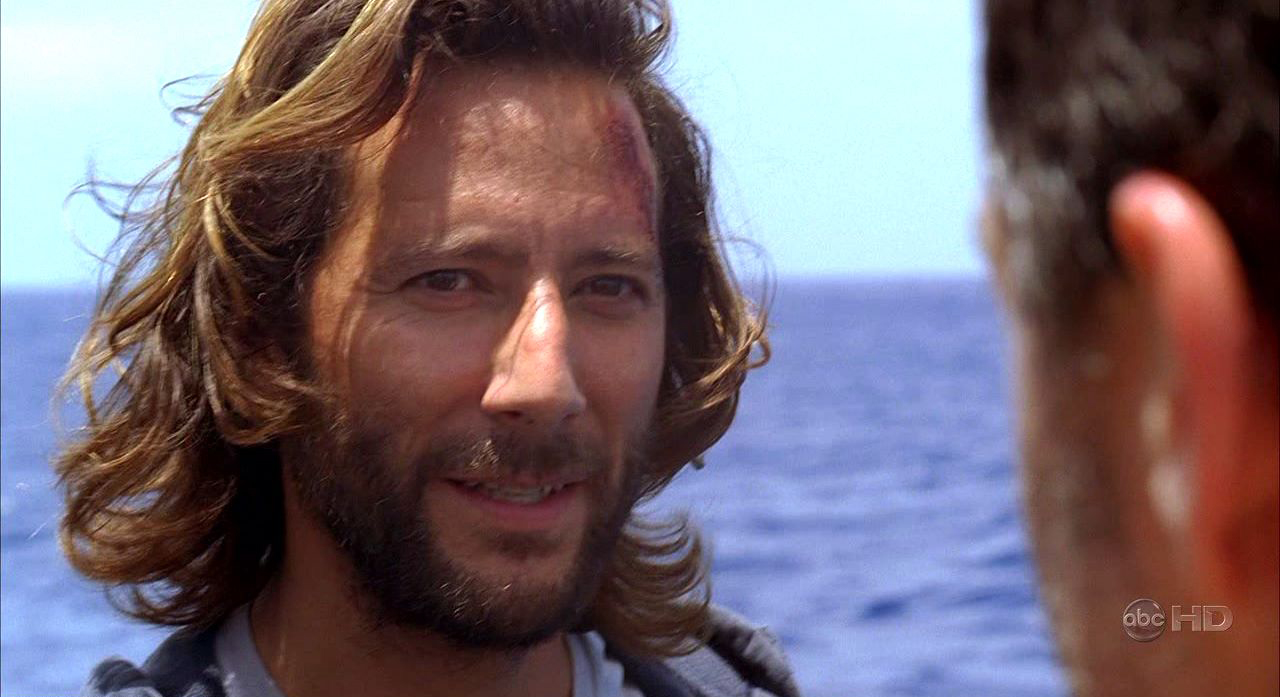 |
| Desmond can see the future because the future's already been written. |
This also allows us to sciencify more standard prediction of the future, such as when Desmond has premonitions throughout Season Three. If your timeline is completely fixed, if all of your actions are pre-ordained, then it isn't really a stretch that you can accurately say what's gonna happen next. We don't even need to worry about a God - as I mentioned in a previous metaphysics article, the future in Lost is written by... the writers.
The first model doesn't let you change anything within your own perception, which is pretty much useless for a lot of writers, for whom changing the past is the main aim of your journey. Thus we meet the second model, known by me as the Many Worlds Model after the Many Worlds Theory of Quantum Mechanics. As seen in such films as Back To The Future and Déja Vu, it supposes that travelling back in time isn't really time travel at all. Rather, you cease existing in your own Universe and begin spontaneously existing at an earlier point in time in an otherwise identical parallel universe. The man going back to kill his grandfather is able to do so without any bother at all; but should he travel forward, he will find a Universe in which he never existed.
 |
| The Doc exists in eight different parallel universes because of the first one's time travelling. |
All this is rather fun. But unfortunately, this is fiction. In reality both models come under a lot of extreme scrutiny, and it all ties into energy and science and the laws of physics and such. The first model doesn't work because quantum mechanics makes it definitively clear that the future is not a certainty; we aren't living on a fixed set of events. The second is more sciencey; we're not even sure that parallel universes exist, and the entire idea of things spontaneously disappearing and reappearing goes against the idea that energy cannot be created or destroyed. Time Travel is a nice thought, and looking at the way that it's applied in fiction can be quite interesting. But for now, it seems rather more like a distant dream.
Oh well. Back to the TV set.
Thanks

No comments:
Post a Comment
Note: only a member of this blog may post a comment.