Wednesday, 17 April 2013

Review: Lost 6.13: The Last Recruit

http://images1.wikia.nocookie.net/__cb20100422163222/lostpedia/images/f/f9/6x13jack-jumps.jpg
Jack is The Man Of Faith...
Lost - Season Six, Episode Thirteen - The Last Recruit
Written 5/3/13

Weirdly, The Last Recruit, despite being another furniture moving episode, managed to be quite captivating. It's distinctly non-centric, and that was very much to its benefit, as it felt for perhaps the first time in a while that the old gang was back together again after Season Four and Five's various seperations. There was a newfound sense of pace after a few episodes of exposition and some of the more boring characters getting their centrics out of the way. We're in full finale mode now. And it feels awesome.
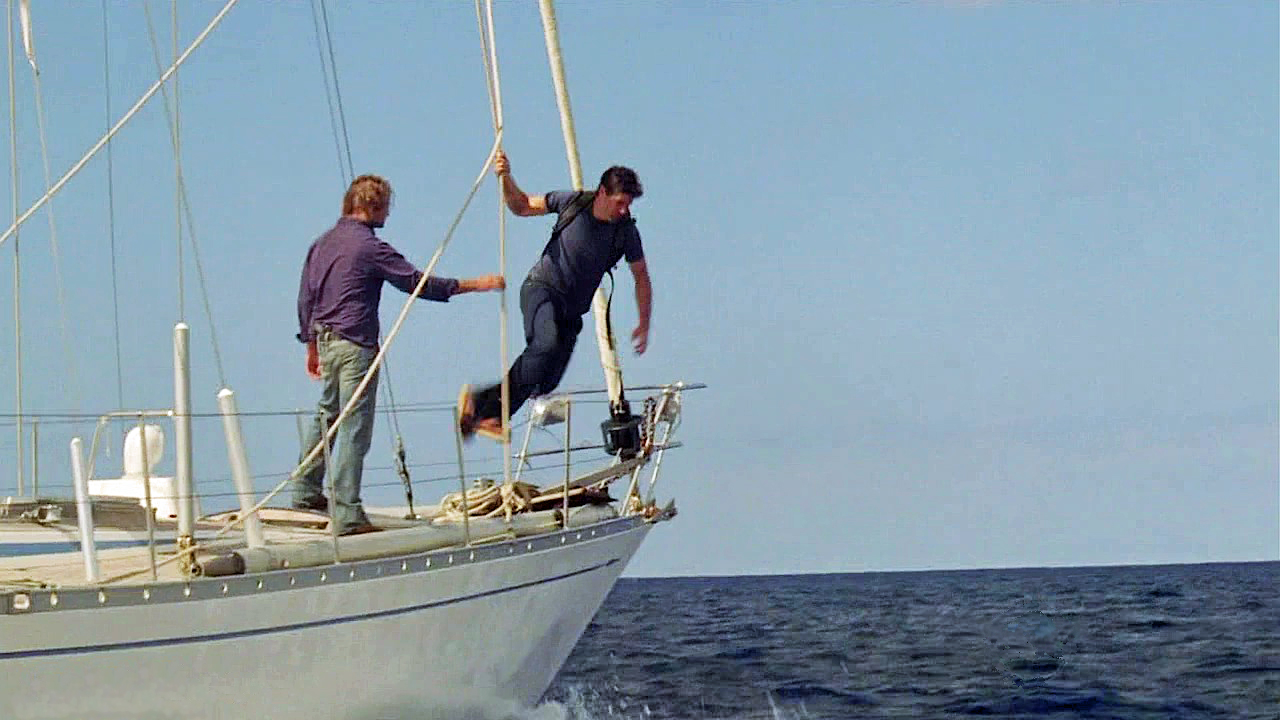
     On the Island, Jack confronted the MIB about his various impersonations of dead people through the years, and became part of Sawyer's plan to leave MIB in the lurch and reunite the original 815 crew (sans Sayid) on the Submarine. They manage to execute the plan, with Claire hopping along as well. Sayid is sent to kill Desmond, but the wily scotsman talks him out of it and he appears to be recovered when MIB asks him what has happened. Jack tells Sawyer that his fate is to stay on the Island, so he swims back to shore. Once the gang arrives on Hydra Island, Widmore's men corner them, telling them the deal is off. Jin and Sun tearfully reunite. Widmore attacks the mainland with mortars, and MIB makes a point of saving Jack's life.
      In the flash-sideways, all sorts of crazy shenanigans are going on. Desmond pushes Claire towards her brother Jack at a law firm, where they both share info on Christian Shepherd and how much he got around. Jack was forced to get away when Locke was rolled into the Hospital, where Sun has also been taken after Jin accidentally shot her a couple of weeks back. Sawyer has a nice chat with Kate, who still protests her innocence, and then goes with Miles and captures Sayid, who has been blamed for all of the shootings.
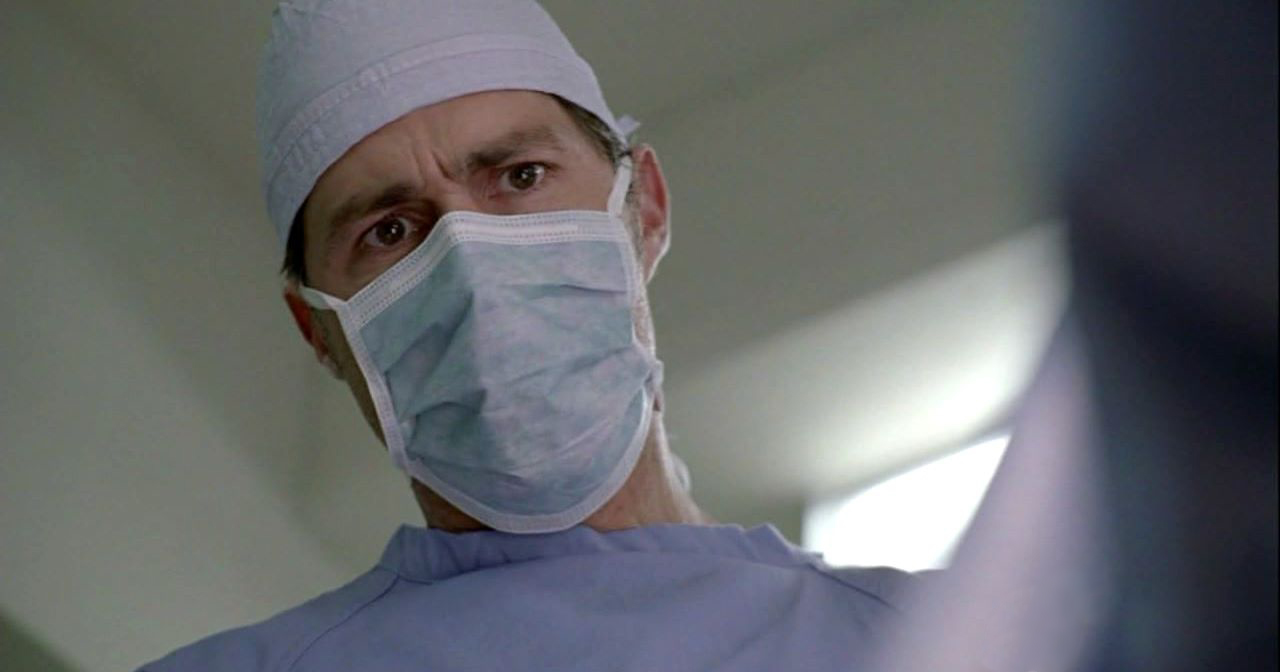
http://images2.wikia.nocookie.net/__cb20100429063406/lostpedia/images/0/02/6x13_IKnowHim.jpg
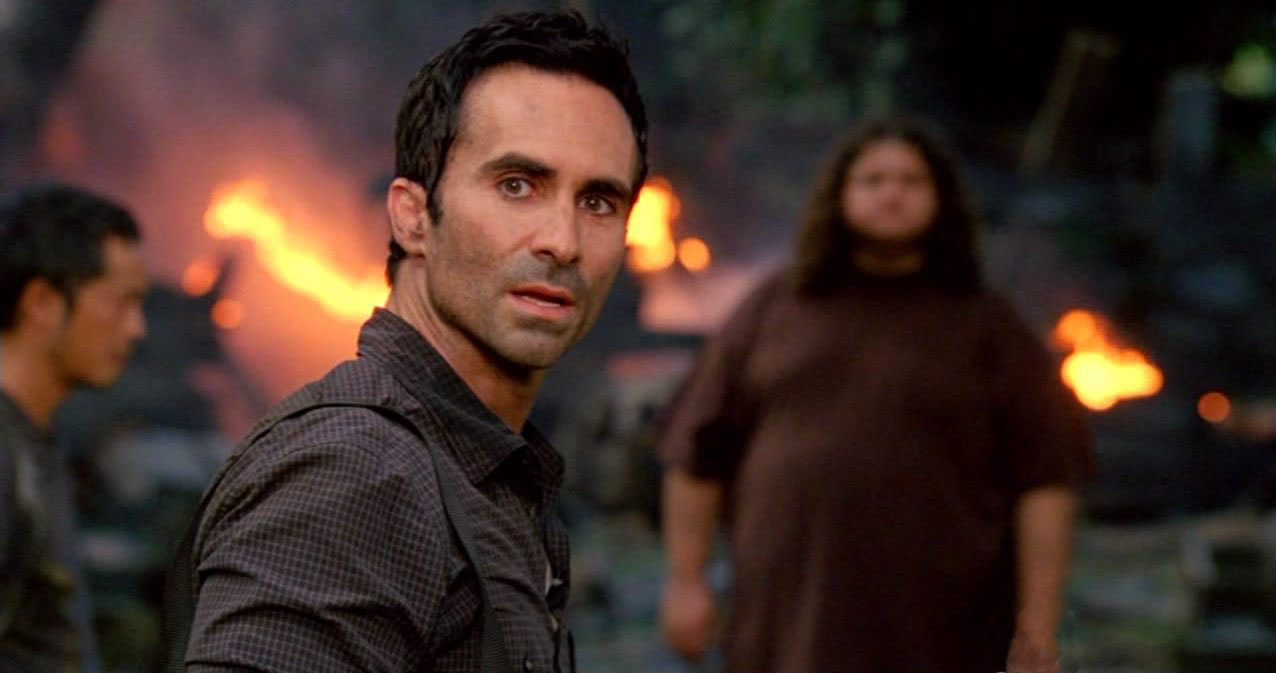
Flash-sideways Jack recognises his patient.
     My writings about Lost are going to become increasingly incohearant as we reach the finale, mainly becasue I don't particularly have much to rage about or praise. I did enjoy all of the character work that this episode gave us, especially in the interactions between Jack and the MIB. I won't say that I like the fact that Jack has gone from the show's representation of science and rationality and turned blindly towards faith, but it does certainly give Matthew Fox a lot of interesting things to do. The MIB is still an incredibly enjoyable villain, straddling the line between a man with understandable desperation and a complete and utter bastard who enjoys his manipulation.
     The Last Recruit was the last bit of peacetime we're gonna get around here. One last little adventure for our gang to undertake, one last moment for a bit of optimism. It had a lack of focus, but that really wasn't a problem as the character work for everyone was above par. Next week's episode is a complete washout of tears and misery as three of our major characters die in very depressing and somewhat suspect ways. See you there.

Thanks.

Tuesday, 16 April 2013

Review: Moonrise Kingdom

http://24.media.tumblr.com/b4314b9a5cd8dd7cb6ba90ac074c39be/tumblr_mq2oal8zPZ1qbxuwto1_500.gif
3.25 Mile Outlet.
Moonrise Kingdom
2012, Directed by Wes Anderson.
Written 13/4/13

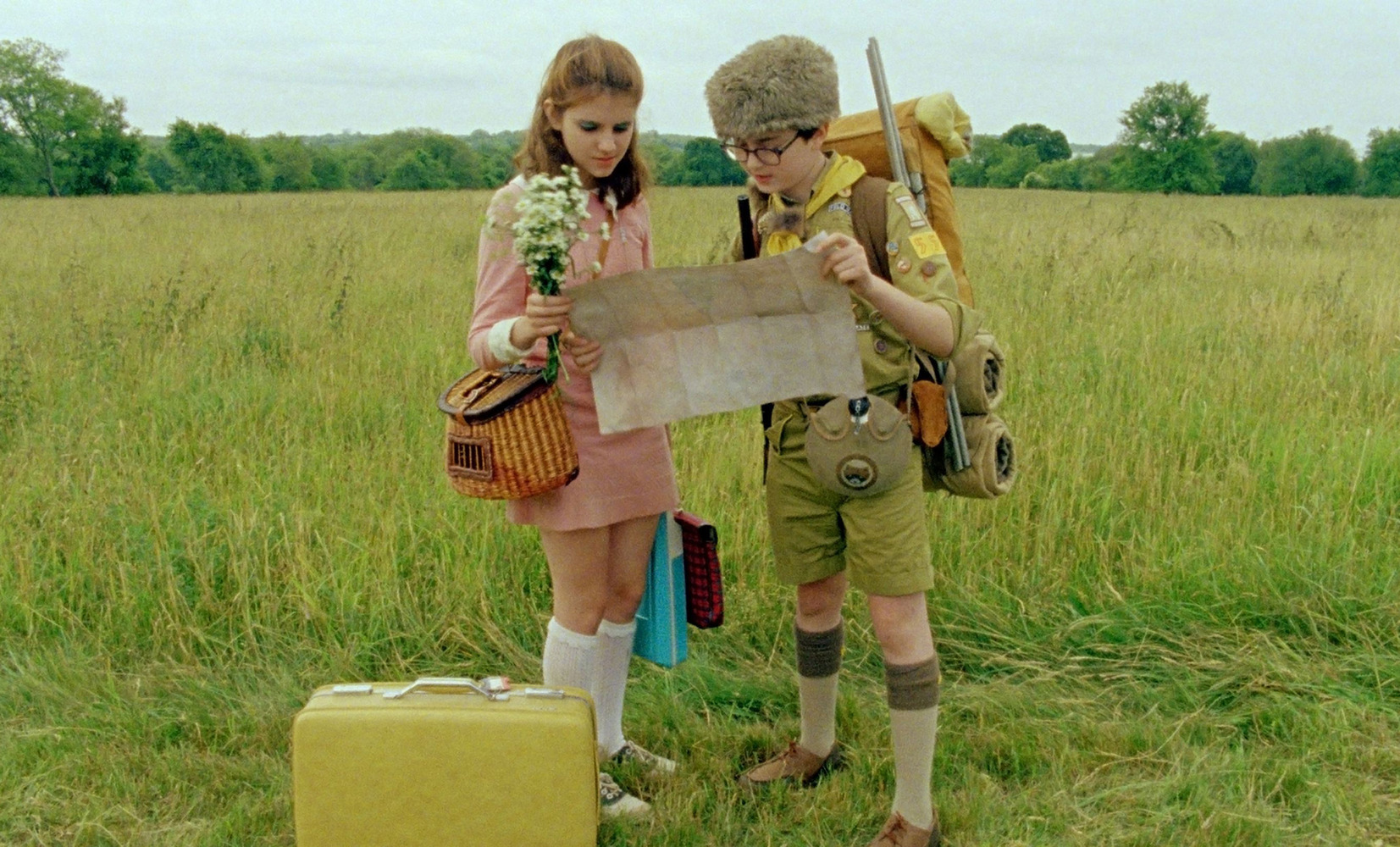
Wes Anderson is a director that I've not really experienced before, but his 2012 piece Moonrise Kingdom was an experience that I just had to tell you about. The film is one with a highly charged aesthetic, full of jump-cuts and shots meant to portray a sense of the make-believe, or the whimsical. Through this aesthetic, draped further with a soundtrack stuffed with French New-wave and light opera, Anderson delivers a script that examines all manners of human existence, from the innocence of young love to the cynicism of middle-age. It throws out a number of standard children's comedy tropes and then casts them in a delightfully darker light. Don't be fooled by Moonrise Kingdom's whimsey - there is something dark and deranged hiding behind it all, and that's what makes it all worthwhile.
      It's 1965. Sam Shakusky (Jared Gilman) and Suzy Bishop (Kara Heyward) are both maladjusted children living in uncomfortable circumstances on the fictional New England island of New Penzanzce; Sam as an orphan permenantly drafted into the Scouts (led by Ed Norton's Randy Ward) and Suzy as a stressed-out teen living with highly dysfunctional parents Walt (Bill Murray) and Laura (Frances McDormand). The search for the two children is led by Island Police chief Captain Sharp (Bruce Willis), who soon grows to realise that his own life has been robbed of the innocence and drive that the two children, despite their personal problems, do possess. As the two children attempt to escape both their carers and the authorities, everyone involved is forced to re-evaluate their life-choices and question whether they did the right thing.
     The film's New England aesthetic, filled with forests, lakes and coves, contributes towards a thematic turn towards the fairy-tale. The film's quiet genius is that it manages to mingle the simplistic morality of the two children ("We're in love; we just want to be together") with the more muddy waters of Laura's infidelity and abusive nature towards her husband (who has two black eyes by the end of the film - ironic, considering some of the claims made against Bill Murray in real life.) There's a deliberate ambiguity as to which is to be prefered - the children's relationship almost mocks the later, with easily-resolved petty arguments and a faux marriage ceremony, while on the other side Bill Murray and Bruce Willis' characters both express regret at their current circumstances and have been driven to their pessimism by years of bad decisions.
http://sojo.net/sites/default/files/mainimages/blog/movie_-_Moonrise-Kingdom.jpg
Suzy and Sam run away from their troubles, and fall in love.
     Quite interesting, I find, is the film's pacing. One of the reasons that I think the characterisations work so well is due to the relaxed introduction into the story in the first half, where we explore the relationships between our characters to the full extent that we can. As an ensemble it's very well developped, with a lot of attention going into subconscious actions as well as just the dialogue, which is often used to derive most of the film's quirky humour. I definitely prefer that first part to the eventual climax and the blissfully happy ending, but that second half does clarifiy a lot of the first half's ideas and ultimately gives us some of the film's most memorable moments.
     Moonrise Kingdom was adored by critics but mostly ignored by the General Public, which is a damn shame. It's a film that mixes cerebrality and a thorough examination of human happiness with quirky direction and diagogue that is on its own heartwarmingly written. If Wes Anderson's technique and his tacit acknoweldgement of the medium gets on your goat, then I suppose you might have some problem here, but otherwise this is a hidden gem amongst 2012's film arsenal.

Thanks.

Monday, 15 April 2013

Review: Doctor Who 3.10: Blink

Carey faces the angels.
Doctor Who - Season 29, Episode Ten - Blink
Written 3/3/13

"Moffat!" I scream as I shake my fist into the sky. It's arguable that Blink is the story which won Moffat the role of showrunner, mainly because it's often voted one of the best stories in the history of the program. The love for Blink is immense from all corners - the public loved it, most of the fans love it, and it's won enough awards to make sure that it got the praise many felt it deserved. And, weirdly enough for a Doctor-lite story, it's a story often used to introduce new people to the show. I, however, am deeply conflicted as to whether Blink really does deserve its lauded reputation - mainly, of course, due to certain aspects of Moffat's writing.
     The story is an adaptation of one of Moffat's short stories from the 2006 Annual, "What I Did On My Holidays By Sally Sparrow." Here the pre-teen protagonist is sexed up a bit into the shape of at-the-time-up-and-coming actress Carey Mulligan. While investigating a spooky house, her friend Kathy (Lucy Gaskell) ends up being zapped back in time by the Weeping Angels. After the same thing happens to flirty police officer Billy Shipton (Michael Obiora), Sally discovers via Kathy's brother Larry that The Doctor has been trying to communicate with her via DVD easter-egg from 1969, where he and Martha are trapped. Following his instructions, she manages to send the TARDIS back in time and temporarily trap the Weeping Angels in the house. They then give info on the event to a time-travelling Doctor from before the events of the episode.
     Carey Mulligan's Sally Sparrow exudes a great deal of charm and she's an identifiable audience figure, but I really think this is more her acting than the script, which gives her rather blandly "weird" statements that don't really form cogent characterisations. Certain events, like Larry first meeting Sally while nude, feel like they've come straight out of a sitcom, and the characterisations reflect that. Sally is a hipster who thinks "Sad is happy for deep people" and takes pictures of abandoned buildings, whereas Larry is a harsh parody of Doctor Who fans that feels like a very bitter jab on Moffat's part.
Billy Shipton took the slow path.
    And that's the reason why it just doesn't feel as frightening or as wonderous to me as it does to others. I mean, I absolutely love the timey-wimey plot (and this is the origin of that term) and I think it's very well crafted, technically speaking. But when I watch, I can't help but see Sally and Larry as archetypes rather than people. There's nothing about Sally Sparrow that suggests to me that she's at all real - she doesn't seem to have a job, she doesn't have any family, and she has enough free time to go around taking photos of abandoned buildings on weekdays. 
     Now I'm not going to be mad enough to say that I think that Blink is bad, because it's not - as a piece of horror drama it's been shown that it scares the pants off of most people. But the gimmicky nature of the villain and the archetype-stuffed cast means that despite all of the love that people have for it, I just don't find it very memorable. It's nothing personal, just a simple matter of taste - Blink isn't my kind of Doctor Who. And, given what I've said on this blog about the parts of Who I have ended up liking, that shouldn't come as a massive surprise.

Thanks.

Saturday, 13 April 2013

Review: Doctor Who 7.8: Cold War

http://doctorwhotv.co.uk/wp-content/uploads/doctor-who-cold-war-promo-pics-27.jpg
The Doctor meets Skaldak.
Argh! Yay! This is the first Ice Warriors story since 1974, and their 39 year absence from the show has meant that they've gained something of a fabled status in the Doctor Who Fandom. I myself only took a look at one of the Ice Warriors stories, The Seeds of Death, a couple of weeks ago. They're such a great villain because behind an admirably scary exterior thay have a complex biology and a set of societal rules that makes Star Trek's politics look fairly uncomplicated. Cold War wasn't perfect, and contained a number of things that were rather odd, but it was a perfectly executed base-under-siege story and both honoured and revived the Ice Warriors in the manner they deserve.
     It's 1983 at the heart of the Cold War, and an Ice Warrior awakens from a block of ice on a Russian submarine, having slept for 5000 years. Just as things are getting prickly, The Doctor and Clara arrive, in time to discover that the Ice Warrior is Skaldak, an ancient Ice Warrior "hero" known for breathtaking feats in battle. They try to keep him in chains while The Doctor tries to sort out the democratic incident that this has created, but Skaldak escapes from his armour and almost triggers the submarine's nuclear weapons in an attempt to kill humanity. Just as Skaldak accepts that there isn't really a reason to commit genocide, an Ice Warrior spaceship turns up to whisk him away.
     Mark Gattiss delivered this week what was probably his best script, balancing his habit of turning the episode into a period piece with a genuine stab at an old monster that both respected their complexities from the Classic Series while also adding other elements. There was always the danger that a modern writer could turn the Ice Warriors into generic, slow-moving aliens, and I am very glad that Gattiss was able to pull it off. Skaldak, certain dodgey pieces of CGI aside, was a wonderful villain with tons of nice juicy complexities.
http://doctorwhotv.co.uk/wp-content/uploads/doctor-who-cold-war-promo-pics-6.jpg
Clara finds that Skaldak has left his shell.
     As is Base-Under-Siege tradition, we also had a fair number of guest characters. Liam Cunningham, last seen in Game of Thrones after the embarrassment that was Outcasts, works the standard leader role and isn't given the standard "evil Russian boat captain" schtick that usually arrives with these kinds of characters. Of notability was the rather odd Professor Grisenko, whose boundless enthusiasm in the body of an old man made me immediately suspicious of everything he said and did. (It's that kind of show).
     Basically, a barn-storming success. Cold War was Doctor Who at its most classical - a blending of Classic and Nu that united the two in glorious union. I can't really think of any way that this script could have been better, and it's given me a really positive feeling about what it currently looking like an excellent string of episodes. The first half of Series Seven was very hit and miss, but somehow the second half has managed to recapture the essence of the show that I originally grew to love. Cold War didn't just follow that, it cemented it, and I'm sure that it'll be remembered as a classic for years to come

Thanks.

Thursday, 11 April 2013

Review: Cannibals

Cannibals
Written by Rory Mullarkey, directed by Michael Longhurst, currently showing between the 3rd and 27th April 2013 at the Manchester Royal Exchange Theatre

http://static.guim.co.uk/sys-images/Arts/Arts_/Pictures/2013/4/9/1365508536080/Cannibals-Royal-Exchange--010.jpg
Photograph: Jonathan Keenan, for The Guardian
Cannibals is a play that shows, behind a very well-executed exterior, a troubling inexperience. It is a play that rather unfortunately leaves many ideas painfully undevelopped, and the main point of the play gets lost towards the end. What makes this rather tragic for me is that I rather enjoyed the Royal Exchange Theatre production, and I feel that the main thrust of the play was quite subtle and nuanced. It was the advertised content of the play, what amounted to a last-minute subplot, that left me wondering what it was all about.
     The story followed Lizaveta (Ony Uhiara), a woman from an unspecified ex-Soviet state whose life is drawn into tragedy when her husband is killed by a local milita and she is forced to escape to a local village, where there are tales of suffering and loss as well as rumours of cannibalism. Later, Lizaveta is swept from her last comfortable surroundings and sold to a wealthy Manccunian man as a mail-order bride. The play was sold on that last line, and it's a shame because that only really takes up the last ten minutes, the narrative climax coming rather earlier when a spotless monologue by Uhiara basically dredged through her painful life story. As such, it felt tacked on an unnecessary.
     Not a difficult thing on its own, but for the amount of effort that went into this final, almost denoument-like segment of the production. Not only were the themes and ideas presented at odds with those in the rest of the play, there were several clever techniques that actually worked pretty well. One such technique was the representation of Lisaveta's confusion at her surroundings through a lanugage-switch, having all English be Russian and so forth. I wanted this part of the play to be more developed, but it just seems to end on a narrative note that references the play's beginning but has little to say in regards to change.
     One could argue from an artistic perspective that the nature of that segment of the play was deliberate; like Lizaveta, we have been robbed from our comfortable surroundings and the future for our characters is unclear. The problem comes with the pacing - had there been ten more minutes or so spent on that part of the plot, it would feel more like a tragic final act than an add-on that robbed time away from the other developing subplots. One such subplot refered to the history of cannibalism in the village, and while it was adressed admirably through some implicit dialogue, the confrontation that was needed never arrived.
     There was nothing wrong in any of the play's execution - the direction was top-notch, and exploited the theatre to full effect. The troupe was on top-form and I found Uhiara's performance especially commendable, spending the entire 105 minutes on-stage. It's a blessing of the Exchange that the quality of their physical production can elevate any script, and I really did enjoy myself. I would go and see it; I haven't spoilt too much, and I think it's for the viewer to really decide whether the issues that the play presents in the eleventh hour gel with the rest of the play's more developped themes or otherwise.

Thanks.

Wednesday, 10 April 2013

Review: Doctor Who 7.7: The Rings of Akhaten

http://www.radiotimes.com/rt-service/image/render/Doctor_Who__The_Rings_of_Akhaten_review.jpg?imageUrl=/uploads/images/original/28148.jpg&width=620&height=374&quality=85&mode=crop
Clara offers up her Leaf, which carries all the lost potential
of her mother's life.
Written between 9th and 10th April 2013

Hey y'all. Sorry I'm late with this, I was in Wales and there was very little internet reception and we were burning sweet wrappers to keep warm and tons of other stuff. Luckily, I did get to see this week's episode, The Rings of Akhaten, which despite having a few nitpicks managed to work so much good into the fundamentals that I didn't really care. New writer Neil Cross is obviously someone I want to look out, what with his life-affirming concepts and one of the best alien worlds in ages.
     Trying to discover what the hell's going on with the present-day version of new companion Clara, we discover The Doctor looking back through her history, retelling the story of how a stray leaf helped her parents to meet, and how Clara was affected by the tragedy of her mother's death. The Doctor then picked Clara up and took her to the Rings of Ahkaten, a system of asteroids surrounding a massive sun that carried many species, all coming to witness the continuating of an ancient tradition - the Song, which was used to keep asleep the great God Ahkaten. Witnessing the ceremony for the first time, The Doctor refuses to let young Merry Galel (Emilia Jones) have her memories eaten by the Old God, and offers his own experiences in order to try and defeat him. Eventually, it's left to Clara's leaf and the potential it holds to save the day.
     The episode's wonderful exotic setting was complimented by a set of stunning visuals that swapped Moffat!Who's standard blue pallete for a set of warmer colours. Ooh. That sounded a bit Changing Rooms. Anyway, the episode looked great, and that only helped the fact that this is one of the first genuinely new alien worlds since probably The End of the World. The idea of a world that sues memories and sentiment as currency was something both novel and fits in well with similar themes thoughout Moffat's era so far. Except, done better.
http://img.ibtimes.com/www/data/images/full/2013/04/08/360288.png
The Doctor offers his memories to Akhaten.
     One of my friends argued that the episode is simply another of NuWho's Power of Love endings, and while I see where they're coming from I disagree on the implications of that statement. It's a matter of context - previous Power of Love endings have let the power of emotions do things that were previously outside of the series' defined parameters: the ability to weld steel with love in Closing Time, a love-powered spaceship in Fear Her. The nature of emotions in this story was established very early on, and it isn't just a random solution, it's a theme that runs through the episode and allows us to see our characters in a better light, culminating in a speech each for Smith and Coleman, the former almost making me tear up.
     I get the impression from the fandom that this episode isn't well liked. But each to their own, eh? I love the Rings of Akhaten - it's Doctor Who that's both smart and emotionally charged, that balances both complex characterisation and a set of well-executed ideas. It was fun to watch, it looked good, and it's gonna go down as one of my favourite episodes from Matt Smith's era so far.

Thanks.

Review: Lost 6.12: Everybody Loves Hugo

http://images3.wikia.nocookie.net/__cb20100416020349/lostpedia/images/0/02/6x12_WhereIsJacob.jpg
Richard and Hurley have a falling out.
Lost - Season Six, Episode Twelve - Everybody Loves Hugo
Written between 2nd and 3rd March 2013

It's turning into one of those seasons again, although my distaste here stems very much from personal opinion rather than massive leaps in logic. The flash-sideways storyline is stuffed with sufficient mushy love stuff that I am thoroughly tired of it, while the main story didn't really advance at the pace I liked. It felt very much like filler, moving from the mid-season arrangements to our final layout before the grand finale and the episodes preceeding it.
     Hugo was spoken to by the ghost of Michael, who told him to blow up the Black Rock and stop Richard from doing the same to the Ajira Plane. Ilana was blown up by dropping some dynamite, and Richard, Miles and Ben went off on their own to destroy the plane while Hurley, Jack, Frank and Sun went to Locke's camp. With Desmond in his position, Locke questioned him before throwing him into an ancient well. In the flash-sideways, millionaire philanthropist Hurley was accosted by a semi-awakened Libby, and despite his doubts he was able to awaken with very little prodding from Desmond. Oh, and Desmond runs down Locke with his car. That too.
      I will admit right here and now that I am perhaps affected by several different things here. Namely, this is one of the only episodes of Season Six that I missed on broadcast - we went to Wales on Holiday around that time and the Sky box didn't record it properly. Thus why it doesn't have as much impact on me as the rest of the season has the potential to. Furthermore, a lot of this episode hinges on the viewer's memory of the Hurley/Libby relationship... which I've never seen, having only seen the first and last three seasons. I am rather exposing myself here to how drastically unqualified I am,
     The core problem, I feel then, is that this is a centric episode of the style we saw earlier in the season with Sundown and The Substitute, etc, except that this has just come after last week's massive plot mover. Next week is a pretty big plot episode too, and so Everybody Loves Hugo feels very much out of place as the series' final single-centric episode. I mean, we've just been told that the main timeline and the flash-sideways are intimately connected, and that people from the flash-sideways can remember their time on the island. It was nice to see Hurley undergo that process, but it felt like we met his story much later than the other survivors. It's all very last minute.
http://images2.wikia.nocookie.net/__cb20100503044628/lostpedia/images/0/01/6x12_Let%27sGoOnADate.jpg
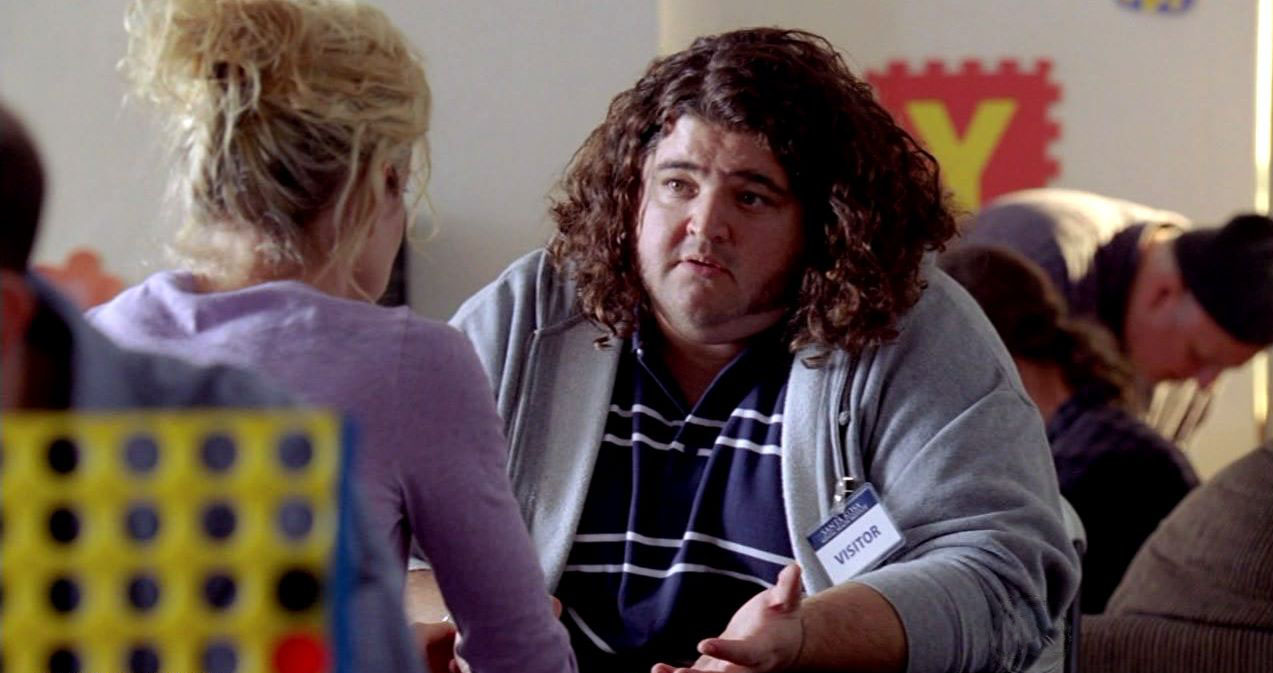
Hurley meets Libby in the Flash-sideways.
      There were a few positives in the main timeline, though. The Man in Black and Desmond had a great set of conversations, with The MIB utterly baffled as to why Desmond is so unafraid of him. The split between science and faith in Richard's camp felt very important thematically, especially when Jack explained that he felt he couldn't make up for causing Juliet's death (which endeared him more to me by far) and so had resolved to listen rather than try to lead people into disaster. That was really good for me to hear, especially after all the Jack-bashing I did last season.
     Everybody Loves Hugo, apart from one or two character changes, was fairly inconsequential. It was a movement of chess pieces around the board before some of the final moves, and although it explored some of the themes presented in the previous episode it did so in a way which failed to live up to it. And, probably because I've never seen Season Two, I didn't really care much about Libby and Hurley in the Flash-sideways. It felt rather unfortunately like filler, and that was my only real problem with it.

Thanks.

NEXT WEEK: Who will be The Last Recruit into MIB's camp?

Monday, 8 April 2013

Review: Doctor Who 3.8-9: Human Nature and The Family of Blood

http://images1.wikia.nocookie.net/__cb20111028224259/tardis/images/7/72/Baines_(Son_of_Mine).jpg
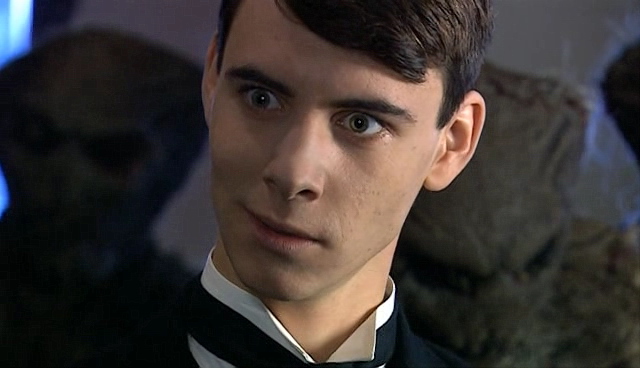
The creepy Son of Mine leads the Family of Blood
Doctor Who - Season 29, Episodes Eight and Nine - Human Nature and The Family of Blood
Written 2/3/13

In the Wilderness years between the cancellation and the return, the only source of new Who were several series of books, running under various different companies - the most popular of which can be said to be the Virgin New Adventures. The thirty-eighth novel in that series was Human Nature, written by the erstwhile NuWho writer Paul Cornell. Like Blink next week, prose was adapted to screen and we got this rather interesting two-parter that juggles examinations of historical attitudes with a scathing deconstruction of who The Doctor really is. It has the moral ambiguity that the series held during the Wilderness Years, and that's probably one of its main selling points.
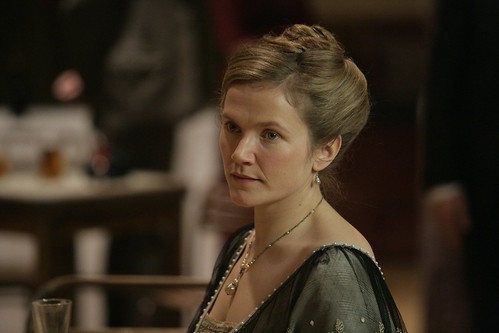
     The Family of Blood are an alien family of amorphous smoke who have been chasing The Doctor in order to adapt his Time-Lord DNA and live forever. Planning to let them die out, the Doctor uses a machine to change him into a Human and put his Time-Lord consciousness into a pocketwatch - a Chameleon Arch. Five months later, and The Doc is living as John Smith in a school in 1913, a product of his time who hires maid Martha to do his handywork for him. Martha is troubled when John falls in love with Nurse Joan Redfern (Jessica Hynes) and the Family of Blood catch up with them. With the Watch kept safe by young boy Timothy Latimer (Thomas Sangster), John Smith must face the reality of becoming The Doctor once again, losing his human identity.
http://farm5.static.flickr.com/4092/5150415610_55d097b6f6.jpg
Joan (Jessica Hynes) falls in love with John Smith and is
forced to put The Doctor in his place.
     The New Series has a massive habit of really pumping The Doctor up beyond his means. We know the Tenth Doctor has an ego, and it's one of that the series is very happy to stroke. But this episode sorta takes that down a level, by throwing all of this hype at a normal person and seeing a real reaction to it. John Smith isn't just scared by the idea of losing his life to become The Doctor - he also thinks that The Doctor is kind of a dick. This gets some concrete confirmation when Joan inquires to a flirting Doctor whether his presence on Earth caused so many people's deaths.
     The continuation of the Martha/Doctor dynamic is really well done, too. The show never pretends that their relationship is healthy one, and John Smith's rascist abuse of Martha only encourages that. She's put up with five months of abuse from the locals, especially with the imperialist attitudes surrounding colonial wars in Africa. The rest of this series is basically gonna see how much abuse we can put Martha through before she finally leaves - like, almost non-stop. And she still gets battered by fandom. Bah.
     Those colonialist attitudes underlined the story in many other ways, taking on the guise of a Wilfred Owen-style criticism of the dulce et decorum est attitudes of the Edwardian era and how they led to large numbers of casualties in the First World War. There's a wonderful sense of that impending doom that makes the attack by the awesome Family of Blood that more ominous. I do think that the episode goes an incy wincy bit over the top with this, with it ending on an aging Latimer attending a Remembrance celebration in the Present, but I do love the way the idea is implemented.
http://i301.photobucket.com/albums/nn41/sue_denimme/Family_of_Blood_542.jpg
David Tennant is awesome in this story, by the way.
     The question that Human Nature/The Family of Blood asks is simple: would you actually want to be The Doctor? It's an admission that the moment you lose the Classic Series' perception of The Doctor as a travelling magician who pops from place to place and enter this modern era of The Doctor being a universally famous action hero, then you must also accept that he's no longer the same kind of role model. The Doctor here is not someone that we (or, for that matter, John Smith) would want to become, and that is the kind of nuanced portrayl of the character that I so enjoy. The two-parter is complex and bold while still providing a fun narrative for the kids, and that is one definiton of perfect Who.

Thanks.

Thursday, 4 April 2013

Review: Survivors 2.6

Whitakker has Peter held captive.
Survivors - Series Two, Episode Six
Written 23/2/13

In the first series of Survivors, the problem came not with its core ideas but in the way it treated its characters, unable to escape their core tokenisms as created by the series' modernisation. The second series realised this and gave most of the characters more complex motivations, which is one of the reasons why it's vastly better than its predecessor. The only problem now comes in its simple lack of ambition - it doesn't know whether to carry on as a realistic examination of a post-apocalypse Britain or to go into full sci-fi conspiracy mode. The result is a finale that shoved a series of exposition into five minutes, and did very little for the remainder.
     Still in the PSJ facility, the gang found scientist Fiona Douglas, who revealed that Peter had been taken to the facility for a short time and has the same immunity against the virus as his mother. She explained that she had created from their blood a vaccine that targeted all forms of the flu, and that she needed a short amount of time to work on it. While Whitakker was captured by the group, refusing to reveal Peter's location in a local static caravan park, she finished the vaccine. Evidence on Whitakker's computer shows Greg that PSJ had a larger role in the virus' spread, with it beginning in China a whole year before the outbreak. The vaccine is tested on Al and it works. Fiona lets Whitakker go in exchange for a place on his plane; the group ends up in a confrontation with a man named Landry at the airfield, who explains that his company was attempting to create a vaccine for all forms of flu, and created a secluded paradise filled with chosen individuals when the experiments went awry. While Peter is returned to his mother and the vaccine heads off to be mass-produced, an injured Tom ends up hiding on Landry's plane.
     The final few minutes of pure exposition do tie up a lot of new ends, and had the ideas been explored fully (and perhaps hinted at from the beginning), then they would have real potential. The central arc with the mine seems to have distracted away from that, leading to this rushed conclusion to the central mythos, and that I feel is in part one of the reasons why the show was canned. It all goes a bit Lost, really, and not in a way that Survivors can support.
Landry comes out of the woodwork as the virus' creator.
     It's weird whenever I come to the end of a series. Especially when this is one of the first series that I long-hauled on the blog, and one of the ones I had the most fun tearing apart. Survivors suffered not from being inherantly bad, but from a lack of that spark the seperated it from all the rest. That, combined with the unintentional year gap between its series, meant that it sorta ran out of steam even when the writing wasn't half bad. It died because of mediocrity and public apathy, and because it made several mistakes in its first series that the second just couldn't fix. And that's a shame.

Thanks.

IN TWO WEEKS: I start reviewing the second series of TORCHWOOD! "cue cheers" And this time, I won't be unfairly ripping into it...

Monday, 1 April 2013

Review: Doctor Who 3.7: 42

https://blogger.googleusercontent.com/img/b/R29vZ2xl/AVvXsEhNStqJp6otVOXj64FWPg6YfyzmA9kEpIi_N12ihyHfDCOxG95ElLGTNetc7ZqxOxV2XNUvnCdSvRzk-ucBnvfMkGq_i3hwl9-kW2S9DCgYR8G3DNm2YzUWrNN_5iQEqB4cXVx3UfTQQI8b/s1600/42.jpg
It's a very Red episode...
Doctor Who - Season 29, Episode Seven - 42
Written 21/2/13.

Me and ol' Chris Chibnall have had a rough time. My main frustration comes from his inconsistency as a writer - there are a number of his works (mainly outside of Doctor Who) that I really do enjoy for many reasons - usually to do with strong characterisations and well-executed concepts. And then there are his real fuck-ups: every episode he's written in the Moffat Era, for example. While I do sometimes respect him as a writer, I don't want him anywhere near Doctor Who and I was very worried when he wrote not only two episodes of the September Season in 2012, but also wrote pieces bookending it. Despite my anguish, I'm of the opinion that 42 is... not bad.
     The core concept is sound if fundamentally stupid - the Doctor and Martha arrive upon a ship destined to fall into an alien sun, with a real-time countdown timer punctuating every scene. The sun turns out to be sentient, and has infected members of the crew and sabotaged the ship due to the Captain's use of illegal tech to scrape out the sun's core. There's a point where The Doctor gets possessed, Martha gets stuck in an airlock - it's a bit of a run-around. The idea of a sentient sun may be fun but is fundamentally quite silly, as a sun is just Hydrogen fusing into Helium, and there's not enough complexity for even simple metabolic processes. That doesn't really affect the episode's impact, though. We have the big guns, here.
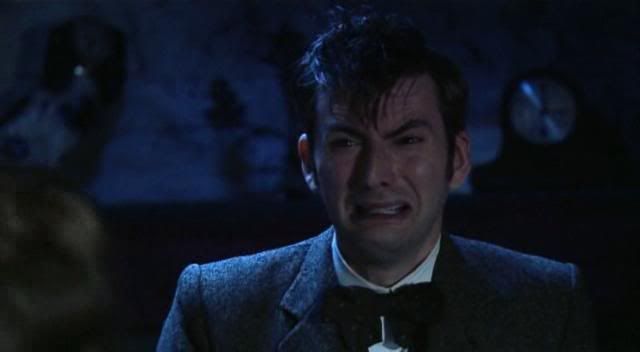
      And by big guns, I mean director Graeme Harper. Harper is one of the best directors the series has ever had, and directed two of my favourite Classic Stories (Caves of Androzani and Revelation of the Daleks). His sharp style and appropriation of the real-time element gives the episode a sense of constant action and tension that never really lets up, and is one of the episode's main saving graces. He takes what could have been rather bumpy bits in the script and turns them into great moments - my favourite of which is probably a moment of vacuum-induced silence as Martha's escape pod drifts away, The Doctor helpless. There's also a wonderfully primal scene when the Doctor is possessed, and Tennant's whimpering and screaming makes the whole affair seem more brutal than they're allowed to show.
http://newslang89.files.wordpress.com/2011/10/doctorwho42.png
I tried finding a good pun. Settled on,
"Turn around, Bright Eyes!"
     If there are some downsides, its the guest cast. Michelle Collins' Captain is yet another person to add to the "annoying guest cast" list, as Chibnall takes the stereotype of strong sci-fi captain and throws it in the wrong direction, turning her into a delusional idiot who is constantly soppy and can't recognise that her husband is no longer there even when he's burnt two people to death. Also rather terrible that the only crew members who get outright killed by the sun-possessed zombies are the women - nice vote for gender equality there, Chibbers.
     42 doesn't have anything new to offer the world, but what it does have it manages to process and package in a way which is consistently entertaining. In terms of Chibnall's career, this is pretty middle-of-the-road - by no means the worst thing he's ever done, but not his ultimate high either. Taken on its own, the script is fairly average, and it's a mixture of outstanding direction from an unlikely source and the sheer conviction of its main players that carries it forward into quite an underrated experience.

Thanks.

NEXT WEEK: Paul Cornell returns with an adaptation of a book that features living scarecrows, creepy immortal schoolboys and David Tennant's best performance in anything, ever. It's Human Nature/The Family of Blood.