Saturday, 10 November 2012

Review: Merlin 5.6: The Dark Tower

After a season of neglect, Angel Coulby's Gwen
got a hell of a lot more to do.
Usually I can tell if an episode of Merlin is good or not within the first 15 minutes. The Dark Tower presented something all over different, and for the vast majority left me incredibly confused as to whether the story was absolutely first rate genius or tripe of the most smelly and unpleasant kind. Julian Jones' characters seemed to have gone all weird on us for some reason, but unlike last week's shitstorming stupidity on the part of Merlin, the characters were different in annoying subtle ways. Frustraingly, this actually helped the story do what it was trying to do character-wise, and for once Morgana's scheme turns out to be absolutely brilliant.
     Gwen and the Knights, sans Arthur and Merlin, head out to pay respects to the Queen's dead father. On the way back, their troupe is ambushed by a fairly resourceful Morgana, who poisons a few of them with magic vision-giving venom and takes Gwen to the hallucination-inducing Dark Tower, a place of legend that Knights are taught to fear. While Merlin is suddenly super-confident and helps Arthur get through to the Tower,
Morgana tries to make Gwen like her by leaving her alone in a chamber that shows all of her friends laughing at her. Elyan drives forward through the traps despite Arthur and Merlin's cries for him to stop. In a fight with a magical flying sword, Elyan is fatally wounded, and dies in Gwen's arms. As they return to Camelot, it is revealed that Morgana's mindfucking has turned Gwen into what Morgana was in Series Three.
     While I was pretty pissed when I read the synopsis for next week about how Morgana's got a spy within Camelot (for reasons that I'm sure I'll spell out in full detail next week), I do love how we can see Gwen's slow turn to the Dark Side. For once, Morgana actually used psychology is a good way and the way it mirrors her own transformation is actually pretty awesome. Their interactions, beyond the slightly slashy tone to it all, were by far this episode's best quality.
Seriously, these guys have zero security.
Morgana keeps ambushing them, it's something you think
they'd catch on to.

     Meanwhile, the guys on the team seemed to lose their normal characterisations, especially Merlin. It was really baffling for me, especially as this is written by series-creator Julian Jones. Merlin stopped being the slightly nervous yet brave young man and instead spent the episode as the tough-faced action hero who speaks in heroic and prophetic statements. I think it was a mix of the writing and something that Colin Morgan had perhaps eaten that week, but it threw the episode off completely and left me wondering what exactly was going on.
     This episode left me both optimistic about what Merlin is able to accomplish with its characters and pessimistic about how weird the characters seemed to be even under the leadership of the series' creator. At the moment, the final series seems to be hovering on the edge of a few good ideas, and even though next week will be an advancement on a plot idea that's literally been used in 50% of the series' stories, I still don't know if Merlin has lost its momentum or is simply hiding it.

Thanks.

Friday, 9 November 2012

Review: Red Dwarf 10.6: The Beginning

Dat Simulant Ship.
Red Dwarf - Series X, Story Six - The Beginning

The Beginning made me both very happy and very, very sad. On the one hand, it was an interestingly made and action-packed finale that had a lot of nice idea and exploited well all of the characterisations at play. On the other, it took a fundamental part of what makes Red Dwarf what it is and completely removed it, finishing the process started in Trojan and completely and utterly ruining Arnold Rimmers character. There has to be a Series XI, if only to give the show a proper conclusion, but I will be very annoyed if this betrayel of his character has large effects on the series.
     A visit by strangely racist archetype Roguey Hoagie, a rogue droid obsessed with his destablisiation ray and duals across space and time, leaves the ship vulnerable to attack from a group of Rogue Simulants who are intent on revenge and destruction. While the crew escape on Blue Midget, they accept that they are going to die; Rimmer plays a last holo-message from his father, who tells him that he is in fact the son of their incompetant gardener Dungo; thus, compared to his family's accomplishments, Rimmer is a hero. This inspires Rimmer to find a way to destroy the Simulants, which he does as his first act as a Common Man.
     The essence of the Rimmer/Lister dynamic is most adequately described in Series II's Thanks For The Memory. There, a drunk Rimmer explains the problem; Lister is a complete and total bum - a waster whose instinctive intelligence is left behind, and yet his life has gone relatively well by his own standards. On the other hand, Rimmer has desperately tried his entire life to be the model of sophistication and power, driven by his high-acheiving family and their pressure on him. Despite this, he is incompetant, snide and, by his own standards, completely worthless. The battle has always been between a man who thinks he should be better and man who is better but doesn't care. As of now... Rimmer and Lister are on a level playing field. And that sucks.
     The episode, however, wasn't terrible and it had a lot of great moments. I enjoyed the perception of the Simulants as a dictatorial society run by a snide Dominator, as well as the scene wherin he deliberately implies that one of his generals should commit Seppuku before informing him to simply polish the blade. Elsewhere, and there was a cheeky reference to the ending of Only The Good..., which despite being something I'd wished to forget, at least allowed Dwarf some humility. (If still not explaining whether this Rimmer is the Original or the Duplicate.)
Hoagie The Roguey
     The Beginning left Red Dwarf's future uncertain. Perhaps instead of a sneaky reference to the pilot episode, The End, The Beginning tells of a new era in Red Dwarf's history - a NuDwarf of sorts. Whether that's something I want, or something the world needs, is to be decided. But for now I can say that this series has been... ok. It's been as good as I expected it to be, and despite its many failures it's good to see Red Dwarf back on our screens with a new spirit and ideas.

Thanks.

Wednesday, 7 November 2012

Metaphysics and Gene Hunt

Thanks to the Life On Mars wiki for this convenient
and wonderful image.
Listen, I know this article is total bullshit. But it's here. Hopefully the last in my three-part series on Metaphysics. Written 5/10/12.

The worlds present in the GHTTB are fairly consistent for the vast majority of its run. The Coma World (I refuse to ascribe to the silly Limbo theory and explain away that solution as Alex's fevered dreams in the few moments of semi-consciousness before death) runs parallel to reality and is affected by what is happening to said Coma World's host. In Life On Mars, Sam is the world's Host. His memories of 1973 create a brown world with cowboy cops like Gene Hunt, one in which he faces his parental issues and in which he learns how to feel happy with his life. For him, while the world around him is definitely produced by his own head, that does not dismiss its validity as a reality.
     More than Alex, Sam's world is very much affected by the status of his body in Reality. He is much more prone to hallucinations, blackouts and delusions due to too many meds, the return of old colleagues, the death of a mentor - there's an explicit chain between the realities that creates many a plot point and, indeed, most of the tension in the series. Unlike the cheeky reference to the Creator connection in Back To Earth, the Bonanza has a much more personal and powerful singular Creator - one that is unwilling. This makes its status in the quantum multiverse more troublesome, because that would imply a causal link between the Sam of the Bonanza's reality and of the Universe elsewhere, as opposed to a single entity.
      Alex's world reflected her memories of the Eighties, which for her were tainted by not only her mother's affair but the death of her parents and her eventual adoption. While Sam's attempts to change his Coma World were in order to return home, Alex's were always a lot more personally motivated - she didn't just remember Tim and Caroline Price as her parents, but she had also grown to respect them as people while in the Coma World. While Alex has fewer (but more vivid, usually) hallucinations than Sam, she has a much stronger bond with the Coma World than she does with Reality, which helps to explain why she is unable to escape.
Sam gets more crazy shit, but that's because
he's more in tune with Reality.
     Ashes To Ashes went all weird on us during the gap between the final two seasons, presenting a third reality that was supposed to represent Alex's death in the operating theatre. Time dilation between Universes is a common theme in the Bonanza, and thus explains why the moment of death was seen as a completely different reality from the moments of believed post-death. Strangely, Alex's stronger connection to her personal Coma World can be seen here as well - even in this reality within a reality, Gene and the crew of CID bleed through and her "awakening" is not to the real world, but to the 1980s. While it may just seem to be weird for the sake of being weird, it instead presents the largest part of the metaphysical theory surrounding the Bonanza as a whole.
      In the Life on Mars and Ashes To Ashes universe, the greater poignancy with which you remember one's past, the stronger bonds you form within the world created by your mind. Sam was sent back to 1973 because that was the year his father ran away, an event that, while it had troubled him, isn't seen to have had a large effect on Sam in the present. Alex, on the other hand, was eyewitness to her parent's murder-suicide, and the following years of foster parenting by the man who arguably led to said event (by having an affair with her mother) made sure that it became imprinted on her mind. When Alex heard Sam's description of the Coma World, she instantly became obsessed with the idea of causality within such a vivid world and that is the reason why she is so much more in tune. For Sam, it remains 1973 throughout his entire stay in the Coma World. His experiences and memories are stagnant, unchanging. Alex's time moves rather swiftly, comparably.
      One constant remains in both worlds that lends credence to the idea that the Coma World is in fact part of the Quantum Multiverse, and exists as a Parasite Universe that can only be controlled by the counterparts of those in Reality. Gene, Ray, Chris, Annie, Shaz, Martin Summers - these people all once existed in Reality, outside of the Host's memories. What does that mean, then? Who is the Host when these guys aren't around? If we are to preserve the Coma World without straying off into Limbo territory, then we have to concede that the quantum doubles created by this parasite Universe can live on after their counterparts in Reality have already died. And that, perhaps, is why both Sam and Alex end up dead, even though the former was able to escape. To create a double in another Universe, you must incapacitate, remove or kill the original in Reality. The reason why there was a connection between the two Universes was that this doubling up created an unstable point - a weak spot, allowing one reality to spill over into the other.
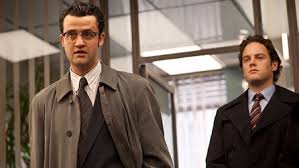
This theory doesn't cover Keats. But I try to ignore him,
despite how wonderfully he's played by Daniel Mays.
      This, then, becomes consistant with our exploration of Red Dwarf. If a Universe created via Hallucination is maintained by said person, then there will be inconsistancies where reality and the imagination of the host collide in a sort of cosmic reaction. In BTE, it was Lister's acceptance of the reality's true nature that allowed Kochanski to form within it, and it's because both Sam and Alex realise what's going on that their worlds are so relatively affected by the outside. The Gene Hunt Time Travel Bonanza, for all of its bullshit regarding demons and limbo, can be turned into an interesting collection of sci-fi concepts that neatly explain exactly what's going on without even touching the supernatural. It may not be actual proven science, but it's still fun and I'm glad that this series of articles has allowed me to examine this.

Thanks.

  << Red Dwarf - Back To Earth ----------Metaphysics---------- ||                                                      

Monday, 5 November 2012

Review: Misfits 4.2

Sadie is held captive by Finn.
Man, I wish Misfits had episode titles. Written 5/11/12

While last week's premier was ok, it didn't really capture a lot of people's imaginations. In that regard, this week was a hell of a lot more confident with its characterisations and dilemma, picking up the cliffhanger from last week and turning it into a funny if crude examination of love and gender roles. I suppose you could say that it was Finn-centric, but the episode managed to juggle all of its characters and give them a decent amount to do - even if, for some reason, Karla Crome's character doesn't seem to be getting a lot of focus.
     As Finn (Nathan McMullen) continues to for some reason hold his girlfriend hostage, gagged and tied up, the new probation worker (Shaun Dooley, whose performance I am absolutely adoring) orders the four to help out at a sculpting class for the blind. There they meet a beautiful blind girl, Ally, who Curtis initially likes until it turns out that, despite being blind, she is incredibly racist. Rudy is kicked out of his accomodation, and barges into Finn's place to stay the night. Soon he becomes suspicious of his locked room, and when the gang confront him he reveals that Sadie, his girlfriend, had a mind-control power that forced him into being the perfect boyfriend. In order to preserve his free-will, he's gagged her so she can't effect him - but he doesn't want to leave her, since she's his first girlfriend and he's still in love. When Frudy releases Sadie, Finn initially goes back to being under her control just to make the relationship work - until Jess has Seth do one last job before he returns to Africa, taking away Sadie's power and ending their relationship. As the episode ends, we find that there's a smoking-hot new trainee-probation worker, Lola (a much more aggressive Lucy Gaskell, Being Human and Casualty) eyeing up the group.
     If I thought Nathan McMullen was a bit shakey this week, he's come into his own here. His character beats are a subtle mix of Nathan and Simon - he's a social pariah, but he's like that with good reason. The dilemma of the episode is actually quite a topical one; was Finn right to go to the lengths he did to retain his personal freedom in the relationship when he'd only ever been good at being a boyfriend while under her control? It's a greater argument about whether personal freedom is better than the overall greater good, and that's a very poweful message to be inserting alongside the nob gags and three, count three, sex scenes.
S4-Ep2 Preview Pictures
Lola (Lucy Gaskell) looks like trouble.
     The blind girl subplot was a tad weird, to be honest. As Rudy lampshades, the series seems to be throwing an awful lot at us under the umbrella of, "the storm did it." In this case, a blind woman (who somehow happens to be racist) has been telepathically connected to her guide dog, who rather literally acts as her eyes now. It gave Curtis and Rudy something to focus their efforts on this episode, but it only led to an oddly vulgar sex scene involving clingfilm and a rubber band. New character Alex, who's probably going to provide Jess's main subplots in this series, was strangely cryptic and ultimately unsatisfying.
     However, this week did manage to have a bit more pacing and drive than the premier, as well as providing better characterisation for Nathan McMullen's Finn. It felt like Misfits again - the gang back together, all working towards common goals. I get the wonderful feeling that the loss of Nathan, Simon, Alesha and Kelly really won't harm this series in the way that I was afraid it would - Rudy and Finn now feel really engaging and this episode at least shows that they can carry an episode on their own. That leaves one missing link - Jess, who despite Karla Crome's best efforts seems to be left out. Hopefully this will improve, given time.

Thanks.

Review: Doctor Who Classic: Meglos

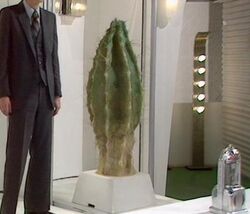
Someone's a bit of a prickly customer.
Doctor Who - Season 18, Story Two - Meglos
Written between 10th and 11th August 2012

Meglos is a funny little story, really. It tries to do so much, and yet at its heart it ends up being a rather unassuming runaround. It's got some really well-executed ideas, but there's also a lot of seemingly unintentional silliness that smothers a lot of the issues and ultimately just highlights the story's incredibly predictability even in absurdity. It is a bit fun though, as Tom's dual performances carry the story out of mediocrity.
     A few hundred years ago, the planet Zolfa-Thura was annihilated by a nuclear war fighting over a nuclear-power source called the Dodecahedron. Now the twelve-sided-shape is at the centre of the civilisation on neighbouring planet Tigella, ruled by the scientifically stringent Savants and the batshit-insane cultists the Deons. In order to stop them from killing each other, coordinator Zastor aims to invite back his old friend the Fourth Doctor to find out what the multi-pentagoned-thing actually is. He's intercepted along the way by Meglos, the last surviving Zolfa-Thuran who happens to look like a massive sentient shape-shifting cactus. After trying and failing to trap The Doctor and Romana in a complicatedly-named time loop, he takes on The Doctor's appearance and steals the Dodekaeder under their noses. Having never heard of "good P.R.", the perfectly and wonderfully rational Deons decide that the best course of action would be to sentence The Doctor to a good old ritual sacrifice. Luckily the Savants stop them in time and they track Meglos back to Zolfa-Thura, where he's turned back into a cactus and blown up by his own machinery.
     The episode has a really good cast, especially Tom Baker, who's absolutely loving the evil role. The leader of the Deons, Lexi, sees a return to the series for Jacqueline Hill, who played the first companion, Barbara, from 1963 till 1965. It's a shame that her character is so absolutely hateful, but her performance is tempered by that of the reassuring Edward Underdown. Romana is actually great here, and it's the first time that I've really taken to the characterisation as something other than a copy of Mary Tamm's incarnation.
The shape whose faces number
greater than 11 but lesser than 13.
      Using the Savants and the Deons, the episode tried to show a dichotomy between religion and science, discussing tolerance between the two sides. This suffers from one very simple problem; the moment that the discussions between the perfectly sane and the batshit insane really gets going, we're introduced to a talking cactus. Any signs of a serious discussion are completely annihilated the moment that he appears, from the funny repeating scenes in the TARDIS time-loop, to the later scenes where the Deons prepare to sacrifice the Doctor in a manner not unfamiliar to the geniuses over at Monty Python. Not that I necessarily wanted Doctor Who to do the religion debate, because I'm fairly biased in that regard, but the episode presented itself in a certain way and it feels so inconsistent in its execution.
   One of the notable technological parts of the serial come with Scene Sync, a technology unique to this serial that allowed the producers to better create chroma-key shots, and is used to great effect in the fourth episode to display the surface of Zolfa-Thura. It's a real shame because it's used so sparingly that I just thought it was good old CSO. It's certainly better, though, than the stuff that would later go on to be used in both Timeflight and Arc of Infinity, both of which looked were horriffically fake.
     I had a lot of fun with Meglos, sure, but it came not out of the way the story entertained and more out of the patent absurdity of the premise. At the end of the day it was forgettable, predictable fun, but so much of the story went to waste and it's a real shame when the story itself promised to tackle some big if uncomfortable issues. Meglos could have done so much more, but it settled instead for some old-fashioned, comfortable content that didn't live up to expectations.

Thanks.

Saturday, 3 November 2012

Review: Merlin 5.5: The Disir

I will avoid the temptation to make a Monty Python joke. For now.
If there's one thing that this new, darker Merlin is still pretty good at, it's taking opportunities to further the myth and simply get on with telling the story and completely and utterly fucking them up. The Disir was a rather bad example, because it came rather close to actually making some progress. How radical would that have been, eh, to actually make some progress near the beginning of the season and then present some interesting scenarios. But no. The writers of Merlin, even when they make a tremendously good episode like this, just can't do it.
     The Disir, the mightiest court of the Old Religion, give a coin to a bloke named Osgar, who passes it on to Arthur. The coin is a rune that acts as his judgement, predicting his death at the hands of Mordred. Arthur, initially skeptical, becomes obsessed with discovering why the Disir are so pissed off at him. Merlin talks to Killgarrah, who of course tells him to off Mordred whenever he gets the chance. Arthur soon becomes restless, and asks Merlin to take him to the Disir to face judgement. Mordred, knowing what's going on, asks to come-with, and Arthur lets him. The Disir give Arthur a good talking down to, and as they escape with an injured Mordred, Merlin lets the three know that there's at least one magical person in the Kingdom. He ends up with a moral dilemma; he is the only one who can save Mordred's life, but he doesn't know if he should. Arthur decides that the best tac will be to head to the Disir and beg for them to save Mordred's life, so he and Merlin go out to them. They tell him that they'll only help him if he promises to embrace the Old Religion like the rest of the world. Arthur asks him what he thinks about magic, and Merlin has a kerfuffle before sprouting some stupid Utherian shite against magic. Luckily, Mordred is fine when they return, and Merlin realises what a total and utter twat he's just been.
     And that really baffled me. There are moments here and there where I'm often taken out of a show's narrative because characters stop acting like themselves and start acting as the writer needs them to act to shove the plot in a particular direction. The best example is probably Season Five of LOST, but this was just as good - Merlin reverted to Series One and took the Dragon's advice as 100% gospel, when he knows that the Dragon can be an opinionated dick and his advice never really helps. Merlin had an opportunity there to do what he's been working towards for four whole series now, and because the plot says so he sprouts some complete and utter bullshit that doesn't even feel right in-universe.
Merlin doesn't just grab the Idiot Ball, he absorbs it.
     But. And it's a big but. I did love this episode up until that point. It managed to mix together the mythos of the show with its characterisation, making Arthur seriously consider his stance towards magic and actually having members of the Old Religion calling Arthur out on the bullshit of his fathers' that he's still spreading. There were some nice character beats from the main trio, and while Merlin's situation was bullshit driven by the writers (I mean, why did he call Kilgarragh in the first place?) it was certainly good to see Colin Morgan doing some quite brilliant acting. Everything seemed to work this week, up until that point where unfortunately the writers' wish to keep to easy story formulas made sure it didn't pull through.

Thanks.

NEXT WEEK: Morgana has another kerazeeeee scheme! I wonder if she'll win this time?

Thursday, 1 November 2012

Review: Red Dwarf 10.5: Dear Dave

Lister accidentally (or not so accidentally, I don't know)
chats up Vending Machine 23.
Red Dwarf - Series Ten, Episode Five - Dear Dave
Written 1/11/12

The lesser the budget, the higher the quality. That's always been a very general rule on Red Dwarf, and in this very, very low budget episode of a series that's already strapped for cash, there had to be something to say in the rule's favour. Dear Dave, I think, was much better off without cash to spend, as it instead took the whole episode to develop Lister in a really fun way that took the inklings from Fathers and Suns and developed them into real ideas. Themes and ideas from across the series were re-addressed, and done so in a way that combined slight vulgarity with absolute hilarity. It's my favourite episode so far.
     Lister is down about the Human Race, sad that he's the last member of his species; the other members of the crew are unsympathetic. While Rimmer gets a message from the computer that he will be demoted to the same rank as Lister if he doesn't find a reason to take a sabbatical, Lister accidentally hits on Vending Machine 23 and Vending Machine 24 gets jealous. A mail pod arrives containing dozens of letters, one of them from one of Lister's old flames, telling him that her unborn child may be his. He scrambles to find the letter following, and in the process helps Rimmer to write his sabatical report. It turns out that Lister isn't the father, but he's over it.
     The vending machines have been incredibly well-used this season, after first showing sentience at the end of Series VIII being voiced by a tired Tony Slattery. Here Isla Cole (I think that's the name, IMDb has nothing) voices both, and manages to create two distinct and funny characters. I do think that the vending machine plot was a little out of the way, but then again there wasn't much to the main plot either. I'm still not sure whether this episode's thinness of plot was a good thing or not - it allowed for decent character development while keeping the laughs high, but it never felt consistent and the solution to all of the plot strands felt unsatisfying.
Never ask Cat to play charades.
     But it was interesting too, and all of the actors really got their chance to sink their teeth into the role - especially Craig and Chris, who both really feel as though they're used to playing their characters again after such a long time. And that was weird, really, as at times the episode felt very similar to those first two embryonic series in which the characters were just being developed. And that was to its credit. I really did quite enjoy Dear Dave, and while it wasn't as pacey or imaginative as the good old days, it still make me chuckle in its own way. Next week we visit the provocatively titled The Beginning - is this the End for Red Dwarf?

Thanks