Showing posts with label DW18. Show all posts

Tuesday, 25 August 2015

FTA: Doctor Who Classic: Spearhead From Space, The Androids of Tara, Full Circle and Logopolis

This second volume of articles from Celebrate, Regenerate! covers the Third and Fourth Doctors. (See here for more on this project.)

Spearhead From Space (120 Words)

Spearhead From Space is the definition of an archetypal Doctor Who story, and it defines the Tom Pertwee era almost as much as Inferno and Planet of the Spiders simply through a combination of luck, skill and what really feels like hard work. The story’s greatest blessing comes directly from the initial strike which prevented them from using video, and while it does start the Colour Era off very grainily, it also makes sure that the beginning of Pertwee’s time on the program looks and feels epic. Adding to that is the absolute wunderkind that is Robert Holmes, whose script mixes humour, scares and interesting concepts to provide not only a great opener, but also a monster that would be remembered by children around the country for the rest of their lives. 

The Androids of Tara

So often these days, The Doctor is off saving the Universe time and time again. I remember the good old days. When The Doctor wasn’t saving a galaxy, or even a planet, but a small feudal kingdom on a planet of humanlike aliens far away from everything we know. The Androids of Tara, a barefaced if loving adaptation of The Prisoner of Zenda, takes Doctor Who the furthest it has ever been into the realm of fantasy, facing us with Princes, Princesses, Counts and Peasants, as well as the odd robot dog. What I love most about Androids is simply that the story not only adapts the fantasy setting to a more Doctor Who world, but that the transition is completely seamless. Only Doctor Who could take entire scenes from another work word for word and mess around with it enough for it to feel like a bona-fide Who classic.
     The story’s most memorable feature is by far the erstwhile Count Grendel, a villain whose villainy extends to such epic proportion that by the end he’s given up all pretence and is simply telling the officials around him to abide by his evil plans for the sake of common decency. His goatee, his incredibly potent voice – Grendel is, after maybe Count Scarlioni, one of the Classic Series’ most fun standalone villains simply for how much he gets away with. My favourites of his scenes are the scene in which he casually tells the Archimandrite that he needs a Wedding, a Funeral and another Wedding in quick succession, and his final words – “Next time, I will not be so lenient!”
     The story also allows us some fun with doppelgangers, allowing Mary Tamm a whopping four credits as Romana, Princess Strella and the android duplicates of both. Luckily, the story avoids playing this device for comedy, and thus it’s an actual shock when The Doctor appears to strike Romana down at the end of part Two. On that. This story’s cliffhangers are great too. First our heroes randomly start to fall unconscious, then The Doctor bludgeons Romana in the back of the head, and then Grendel manages to steal Romana from under The Doctor’s nose. It all ties together to produce a story that, while derivative in the extreme, is fun from start to finish in all of the good ways. 

Full Circle

My first encounter with this story came due to the wondrous popularity of my name, which informed me as a child that this was the story that apparently I had written. That had always made me excited to see it, even when I learnt about (and experienced) Adric’s bad turns. For me, this was a sign that surely this JNT guy was great – hey, he allowed fans to write for the series. I think I secretly hoped that one day I’d be able to write for the revived series, and while that hasn’t quite come true I do spend a lot of my free time writing articles, like this, about my favourite TV show.
     What, then, of the story? What Full Circle does exceedingly well is to take a sci-fi idea and make it work in lots of different directions. The story’s main boasting point (and its biggest spoiler, don’t say I didn’t warn you) is the reveal near the end, where it’s discovered that the suspiciously-human-looking Alzarians are not the descendants of settlers from Terradon, but instead the hyper-evolved descendants of the planets’ native Marshmen, who had rushed to fill in the void when the crew of the Terradonian ship had died. There are subtle hints as to this throughout the story, presenting the idea of hyper-evolution and, unlike a lot of its bedfellows in Season 18, executing it properly.
     The story’s biggest contribution to the series is probably Adric, named after influential particle-physicist Paul Dirac (who predicted the existence of Antimatter) and possibly one of the least-liked companions in the show’s history. Of course most people will tell you that he’s not as bad as the stereotype says, and I’m one of those people. Despite how whiney and annoying he can be sometimes, at heart Adric is just a perfect representation of a troubled teenage boy trying to fit in. He’s flawed, sure, but those flaws fluctuated with his writers and in his initial story he’s actually one of the highlights.
     Narratively, Full Circle presents a strange turn for Classic Who, at least in this stage of its life. Two seasons prior had seen a big arc in the form of The Key To Time, but this was the first time that a narrative arc (or, more commonly for the JNT Era, a trilogy) had been dropped in the middle of a season. I’m strange, really, in that I think that Full Circle is perhaps the most entertaining story of the three in the E-Space Trilogy. It has cool monsters, an interesting and well-executed sci-fi idea, and proof of sorts that fans can actually write good Doctor Who. Which is always a nice thing to hear.

Logopolis
(Main article.)

It was the end of an era that had lasted seven years. The Tom Baker years are often heralded as the show’s Golden Age, featuring classics like Genesis of the Daleks, The Pyramids of Mars, The Hand of Fear and The City of Death. It’s strange then, that Baker’s final story in the role doesn’t hearken back to those halcyon days but instead chooses to look forward to the style that would be prevalent in the rest of the JNT era.
     The first outing of the Ainley Master shows off both sides of his character – the cackling, scheming madman and the clueless panto villain. One gets the feeling that this Master has bitten off more than he can chew, but he always manages to adapt his schemes to cause the most pain and suffering as is possible. In fact, going by death count, this accidental scheme is the Master’s most profitable, managing to destroy one quarter of the entire Universe. It’s amazing how his first serial manages to be so representative of his tenure – bumbling and incompetent most of the time, but dangerous when he manages to succeed.
     Logopolis is rather unique, in a way. There’s no setup, no normal, “The Doctor lands on planet X, meets villain Y, defeats villain Y and pops on his way.” No, the story (for the most part) feels a lot more fluid and refreshing. And while in some parts this manifests as Tegan trying to blow up a spare tyre, elsewhere it provides insights into The Doctor and Adric’s characterisations. This structure provides the story with that unique feeling that Tom’s swan-song needs, as well as facilitating the wonderful sense of forboding that the character of The Watcher creates.
     Important to note is that Logopolis not only ends the Tom Baker era, but also the wonderful Season 18. I like the storyline running through the season, but I tend to get bogged down when it comes to the individual story. Bidmead’s vast supply of technobabble doesn’t make this story any different, but what it does do is tie together the season’s themes of entropy and loss together into a single thesis.
     And so the era of Tom Baker is over. But don’t worry. For the moment has been prepared for, especially by JNT. At the end of this story, the TARDIS is stuffed with three companions, two of which have arrived somewhat traditionally and one which doesn’t really need to be here. Together, they advance into Doctor Who’s uncertain future – the true beginning of Eighties Who. It may be the end of one era. But there’s another still to come.

Thanks

Friday, 30 November 2012

Overview: Doctor Who Classic: Season 18

Tom and Lalla were a fun team, but their personal
relationship got in the way of their acting.
Written between 30th August and 2nd September 2012 

Season 18 of Doctor Who is always called boring, and I don't believe that's entirely true. I say entirely for the simple reason that, unfortunately, a lot of the season sorta is. Newly-promoted John Nathan Turner wanted to turn the show away from the silliness it had become soaked in during the reign of previous producers Graham Williams and Douglas Adams. In doing so he hired scientific journalist Christopher H Bidmead, a man who brought not only great real-life ideas but also a lax way of using them. He also took up Tom Baker's resignation, and began preparations for a new Doctor and new companions.
     The problem with using real-world science as your standard technobabble is that those words actually mean something. Oh sure, Pip 'n' Jane Baker may boast about how Strange Matter is a real thing, but that doesn't make the science in their episode any more ridiculously wrong. If anything, using real terms and ideas only highlights when you're doing it wrong. Thus in our first story of the season, The Leisure Hive, where Tachyons, a real world concept, are strangulated. Again in Logopolis, where Mathemathics, Entropy and Gravity are all bastardised by the man himself. Furthermore, while these ideas are certainly interesting and add a lot of maturity to the series, they are not enough to carry a story by itself, leaving the characters to wander around doing standard, run-of-the-mill things. The only stories that really manage to carry themselves under their own weight are the odd Meglos and the slightly Shakespearean Keeper of Traken.
     The series themology, surrounding the idea of Entropy and the end of all things, fits well as foreshadowing of the Fourth Doctor's demise, but a lot of the stories in the season only barely cover it. In The Leisure Hive, entropy is seen in the life cycle of the Argolins, who live for long periods then suddenly start aging and turn to stone within a month. Meglos saw the failing planet of Zolfa-Thura, and of the society on Tigella. In Full Circle, Alzarius collapsed back into the time of the Marshmen, and in Warrior's Gate the Vampires' society is already run down. In Warrior's Gate the Gateway Realm is collapsing and in The Keeper of Traken sees the autumn years of the titular character's reign. Logopolis, despite not really getting what Entropy is, caps off the season by seeing actual Entropy destroy stuff and seeing The Fourth Doctor's demise. It's a themology that really isn't immediately obvious until Logopolis, and even then we get an extra theme surrounding Recursion to cross over into Season 19.
Thanks for the ride, JNT. You'll be missed.
      Overall, my experience of Season 18 has been rather a downer. I like good Who and I like bad Who, but Season 18's mix of stories, while intellectually stimulating, just weren't entertaining enough to sustain my interest. I loved the themes, the ideas and the overal storyline, but the stories themselves were incredibly dense and I often struggled to get through them (State of Decay and Warrior's Gate being the biggest offenders in that regard.) After loving the rest of the JNT Era, I was disappointed that his first season was so lifeless and dull. Now that my coverage of the JNT era is over, I'll be heading first back to the season that caused this whole mess, Season 17.

Thanks.

Monday, 26 November 2012

Review: Doctor Who Classic: Warrior's Gate

Bircon ain't got the noive.
Doctor Who - Season 18, Story Five - Warrior's Gate
Written 30/8/12

This is the last of my "new" stories from the JNT Era, and that's made me rather poignant about the past few years. Now, my journey through JNT is over; no more being amazed at characters written on a whim, no more wondering exactly why the story was filmed in Amsterdam, and certainly no more trying to defend myself from other fans' opinions (although a lot of that will still go on.) Despite this, I wasn't really prepared for the final few shocks that Warrior's Gate had in store in its mix of high-concept sci-fi, incredible boredom and absolute what-the-fuckery.
     While trying to find a way out of E-Space, the TARDIS is dragged through a Time-Rift by a mysterious Lion-headed-man named Biroc. On the other side, they find themselves in a white void where there's nothing but null co-ordinates, an ornate gateway with a mirror in it, and a large space-ship featuring a crew led by toughie Rorvik. Through some investigation, they discover that the lion-headed-people are called the Tharils, and their time-sensitivity allows them to plot co-ordinates in the Gateway Realm. It turns out that they used to rule this realm, using humans as servants, until a violent uprising left the Tharils as their slaves instead. While the Tharils are at least guilty for their actions in the past, Biroc and his crew treat them as Cargo and are prepared to destroy the Gateway Realm to cross into the Tharil's world. Luckily, the Doctor helps Biroc to free all of the Tharils and get them itno their dimension before Rorvik destroys the place. The Doctor and Adric head off back into N-Space while Romana and K9 choose to stay behind in E-Space, helping Biroc to free more of his kind.
     The visual aethetic of the story, while appropriate for the script, makes it incredibly bland and lifeless. The ship is a mix of military grey and ocean grey, while the crewmen's orange jumpsuits made me feel like I was watching Red Dwarf VIII. The beginning of the story, like that of its predecessor, is very hard to get through and there are similar periods of immense tedium throughout. Less, I may add, than last week, due mainly to Steven Gallagher's brilliantly conceptual script that uses grey-vs-grey morality to make every action the Time Lords take dangerous. The problem comes when the Tharils end up looking slightly better for it; their human servants are just knocked about a bit, wheras the Tharils under human slavery are tortured, sold and treated as bonuses rather than people.
Romana bows out. Without much ado.
     The story takes a while to pick up, and when it does it makes little sense. The best thing in it besides the concepts present is villain Rorvik, whose "I just want to do my job" attitude is much more ruthless than JNT's other executions of that character. He's clearly mad, but you can see the seeds of what drove him to it - his workaholic attitude, the many attempts to escape the Gateway Realm, a cynical crew. Rorvick's collapse into madness, culminating in the crazed cry of, "Finally I can get something done!" makes him a psychiatrist's wet dream. Not that it was particularly pleasant to watch, that is. Madness or no madness, Rorvick's sheer dickery made him a character easy to despise.
     Warrior's Gate made me rather regret taking on Seven's era before I went back to this season. Had I done it the other way around, then my final JNT story would be the wonderful Survival, whose themes would suit my ending better. It also did not suit me to be bored! The problem with Season 18 is that while the higher concepts and themes on show did make the show a lot more adult than the previous season, the show never really executed these ideas with the required dexterity. Warrior's Gate is no exeption. The sequences required to show us the dichotomy between the slavery of Humanity and of the Tharils seemed forced in there, as if the script was limiting itself. For the most part, Warrior's Gate was interesting to me on a few levels. But on very few was it entertaining.

Thanks.

NEXT WEEK: We turn back the clock one year to see what caused all this...

Monday, 19 November 2012

Review: Doctor Who Classic: State of Decay

The Three Who Rule, looking appropriately hammy.
Ooh, doesn't the one on the right look like
Matthew Baynton from this angle? No? Just me? Ok.
Doctor Who - Season 18, Story Four - State of Decay
Written 19/8/12

Vampires, vampires, vampires. Who doesn't just love a bit of bite and suck, eh? Ever since the Victorian Era, those suckers have been on our screens in a million different forms, and they took cinema by storm due to the simple fact that hey, they're cool. Unsuprisingly, Doctor Who took on Vampires many times, both deconstructing them (Smith and Jones, Vampires in Venice) and taking them entirely too seriously (The Stones of Blood, and today's story.) State of Decay doesn't so much reference Vampire myth as much as it bathes in it, all the while wondering exactly whether it's trying a little too hard.
     Still stuck in E-Space, the Doctor and Romana head off from Alzarius and decide to stop and ask for directions on the nearest inhabited planet. When they get there, they find a degenerating society of subservient peasants, living under the control and reverence of the Three Who Rule, vampires themselves in servive of The King Vampire. The Doctor, taking a second to look up his history, discovers that these Vampires are powerful creatures from the Dark Times who were hunted to near-extinction by the Time Lords - apart from their even-more-ultra-powerful leader, who managed to escape through a CVE onto the planet he's currently sleeping on. While the Vampires try to convert Adric and sacrifice Romana, The Doctor uses his research knowledge to organise the resistance movement and storm the castle, using one of the Vampires' spaceships to stab the King Vampire through the heart and end their power. Everything sorted, The Doctor, Romana and Adric pop off in the TARDIS, The Doctor fully intending to send him home.
     The Vampires in this story skirt the lines between myth and cliche. A lot like The Daemons and later The Satan Pit, the creatures in this story purport to be those that inspired the myths in Human lore, which goes to explain some of their more cliched aspects - pale skin, fear of certain herbs, reliance on the blood from the living to survive. Of course, these are just human scouts who have fallen under the influence of the Great Vampire, but that doesn't explain their eyeshadow. This "big secret fascade" thing keeps reoccuring in Season 18 - Pangol is a child of the machine, what appears to be The Doctor is in fact Meglos, the Alzarians are decended from the Marshmen - it says a lot about what the season is having to do with its ideas. Sure, the concepts are there and the ideas are strong, but does that a good story make? No, and so the season has to rely on revelations, has to rely upon twists and turns in order to inject some suspense into things.
Romana just tried to get through a montage of the
story's slow bits.
     And that was my biggest problem with State of Decay. It was so... so run-of-the-mill that it didn't invoke any response in me, apart from a chuckle at the few jokes and a slow awe at Tom's monologuing (which I could listen to all day.) I mean, there were some fun bits here or there that dealt more openly with the sci-fi bits in the premise, but that Draculean stuff with peasants, Lords and chosen ones was bland as all hell. Even something like The Androids of Tara, which was based entirely upon a story of Lord and Ladies, managed to make said story really, really fun. This? Well, I liked bits of it, and the overall premise, but it felt much like trying to make my way through a shallow bog; there were high points, but the low points were boggy enough to dampen the whole enterprise. I can't laugh with it. I can't even find anything to laugh at. And I certainly wasn't on the edge of my seat.
      This is a Terrence Dicks script, so I don't want to be so down on it, but there were long stretches where it was simply far too dull. The end result certainly isn't bad, by any stretch of the word, but it is burdoned by an overemphasis on some of the traditional elements of Vampire folklore, which tend to whitewash the interesting, creative new ideas. This story won't be remembered as "the one with all the Gallifreyan lore." It'll be called, "That one with the vampires." And while that may not be a bad thing, the story just doesn't execute its key concepts with enough dexterity to keep me sufficiently interested.

Thanks.

NEXT TIME: I finish all of JNT, and the E-Space Trilogy, as we try to pass the Warrior's Gate.

Monday, 12 November 2012

Review: Doctor Who Classic: Full Circle

The Marshmen are the Alzarians' ancestors.
Doctor Who - Season 18, Story Three - Full Circle
Written 16/8/12

As I a child I always wanted to see this story, for the simple reason that writer Andrew Smith shares my name. The first fan-written story, Full Circle was commissioned to introduce new companion Adric and to begin JNT's first arc, the E-Space trilogy. What does having a fan-writer mean to the serial? Well, there are a few problems here or there, but fundamentally it's much more interesting and well-done than you'd expect. It's a story of tolerance, of trust and of the dangers of ignorance. And about stealing river fruit.
     On their way back to Gallifrey, the Time Lord Twosome encounter a spacial anomaly which, despite the TARDIS telling them they're in the right place, has sent them to a green-tinted parallel world. They land on the planet Alzarius, where the human-like natives retreat from the Mistfall into their spaceship, which they believe carried their decendants from the planet Terradon. A young Alzarian called Adric ends up encountering the TARDIS, and together they enter the ship and witness an attack by the native Marshmen. The Doctor discovers that the Alzarians are run by an oligarchy known as The Deciders, who have been hiding information from the public concerning their inability to actually run the ship. Looking at DNA samples of the crew and the Marshmen, The Doctor discovers that the Alzarians are in fact the Marshmen's decendants, and he finds the way to deter them. Having finally set the ship on its way, The Doctor and Romana go forth to try and find the exit to this world - not knowing that Adric has stowed away onboard.
     Adric, named after an anagram of revolutionary particle physicist Paul Dirac, is pretty much an accidental author-insert for the at-the-time teenaged Andrew Smith. Adric was supposed to be an effort by JNT to represent the show's key demographic, and it's perhaps unfortunate that the result is a character less identifiable and more irritating. In a few words, Adric is pompous, arrogant, incredibly assuming and yet ridiculously incompetant in all walks of life besides Mathemathics. He's fine with Tom, for the most part, but his real moments of annoyance come here and later in Season 19.
K-9 was used well this week.
     Season 18's high-concept sci-fi themes continue here, and for me this is the first one that really works - a highly adaptable species that is able to evolve into different forms over the course of only a few tens of thousands of years. The Marshmen look awesome, and their humanoid appearance lends credence to the idea that they are the Alzarians' ancestors. I also loved the idea of the Deciders and their endless bureaucratic procrastination, which evolved not out of their human failures but simply because they weren't in fact decended from the ships' original inhabitants. I wish that there'd been a few minutes more focus upon the overall arc story, but I get the feeling that this trilogy is a lot more loose than JNT's other arcs.
     Full Circle was a great 100 minutes. While it did unleash Adric upon the world, it also had a lot of interesting ideas and the interactions between characters were good fun. At the end of the day it probably wasn't very memorable, and that's an issue that so far has been plaguing this season, but the first part of the E-Space trilogy was a brilliant start and I'm looking forward to the last two parts of my look at JNT.

Thanks.

Monday, 5 November 2012

Review: Doctor Who Classic: Meglos

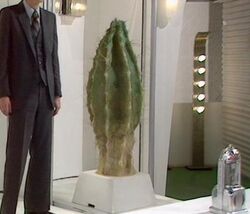
Someone's a bit of a prickly customer.
Doctor Who - Season 18, Story Two - Meglos
Written between 10th and 11th August 2012

Meglos is a funny little story, really. It tries to do so much, and yet at its heart it ends up being a rather unassuming runaround. It's got some really well-executed ideas, but there's also a lot of seemingly unintentional silliness that smothers a lot of the issues and ultimately just highlights the story's incredibly predictability even in absurdity. It is a bit fun though, as Tom's dual performances carry the story out of mediocrity.
     A few hundred years ago, the planet Zolfa-Thura was annihilated by a nuclear war fighting over a nuclear-power source called the Dodecahedron. Now the twelve-sided-shape is at the centre of the civilisation on neighbouring planet Tigella, ruled by the scientifically stringent Savants and the batshit-insane cultists the Deons. In order to stop them from killing each other, coordinator Zastor aims to invite back his old friend the Fourth Doctor to find out what the multi-pentagoned-thing actually is. He's intercepted along the way by Meglos, the last surviving Zolfa-Thuran who happens to look like a massive sentient shape-shifting cactus. After trying and failing to trap The Doctor and Romana in a complicatedly-named time loop, he takes on The Doctor's appearance and steals the Dodekaeder under their noses. Having never heard of "good P.R.", the perfectly and wonderfully rational Deons decide that the best course of action would be to sentence The Doctor to a good old ritual sacrifice. Luckily the Savants stop them in time and they track Meglos back to Zolfa-Thura, where he's turned back into a cactus and blown up by his own machinery.
     The episode has a really good cast, especially Tom Baker, who's absolutely loving the evil role. The leader of the Deons, Lexi, sees a return to the series for Jacqueline Hill, who played the first companion, Barbara, from 1963 till 1965. It's a shame that her character is so absolutely hateful, but her performance is tempered by that of the reassuring Edward Underdown. Romana is actually great here, and it's the first time that I've really taken to the characterisation as something other than a copy of Mary Tamm's incarnation.
The shape whose faces number
greater than 11 but lesser than 13.
      Using the Savants and the Deons, the episode tried to show a dichotomy between religion and science, discussing tolerance between the two sides. This suffers from one very simple problem; the moment that the discussions between the perfectly sane and the batshit insane really gets going, we're introduced to a talking cactus. Any signs of a serious discussion are completely annihilated the moment that he appears, from the funny repeating scenes in the TARDIS time-loop, to the later scenes where the Deons prepare to sacrifice the Doctor in a manner not unfamiliar to the geniuses over at Monty Python. Not that I necessarily wanted Doctor Who to do the religion debate, because I'm fairly biased in that regard, but the episode presented itself in a certain way and it feels so inconsistent in its execution.
   One of the notable technological parts of the serial come with Scene Sync, a technology unique to this serial that allowed the producers to better create chroma-key shots, and is used to great effect in the fourth episode to display the surface of Zolfa-Thura. It's a real shame because it's used so sparingly that I just thought it was good old CSO. It's certainly better, though, than the stuff that would later go on to be used in both Timeflight and Arc of Infinity, both of which looked were horriffically fake.
     I had a lot of fun with Meglos, sure, but it came not out of the way the story entertained and more out of the patent absurdity of the premise. At the end of the day it was forgettable, predictable fun, but so much of the story went to waste and it's a real shame when the story itself promised to tackle some big if uncomfortable issues. Meglos could have done so much more, but it settled instead for some old-fashioned, comfortable content that didn't live up to expectations.

Thanks.

Monday, 29 October 2012

Review: Doctor Who Classic: The Leisure Hive

Four and Romana go on holiday.
Doctor Who - Season 18, Story One - The Leisure Hive
Written between 6th and 7th July 2012

And we begin the weird and wonderful Bidmead era, a series characterised by its use of more interesting scientific topics and a massive reduction of the humour that threatened to sink the series the year before. So, what has Bidmead got for us? Well, this is cheating a little bit - this episode was made before he was even hired as script editor, but it's still an interesting look at the mixing styles of newly-promoted innovator John Nathan Turner and old-hand Executive Producer Barry Letts, who served as series controller across the Pertwee era. The story's structure is a bit unorthodox, and that causes a few problems, but for now the focus on ideas over humour does the serial justice.
     Removing the Randomiser from the TARDIS after having escaped from the Black Guardian, The Doctor and Romana decide to go on holiday to The Leisure Hive, a spa on the war-torn planet of Argolis. The Argolins are troubled; their race is dying due to their sterility, caused by experimentation with Tachyon technology. When the two try and investigate the Argolins' machines, The Doctor is aged dramatically and, together with Romana and other assistance, he manages to uncover one conspiracy after the other. By the end, The Doctor's age has returned to normal and everyone's hunky dory.
     The story's structure is very bottom-ended, with a ridiculously slow beginning that leads into a rushed expositional finale. The opening shot of a dull Brighton beach is two minutes long before we even see the main characters, and the first two episodes contain several long, long, model shots that go on forever and add nothing to the story. While television is a show don't tell medium, I think it's ok for us just to hear, "The shuttle has arrived." rather than wasting time watching it slowly enter into the docking bay. Luckily this slow start gives our characters a lot more room to breathe, and the politics and beliefs of the Argolins are rather wonderfully explained in great detail. It's such a shame, then, that the main villain's plan only starts at the end of the third episode, and we rush through the end to ensure everything's tied up properly.
David Haig plays the slimey Pangol.
     I loved the episode's villain, Pangol; an Argolin created using their Tachyon technology who is hell-bent on not just using the technology to continue his race, but also to gain revenge against their old enemies the Foamasi. It was a bit distracting when I realised who played him; David Haig would later go on to play the desperate DCI in 90s Rowan Atkinson sitcom The Thin Blue Line. The Foamasi are an interesting alien species, and they subvert the usual, "it's reptilian; must be evil" tropes, but their design is a tad lazy; it looks like a man standing in a green bag with some eyes stuck on.
     The big high-concept for this episode was Tachyon techology, which is briefly explained to be a particle that always travels faster than the speed of light. These particles have been theorised by real world scientists; they wouldn't break the Cosmic Speed Limit's grip on reality because they would be travelling so fast that they could never deliver information on an event before it happened (and thus causality is conserved). Put simply, objects can't travel faster than the speed of light because they would arrive before they left, breaking causality. Tachyons are fine with this. The episode does unfortunately mix this up a bit, with Tachyon technology being used as a placeholder for "magic!" - such technology being used to age and youthen people, as well as create clones. There's also a random piece of technobabble about Baryon shielding. A Baryon is a type of subatomic particle; it describes particles made of three quarks with neutral chromodynamics. I don't really see how blocking Protons and Neutrons from hitting machinery is a great concern.
     The atmosphere of the story is helped greatly by a great soundtrack, which uses Eighties synth to its very best. It's the first of a number of aesthetic changes that are immediately apparent now that JNT has taken over the series; including, importantly, the level of humour. Sure, Tom is still madcap and uncontrollable, but there's a lot less slapstick and ham when compared with the previous story, The Horns of Nimon. JNT is clearly trying to impress. He'd been working on Doctor Who since the Sixties, and so he had a lot of pressure on his shoulders to sort things out. Personally, for now I like this more serious direction for the series. It's a lot more focussed, and before all hell broke loose, it was a fairly good story.
The last of the old Argolins.
     When compared to the rest of the series, The Leisure Hive is a step back onto the straight and narrow. At it's heart it's a straight-forward story held up by a high-concept and a very strong characterisation. It was slightly let down by its structure, which gave it a rushed ending and a lack of a real pay-off, but it's still a great start to what looks to be a promising season.

Thanks.

NEXT WEEK: Tom Baker plays a shape-shifting Cactus in Meglos.

Wednesday, 17 August 2011

Review: Doctor Who Classic: Logopolis

Hang on in there, Tom!
Doctor Who, Season 18, Story Seven - 
Logopolis

Tom Baker, in his record seven years on the program, came to become the audience favourite and define the series around the world. With 42 serials, 9 companions and 3 producers, Baker's long reign as The Doctor put his image and noteworthy voice into the hearts and minds of the British people and culture. It should be expected, then, that the final serial in his long tenure would act as a fantastic send-off and a tribute to his seven years. Well. Not if Christopher Hamilton Bidmead was on the scene.
     Chris H Bidmead, hereafter CHB, was the head writer during Season 18. A writer of of scientific journals, it was his decision to transform the show into something he deemed more serious. Logopolis is an example of this, unfortunately, and while it suffers from many other problems (of which I will get to) the main fault, in my eyes, is the staunch and often quite frankly dull tone this story takes. Hard science shouldn't have to be boring, but the way that CHB takes it and tries to mix it with the lightheaded scifi-fantasy of Who makes this story a bit of a let down. Not that I don't like Bidmead, of course - I think he's a nice guy with a penchent for science, but I'm disappointed by what he did here.
      Another reason why the serial has some issues is JNT’s masterplan for the end of Tom’s tenure. To offset the public despair at the loss of “their” Doctor, and to help viewers of the program who’d grown up watching him, JNT created a team of new characters (Adric, Nyssa and Tegan) and really foreshadowed the Doctor’s death. This leaves little room for everything else, as well as striking the episode in much the wrong direction. For example – a lot of the first episode is taken up with a very clumsy introduction for Tegan, who simply wanders into the TARDIS, which happened to materialise on the same spot as a real Police Box. Even Chris Bidmead himself says on the commentary that her scenes don’t really go anywhere or contribute anything to the bigger story. Furthermore, there's little actual reason for Tegan to want to travel with The Doctor at all - despite being effectively (albeit accidentally) kidnapped, she seems to get used to the ordeal in an unrealistic amount of time.
"In some ways have the same mind."
     Into the story. The Doctor and Adric are sat in a more rundown part of the TARDIS, discussing such topics as Entropy, why they can’t return to Gallifrey and, principally, The Doctor’s desire to fix the chameleon circuit. We introduce Tegan, an Australian flight attendant being driven to her first day at the airport by her aunt. They end up with a flat tire on a motorway lay-by, where the police box has been copied-over by the Master’s TARDIS. The Doctor is planning to do the same and take the measurements of a police box to a planet named Logopolis. They arrive, and discover a series of recursive TARDISes inside The Doctor’s. Meanwhile, Tegan wanders in and gets lost in the more rundown room, and The Doctor is arrested as we see that Tegan’s aunt has been shrunk, a la The Master’s method of killing, and The Doctor identifies it as such.
     The first episode is mainly composed of slow-moving segments of Tegan fixing her car, which really slow down the episode, and Adric and The Doctor talking in thick scientific jargon (courtesy of CHB). The soundtrack is carried over from the last episode, and is still as chilling and potent as it was there. Not at all chilling or potent is the cliffhanger, especially for the so called “new fans” that they were trying to attract.
     Adric creates a diversion to help The Doctor escape the police by doing what he does best - moaning. They get away and inside the Tardis notice that The Master's Tardis has gone. They try to escape but don't have enough power, so they burn up Romana's room as fuel using one of the Tardis' functions. The police here are pretty much dull, apart from their closing line upon discovering an empty, normal-sized policebox. Tegan finds herself in the run-down room, where The Master's Tardis lands. The Doctor receives a message from Traken, explaining that The Master had taken Tremas' body. They come up with a rather infamous idea to flood the Tardis by materialising underwater, "flushing out" the Master. 
Tegan and her Aunt
     Pardon? The Tardis, which has a more or less infinite interior mass, would not be "flushed out" by the River Thames as The Doctor attempts. Even if the water could have filled the Tardis interior, what then? The Master is safe and sound in his Tardis, there'd be no way of getting the water out as neither The Doctor nor Adric have gills. Even Bidmead admits that it was a silly idea, as before. Anyway, the plan doesn't work, mainly because The Doctor materialises on a boat rather than on the riverbed. Tegan goes wandering around, looking for "the pilot," and ends up in the same room again.
     Eventually she stumbles upon the Console Room just as they materialise on Logopolis, a planet where the people value mathematical computations and don't use computers - until recently. They've installed a large telescope like the Pharos Telescope on Earth and also have a shiny new computer. Logopolis is run entirely by lots of old men calculating things with abacusses and passing numbers along. The Moniter, a Noel Edmonds lookalike, assists The Doctor in his needs. Tegan recovers from the shock of landing on another planet ridiculously quickly.
     The Master, however, is keen on ballsing everything up. He kills one of the little old men. This buggers up the Doctor's plans royally, and his TARDIS shrinks with him inside in another limp cliffhanger. Also, Nyssa appears out of nowwhere with a handwave explanation. Oh joy.
The Moniter
     Like a scene out of Willy Wonka and the Chocolate Factory, the tiny TARDIS is taken through the streets. The Master appears and cackles randomly. Inside, Four is having a drugs-trip. The Moniter tells Adric to check all the computations. Along the way, he explains that computers can't be used because Logopolis' mathematics somehow change the real world and thus need living people. They track the errors down to a section of the street where the old men have been turned into dolls by The Master. Nyssa and Adric head off to look for The Master on the streets of Logopolis. The Doctor rambles.
     Adric thinks The Watcher is The Master. Nyssa is pulled aside by the real Master, who of course looks identical to her father Tremas (apart from the evil laugh and the penchent for black). He gives Nyssa a brainwash-brooch. The Doctor is shocked to hear about The Master as he escapes (now fully sized). Nyssa is brainwashed. Surprise surprise. The Master brainwashes all of the Logopolitians and outside the world becomes silent. The Master threatens the Moniter with the destruction of the Universe. He and The Doctor banter. Brainwashed!Nyssa strangles Adric to demonstrate The Master's power. 
     The Master attempts to restart Logopolis using Brainwashing but he's now started "Entropy". The world begins to collapse and a "wave" of Entropy spreads across the Universe. This includes destroying the brainwash brooch. It turns out that they've been "channelling Entropy into other universes." I'm sorry, but that's not how Entropy works. It's not a thing, it's a process of energy. Regardless, The Master and The Doctor band together to save the universe as a cliffhanger. 
Tegan wanders the TARDIS
     Tegan stays on Logopolis as The Doctor and The Master look for The Moniter. They look at some information about something or other. The two "The"s talk technobabble while The Moniter dies... "of entropy". The Master is knocked out by falling rocks as The Doctor talks inpenetrable technobabble. They get to the Master and free him, and they head towards the Pharos project. The Watcher is flying the TARDIS outside of space and time and they arrive at the Pharos project as well. 
     The Watcher chats to Adric out of scene as the Thes babble more. From the TARDIS they can see the entire universe, with Earth visible at scale (The Physics Proffessor is Crying Again!!) Traken has been entropy'd, which Nyssa finds upseting for five seconds. Escaping some guards, the Thes climb up the Pharos telescope (an obvious Jodrell Bank photofit). The Doctor has to connect a cable together to make sure that the "Entropy" escapes our Universe but The Master uses the Project to hold the remaining Universe to ransom. To stop The Master, Four must crawl out across a walkway and connect a cable. He does so, but at the cost of having to hang onto the telescope for dear life. He falls. The audience cries. We get a quick montage of his enemies and friends as Tom Baker is replaced by the white-faced Peter Davison.
     The review took a month to complete. Not to write, but to gather the willpower necessary to sit down and watch more of this serial when I could be doing better things. The number of definite articles alone is enough to irritate me. Unlike Traken, where our setting and main characters are introduced within the first ten minutes or so, the themes are clear early on and the plot has some oomph, here we bugger about for the first half before rushed running through heaps of technobabble. The first time I watched this I had absolutely no clue what was going on.
The Thes run to the Pharos telescope.
     Nyssa's appearance feels incredibly forced and contrived, while Tegan's less-than-endearing entrance and ridiculously quick acceptance of the matter made things all the more ridiculous. The Master, despite being the story's driving force, felt like he didn't deserve to be there at all. The entire concept of leaking Entropy as if it were a liquid is so against anything scientific that it's a wonder that it didn't blacken Bidmead's career in scientific journalism. For once Adric is the only character in this story (besides Four) whose presence feels at all warranted. 
     Tom Baker isn't my favourite Doctor, I'll say it now. I much prefer the camp satire of the later 80s and the ultra-serious Season 18 doesn't feel right. But he is excellent when he needs to be, and is perhaps one of the most varied and well characterised of the Doctors - not hard to understand, considering the length of his tenure. Tom, for those seven years, was the Doctor - their personalities were identical, and this incarnation grew along with him. He didn't deserve such a badly-written story to end on, and it's a damn shame that he didn't get the send off that he, the most prolific Doctor in the show's history, deserved.


Thanks.


P.S. This is very, very late, I know. This story was so dull and so longwinded that I kept postponing it for other things. Also, this is my 300th post! Hurrah.