Friday, 14 September 2012

Review: GHTTB: Ashes To Ashes 3.1

Alex asks herself what is real.
Ashes To Ashes - Series Three, Episode One
Written 13/4/12

The first piece of TV I really talked about on this site was the final ever episode of Ashes To Ashes. For me, it's a little strange to come back to that, but I think it's going to be a lot of fun. After a mind-boggling cliff-hanger that left the nation on the edge of their seats, the first episode of this series had to give us answers. While it didn't manage exactly that, it did set up the unique world of this final series that would lead to a shocking revelation about the Bonanza's world.
     Still living in a comatose 2010, Alex starts to feel disconnected from the present, culminating in a scene in a Tesco-extra where she sees the rest of the gang on TV screens and then wakes up, hair permed, in 1983, after having a hallucination of her 2010 hospital bed and a mutilated young police officer. Gene, having been blamed for her shooting, has just returned from Spain and woke her up to clear his name. Back in CID, and Ray has been promoted to DI in both the Guv and Alex's absence. As the team work on a kidnapping case, Gene is held back by officer Jim Keats (the excellent, excellent Daniel Mays), an independant officer trying to bring Gene down and who has information for Alex about the disappearance of Sam Tyler eight years prior. Despite Keats' warnings, Gene still trys to keep involved in the case when he discovers that the evidence points towards supposedly incapacitated gangster Gary Soaper. After an unsuccessful sting, they continue to investigate and discover that one of Soaper's assosciates has seen him only very recently. Using the girl's stepmother, who used to be Soaper's wife, they track down the girl to an abandoned factory and the team save the day. Back at CID, and Keats calls for celebration before going into Gene's office and going on a seething tirade about how much hatred he has for the entire department.
     Daniel Mays is deliciously devious as Jim Keats, flipping between a quiet, amiable persona and a desperate, seething rage. The character is elusive and interesting, and the first clues of his true nature are already here - he knows every word of the Bible, he's "a superstitious person" and he doesn't like the cold. Mays makes his presence known immediately and it's a captivating performance as we're unsure as to who is the villain - him, or Gene himself. The rest of the characters are fine, but there's a silly thing where Chris and Shaz have seperated in between series. After the buildup that it garnered in Series Two, it's a real waste to see it just brushed aside for little-to-no reason.
Daniel Mays' Jim Keats is a delicious performance.
     The plot itself was tense enough, with the revelation of the old gangster being an interesting reveal. The tragedy of Maggie Soaper added a nice poignancy to the episode, but that didn't stop the victim's dad from coming off as a bit of a knob. Half-way through the story Chris randomly brought in a countdown timer which served entirely to provide tension, which really felt like a cheap-shot to me. Other than that, it was Ashes To Ashes as usual.
     3.1 was an ok start to this final series, and it did all it needed to do in introducing to us the main themes and motifs that this series would have to offer. What it didn't do was satisfyingly answer last series' cliffhanger, and instead seemed only to create more questions than it answered. Overall though, it did leave me excited for the final series and for this series of reviews.

Thanks.

Wednesday, 12 September 2012

Review: GHTTB: Ashes To Ashes 2.8

Gene reads Alex's story for Jackanory.
Ashes To Ashes - Series Two, Episode Eight
Written Saturday 10th March 2012

Like Lost, the deep-set rot of its final series stretches into the preceeding one. Luckily for Ashes To Ashes, that amounts to thirty-seconds' worth of runtime, and 2.8 is the best of the five finales in the Bonanza. The way that it treats its characters and themes makes it stand as a perfect send off to by far the most engaging and powerful eight episodes that this cast ever produced. If Series One was about showing how Life On Mars could work in the Eighties, then Series Two showed us that the team had the balls to back that up.
      Over the TV, the surgeons on Alex's end announce that having removed the bullet, an infection has set in. She has to fight the infection while they administer 50ml of strong anti-biotics. In this world, Gene has discovered from several sources that a massive blag is about to happen. A criminal that Gene has interrogated turns up tortured and killed, and when they find the killer he inadvertantly reveals that the blag is Operation Rose, a bullion robbery wherein corrupt police officers will take the gold for themselves. Things are going swimmingly, until Summers leaves one of Alex's tapes on Gene's desk, in which she laments being in the Coma world. Alex comes clean to Gene about her true nature, but Gene refuses to believe her and this creates mistrust between them.
      After being contacted again by Summers over the phone, Alex helps Chris to redeem himself after last week by playing the double agent and giving them info on Operation Rose. Alex now remembers the robbery from 2008 and points to Douglas Road, but after the machinations of a female suspect called Jennette, Gene refuses to believe her. Alex, fighting to destroy the infection in her mind, tracks the team as the heist happens, and when it inevitably does turn towards Douglas Road it's her advice that leads to Gene and the Gang being there in time. As Summers is about to shoot Alex, Gene shoots him and the full 50mls are finally administered. Jennette, in on the operation, hold Alex hostage and in Gene's attempt to save her he instead manages to shoot her in the stomach. She wakes up, seemingly in the present, with Molly at her side. As the episode ends, we see that she isn't out of the woods yet; Gene appears on all of the TV screens telling her that she's in a coma, and needs to wake up.
Welcome to the mindfuck.
     At the time, we all thought that this was going to be the last episode of Ashes to Ashes, and of the Bonanza. The mindfuck ending changed this dramatically and despite how much I hate it, it is an accomplishment in British TV that Ashes To Ashes was able to pull it off. Regardless, it ruins what is otherwise an excellent ending, an ending that the character deserved after a series as dark as this one. On the other hand, the series still had one loose end - the much deserved reconcilliation of Gene and Alex after their disagreement. Because of this, the third series had to pretend to offer answers only by creating mysteries, much like a supermarket that has to bring up its prices to offer a 5% off sale.
      And really, as well head into the shitstorm that is Series Three on Friday, I just have to say that it's been great. It really has. Glenister, Hawes, Lancaster, Andrews and Lombard have acted their arses off and the writing has been absolutely superb beyond belief. Series Two of Ashes To Ashes will always be my favourite series of the Bonanza, and I'm eternally grateful for it. Of course, this just makes the tragedy of what happened next even worse. See you on Fridays, where I begin Series Three.

Thanks.
 

Monday, 10 September 2012

Review: Doctor Who Classic: Silver Nemesis

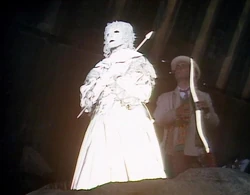
Hi! We're here because... erm... destroy them!
Doctor Who - Season 25, Story Three - Silver Nemesis
Written 18/6/12

JNT was determined to get the show popular again, and to do that he set about producing the show's Silver Anniversary. With a silver theme, the story was to feature royal themes as well as start probing into the Doctor's history with Cartmel's Lungbarrow plotline. They even went to Windsor palace and tried to get Prince Edward involved with the rag, leading to press stories and an official statement from the Royal Family that they would not, in fact, be part of Doctor Who's 25th Anniversary Celebrations. But, unfortunately, for all of Silver Nemesis' attempt to be something, it turns out to be one long 75 minutes of nothing. 
        The Doctor has just had an alarm call; a plan he set in motion 350 years prior is coming to fruition. The asteroid Nemesis, made of living Galifreyan metal Validium, is returning to Earth one last time, and everyone wants it. The Lady who initially designed the Nemesis statue's current form, Lady Peinforte, uses magic to travel forwards in time. Some Neo-Nazis decide to go after the power of the Nemesis, and plan to create a Third Reich. And, just as it's all getting nasty, the Cybermen turn up to claim the power for themselves. Through some carefully crafty explosives and chess-dancing, The Doctor and Ace revive the Nemesis Statue, eliminate the Neo-Nazis, vanquish Lady Peinforte and destroy the Cyber Fleet. Then everyone goes home. And The Doctor is mysterious.
      It literally is this simple. The plot is a basic MacGuffin quest, a hunt for a mystical item that's wanted by multiple parties. It's executed with such bland simplicity that there's nothing really to get behind. Lady Peinforte and co. have a bland "fish of out time" sort of plot that's played for laughs but doesn't really go anywhere, the Neo-Nazis are all cackling villainy but they're not at all camp about it so it doesn't mean anything, and the Cybermen are perhaps the blandest iterations the Classic Series ever produced. There's no clue as to why they're here, where they fit in within the Cybermen's timeline or why the hell Gold has turned from a mild irritant to their systems into a sustance that practically explodes on contact with them.
The Nemesis wakes.
      As I explained in an earlier review, the Cartmel Masterplan was the revelation that The Doctor had been loomed from the genetic structure of The Other, a Timelord founder whose role in forging Time-Lord society was hidden by Rassillon and Omega. Personally, like a lot of fandom I hate this plotline because it presents The Doctor as some kind of God in lieu of the chaotic travelling wizard that he's always been presented as. It also provides so much pretense and fluff to an otherwise fun tale; Russell T Davies would go on to make exactly the same mistake when lauding Ten as the "Lonely God" in NuWho. I hope that this is the last time this will really rear its head, because if it continues like this then Seven will become unbearable before too long.
      Silver Nemesis was an absolute shell of a story, and that's a damn-fine shame. It could have been a spectacle to rival the Five Doctors, but it had an even weaker script and instead tried to stuff more plot elements into a shorter run time, to little avail. The Nazis didn't need to be here, the Cybermen had no excuse for being here and it's just another Cartmel machination that The Doctor was on the scene at all. I didn't loathe it, but it did bore me and leave me with very little impression at all. My first Seven clunker.

Thanks.

Saturday, 8 September 2012

Review: Doctor Who 7.2: Dinosaurs On A Spaceship

Written 8/9/12

It's actually quite rare that I find a story so bland and useless that it has no value to me, but this happened to be one of those delightful stories. The horrifically gimmicky title promised so many things, and of course the well-worn destructive hands of Chris Chibnall failed to do anything with any form of competancy whatsoever. Dinosaurs In A Spaceship was never actively offensive (except with certain gender politics issues that the show's been suffering from recently,) but it did fail on nearly every level - as entertainment, as drama and, most importantly, as Doctor Who.
The Doctor has a "gang" which means the standard, "I'm Chris Chibnall,
look at me create a load of hollow side-characters" thing.
      An alien ship is heading towards Earth, and The Doctor wants to investigate, so he drags along a random Queen Nefetiti of Egypt, picks up a 1900s bounty hunter (Rupert Graves) and tries to pick up Amy and Rory, managing to suck up Rory's amazed Dad (Mark Williams) in the process. They discover that the ship's cargo is a ton of Cretaceous-era Dinosaurs and plants, and that the ship used to be a Silurian seeding ship that was trying to find a new planet. The Doctor ends up confronting bounty hunter Solomon, who, with his annoying robot sidekicks (an unfortunately cast Mitchell and Webb) manage to have committed a little genocide on board. After selling Nefetiti to him to get him to retreat to his ship The Doctor gets Rory and his Dad to pilot the ship away from Earth and manages to get Solomon's ship blown up. Everyone goes home and I felt pissed.
     The episode's incredibly rushed pace also leant to it it's biggest weakness - none of the characters seemed to have a real reason to be there, and their convenient uses felt more contrived than deliberate. I have enjoyed Chibnall's work before on Life On Mars and one or two episodes of Torchwood, but here it didn't even feel like his writing; more the combined ramblings of an over-excited five-year-old and someone desperately unaware of what the series is. Had this been an episode of the Sarah Jane Adventures... I might have understood. But it was just so empty of any meaning or themology - it didn't even try to say anything or do anything particularly interesting.
      So what do you do if you can't do anything interesting? Hey, let's replace it with annoying! First of all are the Mitchell and Webb robots, whose dialogue is absolutely excruciating and belongs more in a parody of science fiction than anything else. Then there's the issue of gender politics, which is treated as subtlely as we've come to expect of Moffat Who - Solomon treats Queen Nefetiti like an object (literally,) Amy has to tell of the misogynistic Riddell, it's all stuff we've seen before, done better. The humour, especially from Mark Williams' character, was incredibly crude and mindless, and I had notable flashbacks to The Dark Times of Red Dwarf. The dinosaurs were either really bag CGI or useless animatronics, and they played such a little part in the story that it feels like the Let's Kill Hiter title fiasco all over again.
The only decent thing in the episode was Amy's writing,
which is miles better than under Moffat. Shame the same
couldn't be said of all the other characters.
     There was some good here, although only where the bad seemed to dry up. As we saw in Torchwood, Chibnall is probably better at writing for female characters in general than Moffat is, and so Amy here suddenly became incredibly competant and generally the best she's been since The Eleventh Hour, taking charge of Riddell and Nefetiti and ultimately helping to discover most of the episode's expositional material. David Bradley, who played Solomon, is a great British character actor and, while I dislike the way the character was written, I found his performance incredibly captivating as someone so materialistic as to see people as prized possessions.
     In his element, Chibnall is not a bad writer, but when it comes to this show he has a track record of producing complete and utter tosh. Dinosaurs On A Spaceship continues this track record with ferver, and makes me very, very nervous not only for the fourth episode of this series, also written by him, but also for the rumours that Chibnall is being lined up to Moffat's successor. If this episode is anything to go by, I won't be tuning in. It was crude, heartless and completely pedestrian despite the abnormality of its premise, and that is the greatest failing of all.

Thanks.

Wednesday, 5 September 2012

Review: GHTTB: Ashes To Ashes 2.7

Martin Summers' traps start to close in on CID.
Ashes To Ashes - Series Two, Episode Seven

While it began in a mediocre way, 2.7 evolved into a list of the reasons why I adore this fourth series of the Bonanza. It was very dark and a lot of it didn't make sense when you really thought about it, but because of the strength of this series' characters and of this arc, it pulled through and ended with a spectacularly written and acted final few scenes. Last week may have been a dip in the series, but this episode uplifts us back to an excellent standard.
    After chasing a drugs gang based on an anonymous tip-off, CID find a Polish man buried in concrete at a building site. Excavation reveals that the man was murdered, but the site mananger Michael Rafferty denies any involvement. Police officer Martin Summers (the young version of the corrupt cop from 2008 that has been manipulating Alex) comes in to tell Gene that Rafferty is bad news, and Rafferty claims that Summers is the one in the wrong, having come asking for a bribe in exchange for his safety. Alex follows a note sent by the 2008 Summers and meets the young Summers at the building site. There, Old!Summers shoots his younger self, shattering Alex's preconceptions about this world and making her have nightmares wherein her parents tell her that she should have tried harder to save their lives. Old!Summers puts the gun in her hand, leaving her to clean up by dropping the Young!Summers corpse into some conveniently wet concrete.
     A vital piece of evidence goes missing in the investigation, and the signature on the release form is that of Summers. Knowing that the young Summers is dead, Alex reveals that the perpetrator must be a member of CID. Still bitter after the Mac scandal, Gene goes on the warpath. He gives Chris, Ray, Chaz and Vic the number of a vault at an open storage building, knowing that if one of them is a traitor, then Rafferty will go there and open a specific vault. He does so, and that evening Alex joins gene as he confronts the traitor - Chris. Feeling pressured by the wedding, Chris has been working for a voice over the phone as far back as Episode 2, trying to get the money to pay back a loan. He was the one who destroyed Kevin Hales' records, stopping the team from preventing his eventual murder and postponing their discovery of Mac's operation. Gene forgives Chris on one condition - that he never leave the police force, and forever live with his shame. Alex tracks back the phone number to a small flat - and discovers that Summers has been manipulating events from the beginning.
Chris is forced to reveal his betrayal.
     The first half of the episode wasn't as engaging as I would have liked it to have been, not really covering any themes other than the usual undercurrant of Police Corruption. Like in 2.5, Alex acted the psycho again and started attacking someone who didn't know her, but the cards really fell onto the table when Old and Young Summers met. It felt like a direct response from the writers, saying that this isn't really a Time Travel show and at the same time allowing Alex to show a real depth to her character. It was a final seperation from the world of Life On Mars, and a preview towards the more religiously-oriented finale next series. Unlike that finale, however, this is far from disappointing.
      The second half provided some outstanding drama and a real chance for Marshall Lancaster, who usually plays the bumbling comic relief, to give some actual emotions. Despite how surprising it was, it makes so much sense and also neatly ties the otherwise irrelevant Shaz and Chris storyline into the main arc. Adrian Dunbar is so strong as Summers, with his charming but equally sinister voice and demeanor, that he's easily one of the most memorable villains in the Bonanza. His existance as a malevolent entity is completely at odds with the Mars finale, where Gene was the force to be fought, and shows not only how much the characters have grown, but also how much the writing has moved on since the simple caricatures of Life On Mars' first series.
Gene is disappointed in Chris.
      Episode 2.7 was a due reminder of how good the Bonanza can be, and showed off this series characters and themes in a way that left me gagging for the finale. It may have a had a bit of a shitty first half, but the second half made up for it thousandfold and stands as some of the best Ashes To Ashes ever made.

Thanks.

Tuesday, 4 September 2012

My Problem With Harry Potter (Or At Least The Last Book)

Harry's confrontation of Death is brave, but it turns him
into an uncomfortable Jesus analogue.
I felt like a rant. Written 1/9/12.

I've spoken about Harry Potter before, both covering the individual books and a retrospective of the films. I've been a fan since I've been able to read, and the wonderful world presented by JK Rowling is still one that I consider to be one of the best in fiction. When it comes to which medium I prefer, then I'd have to say... Harry Potter and the Methods of Rationality, by Eliezer Yudkowsky. Seriously, read it. In canon? Well, that's why I'm writing this article. Yesterday I watched the last two Harry Potter movies back-to-back for the first time, and was blown away by the amazing cinematography. But I also realised some of the problems endemic not only in the films' adaptation of the series, but also in the book series itself.
     My biggest beef with the final book, Harry Potter and the Deathly Hallows, came during the final battle, in which Harry realises that he contains part of Voldemort's soul and must therefore face death in order to save everyone else's lives. When he does so, he has a moment in a heavenly environment where he chats with Professor Dumbledore, and then he returns to like in the nick of time to face down the now vulnerable Voldy and save the day. Hurrah. Well, not so for me. This is an issue that I'm going to cover when I get to the end of Ashes To Ashes, and it really surrounds the way religious themes are used in fiction. Now, as much as I dislike them, I am not averse to religious themes in general. What I am averse to is the use of them when said themes aren't present in the work beforehand. LOST pissed me off because it had always presented scientific answers to supernatural phenomena, and then had a freakin' afterlife. Ashes To Ashes, which had always been a secular comadream, suddenly became an issue of Angels and Demons. And here, in a work known for being burnt by Fundamentalists for its use of Witchcraft, our hero is not just presented as a messanic archetype, but also does what Jesus does in the Gospels. Why's that such a problem? It's simple, really. The character of Harry is too good for that. This is one of only a few series where I'm invested in the characters over the world and themes surrounding them, and so it felt terrible when a character as well-rounded and well-written as Harry was fobbed off as a Christian archetype.
Voldemort turned into a cardboard cutout.
     And that leads me to another problem with the Harry Potter world - it glorifies Death. I've never understood the practice in fiction of encouraging death and destruction as if it's an honourable thing to have happen to you. This runs through the books rather well; I sympathised with Voldemort rather a lot as a man so afraid of Death that he did evil things in order to live forever, to the point where he lost his moral compass and decided to take power with it. In the films and in the final book, all of that humanisation is thrown away. In his fevered afterlife dream, Harry sees Voldemort as a skeletal child, forever alone and beyond redemption or help. He becomes a cackling madman, and all of the motivation that we saw driving him in Book Six's flashbacks seemed to evaporate. Further, the scene immediately before Harry's sacrifice sees him suing an artifact known as the Ressurection Stone to speak with the "ghosts" of his dead parents and their friends. This short scene was a lot more frightening for me than anything Voldemort did; the twinkle in Gary Oldman's eyes as Sirius called dying "quicker than falling asleep." That may be so in a world with an afterlife, but it's a stupid lesson to be sprouting for the real world, where the end of consciousness is the end of you.
     It's maybe a bit more personal, but that's my problem with Harry Potter and what I love about Yudowsky's Methods of Rationality. The end of the canon series tries for something clever with the way it treats the core dynamic between hero and villain, and in the process it ignores all of the character development that those two had had over the previous six books/films. Harry Potter is not Jesus Christ, and the many people who die across the series cannot come back in the way that he did. I just wish the series would remember that too.

Thanks.

Monday, 3 September 2012

Review: Doctor Who Classic: The Happiness Patrol

Warning: This review may get a bit political. Happiness will prevail.

Doctor Who - Season 25, Story Two - The Happiness Patrol
Written between 17th and 18th June 2012

Some claim that during the Eighties, Doctor Who became much more politcal than, as a family teatime show, it really should have been. This is epitomised by today's story, The Happiness Patrol - a tale of a dictatorial regime, where the Doctor must step in and release everyone from the hands of oppression. It could have been awfully dry, but the addition of just a few ounces of absurdism makes The Happiness Patrol into a complete and total classic. It's scary, disturbing, funny, melancholy, and exciting. For the first time in a while, I was genuinely on the edge of my seat, and that says a lot more for me than I can put in words.
The series actually got a copyright claim from Bassetts,
claiming that the Kandyman was too similar in design
to their company mascot. It's still awesome.
      The Doctor and Ace arrive on the Earth colony Terra Alpha, a world that has come under the autocratic control of Helen A, a frighteningly dotty old woman who insists that everyone must be happy and conform to her vision of happiness. Those who do not are executed; or, worse, subjected to the torturous delights of the dreaded Kandyman. Helping some of the Happiness Patrol to work up the courage to fight against the regime, the Doctor manages to combine the world's forces to bring down Helen A's regime and free the peoples of Terra Alpha.
     Even for someone who was born in the late nineties, the politcal analogue is blaringly obvious. Helen A (played here by the wonderful Sheila Hancock) is a symbol of conformity, who is dependant upon her pet dog Fifi and upon henpecking her timid husband. She's a toned down version of Conservative Prime Minister Margaret Thatcher, who was in power between 1979 and 1990, for better or worse. The character here is a scathing satire of the naive nature of her policies and the way she hid her iron will behind a pleasant exterior. I was shocked to find out that the comparison had been toned down; apparently, as Sylvester McCoy put it in 2010, "Our feeling was that Margaret Thatcher was far more terrifying than any monster the Doctor had encountered." Personally, I love it - it's strong, gets the point across and is damn hilarious in doing it. Funnily enough, the character was going to have been by veteran actress and singer Patricia Routlege. I do fear that it would have put me off Keeping Up Apperances forever.
      Slightly less effective is the Kandyman, but he still manages to be incredibly scary. I do find the idea far fetched - I just don't see the occasion for someone to create a robot composed entirely out of sucrose who then tortures people using sweets. It is, however, a great idea to scare the kids, and that's what's important. I especially love his monologue towards the Doctor at the beginning of the second episode - "You see, I make sweets. Not just any old sweets, but sweets that are so good, so delicious, that sometimes, if I'm on form, the human physiology is not equipped to bear the pleasure." If anyone can scare the kids, the Kandyman can.
Sheila Hancock is great as Thatcher send-up Helen A.
     Sometimes the aburdity enforced by the story's premise oversteps the boundaries somewhat. The first appearance of the Happiness Patrol, in their frilly pink uniforms and dye-pink hairdos, was an absolute spectacle that didn't embue them with any sense of forboding at all. Luckily, the script worked well enough to do so over the course of the story, and by the beginning of the regime's downfall they're almost terrifying in their fanatical devotion to our lady leader. The Kandyman's repeated defeats by the Doctor, amounting to being stuck to the floor with lemonade, feel quite farcical and only highlight the implausability of his creation; is this creature, who works in a laboratory, really never exposed to substances that might react aversely to his sucrose-based makeup? Not even the lemonade, which was found in HIS kitchen?
     In short, The Happiness Patrol's absurdity is what makes it such a powerful piece. It's satirical and that not only gives it charm, but it also improves what is a concept so tired we only saw it a few stories ago. The premise and the way it works into the contemporary political scene - that's pure genius, and one of the reasons that The Happiness Patrol is one of the best McCoys I've seen so far.

Happiness Will Prevail!
Thanks.

Saturday, 1 September 2012

Review: Doctor Who 7.1: Asylum of the Daleks

It wasn't as epic as the poster, but it was still fun.
Written 1/9/12

Mind. Blown. Moffat usually doesn't like to use stunts in Doctor Who, but this was one hell of a stunt. Asylum of the Daleks was confusing and brilliant and surprising and wonderfully frustrating in so many ways. It felt like a redemption after the other failures of Moffat's run, especially where the Daleks are concerned, but it also left me wondering whether the episode's clever twist was a smart move or a dickish one. Spoilers follow.
     The Doctor, Amy and Rory are beamed to the Dalek Parliament by humans who have been mentally and physcially augmented to serve them, and are told by the Dalek Prime Minister (think David Cameron with more charisma) that they've been chosen to head down to the Dalek Asylum and turn off its inpenetrable forcefield. Once there, they find themselves assisted by a lovely-looking woman named Oswin Oswald (Jenna-Louise Coleman), who is cooped up in an escape pod and seems to be able to hack into the entire planet. Soon, the planet's defensive nanobots start to convert Amy, but The Doctor, with Oswin's help, gets them to safety. Going to fetch Oswin from her pod, The Doctor discovers that the Asylum Daleks in fact converted her into a fully-fledged Dalek, with the image of her human form a comfortable illusion. Retaining her human side, Oswin deletes all trace of The Doctor in the Dalek memory banks and tells him to remember her. The Doctor escapes, the Daleks blow the planet up and Amy and Rory are dropped off home again.
     The twist that Jenna Louise-Coleman's character here is in fact a Dalek (and has never met The Doctor before) suggests that Moffat simply put her here to show off her acting chops before she joins the roster as a companion in the Christmas special. Suffice to say it's made fans go mad wondering what the hell is going on, a feeling that Moffat is very good at giving. Discussion of whether the character is at all related to her role as companion is still ongoing, but luckily the confusion will probably be over by Christmas. What we do gather from this, however, is simply the strength of her performance. Oswin was cheeky, fun, smart and seems a great improvement over the very flawed Amy and Rory, whose domestic troubles formed some of the episode's most awkward scenes. It was unfortunate that Oswin's characterisation echoed that of River Song - the sexy promiscuous genius who can't help but flirt with everyone - but we're a while away from her companionship and so there should be room for change.
Moffat... you're either clever or an arse. Or both.
     Elsewhere, I loved the ways that Moffat is attempting to make these "insane tanks" scary once again. The Dalek conversion, with an eyestalk jutting through a person's skull, was brilliantly grotesque and the use of conversion as an airborne plague carried by nanogenes... wait, this is just The Empty Child again! Airborne plague of nanogenes converting organic material into a form which requires something jutting through their face? I mentioned last year at the start of Series 6 that Moffat was repeating his ideas ad nauseum, and it's no different here. That doesn't stop said concept from working, however, and it certainly has the right effect. I just wish that the core concept - that of a Dalek insane asylum - had been utilised more effectively instead of switching back to Moff 101.
     Tonight's episode wasn't perfect by any stretch, and a lot of the elements were placed there deliberately to confuse. But it certainly was entertaining, and it explored the Daleks in much the same way that Moffat explored the Cybermen back in The Pandorica Opens - making them bigger and better. It would have been nice if the so-often-advertised Dalek Asylum had featured a bit more, but the crazy Oswin subplot more than made up for it. No doubt this episode will look completely different by Christmas, but for now, a great start.

Thanks.

Wednesday, 29 August 2012

Review: GHTTB: Ashes To Ashes 2.6

Riley is a mobster-esque loan shark.
Ashes To Ashes - Series Two, Episode Six

I suppose there really isn't any "light relief" in a crime drama focussed around murder and mayhem, but this was definitely one of them, taking a solid independant story that didn't touch the arc and giving us a break from thick mythos before the finalé arrives. Its issues mainly surrounded a lack of focus and tension, but it delivered some interesting character dynamics which more than made up for it.
     CID happen upon a body floating on a canal and identify it as Colin Mitchell, a man reported missing by his wife Donna (Daisy Haggerd) several days before. Alex is being operated upon in the Overworld, and she's feeling the strain as the doctors remove the bullet from her brain. Leader of the neighbourhood watch and Colin's father Stanley Mitchell tells them that a distinct mark on the body indicates local loan shark Riley, who beat him up previously. Colin was working for Riley, but left the organisation and was killed soon after.
     With little evidence, the team raid Riley's organisation and find a sex-tape of Riley and Donna; Donna explains that she was fulfilling Riley's debt demands in return for Colin's safety. Angry at Gene's intrusion, Riley sends men round to attack both he and Alex. While Alex escapes unscathed, Gene is beat up and the following day his ego is clearly badly damaged. Following a path of retribution he traps Riley in a car and begins to crush the car with a crane - just in time for Alex and Ray to use psych profiling to work out the real killer. Together they confront Stanley, who reveals that he killed his son in a fit of rage after discovering him working for Riley and then used the murder to frame him.
Gene excercises retribution... imaginatively.
     Like last week, there was a lot of good character work. Ray explored his more mental side, while Chris and Shaz's relationship fell on a rocky patch. Their relationship has never really felt that realistic to me, and just felt like a way of giving the show's least interesting characters some unique trait. Daisy Haggerd is best known for her comic acting, and at times it did feel a little forced when she spontaneously burst into tears. The best performance of the piece was definitely Phillip Glenister, who managed to channel his usual aggression into a bitter, seething anger that made his revenge all the sweeter.
      It wasn't exactly first-rate, but it was an interesting week that felt relatively chilled before next week's mythos-filled pre-finalé episode.  It wasn't so much a whodunnit as it was a "hedunnitbutshedunnitbuthedunnit," and that ultimately left me a little empty, but Alex's predicament left open a long trail of hope to lead us into the stormy end of what we thought was going to be the penultimate episode.

Thanks.

Monday, 27 August 2012

Review: Doctor Who Classic: Remembrance of the Daleks (Revisited)

See here for my previous look at this story.

The beginning of the great team of Seven and Ace
Doctor Who - Season 25, Story One - Remembrance of the Daleks (Revisited)
Written between 12th and 15th June 2012

My first look wasn't really a review, was it? It was more of a single paragraph with some gushing in it. After Season 24, Remembrance of the Daleks instantly presents a very different image of the Seventh Doctor, while setting the series back on track with some traditional Dalek action. Not tired after the 20th Anniversary, JNT decided to throw in some effort for this 25th Season, and Remembrance was the first step towards this. Notably, Remembrance is the first story that I can call good in the classic sense -  a witty script that exploits the mythos while still providing a fun and entertaining experience. You don't need to have seen the Daleks before to love this serial; their awesomeness is cemented in a myriad of ways.
     Unlike in Attack of the Cybermen, the serial is set in the location and time of An Unearthly Child for an actual reason. The Doctor and Ace arrive at an opportune time; an army regiment has arrived to deal with a renegade Dalek, and The Doctor is on hand to offer them advice. Little do they know that the situation is being manipulated by the Doctor, who left behind a powerful artefact called the Hand of Omega in the time before the first serial back in 1963. Now faced with two Dalek factions, the Doctor and Ace must further manipulate events around Coal Hill School and make sure that the right Daleks do the right thing. Eventually the Imperial Daleks win under Davros, and take command of the Hand of Omega... which promptly destroys Skaro and then the Dalek Mothership.
      Out of perspective, the serial is very much a product of its time; the production seems to have more in common with Heartbeat than with the previous season. However, it is very clever, and is the first real sign of Andrew Cartmel's effects of the series and on the Doctor's character. Cartmel's design was later realised by the novel Lungbarrow, which had some conspiracy-theory-esque notions that The Doctor was the decendant of a Gallifreyan founder called The Other, woven together from his genetic material. This is more obvious when one watches the deleted scenes; Seven makes a few more grandiose statements, including the idea that he is "far more than just another Time Lord." Seven overall is much more manipulative and scheming, this being the first of his many schemes and plans. He also keeps his ascerbic wit from the previous season, and this combined with the great scipt makes a perfect whole.
Daleks climb stairs for the first time.
     Not to say that it's all brilliance and wit. The very nature of the serial means that at times the Doctor's dialogue feels clunky and expositional, especially when he takes the time out to explain the Daleks' entire backstory as well as explaining his incredibly detailed plans. There's also the random inclusion of Davros at the end, who, while the inspiration for one of Seven's best speeches ("Unlimited Rice Pudding!"), does seem incredibly tacked-on and unnecessary.
     Remembrance of the Daleks is damn-awesome, a great final swan-song for the Daleks regardless of whether or not it intended to be one. It contains some of the Daleks and Ace's finest moments, and begins the final run of the series in good style. It is, in every sense, a complete Classic. The Daleks wouldn't appear on television again for another 17 years, and this was as good a way as any to say goodbye.

Thanks.

NEXT WEEK: Maggie Maggie Maggie in The Happiness Patrol.