Friday, 8 June 2012

Josh: Doctor Who Classic: The Daemons

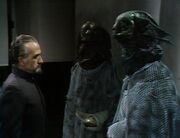
Badly costumed Bok, Three and bloody Jo Grant
Doctor Who - Season 8, Story Five - The Daemons
Written between 2nd and 8th June 2012
"Fancy a dance, Brigadier?"

In the village of Devil's End people are dying without explanation though local 'witch', Olive Hawthorne claims evil is afoot and the deaths are a result of fright. Near the village, BBC Three are covering the excavation of the Devil's Hump with Professor Horner. When the dig begins at the start of the Pagan  festival; Beltane, they expect to find the treasures and tomb of a warrior chieftain. At UNIT, the Doctor and the others watch the television broadcast. Jo speculates the coming of the Age of the Aquarius and the supernatural which the Doctor scoffs at. However, as the dig starts and Olive protests and warns of danger, the Doctor believes her so he and Jo head off to Devil's End. During a sudden gust of wind, Olive is nearly struck down by a police officer under a trance as she goes to visit the vicar. It appears he has been mysteriously replaced by Mr Magister who is really the Master. The Master assures Olive nothing bad will happen but she dismisses him and goes to find someone to believe her. When the Doctor and Jo get lost and end up in a pub, a villager informs the Master of the Doctor who tells the man to prepare the ceremony. As the Doctor and Jo rush to the mound, the Master and 13 acolytes are chanting more and more frenziedly in a ritual in the Church's catacombs as the Master shouts the name of the entity; Azal, as the gargoyle Bok's eyes flash red. As the tomb is opened at the Hump,  icy winds burst out killing Horner and temporarily freezing the Doctor.
     After the village doctor notices the Doctor's two hearts and the latter starts to wake back up, Jo calls a confused Benton and Yates who agree to go to Devil's End the next morning by copter. The Master then prays as the police officer who had been in a trance falls to something gigantic which has risen. When Benton and Yates fly to Devil's End they spot massive burnt footprints on the fields. Yates contacts the Brigadier who calls himself a car to come down also. Benton finds Olive trapped in a cupboard in the Master's verger where a man called Garvin has locked her in. Garvin then appears with a rifle so Benton attempts to disarm him but seizes up on a stone the Master has marked. However, Garvin is soon engulfed in a heat wave that spreads right across the village waking up the Doctor.
Hipster Master was summoning the Devil before it was cool
     Olive and Benton venture to pub where Olive tells the Doctor of the Magister and realises he's up against the Master, again, and that she saw a large horned beast.  The Brigadier's unable to access the village due to a heat barrier as he's briefed. In the Hump, the Doctor and Jo find a small spaceship like the Hump as Bok tries to attack them. The gargoyle's own superstition drives him away when the Doctor talks in a strange language. The Master hypnotises the squire, Winstanley. The Doctor tells that all the horned gods in mythology over thousands of years have been the Daemons from Daemos who arrived 100,000 years ago. The shrinking and growing of their spaceship causes blasts of both cold and hot waves which have created a heat wave dome over the village. The Daemon the Master has summoned was small causing the cold wave but on the third summoning it will be massive causing the end of the world. The Doctor orders UNIT technician Osgood to set up a diathermic energy exchanger to break the heat shield. On the way to the barrier to explain the Doctor is attacked via the helicopter controlled by a hypnotised Tom Girton but the copter is destroyed. The Master summons Azal again who curses the Master for doing so.
     The Master wants Azal's power but he refuses to give it to him. Azal may give the Master control of Earth if he thinks him worthy after meeting the Doctor or he might destroy the planet on third summoning. After explaining the exchanger, the Doctor is captured by hypnotised villagers to be burnt alive. Olive and the Doctor convince the villagers to release him as Benton tricks them with his silenced gun and the Doctor with his remote controlled car; Bessie. Jo and Mike witness the final ritual as Jo fails to prevent it. Azal manifests himself as Jo is offered for sacrifice. The Doctor explains how psychokinetic energy of humans is used to summon the Daemons. The exchanger works so UNIT get through the barrier with it before it explodes. Bok guards the entrance to the catacombs but the exchanger weakens him so the Doctor is able to get into the ritual. As UNIT attacks Bok with all their weapons, Azal goes to kill the Doctor as the former wants humans to be left alone. However, Jo then self-sacrifices herself and the confusion turns Azal into stone before the church blows up. The Master fails to escape in Bessie which is remotely controlled to come back so the Master is arrested under maximum security as UNIT, the Doctor, Jo and Olive celebrate May Day.
The Master rocks out in a ritual


Doctor Who is known to be purely that of science-fiction so when this serial began to deal with more supernatural themes I immediately became a fan. This serial's intelligent script is able to show the diversity between the supernatural and science and how the two can conflict on many occasions depending on the situation. This serial really alienates the Doctor as he appears to be the only person who realises it isn't demons and myths causing everything but science. This therefore just reinforces the idea that we should remember the Doctor is of much higher intelligence than any other character as well as being from a different species and this serial highlights his individualism. This serial is filmed differently and to be honest I love it. The direction excels the previous stories in this season and the many pieces of camera trickery used have worked efficiently such as shaking and obscure angles give the tone of the serial are more quirky, rough edge to it. This serial also sees an entirely different side to the Master. For the previous four stories of the season the Master has been coldly calculating and intelligently intimidating. This serial though exposed his desperation for power and the extremities of things he has to do to claim it even though his normal behaviour would usually defy it. This new side to the Master has helped develop him further as a character and so after a couple of mediocre performances, Roger Delgado is finally back on full form like he was in Terror of the Autons. Though the Master has been in each serial during this season we still haven't been able to explore his back-story and delved properly into his character. Having him arrested by UNIT as a cliffhanger leaves his story unfinished and the possibility that we can go and explore more about him. As a fan of the Master, I can honestly say Delgado's performances are fantastically acted and makes the character so very interesting.
     This has got to be season eight's most creepiest serial of them all. The supernatural rituals, unexplainable (at the time) random events, freaky weather and, though badly costumed, daunting creatures. We've had a variety of moods to this season as we've had the camp frivolity of Terror, the politics of Mind of Evil, the colonisation argument in Colony and the science of Claws and now we have the chilling supernatural of Daemons. I'd like to point out that Damaris Hayman's Olive Hawthorne takes the prize for the most annoying character for the season. Her character could have been potentially interesting if it hadn't of been for the silly over-acting and taking of the stereotype of a believer in mythology and witches but Who has taken that and given it to her and it's awful. Though this isn't a scratch on the previous season finale Inferno, I'm very glad this was the only serial of the season which didn't use any of the recurring plot devices such as group takeovers, extended gun battles. Instead we did have another capturing of Jo Grant, twice, again. So, I'd like to take this opportunity to complain about how I, let's not say hate but majorly dislike her. Jo's got to be one of the clingiest, most annoying companions that the Doctor has had. Though she doesn't meet the standards of Five's Adric, I don't find her too likable. She's supposed to be a scientist yet seems undoubtedly dim-witted and without common sense. She seems to be recycled between the same plot devices of being captured and near death every serial and yet Three isn't sick of her yet. Well, frankly, I am. I don't see why she hangs around when all she does is cause more trouble and complain about it later. Anyway...
COME AT ME BRO! (This-is-awful)
     The action sequence involving the helicopter, the motorbike and the car has got to be the most exciting action sequence of the season. It isn't overlong like all the others and is cleverly well-filmed. The special effects used in this serial are particularly jarring and not spectacular like others we have seen but are used for good effect when needed. I'd also just like to have a fan-boy moment as I spotted two of the most famous Classic Who lines; 'Reverse the polarity' and 'five rounds rapid.' I'd also like to say that its difficult to comprehend how Mike is higher up in the ranks than Benton when there's such a big age gap between them. Also, I'm happy Mike is back here and is featured heavily because as a new character to the show we haven't seen that much of him until now. I'd also like to say how I'm liking the adaption of Benton into a fighting man all of a sudden. Now, something I mentioned earlier was bad costuming. Our aliens, the Daemons, are not very well made even considering its the early Seventies, they could of been such better. Considering Azal is supposed to be this horrid Devil-like beast the voicing doesn't suit the character and I didn't find him that intimidating at all. Still, I like how Who here has tried to explore the effects of mythology on smaller, rural communities which is possibly still occurring today. Though there was a lack of sci-fi in the serial to explain certain things, the use of the supernatural made this story unique. It's humorous (remembering the Grand High Wizard - the Doctor), contains a intelligent script and delivers a visually chilling set of episodes. By far is this the best serial of the season making up for the disaster that was Colony in Space and an excellent finale. Due to it's originality and indifference to previous stories and defying Who's set conventions, Daemons deservedly earns its title as one of the more successfully popular stories of Classic Who. I definitely enjoyed this one.

Thanks, Josh.
P.S. This is my last Classic Who review until further notice, I may or may not resume sometime during the summer holidays, so, stay tuned.

Wednesday, 6 June 2012

Review: Hit and Miss 1.3

"What's a transexual?"
"A cross between a man and a robot?"

Hit & Miss: Episode 1 Photos
While Riley got some charactisation, Ryan was just... odd.
You know, when last week's episode repeated a few elements from the premiere, I didn't mind. But there are several thematic and simply cinematic things that keep getting repeated and it feels more xerox than anything else; certain scenes feel almost exactly the same, like they had a routine event and thus used the same footage three times to save on costs. That felt even more the strange, as this week saw several revelations and changes between our characters in fairly interesting ways, as well ironing out a few problems I had with last week.
     After going against her word and threatening to murder John (the Landlord) if he doesn't leave them alone, Mia went out on a date with Jack (Jonas Armstrong, Robin Hood) where she still felt uncomfortable with her own place in the relationship. Ryan and the Farmer's son, having made friends (somehow) went to John's barn, where seeing a cow being beaten and then shot led Ryan to develop a rebellious environmental streak, making him do several crazy things throughout the episode. Desperate for the small emotional support he gives her, Riley was shocked when John heeded Mia's word and left her alone. On a job, Mia is nearly killed by her target, swiftly after which she is knocked down and is forced to escape from hospital semi-conscious. Jack finds her and carries her home, after which she tries to break up with him and she is forced to reveal her transexuality. He storms out. At the same time, Riley is randomly searching Mia's room and finds one of her guns, which Mia claims is security after having been raped. The two bond as Riley tries to tell her about her pregnancy by John but is unable to.
     I didn't really get Ryan's character this week. His little sister Leonie is often seen doing crazy shit (seeing hallucinations, hearing her mother's voice, cutting off a Barbie doll's hair) but that's because she's still facing the grief of losing a mother. Ryan, on the other hand, just randomly starts being a troublemaker, culminating in a scene where, face and hands painted green, he releases his Science classes' frogs and starts jumping around. I could maybe accept his transvestite experimentation last week as an examination of dysmorphia, but this week it felt like, "lets get kids to do weird shit and call it drama". There was a touching scene where Mia assured Ryan that he wasn't to blame for killing his mother (which he believes having prayed for her to be taken to heaven where she would no longer be in pain), but it didn't link in with any of the weird, weird stuff he was doing.
    Like I mentioned, I'm noticing a few repeated once-a-week things. Mia kills someone, Riley goes swimming, Riley has an encounter with John, John threatens to sell the farm and Mia shuts his mouth - it seems a bit repetitive for a series with so much to actually do. There's also this weird attitude that we have to see the prostethic penis every ten minutes or so, like the audience would be unable to appreciate the drama if we weren't constantly reminded of Mia's true nature. After everything that Sevigny has done with the character implicitly, with her stance, and manner of dress, it comes off as a bit crass that every once in a while they say, "Hey, in case you forgot, here's Mia's penis." Despite this, I am glad that the series is treating transexuality with a respect and realism rarely afforded to it by the media.
     What else is there to say? Hit and Miss may have a few repetitive elements, but at the moment it still manages to allow enough plotlines to slither forward to keep me interested. At least 50% of it is Chloe Sevigny's excellent performance, as well as the series' raw and mostly realistic portrayl of transexuality. It didn't have the pure power of the premiere or the thematic significance of last week, but it was still an enjoyable hour of drama.

Thanks.

Review: GHTTB: Ashes To Ashes 1.3

 Yes, it's been a while since the last Gene Hunt Time Travel Bonanza review. Humour me.

Trixie claims she was raped.
Ashes To Ashes - Series One, Episode Three

Something that really overwhelms me about Ashes To Ashes in comparison to Life On Mars is that it has a more overwhelming theme of Feminism. It's not that I don't support feminism, it's just that Life On Mars got to cover so many more topics - Rascism, inequality, drug ethics, work ethics, pornography, police corruption, hero worship, football violence, terrorism and many others. Ashes To Ashes is Feminism, Animal Ethics, Homosexuality and Police Corruption. If Episode Three had spent more time on a case instead of having the central characters explore ethics, then it would have been a much more focused and enjoyable hour.
     A prostitute claims to have been raped and slashed on the breast, re-opening the case of Delphine Parks who was murdered in the same way a year earlier. While Alex tries to track down the religiously-motivated killer, her team have trouble believing the word of a prostitute. After Alex visits Evan and her mother again, the team head to a boat where they track down the killer - a member of Delphine's Choir convinced that impure women must be cleansed.
     For some reason, the fact that Drake is female just turns into a gimmick. There's a scene where she tells the team that the only reason that she cares is because she used to be a prostitute herself, before revealing the truth and chastising them for their preconceptions. All it ever boils down to is a hell of a lot of Belligerant Sexual Tension. Why is it that just because the protagonist is a woman that she has to have sexual tension with Gene? Can't we just have a strong woman capable of not falling for this prejudiced, middle-aged man?
Alex and Gene get in costume for the party.
     The religious angle of the killer would have been an interesting theme in its own right, if it had been properly explored. Instead, it took five seconds to figure out and was thrown aside for Alex to be all bolshy and have a drunken night out. It's also a shame considering how digustingly religious the final series will be. There were a few steps towards the finale, especially in a touching scene near the end where Ray works out the truth behind the case by being nice to a fragile suspect.
     Episode Three irritated me because it continued to reinforce the parts of Alex's personality that I don't like.  The dynamic between Alex and Gene is only a more stark version of the one we saw during Life On Mars, and Alex only continues to be less astute and more irritating than her predecessor. However, it had become entertaining enough in the last ten minutes that I can't bring myself to call it a complete failure.

Thanks.

Monday, 4 June 2012

Review: Doctor Who Classic: Attack of the Cybermen (Revisited)

The Doctor takes a... hands on approach.
See here for my previous look at this story.

Doctor Who - Season 22, Story One - Attack of the Cybermen
Written 15/4/12

Saward didn't like Colin Baker, but he sure did love his Cybermen, as we see in Earthshock and in their large role in The Five Doctors, much to the other wrtiers' chagrin. When JNT called for a strong opener to Baker's first full series, Saward decided to deliver his magnum opus; a shining example of his style that will go down in the annals of Who history. For better or for worse. At its heart, Attack of the Cybermen is trying to be something a lot bigger than it manages to be, but that's not for want of trying. At the end of the day, it's still a great Cyberman story, and allows us an incite into both The Sixth Doctor and the Saward Cybermen.
     The Doctor and Peri, still reeling after the events of The Twin Dilemma, follow a distress call to 1985 Earth. There they find old soldier Lytton (from Resurrection of the Daleks) working with time-travelling Cybermen. Under duress, Lytton and The Doctor are transported to the far future on the planet Telos, where they join the Cryons in their attempt to revolt against the Cybermen and prevent temporal disaster. Along the way they meet undercover cop Russell (Davros-actor Terry Molloy), partial-Cybermen Bates and Stratton and the Cryon Leader. They also manage to fix the Chamelion Circuit, albeit temporarily.
This serial is obsessed with continuity - sometimes to its
detriment.
     The serials' ownership is the most complex and difficult to pinpoint in the series' entire history. The version I choose to believe is much-simplified; the serial is acreddited to "Paula Moore," a penname used by Eric Saward to hide his involvement in the script. Saward, as script-editor, was unable to commission his own work. Ian Levine, the infamous fan who was the show's unofficial continuity adviser, likely contributed a lot of details to the serial regarding the history of the Cybermen.
     As ever, Six is brash here, but he shows a more consistantly.... pleasant streak than in Dilemma. His character is erudite and witty, but there are a few moments where he's a little too willing to become violent. At the end of the day he doesn't really save the day; his presence is simply the catalyst for the Cryon resistance movement to start working. This is a key feature that you see a lot in this era, and for me it feels a lot more natural than some of the later stories where the Doctor is shoe-horned into the action in unrealistic ways. Sometimes The Doctor just doesn't get the big roles; much better than in, say, Midnight, where the evil invisible monster just happens to attack the tourists on the trip that The Doctor attends.
     All of the key Sawardisms are here. There are multiple storylines, all running along different streams which eventually converge. There's also a deeply entrenched dark humour absoutely everywhere, from the direction to the costumes, from the dialogue to the musical score. At times it feels almost inappropriate, but what it does do is create a memorable atmosphere. Wihout that humour, then this dark affair would be very bleak indeed. A key feature that sets Attack of the Cybermen apart is the mass of continuity references; it starts from the very beginning, with The Doctor landing in the original setting of the pilot for no reason, and then having to stop the Cybermen from changing things that were only seen twenty years prior to its broadcast. While I love some good continuity as much as the next person, the problem here is that it just doesn't feel relevant; it becomes overactive fanwank that most people at the time wouldn't have been able to appreciate.
Maurine Colbourne is great as the slippery Lytton.
     The story is the first exploration of the 45-minute format that would become common-place in the new series, but here it jarrs with the series' tone and makes it feel even longer, despite the fact that it's actually 10-minutes shorter than the average 4-parter. Despite this, I like the format for the same reasons I like it in Nu Who - it allows you to do a lot more with the characters, makes filler less viable and prevents some of the more silly types of cliffhangers that the show's seen.
     There are a few issues with this story's tone, and its fan-wank stuffed content feels a little overindulgent for what the serial ultimately becomes. But I love the story. It gives me a decent chuckle now and then, and the dark humour is just so consistant and so ubiquitous that it gives the story this deliciously thick tone. Attack of the Cybermen may not be the best story in the world, but it's certainly a hell of a lot of fun.

Thanks.

NEXT WEEK: I did Vengeance on Varos last November, so next week is The Mark of the Rani

Friday, 1 June 2012

Josh: Doctor Who Classic: Colony in Space

Jo takes her first trip in the TARDIS
Doctor Who - Season 8, Story Four - Colony in Space
Written between 6th and 7th May 2012
"I did a course in escapology...once."


Colony in Space is significant concerning Classic Who's history. It sees the first off-Earth colour narrative with a newly updated TARDIS interior and companion Jo Grant's first trip within it, the first of any companion to travel in it since Season Six's 'War Games'. Michael Briant makes his directorial debut for Who, soon going onto direct popular serials such as; 'The Robots of Death' and 'The Sea Devils'. The science fictional comment in the script by Malcolm Hulke is based on relations between European Settlers and Native Americans. Now let's explore this six part serial;
     The Master has stolen the Time Lord's secret file on the Doomsday Weapon so fix the Doctor's TARDIS so he and Jo materialise on planet Uxarieus in 2472. An excited Doctor free from exile and scared Jo off-world for the first time meet Ashe, the leader of a human colony who are struggling to survive. They have an uneasy truce with the Uxarien primitives, their crops are failing without reason and members are being killed by 'monsters'. They also fear losing their colony in favour of the Interplanetary Mining Corporation who want rid of the colonists so they can take the planet's rich source of duralinium. The humans not wanting to return to their repressive, polluted Earth object to IMC's wish for the much-needed mineral for profit. As Captain Dent from IMC calls for the Adjudicator to make a decision on who has rights to the planet, a man called Norton arrives claiming to be the last survivor of another colony attacked by the same monsters that are killing colony members. The Doctor investigates to find the monsters are actually holographic images produced by an IMC machine and the killings are a result of one of their employees. Norton's revealed to be an IMC agent who kills the colonist's chief scientists and vandalises their power supply as Dent tries to get the Colonists to evacuate.
Before Corrie, Helen Worth could act, and very well!
     As the IMC and the colony engage in armed hostility the Adjudicator, who's really the Master with falsified credentials, arrives secretly in search of the Doomsday Weapon. When Jo is taken hostage by the Primitives, the Doctor discovers the Guardian and the last of the ancient Uxariens. The Doctor, as long as he and Jo do not return to the Primitive city, manages to escape being executed. The Master rules in favour of the IMC which sees Dent threaten Ashe with execution for the colony's crimes unless they all leave. With no other choice, the colonists must leave in their spaceship whose conditions are so poor it explodes in flight before Jo and Caldwell, an IMC employee helping out the colony. Jo is then locked in a chamber in the Master's TARDIS and the Master threatens her death by gas if the Doctor doesn't help him find the Doomsday Weapon. So, the Doctor and the Master go to the Primitive city and in the Guardian's chambers find the Doomsday Weapon. The weapon can turn any sun supernova, and the Master wants universal control and offers the Doctor a partnership but he declines. The Doctor convinces the Guardian the weapon caused the fall of the Uxarien civilisation from greatly scientific to primitively religious. The Guardian lets the Doctor destroy him, the weapon and the city. Jo has been set free by Caldwell and the Master escapes in his TARDIS. Thanks to Ashe flying the ship alone, all of the colonists escaped and overpower the IMC. Confident the real Adjudicator will rule in their favour and the fact the radiation from the weapon caused their crop failure, the colony's future is now secure. The Doctor and Jo return to UNIT seconds after they left unbeknown to the Brigadier
     Colony in Space is one of season eight's more mixed serials. Whereas the previous three stories had the ability to be judged either as good or bad, Colony has some excellent moments balanced by scenes where I sat back thinking; 'Oh no...'. Colony is very clever and grapples with a challenging basis for a storyline excellently. The present day finds the concept of colonisation popular amongst scientists, to be seen as an option of what to do when things go wrong in the future. Though this serial was released in 1971, the script clearly identifies the possible problems humanity could face in the future. This is why I like Colony, because it delivers a brilliant exploration into the human agenda, how normal civilians behave when found in situations that cannot possibly control. Malcolm Hulke's script addresses an everyday, serious issue, merging the fiction of Doctor Who with what's going on in the real world. Colony's exposition of human nature is really what makes it satisfying to watch. Though, I can admit the usage of one of Classic Who's many quarries works well as the backdrop for this more, gloomy serial. Colony's adventurous attempts in CGI are very, well done for the time and because we're on another planet for the first time everything becomes very much more visually interesting.
The Guardian...the only Uxarien to speak...in a silly voice...
     So, though the aesthetics and examination of human nature makes Colony stand out from the previous three stories in this season there are several times where everything isn't going Who's way. Again, we were exposed to multiple use of Three's martial art skills. Yes, this can be acceptable when the character genuinely needs to escape a dangerous situation but several occurrences in this serial saw Pertwee's Doctor use of violence unnecessary on various occasions. His Doctor's violent attitudes to innocent Primitives and people damns his flamboyant image. Along with this, there seems to be a development of recurring ideas within this season. Each serial has seen a senseless array of gun-fights and takeovers from two forces alternately. After such an outstanding ending to season seven and the fantastically characterised introduction of the Time Lord villain the Master, season eight is letting itself down in this area. I'm become a little down-hearted that these stories are becoming to similar to one another and need more differentiation. With repeated storyline ideas all crammed into the same season, serial after serial, Season Eight becomes a little tiresome.
     Though I fully understand the integration of the character is essential, the Master's appearance for the fourth time in a row is becoming too predictable. His motive is usually the same and the coincidence of him and the Doctor meeting regularly is becoming most unlikely. Still, Roger Delgado's Master is great to watch. If there wasn't as many ridiculous moments such as Jo's claim to of done a course in escapology when she's tied up or the portrayal of the Guardian, then Colony could a much more enjoyable serial. I put off watching this for a while and there was a reason why. Colony isn't the most entertaining of Classic Who spectacles but it can be enjoyed in the sense that it's Pertwee's first off-world adventure. Not a very well executed but still a well-performed, gritty serial that leaves the Master available to reappear for the season's finale!

Thanks, Josh.

Wednesday, 30 May 2012

Review: Hit and Miss 1.2

Hit & Miss: Cast and Characters
Mia and Ryan share a similar character arc.
After the intense premier, the second episode of Hit And Miss continued on a good track. This week took a much more raw look at the nature of dysmorphia, while still continuing to work on these interesting and fulfilling characters. Some of the characters aren't developing in the way I thought they would, but the series still feels compelling despite that - mainly due to Chloe Sevigny's astounding performance.
     Understandably pissed off at having been beaten up and humiliated, the Landlord put the kids' cottage up for sale. The older kids blame this on Mia; Levi is broken by the fact that he can't keep his family together after his mother's death, and Riley, having been secretly having it off with the landlord to keep his favour, is shocked by his betrayel. Levi calls Mia a freak, which causes her to go into a period of gender dysmorphia; culminating in a dark scene where Mia stands naked except for a party nose in front of a mirror and begs to be real. At the same time, Mia's son Ryan tried to emulate his father and began to experiment with female clothing. The Landlord refusing to buy the house from Mia, her concerned employer Eddie offers to use his legal existence to buy the house with her money, allowing her to keep control. They hold a party in celebration, where Mia confronts Ryan about his attempts to emulate her, and where she finally feels she can accept her femininity.
     I loved the very clever thematic device regarding gender politics that this episode used, and it worked across all of the characters. Mia's harrowing scenes in front of the mirror, and her refusal to help Leonie dance at her recital, allowed Sevigny to really dig deep into the character's recesses. Her relationship with Ryan became awfully symbolic in this regard. Ryan, named after Mia's male identity, acts as a metaphor here - Ryan experimenting with feminity and Mia telling him to be himself instead of emulating her. Levi felt his masculinity being questioned by his inability to protect the household, but then accepted that he couldn't win all of the battles. Riley lost her motherly instincts as she grew to resent both the Landlord and Mia.
Hit_&_Miss_S1E2
Mia tries to balance her home life with cold-blooded murder.
     I was a bit weirded out by Riley's change of pace as a character, though. After the headstrong and responsible parental figure from the premiere, it felt like a drastically different character the moment she started to act like a grumpy teenager. The character spent the entire episode going off the rails, when she'd been the most mature of the kids last week. I suppose you could put this down to the clash between her twisted loyalty to the Landlord and her new mum Mia, but it was the one thing in the episode that struck me as odd.
     Hit and Miss is well on its way to becoming an absolutely brilliant drama. The way that it handled the concepts surroundng dysphoria were masterful, and Chloe Sevingy is a truly amaing actress for being able to do what she does in this episode. The script is absolutely superb and I'm enjoying this series on so many levels that other shows on British TV just aren't providing.

Thanks.

Review: Lost 5.17: The Incident (Part Two)

http://images.wikia.com/lostpedia/images/3/3d/5x16_JackWithTheJughead.jpg
Jack Shepard, selfish jerk, prepares to not change anything
at all due to his own stupidity!
Our final hour plays out very much like a retread of all the stupid decisions that have been made over these past four episodes. What's perhaps the enraging thing is that all of the tension, all of the character work that supposedly drove this more mature and complex season is revealed to boil down to the fucking Quadrangle. This plot device was the bane of my existance in Season Four, but it never directly influenced the plot, because we had sensible characters like Ben and Locke doing things of actual interest. Now we're left with the quadrangle, and we suffer because of it. Sorry if I get a bit ranty.
     Saywer has a chat with Jack about why he wants to erase the past four years of everyone else's lives. Jack eventually explains that he's butt-hurt about losing Kate. Newsflash, Jack - that's your fault. This isn't a justification for ruining the lives of everyone around you, it's self-pity. And that still doesn't explain why nobody can see that his plan will not in any way work. Sawyer starts to beat up Jack (which I'm enjoying more than I should) but Juliet stops him, having changed her mind for the eighth time in a row and now supporting Jack's cause. The reason for this? She thinks that she and Sawyer aren't "meant to be".
      Destiny is fine. Really. It's completely BS and it can cause some really horrible storytelling decisions, but it's fine. But these four episodes really take the biscuit in that destiny guides the paths of the main characters even when it doesn't. We're supposed to sympathise with Jack in this fight. And yet what is he, after this season? After five seasons? A whiny, self-pitying, selfish jerk who destroys everything he touches and then is prepared to destroy everyone else's lives on a pipe-dream that he might save his own. How this even qualifies as a protagonist is beyond me; he seems like the villain of the piece.
http://images.wikia.com/lostpedia/images/9/9e/S5finale-Jacob-touches-Hugo.jpg
Jacob tells Hurley what to do.
      Juliet's constant indecision feels less like realistic storytelling and so much more like the writers having to shift her into situations that just don't fit. Her excuse here, that they weren't meant to be, doesn't ring true now and it won't later in Season Six, where, guess what, they're soulmates. But even on a basic level, Juliet, like Jack, is a scientist. And yet she sprouts this destiny-driven meant-to-be crap like a teenage love poem. How can anyone empathise with characters stupid enough to believe that their lives are driven by destiny, which, in fact, is the exact opposite of what Faraday said?!
      Anyway, there's a firefight at the Swan and Jack drops the bomb down the borehole. Initially nothing happens, until metal starts getting pulled into the pocket of electromagnetism. Everyone tries to escape, but Juliet is pulled back by some chains and dragged into the borehole, letting go of Sawyer's hand and falling to her doom. At the bottom of the borehole, she strikes the core eight times with a rock, and the screen fades to white.
     In the past, Jacob touches both Jack and Locke. On the Island in the present, Richard, Flocke and Ben finally arrive at the Statue, where Jacob lives. As they enter, Ilana approaches with the crate, and reveals to Richard using Locke's body that Flocke is the Man In Black. Inside, Jacob tells the MiB that he found his loophole. Ben questions him on why he was ignored for all of his 35 years on the Island, and yet Locke got to visit him straight away. The answer is of course that he isn't a Candidate, but because the writers don't want us to know this, Jacob is unnecessarily mystical and deep. So Ben stabs him to death, and the MiB triumphantly burns his corpse.
http://images.wikia.com/lostpedia/images/4/49/5x17_DyingInBen%27sArms.jpg
Ben kills Jacob.
     A lot of The Incident (Part Two) is just excuses for the idiocy of what I dub the Faraday Fallacy storyline. I'd have loved it if these excuses had made real sense, but they really didn't and instead appealed to both the Quadrangle and Destiny themes that really have no right to be here. I loved the Jacob/MiB side of the storyline, but it was painfully short. Despite that, I prefer the one or two minutes of Michael Emerson's outstanding acting to this two hour horror story created by our supposed protagonists.

-----

This wraps up my Lost Reviews, pretty much forever. I had at one point considered going through Season Six, but as you can tell from my ranty posts for these past few weeks, I don't think that would be a good idea. Nevertheless, it's mostly been a very fun thing to do and I've enjoyed not only watching Lost but examining it like this. I hope you've enjoyed reading and if you haven't, then you're right and I'm wrong, as usual.

Thanks.

NEXT WEEK: Not Lost. Oh well. Ashes to Ashes. Funk to Funky.

Monday, 28 May 2012

Review: Doctor Who Classic: The Sea Devils

Sea Devil and Doctor face to face.jpg
The Sea Devils invade! Mwahahaha!
Doctor Who - Season 9, Story Three - The Sea Devils

What would happen if the Silurians was done again, with all of the soldiers as Navymen and with The Master as a spanner in the works? Malcolm Hulke's six-part sequel to The Silurians is by and large a much more consistently entertaining outing, if only by its comparative brevity. I wasn't looking forward to the Sea Devils because of my disinterest with this era of the show, but I was pleasantly surprised once the rather dull beginning gave way to a tale that most definitely surpassed its predecessor.
     Having been imprisoned by the authorities after Season Eight finale The Daemons, The Doctor and companion Jo Grant visit The Master (Roger Delgado). As they're about to leave, they discover that there have been a spate of killings in the area; boats going missing. As The Master conspires, The Doctor discovers that the killings are the fault of The Sea Devils, a soldier caste of reptiles that lived under the Silurians and had adapted for amphibious life. The Master reveals that he plans to help the Sea Devils, reviving their colonies and allowing them to commit Genocide upon humanity. When The Doctor attempts to make peace, human beaurocrats follow the orders given in The Silurians and try to destroy them with artillary. This fails, only making them angry. The Doctor sabotages their machinery and escapes, just as the base self-destructs.
     The most immediate thing you notice is the music, which is similar to that of its predecessor. It's jarring and often painful - sharp techno slurs at pitches usually reserved for the ears of small animals. A lot of the time it adds to the feel of the story, but quite often it just doesn't fit at all. However, nothing comes close to one scene in The Silurians where the already high-pitched beeping increases in pitch and volume for about a minute. Ouch.
Ol' Roger Delgado is helping the Devils.
     As for my opinion of the Delgado Master... this was somewhat of a new experience for me. The Delgado Master is a very different beast than the Ainley one I've been used to on my Five marathon, mainly because Delgado is the origin of all of Ainley's traits (at least in Season 19). He's suarve yet dirty, confident yet cowardly. A schemer of the more realistic kind. His presence here at least gives the six-parter something more to do, but it's a shame he takes over in a story called, "The Sea Devils." The eponymous creatures, in the end, only end up sprouting the same ideas from The Silurians but being a bit more aggressive about it.
     In this period of Doctor Who there are a lot of imperialist themes, and this story uses the Navy a hell of a lot. It helped that both producer Barry Letts and John Pertwee served in the Navy, and so they had the experience to go on. The presence is rather noticable, but it is to the story's benefit, as the eager Navy servicemen formed an army of extras for the team to use. It's a very sharp contrast for the anti-authoritatian attitudes of the Saward era.
     One of my problems is that the first half of the story is spent in the Prison environment, which is an interesting detour in the first part but then does drag a lot, considering that everyone there ends up dead anyway. This is still a four-part story that's had to be extended, and it drags. There's this one scene in Part Two where the the Doctor, out of nowhere, begins to have a swordfight with The Master. It made me giggle like mad, because it was completely over the top and clearly there just to bolster the story.
Sea Devilssss ssssay Byeeee Byeeee
      Still a little flabby around the edges, but The Sea Devils continues the Silurians' pedigree in theme and style. In parts it was a tremendously exciting piece of television. It may be from an era that isn't particularly my style, but it was very well made and performed by all those involved. The Sea Devils is yet another Doctor Who Classic to go down in the history of television.

Thanks.

NEXT WEEK: We start to look at the impressive Season 22, with Attack of the Cybermen (Revisited).

Saturday, 26 May 2012

Review: Hit And Miss 1.1

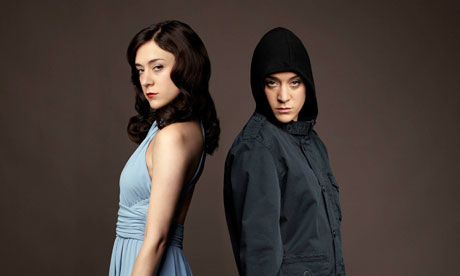
Mia (Chloe Sevigny) has a double life - in more ways than one.
"I don't know about the dick in your pants, but you've definitely got a dick in your brain - you're fucked in the head."

In anyone else's hands, the premise of this new Sky Atlantic drama would sound rather ridiculous. Big Love's Chloe Sevigny plays Mia, a transsexual hitwoman who discovers that she has a son and an entire family of kids left to her by her late girlfriend Wendy. Written by Shameless' Paul Abbot, the first episode of the series managed to escape any possible connotations of being a freak-show or a gimmick, which a witty script that combined powerful characterisations (especially from Sevigny) with humour and drama. Importantly enough for me, it was filmed in the city where I live, and so I got a lot of enjoyment from musing over the locations used.
     One of the things I loved was how easily it mixed a sort of Wild-West theme with a great deal of realism. At one point we see Mia undress for a shower, and we see some full-frontal nudity using a prothetic penis. Now while this is what every reviewer is going to be talking about, it speaks volumes that Mia's transsexuality is so realistically shown, and it doesn't form the entirety of her character. It helps that Sevigny is somewhat androgynous, and there have been some clever wardrobe decisions that highlight the character's former form. There's also a considerable lack of Northern stereotyping, although this is probably due to Paul Abbot's background. I was glad that it had humour; the premise is so stuffed that the series risked taking itself too seriously, and the Shameless-style humour highlights the characters' humanity.
     Sevigny is perfect for the role, and despite the actresses' controvertial comments about Manchester itself, she does a bloody good job here. I loved her in Big Love and she's even stronger here, as the broken woman who recognises what taking care of the family could do for her life. She insists that she used to love Wendy, and you can tell simply by the way that she acts around her kids and her bedroom. It was a performance that never reminded me of her American heritage, or of the actress' other works. It was a strange, strange casting decision, but it's had a great result.
Leonie, Levi (Reece Noi), Mia, Riley (Karla Crome) and Ryan.
  The children are a good selection of promising actors. Karla Crome (future Misfits star) is great as the abrasive Riley, who wants the kids to remain self-sufficient, as was Reece Noi (Waterloo Road) as troublesome Levi. Especially impressive were Mia's son Ryan and the youngest child, Leonie, both of whom managed to express their grief at their mother's death in several touching scenes - one where Mia teaches Ryan how to fight a local bully, or another where Leonie is left on her own and cuts the hair off of a Barbie doll to resemble her mother. It was a lot more raw and domestic than the advertising suggested, but that's really all for the better.
     Hit And Miss was almost nothing like I expected. It didn't use its unorthodox premise as an excuse but as a driving device and when mixed with the Shameless-style humour it was a fulfilling and empowering experience. As one of my friends commented, the series is, "Shameless, given emotional depth." Hit and Miss is like nothing on British TV at the moment and deserves to be seen as the start of something beautiful for Sky Atlantic's homegrown productions.

Thanks.

Friday, 25 May 2012

Josh: Doctor Who Classic: The Claws of Axos

The Time Lord enemies work together
Doctor Who - Season 8, Story Three - The Claws of Axos

The season long Master arc of Season Eight continues with the creators of K-9 and Omega; Bob Baker and Dave Martin writing our four-part instalment. The tag for this one is; 'The Axons promise Earth a golden age of prosperity and big frogs.' Let's hope it isn't as cheesy as it sounds.
     UNIT detect a UFO is heading towards Earth as the Brigadier, the Doctor, Jo, Yates and Benton are holding a conference with a security inspector; Chinn and an American agent; Bill Filer to discuss the threat of the Master. Chinn fails to destroy the craft with a missile, the craft then is detected to have landed nearby a power plant causing freak weather conditions, it then opens to reveal tentacles that bring a homeless man into the ship, scan him and consider him not usable so kill him. They also capture/scan Filer and keep him for further investigation along with fellow captive; the Master. The Doctor, the Brigadier, Chinn and two scientists from the power plant who shot the missiles go into the ship where the Doctor is also scanned but left alone. There they find the Axons whose world was destroyed by solar flares and now they need to refuel on Earth, in return they offer Axonite (a 'thinking' molecule that can replicate any substance). Seeing the possibility of unlimited food and power Chinn and the Nuton scientists are transfixed as they all overhear Jo's screams as she's followed them and met some kind of monster on her way to find Filer. The Axons blame her hearing on hallucinations which the Doctor agrees with, Jo doesn't accept this.
     Chinn accepts the gift of Axonite on behalf of the planet as his men put UNIT under security arrest and take control of the investigation into how Axonite works though the Doctor is allowed to assist one of the scientists; Winser. Elsewhere the Master and Filer fail at escaping and are reimprisoned for reasons unknown. The Doctor then tries to use a particle accelerator to discover Axonite's true meaning. The Master then strikes a deal with the Axons to help them distribute Axonite worldwide in order for his freedom but his TARDIS stays with them. The Axons duplicate Filer as they need a Time Lord and the duplicate goes to capture the Doctor but is killed by the real Filer who has escaped. Winser then interrupts and is killed by radiation from the Axonite which spawns monsters that turn into Axons. Axos, Axonite and Axons seem to be all the same thing as the Doctor and Jo are taken captive as the Master starts to hypnotise Chinn's men.
The Axons in one of their many forms...
     The Axons remove memory blocks the Time Lords put in the Doctor's head to allow him to reveal to them the secrets of space-time travel. The Axons plan to drain Earth and move through the universe for fuel. Meanwhile the Master has no intention of helping the Axons but tries to fix the Doctor's broken TARDIS to escape, he tries hooking it up to the power complex where he's caught by the Brigadier and troops. The latter had arrived as the Brigadier had spotted one of the Axons in monster form making its way there. Chinn has now begun to export Axonite worldwide under the UN's orders. The Axons having control of the power complex have the potential to cause a nuclear explosion but the Brigadier agrees on the Master's freedom if he helps to stop it. The Master plans to reverse the power of the Axonite against the Axons killing the trapped Doctor and Jo in the process. However the plan fails and the Doctor and Jo escape for the Master and the Doctor to work together but the Doctor plans to escape Earth and leave it to it's fate.
     As the Axons attack the power complex the newly fixed TARDIS materialises in the Axos where the Doctor makes a deal with the Axons to link ships and take on the Time Lords. They agree as the Master tries to escape in his own found TARDIS. The Doctor tricks the Axons and traps them in a time loop causing all Axonite to disappear worldwide, the Doctor just manages to break out the loop and escape a detonated power plant. The Master's fate is left unknown.
     With a predictable yet casual entrance for the Master the Claws of Axos delivers a serial with various surprising events. The Master himself isn't our main villain for the first time this season even though he has a moment where he nearly works with the Axons. Instead we're shown a different, interesting side to the Master which sees him willing to do anything to help him escape to freedom even saving UNIT and working with the Doctor. We also saw a different side to the Doctor which disappointedly turned out to be a total charade, or was it? The fact he was willing to let Earth be consumed by the Axons in order to escape for himself showed a selfish, darker side and what appeared to be the need for revenge against the Time Lord High Council who exiled him. This serial is also visually excellent with it's use of sets and costumes for the Axons, the grandeur of the serial in terms of CG work and directory is the best of the season. It also makes me wonder whether the budget had been bumped up considering the firing of the previous serial's director who overspent though compared to this Mind of Evil appears cheap.
...and in another one.
     The script for this serial is clever in many ways with it's multiple twists and turns as you never know really what's going to happen next. It was a shame we never got to see any more productive dialogue between the humans and the Axons as we saw in the first episode. I'm also happy that we've been slowly drawn to new ideas about time travel such as the time loop and the reintroduction of the TARDIS was a successful addition to the resolving of the problem. I also find myself admiring the slight political aspect to this serial that was eventually thrown out of the window with the plentiful amounts of gun-violence as per usual with Pertwee's stories. The fact we had some kind of satire was different to this season's previous two stories and made things much more interesting. The satire studied the human condition which sees the endless possibilities of power overthrow the potential negative outcomes of taking advantage of the opportunities. The Claws of Axos takes it's time to get going and has a brilliant satirical side to it's story which is sadly dwindled to an attack of monsters. However, we explore different aspects to our regular characters in a serial that eventually becomes exciting but fails to beat it's predecessing story in terms of enjoyment and creativity in plot terms.

Thanks, Josh.