Sunday, 25 March 2012

Review: Being Human 4.8: The War Child

Gatiss is good as the impressive Mr. Snow.
"These eyes have looked upon pharohs.... upon the Son of the Carpenter.... and now they have to look at you." Mr. Snow to Cutler.

No real surprises came from this finale, but it did contain a few good character pieces. It felt like it was trying to be a normal episode but was stymied by its own nature as a finale, and I didn't really feel the tension that I needed to. Even when Being Human's finales were written badly, the stakes were high. Here the prophetic nature of this series' threat meant that it felt like they had plenty of time to sort themselves out.
     The Old Ones finally arrived, as it was revealed that the prophecy stated that Eve's death would destroy the vampires instead of saving them. While Tom worked on making a home-made explosive to destroy the Old Ones, Cutler dealt with his rejection by coming round to Honolulu Hights and trying to kill Eve. He was staked by a lamentful Annie. Hal, still fighting his addiction, was met by the evil Mr. Snow (Mark Gattiss), who tried to pull him over to the dark side. As Tom handed Eve over to the Vampires for her own safety, Alex tried to solve her unfinished business with Annie. Hal arrived with a bomb to try and get over his addiction and save the world, but Annie arrived with Alex just in time and got the main trio out of there, killing the baby and Mr. Snow and saving the world from immenent invasion.
     Mark Gattiss I expected to be terrible, but his portrayl was easily one of the best things about the episode - cruel, potent and deliciously creepy. His put-downs toward Cutler were Being Human gold and his exchanges with Hal were excellent. Werewolf Milo was less well-expressed, and he didn't seem to go anywhere. Alex improved by a vast amount this week, as we saw her working in very different situations, although it seemed a tad off when she and Annie had "ghost lessons." They felt much more like they were excercising another episode concept in the middle of this finale, and it had to be rushed in because Annie was going to go soon.
Alex joins the team as the new Ghost.
     About that. This is the woman who turned down the Door. Who made the people in purgatory scared. Who managed to drag her exorcisor into Purgatory with her, and then came back. This is the ghost who evaporated into nothing and then fought back through sheer will. And she just committed casual infanticide. I wanted Annie to go, desperately so, but I thought that it would have been done with a great more pizzaz than it ultimately was. This character, who we have followed through thick and thin for four years, disappears in a heart-beat. I wasn't really an Annie fan, but I recognised her importance in the Being Human universe and I was sad to see her go in such a pathetic way.
      The previews heralded this as the best finale Being Human has ever had, and in terms of character it was. But ultimately, The War Child was totally devoid of any tension, any suspense or any real drive. Our character just seemed to lull around for an hour instead of actually getting down to business, and the reliance on the Prophecy meant that when we did get our resolution, there were absolutely zero visible consequences. A fifth series has been commissioned, and I shall be watching, but as the beginning of a new era for Being Human, this hasn't been a powerful start.

Thanks.

Thursday, 22 March 2012

Review: Pramface 1.5

Pramface - Series One, Episode Five - Knocked Up And Homeless
"Would you like a pregnant chick around at your house? With all those, hormones and stuff..." Stupid Announcer.

Better. Pramface has really gone past the point of no return in terms of its characters, writing and plots, but there was a general turn towards a more positive experience. The problems are still there, but the dynamics are a little more developed and thus they overshadow them slightly. I suppose the game is finding which stereotypes they're abusing this week, and seeing which ones are less offensive.
     Laura has been staying at Jamie's house for eight weeks now, and despite his parents' issues with her presence she feels welcome. Feeling the full hormonal effects of pregnancy, Laura calls upon Jamie to heed to her every beck and call, with Mike and Beth looking on bemused. Angus and Anna, meanwhile, have a much better subplot in which they try to fix their relationship, which felt so much like a different, better sitcom. Jamie just comes across as a poor, poor sap while Laura has become an unrealistically portrayed, hormone-addled pregnant woman. Beth and Laura clash when Mike and Beth come to the house, and while Jamie confronts Beth's standoffishness, Mike and Laura start playing video games together. In typical sitcom traditions, Laura has false contractions. Anna tells Laura about her fixed marriage and how Jamie's parents have been trying to get her out. Taking hold of the Smart Ball, Laura realises what a douche she's been and Jamie comforts her, resulting in a kiss. Now a safer environment, Laura goes back to live with her parents.
     So, were these stereotypes less offensive? Well, the whole pregnant-woman-is-insane thing is terribly cliché, but we can't really say that it wasn't expected. Pramface is executing these tired sitcom situations in such a standard way that there isn't really any entertainment to it any more. The teen side of the story isn't annoying any more; it's just boring. The Angus and Anna segments were yet again painfully brief, but they at least provided some nice, witty moments. I really don't get how the quality of the writing can change so much between the two subplots; it's remarkable.
     "Knocked Up And Homeless" was business as usual for Pramface; clichéd characters in boring situations in nine-tenths, and brilliant witty charm in the remainder. I'm gonna finish this series for the sake of completion, but I really do have to say that if it wasn't for the blog, I would have abandoned this series a while ago.

Thanks.

Wednesday, 21 March 2012

News: New Doctor Who Companion!

JLC is the new companion.
Yes, this is rather late in the day, but I just had to comment. The Moff has revealed his new companion, as well as some details about how Season Thirty-Three is gonna go down, and despite some reservations this has certainly made me more excited for the Autumn series.
     Jenna-Louise Coleman, 26, is a Blackpudlian actress best known for her work in Emmerdale and Waterloo Road. It's great to see actors from the North of England getting involved in Doctor Who; the last time a major actor hailed from there was in Season 27 with Christopher Ecclestone and Bruno Langley. While I've not really payed attention to any of her other work, Moffat usually picks decent actors regardless of how he treats their characters.
     I was greatly divided when I first saw the announcement. I was disappointed at first, because Doctor Who needs some change and there hasn't been a movement away from the "Present-Day Earthborn girl" in the entire history of Nu Who. On the other hand, Jenna-Louise (whom I shall refer to as JLC from now on, because I think it sounds cool) is absolutely charming and strikes me as an excellent addition to the show.
     There will be five episodes of Amy and Rory in Autumn/Winter 2012. The fifth of those episodes will feature their departure and the return of the Weeping Angels, followed by a Christmas Special and a new series with the new companion. I wish Ms. Coleman all the best, and I can only hope that Audenshaw Reviews will still be there when she premieres.

Thanks.

Review: Lost 5.9: Namaste

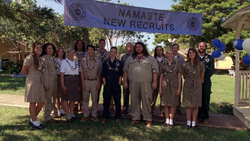
Groupshot509.png
Namaste!
Namaste is an Indian greeting used across the subcontinent, and as they welcome one another, and as our survivors are introduced to the Dharma Initiative, we welcome the second half of this series. A second half that brings with it a key change in Season Five's format that should feel rather jarring but instead blends in nicely. For one of the first times on Lost, there isn't any obvious character centricity, which makes the transitionary nature of this episode all the more apparent
     As a new batch of Dharma recruits came to the island, James used the submarine as a cover story for the newly arrived Jack, Hurley and Kate to create yet another lie. The three were inducted into the Dharma Initiatve, but Sayid was caught on the outskirts of the facility and was forced to admit that he was a "Hostile". He was thus locked up, as James was forced to treat him like a criminal. Jin looked for his wife, but found that she hadn't arrived in 1977 as her four Oceanic Six comrades had.
     In 2007, we see Frank land Flight 316 on Hydra Island, a smaller island off the shore of the bigger one. Ben wanders off towards The Island and Sun and Frank follow, Sun to find Jin and Frank to protect her. They enter an old Dharma building and find The Man In Black as Christian Shepherd, who shows them the crew roster from 1977, making Sun aware of her husband's present fate.
     There were some interesting discussions in the episode between Jack and Sawyer which I thought were quite interesting, particularly around the issue of Leadership. Jack, who had been the de-facto leader of the Survivors since the Pilot, was forced to become a workman under Security Chief James, who tells Jack that in his three-year stretch, he changed his attitude and decided to think things through before doing them, unlike Jack's reactionary attitude. This is rather ironic, really, as it's Jack who thinks that detonating a Hydrogen Bomb is a good idea in the finale and Sawyer eventually goes on with him. But that's an issue for in a few weeks time.
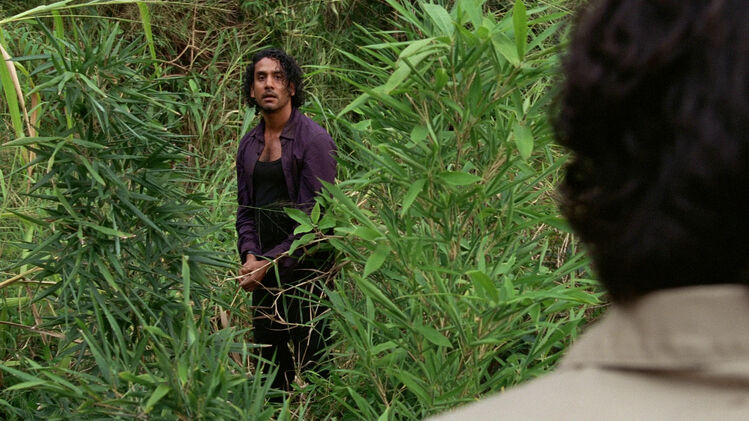
5x09-sayid-hostile-jin-dharma.jpg
Sayid is caught as a "Hostile".
     Namaste touched upon a few of the characters' struggles but otherwise it served only to set-up this second half of the series set alternately in the Dharma Inititive in 1977 and with the Man In Black in 2007. Other than that it felt rather empty, and there wasn't anything that really stood out from the norm, very much contrary to last week's brilliant tale. There's certainly a lot of stupid to come on Lost, but Namaste was a fun bit of nothing.

Thank.

NEXT WEEK: The torturer is tortured in He's Our You.

Monday, 19 March 2012

Review: Doctor Who Classic: Enlightenment

Turlough considers Enlightenment.
Doctor Who - Season 20, Story Five - Enlightenment

Enlightenment is a unique story in many ways. It presents itself first as a pseudohistorical, but very soon it becomes apparent that this story is much deeper than it appears. Even more importantly, the story justified the Black Guardian Triolgy by taking a brilliant concept and building it around the Black Guardian and his counterpart. For the first time, Turlough shows some promise as a companion and his presence is justified also.
      When The White Guardian contacts a damaged Tardis, The Doctor follows his co-ordinates and finds himself on what appears to be a 17th Century ship. Upon cohorting with the crew, he is taken to meet the Officer class - a group of people called Eternals with telepathic powers, who occupy space but not time. The Eternals have the ability to conjure into being whatever they find in the minds of time-occupying beings (known to them as Ephemerals), and because of the boredom of eternity use this power to entertain themselves.
     The Eternals on this ship happen to be part of a race, organised by the White and Black Guardians. The winner of the race would acheive what the Eternals call, "Enlightenment," a powerful prize that they believe will allow them to have emotion and imagination of their own. The Black Guardian abandons Turlough, and he throws himself off-board to escape his wrath, finding himself floating off to another Eternal ship commanded by Wrack (Lynda Baron), who is also in service of The Black Guardian. In their pursuit of Enlightenment, Wrack's ship has destroyed the majority of the other competitors using powers from the Guardian. The Doctor saves Turlough and finally sets his mind against the Black Guardian. When they inadvertantly win Enlightenment, Turlough rejects the Black Guardian and the White Guardian explains that Enlightenment is in fact the choice between Good and Evil.
     The core ideas of the story are a lot more consistant than the previous two stories in the triolgy, focussing on the very nature of human morality. The Eternals are emotionless and thus amoral; they may display emotional tendencies but everything they experience is robbed from mortal beings. Their contempt for mortality is only matched by their lack of imagination or drive - they rely on the Guardians to organise activities for them, and take everything they knwo from the Ephemerals. While Wrack's chaotic activities do oppose Striker's starch Upper-Class pride, it's allegance to a Guardian rather than a true sense of right or wrong.
Captain Wrack works for The Black Guardian.
    The actors playing the Eternals on Striker's ship are creepily emotionless, but they all show their own signs of character. Keith Barrat's striker is persistant and determined despite his lack of drive for the rest of life. Christopher Brown plays the slightly frightening Marriner, who through Tegan's mind falls in love with the simple concept of mortal life. Lynda Baron, on the other hand, is very hammy as Wrack, and often at times her bodaciousness clashes with the nature of the Eternals as a race.
      And, after some silly costume design from both Mawdryn Undead and Terminus, this story looks gorgeous. The Eternal's obsession means that the ships are beautifully detailed with period features - what the BBC do best - and the costumes are straight out of historical dramas. The production values in creating a race in space are incredibly high, and it's clear where the majority of the trilogy's budget went.  
      Enlightenment corners off our trilogy with another brilliant Sci-Fi idea, only this time the plot isn't clouded. Weaving The Guardians into plot made it all seem rather relevant, and the final story in Turlough's turmoil-filled encounter with the Black Guardian provides excellent closure for his opening development and for the arc that it occupies.

Thanks.

NEXT TIME: When Robots Fail Because Their Owners Die! See you next time in The King's Demons.

Sunday, 18 March 2012

Review: Being Human 4.7: Making History

Cutler tries to impress.
Is it really the penultimate episode? I've spent so long for this series to really get going that it doesn't really feel right for the usually powerful pre-finale to be here yet. Nevertheless, Making History did not disappoint. While it wasn't as powerful as previous pre-finales, it advanced the plot and developed the characters in ways that this series desperately needs. And, while its cliffhanger didn't have the cinematic thump that I've come to expect, it did leave me hoping that this finale would be better than the three we've had so far.
     Cutler prepared Tom to supposedly destroy the Old Ones, the arrival being merely a day away. At the same time, Hal's investigations into the Vampire PR stunt lead him to Cutler - a man whom he made and tortured a few years before he decided to go clean. Being given blood by a scheming Cutler, Hal fights between his newfound sense of ethics and his primal urges, ultimately settling upon the former when Cutler explains his plan to introduce Vampires as the saviours of the world. The Vampires, copying one of Hal's old tricks, have killed Hal's girlfriend Alex and fed him her blood, but this only makes him more resolute.
     In the afterlife, Eve takes a confused Annie on a sight-seeing tour of the future, discussing how Annie has evaporated out of sadness, Tom was killed in a dog-fight after being put in a Werewolf/Human concentration camp, and how Hal has become the most ruthless killer in the Vampires' arsenal. Claiming that the final part of the prophecy says that the war-child must die, and that she herself is the killer, Eve tells Annie that she will have to kill her at some point.
Alex is a ghost now. Woo. (pardon the pun).
     I'm just going to take issue with this for a second. Now this is immensely stupid for two reasons. The first is something I brought up when this plot reared its head in the premiere: that this is Paradox 101 and if you're trying to be a clever sci-fi writer then you should know that this is impossible. We're not talking some obscure rule of Time Travel that might have gone over the writer's heads, this is really, really basic stuff to tackle when writing about Time Travel. The second is slightly more frustrating, in that this isn't a live Eve telling Annie this, this is Ghost!Eve. Eve thinks that the young version of herself needs to die when hey, SHE'S ALREADY DEAD! By dying and coming back in time she's changed the future enough for Hal to reject blood and try and save the world, her job is as good as done. She does not need to then be incredibly stupid and try and destroy the space-time continuum!
     Hal, with the ghost of Alex (whom I hope will become the Annie's replacement in the Trio), manage to help everyone escape from the hall where Cutler had planned on revealing Werewolves, and they stop Tom from killing anyone. As we see Hal get mauled (maybe), the Old Ones arrive.
     This week shone a light very much on Cutler, and that really pushed Andrew Gower to the depths of his character. It was revealed this week that his nervous exterior was simply the reaction his original making by Hal, who, as we see in the episode's flashbacks, tortured him in many cruel and unusual ways. It was really quite interesting to see how much the power dynamics between Hal and Cutler in 1955 and 2012 affected their behaviour. This followed the pattern of previous finales, having the vampire revert to his bloody ways, but this time it was done in a much more human way.
     Eve and Annie's storyline was the one that I was most interested in, although it didn't really have the impact that I expected it to. It felt very much like a budget-saving exercise; wandering around abandoned buildings while only sound-effects of these supposedly horriffic acts of torture and despair occurred. Aside from the odd mentality, as I covered about, there was something about Eve's attitude which felt a little off to me, which was probably from Gina Bramhill's interpretation. There was the hint of a mother/daughter-esque relationship between the two of them but because of all the conflicting storylines it never got a chance to shine.
Mark fucking Gattiss is head of the Old Ones.
     Making History certainly wasn't disappointing by any stretch, and its character work was really some of the deepest that we've seen in this series so far. It's really up to viewer to decide whether this character focus makes up for a plot that promised an epic scale and has, ultimately led to answers that we worked out six weeks ago. Now I can only hope that the finale will make justice of what has been a difficult rebirth for this troubled series.

Thanks.

Thursday, 15 March 2012

Review: Pramface 1.4


This image isn't from this episode. But I really don't care.
Pramface - Series One, Episode Four - Man of the Moment

This week saw the first actual fulfillment of the show's premise. The appeal of Pramface's concept was the interaction between Jamie and Laura, the two main characters, and for the first three episodes this has basically amounted to bad stalking. Man of the Moment was the first time that we saw the characters really gel, with an emerging odd-couple dynamic. The rest of the characters fell into the same irrelevance and cliché that's killed the rest of the series.
     Jamie and Laura attend childbirth classes. The over-active teacher is admittedly quite funny, and I loved seeing the relationship between the two leads instead of just their friends. It's been arranged for Jamie and his parents to arrive at the Derbyshire household for a meet, and Beth is showing off her date with a Hollywood Atheist stereotype (not making friends with me, Pramface), as well as Mike. These two characters feel like they're desperately trying to cling to relevance at the moment. While there are awkward motions at the Derbyshire's theres a bisexual joke at the date as Mike tries to impress a hot girl. (Keeping it classy, Pramface.) That however did lead into a funny joke where Mike discovered that the hot girl's gay friend was his date instead.
      Angus Deayton flirts with Jamie's mum, they argue over what's going to happen once the baby is born. There's the boring sitcom misunderstanding moment between Jamie's mum and Angus, while Mike is tempted into a bisexual threesome. After some boring arguments, there's one moment of physcial comedy as Angus is stabbed with a carving fork. The date storyline did have a decent end, but it was still characteristic of a long line of Pramface's problems. Laura announces to her parents that she's going to stay at Jamie's.
      It was certainly a more solid episode, with only two storylines, and I saw some shoots poking through that might have a chance of improving Pramface's squalid record. But it's still a bad mix of terrible characters making clichéd jokes and boring sitcom situations. I was expecting so much from Pramface, and I can really say that this series hasn't provided television with anything it couldn't do without.

Thanks.

Wednesday, 14 March 2012

Review: Lost 5.8: LaFleur

http://images.wikia.com/lostpedia/images/1/12/LaFleur_avec_la_fleur.jpg
Sawyer is content with his new life.
The series was due a Sawyer-centric episode, not having time for one in Season Four due to the Writer's Guild of America Strike. Covering what happened to the Leftbehind's after Locke turned the wheel, LaFleur pushed all of my buttons by mixing all of Lost's aspects and spinning them in an interesting way, mixing science ficiton and good old-fashioned emotionfest. LaFleur is the best episode of this season so far.
     The leftovers wait as Locke turns the wheel, and after another time-flash they find themselves in 1974. Wandering to start again on The Beack, they come across two men torturing a woman, and Sawyer kills them. It turns out that the woman was a member of the Dharma Initiative, and that the two men were from the Others, known to Dharma as "The Hostiles." The leftovers take the corpse of the woman's wife, Paul, back to the Dharma Initiative where they are questioned by their leader, Horace Goodspeed, who we saw the ghost of back in Cabin Fever. Richard Alpert arrives to question Dharma about the loss of his men, but James (going by the name LaFleur) goes and resolves the situation by using his knowledge of the events of 1954 to gain Richard' trust.
      In 1977, we see that James LaFleur is now Dharma's Chief of Security. Two workers report seeing Horace drunk and throwing Dynamite around. James then helps Horace's wife Amy, who is having their baby and who has just gone into labour. Since there are no other fertility specialists on The Island, James is forced to employ Juliet's help. The baby is born with her help, and later James visits their home and gives her a flower in thanks. It's then revealed that over the past three years, the two have become lovers. In the morning, James receives a call. It's from Jin, and he has found the three others.
http://images.wikia.com/lostpedia/images/8/8c/Chalpert.jpg
James uses timey-wimey knowledge to help Dharma.
      This particular era of the show's history has a wonderful theme running through it of pre-ordination coming not from "destiny" but from time travel. I think this is such a wonderful quirk of Lost. Everything mystical in Lost can have a semi-scientific explanation, even some of the worst recesses of Season Six. Like in Mawdryn Undead, LaFleur has two storylines running parallel to one another, in different time streams. I loved it there and I love it here; it's Lost's twisty turny plotting at its logical best.
      And, despite my hated for the Quadrangle, I think that LaFleur did it well. Sawyer and Juliet's relationship made sense; they bonded over their rejections by Jack and Kate and had three years to work their relationship. Jack and Kate make sense through sheer idiocy; they're both as vapid and empty headed as one another.
     LaFleur was simply good characterisation put to good plotting. Lost ususally falls down on one or the other, but here it was the perfect hand and everything fell together in a way that makes LaFleur one of the best episodes of the series so far.

Thanks.

NEXT WEEK: We set up the second half of the series in Namaste.

Monday, 12 March 2012

Review: Doctor Who Classic: Terminus

The Doctor tries to save The Universe.
Doctor Who - Season 20, Story Four - Terminus

Terminus is another story that I vaguely remember from childhood, although more for its rather ambitious premise rather than anything that actually happened. It's Nyssa's final story, and I must admit that over this Five marathon I've become rather attached. Peter Davison had it spot on when he said that Nyssa was Five's perfect companion, and despite the fact that the crowded Tardis robbed any of the companions of really powerful moments with the lead, Nyssa had some of the best natural chemistry with him. Terminus, rather appropriately, signifies the end.
     Somewhat strangely for a Who story, it starts and ends in situe. JNT was a big fan of arcs, as evidenced by his use of them four times during his seven-year era. The story itself is far from conventional, and this often causes many fans to label it boring. It's not boring at all - it's dark, dreadfully dark in a brilliant way. Funnily enough, this comes from Steven Gallagher's dark script and not from the Black Guardian.
     Turlough sabotages the Tardis, causing it to latch onto the nearest ship. This happens to be a strange ship being scouted by two raiders called Kari and Olvir. They soon discover that the ship is a Plague Liner, headed to dock with the space-hospital Terminus at the exact centre of the Universe. Nyssa is infected by Lazar's Disease and is taken into Terminus to be "cured," a process which usually kills the sufferers. The Doctor, while trying to save Nyssa, comes across the station's workers, the Vanir, who are being used as slave labour - paid only in temporary cures for Lazar's Disease.
     Curious about the ship's centric position, The Doctor investigates in the high-radiation zones and theorises that the ship used to be able to time travel. A while ago, the ship travelled back to the dawn of time and emergency protocols led it to dump a high quantity of radioactive waste into "the Void". This, The Doctor theorises, caused the Big Bang, and if the ship were to destabilise again then a second explosion could destroy the Universe. More of Turlough's machinations begin this destabilisation, but the Doctor manages to stop it. Nyssa, having been healed by the facility, realises that she could improve upon the design and turn the facility into a working hospital, as well as freeing the Vanir from slavery by synthesising the drug they need. In a scene that still moves me to tears, Nyssa decides to stay, and The Doctor reluctantly agrees.
Nyssa recovers, and makes up her mind.
    Terminus's main problem plotwise is that it takes two very distinct ideas and melds them together, like two written-off cars welded into a knock-off banger. Both ideas are interesting in their own right - the Leper Colony plot exploits a lot of our modern fears about disease and sickness, as well as mixing in some great references to Norse mythology. The Big Bang plot is pure sci-fi goodness and it's rightfully what I remembered the most about the story. Sure, the science is a bit iffy, but it's a great link back into Castrovalva and the explanations are better.
     Turlough's continuing presence only serves to highlight the issue that three companions is too many. One of the reasons that Nyssa was so badly used over the course of her tenure was that she often fell into a "surplus" position due to her more brainy nature. She doesn't leave the Tardis in Kinda, spends a lot of time there on her own in The Visitation, does the same in Earthshock and then gets posessed in Time-Flight. On the contrary, Terminus uses Nyssa rather well, and her gradual increase in confidence throughout the beginning of Season 20 is rather interesting. Arc of Infinity saw her travelling with The Doctor alone, and saw her use weapons a hell of a lot more than before. In Snakedance, she finally changed out of her "costume", and through these two stories from the Black Guardian, Nyssa gradually loses her inhibitions. (And her clothes.)
     Turlough and Tegan spend the entire episode trapped together in claustrophobic conditions, hiding in Terminus' air vents. Their subplot does nothing, goes nowhere and wasn't even filmed at the same time as the rest of the story. As a part of the Black Guardian Trilogy, Terminus has no place. Other than Turlough setting the plot off, his presence in the story after that can be largely ignored. It's ridiculous, and while this isn't the worst of JNT's arcs it isn't exactly engaging. Tegan's useless.
     But that ignores the character work on Terminus, which while a little blunt for Kari and Turlough, excells everywhere else. The sick Vanir theorist Bor, whose rambling reveal his knowledge of the truth. The deep, seething rivalries between the Vanir leaders. The touching moments at the end, where Nyssa becomes the first companion to ever kiss The Doctor, albeit on the cheek. For the first time in Who, the relationship between companion and Doctor felt real and, fundamental to the entire premise of the Fifth Doctor's characterisation, human.
Nyssa and Five hide.
     Terminus takes a couple of good ideas and gets lost along the way, but the character work for The Doctor and especially for Nyssa makes this a vital story in Five's era. I love it, and it's a shame to see Nyssa go. Goodbye, Nyssa of Traken.

Thanks.

NEXT TIME: The Eternals and the Guardians in Enlightenment.
P.S. Nyssa spends half the story in her underwear. There, I mentioned it, ok?

Sunday, 11 March 2012

Review: Being Human 4.6: Puppy Love

Allison (Ellie Kendrick) and Tom fall in love.
Puppy Love felt like it came from a place a lot earlier in Being Human's development, both within this series and in general. One of the main issues, really was that the Guest of the Week formula was copied and pasted over every main character (including the villain, bizzarely). But underneath all that there was a whole bunch of really fun characters and this is by far the best episode of Being Human I've seen in a long time.
     Tom was met by geeky female werewolf Allison, who's the school debating champion and managed to track them down based on Cutler's Youtube video. They go to talk to Cutler, and Allison is shocked by Tom's violent ways. Cutler gets a visit from the Vampire Head of Britain, Golda, which peeves him off a bit. Annie accidentally kills an old man, Emrys (Merlin flashback) and has to help his ghost solve his unfinished business. Culter plays the nice guy and tells Tom and Allison that Golda is the one who spread the video, telling Tom to go and kill her. Hal, trying to adhere to routine and avoid temptation, meets a strange woman, Alex, who insists on flirting with him, and they leave on bad terms.
     Playing "revision buddies," Tom teaches Allison how to stake vampires and she teaches him debating skills, in a Hallmark montage to S-Club 8's "Puppy Love". As Tom tells Hal that he can't help him because of Allison, and Alex pops in. While Hal hides, Tom organises a double date. Emrys reveals to Annie that his unfinished business is never having been kissed, which turns out to be a lie. They then find out that Emrys is really mad about his cheating wife. He gives a bitter confession to his wife, but the door doesn't appear. Alex turns up for the date, which turns out to be at a museum's tea shop. Cutler tells Golda to go to a warehouse to get a werewolf (setting her up for Tom), and at learning of his fellow's demise, Golda's gold-coloured pimp lets out a loud, melodramatic, Noooo! (He's obsessed with film clichés). As Tom goes off to kill the gimp, Hal tries to resist the temptation to murder Alex. After managing to kill the gimp, Allison tries to get it on with Tom but he's avoiding things. Tom, brought up by old-fashioned McNair, is put-off by her modern sexuality.
http://i1.cdnds.net/12/10/618x409/cult_being_human_s04_e06_2.jpg
Hal tries to resist temptation.
     Golda gets wise to Cutler's tricks but Allison goes off alone to confront her. Before she can kill her, Tom comes with an emotional appeal for Allison. As she lets Golda go, she tries to murder her, so Cutler stakes her instead. Tom calls Alex to try and get Hal to talk to her, and he leaves a voicemail. Tom tells Allison that they can't see each other again, because he doesn't want to change her. At his request, Emrys and Annie spook his ex-wife, finishing his business and letting him pass on. The Woman then comes through the door, and asks Annie to come into the Afterlife, telling her that she's Eve. (This isn't a revelation, really.)
      I'm going to be honest; this is the most fun that I've ever had watching Being Human, and I'm serious about that. Even when it was a pure comedy, it wasn't as funny and as entertaining as tonight's episode managed to be. And yet at the same time, it was a complete mess - totally unfocussed, overstuffed to the brim and filled with aspects that just don't add up. Together? It. Was. Awesome.
     This was in part due to the character of Allison. Ellie Kendrick, known only for The Diary of Anne Frank, is a superb character actress and I fell for her geeky nymphomaniac almost immediately. Her character over all others gave their respective main character something decent to do, and Socha's final goodbye to her is damn heartbreaking. The way that the episode dealt with love in general was actually really interesting; Tom and Allison showed young love, Hal and Alex showed celibacy and temptation, Emrys showed the bitterness of divorce and Golda's gimps showed hedonistic melodrama. Every aspect of the admittedly overegged story showed a glorious mix of completely over-the-top characterisation and something uniquely human and special.
Emrys showed that not all bitterness is bad bitterness.
      Yeah, I can't be allowed to continue gushing. Despite how many cooks were at this broth, it was most certainly not spoilt and I found myself loveing every last second of it. I may have been blinded to its faults, but it pushed all my buttons and I'm willing to call this the best episode of Being Human ever made.

Thanks.

P.S. There was even a reference to Daddy Ghoul. I was wowed.