
| The Malus. This image used to frighten me as a child, but now it's just a little silly. |
Written between the 3rd and 4th May 2012
I'll be the first to admit that my reviewing of Season 21 has been a total and complete shambles. I often considered renaming this site's tagline to "it's all in the wrong order" when I began writing these reviews in advance, and I think that it's also an appropriate description of the topsy turvy way I've treated Season 21. The Awakening is the last two-parter to have 25-minute episodes, and it really shows the problems that could arise when this format was used.
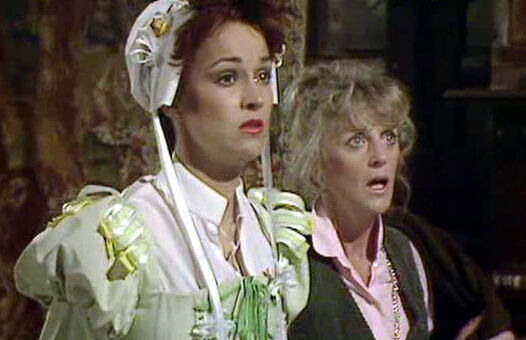
The Saward Era seemed to have this vision of the past as hovering around the 17th/18th Centuries, and the only historical stories were set there. If I'm honest that isn't really a period of history that I find particularly fascinating, not least when it's executed in a dull way. The Awakening isn't set in the period, but for various timey-wimey reasons (and some stupid ones) everyone is dressed in 1640s attire and are reenacting the English Civil War. They're being controlled by a demonic creature called the Malus, a genetically engineered creature sent to Earth to destroy it several hundred years ago. The creature is now controlling Sir George Hutchinson, who has began a town-wide reenactment of the Civil War to create the perfect conditions for the Malus' return - intending for the final battle to cause a massive bloodbath.
My main problem with the story's premise is not with the actual concepts at hand. It's quite fun time-travel BS, and given the proper (subtle) development it could have worked. Instead, the concept doesn't get room to breathe because we spend so much time developing these insane villains who make little-to-no rational sense. The Malus is controlling one man. That man has managed to persuade several perfectly sane people not under the influence of a demonic alien to commit several crimes, and until The Doctor shows up nobody bats an eyelid apart from one schoolteacher, Jane. I know that the country-folk are a bit out of it, but I really don't see how an entire village could become so insane as to follow every crazy order of one guy during a battle reenactment.
 |
| Oh yeah, and this happened. Never again. |
When I missed The Awakening, I certainly wasn't missing anything important. The story does have some fun ideas, but they're strangled by a running time that puts greater priority on the mysteries and then doesn't bother to do anything interesting with them. I rarely get to call a Who story dull, but The Awakening's problems leave it a complete non-entity in a season that has so many strong and memorable stories already. A third episode might have given it the space to be a bit more dynamic, but it's too little too late.
Thanks.

No comments:
Post a Comment
Note: only a member of this blog may post a comment.