Written between 19th March and 31st July 2015. Spoilers.
Ask a Walking Dead fan about Season Two and there's likely to be some grumbling about "that damn farm," and "they should just kill Sophia already." After the relatively brief first season, the show's sophomore outing got a double-length season of 13 episodes, split in half (of course, this is US TV). While Season One had been an interest to critics, Season Two is where the show began courting some mainstream popularity. Which is confusing, given this is a season full of frustrating character decisions, a long-winded and dry storyline and, true to what I mentioned earlier, that damn farm. Season Two does have a few cracking episodes and it gives us some fairly interesting and long-lived characters, but at the same time it takes a certain amount of commitment to keep coming back each week.
One thing to bear in mind about these infrequent Walking Dead reviews: I haven't seen these seasons in about two or three years. And I really don't know if I can set aside the time to go back and watch 10-12 hours of television. I'm not entirely sure why this show's season length increases so dramatically from the initial mini-season to 13 and then 16 episodes, but it doesn't actually help the show that much. We do get some more character beats for that extra time, but in Season Two those beats are focussed on one or two characters - which, for an ensemble piece, means that most of the cast has to deal with obnoxious filler. Examples of which include: Andrea shooting Daryl because she thought he was a walker; Lori crashing her car on an empty highway; Daryl being taunted by a hallucination of his brother, and Carl having a teenage strop which inevitably leads to Dale's death.
Maybe the filler isn't the best place to start. This season's main developing storyline sees our survivors, having escaped from the CDC, attempt to travel to Fort Benning. Along the way they are forced to stop by a traffic build-up on the highway, and a sequence of events leads to them staying on the Greene Family Farm and the disappearance of Carol's daughter, Sophia. While Hershel Greene and his daughters are initially quite friendly and helpful in the search for Sophia, the survivors soon discover that he refuses to see the Walkers as anything less than human, and so has been keeping a herd of them (including, unfortunately, Sophia) in his barn. After the group slaughters the zombies kept in the barn, the group is forced to deal with infighting and the threat of another, unknown group of survivors. Eventually, the Atlanta Herd from the pilot episode works its way over to the farm, and the survivors (+ the Greene family) are forced to escape. Shane and Rick confront each other, and Shane is killed.
The thing that Season Two does get right is the development of Shane and his decent into pure hatred and villainy. Robert Kirkman used the series to keep the character alive longer and flesh him out, and Jon Bernthal more than rises to the challenge. Shane is a pragmatist; he genuinely believes that he can lead the group and keep them safe more than Rick can, and he's prepared to kill/threaten anyone who gets in the way of that vision. On a moral level Shane lost me the moment he tried to rape Lori at the end of last season, but that doesn't really get brought up this season - probably so that the more sympathetic moments he gets this season actually ring true.
The nature of the season means that there's lots of weird filler in almost all episodes. Even my favourite episode of this season, the stand-out 18 Miles Out, is 60% a brilliant two-hander character piece between Shane and Rick and 40% weird sub-plot where Lori argues that women should stay in the kitchen and Andrea tries to help new character Beth Greene commit suicide. Season Two stands out as a sort of teething stage as the show developed from its original miniseries format into its eventual style, and the two forms really do clash, leading to a season with good storytelling and characters in some areas and pointless filler and stupid decisions in others. It's an uneven, wandering season, but it certainly points the show in the right direction.
Thanks.
P.S. This isn't my best work. But it'll be better when I look at Season 3A some time in the future. :D
Over a year since my last Trek review... they're back!
Janeway and Tuvok relive his time upon the USS Excelsior.
Star Trek Voyager - Season Three, Episode Two - Flashback Written 29/7/15
At the time of Star Trek's 30th Anniversary in 1996, the two shows currently on air were Deep Space Nine, in its fifth, phenomenally successful series, and Voyager, in its third, less successful one. In order to celebrate this anniversary, a special was written for each show, both with flashbacks to moments in the Original Series' run, both reflecting on the progress that had been made in the succeeding years. Whereas DS9 gave us the brilliant Trials and Tribble-ations in which Sisko and the crew actually time-travel back to meet Kirk and the Enterprise, Voyager takes every opportunity to be the mediocre sibling and so gives us an obscure reference to Star Trek VI: The Undiscovered Country, complete with retconned backstory for Tuvok and a villain almost designed to be forgettable.
Voyager enters a technobabble nebula and Tuvok begins having traumatic flashbacks to his childhood, in which his childhood self accidentally lets a child fall from a cliff-edge. In order to help locate the crux of the memory, which The Doctor says appears to be a foreign object in his mind, Janeway agrees to mind-meld with him, taking them both back to Tuvok's memories of serving with Captain Hikaru Sulu in 2293, slap-bang in the middle of the sixth Trek movie, The Undiscovered Country. This seems confusing, because they're trying to find the memory of him dropping the girl off the cliff. By coincidence, it seems that the memory takes place at a time when Sulu's ship, The Excelsior, encountered a very similar technobabble nebula to the one they've just found in the present. The Doctor realises that the memory is in fact a mental virus which passes between hosts, and manages to kill it before it migrates to Janeway.
This episode exists primarily in order to bring up nostalgia about TOS, and in that aim is does succeed. The main problem arrives in comparison - Trials and Tribble-ations actually puts us inside a TOS episode and thus can give us all of the major cast. This episode is exploiting nostalgia for a film which came out in 1991. Michael Dorn was a cast member! I don't like to keep on making comparions to DS9 here because that's not really fair - they were made by different people looking for different things. But here the anniversary-ness falls flat for two important reasons: the place it's going back to isn't as timeless as in the DS9 anniversary, and is thus less recognisable; and the fact that it's shoved into the plot, it's purpose for being there being weakly explained five minutes before the end.
Tuvok faces his most terrifying moment - an unhappy Janeway.
Because, behind the presented facade of being an anniversary episode, the episode is a lot more suited as a Tuvok-centric character piece, shedding some light on his history in Starfleet and what he was getting up to before joining Janeway's crew. This was actually fairly imporant - most of the other characters had had episodes explaining their backgrounds, while Tuvok was just "Janeway's friend" who had spied on Chakotay's terrorist cell for her. Here we find out that he's been serving in Starfleet for over ninety years, and left at one point due to developing a prejudice against humans, spurred by the incident he remembers in the episode. It's nice to see that Tuvok is not the perfect being he often pretends to be sometimes, and it's so fun to see him as a relatively young 29 year-old. (I'm not sure how Tuvok hasn't aged at all in 86 years, but it's sci-fi, so whatever.)
Flashback, the first of many Season Three episodes defined by vague, single-word titles, feels very unnecessary. Its nature as an attempt at an anniversary special is both its only virtue and its major downfall. The anniversary stuff doesn't work because if the audience hasn't seen Star Trek VI it doesn't bring any warm, fuzzy feelings, and the character study feels less believable because the minor, forgettable plot about the mental virus doesn't compare to buzzing around in the past with Sulu. I knew there was a reason I'd stopped reviewing Voyager here - but I know there's still some awesome episodes to come, so I'm sure this will be the first of many new articles. Shame it had to be on one so disappointing.
Thanks.
NEXT WEEK: Oh, Harry. Poor, poor Harry. We find out just how bad he can have it in Chute.
The standout of the show, Anita/Mia (Gemma Chan).
From digitalspy
Artifical Intelligence and Robotics are old, old themes in science fiction, taking a multitude of guises and genres. A small niche genre takes these themes and supplants them into a suburban setting, exploring what life would be like with robots living among us. AMC and Channel Four's new drama Humans, a remake of Swedish series "The Real Humans", does this for Britain, presenting an alternate universe in which human-like "Synths" are in nearly every home, acting as nannies, maids, doctors, call-centre operators and even as sex workers. Through a combination of stellar writing, direction and cast, Humans has set itself up as a clear contender for 2015's best new show, very quickly getting us invested in a universe and a set of characters which take this show beyond a simple execution of concept and into some captivating television.
The show initially takes its centre from the Hawkins family - workaholic mum Laura (Katherine Parkinson, finally getting a chance to show off her acting chops), work-shy dad Joe (Tim Goodman-Hill) and their kids Mattie (Lucy Carless, in an outstanding second outing), Tobey and Sophie. Joe decides, against Laura's best wishes, to buy a synth, Anita (Gemma Chan), who begins to show signs that there is something more beneath the surface of her programming. Running parallel are the stories of George Millikan (William Hurt, in a similar role to the one he played in A.I.), a retired scientist who is now being brow-beaten by the system, synth-prejudiced cop DS Pete Drummond, and a group of sentient synths led by Leo Elster (Colin Morgan, Merlin). Their storylines eventually begin to crossover and merge as the backstory of the show is revealed, eventually discovering that Anita was once a sentient synth called Mia, and that Leo's group of synths contain a code which can grant sentience to other synths.
Pretty much any and all concepts regarding the place of robots in our society has been explored in this show, within the first few episodes, as well as the various different ways they're used in science fiction. Synths here are used as substitutes - substitute family members, substitute workers, substitute sexual partners. George Millikan cares for his rundown synth Odi like a son, and early scenes between them often come across as someone attempting to converse with a dementia sufferer - a cruel irony considering Odi's original purpose of helping Millikan remember his life before the stroke which took a great deal of his memory. The rights of human workers are discussed, and the idea of human obsolescence in the face of machines which can replace them in every way, and the threat of synth reproduction.
Watch Humans after A.I. and Millikan is even sadder.
The show's characters are all developed magically and realistically, there being no moments where I've gone, "Hey, he wouldn't do that." All of the actors playing Synths deserve awards for being able to adopt the mannerisms of a robot without making it corny or weird, with special props to Gemma Chan, whose performance as Anita is a tour-de-force of technical ability, allowing small hints of human emotion to pass between the "robotic" performance, communicating, as George Millikan discusses in one episode, "the things you try not to say, the spaces between words." Speaking of Millikan, and Hurt's performance is one of my favourites. In the past he's been called wooden, and not without good reason, but his performance here really brings out a tired man with nothing left to fear. I'm also going to give props to Katherine Parkinson, who has been criminally underused in her career up to this point, and to Lucy Carless, whom I was astounded to discover has only just started to get work.
This series isn't quite over yet, but a lot of the show's backstory and mythos has been explored, so I'm wondering where the show will go and if it will go to a second series. Regardless of whether that happens or not, Humans has more than earnt a place in the telly history books. So, if you've never seen it before or just aren't caught up, go out and catch it while you still can. You won't regret it.
Thanks.
Edit (31/7/15): Humans has been commissioned for a second series!
In my past two reviews, Into The Wild and Tracks, both of the films I reviewed focused on young people, setting out into the world and taking their desire to leave society to a logical extreme, with tragedy in the former case and future success in the latter. But explorer Robyn Davidson was a member of the Baby Boomer generation, and Chris McCandless was in Generation X. What about the young people of today - the so called "millenials", the "90s kids", the "lizard people"? With this film, starring and co-written by indie actress Greta Gerwing, I touch upon an entire genre of films about semi-rich, obnoxious white kids living in the city and not knowing what to do with their lives.
Frances (Gerwig) is a 27-year-old trainee dancer who lives with her best friend Sophie. After breaking up with her boyfriend, Sophie ends up moving to a better apartment without her, and Frances spends the rest of the film couch-surfing and moving around social groups, dropping the few opportunities that her life does bless her with. After falling out with and reconciling with Sophie and other friends, she eventually achieves some form of hope for the future, with her own apartment, a potential boyfriend, and a job opportunity.
Gerwig arrived in the mainstream from a film movement known contentiously as "Mumblecore", an informal collection of films mostly by the same people, following young people through their struggles in post-graduate life, expressing their feelings through naturalistic dialogue and the inanities of modern life. This films feels slightly more focused than some of those Mumblecore films, but the film focusses on the same issues. I've heard the idea of a "quarter-life crisis" often discussed, and this film is an 85-minute essay on that very concept. It's not like Frances doesn't have hopes and aspirations, and it's not like she's completely talentless - it's just that all of the parts of her life don't come together as naturally as we're taught that they will. She doesn't always have a network of friends, even in this age of constant communication and social networking, and she doesn't always have the financial ability to invest in and carry through the things she wants to do. Her life is built upon dreams more than it is resources and ability, something I know I'm guilty of in my life.
Sophie and Frances, in the film's monochrome style.
But even though I identify with the film and the movement, and its terrifying implications for the future of my life, as I try and reconcile my love of film with my attempt at a Physics degree, I can't say it was all sunshine and roses. Not all films are meant to be entertaining first and foremost, but they have to at least capture one's interest.over the running time. Near its middle, in Frances' most bleak moments, the film risks dragging its audience into a deep apathy at the hopelessness and lack of drive that it possesses. This is not helped by the film's greyscale complexion (the artistic reason for which I can't really place), and the fact we spend good portions of the film with pretentious socialites.
Frances Ha is not a mood film; it's not a film that you sit down when you want to feel anything in particular. It has its funny moments, its sad moments, but the result is something which manages to be both as naturalistic as it's trying to be and still a little twinged with the air of an artistic movement its lead can't really escape. A lot of the film can be unpleasant, both for parts of its listless dialogue and for the worryingly familiar subject matter, but all of its foibles and plot points come from life itself, and so I can't really fault it. What is life, after all, if not a slightly crappy and less structured form of storytelling, each of us the lead in our own picture? And if that idea is what this film represents, then it did so perfectly.
Following on from Into The Wild in a loose theme, we come across another true-story film about someone travelling through the wilderness. Like that film, this film has amazing cinematography and landscapes, although unlike that film, I don't hate the main protagonist. Starring Mia Wasikowska (Tim Burton's Alice In Wonderland) and Adam Driver (Frances Ha) the story follows future travel writer Robyn Davidson on her single-minded quest to trek across the Australian desert with nothing but four camels and a dog in 1977, and despite its fairly lackadaisical pace it more than makes up for it with barrelfuls of charm and astounding visuals.
I'll admit the only other role I've seen Wasikowska in was her American breakout film Alice In Wonderland, where many found her attempt to act unworldly come across as a tad static. I'm convinced now that that was down to the script and not the actress, as Wasikowska's portrayal of Davidson is layered and subtle, capturing her both in moments of dogged determination and strength, and in the journey's low points where, struck by isolation and heat, she begins to lose herself. Which is lucky, as she's rarely ever off-screen, and carries most of the film reacting off of the landscape, and a small cast of side characters devoted to aiding or documenting her journey.The only other standout character is Driver's Rick Smolan, Davidson's photographer and sort-of love interest, who despite less than promising beginnings is able to develop from an annoying presence to a decent guy.
John Curran treats the story with a great deal of artistic loyalty - he doesn't big up Davidson as some kind of folk hero as Penn did to the subject of Into The Wild - he lets the character more or less tell her own story. An important aspect of this is the cinematography - deserts are at risk of becoming very boring, but Curran manages to make every shot beautiful and uses them to contribute towards the film's amazing otherworldly tone. Borrowing heavily from the culture of the Aboriginal people that Davidson met along her journey, the film's imagery and sound design evokes a spirituality which manages to establish the film's dual nature as both a travelogue of Davidson's journey and as a wider examination of life and culture in the Australian outback.
Robyn Davidson (Mia Wasikowska) and her dog Diggity.
It's hard to pick this out as a thing because of the film's biographical nature, but I seriously love this film's narrative structure. Way before the journey actually begins, we follow Davidson's arrival in Alice Springs and her attempt to set herself up for the journey, learning about camels and arranging funding from National Geographic. In all this she is fundamentally ungrounded - an ethereal girl with a few mentions of a home life, but with that base replaced by her determination to make her trip. But just before she's about to leave, her friends arrive - clean clothed, evidently used to society, they instantly force Davidson into context, both making her seem much stranger than before, and, in my case, demonstrating more than ever why she wanted to make the trip in the first place. Her friends come and they booze and chatter and argue and even though I probably have more in common with them than I do Davidson, the structure just makes me get it. It's genius.
It's lucky that I'm reviewing this straight after I reviewed Into The Wild. I feel guilty about making the comparison so often because this should really stand on its own, but the similarities between the films are just so striking. This journey is a triumph and not a tragedy - admittedly, you know, Davidson survived and became a writer, while Chris McCandless died on his journey, but the truth is that their journeys are just as ill-advised as the other. The difference is that even in the harsh environment of the Outback, Davidson never fully rejects other people, and one of the lessons she appears to learn in her travels is to value the connections she has with those close to her. She's an inspiring woman, this is an inspiring film, and I'd really recommend it.
In the April of 1992, rambler Christopher Johnson McCandless ventured out into an area of the Alaskan wilderness known as the Stampede Trail. He had a small number of provisions - he had spent the last two years on the road, not communicating with his old friends and family, aiming to become totally independent and self-sufficient. In the September of the same year, McCandless' malnourished body was discovered by hikers, and the story of his doomed adventure entered into the American consciousness. And then, fifteen years after his death, two films were released which investigated McCandless - one by an independent filmmaker with a more documentary bent, and this film, directed by Sean Penn and fully dramatised.
Penn seems to admire the subject of his film - the man who liked to refer to himself by the alias "Alex Supertramp" on his travels. The film covers his journey across the States over the two years before he travelled to Alaska, presenting itself as a sideshow of interesting places and faces, and intercutting with a more conjectured portrayal of the last few months of his life, living in an abandoned bus. It's difficult for me to make judgement on the film without directly judging the man himself, which I feel would be something of a dick move on my part, and so I'll clarify that when I say that Alex is someone I have very little sympathy for, I am referring to his dramatised counterpart, here played by Emile Hirsch.
On first viewing Into The Wild I didn't know that this was a true story - this was one story that hadn't crossed the pond. This is important because it meant that my view of the subject was completely free of prior bias. Chris is from a fairly wealthy middle-class family that can afford to let him run a car and is prepared to buy him a new one on a whim. He seems to have gone to a fairly good University and passed with flying colours, with Harvard being a possible career path. His eventual escape from his home-life therefore feels an act of pure selfishness. We hear possible rationalisations from his family: his father was abusive; his father never told him or his sister that they were bastards. But none of those things (with the exception of his father's alleged abuse) cover up the fact that though all this, I see Chris as a pretentious, naiive figure, far from the tragic martyr to the American Dream that the film paints him as.
The last photo taken by the real McCandless, rip.
Which is, as far as I see it, something of a flaw within the diamond that is the rest of the film. In all the ways that matter, this film is excellently made and it looks and sounds gorgeous. The cinematography is clever and vibrant and it brings out the best of the film's sweeping landscapes. It also takes an amazingly demented turn near the very end of the film as we see Chris literally shuffle to his final resting place and die of malnutrition. By far my favourite thing about the film, though, is its soundtrack and audo work. Complementing an amazingly poignant soundtrack by Eddie Vedder are the voiceovers done by Hirsch as Chris and Jenna Malone (The Hunger Games) as Chris' sister Carine, the latter of whom gives the film the vast majority of its hindsight.
Despite the film's popularity having stemmed from the perception of its protagonist as a great figure of freedom and independence and rejection of society, I think the film works a lot better as a long, bittersweet epitaph - one which, despite often being as pretentious and unnecessarily verbose as its subject, Which is why I think you really should watch this movie - because, no matter what conclusion you come to on McCandless himself, this is a beautiful movie and a beautiful, real world tragedy.
First off: Red Dwarf is coming back! It's official: two new series, one for 2016, one for 2017. What with this blog and its history of following Red Dwarf stuff, I'll of course be wanting to talk about them when they come out. That may or may not happen, but if there's anything which can give me motivation to continue Nostalgia Filter, it's two new series of Red Dwarf.
So, about continuing Nostalgia Filter. My plans to review The Walking Dead more or less fell through - those reviews will probably be written at some point, but right now I have neither the time nor the motivation to sit through The Walking Dead's early season drudgery. Nor will there be articles on Orphan Black or Game of Thrones - I can't really analyse them in detail and I just enjoy watching them without doing that sorta thing.
One thing I have considered is going back and finishing my reviews of Misfits, finally explaining what stopped me reviewing and covering the final season and a half. If that happens, it's likely to start in the summertime - right now I'm spending half of my time doing coursework and the rest procrastinating studying dutifully for my exams.
Talking about Red Dwarf, I've wanted for a while now to find some way of revisiting those old reviews - anyone can see that my writing style has changed since my 2010 reviews, and even since my 2012 reviews (my style now seemingly being that I don't write any more, I say with bitter laughter). Revisiting all of the episodes might be a little difficult though, and it really would affect the infrastructure of the blog to have two or more reviews for each episode of what is a half-hour-format comedy. If I did revisit them, I'd have to make sure that I had something original and useful to say, and that's difficult.
Before I stopped writing I did have something to do with Star Trek reviews - I almost started reviewing Voyager's third season, but I then put off writing a review for Flashback, the 30th Anniversary Special, and then didn't bring that boxset to Uni with me. I do however have some Deep Space Nine boxsets on me, and this summer might see either individual episode reviews or season overviews. I have to be honest with myself about what I'm capable of now that I'm this out of practice.
So I have this blog tag called Eurovision which I used all the way back in 2010 to discuss our national selection process, and I did so with some fairly unpleasant words at that. I really shouldn't have, because Eurovision is about coming together as a continent to do something relatively fun and frivolous. If I liked it then I love it now, and actually spend a lot of time listening to all of the songs. It's my equivalent of watching sports or racing, but with a fantastic blend of camp performances, great music and the lingering stain of sixty years' international politics. So here, in a rough order, are my top 12 songs of the 40 from this year. (I love them all, I'm just organising them for funsies.)
12 - Hungary - "Wars for Nothing", Boggie
Do you know our earth is a mess
All the wars for nothing, it never ends
Singer Boggie reached international aclaim (apparently) after her video for the song, "Nouveau Parfum", which acted as a protest against the retouching of women in magazines and the draconian standards of beauty created by the media. This time she presents a ballad (the first on this list of a large selection of ballads this year) which acts as a cry-out for peace, a common Eurovision topic of choice. Boggie's got a great voice, and while I'm not sure "Wars for Nothing" is a winner, it's really quite pleasant and easily makes this list. 11 - Lithuania - "This Time", Monika Linkyte and Vaidas Baumila
My God, stop for a minute and think
How about we just go out for a drink?
Monika Linyte has been trying to represent her country every year since 2010; she in fact competed against fellow singer Vaidas Baumila in last year's selection. Together they present an upbeat pop song with some catchy lyrics. And a pretty cool drop. I do hope that these two see some success this year, what with how long Linkyte has been trying to reach this point, but that's a story true of a few other artists this year too.
10 - Latvia - "Love Injected", Aminata
Your love revives my soul
And I know you’ll choose it whole overall
With FKA-twigs style verses on top of a Florence-esque chorus, Aminata pours out a great chunk of her soul into "Love Injected". An economics student (and prospective pop star), Aminata's got great style and despite how strange it may seem to the modern contest, I think it could be a real contender if the wind is in the right direction. Better than last year's "Cake To Bake" anyway, as fun as that was.
9 - Austria - "I Am Yours", The Makemakes
You’re what I belong to, the one thing that feels true
Everything I could ever want
The defending champions, following up Conchita Wurst's impressive bond-theme "Rise Like A Phoenix", have chosen young band The Makemakes and their love song "I Am Yours". Aside from the obvious Jason Mraz comparisons, the song is actually quite sweet, sincere and catchy to boot. It's near impossible for Austria to win twice in a row, but The Makemakes are pretty cool and you really couldn't ask for a better act in the "probably won't win" slot. (Well, one of the "probably won't win" slots.) 8 - Germany - "Black Smoke", Ann Sophie
Two hearts are left to burn, do you know
We’re only left with smoke
My second entry from the seven entries that are automatically going through to the final, Black Smoke is a jazzy number from London-born Hamburger Ann Sophie. Written by the fantastic Ella Eyre (whose album I've been waiting for since Christmas 2013 and which won't land until August of this year. It feels odd to me, because I never would have heard about her involvement in Eurovision had the actual winner of Germany's selection program "Unser Song für Österreich" not dropped out when he was announced as winner. Questions about whether he was right to even be in the running aside, I'm glad that this song ended up being Germany's instead of yet another goddamn ballad.
7 - Norway - "A Monster Like Me", Mørland & Debrah Scarlett
To find the prince you thought you found in me
I better set you free and give you up
This one had to grow on me first. As a song on its own, Norway's "A Monster Like Me" is a fairly nice ballad, balancing Mørland's quiet poignancy with Debrah Scarlett's frankness and power. It's also got a video which becomes really quite odd at the end. Other than that though I'm struggling to have a lot to say about it - it really did sneak up on me, but of all the other dry ballads this year, this is the one which has managed to stick in my head.
6 - Belarus - "Time", Uzari & Maimuna
Time is like thunder ah-ah
Hear it like thunder ah-ah
Uzari
is a Belarusian singer who's been working with Eurovision for five
years, this being his first time in the hotseat. Maimuna is a Russian-born violinist who grew up in Belarus and Mali. Together they've released "Time", a
song whose catchy chorus and epic verses describe the inevitability of
the passage of time. Belarus' last two entries (trashy "Solayoh" and
cheeky "Cheesecake") didn't have half this much class and energy, and I
actually do hope that this a contender - if only for Maimuna's fantastic
violin score. 5 - United Kingdom - "Still In Love With You", Electro Velvet
Don't get on the wrong train, don't fly in an old plane
Don't go out in the pouring rain, you might get wet; I'd be upset
Here in the UK it's easy to just give up on the hope of ever winning the contest. After Josh Dubovies painful entry back in 2010 put a dampener on our 2009 success, we've sent a succession of old acts with little success. Last year I was convinced we had a chance thanks to Molly and her catchy anthem "Children of the Universe", but no luck. This year, instead of finding a popular singer, the BBC appointed Electro Velvet, a primary school music teacher and a reject from last year's series of The Voice UK. Together they perform Still In Love With You, a jazzy, fast paced pop song which either plays on the stereotype of British uptightness or is just cheesy as hell. Either way, I keep finding myself humming along to it, prepared as I am for it to fail completely.
4 - Denmark - "The Way You Are", Anti-Social Media
Summer's here, winter's gone
Finally I can see the sun
Every time you walk in to the room
Fresh off their hosting last year's contest, Denmark's made-for-the-contest band Anti-Social Media presents us with a fantastic, upbeat love song of the sort that ends up being quite popular at the contest. It's really catchy, the guy at mic isn't bad looking and in last year's contest, this would have been one of the high-flyers. I'm a little conflicted on its chances this year, however, as I can't help but wonder if the sheer number of ballads shows that Europe's tastes are moving away from this sort of song. For me though, this is a serious contender, and I hope it comes somewhere high.
3 - Estonia - "Goodbye to Yesterday", Elina Born & Stig Rasta
I didn't wanna wake you up, my love was never gonna be enough, so I took my things and got out of the way now, girl
Last year, The Netherlands submitted the amazing "Calm After The Storm". While that had more of a country vibe, this year's Estonian entry certainly follows in its spirit, and of all the love duets on this list it's by far my favourite. This was the song that stuck in my head the first time I skimmed through all of the songs, and I found my self humming the tune to it back in March before I'd even seriously thought about this year's selections. It's a beautiful song, it's catchy-ish, and it might be a contender. Might.
2 - Belgium - "Rhythm Inside", Loic Nottet
And if we die , tomorrow
What’ll we have to show
For the wicked ways, down below
The rhythm inside is telling us
Okay, so there's been some talk that this song rips off Lorde, and I can certainly see where they're coming from - the beat certainly takes after "Royals" in its pacing - but I'm not really ready to use that to tar the song. Inbetween ethereal yet sinister verses, Nottet delivers a powerful and aggressive chorus that gets me singing along every time. It's surprising to me that a song that feels this avant-garde is coming from a runner-up on The Voice Belgique, but I'm glad that this guy has had the chance to submit a song like this. It just goes to show that despite all the ballads that this year's given us, Eurovision can still provide some interesting music.
1 - Australia - "Tonight Again", Guy Sebastian
This is one tough act to follow
Oh baby tonight’s so good
Forget tomorrow
We can do tonight again
What the hell is this? Australia is literally on the other side of the planet to Europe, how can it be part of the Eurovision Song Contest? I'm more okay with it than I sound - as a one-off arrangement for the 60th Anniversary, Australia gets to field an act in the finale, with the agreement being that they can only return next year if they win. So of course they sent Guy Sebastian, an actual pop star dude in Australia whose soul-infused "Tonight Again" has been stuck in my head for weeks. Sebastian manages to embody a lot of things in one song - he's got soul chops and he's the life of the party. I just love this song, and I actually hope it wins - if only to shake Eurovision up a bit and show that maybe this guest thing can work again in the future.
The One I Love (2014), Directed by Charlie McDowell
Spoiler Warning. If you have any intention of seeing this film, go ahead and do so before reading beyond the first paragraph of this article. This is not just my reccomendation - this was the main message given to the press upon this film's release last year, promising a provocative twist on an otherwise run-of-the-mill story about a couple - Ethan (Mark Duplass, Jeff, Who Lives At Home) and Sophie (Elisabeth Moss, Mad Men) - who go away on a retreat to try and rekindle their marriage. The promise of such a twist has been so woven into the film's marketing blurb that it's almost certain to result in disappointment from some viewers, but I certainly wasn't one of them, as much as I think the film needed some fine tuning on its Charlie-Kaufman style plot. Remember, spoilers from now.
Ethan and Sophie have been failing to rekindle their relationship, unable to develop their relationship beyond their initial spark of passion and now reaping the unhappiness from having not moved it forward. Their new marriage councillor sends them to a retreat which seems normal at first, until both of them experience things with the other that their spouse does not remember. It seems that when one of them enters the property's guest house, they are able to interact with a doppelgänger of the other, with certain things refined and improved - Sophie's doppelgänger cooks fried breakfasts for her husband, and Ethan's is sensitive and works out. Things take a strange turn when both doppelgängers are able to leave the guest house, spiralling the film out into a bizzare sci-fi-lite plot in which it's revealed their copies are people conditioned to be like them in order to escape the house. It all gets confused from that point, until the real Ethan escapes with the woman he believes to be his real wife - and we are left to wonder whether he is right.
I wouldn't usually put focus on a film's advertising, but the director put so much PR into the preservation of a spoiler-free experience that one must wonder where that's coming from. The One I Love's concept is something out of a Twilight Zone episode (indeed, that show is name-dropped) and the film doesn't really drop its big "twists" until about two-thirds of the way through. If you accept that McDonnell just wanted to preserve the first time experience (despite living in this age of digital free information), then it was a poor decision - said third-act twist is poorly explained and not really elaboated on - and that's okay for the purpose of the movie, it's just not something to get hyped up over. A more cynical view is that the whole thing was a marketing plot to allow the film to be advertised as a more mainstream romantic comedy instead of the quirky pseudo-thriller that it is.
All that makes things a little awkward from the off, because despite that little bit of strangeness in its marketing, I really love this film. Duplass and Moss carry the film for pretty much its entire runtime, and play two characters who are subtly the same but different. Moss especially manages some Tatiana Maslany style subtlety whenever she gets to play her doppelgänger (mainly near the film's end.) On a textual level, The One I Love captures the necessity of renewal in long-term relationships, with both characters defeated by their inability to compromise and work towards maintaining their relationship as both of them change and grow older. If the final scene's suggestion is to be believed, then Ethan can never learn his lesson, because he now lives with a version of his wife who will change to acquiesce to his desires, and by pursuing Fake!Ethan, Sophie is now trapped in the estate for some unknown amount of time, possibly for the rest of her life.
The supernatural idea that defines the first half the of the movie becomes its main flaw when they try to explain it - as a plot device it just exists, but the moment you try and explain its mechanics in real-world terms you start to strain suspension of disbelief. A doppelgänger producing house in the middle of nowhere is a random supernatural occurrence. Introduce elements of conspiracy and secret files and a strange, lethal force-field, and you start wanting to put people behind their existence. And the film doesn't need that, because as it stands its a good enough exploration of the central relationship. If you've not seen the film and you read this far anyway just to defy me (it's okay, I still love you, reader), go and see it. There are a few shots that linger for too long and all over the direction could have some fat cut away from it, but as an experience it's still a fantastic rollercoaster with a fairly decent message behind it.
Written between 2nd and 13th March 2015. Contains spoilers for both seasons. Like seriously, play the game before reading anything past the second paragraph.
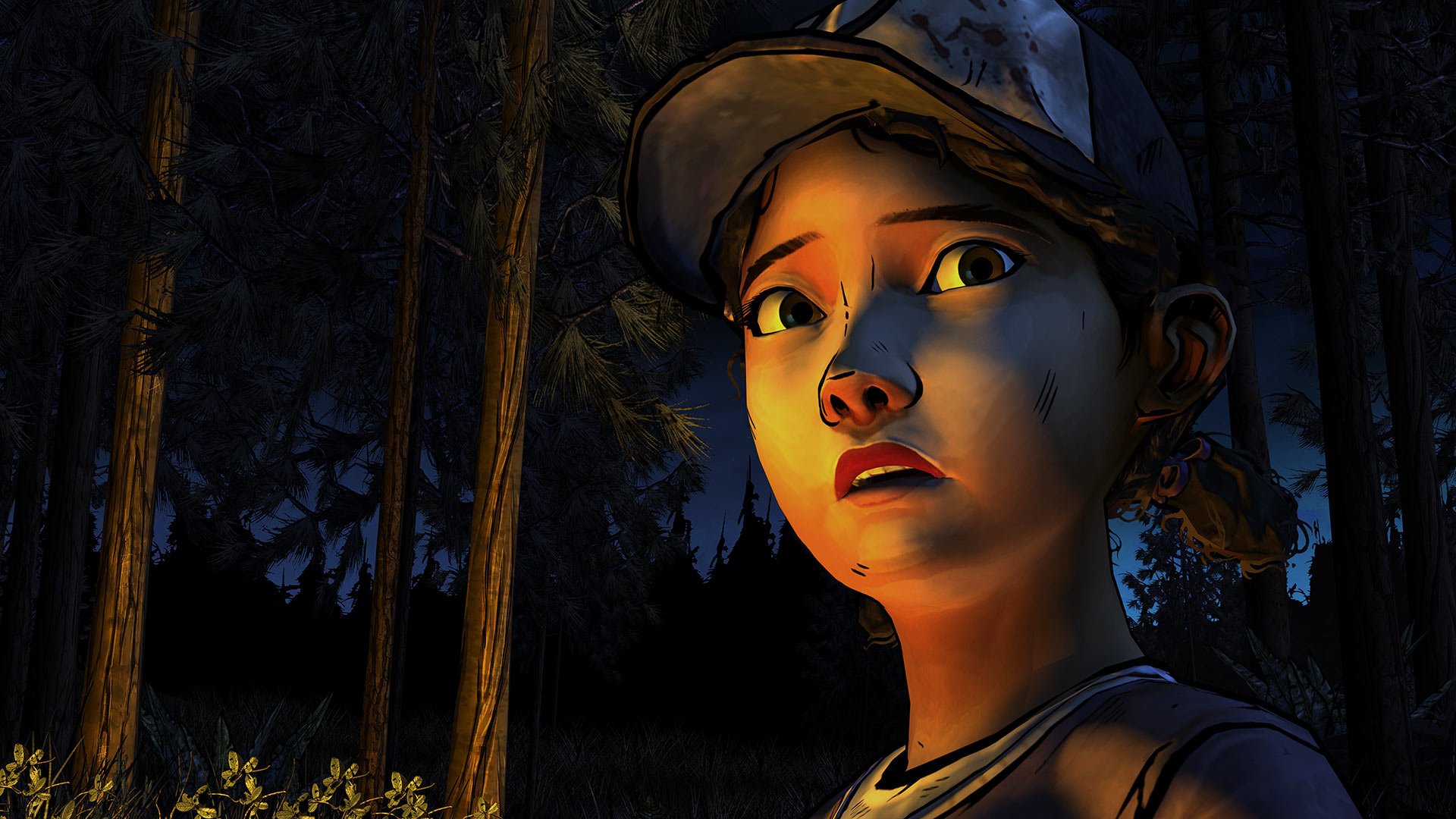
Clementine takes centre-stage this season.
Image from themarysue.com
If there's one writing cliché I'm guilty of using on this blog, it's the idea of the "difficult second album." It's hard for a second outing of anything if it has to focus on living up to the expectations left by its predecessor. Season Two of The Walking Dead Game was following up a literally Bafta-winning story, and they had to carry on despite having killed off their relatable, popular main character and almost all of his friends. The game's second season does many things admirably, and mostly continues the legacy of its predecessor, but there are several areas where the game loses its way and suffers as a result. As last time, my focus will be mainly on the game's plot, but I will discuss my experience of the game's interactive dynamics. And how they made me scream at my desktop.
What shines through as the problem with Season Two is poor writing decisions on a story level. In a game this dependant on its plot to get by, mistakes like that can disrupt the entire experience - and this time there's the weight of expectation on the game's shoulders. I'm going to get into more specifics later on, but for now I'll comment on something I noticed - some of my main criticisms of the game's poor writing can also apply to the first season. The difference is that Season Two rarely takes the time to develop the relationships between characters in the same way that the first season does, with characters either dead, doomed or emotionally cold. While some fans argue this is just the way of the zombie apocalypse, this robs the player of their connection to the characters.
Two years after the events of Season One, and Clementine is still travelling with Omid and Christa. After an altercation, Omid gets shot. Sixteen months pass, and Clem is seperated from Christa in a confrontation with bandits. On her own, she gets bitten by a dog and is then encountered by a group of survivors living in a cabin. After learning to trust her, she stays with them and eventually runs with them as they flee from William Carver, the man whose group they had previously separated from. After they meet up with Kenny from Season One in a ski lodge, they are eventually all captured by Carver. With the help of survivalist Jane, they escape, but on the run their group slowly loses members. One way or another, we end up with Clementine travelling with Kenny and Jane. In a surprising amount of choice, the player can either end the season travelling with Kenny, with Jane, or making it on her own.
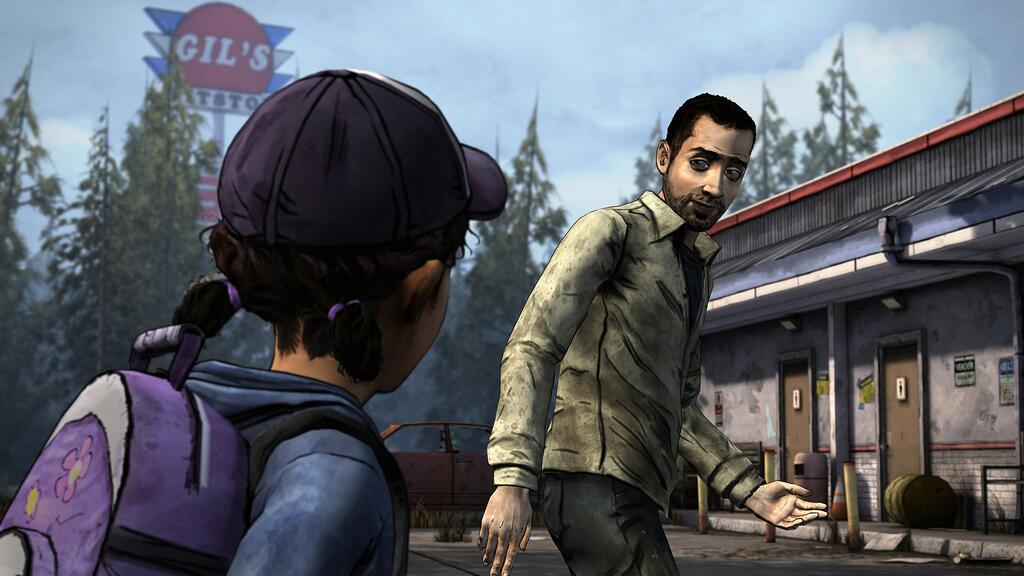
Hey Clementine, I know we're two years into a zombie
apocalypse, but I'm going to leave you alone in a dark restroom
to do something with my pregnant girlfriend that I don't want
you to be in the same room for.
Image from Wikia
Choosing to have Clementine as the player character has its ups and downs. As one of the most popular characters from the first season, it's fun to see how Clementine has changed since she was younger, and especially interesting to develop her more directly as a character using either the same philosophy that the player used in Season One, or down a completely different path. My Lee was a diplomat who knew when to be pragmatic and when to keep people on his side. My Clementine, for reasons which will become apparent, is a girl who calls everyone around her out on their bullshit. That becomes necessary because of the main downside to having Clementine as the PC - in order for the player to get to do anything, every single adult character around her is either embarassingly incompetent or just hilariously obnoxious. You do find yourself wondering why the twelve-year-old girl ends up being this group's rational head.
Because, no matter what you choose, Clementine will be the smart one here. The Cabin survivors that the season kinda focuses around don't make a very good impression - upon finding that Clementine has a dog-bite, the group's resident doctor suggests leaving her out in a cold, exposed shed overnight without cleaning the wound, because a trained medical professional apparently can't tell the difference between a long, saliva-filled dog bite and the rounder, decaying-remains-filled Walker bite. The way the group and the personalities of its various members has been written, it's very difficult to believe that these people have survived this far - especially as this three year time skip places the game further into the apocalypse than any other media in the franchise. And I don't just mean the strange things they do to force Clementine into doing stuff, I mean the headcount on these guys - Walkers are slow and easy to kill individually, only threateningly dangerous in hordes, but the game (in both seasons) makes false tension out of a few shuffling dudes who you could literally walk away from.
One thing that could explain how the group survived is Pete, the guy who you can choose to try and save as the end-of-episode cliffhanger to the season's premier. The fact that Pete dies either way is a small sample of this thing recurring across the season - there are about five or six characters where you can choose to save them or not, and whatever happens they die anyway. Again, same thing happened in Season One, but this time the inevitability of those characters' deaths isn't worked into the story, and they just sorta leave. This is bad enough with Pete, Sarita, Alvin and Luke, but it's especially painful with Nick and Sarah. (More on them later.) This also reflects one of the greater overall problems - your decisions may affect which scenes you see, but everything more or less happens the same until those last few scenes deciding between Kenny and Jane. And, given the game's track record, I can't help but see Clementine ending up on her own next season anyway, seeing as there's really no way that Telltale would make two or three seperate games all at once just to follow these plot threads.
Seriously, anyone who doesn't choose [HUG KENNY] here
has a heart of stone...
Talking of predicting next season... of course Kenny is back. In a fantastic application of "we never saw the body", Kenny appears in Episode Two, freshly bearded and filled with enough PTSD to shake a stick at. By this point the player has been used and abused by the Cabin Survivors enough to want to welcome Kenny with open arms as the last vestige of familiarity, and I found it quite laughable that the rest of the episode kept trying to set up a rivalry between Kenny and Clem's closest ally in the Cabin Survivors, Luke. Of course it really depends on whether you liked Kenny in the first season (which I know a lot of people didn't given his tendency to hold a grudge on the player if they ever sided against him), but I felt like the episode was trying to use his internal grief at the loss of his original family as some sort of argument against the player siding with him. I don't blame Kenny for being messed up - the man lost his wife and son in the space of a few hours, after they'd survived together for so long. He may be angry and irrational sometimes, but he has his priorities right, and for me that's what matters.
Compare this to Jane. Jane is more or less a carbon copy of Molly from the first season - a hardened, pragmatist survivalist who insists on isolationism ahead of compassion at all costs. Jane believes in manipulating people to break them apart and pray on their weaknessses - she leaves a baby exposed in the cold just to try and make Kenny out to be dangerous and irrational. Going with Kenny gives you the chance to live in a safe and thriving community up in Wellington, while going with Jane leaves you living with her in an abandoned hardware store filled with supplies, constantly looking after a child. For me, at least, the game's final decision was the easiest I'd ever had to make, and even taking into account my prior knowledge of events, the lengths the game has to go to to demonise Kenny in the narrative just seems really bitter and cynical. The Walking Dead is a depressing universe, but this second season never has any moments of real levity, and the result is a really harsh and unpleasant look at humanity.
Pushing that even further is Nick and Sarah, who share an issue with Kenny and Jane. In this universe a lot of characters have mental health issues - Jane and Kenny are both changed people because of events in their past, for example. Nick and Sarah are different though - they are both designed to be hated characters, and both characters die horribly, even after you've saved them. Although neither character explicitly says as much, it's fairly clear (at least from my perception and the perception of a lot of fans on the internet) that Nick suffers from depression and that Sarah is autistic.1 The fact that these characters were designed to be hated, the fact that their deaths end up being so gruesome and are intended to be cathartic for the player - that leaves a very sour taste in my mouth. Especially given the producers' seeming delight while discussing the inevitable death of a scared 15 year-old girl in an interview at the time. (More on that here.)
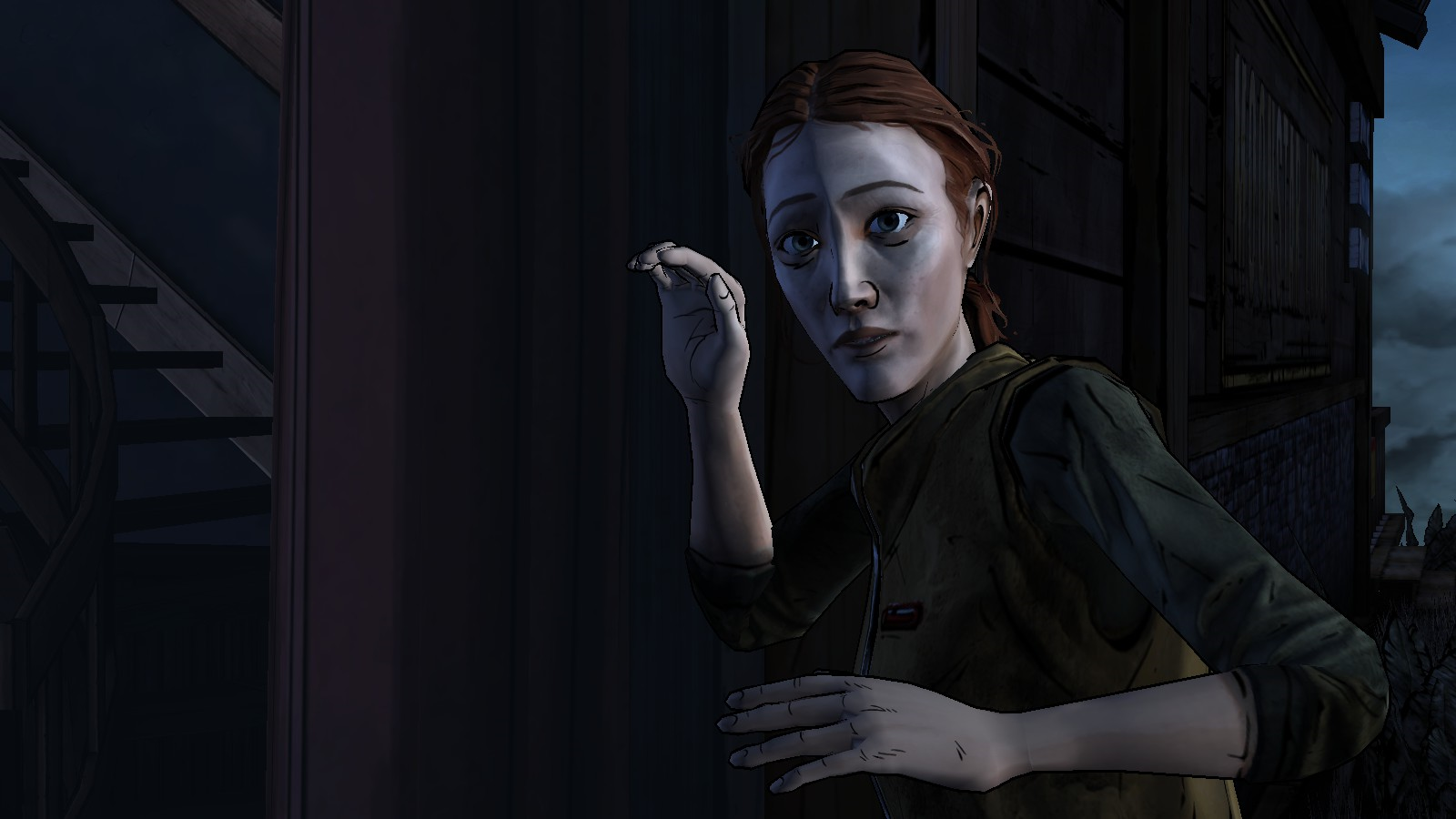
I hope Bonnie was your favourite 400 Days character. Cos
you're pretty stuffed otherwise.
Image from Wikia
Now, a quick aside. Between the two seasons there was released a sixth episode, a DLC called "400 Days", which gave us short glimpses of five brand new characters across the first 400 days of the apocalypse. At the end of that episode, we discovered a representative from a survivor group, and depending on your choices, particular characters would go with her or stay by themselves. (I got all five, btw. Just saying.) We were told this would pay off in Season Two - and it does! One of the characters, Bonnie, can star in four of the five episodes... except, she goes to the group no matter what you did in her chapter. The other four characters we were introduced to? If you got them to go along, they make five-second cameos in Episode Three and then die. Oh, and Bonnie can die in Episode Five, so she's for it come Season Three either way. In other words, another fantastic demonstration of the impotence of the player in their decisionmaking.
I didn't get to cover everything in this article and I could go on ranting a lot more - about how Omid and Christa die because they decided to leave Clementine alone and randomly have sex in a disused public bathroom, how Carver decided to kidnap a bunch of random people for no reason, and how the game makes characters do irrational things near the end just to give us our end conflict. But the biggest problem is that which I've mentioned - the game insists on telling its own version of events instead of allowing the player to give events their own context. And the paint with which the game brushes its canvas is in particularly muddy colours, a sad and bitter worldview which makes you hate all of the other characters for their sheer inhumanity. It's really disappointing that a game like The Walking Dead ended up like this, and although I'm still sorta looking forward to Season Three (to just find out what the hell they do), I'm not as gripped by it as I once was.
Thanks.
1 I am not autistic, nor a medical professional, and thus have no real basis on which to actually say that Sarah is autistic. I am basing this entirely on the way I have seen people identify with the character as such, and the hurt they felt when she was treated the way she was. I apologise in advance if this offends any readers who do have autism and who do not feel that the character adequately represents someone with the condition.