Friday, 4 July 2014

Review: Voyager 3.1: Basics (Part Two)

The more eagle-eyed members of my meagre readership will notice that it's been six months since I wrote anything to do with Voyager - this article being inspired by the end of my exams yesterday and the fact that the review of Basics (Part One) went up this morning. Here goes, then. :D

https://blogger.googleusercontent.com/img/b/R29vZ2xl/AVvXsEglAHFvk3a-PEHB5N3HWEpKAd2OmrL_xxi_UOLYF-eBDpQN-hJXpwWnOt3kgYa9IP219Z6y9OGQsVp2XJpCVvdcCiS0ShHG_4d3NzApNxglLq2jo4XZiWSx29wpkxsmcjegiR1lGzmudQE/s1600/basicsII077.jpg
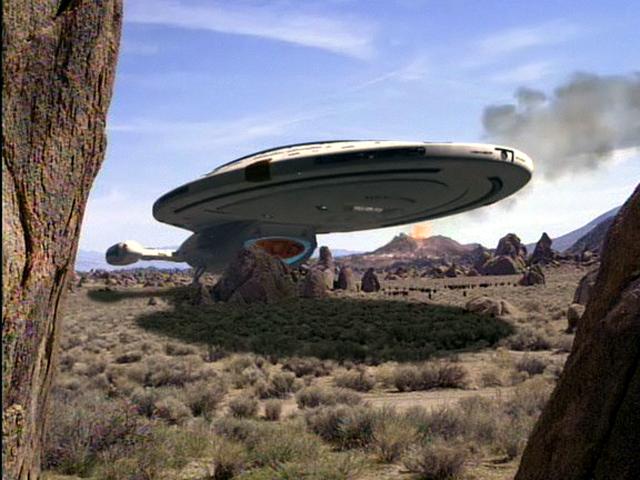
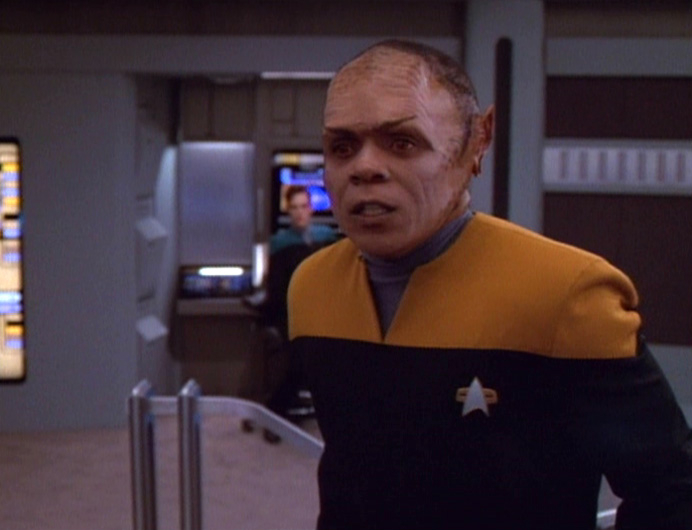
Chakotay can communicate with alien cavemen.
From Doc Oho
Star Trek: Voyager - Season Three, Episode One - Basics (Part Two)
Written between 20th and 21st June 2014

I've always thought that cross-season two-parters were weird. A two-part story is supposed to establish continuity within itself, both in terms of plot and tone, and one of the points of having different seasons is that each develops its own distinctive voice. The result is that Season Three's premier is quite deeply entrenched in the Kazon politics of its beleaguered predecessor - except, well, this time it's a damn sight better. While this vast improvement mostly comes from the fact that "take over the ship again" stories are more fun to watch than "see Voyager get its ass kicked" stories, there are also a few interesting musings on Star Trek's core philosophy which, while ultimately forgotten for the A-plot, were appreciated.
      On the pre-historic planet they were dumped on at the end of the last season, our intrepid heroes (I think I've used that term so many times ironically that it's become 100% serious) run into a tribe of caveman-esque aliens who kidnap Neelix and Kes before leading to an encounter with a weird space-dinosaur. Their animosity is put on hold when a nearby volcano starts to erupt, and the two groups bond. Out in space, and Tom Paris is on one of Voyager's infinite shuttlecraft, planning to attack the Kazon-controlled Voyager with the help of a fleet of Talaxians. On the ship, The Doctor does his best to act as an insurgent, with the help of crazed Betazoid Lon Suder who made two guest appearances in Season Two. Suder has trouble with the task, seeing as he's spent the past year trying not to give into his violent tendencies, but eventually he intervenes when The Doctor is deactivated and manages to aide Tom and the Talaxians in re-taking the ship, dying soon afterwards. Everyone back on board, they head off back to Earth, with Seska dead and Maje having done a runner with his baby.
     It was a bit weird that one of the episode's main focuses was on the adventures of the crew stranded on the planet. Ostensibly, this two-parter was about examining how the Voyager crew would react when their technology is taken away, but they react to it with a surprising level of acceptance - within a few minutes they've found food sources and made deadly weapons. It felt so tangential and most of the time incredibly weird, and there was little character development for them besides a few awesome moments with Chakotay, and Tuvok for some reason becoming a murderous little shit. (Apparently Vulcans have Professors of Archery, which is mind-boggling and is never mentioned again.)
http://voy.trekcore.com/gallery/albums/3x01/basicsII029.jpg
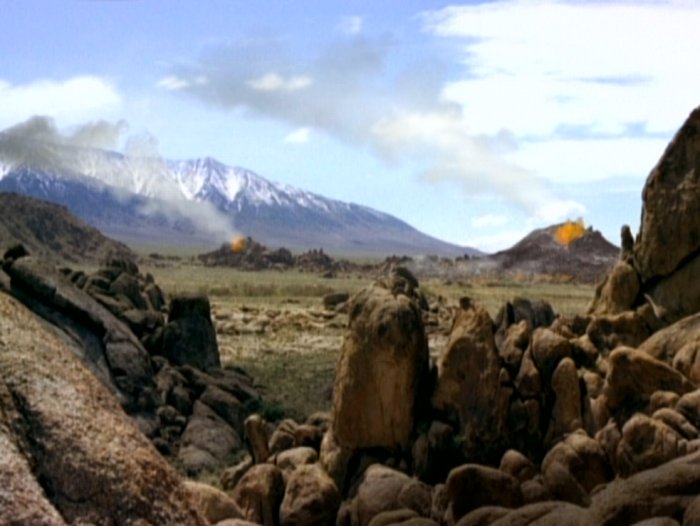
Just before she goes - one thing I've always wondered
is why, after the restoration of her Cardassian physiology,
Seska still has pink skin and light features. Weird.
From Trekcore
     The episode is significant for ending (pretty much for good) the Kazon storyline, as the Kazon Nistrim scuttle away into insignificance. They would make only four more appearances (to my memory) in the rest of the show, all of which were deliberate call-backs. Despite the build-up this conclusion to their story had in the second season, it all goes rather splat, as the Kazon do what they normally do - they ignore every last piece of advice that Seska gives them, which inevitably on all fronts leads to their downfall. Added to that is the last-second script turnaround which results in Seska's death, and the revelation that Seska didn't impregnate herself with Chakotay's DNA after all, because she was already pregnant with a Kazon baby. It was somewhat fitting that the abject stupidity that often led the Voyager crew into the Kazon's traps is now exactly what causes their defeat.
     As I said, Basics II doesn't really fit in with the tone of the season it premiers, and it spends most of its time entertaining a story concept which doesn't really make any headway. The story could have been a single stranded, epic conspiracy in which the Voyager crew used espoinage and trickery to win back the ship. Instead, we wobble between Lon Suder undoing all of his character development and Chakotay playing Fred Flintstone. While it was probably a difficult thing to give characters like the Kazon a good send off, the episode's main problem is that it doesn't seem very interested in them at all - and that says everything it needs to, really.

Thanks.

NEXT WEEK: Voyager celebrates Trek's 30th anniversary with an appearance by Sulu in the imaginatively titled Flashback.

Wednesday, 2 July 2014

Prologue: Lost: Season Three

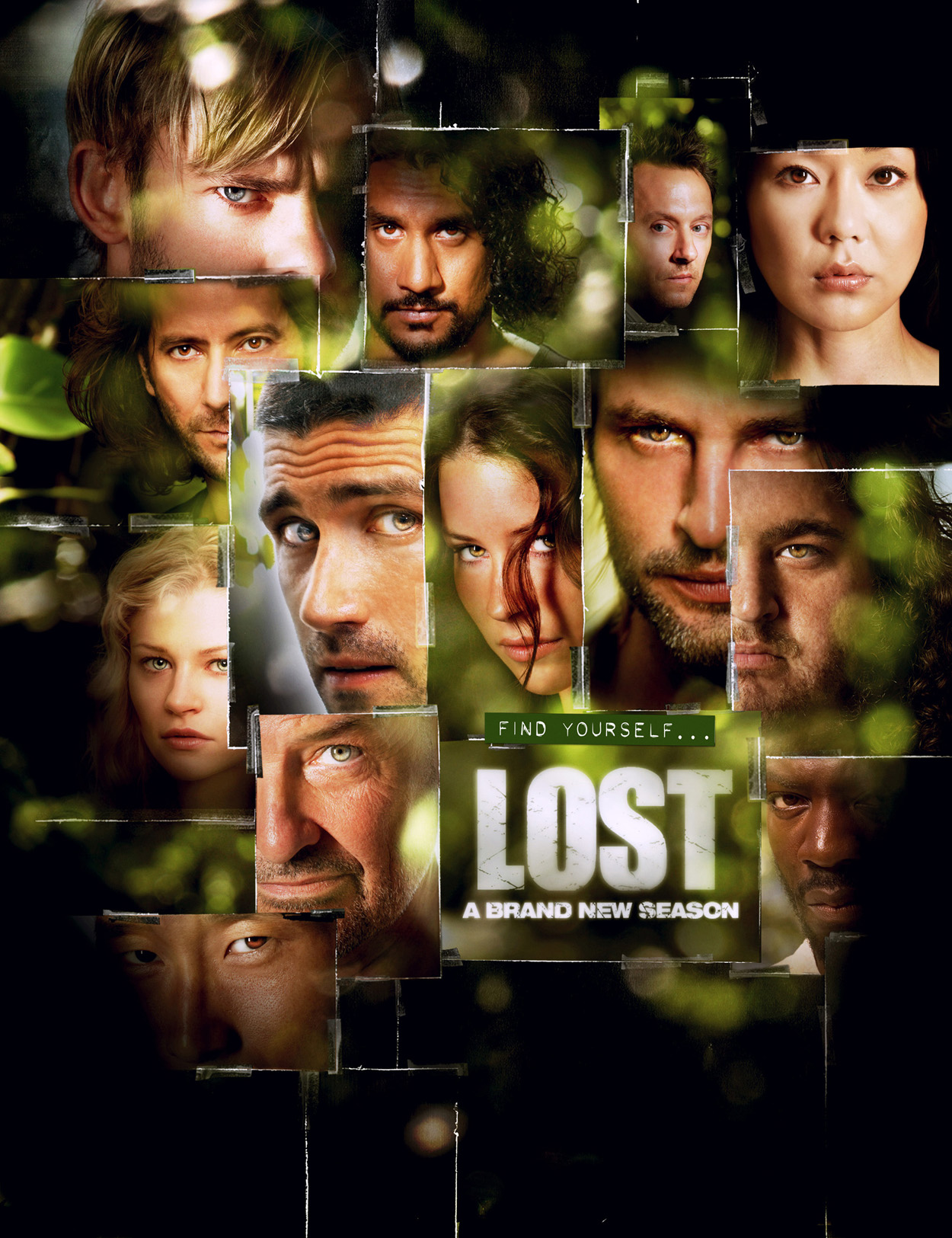
http://static2.wikia.nocookie.net/__cb20060916080235/lostpedia/images/8/82/Sea3promo.jpgWritten 1/2/14.

So - to my final season of Lost reviews. Season Three is not anyone's favourite really, as it flashes up and down between some of the best episodes of the show so far and some of the worst. Such greats as Not In Portland and The Man Behind The Curtain, contrasted with the drecks that are Stranger in a Strange Land and Exposé. It was a season of production decisions and mistakes made on the part of the writers - mistakes which, when confounded by next year's Writer's Strike, led to the show's planned end three seasons later.
     On paper, the season doesn't sound so divisive. It begins with an in-depth look into The Others' society as our kidnapped threesome of heroes is kept in the Hydra, a Dharma station on a small sub-Island. Henry Gale, now called Ben, is leading the show while Jack makes liasons with an Other named Juliet, played by new cast member Elizabeth Mitchell. Elsewhere, Desmond is having visions of the future, and a strange woman parachutes onto the Island, claiming to be from a freighter of people sent there to rescue them.
     I'm keeping this short and sweet, as I'm a bit out of practice. I'm not quite sure what I feel about Lost's third season, as it's the one I've had the least exposure too and it marks a very clear boundary between what the show was in its first two seasons and the very different show that it would become starting in Season Four. I suppose I'm just hoping that I'll enjoy it, and that I'll have something to say about some of its less favourable hours, some of which are worse than the low points of Season Six.

Thanks.

Friday, 20 June 2014

Review: Voyager 2.26: Basics (Part One)

File:Voyager landing.jpg
Voyager leaves our intrepid heroes behind...
From Wikia
Star Trek Voyager - Season Two, Episode Twenty-Six - Basics (Part One)
Written 1/12/13

And so the first of Voyager's finale/premiere two-parters has arrived, as we end the season on a cliffhanger which is both brilliant and terrible in all the myriad ways in which Voyager excels at being. This story sees the last blast for the Kazon as well as a revisitation of a lot of the plotlines which ran through the first two seasons, and it marks the end of Voyager's rocky beginnings - well, the next episode does, at least. Season Two has been very up and down - compared to its predecessor, it's had much higher highs and much lower lows. But that doesn't stop me from loving it just as much as I always have done.
     Like in Maneuvers, Seska sends Voyager a ridiculously obvious trap, this time pulling at her lie that she's given birth to Chakotay's child. After some spirit searching with his dad, Chakotay agrees to go to the co-ordinates in order to "save" his son. They pick up one of Seska's aides on a damaged shuttle, who supports her story. Despite Voyager's precautions against attack, the aide is actually on a suicide run and blows himself up, leaving the ship open to attack from the Kazon-Nistrim, accompanied by a very-much-okay Seska. They take over command of the ship and, not counting The Doctor and psychopath Lon Suder, they leave the entire crew of Voyager on a small planet occupied entirely by Dinosaurs and primitive hominids.
      The episode is very epic 'n' all, but despite the narrative significance of the Kazon finally getting their hour in the sun, it made very little sense when you thought about it for any length of time. Not does Voyager's involvement in the conflict depend on them falling for the same trick twice, as well as then being out-maneuvered and out-witted by a race of people who, despite having the capacity to travel through space, is unable to adequately find water. Basically, it relies on the idea that the crew of Voyager are just immensely, immensely stupid people. Which doesn't help a lot of viewers, who probably think that already.
http://static3.wikia.nocookie.net/__cb20080813121808/memoryalpha/en/images/2/23/HanonIV_surface.jpg
...in the setting of The Flintstones. From Wikia
     I suppose a lot of the episode's weaknesses come down to the fact that the Kazon seem inserted into the story in the place of a generic alien race, and as a result the plotlines that they're desperately trying to tie up and make into a neat finale never really mesh together. I'm more stunned into disbelief at the crew of Voyager ever letting themselves get into this situation than I am excited and suspenseful. The result is an episode which is very self-important and busy, while simultaneously not really getting much done in terms of characters besides make us wonder why we care about them at all. Which isn't really a good thing.

Thanks.

IN TWO WEEKS: Season Three kicks off with the resolution we all need, Basics (Part Two).

Wednesday, 18 June 2014

Review: Lost 2.23-24: Live Together, Die Alone

"Henry" isn't just an Other - he's the Leader of the Others.
From Wikia
Lost - Season Two, Episodes Twenty-Three and Twenty-Four - Live Together, Die Alone
Written 24/11/13

Lost's sophomore season both triumphed over and fell far behind its predecessor, both in terms of characters and in plot. The show was trying out new things to stop its tried-and-true formula from going stale, with the introduction of a number of hit-and-miss new characters, most of whom didn't last the season out or barely got a chance to say anything while there were there. Live Together, Die Alone is an episode which pays homage to the promise at the beginning of this season, tying it together in a knot while leaving a juicy cliffhanger - one that, while not as tempting as last years, still leaves a lot of stuff to resolve.
       It was odd that this finale decided to put two-thirds of its focus upon Desmond, who is revealed to be piloting the Elizabeth as it arrives at Libby and Ana-Lucia's funeral. In flashbacks we see snapshots of why he came to the Island, followed by his arrival and his effective incarceration under the hand of Kelvin Inman, the disgraced US Veteran who taught Sayid how to torture back in One of Them. In the present, he helps Locke to test what would happen if the Button wasn't pushed, leading to them locking out Eko and Charlie. A read-out from the Pearl eventually reveals to Desmond that it was his neglecting to push the Button on the 22nd September that led to the crash of Oceanic 815, leading him to have to turn a key in order to implode the Swan station around them. The implosion of the Swan makes a light blast across the Island that everyone can see.
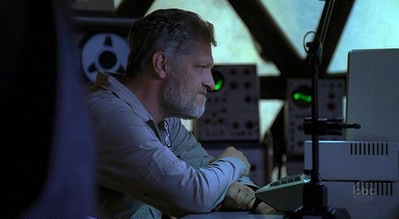
Inman teaches Desmond the ways of the Swan...
From Wikia
     Henry Ian Cuisick was brought back to the series due to positive fan reaction to his character during the first three episodes, and he gets quite a lot to do here, as the flashbacks showing his entrance to the Island are far more informative than his explanations were, and provide closure to a lot of the burning questions about the mysterious station. In this episode he is paralleled with Locke - both men who have lost their faith in pushing the button, one because it robbed him of three years of his life and the other because it stood as a mark of all the wrong decisions he made since he found the Hatch. Desmond's self-sacrifice (Well, supposed self-sacrifice, as we'll see) is shown as an act of resolution - an act that Locke, with his obsessive tendencies, is unable to make.
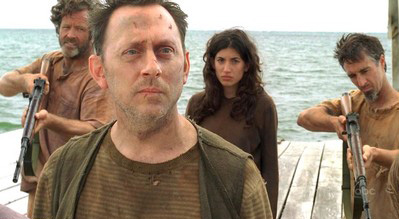
    In our other trundling subplot, the chosen few made their way across the Island, as Sayid, Jin and Sun went around the other way on the Elizabeth. An encounter with two Others soon leads Jack to reveal that he knows about Michael's deception, while Sayid goes ashore at The Others' village and finds that the whole thing is a fake. Reaching a capsule dump where it appears that all of the Pearl's reports get left at (perhaps proving Desmond's suspicion that it is the Pearl that is the psychological experiment, and not the Swan), the four chosen get drugged and kidnapped, leading to a final confrontation with Henry Gale at a dock, where Michael and Walt got to sail away into the sunset. Hurley sent back to the main camp as a warning, Jack, Kate and Sawyer are hooded, their fate left unknown.
     Ultimately, Jack's "plan" to save them fails spectacularly - against the Others' attack, he is powerless. It would have been a much better plan considering his knowledge to confront Michael and then stage a sting on the Survivors' territory, giving them the upper hand instead of leading four people into enemy territory and leaving them extremely vulnerable. It is far too common on Lost in which someone with a tactical upper hand then throws it away for the sake of the plot. It sets up an unintentional parallel between Jack and Locke in which both spend each and every season finale revelling in the consequences of their own bad decisions.
The first appearance of the Four-Toed Statue.
From Wikia
     There were times this season where I was blown away by the quality of the show's characterisations - both those built from scratch and those built upon those from the previous season. There were also times in which I was bored out of my skull by a series of odd decisions and episodes where the moving plot managed to negate any interesting writing. Luckily for the show, the finalĂ© manages to swing round to the former, settling Locke's road into despair and building up fan-favourite Desmond into the three-dimensional sixth-ranger figure he would grow to become. I've really enjoyed writing about Season Two, and am looking forward to the turbulent and difficult to watch segments of the next season.

Thanks.

P.S. It's awesome that the Elizabeth is revealed to be named after Libby, even if this is the last time she'll be mentioned until Season 6.

Friday, 13 June 2014

Review: Voyager 2.25: Resolutions

http://i241.photobucket.com/albums/ff32/Donata_2000/resolutions_077.jpg
"My acting isn't the only thing that's wooden around here..."
From StarTrek.com
Star Trek Voyager - Season Two, Episode Twenty-Five - Resolutions
Written 30/11/13

Oh my bally god, my shipper's heart doth fly when I think of Resolutions. Janeway was only murdering innocents last week but now I can't help but turn into a squishy ball of goo whenever I think of the way that her relationship with Chakotay is handled - especially in this episode, which is the biggest of all teases, and which seems put together almost entirely to make us sail this doomed ship off into the horizon. Whether you think it's a powerful romance story or a tragic comedy of errors, Resolutions has one or two things that make it quite special - fitting, for the last lone story of this season.
     Janeway and Chakotay have been infected with a virus which is only subdued when they're on a particular paradise-esque planet. Accepting their fate, they have some supplies beamed down and give orders for the ship to resume course, despite The Doctor's desire to contact the Vidiians for their medical expertise. While on the planet together, the two grow very close, especially as they plan to spend the rest of their lives together. With Tuvok in charge of Voyager, everyone complains about Janeway's orders, and reluctantly he agrees to go to the Vidiians. They almost double cross them, but Dr. Denara Pel (whom we met a few weeks ago) helps The Doctor get the cure in time for Voyager to escape. Just as the two lovebirds are settling in with each other, the cure is found, and the two resume their old lives, with nought but the promise of what might have been.
      Mulgrew and Beltran have an inexpliquably strong chemistry, especially considering their normal characterisations only tend to mingle when they have their little intimate chats about the moral and political issues of each episode. Yet it's clear here that there was a lot of potential in their possible relationship. I'm confused why after this they didn't get together - at least if not immediately, after a while. Instead the episode treats its relationship as a one-time thing, with the two completely forgetting their feelings once they're back on the ship, with not even a glance or a look to suggest otherwise. Personally, I find that immensely frustrating, especially when one considers (spoilers) that they'd end up giving Chakotay a rushed relationship with another character with whom he had no chemistry in the final episodes of the show.
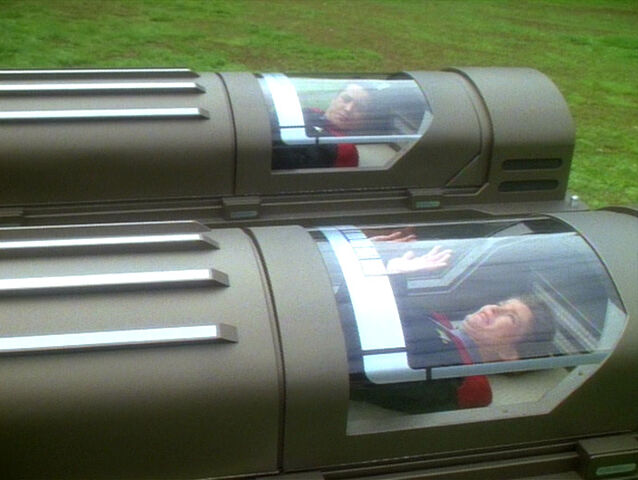
File:Stasis units, Resolutions.jpg
Voyager's little-known range of sentient action-figures.
From Wikia
     I suppose you could say the episode as a whole was about loyalty and compassion. The loyalty Chakotay feels towards Janeway and the gratitude he has for her bringing him into the fold and letting him "know true peace," the loyalty of the crew as they petition Tuvok to allow them to risk their lives contacting the Vidiians (who, in their final appearance, are still a little pissed off about the whole thing in Deadlock). It was all rather touching, and worked quite well as a call-back to the final moments of the season's first episode, The 37's, in which everyone on the ship, when offered a stable place to live, still choose to remain on their journey.
      I suppose my resolution on resolutions is that I enjoyed it far more than I should. While I don't like to admit it, I do get carried away with a good romance, especially when it's one in which the chemistry is perfect but it never actually goes anywhere. I've said the same about the relationship between Kes and The Doctor in the past, and the same is true for Janeway and Chakotay throughout the entirety of the show's run. I think that above all other things, Resolutions was a way for the show to explore a relationship that it had teased at but that it knew it was never going to go through with, and I suppose I should be grateful for that one small glimmer of hope.

Thanks.

NEXT WEEK: We return to Basics as we face the Kazon for one last time.

Wednesday, 11 June 2014

Review: Lost 2.22: Three Minutes

http://img1.wikia.nocookie.net/__cb20061211183002/lostpedia/images/a/ab/Waltin3min.jpg
We finally meet Walt again. From Wikia
Lost - Season Two, Episode Twenty-Two - Three Minutes
Written 23/11/13

 The last time we spent an entire episode on The Island was The Other 48 Days, whichwas a fantastic episode filling in a massive gap in our knowledge about what the fuck had been going on. Three Minutes shares a similar purpose, although this time for a character who we had pretty much left for dead and who by this point has made himself very unpopular. Michael's plot arc over these two seasons is an odd one in many ways - he's the only parent, the only African-American, and is embodied by this repeated idea of a father desperate to be with his son despite knowing very little about him.
      In the present, we see the preparations for the funeral of Libby and Ana-Lucia, as Jack prepares to use Michael to hunt down The Others a few miles down the coast. Michael is on-edge and is strangely specific about the people he wants involved in the trek - Jack, Kate, Sawyer and Hurley. This leads former interrogator Sayid to believe that Michael is setting them up, and so he suggests his own involvement be secret. At the funeral, a ship appears on the horizon - it is the Elizabeth. In flashbacks, we see the events of The Hunting Party from Michael's point of view - captured by the Others and given a deal - gather the four names together, and get to leave the Island with Walt. He also meets the girl from Claire's dream, who is confirmed to be Alex, Danielle Rousseau's daughter.
     Like last week, we're working on an action-y plot so there's very little explicit character development, but the divulsion of Michael's journey from concerned father to nervy turncoat was worth a look. It's fair to say that the two aren't exactly inconsistent in character, and so my focus is more on the look at The Others we get to see. (Those of you unspoilered, skip to the next paragraph.) In the later seasons we see that behind this fascade, the Others are quite a sophisticated and organised group of people. It makes their actions here look exceedingly strange, especially as it would be easier for the Others (and later Jacob) to just be open and honest in their dealings with the Survivors instead of resorting to deceit, manipulation and murder.
http://img2.wikia.nocookie.net/__cb20061122133224/lostpedia/images/9/97/1x22_eko.JPG
Eko takes over at the Hatch. From Wikia
     A problem which overwhelmed quite a lot of this episode's impact, really. The Others' plan relies on the Survivors' demonstrated reactionism guiding them to retaliate against a supposed attack by them, but their ridiculously specific demands for hostages mean that even if Michael wasn't a guilty, nervous mess, they'd probably guess that something was up. There is no reason for Michael to not just tell the Survivors about his predicament, and had he done so them they might have had the time to work out how to save everyone and defeat The Others there and then.
      Unlike my ragings at the end of the fifth season, this antepenultimate episode leaves me with very little to say at all. The season began with a lot of promise and some very good characters, but I think the writers must have been far too used to the slow-and-steady stories to write a show that managed to be hard-hitting and well-developed at the same time. A lot of the mysteries presented by the second season would later go on to be picked up, but in my present hindsight their appearance here seems strange and inconsistant with what would come later - especially in the character of Michael - the man once willing to organise an operation to save a man from a cave-in, who attempted to build a raft to leave the Island, who is now so dodgy and desperate that he follows enemy orders in a way less subtle than a Dalek's stag do.

Thanks.

NEXT WEEK: The first part of the finalé, as Desmond helps us repeat the phrase, Live Together, Die Alone.

Sunday, 8 June 2014

Papers, Please

Papers, Please is a video game where you role-play the action-filled life of an immigration officer in the fake communist country Arstotzka. People walk into your checkpoint, you check their papers and then decide whether or not they can come into the country. It is my game of the year, better than Tomb Raider, Saints Row, Bioshock Infinite or any other game that was released in 2013. But wait, you say. Surely something with gameplay of this calibre must have something else up its sleeve. Well of course it fucking does. The game does everything right and combines story, art style, gameplay and atmosphere to make an exceptional game.

Glory to Arstotzka! The greatest country!
In the game you and your family are given an apartment to stay in because of your job as border control and you are payed for every person you deal with, unless of course you make a mistake, in which case you will not be payed and eventually fined and that's a problem because of that family at home you have to feed. First, the game starts off easy. On the first day, all people need is a valid passport to enter the country (though one hilarious, recurring character even fails this), but after a terrorist attack on your checkpoint, the system becomes more and more bureaucratic. So by the 15th level or so, the game starts to look like that picture on the right, so making a mistake that costs your son that life-saving medicine he needs is pretty easy. You are in a hopeless situation and Arstotzka doesn't give a shit about you, so you have to take care of yourself and your family, often at the cost of others. The game likes to give you choices that can turn you into either a heartless monster or the most corrupt government official in the Universe, or both. One good example is the woman who didn't get into the country because she took the piss out my son's crayon drawing. Another is the husband and wife seeking asylum. The husband gets through without a problem, but the wife doesn't have an entry permit. You have to make a choice between receiving a fine, but reuniting a couple or doing your job and rejecting her entry into the country. It might seem an obvious choice without the context of playing the game, but since all your money in game basically goes to rent and food for your family, losing even a small amount of money can be catastrophic and its easy to be unforgiving or even corrupt if it means you can that extra bit of cash by bending the system in your favour. This is the whole point of the game. You immerse yourself into the situation you are in and you see the effect your choices have on the people you interact with. Being good isn't always easy and this game showcases better than most.

You may not have realised this from my review, but Papers Please can be as depressing as fuck. The world of Arstotka is crafted with a grey, pixelated art style, almost completely devoid of colour, apart from that giant bright red stamp that says "DENIED" on it. But fear not, for every sad story, there is a hopeful one (though these hopeful stories can be fucked over by the sad ones). The game takes care in showing the humanity being crushed by the beaurocracy, authoritarian tendencies and all-round bullshit of the government. But the humanity is still there and that's what makes Papers Please so beautiful, the balance of people's compassion and dickishness. You can see loved ones reunited, save people seeking asylum from neighboring countries, but who don't have the paperwork needed to pass. You have the choice to make a huge difference in people's lives. Or you can fuck them over. Your choice.

Friday, 6 June 2014

Review: Voyager 2.24: Tuvix

http://static1.wikia.nocookie.net/__cb20110827030508/memoryalpha/en/images/e/e0/Tuvix_argues_for_his_right_to_exist.jpg
Tuvix begs for his life before the entire bridge crew.
From Wikia
Star Trek Voyager - Season Two, Episode Twenty-Four - Tuvix
Written 30/11/13

One of the aspects of 20th Century thinking that bleeds into Star Trek quite a lot is a focus on individuality - the loss of individuality is the reason why we're meant to fear The Borg, while elsewhere the rights of the individual to expression both political and artistic has been the subject of many an episode. As is so often true in Voyager, this week's episode examines these themes through a weird and wonderful premise which, while not well-thought-out in its inception, ends up creating a moral issue which is meant to be as divisive as Star Trek can ever possibly get. The question - would you kill an innocent man if it brought back two of your dead friends?
     Tuvok and Neelix are on an away mission, and Neelix is being a first class douche. When they're transported up to the ship, the result is a single individual, Tuvix (Tom Wright), who has the memories of both men but a single, combined consciousness. At first he's viewed with suspicion by the crew, but he is able to take up the roles of both Neelix and Tuvok as security officer and cook, and as well as doing both their jobs he forms a unique personality of his own. When the technology emerges to seperate the two out again, Tuvix refusesto go through with it, stressing his desire to survive and his right to live as in individual. Tuvix goes to friend Kes for help, who then pushes Captain Janeway to force him to go through with the seperation.
     The argument that Janeways makes is linked directly to the Star Trek theme on Utilitarianism, stressing the sacrifice of the few for the benefit of the many. This has many ups and downs here, and there are some clear flaws in her reasoning. When the Doctor claims that Tuvix may never be seperated, the crew mourns for Tuvok and Neelix as if they are dead, and yet when the technology arises, Janeways bases her entire argument around what the two people would have wanted. "They would want to live," she says, angrily trying to emotionally blackmail Tuvix by talking about families and friends who miss them. The thing is, they're already dead. You mourned them, you said goodbye to them. And I'm sure that they aren't happy when they get back to discover that their resurrection was made possible through the murder of an innocent man.
http://voy.trekcore.com/gallery/albums/2x24/tuvix_629.jpg
Janeway makes a hard decision. From TrekCore
     Credit where credit is due, the decision is not made likely, even if it is made for the wrong reasons. The scene in which Janeway pulls rank to force Tuvix's death is a sombre and tragic one, especially as she is forced to carry out the procedure herself given The Doctor's oath to do no harm. Tuvix appeals to all of our cast members along the way, but none of them do anything but stare blankly and casually ignore the injustice being committed. There's an argument from the Doylian perspective that the episode required that there be a seperation in the interest of drama, but if that was the concern then this episode could have been an introduction to the Tuvix character - a long-term plotline that became more hard-hitting when the technology did arise. With a few B-plots, the two halves of this episode could easily form the beginning and end of an arc, which would have made the loss of Neelix and Tuvok (however technical in nature) that much more apparent to the audience.
     Star Trek tries to do a lot of things, and far too often when it tries to incite passion and opinion in the audience it falls a little short of expectations. The basic premise of Tuvix, of blending two people together with a magic transporter accident, is a stupid one - nobody is denying that. But the moral dilemmas it actually creates is one that I've always loved simply because it arises out of people's relationships, out of biases, and because it makes you demonise the main cast of characters intentionally - that's the good thing. The fact that in the next episode I'm still bitter at what Janeway's done, that I can't look at her in the same way - that's the mark of a powerful script and a memorable episode of this brilliant, brilliant show.

Thanks.

NEXT WEEK: Did you ship Janeway/Chakotay before this? Do you like romance episodes where the two leads have constant UST but never act on it? Did you want to see Kate Mulgrew talk to a monkey? We take a look at Janeway and Chakotay's Resolutions.

Wednesday, 4 June 2014

Review: Lost 2.21: ?

Maaaalkiiiin! From Wikia
Lost - Season Two, Episode Twenty-One - ?
Written between 16th and 17th November 2013

Now we reach the middle of a trilogy of Eko-centric episodes, began in the amazing "The 23rd Psalm" and to be followed up next season with "The Cost of Living." Despite Eko's centricity and the heavyness of his involvement, the development this week clings more closely to Locke, whose loss of faith, begun with the arrival of Henry Gale, nears its explosive (or should I say implosive) climax in a few weeks. Apart from a few moments here or there, it was nothing special, even for an episode whose name is, depending on your outlook, a work of genius or a work of utter sloth.
     Libby got shot, but Libby ain't dead, leading Sawyer to have to reveal the hiding place of his stash to allow Jack to give her heroin, which is the only powerful painkiller they have left. Eko has a dream telling him to help Locke find "the question mark", and as such he pretends to be employing Locke to help track the escaped Henry Gale, while in fact they end up going to the Beechcraft, where it turns out there's a secret entrance to a second Hatch - the Pearl. Within the Pearl they find a video claiming the Swan to be a psychological experiment, which pushes Locke's doubt over the edge and for some reason gets Eko all excited because he now sees pushing the button as a matter of absolute faith.
     In the past, we see Eko as a priest in Auss, ready to go to the US, but postponed by a local "miracle" in which a young girl (Charlotte Malkin, the daughter of Claire's fraudulent psychic Richard Malkin) drowned and then rose from the dead. Eko is skeptical, but both her mother and the coroner's audio recording seem conclusive. Eko is persuaded to turn down the case by Richard, who tells him that he is a fraud and that his wife claimed his daughter's resurrection in order to punish him for his lies. However, the daughter catches up with Eko at Sydney Airport just before he boards 815 and tells him that his brother forgives him.
The Pearl station presents Locke's button as a fake.
From Wikia
       There was a dream in this episode that summed things up quite well - Eko's story being seen through Locke's eyes. This was an Eko-centric episode and he formed its fabric, but it was Locke that really got the most juicy moments, with his bitter recollections of all the times that his blind faith had led to death and destruction. Terry O'Quinn's quiet despair as he laconically accounts for why the Beechcraft with, "Boone. Boone made it fall. And then he died." make me shiver with glee, as well as his final grand proclamation that reminds me somewhat of The Man In Black's opinion of his host. (Don't follow that link if you don't want spoilers.) It's an awesome moment in which Locke's self-pity, the same sort we saw rise in his flashbacks from this season, came to a fore in the present in a way which was fantastic.
     Which makes me wonder if this season wasn't crying out for a Locke episode. While it's nice to see Eko get a good showing, this episode does very little to develop his awesome character and his flashbacks are ridiculously throwaway - especially strange, since the flashbacks in the next Eko episode, The Cost of Living, pick up from those in The 23rd Psalm. He's such a strong character, and a centric this close to the season finale should have a little more potency and drive to it. Instead, this episode fits exactly to its title, making me wonder why the hell the stakes are so low when there's so much action to come.

Thanks.

NEXT WEEK: We mess around once again with the format and get an awesome set of flashbacks in an episode confusingly called Three Minutes.

Friday, 30 May 2014

Review: Voyager 2.23: The Thaw

http://static2.wikia.nocookie.net/__cb20050825172719/memoryalpha/en/images/c/c4/The_Doctor_and_the_Clown.jpg
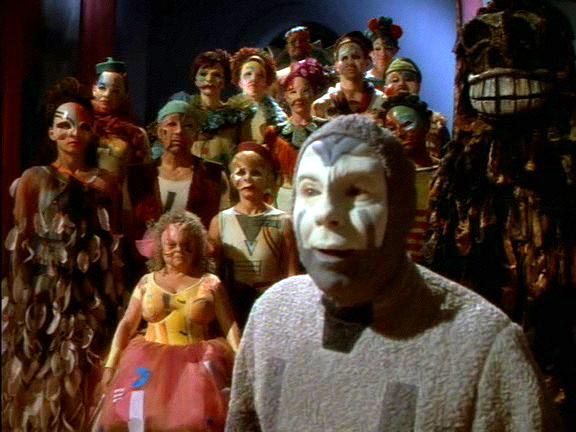
The Doctor banters with Fear. From Wikia
Star Trek Voyager - Season Two, Episode Twenty-Three - The Thaw
Written 29/11/13

Oh, Voyager. I love you. Sometimes after a long line of slightly boring or weird episodes, a work of pure genius comes along that makes everything right again. We already had one such episode with Meld earlier in the season, but now we hit upon an episode whose simple premise manages to take a goofy villain and use him to tap into the darkest recesses of the human soul. It's episodes like these that really help me justify my love for this little show - for where else in Star Trek could you find an episode in which our intrepid heroes must do battle with the idea of Fear itself?
     An exploration on a devastated planet reveals a group of survivors from the planet's civilisation - a group of people meant to have woken up from their self-imposed stasis four years prior to their discovery. Noting that two of the five stasis chambers contain dead inhabitants, Harry Kim and B'Elanna Torres are sent in to the stasis chambers' virtual world to find out what's up - leading to the discovery of Fear (Michael McKean), an embodiment of the occupants' anxiety who is holding them hostage as a safeguard against the threat of his own non-existence. Fear punishes his hostages by torturing them with their most primal fears - not helped by the fact that he can read all of their thoughts, and kill them in the real world by decapitating them in their dream state. After sending in The Doctor to negotiate and not having much luck, Janeway tricks Fear by sending in a hologram of herself while simultaneously linking her thoughts to the system, leading Fear to face his own worst nightmare - oblivion.
      From the off, Janeway takes the situation as a challenge - she almost seems delighted, a more cunning and playful Picard. It is for her something of an opportunity - to quite literally fight Fear on its own terms. While she approaches it as a conflict, Michael McKean's Fear does his best to mimic the metaphorical properties that emotion has. His character is paranoid and possessive, passing swiftly from irreverent to draconian at the drop of a hat. He mocks and tears at his captive's mental defences, both in subtle ways and in obvious ones. The to and fro between the two is quite fabulous across the episode, with the final confrontation being a perfect scene in which Janeway reveals that instead of fighting fear head-on, she has managed instead to simply trick it out of existence.
http://static3.wikia.nocookie.net/__cb20050827054228/memoryalpha/en/images/2/27/The_Clown_and_company.jpg
Don't be afraid. From Wikia
       This was also a sorta-centric for Harry Kim, who as ship butt-monkey ends up trapped in with Fear for the longest. Fear was seen to pick on many things - his crippling insecurity, his fear of being helpless, and his childhood fear of hospitals. (Feelin' ya there, Harry.) We also got some fun moments for The Doctor, whose dead-pan provided the perfect straight-man for some of Fear's funnier moments. Yes, funnier moments - that was part of the episode's charm, in the way that it balanced the terrifying concept with a script which found a way to spend most of the downtime milking the funnies from McKean's performance.
     When it's good, it's good. That's the impression that Season Two has given me, and The Thaw is yet another week where, if you ignore one or two moments that don't work, the show doesn't put a foot wrong. It had charm and grace as well as a fluency with its characters which gave it a shroud of confidence - one that Voyager very rarely gets to put on. Thanks to a combination of a fantastic script, a bally good concept and one of my favourite of the early show's guest stars, The Thaw managed to fight off the lingering fears that I had for the show - for a while, at least. Just wait until next week.

Thanks.

NEXT WEEK: We discuss morality, the Devil's Advocate, the true nature of the self and whether the writers were on crack when they came up with Tuvix.