Thursday, 10 April 2014

Review: Voyager 2.16: Meld

https://blogger.googleusercontent.com/img/b/R29vZ2xl/AVvXsEgAZyiZoeUEYwuPZCrXdi3KNvZVoje35ugmAQq7-2ie0vv2qBMrqn4RA4-TJg2BQhjqlIYHWgYuUNAWpvXOk7sK5eJqxutFrs998EmDqwh4BHgNOAtSnXQv2qVBUzC9r48EizDh-b2KhJtj/s400/Star+Trek+Voyager+-+S2E16+-+Meld.avi+-+00001.bmp
Tuvok fails to understand Suder's violent nature.
From dedroidify
Star Trek Voyager - Season Two, Episode Sixteen - Meld
Written 9/8/13

I am at a loss for words. Every so often a piece of television comes along that just knocks your socks off, and this is one of them. An episode that I missed on my run through the series on syndication, Meld is a masterpiece of acting chops from Tuvok's Tim Russ, who shows with great gusto just how subtle and brilliant of an actor he is when you look behind the grey face of his Vulcan control. It also introduced the captivating character of Lon Suder, a violent offender who has a fascinating repartée with Tuvok both in this episode and in the season finale.
     There's been a murder aboard Voyager, and the only suspect is Lon Suder, a calm and quiet man with freaky big eyes. He initially denies it, but when his guilt is proved he calmly confesses and recites the details of his crime. Tuvok is puzzled at his lack of a motive, and in his Vulcan stubbornness he refuses to accept it. He chooses to mind-meld with Suder, sharing his mind with his. As a result, he understands that Suder is a naturally violent individual. While Suder's experience allowed him to utilize some of Tuvok's self-control while in the Brig, Tuvok goes on a downward spiral as his natural violent instincts work their way up, culminating in a scene in which, during treatment to help him get back to normal, he goes on an emotive rant against Janeway, Kes and The Doctor. He goes to face Suder and execute him for his crimes, but Suder warns him that the violence will never stop if he lets it in, and he is partially able to control himself enough not to commit the act.
     Tuvok's journey into what his race would consider madness is handled wonderfully by Tim Russ, starting with the subtlest of changes in the intonation of his voice and his body language. Even the pronounciation of certain words slowly factored into Tuvok's more and more emotive state, especially in the speech scene in which his ability to supress emotion is removed entirely and he doesn't just kick back and portray a human, but instead acts like someone just granted the ability to feel emotion and express all of their hidden desires and opinions. The way he picks on each of the people in the room individually and attempts to null them psychologically was stunning to witness and it's one of my favourite scenes in all of Voyager. And, talking of my favourite scenes, there's also a fantastic sequence where Tuvok lets out some of his rage by strangling Neelix on the holodeck, which is one of the most satisfying things I can imagine doing. (He's that bad, I'm sorry.)
http://images2.wikia.nocookie.net/__cb20080712162958/memoryalpha/en/images/d/df/LonSuder.jpg
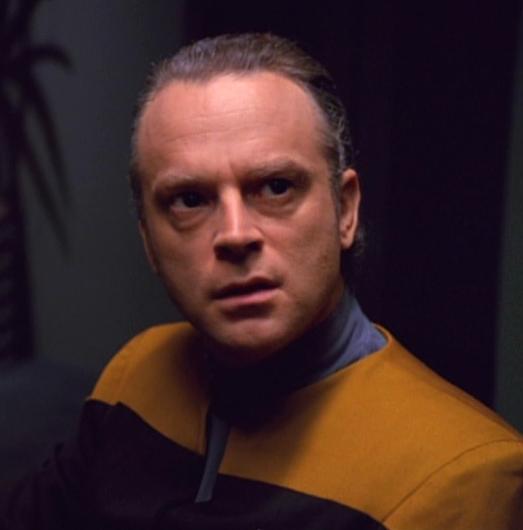
If this ain't a creepy motherfucker I don't know what is.
From Wikia
     This is helped by Suder, whose character is introduced here in order to play a role in the season finale. Psychopaths and the like are always interesting characters because they subvert normal behaviour. Here Suder provides something of a foil to Tuvok. As a Betazoid, Suder should have the ability to feel other people's emotions, but instead he is as emotionless as a Vulcan with the sole exception of a cold violent streak. His character is brilliantly constructed both inside and out, with drawn back hair and subtley larger irises to give his eyes and unsettling, staring quality. When he confesses to his murder and explains how he did it, the delivery is so smooth and confidence that it did actually give me goosebumps.
     After two weeks of bullshit, Voyager totally confounded me by delivering 45 minutes of character development and exploration that left me wondering what the hell had happened. How can you have a piece of television so good so soon after an episode where two characters turn into lizards and have kids together? It's always cool to see characteristically straightlaced Vulcan characters have emotional rampages, but the way that this episode so subtley took us through it from his perspective makes it one of the best episodes in the damn show.

Thanks.

NEXT WEEK: B'elanna makes up for a massive cock-up as she disarms a bomb in Dreadnought.

Wednesday, 9 April 2014

Review: Lost 2.13: The Long Con

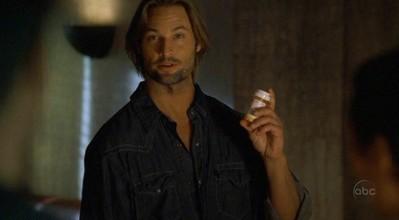
http://images4.wikia.nocookie.net/__cb20061119203652/lostpedia/images/0/0c/2x13_sawyer_medicine.JPG
Sawyer plays the entire camp. And in an enjoyable style,
I might add. From Wikia
Lost - Season Two, Episode Thirteen - The Long Con
Written 13/8/13

Waiting for next week's big plot development that will push this season into perfection, The Long Con follows up last week's disappointment with something slightly similar, except that Sawyer is cool and also has a deliberate psychological reason for why he's being such an asshat. I felt at times like I was watching an episode of Hustle transposed onto a desert island, and while it was cool to see Sawyer's plan to manipulate the other survivors to work against one another come to fruition in so slick a style, it also felt a bit frustrating to see the show mirroring the character beats from the previous season and not doing half as well.
     Jack and Ana-Lucia are all up in trying to train some of the background characters into an army to go off and fight the Others, which has Locke on the defensive as he still believes that the guns are safer locked away and taken only when absolutely necessary. As Jack raids Sawyer's stash to get meds, he begins to cook up a plan. Charlie attempts to kidnap Sun, leaving her dazed and unconscious. This leads the camp to think that The Others have gone back on their promise and attacked. Sawyer leads Kate to believe that it was Ana-Lucia's plan to scare the camp, which thereafter drives her to tell Locke that Ana-Lucia is planning to steal all the guns. Under Locke's nose, Sawyer steals all the guns, declaring himself "the new Sheriff in town." While his bravado makes everyone else hate him, Kate confronts him over the fact that he just wants to be hated. Elsewhere, Hurley cheers up Sayid by giving him Bernard's working radio, and they listen to Glen Millar on a radio channel actually coming from the 1950s. (Thanks Season 5!)
     In his flashback, we see Sawyer attempt his usual routine on a girl named Cassidy. She works it out fairly simply, and asks to become his accomplice and protogĂ©. They go around the country conning people, until Sawyer's real partner Gordy tells him to cough up - it's a long-con, and Sawyer is after Cassidy's money. Despite the fact that he has feelings for Cassidy and feels like shit for doing it to her, he cons her anyway and ditches her, never to see her again.
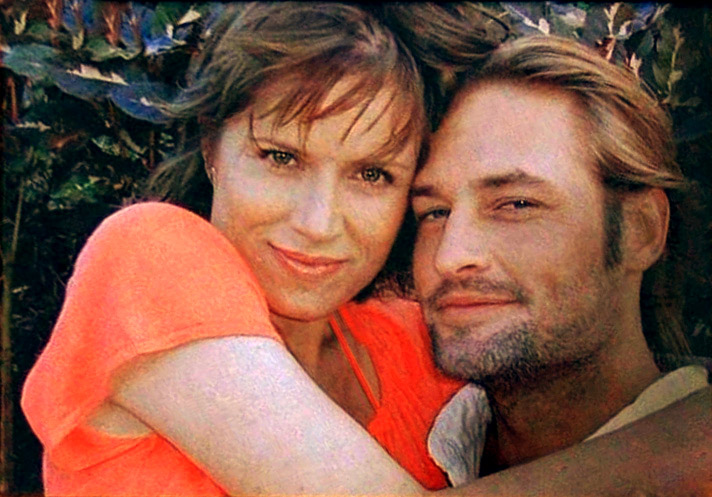
http://images2.wikia.nocookie.net/__cb20100418065338/lostpedia/images/7/7c/Saca.jpg
Sawyer and Cassidy. From Wikia
     All of this links to a statement that Sawyer makes at the end of the episode - that despite his development on the Island and the fact that he had acheived the mean feat of getting everyone in the camp to like him, he still can't forgive himself for the shit he's done - "I ain't never done a good thing in my life." I can understand where he's coming from and it's very true of the character itself to do it, but it feels very melodramatic for me, and to organise Sun's kidnapping in the way he did rather pushed him over a moral boundary that even I am not prepared to look past for the time being. The issues in this episode are revisisted in its "sequel" next season, so at least they don't just get discarded, but their place in this season feels rather oddly placed, even if I did enjoy the episode.

Thanks.

NEXT WEEK: His name is Henry Gale, and he's from Minnesota. Or so he says. We meet Michael Emerson's character in One Of Them.

Monday, 7 April 2014

Overview: Star Trek Deep Space Nine

http://static4.wikia.nocookie.net/__cb20070105230455/memoryalpha/en/images/5/54/Deep_space_9.jpg
The most epic space-station on TV. From Wikia
Written 8/12/13.

A lot of Star Trek's development comes back to "Gene Roddenberry's vision" - the utopian, futuristic society that he lay down with the original series. The Next Generation, created by Roddenberry shortly before his death, was an attempt to both bring the franchise back and capture that vision more successfully. In 1993, as The Next Generation entered its sixth and penultimate season, a second spin-off appeared - Star Trek: Deep Space Nine, which took the previous two series' focus on space exploration and instead focussed on the politics surrounding a single, eponymous space-station. The result is a show which not only divides the fandom, but contains some of Trek's best and worst moments. Mainly best, but that's a matter of opinion.
     Initially focussing on the resettlement of a Cardassian space station by the Bajorans they opressed and the Federation who helped free it, we discover in the pilot that the planet Bajor is adjacent to a stable Wormhole which leads to the Gamma Quadrant, the other side of the galaxy. (But a different other side than Voyager's other side of the galaxy.) Over the course of the series they develop themes on religion, with Bajor worshipping the near-omnipotent aliens that live inside the wormhole, as well as in later seasons focussing on political battles with a powerful Gamma-Quadrant empire known simply as The Dominion. There are also a dozen or so mini-arcs running throughout the series, from a war with the Klingons to the near-collapse of the Ferengi economy.
     The first two seasons of DS9 aren't the best in the world - the show was still picking up on how to effectively write a show that stayed in one place, and similarly to Red Dwarf, they later introduced a spaceship, The Defiant, in order to keep things varied. While a lot of the episodes in the early seasons end up being a little formulaic, the character development that they provide mixes together well and acts as a fairly stable backdrop to what happens as soon as we hit Season Four onwards, in which nearly every other episode is an important, arc-changing reflection on the present political situation. The plot of DS9 is one of the most engrossing of any of the Trek series, and that's simply because the continuity is so well done and the characters so worth investing in.
http://jornadanasestrelas.com/menu/admin/fotos/080905171651.jpg
From diplomats to terrorists to gods to businessmen,
DS9 has it all. From jornadanasestrelas
     And what a varied cast of characters. While the show's pitch was built upon the idea of African-American single-dad Benjamin Sisko raising his son on the "Frontier", the rest of the show's cast (bar a few) all have very interesting quirks which ensures that they're all fairly interesting by themselves. This of course makes character-centric episodes very different and the show very variable - one episode you could be exploring the breeding caverns of Trill and discussing the merits of sentient symbionts, the next you could be on the ridiculously capitalist Ferenginar discussing the links that Capitalism has to systemic oppresssion. One thing DS9 almost never does with its moral quandries is make things easy - one of the best ever episodes, In The Pale Moonlight, is all about trying to get a powerful political power into a war, by any means necessary.
     Outside of its main arcs, it's also well-known for its badass Captain, Benjamin Sisko, and for exploring the Mirror Universe again for the first time since The Original Series. And, more importantly, Deep Space Nine took Next Gen's balanced view of Roddenberry's vision and looked it over with jade-tinted glasses. This was the Star Trek Universe behaving like the real world, with politics and warfare and death on a huge scale. And from its Old West roots through to its thick and delicious sci-fi explorations, Deep Space Nine is one of the most complex and brilliant shows in the Star Trek arsenal. And that needs to be remembered more.

Thanks.

Thursday, 3 April 2014

Review: Voyager 2.15: Threshold

http://voy.trekcore.com/gallery/albums/2x15/threshold_003.jpg
This is not going to end well...
From Trekcore
Star Trek Voyager - Season Two, Episode Fifteen - Threshold
Written 9/8/13

Where do we come from? Where are we going? How many times do we have to talk about having mutant lizard babies together before it becomes creepy? All these questions and more were asked by this charming episode which, in the words of its author Brannon Braga, is a "royal, steaming stinker". While I don't find Threshold outwardly offensive in the way that other famously bad episodes of things are, I do strike it from my personal canon because it's a lot easier to watch if you assume that none of it has any long lasting effect, and conveniently the series never talks about anything that happened in this episode ever again.
     Tom Paris is trying to exceed something called the Transwarp Barrier, which supposes that reaching a speed of "Warp 10" will give you infinite velocity and thus let you experience the entire universe at once. His simulations are successful thanks to a suggestion from Neelix - as is his first trial run, which brands him a hero. However, after the trial run he begins mutating wildly - first with veins everywhere and organs appearing and disappearing, but soon he mutates into a reptilian creature with God-like ambitions. The mutant kidnaps Janeway and flies off at Warp 10, causing her to mutate as well. The Doctor reveals that the form he has mutated into is on the "natural course" for humanity's evolution, and that he has simply mutated early. Tuvok and Chakotay track the two down - they are now lizards and, as it turns out, have had three lizard offspring. The two are returned to their normal selves and have awkward banter about having sex with one another.
      So... I'm assuming I don't have to tell you how silly the whole "travelling really fast makes you mutate" thing is, right? Right. That said, it is not the most ridiculous offense against Science in the episode, which is the famous Brannon Braga misunderstanding of what evolution is. He would later get this wrong again in Enterprise and cause that show's captain to commit a genocide because there was a species that was "evolutionarily better" than another. See, evolution is a slow, gradual process that occurs across generations, because it's a quite abstract thing that relies upon the likelihood that an organism with certain traits will be more likely to reproduce or not due to those traits. It's not randomly mutating into a lizard. And unless something goes seriously weird, humanity's immediate evolutionary future will not be reptilian. Plus, how the fuck did Janeway!Lizard have kids in three days? And, more fucking importantly, why can't the ship just use Warp 10 anyway to get home and then have The Doctor fix everyone? That's one massive plot hole right there.
http://www.treknologic.com/wp-content/uploads/2013/05/salamander21.jpg
...not for anyone. From Treknologic
     It's clear from many scenes that this episode was an attempt to develop Paris' character, with the feeling that after his big showy entrance in Season One that the show had drifted on onto other characters. The problem is that a lot of what he says here doesn't match up with what we've seen in previous episodes - describing how everyone thought he was great in High School and how his father always believed in him. That's pretty much the exact opposite of how he's been presented in the rest of the series, with a bitter relationship with Daddy not helped by repeated run-ins with the law. It may have been believable had it not been paired with such a silly and unpleasant plot but it's not that good anyway.
     One important thing to note though was that Threshold didn't make me angry. I didn't feel offended by it, and despite its well-earnt reputation as the worst episode of Star Trek ever made, there are worse to come in Enterprise and, if you'll excuse my snobbery, in the Abramsverse. It was more a tale of misguidedness - misguided character beats put to a misguided concept, executed to within an inch of its life. It just so happens that these were so misguided that everything that actually happened in this episode has been struck from the Star Trek canon like in no other episode. I for one, remembering those Janeway/Paris lizard baby, am very glad for that fact, even if I wish that the episode had just had a bit more thought behind it.

Thanks.

NEXT TIME: We meet sad slimey psychopath Suder in Meld.

Wednesday, 2 April 2014

Review: Lost 2.12: Fire + Water

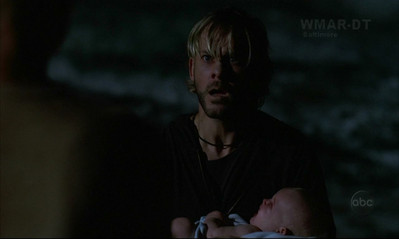
http://images4.wikia.nocookie.net/__cb20061113225007/lostpedia/images/8/88/2X12_-_CharlieAndAaron.jpg
Charlie be kidnapping babies. From Wikia
Lost - Season Two, Episode Twelve - Fire + Water
Written 13/8/13

I didn't say that Season Two was perfect. That would be silly. Some of the characters from the main lot don't get utilised as well as the new guys, and some of them go off in weird and disturbing deviations from their arcs. The best example is Charlie, who goes from being a recovering Junkie managing to find a fairly stable foothold in which to recover by becoming a father figure for Claire's baby, to being a delusional nutjob who kidnaps babies, lies to everyone about everything and who basically needs some serious psychiatric help. It's not the best way for a character to go, really, and instead of feeling interesting like it should do it just makes me want to smack his face every time he sprouts his bullshit.
     Charlie has several visions and delusions where Aaron (pronounced for no apparent reason by Charlie as "eh-ron", which is currently getting my most-annoying-thing-in-Lost reward) is in danger and he is the man expected to run to his rescue, and they're filed with a dozen and three religious references along with it. In his second vision of the episode, he awakens with Aaron in his arms, and it turns out he's been sleepwalking and has stolen Aaron from his crib. After being reprimanded, he starts to become jealous when Locke is acting like a better friend to Claire and a better daddy to Aaron than he ever did. Locke asks if he's using again, and is betrayed when he finds out that Charlie lied about keeping some of the heroin-filled statues. Eventually Charlie becomes convinced, after a conversation with Eko, that Aaron needs to be baptised, so he sets some forest on fire near the camp and uses the distraction to once more kidnap Aaron, leading to Locke punching him out. Meanwhile Hurley flirts with Libby summore.
     It's clear what's going on in Charlie's subconscious, even if it isn't immediately apparent. In the flashback we see his brother flush Charlie's dreams away again in order to get out of his drug addiction, selling Charlie's piano to pay for rehab in order to reconcile with his wife and newborn daughter. In my mind I think that Charlie now associates children with redemption and thinks that if a daughter helped his brother to become better, then adopting Aaron as his own will help him do the same. The problem, as Claire and Locke point out to him, is that he's not in a committed relationship - a month ago he was a stranger to Claire and the way he's latched onto her and her son with that level of possessiveness is really, really creepy. I think any reasonable person would realise that if you're subconsciously snatching babies in your sleep, there is something seriously wrong that you need to sort out.
http://images3.wikia.nocookie.net/__cb20060205072451/lostpedia/images/2/29/Everybutties.jpg
Don't ask. From Wikia
      I'm sure that Fire + Water was trying to do something interesting with its character, like the show did back in The Moth, which was actually pretty good and managed to show Charlie in a three-dimensional manner. The problem with that in this case is that in Fire + Water, even though he isn't even using the drugs, he seems to throw everything that he learnt back in people's faces. He lied and cheated and fell pray to his delusions - okay, Claire can't really talk, considering that she was on the plane because a psychic told her to be - in a way which really just made me question his overall sanity. It makes no sense to me that the funky rocker who began the show seeking redemption for his past transgressions has managed to develop into someone so easily hateable.

Thanks.

NEXT WEEK: Sawyer does exactly the same thing. Except on purpose. And Charlie helps. We find out that Sawyer has been playing The Long Con. 

Monday, 31 March 2014

Review: Doctor Who Classic: Terror of the Autons


For Josh's article on this story, see here.

http://nerdculturepodcast.com/wp-content/uploads/2012/11/TheMaster2b.jpg
"The more he avoids the moment, the greater my ultimate
satisfaction." From nerdculturepodcast
Doctor Who - Season 8, Story One - Terror of the Autons
Written 14/9/13

"I am known as The Master. Universally." And so Season Eight begins, the season in which the villain is always The Master in disguise and in which he continually hooks up with alien intelligences just to piss The Doctor off and then saves the day at the last second due to their sudden but inevitable betrayal. Terror of the Autons follows this pattern with very little fuss, allowing Roger Delgado to shine in his premier as the ruthless, inventive and somewhat understated Master, while the villains from last year's premier hitch the ride for a series of sometimes hilarious and always disturbing murders, obviously concocted from the mind of a serial-killer left inside a Toys R Us.
     The Master shows up and steals a Nestene power device from under UNIT's nose, hypnotising his way into a Plastics Factory and assisting the Nestenes in creating a preliminary force to distract Earth's forces prior to a full-on invasion. The Time Lords send a strangely dressed man to warn The Doctor about his old enemy (appropriate, as The Doctor is at the top of a radio telescope at the time) and he follows The Master's evil schemes as much as he can. Bumbling new assistant Jo Grant (replacing Liz Shaw) gets hypnotised along the way, even though she comes good along the way and together Jo and The Doctor follow The Master's scheme to the point where The Doctor is able to convince him that the Nestenes will probably kill him too (cos he looks human and all) and to stop their scheme.
     Whereas the previous lot of Nestenes were all about freaky plastic dupicates and shop-window dummies, these guys are more sadistic and inventive, with serial-killing plastic dwarves, film-spewing daffodils and the stretching-credibility-for-a-cliffhanger telephone wire. While being in the presence of The Master is immediately a constant buzzkill for their presence, they are certainly more intimidating and it's much more believable when we're told that they can control all plastic when they literally do just that. In hindsight one could argue that they were trying to scrape the barrel a little bit on the concept, and a few of the executions do bring this to the light, but all things considered there's enough frightening stuff here to justify their frightening reptuation - the reputation that led to their placement as the villain of the revival's pilot.
https://blogger.googleusercontent.com/img/b/R29vZ2xl/AVvXsEh05oJlCbvwMtSfOMuZgJy44nReHdKX4gD8uEs_Z0MUKTCTL1qHRgFfgCmZKaHtgN0n1DdrEmNMZcCVzBgbflh5S5mFgyO6cGpNdFZWwPiLlFw9WHUQunlLLViTIpA6h91FnrymJmqJH7U0/s1600/8x01_-_Terror_of_the_Autons_3of4%255BDrWho%255D_avi_snapshot_18_37_%255B2011_05_14_12_47_09%255D.jpg
I apparently get a starring role in this story...
From docoho

     Ainley was my Master, but the original is rather superb in his way. The character is at this absolute best here, where the execution is at its most fresh. The character outline of being the Moriarty to The Doctor's Holmes works perfectly, and it's especially satisfying to see the dozens of little plots and plans get played off one after the other and to see The Master himself enjoying performing them. He's also fantastically quote-worthy;  "Now, come, come, Doctor. Death is always more frightening when it strikes invisibly."
     The days of gritty realism and visiting a different high-tech research facility every week are definitely over, and Doctor Who begins to stray away from the sci-fi and crime drama influences of the previous season and into something that, while not as painstakingly brilliant as its predecessors, is far more distinctive. Whether I'll still enjoy The Master and his plots another 21 episodes down the I'm not sure, but at this early point in the season it looks as though I'd have a fair chance of enjoying myself.

Thanks.

----------

Even though my original plan was to carry on and finish Colourised Who, I tried watching Mind of Evil and the slog that is the Pertwee Era and the general vibe of early 70s stopped me dead in my tracks. It's been fun watching Classic Who, but for the meantime, I'm dropping out. Thanks for reading my Classic Who reviews over these past few years, and I'll see you next time.

Friday, 28 March 2014

Overview: Doctor Who Classic: Season Seven

http://www.doctorwhotv.co.uk/wp-content/uploads/pertwee-third-liz-brig.jpg
The Brigadier, Three and Liz form a fascinating trio.
From doctorwhotv
Written 24/8/13.

In the past I've often separated my enjoyment of seasons into stories that I enjoy and stories that I, in some badly guided objective sense, think are actually good. Season Seven falls into that latter category, and against a big great heaping set of odds that in later years would have us all ringing the doom bells and foreseeing a complete and utter disaster. The line of Doctor Who "firsts" reads like the Prince of Bavaria's Christmas list - first serial in colour, first to be radically shortened, first to feature the Third Doctor, first to take place entirely on Earth. There are probably some more too, but I'll get to that. Season Seven was produced at a time when the show had decided to take budgetary concerns very seriously, but despite the constriction that being stuck on Earth should give the season, it instead gives it a platform upon which it bases its four exemplary stories.
     Not having to produce alien environments instead opened the series up to human settings, creating a definite style in which we spend the vast majority of our time in scientific research institutes, each being threatened by aliens/precursors and all of whom treat Jon Pertwee's burgeoning Third Doctor with a healthy degree of skepticism. Helping this along is the appearance of UNIT, the signature of the Pertwee Era, headed by Nicolas Courtney's Brigadier and assisting in the hiring of a new companion in the form of Caroline John's Liz. The use of this regular cast of characters in the same locations sweeps away the idea of "The Doctor and companion(s) in the TARDIS" for at least another four years, and instead presents The Doctor as an eccentric man in a very human working environment.
      This would be difficult to work with, if not for the deceptively long serials that occupy this season. Despite actually being the shortest season since the show's inception at that point in time (25 weekly episodes forming four distinct serials), the serials within are all still very long by modern standards, with all but the first lasting a blistering 2 hours and 55 minutes if viewed at once. The downside and the upside is that there's a lot of room for the serials to develop character, atmosphere, themes etc. with the show's relatively slow pace. On the downside, it means that the ideas and events are split up to the point where by the end a lot of the detail is lost on a modern viewer. (I hate to generalise, but my only sample is myself.) On the upside, this development does allow the season to create four very solid sci-fi ideas in a way which is both narratively bold and fundamentally entertaining.
http://media.tumblr.com/tumblr_lq3mrfGhHV1qe5le9.jpg
Pertwee's Doctor is a dashing humanitarian hero.
From grufainia
      And those are my only criticisms. It's a personal thing that I think I've talked about before - I'm just a heathen when it comes to old TV, no matter how much Classic Who I've watched. I'm used to the pace of the 80s, where The Happiness Patrol manages to combine brash political statements with absurdist fun and have it sorted within the time it takes to commute to work. It's clear to me that Season Seven is immensely well-constructed, with the level of control that's apparent in the writing making it perhaps feel more professional and slick than it ever made out to be. Season Seven wants to be taken seriously, it wants to do this right and it doesn't have that many resources to do it with. But, a few dodgey Dinosaur props notwithstanding, this season has stood the test of time and remains one of the best, if not the best season of the show from an objective viewpoint. And that's no small accolade.

Thanks.

Thursday, 27 March 2014

Review: Voyager 2.14: Alliances

http://images3.wikia.nocookie.net/__cb20100123114760/memoryalpha/en/images/7/76/MabusJanewayKazons.jpg
Janeway gets pally with the Trabe, who need to check
their privilege. From Wikia
Star Trek Voyager - Season Two, Episode Fourteen - Alliances
Written 9/8/13

I've been very kind to Voyager over the apst few weeks, sining its praises and wondering what the hell of this negative air was about. And then I reached Alliances, and despite my excitement for yet another tiresome Kazon episode, I really had expected something to happen in the overall plot. In Alliances, Voyager has the opportunity to open up into a level of complexity that its sister DS9 wielded so well - a chance to open up to more stories that were politically relevant, relationships that were politically relevant and analogous to those in the other series but framed in a different way. And, as you can tell my by tone, Voyager squanders this not only thoroughly and completely, but with a strange sort of pride and gusto that left me with a bitter taste in my mouth.
     After another battering from the Kazon, a crew member dies, and several Maquis crewmembers chirp up again about needing to use different tactics. That includes Chakotay, who makes a personal appeal to the Captain that they have to ally themselves with one of the Kazon factions in order to secure themselves and prevent more attacks. Janeway, after some stubbornness, reluctantly agrees - she reaches out to the clan that Seska has allied herself with, while Neelix goes after one I've never heard of. Negotiations fail with Maje Cullah because he's a sexist bastard, while Neelix gets involved in a prison-break held by members of a race called the Trabe. A representative gets very pally with Janeway and reveals that his race used to hold the Kazon in ghettos before they rebelled - but that was a generation ago, and none of those alive now support their persecution. He suggests bringing all of the faction-leaders together for a meeting to discuss peace, but when they do get together, it turns out that the Trabe were being little treacherous shits and were trying to kill all of the Kazon leaders. Janeway gives up on politics and gives a "rousing" speech in which she says that they now have to stick to Federation principles no matter what.
      Alliances, in its concession towards Maquis ideas being used in Voyager's command structure, opens up a little peephole to a well of potential for the series to exploit. Having Maquis crewmembers makes it very easy to imagine a ship structure that straddled the lines between Federation morality and Maquis pragmatism, making allies and enemies in unknown territory and allowing us access then to a whole host of new races and then possibly new main characters as a result. It would be a more realistic scenario by far, and it would deliver a great big dollop of meaty moral ambiguity to a series currently stuck in lazy optimism. I hate the ending of this episode, I actually thoroughly hate it because it's so motherfucking predictable and it ends up painting Janeway in a bad light when just because some murderous assholes fucked up her plan, she's now going to ignore the very real fact that you can't run an efficient judicial hierarchy 70,000 lightyears away from home.
http://voy.trekcore.com/gallery/albums/2x14/alliances_141.jpg
Voyager attempts to ally with Cullah and Seska.
From Trekcore
     That said, I did admire the episode's attempts to try. Seska and Cullah always form a fun double act even if it feels like some kind of weird prime-time soap opera whenever they're on screen. Cullah's sexist bullshit was handled very well, with both Janeway and Seska verbally kicking his ass.The examination of the Trabe's persecution of the Kazon as a reason for their eventual uprising, while trying to fall analogous to the white persection of every other god-damn race on the planet, ended up being a little insulting. I mean, it sorta implied that all persecuted peoples who rebel against their persecutors are naturally violent, evil people. Which is a really quite horrible thing to imply, and it stinks of how little this episode was actually thought out.
     Voyager could have made revolutionary steps in plotting any time it wanted - that's not the issue here, even though I am slightly disappointed that in its early days the show very much felt like a take-off of Next Generation. The issue is that Voyager is so often adept at dangling good things in our faces and then throwing them away - it doesn't seem to know the value of change in its storyline and instead here glorifies the status quo as if it's this holy, wonderous thing instead of the bane of every viewer's existence. This episode was a bit like Merlin in that regard. Maybe that's why I was so angry and bitter at it. I should have to feel angry and bitter at Star Trek - I love Star Trek, but thi episode just pushed too many of the wrong buttons.

Thanks.

NEXT WEEK: Fuck. It's the only non-canon episode in the entire Franchise. We do well not to try and cross Threshold.

Wednesday, 26 March 2014

Review: Lost 2.11: The Hunting Party

http://images3.wikia.nocookie.net/__cb20080811161126/lostpedia/images/f/fe/TheHuntingParty.jpg
Locke, Sawyer and Jack go hunting Michael.
From Wikia
Lost - Season Two, Episode Eleven - The Hunting Party
Written 13/8/13

In the first season, "All Good Cowboys Have Daddy Issues" was a Jack-centric that allowed the main-plot a little push to get it going. The same is true of The Hunting Party, which introduces us more formally to The Others, whose mysterious appearances will continue to plague the survivors until the veil of mystery is thrown off in Season Three. While the main plot didn't really focus much on Jack's character development (which on the main island has pretty much been replaced with more Love Triangle wranglings), the flashbacks were rather spectacularly done and despite my problems with the character's writing on occasion, Matthew Fox is an excellent actor.
     In his flashback, we see the breakdown of Jack's marriage to wife Sarah. He is becoming ever more distant from his wife due to a workaholic streak which leads him to help a rich foreign patient whose daughter, Gabriella, has brought him to Jack in the belief that he is a miracle worker. Jack grows close to Gabrielle - too close for his father Christian's liking. When Gabriella's father dies, she kisses him as he comforts her, and a grovelling Jack returns to his wife only to find that Sarah was leaving him anyway, tired of never actually seeing him.
     On the Island, and Michael locks Jack and Locke in the Gun Room at gunpoint and runs off. Sawyer comes in and lets them out, joining them on a trek to try and follow Michael and convince him to return. As they follow strange directions, they eventually meet Mr. Friendly, the man who kidnapped Walt. Surrounded by Others, Mr. Friendly chastises them for acting like rude guests and tells them that while Walt and Michael are fine, they must not cross a certain point on the Island, and that defying this request would begin open hostilities between the Others and the Survivors. Elsewhere, Jin and Sun talk about how much of a dick Jin was and he apologises, and Hurley admits to Charlie that he likes Tailie Libby.
http://images2.wikia.nocookie.net/__cb20061126221344/lostpedia/images/0/0f/2X11-SarahJack.jpg
Sarah leaves Jack. From Wikia
     The breakdown of Jack's marriage seems a fairly logical conclusion for their two personality types - Jack, a person person who manages to flirt with most of the women he sees and yet has the capacity to be extraordinarily obsessive to the point where it's actually scary, versus Sarah, a woman who was blown away by the extraordinary talent of the doctor who fixed her and suffered from transference as a result. (In which her feelings of gratitude and awe translated into feelings of affection.) The result is a relationship that's nowhere near close to working, and this episode helps to show on and off island why that's the case.
     I get the feeling that The Hunting Party was supposed to be more momentous than it was, but from a characterisation perspective it was a little too bogged down with Jack/Kate/Sawyer drama that I really do find extremely tedious, and when I needed something in the present to counterbalance the turning-a-bit-negative perspective of him in the flashback, I got angry jealous Jack instead. The end result of this episode is knowing very little about The Others, having very little idea about what's going on with Jack and really not knowing what comes next. In a sorta empty way.

Thanks.

NEXT WEEK: Charlie acts like a little shithead in the horrendous Fire + Water.

Monday, 24 March 2014

Review: Doctor Who Classic: The Ambassadors of Death

http://upload.wikimedia.org/wikipedia/en/thumb/3/39/Ambassadors_of_Death.jpg/225px-Ambassadors_of_Death.jpg
An iconic cliffhanger. From Wikimedia
Doctor Who - Season 7, Story Three - The Ambassadors of Death
Written 1/9/13

Doctor Who is known to borrow entire plots and premises from other works, then executing them in such a way that despite the remnant elements of the original, it stands out firmly as its own piece of work. This is true in the later years of the Classic Series and it is clear in the earlier ones, even though to modern viewers the premise of this story may be unique in and of itself. Despite this, The Ambassadors of Death is similar in quality to its Season Seven bedfellows, mixing well-executed high-concept science fiction with Doctor Who's trademark messages, reflecting not only Humanity's avarice but also its capacity for compassion when all the facts are available.
     A space probe has launched off from Mars after having lost radio contact for some time. When the recovery capsule returns, a mysterious group of people go out of their way to hide the occupants, who are alien beings hidden in the astronauts' spacesuits and who are forced to kill and steal for their human masters. The Doctor, immediately suspicious, tries to help find them, fighting along the way the continued efforts of those who have kidnapped the aliens. Eventually he takes the recovery capsule up to the ship, and discovers that the three aliens are the races' ambassadors, and that they are willing to trade the original astronauts for their people. The Doctor gets back to Earth in time to help the Ambassadors free themselves and to save the astronauts and Earth.
     The serial takes its premise from The Quatermass Experiment, a popular British science-fiction serial from 1956 in which astronauts return from a mission only to have been possessed by alien spores. The antagonist of the story (spoiler alert, even if this story is from 1970), General Carrington, seems to be a representative of that story's themes, in which the aliens are hostile for the sole reason that they are different and the protagonist is forced to destroy them before they invade earth. Ambassadors displays this as a sort of mania, instead showing us that in this case, the aliens are perfectly peaceful and that it is man's manipulation of them that has led them to their actions. It's a statement against prejudice, a statement about what good mankind can do to each other.
http://images1.wikia.nocookie.net/__cb20080722064047/tardis/images/7/77/AmbassadorAtTheGate.jpg
The aliens' culture is not important here - it is their sheer
alienness which drives the story's themes. From Wikia
     Unlike the season's other seven parters, which wouldn't hurt to shed and episode or two, The Ambassadors of Death earns its runtime and uses it to build us a sense of mystery and intrigue. The continual and seemingly omnipresent machinations of the organisation working against The Doctor and UNIT provide some interesting scenes, as well as a series of well-done battle scenes throughout the story that really don't pull their punches. Like The Invasion last season, there's a sense of the epic and the idea that there are going to be world-wide consequences to what happens here, which is something that the similarly epic The Silurians and Inferno never quite manage to do.
    As is custom on this blog, I've gone about this season in entirely the wrong order, but I'm glad that for now I've been able to appreciate what an astounding season this really is. The other serials in Season Seven had a style that took a while for me to get used to, but The Ambassadors of Death is by far my favourite for the sole reason that it's compelling and comprehensive from the outset, with very little padding at all. It takes a well-loved sci-fi idea and then executes it in a way which spins the message 180 degrees, turning it into a message of peaceful resolution of conflict that sums up in everything it does the messages that Doctor Who is known for, and the spirit that it pioneered so brilliantly in this fantastic season.

Thanks.

NEXT WEEK: Having done all of the other stories in Season 7, I move onto the next season, with the rise of The Master in Terror of the Autons.