Thursday, 20 March 2014

Review: Voyager 2.13: Prototype

http://images.wikia.com/memoryalpha/en/images/7/75/Pralor_3947_eng.jpg
Why do birds, suddenly appear?
From Wikia
Star Trek Voyager - Season Two, Episode Thirteen - Prototype
Written 9/8/13

This week's episode is one that follows B'elanna Torres, a character who gets quite a fair amount of character development both in the right direction and in some odd ones. There's a lot to work with in her damaged psyche - anger issues, abandonment, obsessiveness, survivor guilt. All make for quite a few juicy episode premises to explore these issues, including this week's odd affair where she, totally implicitly, is kidnapped by the man she loves and is forced to bear a child by him. Except that the man is a robot. Like I said, the symbolism here is odd.
       Voyager finds an android floating through space, which looks like a cross between Kamelion and a shop-window dummy. While its technology is completely alien, B'elanna takes it upon herself to work night and day in order to try and fix it. Eventually she hits a rut and consults The Doctor, who helps her come up with a plasma transplant. When the machine awakens and Voyager returns it to its ship, it kidnaps B'elanna and takes her with it. The robot wants her to undo its creator's failsafe and allow them to reproduce again. Breaking the Prime Directive, she manages to create "new life", but immediately regrets it when she discovers that the robots, and their identical enemies, are the leftovers from a war between two races who called a truce but whose robots continued fighting and killed them in order to carry on. B'elanna destroys the prototype and is saved by Voyager, with B'elanna reeling from having to kill her "child".
     I was getting a lot of weird vibes from the episode's central concept, initially due to the very amourous way in which B'elanna converses with the robot, almost using it as a comforting presence during its inactivity and then sitting in abject awe of it once it awakened. Then, once she had made the prototype and was forced to kill it, I felt that the episode as trying to push for some kind of miscarriage or abortion metaphor that didn't really seem to fit. I'm probably reading too much into things, of course. Neither of these two things are bad - in fact, it's rather interesting. The way that B'elanna, after many years of anger and grief, is able to put that aside in order to have these mother-like instincts is quite fascinating. I do however think that it makes it slightly weird when those instincts are aimed towards robots and not other organic life forms. The idea that she can only confront her feelings on maternity by projecting them onto inorganic beings is for me something quite insulting, because we've seen B'elanna display emotional maturity before.
This scene was really cool. Go Jonathan Frakes!
      I was a little skeptical of the idea that the two alien races would have almost identical automaton soldiers, and that they wouldn't program these robots to never turn on them - the rules of robotics set down by Isaac Assimov are concessions to that. I also fail to believe that the robot in question has been alive for 150 years as he says - given just how vulnerable most ships are in Star Trek, and how much the two sides were bombarding each other, two sides with limited men would wipe themselves out in that time without ado.
     I think Prototype was trying to do a lot of things in a lot of area - on the one hand exploring the ethics of fertility treatments and possibly abortion, and on the other allowing B'elanna to explore her motherly instincts as she is forced to create a new life. The only problem is that it comes off as obsessiveness, more creepy than endearing, because she appears to have basically fallen in love with a robot. Had falling in love with a robot and the ethics surrounding it been the diamond-point focus of the episode, then it might have had something to say, but instead it became tangled in a technobabbley, creepy mess of shop-window-dummy robots and abortion metaphors where the mother stabs the newborn child in the chest with a screwdriver.

Thanks.

NEXT WEEK: Watch your step, guys. I smell bullshit. We see a total waste of an episode in Alliances.

Wednesday, 19 March 2014

Review: Lost 2.10: The 23rd Psalm

http://images4.wikia.nocookie.net/__cb20100507104230/lostpedia/images/a/a1/2x10_Eko_Monster.png
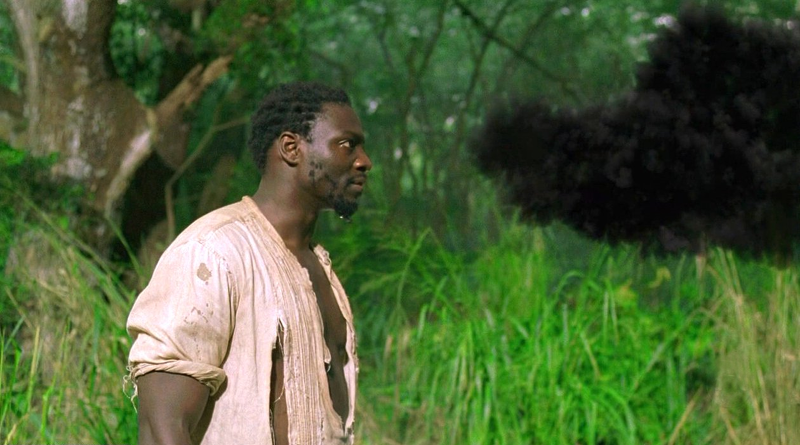
Eko stares down The Monster.
From Wikia
Lost - Season Two, Episode Ten - The 23rd Psalm
Written 12/8/13

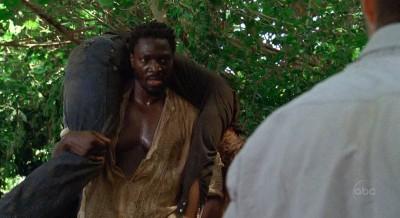
Eko is my Shephard; I shall not want. He maketh me to lie down in good episodes: he leadeth me to enjoy good character development. Yes, finally, this is our Eko centric episode, and while it does progress along Charlie's misguided storyline, it finally shows what Eko has been through to get to this point and what a brilliant character he is. At least to me. Throw in some explanations about some strange things found on the Island and some prep for next week's Event episode, and you got yourself yet another entry on my favourite episodes list.
     In our flashbacks, we find two young brothers in a Nigerian village attacked by a local militia. The older brother is forced to kill a man to save his brother, and is taken off to become a child soldier. He grows up to be Mr. Eko, a drug-lord who intercepts some heroin that needs to be smuggled out of Nigeria. He goes to his younger brother Yemi, now a priest ashamed of his brother's path, and at first asks, and then forces him to let them dress up as priests in order to smuggle the heroin inside some virgin mary statues. Yemi calls the military to their landing strip but is killed in the process, his body bunged aboard the Beechcraft while Eko was forced out, with the authorities now believing him to be a real priest.
     Claire tries to consult Eko about Charlie's "secret religiousness", leading to him finding and revealing the heroin-filled virgin mary statue that Charlie kept from the Beechcraft. Claire feeling betrayed, Eko demands for reasons then unknown to take him to the plane. On their journey to it, they find a corpse that Eko recognises, and Eko has a run-in with the Monster where it just seems to look at him and then run away. When they reach the plane, Eko looks at the body within and it is Yemi. He burns the plane using its own fuel and they head back to camp, where Claire has packed up Charlie's stuff. Elsewhere, Michael communicates summore with Walt on the Swan computer and displays an unhealthy interest in the contents of the gun room.
http://images1.wikia.nocookie.net/__cb20061125042861/lostpedia/images/e/e9/Psalm-cap-01.JPG
Eko is sent away to become a Guerilla as a child.
From Wikia
     In my eyes, Eko's is not a story of faith but one of guilt. For the vast majority of Eko's life, he lives in the real world - one in which black and white mixed readily and in which the way to get by was to not make much distinction between them. Hence Eko has never really felt guilty for anything in his life - that is, until, his brother's death, after which his newfound guilt, something he's never had to deal with before, sends him into the guilt-enabling world of Religion and the church. I don't think we ever hear him acknowledge any idea of God moving his actions - it's the spirituality that appeals to him, and the sense of purpose in a life which, while fine for him before that point, had seen his brother killed without a proper burial.
      Mr. Eko is one of my favourite characters in the whole show, and that's a mixture of the love I have for his character arc (in which he slowly learns to forgive himself for his brother's death and accepts that the majority of his original philosophy was right all along) and for the sheer ability of the actor who plays him, Adewale Akinnuoye-Agbaje. This episode had all of that, and while it also had Charlie, who is increasingly becoming a pain in the backside, there's nothing that can mask the awesomeness of Mr. Eko - washed up junkies or no.

Thanks.

NEXT WEEK: We find out how Jack's life got fucked up as we get to meet the Others en masse.

Monday, 17 March 2014

Overview: Doctor Who: The Tom Baker Era

http://onlyhdwallpapers.com/wallpaper/dalek_fourth_doctor_tom_baker_who_desktop_1920x1080_hd-wallpaper-1198786.jpg
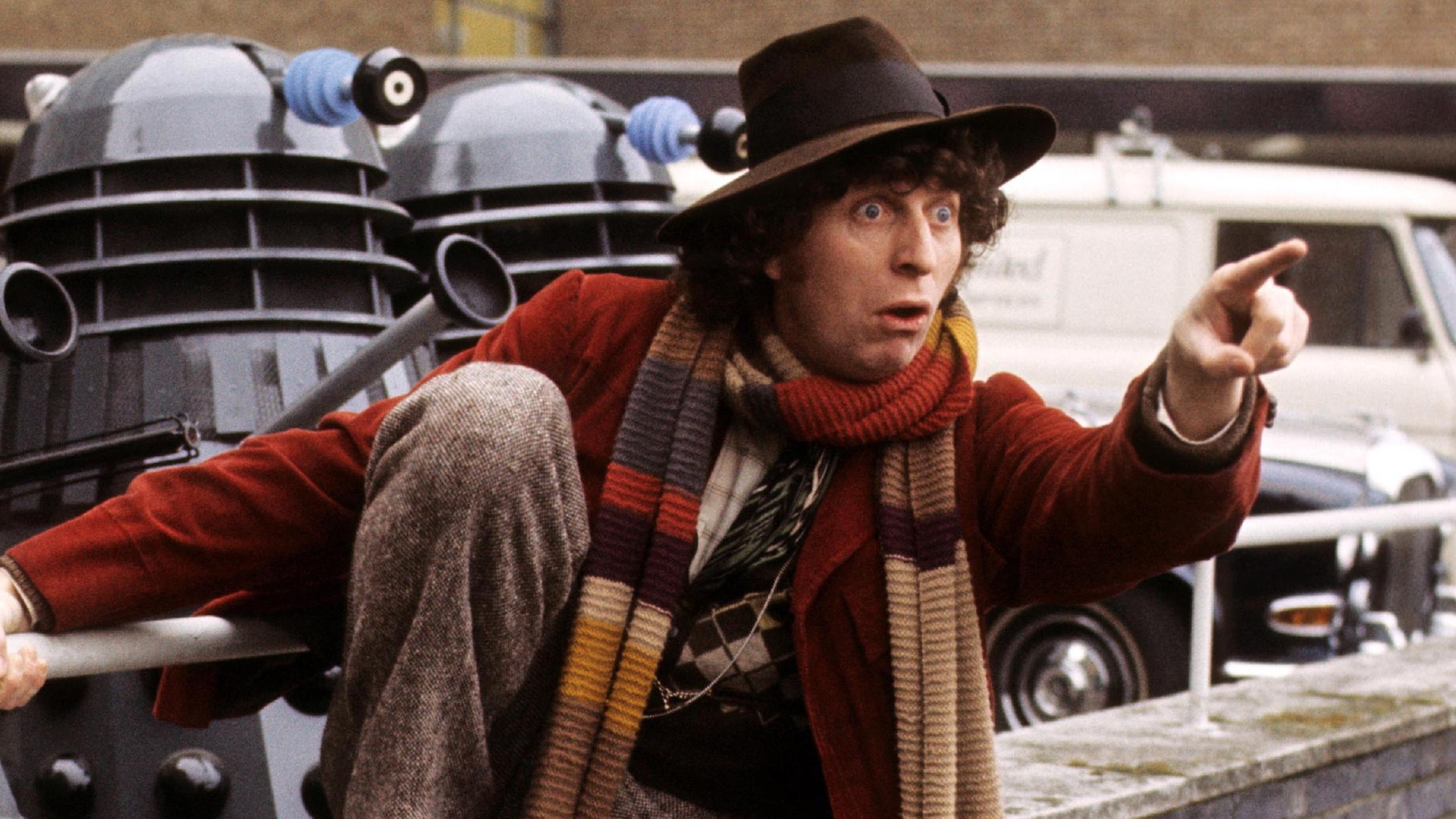
Baker in one of his numerous publicity shoots.
From hdwallpapers
Written between the 8th and 10th August 2013.

It's a common occurance in the popular culture that surrounds Doctor Who to say that while there have been a whole host of interesting Doctors and personalities, the one that will always stick out in the public consciousness will be Tom Baker. This was ensured by his charm, iconic style and ridiculous longevity with the program, with a tenure whose length gives credence to the claims by Tennant and Smith that if they didn't leave after four years, they'd have to be forced out. All this I knew at the beginning of my topsy turvey runthrough of his era, and while I cannot describe why he was so successful in any particularly innovative terms, I can talk about my experiences with that performance.
      The immediate, striking thing about any T.Baker story is the sheer enthusiasm that he brings to the role in pretty much every story (the exceptions coming a little later on in Season 18, when he was grouchy about leaving.) This enthusiasm translated into scripted word means wit, charm and tomfoolery, but the remarkable thing throughout that is that despite this creeping level of genericness that really does bolt up as his era goes along, there's still a deeper character to his Doctor. I think this reaches its pinacle in Season 16, where his fallibility and personal arrogance at their most apparent, and yet not in any way which makes us stop loving him. That genericness does however mean that he rarely has any "raising power" - he delivers the same enthusiastic and witty performance week-in-week-out, so no matter how enjoyable it may be on a bse level it never factors into a story's overall quality.
     I think the best way to tackle Four's seven-year era will be to differentiate between the three different producers he had. Here goes.

http://www.bbc.co.uk/norfolk/content/images/2006/04/23/sarah_doctor_400_400x300.jpg
The Doctor and Sarah Jane were a fun combination.
From the BBC.
Phillip Hinchcliffe (and Robert Holmes) - Seasons 12-14

The Hinchcliffe and Holmes era, often proclaimed a Golden Age, was one that I found rather here nor there. While I enjoyed the interconnectivity of the initial six serials layed down by the previous production team, I found that the moment the duo actually started working the stories became all-over rather tedious. The so called "Classics" of this era often left me feeling high and dry, the worst offender being Pyramids of Mars which is just so, so uneventful and hollow of theme that there's nothing really for me to latch on to. The theme of re-appropriating Gothic themes and ideas as well as Hammer Horror plotting did nothing for me - I want innovation and new ideas. By the time Leela arrived I was getting into things, but the horrendous Talons of Weng-Chiang saw everything I didn't like about this era amplified a thousandfold with a dollop of racism left over.
     This era had three companions; Sarah-Jane, Harry and Leela. Harry was a throwback to the UNIT era, and annoyed me for a while, with his openly sexist opinions that never actually changed throughout his time on the series.  Sarah-Jane continued over from the Pertwee era, and I grew attached to her as time went on despite the fact that increasingly, her role was deviating from the strong feminist that we'd been introduced to and into a more traditional and problematic damsel in distress. Her departure in The Hand of Fear was handled with effortless poignancy and it did bring me to tears, I'm happy to say.
    My favourite story of the Hinchcliffe era is The Deadly Assassin from Season 14, with honourable mentions in each season for The Android Invasion and The Sontaran Experiment. These three embodied a sense of fun while still telling a very well-crafted story, especially Assassin, which slickly introduces the entirety of Gallifreyan Society and also has some fun Matrix action which allows for all sorts of interesting imagery. My least favourite story of the era is most definitely The Talons of Weng-Chiang, which is racist, over-long and showcases a bland, shouty villain who goes around killing under-age girls. Fucking unpleasant.
https://blogger.googleusercontent.com/img/b/R29vZ2xl/AVvXsEh_4zFqAIzcwAS16cGT80tGcEJqISHWv849Zd9PZ5HVKb7kkFLINtaMvRwttYXnybHldtyVH3eQDpv8JXV3Za3diQLr-zKIO6wgrDECGtlTY0J9d9YqrTYVvEIz6iiSmljsKbYKPEg0HWP1/s200/Talons+of+Weng+Chiang_chang.jpg
Get away, Casual Rascism! From taliesinttlg
     Despite my ragings, I do think that Hinchcliffe and Holmes were a skilled team of men. A lot of the stories are certainly written in a dramatic style which in any other series would make me really happy. Robert Holmes especially proved time and time again in Who that he could write stories which had fun characters, dark themes and background messages to agree or disagree with. It just feels like none of these talents are on display during this era, where the vast majority of the stories appeal to bland melodrama. I'll never really get why this era is so highly praised, and I still can't take seriously those who claim that Talons is the best story in Doctor Who.

Graham Williams (and Robert Holmes, Anthony Read and Douglas Adams) - Seasons 15-17

A bit different. I can't really think of a single "era" in Who which is more varied across its duration than the Graham Williams years, lurching back and forwards between competency. Season 15 is a bad pick-up from the previous era which lingers for a while and only demonstrates its own themes with stories which suffer from ridiculous budgetary constraints. Season 16 is exceedingly well-done throughout and is in fact my favourite season of Tom Baker. And Season 17, overseen by Douglas Adams as script editor, is my least favourite as its poor attempts at comedy attempt to cover bad writing. I still enjoy this era a hell of a lot more than I do the previous one, though, so there's something to be said for that.
      This era had four companions - Leela, K9 (who differs little between his two incarnations so I won't split them) and the two incarnations of Romana. Leela was an interesting concept and yet another attempt to move away from Damsel In Distress. While I feel that her character was done well initially, the factor of plot convenience meant that she often knew too much or too little, meaning that her character never underwent a smooth development - not helped by her crappy ending, which is the worst companion exit in colourised Who. The two Romanas are both interesting characters, with Mary Tamm's first incarnation being my favourite. Both of them are smart and snarky and don't tend to fall into the "just there to scream and ask questions" mould, even if the writers really failed to write them in a way which didn't do that to them.
http://images.wikia.com/tardis/images/archive/8/8a/20101031135729!Tom-baker-thinking.jpg
Baker's madcap antics didn't help the poor Season 17.
From Wikia
     My favourite story of the era is The Androids of Tara, for reasons which I've already gone on and on about, with the honourable mentions from the other two seasons being the dry satire of The Sun Makers and Destiny of the Daleks. While on average I enjoyed this era more than the previous, it does have much lower lows, and I can confidently say that my least favourite story in the entire Tom Baker era is the pathetic Horns of Nimon, which astounds me not just by the budgetary constraints but how little effort seems to have been put into the script. (With a dishonourable mention to the unbearable Underworld, which I didn't actually manage to finish.)
     I really don't think that the Williams' era had a clear direction - whatever needed to be done to keep the show afloat, I guess. It did suffer from severe budget and production problems in both Seasons 15 and 17, especially with the unfinished Shada and the hubub that preceded it. While the Key To Time arc was a stroke of genius that gave them a run of six brilliant serials all tied together in a neat little bow, it was lightning in a bottle and they didn't do anything to help the lack of consistency that the era, with its constantly changing parameters, really struggled with.

John Nathan Turner (and Christopher Hamilton Bidmead) - Season 18

As you're probably aware if you were on my blog in 2012, my favourite part of Doctor Who as a whole is the JNT era, and Season 18 is a great part of that, even if it's imbued with a sombreness that doesn't fit in well either with the rest of Tom Baker's run or with what would follow. As I already said at the end of that year, Tom's final season felt a little boring in some of the stories because it had the opposite problem to a lot of the stories in the Hinchcliffe Era - the grand ideas and plots were there, but the characterisation wasn't. Add in the fact that the Tardis is loaded with companions and that JNT's main focus was on bringing Peter Davison into the fore, and you get a season with a grouchy lead and stories that suffer slightly because of it. If you want a longer article about this season, look here.

http://application.denofgeek.com/pics/tv/tom.baker.who/03.jpg
Gotta love these two excited lovebirds.
From Den of Geek
Conclusion

The Tom Baker era was big and varied, held together only by the immense charm (and behind-the-scenes narcissism) of its main star. At times it was big, bold and innovative and in others it was derivative, boring, bland and embarrassing. But it managed to get the balance of the two just right enough to influence a generation of kids and to bring Doctor Who into the public eye as an icon of British culture. For me? It's just that period of the show that everyone really seems to like but that, except for one season and a few other stories, I'm really just not that into. My runthrough of Season 12-16 lasted for about three months of my life, and has been published across six of them. At times I've loved it, other times I've hated it, but it's been a blast and I'm sad to say that I've no more new stories from this era to watch.

Thanks.

NEXT WEEK: Jon Pertwee time, as I go back to finish Season 7 with The Ambassadors of Death.

Friday, 14 March 2014

Overview: Doctor Who Classic: Season 16

Doctor Who - Season 16
Written 7/8/13

It's so tempting for me to go off on a ramble about the Tom Baker era. It's very long, and compared to the Doctors I'm used to there's a bloody lot of it. I have to keep this article contained, however, to the sixteenth season. Not difficult, of course, as Graham Williams' second and much more successful season as producer offers up a lot to talk about in the way that it basically innovated Doctor Who from the ground up. That's probably hyperbole, I'm sure - most of what I say is, so you should be used to that. What I mean by that is a bit more subtle - the idea that a Doctor Who story could effectively throw together humour and horror, the profound and the trivial, the political and the anarchistic. All of this season's stories manage to do that to some degree, and for six stories in a row I think that's fantastic.
http://houseofgeekery.files.wordpress.com/2013/04/the-key-to-time1.png?w=640&h=392&crop=1
A typical Season 16 Tardis scene.
From houseofgeekery


      This season's TARDIS team is a rather unique one. The Doctor and Romana I have this sizzling chemistry and are bounced off of one another exceedingly well, resulting in both having much rounder characters when together than when apart. Romana's pomposity and wit highlights The Doctor's madcap craziness and lack of common sense at times, while his love of the bohemian enlightens her to the wider universe outside of what she learnt stuck on Gallifrey. All of their scenes are just so remarkably well written that the entire season benefits from it, with this continuous relationship developing between the two as they go along, to the point where Romana is more than happy to go off adventuring with The Doctor once their season-long task is finished.
      Not that Romana I is perfect, mind you. She did come fourth on my "Five Favourite Companions" list, and that was only after seeing a single serial of hers. Mary Tamm was only in the role for a year, and it all boiled down to the common perception of Who companions as nothing more than Damsels In Distress. After Jo Grant in the early 70s, an attempt was made by several production teams to create female characters that avoided it - Sarah Jane was a strong feminist, Leela was a proud warrioress, and Romana was The Doctor's intellectual equal (or even superior at times.) The problem with all of them is that a few of the writers didn't really know how to write anything else to provide tension in the story, and so Romana especially ends up kidnapped and screaming on several occasions throughout the season, the most egregious being that cliffhanger in The Power of Kroll. This basically pissed off Mary Tamm to the point where she left the series, which is a damn shame as I loved her version of the character.
      That is, thankfully, my only problem with the season in terms of characterisation. The season was also pretty awesome plot-wise too, with the Key To Time arc being rather wonderfully integrated into things from the outset. It provides a convenient motivation and drive in every story as the couple look for the segment, and yet manages to stay far enough away from things to present us with a brand new society every serial. The Stones of Blood apart, every single story provides us with an interesting alien society and all of the dilemmas that go with them, from Douglas Adams' incredibly literal Pirate Planet to Robert Holmes' squid-infested Delta III. Plus, the budget seems a bit better utilised than Season 15, as everything simply looks more dazzling - and I'm including the Swampies in that.
https://blogger.googleusercontent.com/img/b/R29vZ2xl/AVvXsEhhfUo4GFv7lYqexCCuflQUpoRc_igxHhcLaQGsVxw2dWWjeyAJQGrwRjjWIwsaL7nK_sjLphY2AQ6hvFgWi0xnHHqTE0VChcKpvwfh9s0pX6vKvRwt9ESQG5lHjK7zEtmTLU7xNwgDc4vp/s400/af4.jpg
The completed Key. And Tom Baker.
From cathoderaytube
      My favourite story of the season was The Androids of Tara. Of course I'm going to say that, it's the one I saw before all of the others, it was the one I reviewed back in 2010. In fairness, it is the lightest of the six stories and throws off completely into fantasy territory, which is probably what endeared it so much to me. Of the others, I'd probably pick... you know, I'd actually pick The Power of Kroll, for the audacity of managing to fit a 50 foot squid into a Doctor Who story and making it work. With a race parallel. That's some damn-good writing right there. My least favourite, which on this sole occasion is no great dishonour as the whole season's brilliant, is most likely The Ribos Operation, which despite being brilliantly written by Robert Holmes does I feel lose focus at the end in terms of the plot. (But not the characterisation, which is better than everywhere else. This is hard.)
     The Key To Time arc is fantastic, simply fantastic. Like I think I said at the end of my Armegeddon Factor review (which I should remember because I only wrote it a few hours ago), this is the only Tom Baker season where I like every story without fail. That arrives due to a combination of a genius character dynamic between two very well-written characters, a central arc which gives each story independant motivation while still driving towards a satisfying endpoint, and basic good writing which allowed six independant tales to work their way out of a pre-existing narrative framework. The Key To Time isn't perfect - I'd never be so confident as to say that - but it is my favourite season in the big wide Tom Baker era.
    Talking of that... I'll see you next Monday.

Thanks.

Thursday, 13 March 2014

Review: Voyager 2.12: Resistance

http://images2.wikia.nocookie.net/__cb20060124003423/memoryalpha/en/images/2/23/Caylem.jpg
Caylem is a charming if crazy old man.
From Wikia
Star Trek Voyager - Season Two, Episode Twelve - Resistance
Written 30/7/13

You know, I think I've been getting some of my signals wrong. I distinctly remember Season Two of Voyager as being completely crap. Like, worst-of-the-worst kind of stuff. I know that there are some truly shocking episodes to come (in about three weeks, in fact), but at the same time there are episodes like these which provide engaging, moving science fiction with awesome characterisations. Its premise wasn't that inspired and I'm sure it's been done better elsewhere, but the arrant professionalism with which it seemed to take its own ideas is what pulled it through to becoming almost outstanding.
     An away team has popped down (in secret) to a planet whose authoritarian government is immediately suspicious of everyone and his cat, and just as the crew get their magic Unobtanium, the government soldiers arrive and stir things up, leaving Janeway seperated and on the run with a crazy old man called Caylem who thinks that she is his dead daughter. As negotations get exceedingly pear-shaped, Caylem helps Janeway to lead a mini-assault by the planet's local resistance movement into the Prison where B'elanna and Tuvok are being held, with Caylem's psychosis being revealed just as he is killed. The crew escape and carry on their way, but Janeway feels sad about the man's death.
     The episode dispenses with the usual "Voyager needs X, goes to find X," scenario within the first five minutes, and thanks to this one small degree of innovation we're left with a much more interesting pisode that pushes Broadway actor Joel Gray into developing the character of Caylem into the episode's centrepiece - a doddery figure whose madness Janeway leaves unchallenged throughout. It says a lot about her that she is happy to maintain his delusion as long as it brings him happiness, especially in his dying moments when she explicitly refers to herself as his daughter in order to comfort him.It shows a Captain whose compassion stretches beyond being nice to her crew and eating lunch with them, and is incredibly strong for her in that regard.
The villainous Mokra, not to be confused with a chocolatey
coffee drink.
     The plot of the episode, as Star Trek Wiki Memory Alpha tells me on the other tab, was inspired by the famous Spanish masterpiece Don Quixote, about an old man who decides to go out doing the daring do and names a random woman as his lady love. The episode doesn't rely too much on it, and on the contrary it embodies it with a uniquely human charm that focuses very much on the stress put upon Caylem - the stress that would lead a man to forget the death of his wife and daughter and to drive so forcefully to bring down those who killed them. Despite how slightly weird and creepy he often is, you can't help but feel for the guy, and he is the most memorable thing about the episode.
     Resistance is a gem in this series that I am somewhat confused about not remembering. I did miss a few episodes when I first watched the second season in syndication, but I don't remember this being one of them. I should have remembered it, as for this point in the series so marred even by my own memory as one of low quality and silliness, this episode is written so profoundly well that I don't have to make excuses for it as I often fo other episodes of this show. It is just a teriffic hour of science fiction and I bloody love it.

Thanks.

NEXT WEEK: B'elanna gets kidnapped by a robot who wants to start a world war, in Prototype.

Wednesday, 12 March 2014

Review: Lost 2.9: What Kate Did

http://images2.wikia.nocookie.net/__cb20061120151057/lostpedia/images/8/8d/2x09_jack_kate.JPG
Wotcha doing Kate?
From Wikia

Lost - Season Two, Episode Nine - What Kate Did
Written 1/8/13

I hereby welcome you to an episode that mixes up absurd visions with soap opera relationships and some genuinely powerful drama thrown somewhere in there like the red baseball cap that ruins an entire washload of white shirts. Kate's storyline is an oddly and wonderfully one in that her flashback story is alway 100% more interesting that whatever she happens to be doing on the Island that day, and so as if to compensate her episodes are always (and I mean always) bumpered with other plotlines to keep things movely along nicely. The main island trivia meant that the revelation of What Kate Did lost a bit of its narrative potency, but fuck it.
     In the all-important flashback, we see Kate tuck her abusive, alcoholic stepfather into bed before riding away into the sunset as she blows the goddamn house up. She visits her mother with an insurance policy and a crytic hug, a move which makes it easy for Marshall Mars (whom we met in Season One and whom I love in this episode) to catch her on her way out of the state. Luckily she is saved when Mars, after giving her a long psychoanalytic talk, is forced to swerve due to a black horse standing in the road. She escapes and visits her dad, Sgt. Austen, where she reveals that she did what she did because she discovered that Austen was not her real father, and that she couldn't live knowing that the man she despised was a part of her and she had no way to stop it.
     On the Island, Kate opts out of Shannon's funeral to look after Sawyer, thinking she's going mad after seeing her Horse in the jungle. Sawyer randomly gets... possessed, I guess, and starts strangling her, leading to her having a mental breakdown which ends with her kissing Jack and having a heart-to-heart catch-up with a woken-up Sawyer. Locke shows Eko and Michael the Swan Orientation tape and both notice a missing strand of film, which Eko reveals as being inside the Bible he found inside the Arrow, the DHARMA station the Tailies inhabited on the other side of the island. Just as Locke and Eko discover that the missing reel is about making sure not to use the Swan Computer for outside communication, Michael receives a computer message from Walt.
http://images3.wikia.nocookie.net/__cb20061120152844/lostpedia/images/8/8a/2x09_michael_computer.JPG
Michael discovers the joys of AOL.
From Wikia
     It was inevitable that a Kate episode would end up bringing more focus on the Love Triangle, especially with the way that it feels so often as if it's 50% of Kate's raison d'etre just to keep it going. It had so little bearing on any actual plot and I really can't feel for any of these characters' dilemmas because Kate does change her mind back and forth faster than an astable circuit with an overall resistance of 10 ohms changes state. Like, Kate and Jack don't really have consistent story arcs yet this season, what with all the new characters and stuff. It seems a bit weird to be trying to throw twists and turns and knots into a rope that isn't properly bound yet. The resulting "I saw a horse" freakout is still one of Lost's weirdest premises, even after smoke monsters and polar bears.
     I did enjoy everything, though. It was clearly striking to continue the momentum of the previous few weeks, with Kate's effing massive background revelation and the beginning of the "Michael turns" storyline with him communicating with Walt. But the triangle storyline is one that I find particularly tedious and I think that the whole "I'm going crazy and seeing visions" thing is already a Lost cliche even by this point. The mishandling of Kate's on-island storyline doesn't wreck the episode, and most of it's perfectly fine, but it does move your attention away from the good kids when there's one sat in the corner speaking in tongues. And that's the last weird metaphor I have for you today.

Thanks.

NEXT WEEK: We hear just how much of a badass motherfucker Mr. Eko is as we discuss the merits of The 23rd Pslam.

Monday, 10 March 2014

Review: Doctor Who Classic: The Armageddon Factor

http://www.doctorwhoreviews.co.uk/5F_files/The%20Armageddon%20Factor%208.jpg
The Doctor oversees war on Atrios.
From doctorwhoreviews
Doctor Who - Season 16, Story Six - The Armageddon Factor
Written 7/8/13

My look at the Tom Baker era, as well as the Key To Time arc, ends in a suitably climactic way. This was the final six-part story, and it was given the dual role of presenting a set of conflicts in its own right and in ending the Key To Time arc after twenty or so weeks. This would, for the sake of my purposes, be the perfect time to have a colossal fuck-up. But, I am forever to be denied, and thus I can say that Season 16 is the first (and thus the only) season of Tom Baker's era where I love every story.
      I will say that this story does lead us down the garden path quite a bit. It begins its life like the other five segments, setting out the warring twin planets of Atrios and Zeos and the arsey general who manipulates the situation in order to get rid of his troublesome pacifist royalty, the Princess Astra (Hi Lalla Ward!). The action shifts from the politics of interplanetary nuclear war to the real threat - the Shadow, an admittedly bland villain who acts as the hand of the Black Guardian, and goes out of his way to retrieve the first five pieces. He reveals rather late in the game that the sixth piece is Princess Astra herself. Trapped in his grasp, the two Time Lords rely on fellow renegade Time Lord Drax in order to escape, thereafter facing down a disguised Black Guardian and scattering the pieces throughout time again to prevent any being from holding as much power as it contains.
      Scriptwise, there are very few beats of this story that don't feel necessary. It really is one of the most tightly written six-parters I've ever seen, the introduced worlds of Atrios and Zeos forming the vital backdrop for each of The Doctor and The Shadow's power plays. I adore the misdirection in the way the early serial is structured and that one or two episodes on Atrios allows the six parter more flaviour instead of just being a showdown between The Doctor, The Black Guardian and their respective allies. Further, the unfolding mystery surrounding the planet and its state of warfare actually served as a character profile of the Black Guardian, a semi-detailed model of his eventual plans.
https://blogger.googleusercontent.com/img/b/R29vZ2xl/AVvXsEj262texv4x4hJMoZac66C06takmH7gAchx4KT0DekViwjyBibLuuOq9-Dyrq8imbPWYVAnRmB7bJxW-uC4LH_YEjlRWdL9sGomqLXIak8ib6yRryGKTFwHo0207HGHlkUEdAwQQyUGJE9C/s200/Key-to-time.png
The Doctor ponders over the complete Key To Time.
From karracrow
      In terms of whether it was a satisfying end or not... I thought it was great! Everything that needed to be said was said, with a quick message thrown in along side it about taoism and the balance of all things. I suppose the serial's villains were pretty monotonous, what with the Shouty Marshall, the Shouty Shadow and then the Normal Volume Black Guardian. However, their manipulations are sophisticated enough to prove interesting, even the Marshall, who manages to work The Doctor and Romana into a position where their guilt appears undeniable within five minutes of them showing up. It was a testament to all of the great villainry this season, and a testament to Four in the way that this week, his character just isn't taking any shit.
     The final story of the Key To Time season and, indeed, of my Tom Baker runthrough, is an extraordinary one which, despite its humble trappings, manages to finish the season in fine form. It may appear strange on its own as the conclusion to five other stories and I don't think it quite works without them, but even so there's a level of skill in the way the script is written that makes it immensely rewatchable, from the oh-shit realisation of The Shadow's grand-plan to the laughs at the expense of the charming cockney Time Lord Drax. This was to be Anthony Read's last story as script-editor, to be replaced by Douglas Adams in the unfortunate Season 17, as well as the final story for the late Mary Tamm as the brilliant, brilliant Romana I. It seems fitting that I must now wave a fond farewell to Four's era. It's really been a blast.

Thanks.

NEXT WEEK: I write an essay-like thing about all seven years of Four's Era. 

Thursday, 6 March 2014

Review: Voyager 2.11: Maneuvers

http://images.wikia.com/memoryalpha/en/images/f/fb/ChakotayUnderSeskaInterrogation.jpg
Seska and Chakotay have a heart-to-heart.
From Wikia
Star Trek Voyager - Season Two, Episode Eleven - Maneuvers
Written 29/7/13

Voyager gets into some serious bizniz this week as we return to the early seasons' central storyline involving Seska and the Kazon, in an episode which both draws excellent characters and takes a number of liberties with common sense along the way. The problem came with the Kazon threat, which is usually so lily-livered that the only way to make them threatening is to force the characters on Voyager to make innumerable silly decisions, almost to the point where it breaks character. At the same time, there was also a hell of a lot of very mature sci-fi action going on, even if the direction it took was towards one of Voyager's most soap-opera-esque twists.
     Voyager are hailed by someone with a Federation frequency, and they blunder into a trap wherin the Kazon-Nistrim, led by our old pal Cullah and his new ally Seska, totally thrash Voyager and make-off with transporter equipment which Cullah plans to use to show off to all of the other sects with. Chakotay, who used to screw around with Seska before she revealed her true nature as a spy in the first season, takes the attack personally and decides to save the rest of the crew by gallivanting off after her. His mission is less than successful, but when a reluctant Voyager picks him up again, the ship is able to hold its own long enough to embarrass Cullah in front of all his rival sect leaders. Chakotay is saved, the Kazon don't have the tech any more and Seska impregnates herself with a DNA sample she found somewhere. Wow.
     Seska's manipulative nature, first showcased in Season One's "State of Flux", is expanded on here to great effect, revealing an underbelly of sexual manipulation that gets quite gritty as we see her trying the same trick on Cullah, to much greater success. One of the best scenes for this in the episode is one in which Cullah is trying to torture Chakotay and the latter just keeps reeling off intimate parts of Seska's anatomy. "My favourite part is the mole on her stomach!" The revelation at the end of the episode makes very little sense in-story, and comes out of nowhere - apparently the actress had fallen pregnant, but the writers were amazed when she told them because they'd written it in anyway.
     Elsewhere, and we see Chakotay's character explored in ways that don't manage to offend entire races of people. Both directly in the way that his scenes with Seska are written and indirectly in the discussion regarding his actions that goes on between Janeway and B'elanna, we see his dilemma and his inner struggles working their way to the surface, in what is a star performance from Beltran. Never more have I felt for Chakotay than through the bitterness of his humiliation, of his shame and disappointment in both his former lover and in himself. This is what I meant when I said proper grown-up sci-fi - personalities that feel like real people.
http://images2.wikia.nocookie.net/__cb20080523051121/memoryalpha/en/images/9/93/Kazon_shuttle_breach,_Maneuvers.jpg
Seska's plan puts a thorn in the ship's side.
From Wikia
     Of course, every silver lining has a cloud. The episode contained several moments not already mentioned that made me wonder what the hell was going on, especially with the initial premise, where the entire bridge crew conveniently forgets the fact that Seska ever existed and just assume that after a year and a bit the Federation have managed to traverse the 70,000 light-year barrier and communicate with them. Chakotay goes on his mission to save the day and ends up shooting the rogue tech to disable it, ignoring the fact that he's just used the same tech on his now captive shuttle and that all he's really gone and done is to get captured. As we'll later find out in the season finale, Seska manages to impregnate herself with the wrong DNA sample - not a fault of this episode, sure, but of that entire plotline in general.
     On the face of it though, it's hard not to put that down to Voyager's innate underlying style, and while that may sound quite damning of the series as a whole it is something of a testament to this episode that it stood out not because it was particuarly more offensive than usual, but because the rest of the writing surrounding it was of such top notch. After the very weak introduction of the Kazon plot I feel as though at least some people on the writing team were trying hard to make these plot sections as well-done as possible. That is true here, and despite its glaring inconsistencies it does stand out as a very well-written character piece for our man Chakotay and, for the most part, this season's main villains.

Thanks.

NEXT WEEK: An episode that I've actually never seen before. Let's hope I don't meet too much Resistance.
    

Wednesday, 5 March 2014

Review: Lost 2.8: Collision

http://images3.wikia.nocookie.net/__cb20061119194802/lostpedia/images/0/0b/2x08_ana_sayid.JPG
Ana-Lucia talks to Sayid.
From Wikia
Lost - Season Two, Episode Eight - Collision
Written between 30th and 31st July 2013

Collision is about the coming together of the two subplots that have driven the early part of this season, and it's also about revealing why the fuck Ana-Lucia has been so tetchy and trigger-happy. The result is an episode which I can with pride call one of my favourites ever, and in this patch of reviews that line is going to be a very common one. The way that Collision treats every single one of its characters is, for me, the height of what this show has the potential to do, and the closure it brings to the past six or seven weeks is just spectacularly well-rounded and loaded to the hilt with cinematic symbolism.
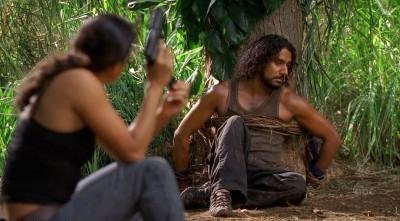
     Ana-Lucia has just shot Libby, and everyone is freaking out, not to mention her. While the rest of her group shy away from her and begin to seriously doubt her mental capacity, she ties Sayid to a tree while Eko, against her wishes, takes a dying Sawyer to find the other camp. Sawyer is taken to the Swan, where Kate and Jack treats him, before Eko is forced to stop Jack and Michael from going to release Sayid by force in his own badass way. As the rest of the group leaves to join the main camp, Ana and Sayid discuss their individual sins and Ana lets him go, with Sayid denying himself revenge on the argument that they've both done bad things and are "already dead". The two camps meet, and as two couples reunite, Jack and Ana meet as the respective leaders of their camps and share a meaningful look.
     In her flashback, we see Ana-Lucia as a cop coming back to work after being shot in the stomach while out on patrol. She is on-edge and angry, forcing her mother (who is also her captain) to put her in a cop-car in order to avoid her transferring to another division. They respond to a burglary and Ana goes a bit mental with her gun, prompting her partner to be concerned. Her shooter is brought in by the cops, but Ana refuses to ID him, instead letting him go free and shooting him six times in the chest in a parking lot.
http://images2.wikia.nocookie.net/__cb20061119194335/lostpedia/images/d/d4/2x08_eko.JPG
Mr. Eko, resident spiritual badass mofo.
From Wikia
     I would go so far as to say that Ana-Lucia is one of the most well-characterised female characters in the show's history, and that's despite the fact that she has a very vocal hatedom in some places. Ana-Lucia is a victim of trauma, one who is constantly places in positions of power that she finds all too easy to abuse. The opportunity for vigilantism or in harsh methods seems rational to someone who not only suffered in the way she did but who was allowed by the negligence of her colleagues to use her power as a police officer to seek retribution for that suffering in a very short space of time. Because of this single-minded vigilantism, she finds it difficult to work with other people and thus her frankly disasterous time as leader of the Tailies came out as harsh and controlling because she was leading them in the only way she knew how.
     And, as happened in the first season, her centric helps to redeem her. It explains her trauma, and it brings out a different side of her steeped in guilt for the things she's done both now and in the past. The way she refuses to let Sayid go because, "I killed someone he loves", gets me every time, as the way the line is delivered speaks a thousand more unspoken words of empathy and regret. The final shot, with her and Jack and in a moment of black-and-white symbolism, is a moment of perfect contrast for their prior meeting, in which Jack was the angry and unreasonable one. Jack and Ana-Lucia's stories continue to intertwine right up until her premature end.
    The rest of the episode's characterisations were well done too, even if the past few episodes have made it a little difficult for me to get back into our main group of characters. That was the point of this episode, really, to reintroduce us after a fortnight or so to the main personalities at the camp, which it did nicely with Jack Kate and Locke as they reacted in their own way to Mr. Eko. Eko himself is continuing to be my favourite character, especially in the way that he rations words so exquisitely. "What do you want? Peace? Justice? Revenge?". We will discover in a fortnight just how awesome Eko is, but the past few weeks alone have been enough reason for me to seriously love this guy.
http://images3.wikia.nocookie.net/__cb20061119195152/lostpedia/images/c/c5/2x08_bernard_rose.JPG
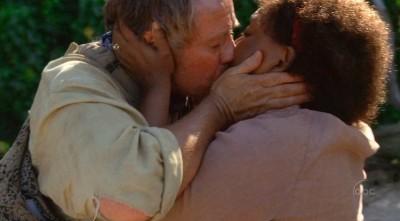
Bernard and Rose, and Jin and Sun, are reunited. Aww.
From Wikia
     I like good characters, and this episode had them. There was so much awesome in the space of so few minutes that I could hardly keep up, from Ana-Lucia's deep problems with herself and with other people to Eko and Locke's immediate underlying curiosity in one another as the equvalent "spiritual guys" from their camps. It was human and it was about real drama, about a group of people joining with another and the tragedy and regret that went with it. It was Lost at its most absolutely superb, and if you can't see that, then I pity you profusely. And, I tell you, we ain't even at the top yet.

Thanks.

NEXT WEEK: We discover, rather well-wordedly, What Kate Did.

Monday, 3 March 2014

Review: Doctor Who Classic: The Power of Kroll

http://images1.wikia.nocookie.net/__cb20101211103629/tardis/images/4/4e/Worship.jpg
Kroll appears and starts attacking stuff.
From Wikia
Doctor Who - Season 16, Story Five - The Power of Kroll
Written 7/8/13

Aaaaaaand we're five-for-five this season as Robert Holmes follows up his excellent season premier with a story that combines racial analogues with B-movie horror stylings to create a serial which is somehow simultaneously tediously serious and completely and utterly barmy. This season is really turning out to be a cracking one, as even though my expectations of a story with a name that sounds like a bad Sy-Fy movie weren't exactly high, I was shown to be wrong in a number of extravagant and at times hilarious ways.
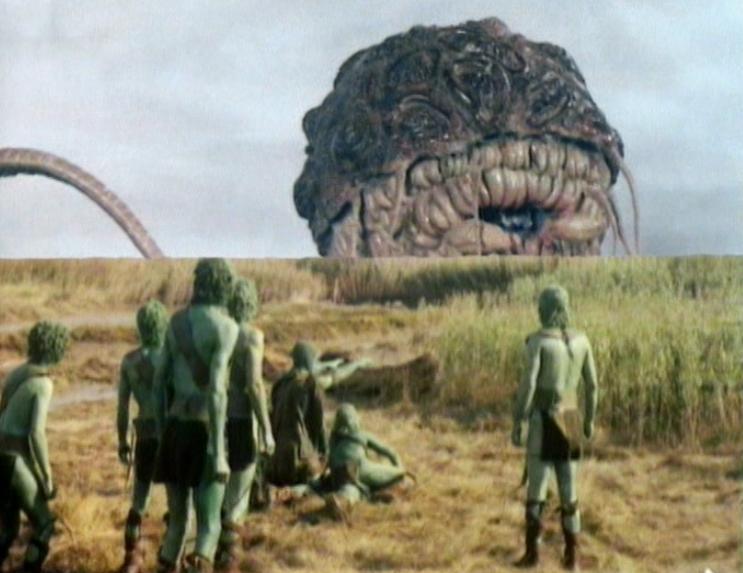
     The Doctor lands on the third moon of Delta Magna, a far-future human colony made up of swampland and inhabited mainly by the green-skinned swampies, a race of tribal peoples whom humanity pushed from their homeworld below and now treat as slaves. When The Doctor and Romana arrive, refinery Captain Thawn has manipulated the native Swampies, arming them in order to give him a reason to wipe them out while simultaneously discrediting the humanitarian organisations opposing his work on the moon. The Swampies believe that their god, Kroll, wishes to sacrifice Romana and The Doctor, but the two Time Lords work out that the real Kroll, a 50 foot giant squid who subsequently attacks both Swampie and Human, was a normal squid who swallowed the fifth segment of the Key To Time - a fact which allows The Doctor to save the day in style and retrieve the segment.
     Robert Holmes uses the character of Thawn and his very human colleagues to create a racial analogue, comparing the uprooted Swampies to, for example, the indigenous population of the Americas, as well as taking a larger stab at British colonialism overall. Thawn's casual attitude towards the genocide of sentient beings means that while the Swampies do spend 90% of the story attempting to kill our protagonists, one is constantly wondering who the villain is. When Kroll arrives, and his arrival is spectacular (and actually quite well-done if you ask me), the pressure he puts on the situation forces the characters to reveal their true colours in what felt like a very realistic manner. Such is the wonderful subtlety in Holmes' scripts.
https://blogger.googleusercontent.com/img/b/R29vZ2xl/AVvXsEjFGZ40G__vVuy0-YBUgikxmFrjgw1mjgEZxPGHlohNXr8HxvEAV_eXOliwXgpLdTrlN7Wy7J_LZOJsmeHD66pEyaJEnX3TNsSJv1XJUwtmZ5jkQpn7zNrOQ9RiP9bS8PK0eVPIIrxS0QE/s400/vlcsnap-2010-07-13-23h28m09s176.png
It's better than it looks, I swear.
From classicalgallifrey

     There are times when the story dips its damp green toes into the realm of absurdity. The first cliffhanger highlights the problem that a lot of the script-writers had with Romana in that they really didn't know how to wrtie a companion who didn't get into trouble, leading to her being tied up and sacrificed with some of the worst and most painful screaming from a companion this side of Melanie Bush. Not to mention that the "Kroll" who is ravaging her is in fact, in-story, a man in a fucking squid suit, which while being remarkably cheeky and metatextual, makes Romana's ridiculous screaming all the more egregious. There's also the solution to the Doctor and Romana's captivity in the third episode, in which The Doctor breaks a window to allow in a convenient storm by shrieking in a high pitch.
      Taken for all of its various values, The Power of Kroll is an enjoyable and engrossing story that actually manages to pull off an "attack of the 50 foot whatever" story that is simulatenously meaningful and entertaining beyond the spectacle of seeing green-skinned men being dragged off by long plastic tentacles. The story's absurdities are few and far between enough to become part of the serial's charm, and the overall effect is immediately both memorable for the right reasons and for the wrong ones. I get the impression that this story isn't liked in fandom for some reason, but for me it's just as good as its four predecessors and I look forward to seeing this season's conclusion.

Thanks.

NEXT WEEK: The Key To Time reaches its end and I reach my final Tom Baker story as we meet Lalla Ward in The Armageddon Factor