Sunday, 24 February 2013

Review: Being Human 5.4: The Greater Good

http://ichef.bbci.co.uk/images/ic/384x216/legacy/clip/p01557x2.jpg?nodefault=true
Crom runs the gamut of emotions.
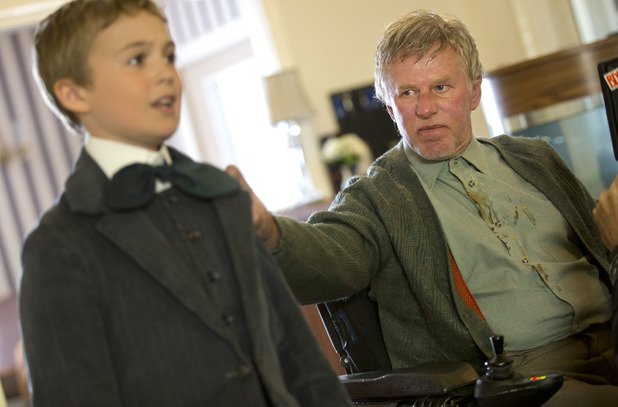
Like last week, The Greater Good was another of Being Human's tried and tested Guest Star Of The Week stories, but the wonderful thing about Series Five so far is that said stories have avoided being formulaic and have done wonders to advance our characterisations. This week was another blinder for Hal, as well as a conclusion piece for excellent guest star Ian Crom. Adding to that was the return of the sinister Captain Hatch and of Mr. Rook, now in a more villainous capacity.
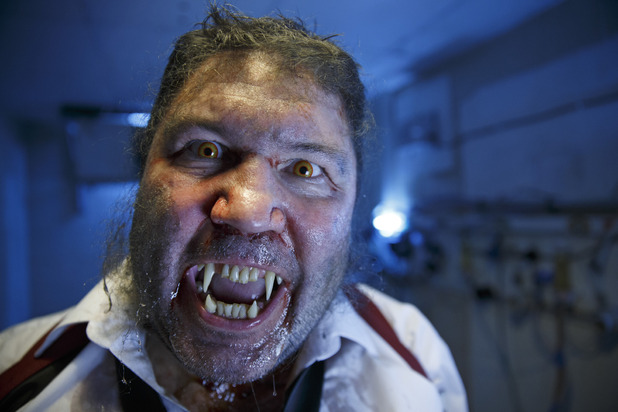
    With the power going out at Rook's facility, he shipped inmate Bobby (Ricky Grover, Eastenders) over to the House in order to keep him satiated, while demanding that Hal go and find Crom, who has converted his assistant, Alan, and gone on a killing spree. Bobby takes to Tom, and the young werewolf is able to help him slowly readjust. Similarly, Hal tried to help Crom get clean. As part of his program, Crom tried to go on a date with Alex, which was sabotagued when she admitted her lack of interest and when a plot by Rook and Captain Hatch nearly saw him torn apart by Bobby. Crom tortures Hal in the cellar, causing Hal's evil persona to surface once more, revealing that Hal is losing control. Crom chooses to not become like him, and so drinks a vial of werewolf's blood, killing himself. Hatch whispers The Secret into Bobby's ear, and he kills himself, but Alex becomes suspicious of him.
     Crom's entire storyline has been a weird and often wonderful deconstruction of Being Human's analogy. The people we've previously seen try to quit blood have all been people of purpose - Mitchell was a soldier, Hal was an ancient Lord. Crom is a lonely, quite creepy man whose life before conversion didn't offer him much happiness, and thus the attempts to return him to that time offer him very little release. It was a subtle examination of Being Human's analogy between vampirism and addiction, and Crom's decision to either drink the werewolf blood or become a monster put me in the mind of Shutter Island and its contempories.
http://i1.cdnds.net/13/08/618x412/cult-being-human-s05-e04-5.jpg
This guy keeps getting cast as thugs and idiots.
Give him a break, guys.
      Captain Hatch, after a notable absence last week, returned with a less grotesque but certainly more sinister role. Much like the devil of folklore, his subtle manipulation of Rook's desperation in order to attempt to eliminate Hal and Tom was quite interesting. I like that the series is picking up the pace, and I appreciate that there was a need to develop our new trinity a little more before getting knee-deep, but I had hoped that there would be a much more intense pace, and next week looks like it can deliver the pre-finale slamdown that we have been used to in series prior. I am really liking this series so far, and I just really hope that when it goes out it does so with a bang.

Thanks.

P.S. This Tuesday, I take a look at Being Human's pilot episode! So, er, put it in your calendars, I guess.

Monday, 18 February 2013

Week Break

We all need a break once in a while. Doctor Who and Lost reviews resume next week, where I also start reviewing the second series of Survivors. And my coverage of Being Human's awesome final series continues on Sunday.

Thanks.

Sunday, 17 February 2013

Review: Being Human 5.3: Pie and Prejudice

http://s4.tvequals.com/tv/up/2013/02/Being-Human-BBC-Series-5-Episode-3-Pie-and-Prejudice-3.jpg
Hal and the obfuscating Lady Mary.
This really is not fair. It's not fair in the slightest. Being Human is on its last series, it should be getting slowly crapper so that we don't feel so bad about its passing, and we can lament its depature and mourn for those old halycon days. But no, the writers are insistent. Against all of my expectations, this episode was bloody brilliant. If last week was the point where I accepted that the old team was gone, this was the point where I came to love the new cast just as much. Bracken, Moloney and Socha are astounding at what they do, and the scripts for this final series are allowing them to squeeze as much as they can out of their characters.
     Like the old style, the episode was split into two mixing subplots. The first involved shady weatherman Larry Chrysler (a star turn by Julian Barratt), who became a werewolf six months ago and has thus ruined his life while still pretending to be a successful personality. Tom becomes enamoured of him, and allows him access to the b'n'b in exchange for "teaching". Elsewhere, Hal revealed to Alex his old friend Lady Mary, a ghost he's been visiting for 250 years. She pretends to be prim and proper around Hal but, as Alex finds out, is thoroughly modernised and irreverent. She believes that she is the only reason that Hal is dry, wrongly believing herself to be his last victim.
     The two subplots came together in a way which allowed all of the characters to evolve. Tom was forced to come to terms withn the fact that the beast within him still affects his life outside his transformations (none of which are shown, which says something of the budget.) Alex, in seeing the delusions Lady Mary spun for herself, confronted her fear of having to be around for an eternity and accepted responsibility of Hal's inner madness. And, unknown to them all, we saw Hal's dark side when he, in response to Chrysler's taunts, lost his cool and strangled him with a TV cord. (In time to call a suicidial Rook.)
http://media.sfx.co.uk/files/2013/02/beinghuman5.3preview_610.jpg
Julian Barratt is the slimey Chrysler
     That last scene especially amazed me. Damian Moloney has always had a very different approach to vampiredom than Aiden Turner, with Hal displaying a much clearer sense of the incredibly controlled personality holding back a monster. He looks shaken up after he lets himself go, just in his mannerisms you can tell something is different now. And to speak of the scene itself, well, that was just amazing. It wasn't just anger, it wasn't even primal - it was the concentrated hate and rage of someone who has killed many, many times before.
     It's subtle and powerful acting like that that makes me more sad than ever that this series is coming to an end. Given its tone, I didn't expect Pie and Prejudice to be much, but despite the fact that the Satan arc was pushed to the side, it's by far the strongest episode of this series so far and one of the best character pieces I've seen on the show in a very, very long time. I get the feeling that this more concentrated series is really doing the show good, and if the remaining three episodes (only three, egads) are as good as this, I will be very happy.

Thanks.

Friday, 15 February 2013

Happy Anniversary Red Dwarf!

Today marks the 25th Anniversary of the initial broadcast of The End on BBC2, and thus 25 years of Red Dwarf!

Albeit with a few large gaps in the middle. But ho hum.

Also, a shout-out to my friend Joel, who is 17 today.

Thanks.

Overview: Doctor Who: Series Two

Written between 26th January and 9th February 2013.

Series One of the revived series is one that I consider to be pretty much flawless, owing to a combination of factors that complement the superb acting of its lead and the writing that enables it. The second series, something of a "difficult second album," had the job of both introducing a brand new Doctor to the public, but also of living up to the insane standards of the previous year. And, probably to the annoyance of many of you, I don't think that it quite succeeded. I will attempt here and now to explain why, without being too pretentious or insulting. (Two counts on which I will probably fail.)
     Firstly, the good bits. Conceptually, a lot of the stories of the season were actually pretty strong. You had the great Impossible Planet two-parter, as well as the well-executed Parallel Earth story earlier on in the series, as well as several strong offerings from others like Moffat and Toby Whithouse. That's gonna sound like I'm only praising the writers from the current series, and that's completely co-incidental. It is a shame that this is where I think that RTD began to slide in my expectations, not due to any abject change in talent but rather because he became too enamoured with his own characters.
     Rose is the centre of this season's problems for me. I'll just spit it out, I'm going to piss off her fans anyway. I don't hate Rose as a character - I think that it was a good idea to bring the show back with a clear audience recognition figure, and Rose provided that in spades as the charming working-class shopgirl who was carried away by the Doctor's adventures at the same time we were. But after the first series, this role seemed to diminish, and either the guest writers didn't know what to do with her or you had the main writers just trying to get her to fit in. Just take a look at the first four episodes to get what I mean: Two RTD episodes, New Earth and Tooth and Claw, in which the Doctor and Rose are all lovey and smug, and then two current writers tell other stories of the Doctor's escapades and Rose fades into the background. Her story had been told, there was nothing else to do with the character, she'd already done the journey from nobody to God and after that there's nothing much you can do.
     The Tenth Doctor is a bit odd in his first season, in that he seems composed primarily of his initial weirdness and doesn't really get a chance for much seriousness of thought. His characterisation seems to change depending on the writer, ranging from a power-mad weirdo in RTD's episodes to a serious, considerate diplomat in the series' two-parters. I think his popularity stems from the overall sense of "awesomeness" that just emanates from the character, which obviously in many cases is subjective. There's just something about the Tenth Doctor that manages to balance attractive youth and incredible experience, to the extent that, for now, his presence is enough to make you more confident about a situation.
     And that's all I can build up the will to say about this season. It's one that will continue to divide fan opinion, but it's almost universally loved by the public, so I don't really feel at liberty to spread more dirt about it. Suffice to say that I don't think it's as perfect as so many of its fangirls would have the world, believe, and while a lot of it is harmless, there are a few episodes that really just abuse the effort that went into getting the show back on the air. Anything I saw about it will probably be uncontrollable rubbish by this point, so feel free to ignore this article and everything I've said. Onto the next series!

Thanks.

P.S. A very Happy Birthday to my friend Joel, who makes cool music here.

Wednesday, 13 February 2013

Review: Lost 6.6: Sundown

http://images3.wikia.nocookie.net/__cb20100325114544/lostpedia/images/9/90/6x06_Sundown.jpg
U k Sayid?
Lost - Season Six, Episode Six - Sundown
Written between 25th and 26th January 2013

Last year, in my review of Season Five's "He's Our You," I said that it was that episode that changed Sayid from being a man conflicted between his duty and his conscience into a tool for the writers to do random shit with. Even after being a torturer and a hit-man, there were enough sympathisable traits in the character that I was really quite shocked at the idea that he would ever try to kill a child. At the time, my single commenter Juanita (whom I hope to hear from again at some point in this series of reviews) asked me why I was so surprised at his behaviour when it's been part of Sayid's characterisation to get to a point of redemption and then slide back into his old ways.
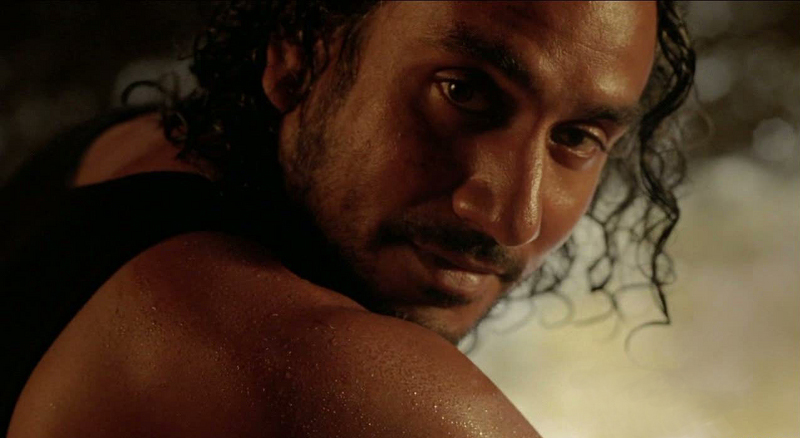
     My problem then was the same as it is now, and, relating this to Sundown, it's more that Sayid's character is defined by regret and remorse. He helps Ben kill people on the Mainland because he's as angry at himself for not saving Nadia as he is at the man sent to kill her. He shoots Ben in the past because he's guilty for killing those people, and so on. What Sundown does is not, as I said before, ruin the character. What Sundown does is to remove and highlight that remorse component and show us a Sayid without it. The results mean quite a lot for the advancement of the series' plot, and we're really running on gas now.
     Sayid confronts Dogen, having learnt of his request to have him poisoned. Dogen is openly aggressive towards him, and they fight, with Dogen gaining the upper hand before restraining himself and banishing Sayid from the Temple. The Man In Black, recruiting followers, sends Claire into the Temple to send the message that those who decide to follow the Man In Black will be spared death in the upcoming massacre. Planning on getting him out of the way, Dogen calls Sayid back and asks him to stab the Man In Black with a ceremonial dagger. It does nothing to the immortal man, who instead persuades Sayid that he can bring Nadia back. Sayid goes back and kills Dogen, allowing The Man In Black to enter. In the aftermath, Kate joins MIB's camp to be with Sawyer and Clare, and Ilana's group stop by to pick up Miles, the other Candidates all having already left.
http://images1.wikia.nocookie.net/__cb20100303180727/lostpedia/images/0/0d/6x06_UsedToBeACouple.jpg
Sayid's afterlife allows him to protect the woman he loves,
even if he can't be with her.
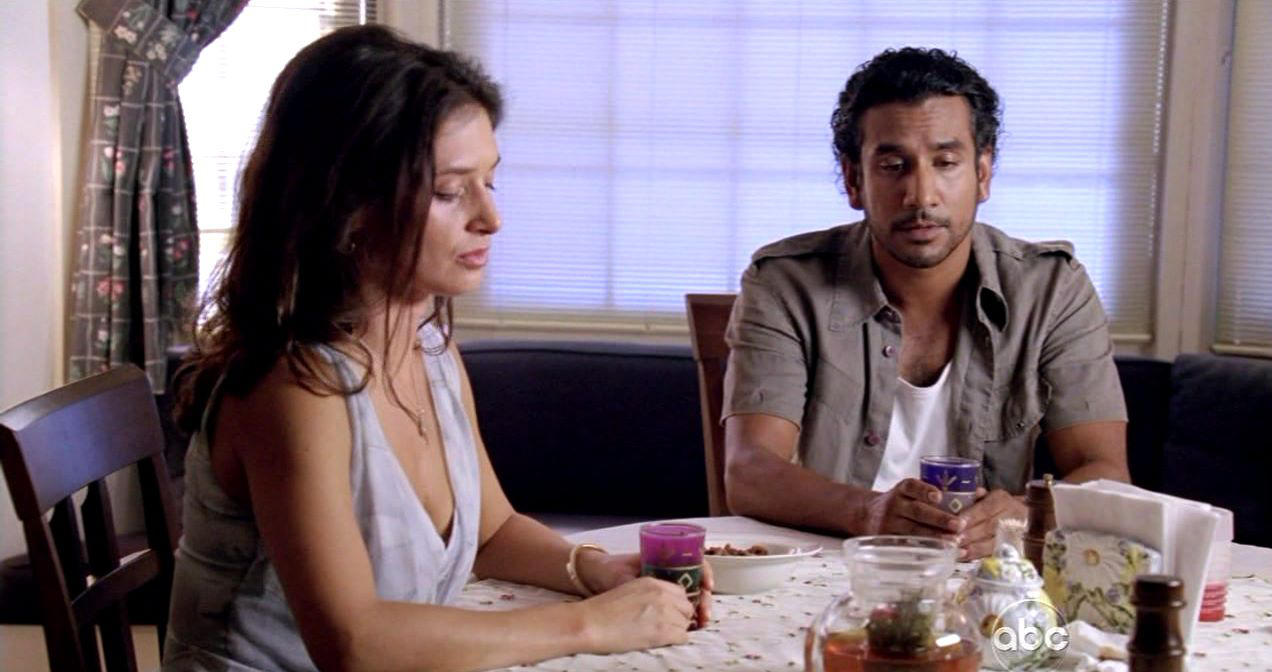
     I'd promised myself that I wouldn't really go into too much detail about the Flash-sideways timeline and its implications for our characters, and neither would I discuss the truth behind it. I realised recently that I've already sorta revealed that the Flash-Sideways is a kind of purgatory, and I think it's important for my assessment of Sayid that I explain what this episode's flash-sideways are about. In previous episodes, the Flash Sideways gave our characters the opportunity to do the things that they failed to do in life, like for Locke to marry Helen, or for Jack to raise a son. For Sayid, the results are very different - he is still apart from Nadia, feeling that he doesn't deserve her love, and is forced to intervene to protect her from his brother's dealings with the mob.
     This is probably the first hint that the flash-sideways is some kind of afterlife, as it shows a Sayid who is living out his chance to protect the woman he loves. In the main story we find a Sayid who has had his remorse completely removed, but one who is still driven by the slightest chance that he may see the love of his life again. While the portrayl of Sayid in this episode alone may cause many fans to dismiss him, as it did at the time, it's a lot more important than that in that it's a final confirmation that despite what our writers have done to the character, his core values are still being acted upon. And consistency like that is good to see in a show that's run this long.

Thanks.

Monday, 11 February 2013

Review: Doctor Who 2.12/13: Army of Ghosts and Doomsday

http://www.bbc.co.uk/doctorwho/medialibrary/s2/images/1024/s2_12_wal_110.jpg?size=1024&promo=/doctorwho/medialibrary/s2/images/main-promo/s2_12_wal_110.jpg&purpose=Computer%20wallpaper&summary=Preparing%20for%20the%20Ghost%20Shift.&info=&tag_file_id=s2_12_wal_03
Torchwood makes its first appearance. And it's cool.
Doctor Who - Season 28, Episode 12/13 - Army of Ghosts and Doomsday
Written 25/1/13

I could get in a lot of trouble here. Fear Her, the Idiot's Lantern - no-one cares what I say about those episodes. They're old news, they're unimportant. But this finale, and Doomsday in particular, is considered by some in the NuWho section of the Doctor Who fandom to be one of the most heart-wrenchingly potent moments in modern television. One's position in said fandom, and the divides within, goes pretty much hand in hand with your particular opinion on this episode, and on how sad you are at the loss (for now) of Rose Marion Tyler. As you may have been able to tell, while I'm getting to like Ten a bit more overall, Rose is still not exactly a character that I am enamoured with.
     I am not someone, however, who particularly cares about having unpopular opinions any more. As long as I'm not talking complete mouth-farts, I think that I can keep some dignity and say that while the structure of the two-parter is well-done, the execution of the epic concept at its heart is less than satisfying. And, behind the buzzwords, what I basically mean is that you're either here for Rose's exit or the monsters. And I was most definitely here for the Monsters. This is the first (and so far only) time that the Daleks and Cybermen have identified with and fought each other in the entire 50 year history of the show. If you're centring an episode around that, I expect it to be a little more than a one-sided cop-out. After the fans put the new Cybermen down in their opening story, it really didn't do them any favours to appear in massive numbers as nothing more than ray-gun fodder.
     Perhaps that's more childish than I realise. There's so much more to this two-parter than monsters shooting at each other, and a lot of it is relevant to the overall plot of the season. Like the previous series, Season 28 had an arc, although one that was much less obscure. The launch of Rusty's new Torchwood spin-off (which I'll be finishing off in April) was punctuated by a series of references in Doctor Who that led up to this story, which takes place mainly in the headquarters of Torchwood's London branch. They're led by the wonderfully characterised Yvonne Hartman, played by a Tracy-Ann Oberman who is enjoying herself immensely. It was very interesting to see that concept explored in the first half, even if it got shoved to the side for our emotional finale. (Which I'll get to at the end, I promise, this is gonna be like the End of Time review but slightly less foamy at the mouth.)
http://img128.imageshack.us/img128/8692/vlcsnap51749096ix.jpg
The Daleks are in this. Spoilers, I guess.
     For what its worth, the sheer unexpectedness of the main elements of the story as they're introduced in Army of Ghosts makes the story quite interesting for the first half. The idea of ghosts leaking through into our world through a hole in spacetime, following a mysterious golden sphere, had us all on our toes. While the reveal of the Cybermen wasn't too surprisingly, their subsequent invasion of the Earth and the final, shattering reveal of four Daleks gives the story one of the best cliffhangers in NuWho. (One which caused my mother, in fact, to emit a high-pitched scream that still haunts me to this day.) It felt like the perfect build up to a perfect finale to what was a less than perfect season.
     As I have likely discussed elsewhere (and likely discuss far too often), the main problem that occurs quite often in Rusty's writing is the extraordinarily good build-up that then gets a shitty pay-off. He's always been better at extracting every last ounce of emotion from the viewer, even if that means distorting the characters and plot to suit. An example would be Rose's change from independant and feisty 19-year-old woman to love-sick teenager who makes inappropriate jokes every few minutes, in order to make her loss in this episode more powerful. I'm skirting on the edge of that subject again, so I'll get this paragraph back on track - Army of Ghosts was building up for a really, really powerful story and then we sorta threw too many things into the pot at once and Davies wrote himself into an impossible situation. We have six billion Cybermen roaming the world's streets, with even more Daleks flying above them, killing us and each other. Davies' solution of a magical interdimensional hoover is as laughable as it is implausable, especially considering the fact that the TARDIS and a few Classic companions have crossed dimensions and we don't see them being sucked in too. And we'll not even talk about Pete Tyler's amazing omniscience.
     Right, onto Rose. I'm pretty much sick and tired of talking, rather inexpertly, about the reasons why I found her character a bit saddening by this point in her history. She had once been a symbol of such confidence during NuWho's beginnings, but her character really just got mangled for some reason into a caricature of her former self. Don't get me wrong - Billie Piper is a wonderful actress that I really quite respect, and it's the writing that forms the crux of my problem with Rose in her second series. Your opinion on Doomsday is very much gonna depend upon whether you like Rose or not, because if you do then it's the most heart-breaking thing in the world, and if you don't then it's a rather underwhelming send-off to a character you didn't much care for in the first place. Seeing as I'm in the latter camp, all I can give you is my perspective.
http://stagevu.com/img/thumbnail/egjgctidviqmbig.jpg
"My name's Rose Tyler, and this is my overly
dramatic voiceover."
     I might talk about this more when I get to the reviews for Series Four, but it deserves to be said here. NuWho during Rusty's era began to use Rose as a crutch, and a lot of the souring of her reputation from certain parts of the fanbase has come from the fact that once she left, we never really got rid of her. The character was mentioned quite frequently in the next series, with brave new companion choice Martha getting sidelined as "not-Rose". Then in Series Four, she's back again and guiding the series towards its messy conclusion. I'm not blaming the character of Rose for all of my problems with RTD's Who, but I am saying that her almost constant background presence made it almost impossible for our main characters to develop a lot of emotional grounding.
     Ok, so those two paragraphs were a bit of a tangent. Never mind me. Rose Tyler's time on the show has come to an end, for now, and while I wasn't particularly moved by her admittedly poignant exit, I was excited by the first half and Rusty's general ability to create a decent build-up around a set of great concepts. I enjoyed the Dalek v Cybermen action, because that's fanboy gold, and I enjoyed some of the more intimate moments with Rose's family reuniting in the parallel world. Army of Ghosts/Doomsday is not a bad story by any means, and is one of the most impressive of this season. But it doesn't tug on my heartstrings as much as it does for other people, and that's something that a lot of you probably won't forgive me for.

Thanks.

P.S. As to why I can write a long article like this in one night while a Lost review takes a couple of days... make of that what you will.

NEXT TIME: I take a week break from Doctor Who for my half-term break, returning with Smith and Jones in the new half-term.

Sunday, 10 February 2013

Review: Being Human 5.2: Sticks and Ropes

http://i2.cdnds.net/13/06/618x424/uktv-being-human-s05-e02-7.jpg
Alex is forced to look after the irritating if tragic Oliver.
After a decidedly lukewarm premiere, Series Five took a deliciously dark turn while still managing to throw in enough elements from across the comedy-drama checklist. It really felt like the premiere that we wanted last week, and we just had to get over some uninteresting backstory to get to the good stuff. We're not just talking decent adventure, we're talking fan-pleasing moments that we've been looking forward to since Annie's arc in the second series, and it was that second series that this episode seemed to emulate the most. It was really getting quite gruesome, to be honest. I don't know whether I think that's good or bad, though.
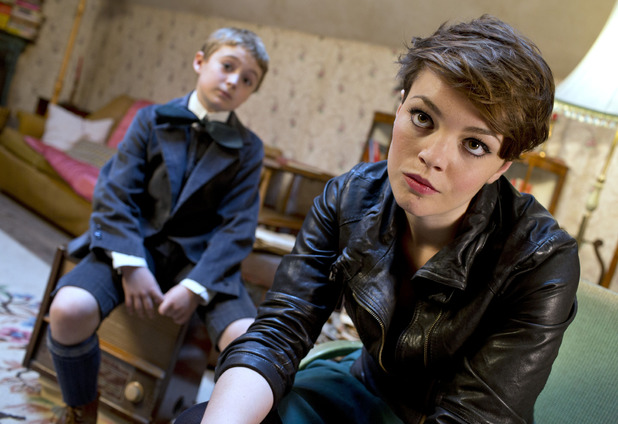
     At work, lusting boss Patsy set up an Employee of the Week competition in order to snag the still uninterested Hal, unintentionally creating a rivalry between him and the work-hardy, oblivious Tom. Alex, reminiscing about her younger brothers, called Hal and Tom home when she discovered Oliver, the ghost of a young Victorian boy who claims to have been hiding in the house since he died, afraid of the Men With Sticks And Ropes, the terrifying demons in charge of the afterlife. While for the most part Oliver hit all the symptoms of Annoying Child Actor Syndrome, I did enjoy when the storyline took a darker turn, Oliver explaining that he feels responsible for the accidental death of his crippled younger brother. While Captain Hatch (who last week was revealed to be the Devil) tried to fan the flames of rivalry, culminating in a food fight between the boys, Alex and Oliver were almost trapped by the Men With Sticks And Ropes, who tried to drag Alex to the afterlife. His plan foiled for now, Captain Hatch talks Patsy into killing herself.
     The episode's best performance by far came from Phil Davis, now comfortable and settled in the role of Captain Hatch and slowly becoming more menacing the more time he stays on screen. Unlike other devil figures that we tend to see on TV these days, he embodies something very crude and grotesque about the human condition, a physical embodiment of man's worst traits piled into one despicable and yet strangely addicting character. His final monologue, where he pretty much sets out his evil plans (mwhahahah, etc.) is probably up there with some of my favourite moments, as we see Patsy bleed from every part of her face at once. Bah. Wonderfully gruesome stuff.
http://i2.cdnds.net/13/06/618x407/uktv-being-human-s05-e02-1.jpg
Oliver is inadvertantly working for Captain Hatch.
     More importantly, this episode did a much better job of developing Alex than last week, and she finally, at least for me, feels rounded as a character. I think a lot of the hesitancy in the fanbase comes from accepting that the show's character dynamics have changed, and episode two post-Annie it's only really just struck me that the show's central matriachal influence, as slightly irritating as I found her at times, has made her absence felt. At the same time, it also blew away a lot of my fears, and Alex is as good a character if not better. She's fun to be around, she's got a great wit and she certainly seems like a more confident ghost than Annie was in her early days. If anything really is missing, it's probably the old feeling that the show gave of the Trinity being a family-esque unit, but we'll no doubt see that improve in the weeks to come.
     I only really give myself an hour to write these "live" reviews, and so it never really feels like it's gonna be enough. Suffice to say that this is gonna go down as one of the better episodes of the series as a whole, and it has certainly made me feel ready for what is now the final series. There was always a fear in the eight-part seasons that it was going to become too easy for filler to fit through the mesh, and now that this series only contains six episodes, I'm fairly confident that it's going to do the series proud. I'm loving the characters, loving the humour and, so far, I'm loving the new tone that the series has going. Keep it up.

Thanks.

P.S. Last week I said that the scenes set in 1918 were in fact set in the 18th Century. Thank God nobody reads these reviews, or I might have actually gotten in trouble for that.

P.S.S I dunno whether to call him The Devil or Captain Hatch. It's like Alisha and Alesha, I don't know.

Wednesday, 6 February 2013

Review: Lost 6.5: Lighthouse

http://images2.wikia.nocookie.net/__cb20100224113253/lostpedia/images/c/c7/Lost.s06e05.hdtv.xvid-xii.avi_000266849.jpg
Jacob's a bit of a creeper.
Lost - Season Six, Episode Five - Lighthouse
Written between 19th and 20th January 2013

Jack is a character that, during the last season, embodied one of the worst possible paradoxes in character design and function. As our blessed hero protagonist dude, he was also one of the less interesting characters in the cast and almost every decision he made was at the detriment of those around him, culminating in his failure to understand very basic logic and the subsequent death of Juliet. Season Six, rather remarkably, pacifies the problems surrounding Jack by turning him into a follower instead of a leader, and a willing follower this time. The episode very much benefited from this development, and the character managed to shine through most of the muck I've spread about him on this blog.
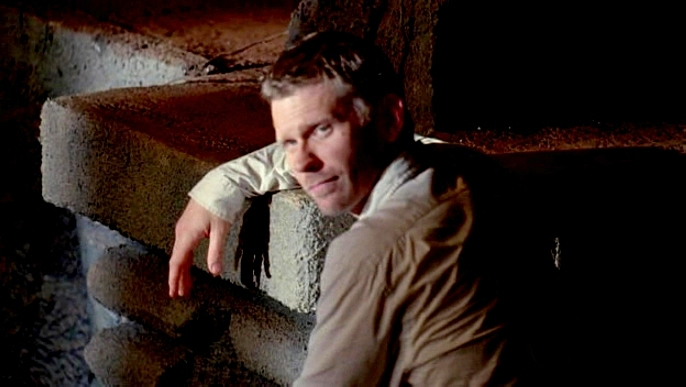
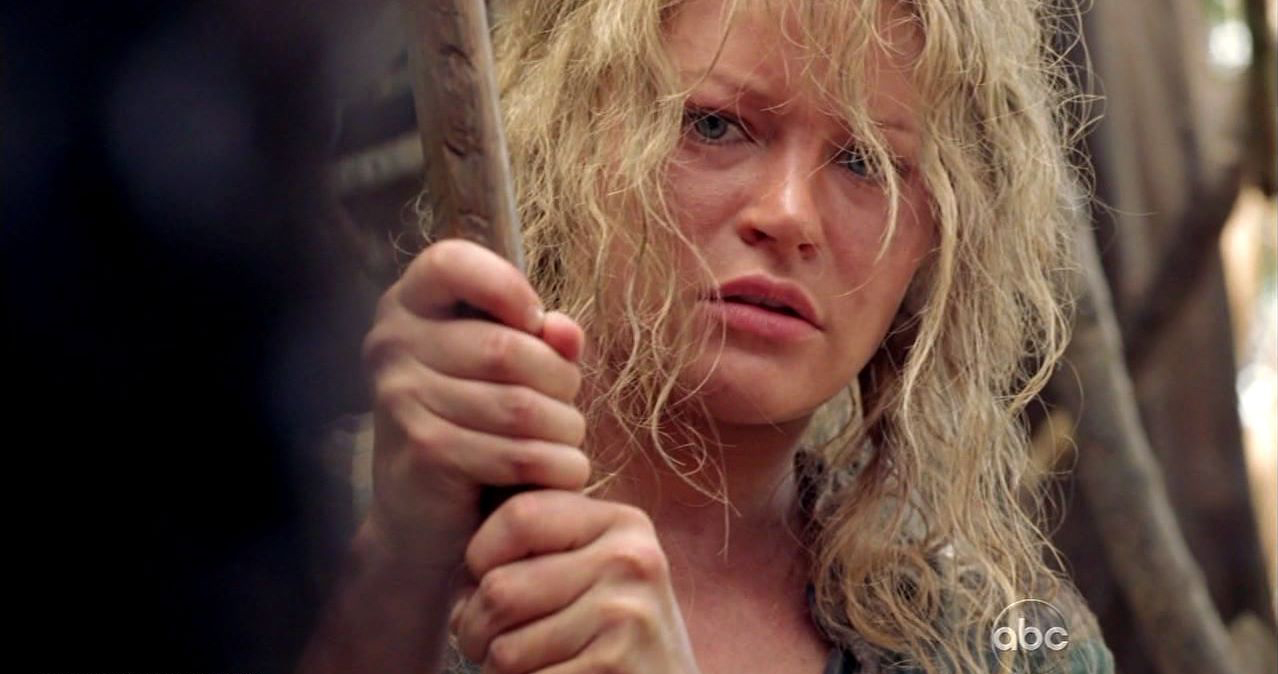
     On the island, Jacob appears once more to Hurley and gives him instructions to leave via a secret passageway with Jack and take him to the Lighthouse, in order to supposedly guide some people to the Island. While initially reluctant to go, Jack agrees when Jacob pulls out a phrase that Jack's father Christian used to use to belittle him. They get to the Lighthouse, where there is a massive compass wheel with 360 names on it, lined up to each degree. Turning the lighthouse to each degree shows an image of that candidate's childhood home; this causes Jack to become angry at the fact that Jacob has arguably been using the Lighthouse to stalk him for his entire life. He smashes the mirrors, and Jacob tells Hurley that this was intentional; he's giving Jack a sense of purpose in his life. Elsewhere, and Clare returned, holding both Jin and one of the Others hostage. She appears to have gone insane, cradling a cow skull as a baby and believing that the Others have taken Aaron. Jin tries to tell her that Aaron is off-island with her mother, but she gets angry and kills the Other anyway, believing now that Jin was lying to her to save the other man's life. He is shocked to discover that the friend who has been feeding her all of these lies is in fact The Man In Black.
     In the flash-sideways timeline, Jack returns home and we find that in this world he has a son, called David. David is emotionally distant from his father and Jack, the product of a bad father himself, is at a loss as to how to deal with him. Jack goes to visit his mother, who despite Christian's body being missing has managed to find his Last Will And Testament, which mentions as one of its benefactors Claire Littleton. When Jack gets home, David is gone, causing him to worry. He goes over to David's mother's house, and using a spare key he is able to enter. Once inside, he discovers that David has gone to a Piano recital - travelling there, Jack discovers that David is still playing, and is a master. David later explains to Jack that the reason he didn't want Jack to see him play was because, like his father before him, he didn't want to appear a failure.
http://images1.wikia.nocookie.net/__cb20100224143429/lostpedia/images/b/b6/6x05_SheDidWhat.jpg
Claire is more paranoid than a noid that's been para'd.
(I'm running out of funny similies, people).
     As I said last week, there are a few things in the flash-sideways that we'll come to question once we reach the end of the series, this week's thing being the existence of David. I liked what the writers were going for here, and it was a neat idea to show how Jack deals with his own paternal issues by trying to be a better dad to his own son - a matter for closure that the Jack in our timeline never got. It's a real exploration of the things that the Flash-Sideways timeline can do, and completes a lot of our character arcs without having to lose drama in the main plot.
     It's probably the wrong attitude to have, but early in the series, I'm not finding much to harp on about and that's at least somewhat disappointing. So far, the only real issues have been a few random touches of mystique where none was needed. Lighthouse had some of that, with Jacob's Jesus-esque plan being well and truly in effect, but it's still caught in this apprehensive, "where is this all gonna go" haze that smoothes over any cracks. Lighthouse was entertaining and intriguing, and while it wasn't as powerful as every episode of a final season should be, it helped me to finally come to like a character I've had problems with for a long time.

Thanks.

Monday, 4 February 2013

Review: Doctor Who 2.11: Fear Her

Much like Queen Bess, this blog has two birthdays - December 7th, which denotes my first published review, and today, which denotes the actual creation of what was then Audenshaw Reviews. I usually put less pathos on the second for various stupid reasons, but this year it's happened to fall on one hell of an episode. So, as we celebrate my three-year-long hobby, we also take a look at one of the most universally hated stories in NuWho this side of Love and Monsters. (Which I reviewed last Summer, so no complaining.)

The real ceremony somehow managed to be cooler
than this.

Doctor Who - Season 28, Episode Eleven - Fear Her
Written between 13th and 18th of January 2013

It's hard to put a finger on what exactly went wrong with Fear Her. The concepts, at least at the beginning, are fundamentally sound, but they tap into several things which are quite risky - mainly making reference to future cultural events and by having a large part of the episode revolve around a child actress. Fear Her's irreverent jabs at the 2012 London Olympics, and Matthew Graham's "Power of Love" solution, push a story that was already pretty lightweight into the dark, demonic depths of mediocrity. And that's pretty much the worst crime you can come up with for a show like this.
     Because really, there's nothing that's too bad about this episode. Ten and Rose are still a little smug here or there, but they're generally tolerable for the most part, especially with some small moments between them discussing The Doctor's past. The main beef of the episode comes from Abisola Agbaje, who plays Chloe Webber. While I'm sure that she's a lovely girl in reality, her acting is piss-poor and it's no surprise that Fear Her was the only thing she ever did. Her line reads are unconvincing and she turns what could be the rather scary prospect of an alien-possessed little girl into something innately laughable. It's probably a fault of the direction and just the general environment, but this story hinged around having a competent child actor and unfortunately that just wasn't the case.
     The story follows The Doctor and Rose as they land in 2012 London, on a small cul-de-sac in which children have been disappearing. It's the run-up to the Olympics, which will be passing the street in a few days. They find in one of the houses a small girl named Chloe Webber, with the power to absorb people into drawings. She's been possessed by an isolus, a space-dwelling plant that has been seperated from its mother and its four billion brothers and sisters, and so is using its amazing reality-bending powers of loneliness to get new friends. Just when they think everything's sorted, a series of stupid mistakes gives Chloe the chance to draw The Doctor, leaving Rose to have to stop her from drawing the entire world. Eventually, Rose is able to use the passion and spirit of Olympic fever to restart the Isolus' pod, and the creature returns home.
      The idea at the core of the story is one that I'm not very happy with, if only, ironically, for its lack of imagination. We're supposed to accept that these tiny little wisp-like creatures have the power to morph reality in quite a profound way, and yet can't even get a tiny spaceship off the ground. I suppose the idea of it all is that this is an alien race powered by love, which is a nice thought but doesn't exactly help me to maintain my suspension of disbelief. It's a bad idea, badly executed, and next to the sub-par acting it causes the story to spiral into the mess that it becomes.
Klow-ee Webbah
     Three years ago I started this blog because I wanted to have a place to write about things without feeling like I was being one of those annoying Facebook people. Now, I’m still here, still writing, perhaps not what I thought I’d be writing about, but regardless at the end of a mountain of work which is longer than most short books. (And, in hindsight, I wish I’d used the time to do that instead.) When I look back, I wonder whether it’s all bee worth it. Nobody has really ever read any of my reviews except out of a strange feeling of pity, and the only commenters here are few and far between. It is simply, in the end, a question of whether I should continue writing even when I know that nobody is ever going to injest it. And the answer, resoundingly, is yes. Because it lets me contribute something, no matter how small. And for me, at least, that's important. Fear Her wasn't the worst story in Who history, but it had such flaws on every level that at the end of the day, it might as well be.

Thanks.

This review is dedicated to my friend Asher, who passed away on the 17th January. She was someone whose extraordinary kindness and good humour made me the man I am today, and my sympathies are still with her family and closest friends. May she rest in peace.